

Note: This article contains affiliate links. If you click on these links and make a purchase, I may earn a small commission at no extra cost to you. This helps support my research and content. Read my full affiliate disclosure here.
Gardenias are prized for fragrant, showy blooms and glossy evergreen leaves, but they are also fussy feeders. Choosing the right fertilizer for gardenia plants matters because the wrong ratio or delivery method can leave plants with poor bloom production, yellowing leaves, or stunted growth. This guide distills the top shortlists for gardeners who want predictable flowering, healthy foliage, and easier pH management. We evaluated options that provide the specific nutrients and application styles gardenias respond to, then shortlisted the best performers across feeding type, acidifying effect, and ease of use. Below are the top picks followed by practical guidance on how to feed and care for gardenias through the season.
Top Picks at a Glance
| Best Overall The best all-around choice for most situations | HiThrive Gardenia Liquid Fertilizer, 16 oz (Makes 96 gal) |  |
| Best Quality Built to a higher standard if you want something more solid | Florida Foliage Gardenia Gold Controlled-Release Fertilizer 12-5-9 (3 lb) |  |
| Best Value The sweet spot between price and what you get | ASTEVORA 8-4-8 Granular Fertilizer for Acid-Loving Plants (12 oz) |  |
| Best Budget The cheapest option that still gets the job done reliably | Gardenera 8-4-8 Slow‑Release Fertilizer for Acid-Loving Plants (8 oz) |  |
| Highest Rated A top-rated pick with lots of positive feedback | Dr. Earth Acid Lovers Organic Granules Plant Food, 3 × 4 lb |  |
| Most Popular A crowd favorite that many people choose with confidence | TPS Nutrients Gardenia Liquid Fertilizer, 8 oz |  |
HiThrive Gardenia Liquid Fertilizer, 16 oz (Makes 96 gal)
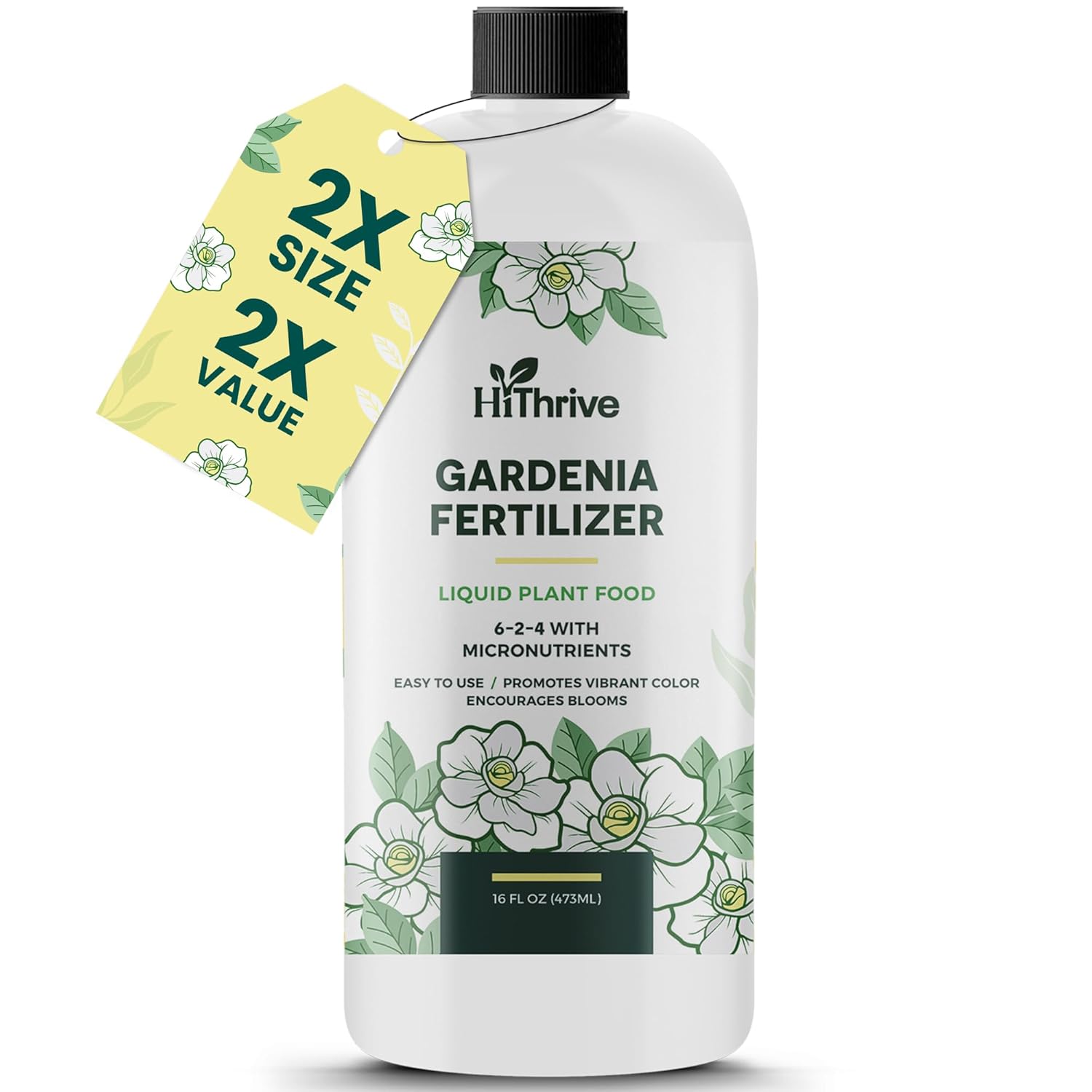
| NPK ratio | 6-2-4 |
|---|---|
| Item Form | Liquid |
| Coverage | Flowering Bushes and Indoor Plants |
| Mixing Ratio | 1 teaspoon per gallon |
| Included Nutrients | Macro & Micronutrients (Ca, Mg, Fe, Cu, Mn, Zn) |
This HiThrive liquid fertilizer is built for regular feeding of gardenias and other acid-loving flowering shrubs and potted houseplants. It uses a 6-2-4 NPK ratio with added micronutrients such as calcium, magnesium, iron, copper, manganese, and zinc to support leaf health, flowering, and to correct nutrient deficiencies. The concentrate is mixed at 1 teaspoon per gallon for standard feeding and 2 teaspoons per gallon for deficiency treatments, and a 16 oz bottle claims to make about 96 gallons of ready-to-use solution, which keeps ongoing feeding simple and economical. In practice the liquid form is easy to apply to soil or by bottom-watering and produces faster green-up and more consistent bloom when used as directed. Important limitations are that the formula is a general-purpose flowering mix rather than a gardenia-specific pH amendment, so gardeners still need to manage soil acidity and drainage for best results. Also liquid feeding requires more frequent application than slow-release granules, so it suits growers who want steady, controllable nutrient delivery rather than hands-off feeding.
Best for: Gardeners who want a straightforward, repeatable liquid feed to promote greener leaves and regular blooms on gardenias and similar flowering shrubs while maintaining control over nutrient levels.
Less Ideal for: People seeking a low-maintenance, infrequent feeding solution or those who need a fertilizer that also modifies soil pH should consider other options.
- Balanced 6-2-4 NPK formula supports both vegetative growth and flowering
- Includes micronutrients (Ca, Mg, Fe, Cu, Mn, Zn) to correct common deficiencies
- Concentrated liquid mixes easily and yields up to 96 gallons from a 16 oz bottle
- Suitable for both outdoor flowering bushes and indoor potted plants
- Does not address soil pH management, which is important for gardenias
- Requires frequent application compared with slow-release fertilizers
Verdict: A concentrated, easy-to-mix liquid feed that gives gardenias steady nutrients for greener growth and more reliable blooms when used regularly.
Florida Foliage Gardenia Gold Controlled-Release Fertilizer 12-5-9 (3 lb)

| Item Form | Granules |
|---|---|
| Application Method | top-dress |
| Target Species | Acid-loving Plants |
| Mixing Ratio | 12:5:9 |
| Coverage | Low |
Gardenia Gold 12-5-9 is a top-dress granular fertilizer made to deliver steady nutrition to acid-loving shrubs and ornamentals. You apply it around the drip line of gardenias, azaleas, or camellias and water it in; the polymer-coated nitrogen releases over 60–90 days to support sustained leaf and bloom development. The formula includes micronutrients such as iron, magnesium, manganese and copper so it helps correct common deficiencies that dull bloom color or cause chlorosis in low-pH soils. Because it is a commercial-grade product, coverage is described as low and it is intended for targeted bed and foundation use rather than blanket lawn feeding. Practical limits are that it is a top-dress granular only, so you will need to reapply on its schedule and avoid direct contact with stems or walkways to prevent staining. For growers focused on strong, long-lasting bloom performance in acidic soils, this is a straightforward, no-frills fertilizing option.
Best for: Gardeners and landscapers who prioritize steady, performance-driven feeding to maximize blooms and foliage on acid-loving shrubs and want a low-maintenance, long-release granular option.
Less Ideal for: People looking to feed large areas quickly, use liquid foliar feeds, or who need an all-purpose fertilizer for mixed pH beds.
- Controlled-release polymer-coated nitrogen that feeds for 60–90 days
- Formulated specifically for acid-loving plants like gardenias, azaleas and camellias
- Includes micronutrients (iron, magnesium, manganese, copper) to address common deficiencies
- Low coverage means multiple spots or beds may require several packages
- Only a top-dress granular product so not suitable for foliar feeding or fertigation systems
Verdict: Choose this fertilizer when you want a professional-grade, slow-release granular that reliably boosts blooms and foliage in gardenias and other acid-loving shrubs.
ASTEVORA 8-4-8 Granular Fertilizer for Acid-Loving Plants (12 oz)

| Item Form | Granules |
|---|---|
| Specific Uses For Product | Acid-loving plants |
| Application Method | Spread evenly to soil and water thoroughly |
| Target Species | azaleas, camellias, hydrangeas, magnolia trees, evergreens, blueberries, gardenias, rhododendrons |
| Unit Count | 12 Fluid Ounces |
ASTEVORA 8-4-8 is a granular, slow-release fertilizer made for acid-loving plants such as gardenias, azaleas, hydrangeas, and blueberries. You apply it by sprinkling evenly under the plant canopy, mixing lightly into the topsoil, and watering; the manufacturer recommends three feedings per year (early spring, summer, early fall). The balanced NPK and added micronutrients like magnesium, iron, and manganese help reduce chlorosis and support blooms and overall vigor, while the formula is described as bio-solid enriched with live bacterial microbes to support soil biology. Practical benefits include easy application, sustained feeding from the granules, and a product aimed at lowering soil pH where needed. Limitations to consider are the small 12 ounce unit size, which may require multiple packages for larger plantings, and the need to follow safety guidance when handling a bio-solid product. It is best used as part of a regular feeding schedule for established acid-loving shrubs rather than as a one-time corrective for severely imbalanced soils.
Best for: Gardeners who want a simple, low-maintenance feed for gardenias and other acid-loving shrubs and who prefer an all-in-one granular product that supports soil biology and bloom color.
Less Ideal for: Gardeners needing large-volume coverage or an immediate, strong pH correction for highly alkaline soil should consider larger bulk fertilizers or targeted soil amendments instead.
- Balanced 8-4-8 NPK with added magnesium, iron, and manganese to support blooms and reduce chlorosis
- Slow-release granular formula designed for just three applications per year
- Formulated to acidify soil and support acid-loving plants like gardenias and hydrangeas
- Contains live bacterial microbes to help enrich soil biology
- Small 12 ounce package may not cover multiple shrubs or larger garden beds
- Contains bio-solid-derived material which requires careful handling and adherence to safety instructions
Verdict: A convenient, slow-release granular fertilizer tailored to nourish gardenias and other acid-loving shrubs while supporting soil microbes for healthier, more vibrant blooms.
Gardenera 8-4-8 Slow‑Release Fertilizer for Acid-Loving Plants (8 oz)

| Item Form | Granules |
|---|---|
| Application Method | Sprinkle, mix into soil, and water |
| Coverage | acid-loving plants |
| Mixing Ratio | 8:4:8 |
Gardenera 8-4-8 is a small, slow‑release granular fertilizer made for acid-loving shrubs and flowering plants such as gardenias, azaleas, hydrangeas, and blueberries. You apply it by sprinkling or mixing into the root zone and watering; its 8-4-8 NPK ratio plus added iron, magnesium, and manganese helps correct chlorosis and encourage stronger blooms and greener foliage. The product emphasizes soil health by including bio-solids with beneficial microbes, which can improve soil biology over time and reduce the need for frequent feedings. Its slow-release design claims only three applications per year, which fits low-maintenance schedules and saves effort. As an 8-ounce unit it is best for small gardens, potted specimens, or spot treatments rather than large beds because supply is limited. If your soil already tests strongly acidic you may see less pH change than in neutral soils. For gardeners focused on boosting flowering gardenias with occasional feeding, this is a compact, easy-to-use option that emphasizes plant color and overall vigor.
Best for: Buyers who want an easy, low-maintenance fertilizer to improve blooms and foliage on a few gardenia plants or potted acid-loving shrubs without frequent feeding.
Less Ideal for: Gardeners who need to feed large landscapes or multiple shrubs regularly should choose a larger volume product or bulk fertilizer to avoid frequent repurchasing.
- Formulated for acid-loving plants with added iron, magnesium, and manganese to reduce chlorosis
- Slow-release granules designed for fewer applications each year
- Includes bio-solid derived microbes to support soil health and root development
- Small 8 oz unit is insufficient for large beds or multiple shrubs without repeated purchases
- No exact application rates for every plant size provided in the included info
Verdict: A compact, slow‑release fertilizer focused on improving blooms and correcting iron-related yellowing in gardenias and other acid-loving plants.
Dr. Earth Acid Lovers Organic Granules Plant Food, 3 × 4 lb

| Item Form | Granules |
|---|---|
| Application Method | Granular |
| Target Species | Azalea, Hydrangea, Gardenia, Japanese Maple |
| Number of Packs | 3 |
This granular organic plant food is designed specifically for acid-loving ornamentals and comes as three 4 lb bags to cover seasonal feedings. You apply it by sprinkling the granules around the root zone, working them lightly into the soil surface, then watering to activate nutrients. Its targeted formulation makes it easy to maintain soil conditions that gardenias favor, and the granular form spreads evenly for beds and containers. Because it is organic, it supports steady, slow nutrient release rather than a fast synthetic spike, which helps reduce leaf burn risk on sensitive shrubs. The multipack provides enough product for routine feeding of several shrubs or repeated applications across a season. Limitations are that specific N-P-K numbers and exact ingredient breakdown are not listed here and application rates must be followed from package instructions to avoid under- or over-feeding. Also, granules require manual spreading so it is less convenient than some liquid fertilizers for quick foliar feeding.
Best for: Gardeners who prioritize reliable, organic feeding for acid-loving shrubs and want a product that supports steady seasonal growth without synthetic spikes.
Less Ideal for: Gardeners who need precise, fast-acting liquid feeds or who prefer ready-made N-P-K specifications for strict nutrient management.
- Formulated for acid-loving plants like gardenias and hydrangeas
- Organic granular formula provides slow, steady nutrient release
- Multipack of three 4 lb bags supplies multiple seasonal feedings
- Granules spread evenly and can be used in beds or containers
- Product listing does not show a clear N-P-K analysis or full ingredient breakdown
- Requires manual application and watering in rather than instant foliar feeding
Verdict: A dependable organic granular fertilizer made for routine feeding of gardenias and other acid-loving shrubs across the season.
TPS Nutrients Gardenia Liquid Fertilizer, 8 oz

| Item Form | Liquid |
|---|---|
| Specific Uses For Product | Plant Food |
| Coverage | Medium |
| Target Species | Gardenia, Camellia, Rhododendron |
This 8 oz liquid fertilizer from TPS Nutrients is formulated specifically for gardenias, camellias, and rhododendrons and is meant to be mixed and applied to container or in-ground plants. It supplies balanced nutrition suited for acid-loving shrubs, which helps reduce leaf yellowing, promote glossy foliage, and encourage more abundant blooms when used as directed. The liquid form makes dosing and foliar feeding straightforward for small gardens or patio containers, and the product description emphasizes root health to improve water and nutrient uptake. Practical benefits include easy mixing for spot treatments and suitability for both outdoor beds and potted specimens. Limitations are the small 8 oz bottle size, which means frequent repurchase or multiple bottles are necessary for larger plantings, and the need to follow safety guidance to avoid skin or eye contact when handling concentrated solution. For gardeners who prefer targeted, plant-specific feeding, this fertilizer is convenient and focused, but those managing many shrubs may prefer a larger-volume option.
Best for: Gardeners growing gardenias in containers or small beds who want a targeted, plant-specific fertilizer and prefer a liquid feed they can control precisely.
Less Ideal for: People managing large landscapes or many shrubs who need bulk or slower-release feeding options.
- Formulated specifically for gardenias and other acid-loving shrubs
- Liquid concentrate is easy to mix and apply to containers or beds
- Claims to reduce leaf yellowing and promote glossy foliage
- Supports root development to improve water and nutrient uptake
- Small 8 oz bottle may not be economical for larger gardens
- Requires careful handling to avoid skin and eye contact
Verdict: A small, easy-to-use liquid fertilizer tailored to gardenias that delivers targeted nutrition for healthier foliage and better blooms.
Choosing the Right Fertilizer for Gardenia Plants: Key Factors to Consider
Nutrient Balance and NPK Ratio
Gardenias prefer a fertilizer whose nitrogen, phosphorus, and potassium ratios support leafy growth and abundant flowering. A formulation with moderate nitrogen and relatively higher phosphorus will promote bud set and bloom development while avoiding excessive vegetative growth that can reduce flowering.
Beyond NPK, the presence of readily available iron and micronutrients like manganese and zinc helps prevent chlorosis in acid-loving shrubs. Look for clear labeling on guaranteed analysis so you can match the nutrient profile to your soil test results or to typical gardenia needs.
Soil pH Influence and Iron Availability
Gardenias perform best in slightly acidic soil where iron and other micronutrients remain soluble. Some fertilizers include acidifying agents that can help lower pH gradually with repeated use, which is useful in alkaline or neutral soils. Others supply chelated iron to make iron immediately available without dramatically changing pH.
Choosing between an acidifying formula and one that supplies chelated micronutrients depends on whether the underlying soil pH needs correction. If you need long-term pH change, select a product with measured acidifying capacity and plan for periodic soil testing.
Application Method and Frequency
Fertilizers for gardenias come as granular slow-release formulations, water-soluble powders or liquids, and concentrated feeds. Slow-release granules reduce maintenance by delivering nutrients over weeks or months, while soluble fertilizers give quicker results but require more frequent feeding.
Consider how often you want to feed and how accessible your planting area is. For patio containers, regular soluble feeding can be easier to tailor; for larger hedges, a slow-release granular may be more practical to maintain even nutrition with fewer applications.
Suitability for Containers Versus In-Ground Beds
Root volume and soil buffering differ dramatically between pots and garden beds. Container-grown gardenias need fertilizers formulated to avoid salt buildup and that work well with frequent watering and smaller root zones. In-ground plants benefit from products that disperse and persist in soil without concentrating salts near roots.
When choosing a fertilizer, match the formulation to the planting environment. Some products list explicit guidance for container use or reduced rates for pots; follow those directions to prevent root burn and nutrient imbalances.
Micronutrient Content and Chelation
Micronutrients, particularly iron, are crucial for avoiding yellowing leaves in gardenias. Chelated forms of iron stay available to plants across a wider pH range and can correct deficiency symptoms faster than elemental iron sources.
Check labels for guaranteed micronutrient percentages and whether the iron is chelated. For persistent chlorosis, a product with chelated iron or supplemental iron drench may be necessary alongside routine feeding.
Compatibility With Mulch and Soil Amendments
Many gardeners use acidic mulches and organic amendments with gardenias. Fertilizer choice should complement these practices rather than work against them. For example, repeated use of a high-lime amendment can counteract acidifying fertilizers.
Consider how often you refresh mulch, whether you add compost or lime, and select a fertilizer that will integrate without causing nutrient lockup or pH swings. Planning feeding with other cultural practices reduces the chance of over-correcting soil chemistry.
When to Feed Gardenias Through the Year
Timing feeds to the plant's growth cycle gets the most bloom for the effort. Start light feeding in early spring as new growth begins, increase through the active growing months, and taper off in late summer to allow plants to harden before cooler weather. Avoid heavy feeding in fall when new tender growth could be damaged by cold.
For container-grown gardenias, regular smaller applications are better than infrequent heavy doses because pots experience faster nutrient leaching with watering. For in-ground plants, a single early spring application of a slow-release product plus a mid-summer top-up often suffices.
- Feed at the start of new growth and during bud development
- Reduce or stop feeding late in the season before frost risk
- Adjust frequency for containers versus garden beds
How to Spot and Correct Nutrient Deficiencies
Yellowing between leaf veins, especially on new growth, points to iron deficiency, which is common in gardenias planted in neutral or alkaline soils. Brown leaf tips and poor bud set can indicate potassium or general micronutrient shortfalls. Uniform pale leaves may be a sign of nitrogen deficiency.
Correcting deficiencies starts with a soil test or a pH check. Short-term fixes include a chelated iron foliar spray or soil drench for iron chlorosis, while long-term correction may require an acidifying fertilizer and adjusted cultural practices. Always follow label directions to avoid overapplication that can harm roots.
- Iron chlorosis shows as interveinal yellowing on new leaves
- Brown or scorched leaf margins suggest potassium issues
- Use foliar treatments for quick response and soil changes for longer-term fixes
Feeding Techniques for Containers
Containers need frequent monitoring because nutrients wash out with each watering and root space is limited. Use a weaker concentration of soluble fertilizer at every other watering or a low-salt slow-release granule designed for pots. Flush pots periodically with plain water to prevent salt buildup.
Repotting every few years with fresh, acidic potting mix also resets nutrient and pH conditions. When repotting, incorporate a controlled amount of slow-release fertilizer or plan a feeding schedule based on the new mix's nutrient content.
- Apply diluted soluble feed more often rather than full-strength seldom
- Choose potting mixes with good acidity or amend with acidic components
- Leach containers occasionally to remove accumulated salts
Organic Versus Synthetic Feeding Options
Organic fertilizers release nutrients as soil biology breaks them down. They are gentler and improve soil structure over time but can act more slowly, which matters if you need a quick correction. Synthetic formulas give predictable nutrient numbers and faster plant response but require careful rate control to avoid salt buildup.
Many gardeners use a combination approach: organic soil amendments to build long-term fertility and a targeted synthetic feed or chelated micronutrient treatment when quick correction is needed. Consider your maintenance preferences and how quickly you expect to see results.
- Organics improve soil life and reduce risk of burning
- Synthetics provide precise NPK and faster uptake
- Hybrid strategies give both long-term and immediate benefits
Practical Tips for Better Blooming
Beyond fertilizer choice, pruning to shape and remove spent flowers, proper watering, and good light exposure are essential for repeat blooms. Gardenias produce best with bright filtered light and even moisture; drought stress or waterlogged roots both reduce bud set.
When feeding for blooms, increase phosphorus slightly during bud formation and ensure micronutrients are available. Monitor for pests and diseases that can sap vigor and reduce flowering despite correct nutrition.
- Maintain even moisture and avoid waterlogged soil
- Provide bright, indirect sun or filtered light for best bud set
- Combine pruning, pest control, and targeted feeding to maximize blooms
How We Chose the Best Fertilizer for Gardenia Plants
We focused on characteristics that matter most for feeding acid-loving evergreen shrubs in home gardens and containers. Key evaluation criteria included nutrient ratio and bioavailability, acidifying effect on soil or substrate, feeding method and application frequency, and suitability for container versus in-ground plantings. We also assessed how quickly plants show response after application and how easy the product is for routine garden use. Products were excluded if they lacked clear NPK information, did not specify pH influence, or were designed exclusively for non-acid-loving plants. We filtered out fertilizers whose application instructions were ambiguous for woody shrubs. The shortlist favors formulations that supply available iron and micronutrients along with the primary macronutrients, options that allow steady feeding or controlled-release scheduling, and products that are practical for both patio containers and garden beds.
FAQ
How often should I fertilize gardenias in pots?
Potted gardenias usually need light feeding every 2 to 4 weeks during the growing season with a diluted soluble fertilizer, or a single application of a low-salt slow-release product that lasts several months. Frequency depends on pot size, watering habits, and the fertilizer type used.
Can I use a general-purpose fertilizer on gardenias?
You can use a general fertilizer if it supplies the right balance and includes iron or micronutrients, but formulations made for acid-loving plants or those that include chelated iron are often a better match. Always check NPK and micronutrient content against gardenia needs.
What should I do if my gardenia leaves are turning yellow?
Yellowing leaves, especially on new growth, often indicate iron deficiency or high soil pH. Test soil pH first. Short-term relief comes from chelated iron foliar sprays or soil drenches, while long-term correction may require an acidifying fertilizer and cultural adjustments.
Is slow-release fertilizer better than liquid feed for gardenias?
Slow-release fertilizers reduce maintenance and supply steady nutrition, which suits in-ground plantings and busy gardeners. Liquid feeds produce faster visible responses and allow finer control but need more frequent applications, which can be useful for container plants or quick corrections.
Will fertilizing more make my gardenia bloom more?
More fertilizer does not always mean more blooms. Excessive nitrogen can promote leafy growth at the expense of flowers. Use formulations and rates that encourage bud set with balanced phosphorus and adequate micronutrients rather than increasing nitrogen alone.
Final Verdict
Choose a fertilizer that matches your planting situation and the soil chemistry where gardenias grow. Prioritize a nutrient balance that supports bud set, products that supply or make iron available, and a feeding method that fits the maintenance schedule you want. Weigh tradeoffs between quick-response soluble feeds and low-maintenance slow-release options, and adjust feeding based on pH and visible plant response. With the right approach you can boost glossy foliage and more consistent blooming without overfeeding.
