

Note: This article contains affiliate links. If you click on these links and make a purchase, I may earn a small commission at no extra cost to you. This helps support my research and content. Read my full affiliate disclosure here.
Growing giant sunflowers requires more than rich soil and full sun. The right fertilizer supplies the nutrients plants need to develop thick stalks, large flower heads, and resilient root systems without encouraging weak, leggy growth. This guide covers seven top fertilizer options chosen for gardeners aiming to grow truly large sunflowers. We shortlist products that fit common garden situations, from in-ground beds to large containers, and evaluate them on nutrient balance, delivery method, and ease of use. Read on to understand how each fertilizer type behaves in the garden and which feeding approach matches your planting style.
Top Picks at a Glance
| Best Overall The best all-around choice for most situations | Osmocote Smart-Release Plant Food Flower & Vegetable, 1 lb. |  |
| Best Quality Built to a higher standard if you want something more solid | FoxFarm Tiger Bloom Liquid Plant Food (1 pint) |  |
| Best Value The sweet spot between price and what you get | Southern Ag All Purpose Granular Fertilizer 10-10-10 (5 lb) |  |
| Best Budget The cheapest option that still gets the job done reliably | Miracle-Gro Water Soluble All Purpose Plant Food, 1.5 lb |  |
| Highest Rated A top-rated pick with lots of positive feedback | CFUTABOH Water‑Soluble 10-30-20 Blossom Booster Fertilizer (8 oz) |  |
| Most Popular A crowd favorite that many people choose with confidence | Miracle-Gro Water Soluble All Purpose Plant Food, 3 lb |  |
| Best Seller A high-volume bestseller chosen again and again | Miracle-Gro Watering Can Singles All Purpose Plant Food, 24 Packets |  |
Osmocote Smart-Release Plant Food Flower & Vegetable, 1 lb.

| Item Form | Granules |
|---|---|
| Specific Uses For Product | Root Development |
| Application Method | Mix into soil |
| Target Species | vegetables and perennials |
| Unit Count | 16 Ounce |
Osmocote Smart-Release Flower & Vegetable is a granular, slow-release fertilizer with a balanced 14-14-14 NPK designed to support both root development and vigorous top growth. Typical use is mixing the granules into the top 1–3 inches of soil or incorporating into raised-bed mix before planting; one pound covers about 40 sq ft and feeds for up to four months based on soil temperature. The included applicator and mistake-proof slow-release formulation make it easy to apply without frequent refeeding, and the product is intended for edible gardens, perennials, and ornamentals. For rhubarb specifically, the balanced nutrients support leafy growth and steady root development without sharp spikes of soluble fertilizer. Limitations are that this is a general-purpose, season-long feed rather than a rhubarb-specific formula and nutrient release depends on soil temperature, so uptake can be slower in cool conditions early in the season.
Best for: Gardeners who want a low-maintenance, season-long feed for vegetable beds and perennials and prefer a straightforward, mistake-resistant product that reduces repeat applications.
Less Ideal for: Growers seeking a specialty fertilizer formulated specifically for rhubarb or those who need quick-release nutrient boosts during cool weather should consider alternative products.
- Balanced 14-14-14 NPK supports both roots and leafy growth
- Slow-release formula feeds up to four months, reducing reapplications
- Granular form and included applicator make soil mixing straightforward
- Mistake-proof release that is unlikely to burn plants if slightly overapplied
- Release rate is temperature dependent and may be slow in cool soils
- Not tailored specifically to rhubarb or high-potassium needs that some growers prefer
Verdict: A simple, low-maintenance slow-release fertilizer that supplies balanced nutrients for a full season, ideal for gardeners wanting steady growth without frequent feeding.
FoxFarm Tiger Bloom Liquid Plant Food (1 pint)
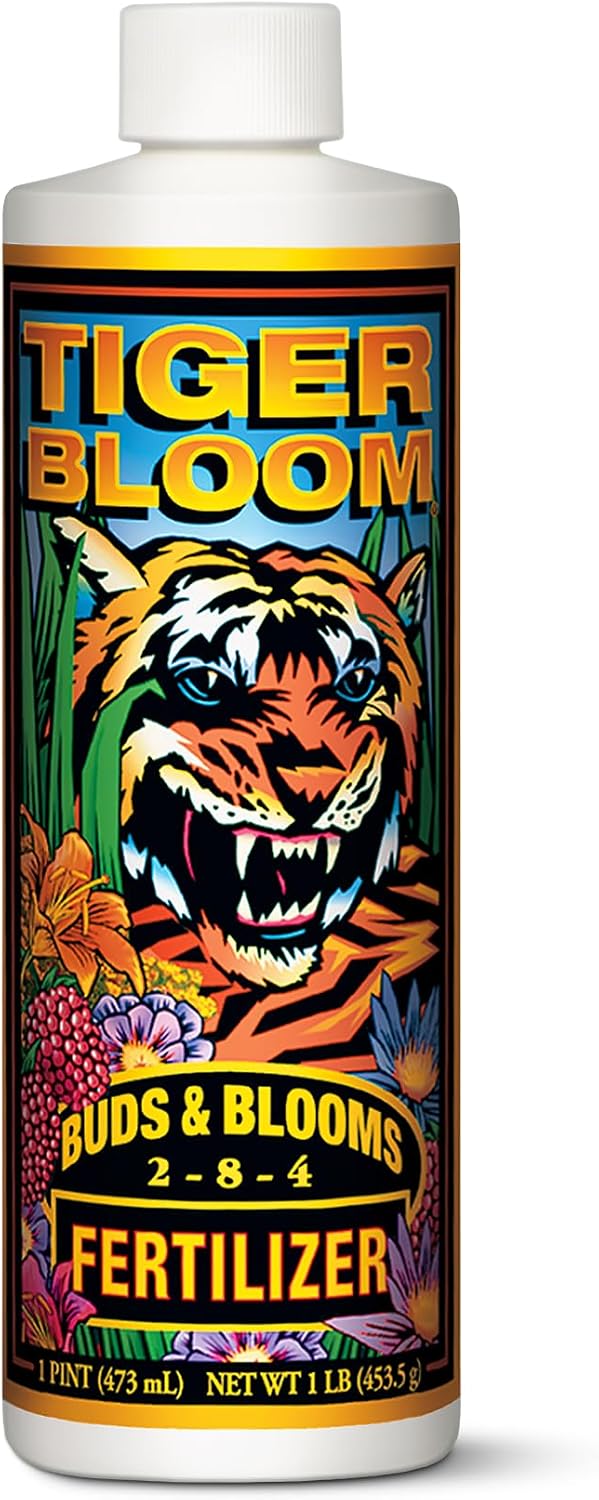
| Item Form | Liquid |
|---|---|
| Specific Uses For Product | Hydroponic |
| Application Method | Watering; Foliar spraying |
| Target Species | Flowering Plants |
| Mixing Ratio | 1:200 or 1:300 |
Tiger Bloom is a liquid, high-phosphorus fertilizer designed to push plants into a strong flowering and fruiting phase. You mix a small amount into the irrigation water or use it as a foliar spray and apply from first signs of flowering through harvest. The 2-8-4 formula and included micronutrients support bud set and larger blooms, and the concentrate mixes at 1:200 to 1:300 for routine feeding or 2 to 4 teaspoons per gallon for heavier feeding. It works in both soil and hydroponic setups and is formulated for quick nutrient uptake and stable micronutrient availability during storage. Practical benefits include flexible application methods, suitability for intensive flowering cycles, and a small bottle that lasts when used at recommended dilutions. Important limitations are that it is bloom-focused rather than an all-purpose feed so it may not meet vegetative needs, and the phosphorus content means users near waterways should follow local regulations to avoid runoff issues.
Best for: Serious growers who prioritize maximizing flower and bloom performance and want a concentrated, fast-acting bloom booster for soil or hydroponic environments.
Less Ideal for: Casual gardeners seeking a single all-purpose fertilizer for every growth stage or those managing turf or non-flowering lawns where phosphorus restrictions apply.
- High phosphorus NPK (2-8-4) concentrated for stronger bud development
- Works in soil and hydroponic systems for versatile use
- Liquid concentrate mixes easily for foliar or watering applications
- Formulated for quick nutrient uptake and stable micronutrient availability
- Focused on flowering so it is not a balanced all-stage fertilizer
- Contains phosphorus which may be restricted near waterways
Verdict: Choose Tiger Bloom when you need a concentrated, fast-acting bloom booster to maximize flower and fruit production.
Southern Ag All Purpose Granular Fertilizer 10-10-10 (5 lb)
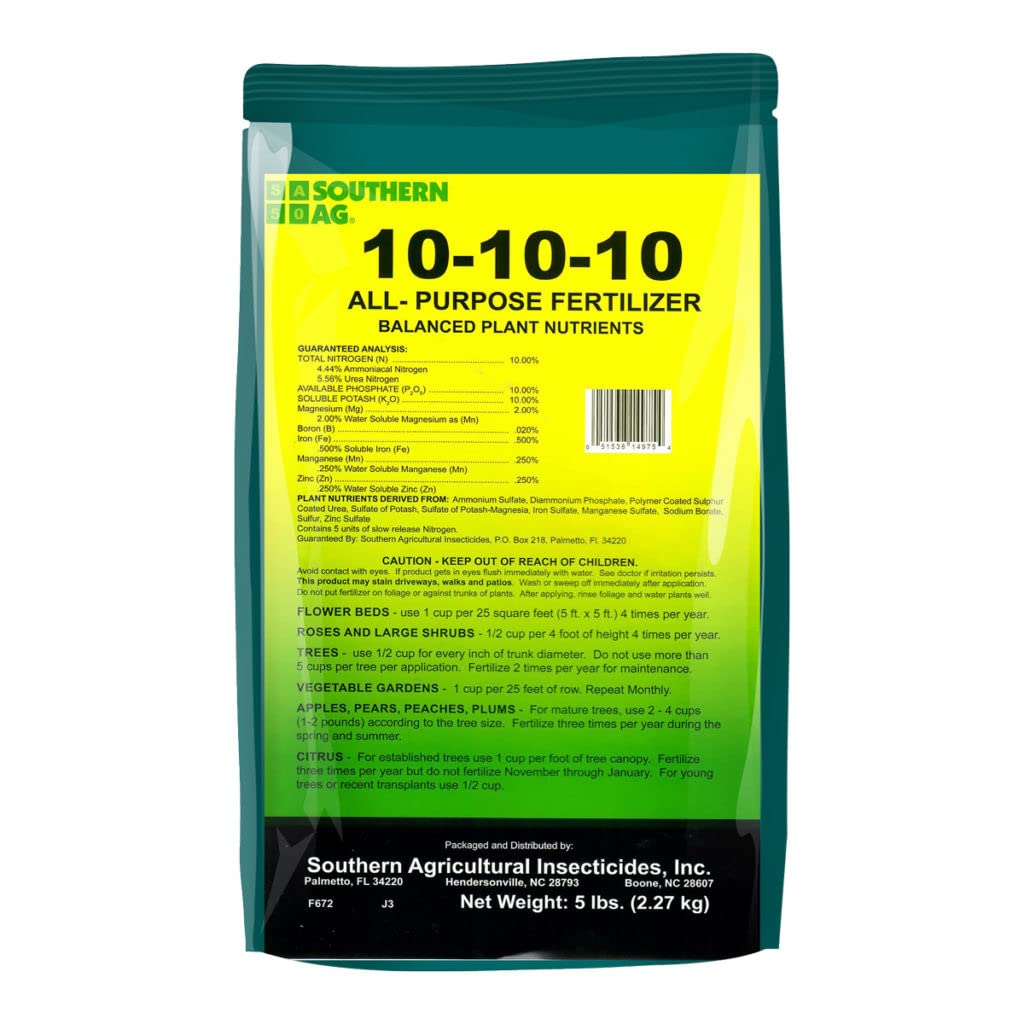
| Item Form | Granules |
|---|---|
| Specific Uses For Product | Citrus and Fruit Trees, Flowerbeds, Roses, and Large Shrubs, Vegetable Gardens |
| Application Method | Broadcast evenly over area and water in. |
| Mixing Ratio | 10:10:10 |
This 5 lb bag of Southern Ag 10-10-10 granular fertilizer is a straightforward, balanced all-purpose feed for vegetable beds, fruit trees, roses, and shrubs. You spread the granules uniformly over soil or beds and water them in; directions and recommended cup measurements are printed for common uses so dosing is easy. The formula supplies equal parts nitrogen, phosphorus, and potassium plus trace minerals like magnesium, iron, manganese, zinc, and boron, which supports steady vegetative growth and overall plant health. For asparagus specifically it can be used as a periodic maintenance feed during the growing season to support fern growth and energy storage in crowns. The product is simple to store and apply, and the small bag size is convenient for trialing on a single bed or patch. Limitations are that it is a general blend rather than a tailored asparagus formula, so heavy feeders or soils needing specific nutrient correction may require additional amendments, and granular broadcast feedings require careful placement to avoid contact with foliage or runoff risks described on the label.
Best for: Gardeners on a budget who want a simple, balanced fertilizer to maintain small asparagus patches and other mixed beds without buying specialty formulas.
Less Ideal for: Growers managing large asparagus plantings, or who need a targeted high-potassium or soil-specific amendment, should choose a crop-specific or soil-test-driven fertilizer.
- Balanced 10-10-10 N-P-K supports general growth and root development.
- Includes micronutrients (iron, manganese, zinc, boron) for broader plant nutrition.
- Clear application instructions and coverage rates for common garden uses.
- Small 5 lb size is convenient for testing on a single asparagus bed or small garden.
- Not formulated specifically for asparagus so may lack the higher potassium or phosphorus some heavy beds benefit from.
- Granular broadcast application can stain hard surfaces and requires watering after application to activate nutrients.
Verdict: A low-cost, easy-to-use balanced granular fertilizer that is a practical maintenance feed for small asparagus beds and mixed gardens.
Miracle-Gro Water Soluble All Purpose Plant Food, 1.5 lb

| Item Form | Powder |
|---|---|
| Application Method | Watering Can |
| Target Species | For all flowers, vegetables, trees, shrubs and houseplants |
| Mixing Ratio | 24-8-16 |
Miracle-Gro Water Soluble All Purpose Plant Food is a powder concentrate you mix with water to give a quick nutrient boost to flowers, vegetables, houseplants, shrubs and trees. It is typically dissolved in a watering can or used with a compatible garden feeder to soak soil at the base of plants, delivering nitrogen-heavy nutrition that shows effects faster than granular fertilizers. Notable features include an easy scooping method for indoor and outdoor dosing, compatibility with containers and in-ground planting, and clear directions for feeding every one to two weeks. In practice this makes the product a convenient option when you want visible growth and greener foliage quickly, and the 1.5 lb container covers roughly 600 sq. ft. Important limitations are that it is a fast-release, high-nitrogen formula best used as a regular quick feed rather than a long-term slow-release solution, and it requires careful measuring to avoid overfeeding. For routine maintenance combine with good watering and follow the label to avoid nutrient imbalance.
Best for: Buyers who prefer proven, easy-to-use feeding routines and want noticeable growth quickly for a variety of garden and houseplants, guided by established usage directions and broad user experience.
Less Ideal for: Gardeners seeking a single, long-term slow-release solution or those who prefer organic or low-nitrogen fertilizers for sensitive plantings should consider alternative products.
- Water-soluble powder starts working quickly at the roots when mixed and applied
- Clear, simple dosing for indoor and outdoor use with included scoop guidance
- Suitable for a wide range of plants including vegetables, flowers, shrubs and houseplants
- Covers a large area from a small container (about 600 sq. ft. per 1.5 lb)
- Fast-release formula means benefits are short-term compared with slow-release granular fertilizers
- Requires precise measuring and regular reapplication to avoid overfeeding
Verdict: A reliable, fast-acting water-soluble plant food for gardeners who want easy, repeatable feeding and quick visible results.
CFUTABOH Water‑Soluble 10-30-20 Blossom Booster Fertilizer (8 oz)

| Item Form | Powder |
|---|---|
| Application Method | water-soluble |
| Target Species | Flowers |
| Ingredients | 10-30-20 |
This concentrated powder fertilizer is designed as a blossom booster for flowering plants, using a high‑phosphorus 10-30-20 N‑P‑K ratio plus micronutrients to encourage bud set, more flowers, and stronger color. It dissolves quickly for use as a root drench, foliar spray, or through drip irrigation, so you can feed potted hibiscus the same way you already water them. The fine powder makes multiple gallons of feed from a small package, which is convenient for seasonal bloom pushes and reduces storage bulk compared with ready‑made liquids. Added trace elements support overall plant vigor and can help potted hibiscus maintain longer flowering periods. Limitations to note are that specific dilution rates and feeding schedules are not listed on the product sheet here so you should follow general phlox/flowering plant recommendations or the label if available, and high phosphorus formulas should be used according to your plant's needs to avoid nutrient imbalance in long term routine feeding.
Best for: Gardeners growing potted flowering plants who want a reliable, concentrated bloom booster they can mix for root or foliar feeding and use with drip systems to increase flower count and color.
Less Ideal for: People seeking an all‑in‑one balanced daily feed for foliage growth or those who prefer pre‑mixed liquid fertilizers with detailed feeding instructions included.
- High phosphorus 10-30-20 formula targeted to increase bud formation and bloom quantity
- Water‑soluble powder that dissolves quickly for root feeding, foliar spray, or drip systems
- Includes micronutrients to support plant vigor and prolong blooming
- Concentrated powder yields multiple gallons of feed from an 8 oz package for efficient storage
- Product listing does not include explicit dilution rates or a recommended feeding schedule
- High phosphorus ratio may not be appropriate for all long‑term fertilizer programs
Verdict: A concentrated, water‑soluble 10-30-20 bloom booster that reliably increases flower production and color for potted flowering plants like hibiscus.
Miracle-Gro Water Soluble All Purpose Plant Food, 3 lb

| Item Form | Powder |
|---|---|
| Application Method | Mix with water in a watering can |
| Fertilizer Analysis (N‑P‑K) | 24-8-16 |
| Unit Count | 48 Ounce |
| Coverage | Feeds approximately 1,200 sq. ft. |
Miracle‑Gro Water Soluble All Purpose Plant Food is a powdered NPK 24‑8‑16 formula that dissolves in water to give plants a quick nutrient boost. You mix measured scoops into a watering can and apply to the soil at the base of plants every 7–14 days for outdoor use or every 14 days for houseplants. Notable features include a high nitrogen content for leafy growth, compatibility with containers and in‑ground beds, and guidance for use with a Miracle‑Gro Garden Feeder for larger areas. In practical terms this is a fast‑acting feed that encourages bigger, greener foliage and works well in regular maintenance of perennials like hostas. Limitations are that it is a fast‑release fertilizer rather than a slow‑release option, so it requires regular reapplication and careful measuring to avoid overfeeding. Also, the 24‑8‑16 balance is geared toward vegetative growth, so it is not optimized if you want to prioritize flowering or bloom boosting.
Best for: Buyers who want a reliable, fast‑acting feed to maintain lush, leafy perennials and container plants and who value proven products with broad user endorsement.
Less Ideal for: Gardeners seeking a single, long‑lasting granular fertilizer or a bloom‑focused formula should consider alternative slow‑release or high‑phosphorus products.
- Water‑soluble powder mixes easily for quick uptake by roots
- High nitrogen formula promotes robust leafy growth ideal for shade plants
- Clear mixing and application instructions for both indoor and outdoor use
- Suitable for containers and in‑ground gardens and compatible with garden feeders
- Requires frequent applications so it is not a low‑maintenance, slow‑release option
- High nitrogen ratio is less suitable when the primary goal is more flowers than foliage
Verdict: A fast‑acting, water‑soluble fertilizer that reliably produces bigger, greener hosta leaves when used as directed.
Miracle-Gro Watering Can Singles All Purpose Plant Food, 24 Packets

| Number of Packs | 24 |
|---|---|
| Unit Count | 10.24 Ounce |
| Item Form | SOLID |
| Application Method | watering can |
| Mixing Ratio | 1 teaspoon per 1 gallon of water |
Miracle-Gro Watering Can Singles are single-use, pre-measured fertilizer packets intended to make feeding roses and other garden plants simple and reliable. To use, tear a packet into a watering can, add the specified amount of water, then apply the solution while watering; the manufacturer recommends feeding every 7 to 14 days during active growth. The packets remove measuring errors and mess, which helps prevent accidental overfeeding. Because the formula is labeled for all flowers, vegetables, trees and shrubs, it fits into regular rose care routines for bloom and bush development. Practical benefits include instant solubility, clear application instructions for outdoor and indoor containers, and consistent coverage per packet for about 10 sq. ft. of garden. Limitations are that you must keep up with the every-1–2-week schedule for best results and that the product is sold as a general-purpose feed rather than a rose-specific bloom booster, so dedicated rosarians seeking targeted NPK ratios might prefer a specialized rose fertilizer.
Best for: Gardeners who want a low-risk, no-mess way to feed roses and mixed flower beds as part of routine watering and prefer simple, foolproof dosing.
Less Ideal for: Specialist rose growers seeking a targeted bloom-boosting formula or those who want a single, slow-release application instead of frequent liquid feedings.
- Pre-measured packets eliminate measuring and reduce mess and dosing errors
- Water-soluble formula mixes quickly in a watering can for immediate application
- Labeled for use on flowers, roses, shrubs, trees and vegetables so it suits mixed beds
- Clear directions for indoor and outdoor application and coverage per packet
- General all-purpose formula rather than a rose-specific NPK for bloom boosting
- Requires regular reapplication every 7–14 days to maintain results
Verdict: If you want a safe, fuss-free way to feed roses while you water, these pre-measured soluble packets make regular feeding simple and consistent.
Choosing the Right Fertilizer for Giant Sunflowers: Key Factors to Consider
Nutrient Ratio and Stage-Specific Needs
Giant sunflowers benefit from different nutrient balances as they progress from seedlings to bloom. Early growth needs more nitrogen to build leaves and a strong stem, while later stages require higher phosphorus and potassium to enlarge flower heads and support seed development.
Understanding the N-P-K ratio on a fertilizer label lets you match a product to the plant's stage. A gardener growing large sunflowers should plan a feeding sequence: a slightly higher-nitrogen feed early, then a bloom-focused formula with elevated phosphorus and potassium once buds form. Overuse of nitrogen late in the season tends to produce tall plants with weak heads, so stage-specific feeding reduces that risk.
Formulation Type and Delivery
Fertilizers come as granular, slow-release, water-soluble, and liquid concentrates, and each behaves differently in a garden. Granular and slow-release options reduce the need for frequent applications and are helpful in large beds or when you want steady nutrition. Water-soluble and liquid feeds give quick uptake and are useful for correcting deficiencies or for targeted bloom-boosting during head development.
Choose a delivery method that fits the planting situation. For in-ground giant sunflowers in established beds, an incorporated granular or slow-release product reduces labor. For container-grown giants or when using drip irrigation, soluble feeds offer precise control and fast responses.
Application Rate and Timing Precision
Getting the amount and timing right is critical when pushing plants toward giant size. Too little fertilizer slows growth and reduces head size. Too much, especially of nitrogen, can cause weak stems, excessive foliar growth, and even fertilizer burn.
Look for products with clear application rates for annual flowers and directions on frequency. Consider soil tests or a baseline organic amendment to avoid unnecessary feeding. Timing matters: apply the vegetative feed early, switch to bloom-supporting nutrients when buds appear, and taper off as seeds set to avoid stressing plants before maturity.
Soil Type and pH Compatibility
Soil texture and pH influence nutrient availability for sunflowers. Sandy soils drain quickly and may need more frequent, lighter feedings. Heavy clay holds nutrients but can lock them up if pH is off. Sunflowers prefer neutral to slightly acidic soil for best nutrient uptake.
Select fertilizers that match your soil conditions or can be paired with soil amendments. If your soil test shows pH extremes, address pH first because fertilizer applications are less effective when nutrients are not available to roots.
Stalk Strength and Structural Support
When aiming for giant specimens, fertilizer choices should support rigid stalk development. Nutrients that help build cellulose and root mass indirectly support stalk strength by promoting healthy overall growth and water transport.
Avoid feeding strategies that encourage rapid, spindly elongation. Balanced feeding and adequate potassium contribute to turgor and tissue strength. Also consider cultural practices such as spacing, staking, and consistent watering to complement fertilization for sturdy, tall plants.
Environmental Impact and Runoff Risk
Large applications of soluble fertilizers can increase the risk of nutrient runoff, which is an environmental concern and wastes product. Slow-release and organic options tend to reduce runoff risk and provide a steadier nutrient supply.
Choose formulations and application methods that minimize leaching, follow label rates, and avoid applying before heavy rainfall. For gardeners near waterways or on slopes, favor low-solubility products or integrate organic matter to retain nutrients.
Feeding Schedule for Giant Sunflowers
Establish a simple feeding calendar tied to plant development rather than fixed calendar dates. Start with a gentle, nitrogen-biased feed at the true-leaf stage to encourage robust stem growth. Switch to a higher phosphorus and potassium formula when flower buds begin to form to support head expansion and bloom quality.
If using a slow-release product at planting, supplement with a water-soluble bloom feed once buds are visible. For container-grown giants, feed more frequently but at reduced strength to avoid salt buildup. Always water thoroughly after granular applications to move nutrients into the root zone.
- Seedling to early vegetative: light nitrogen feed every 2-3 weeks
- Pre-bud stage: transition to balanced feed
- Bud formation to bloom: boost phosphorus and potassium
- After bloom set: reduce nitrogen to favor seed maturation
Soil Prep and Baseline Nutrition
Before planting, improve garden beds with plenty of organic matter such as compost. This raises cation exchange capacity and helps retain applied nutrients. Work a measured granular fertilizer into the planting hole or bed when soils are tested and corrected for pH.
A baseline soil test is the most reliable way to know what a garden needs. If testing is not feasible, a balanced starter amendment plus compost will usually provide enough initial nutrition for sunflowers, with targeted feedings later to push size.
- Incorporate 2 to 3 inches of compost into the top 6 to 8 inches of soil
- Use a starter dose of balanced granular fertilizer if soil is low in organic matter
- Adjust pH toward neutral for best nutrient uptake
Managing Water and Nutrient Uptake
Consistent moisture encourages steady nutrient uptake and reduces stress that can make stems weak. Deep, infrequent watering encourages deeper roots that support giant plant size. When applying soluble feeds, water first if soil is dry to prevent concentrated salts from contacting roots directly.
Mulch helps preserve soil moisture and moderates temperature swings. Combine mulching with appropriate feeding to keep the root environment stable during the rapid growth phases of giant sunflowers.
- Water deeply once or twice weekly depending on soil and weather
- Apply soluble fertilizers after moistening soil
- Use organic mulch to conserve moisture and reduce nutrient leaching
Supporting Structural Growth Without Overfertilizing
Fertilizer is only one part of producing strong, tall sunflowers. Proper spacing, staking or guying, and consistent pruning of excessive side shoots can direct resources into the main stem and flower head. When you aim for maximum size, monitor growth and reduce nitrogen if plants appear overly lush with weak stems.
Mechanical support becomes more important as heads develop. Combine timely feeding with physical support and you will avoid the common pitfall of oversized heads on floppy stems.
- Thin seedlings to recommended spacing early
- Stake tall plants before they lean
- Trim a few lower leaves if airflow or disease risk increases
Organic Vs Synthetic Options
Organic fertilizers release nutrients more slowly and improve soil structure over time. They can be a good fit for gardeners who prefer building long-term fertility and reducing runoff. Synthetic and soluble products offer faster, more predictable nutrient delivery that can be useful when you need a quick response during key growth windows.
Consider combining approaches: use organic matter and slow-release inputs as a base, then apply targeted soluble feeds during bud and bloom development. This gives both structural soil benefits and immediate nutrient availability when sunflowers need it most.
- Organic: steady release, improves soil life
- Synthetic: quick uptake, precise ratios
- Hybrid approach: base soil building plus targeted feeds
How We Chose the Best Fertilizer for Giant Sunflowers
We selected fertilizers that are suited to producing oversized sunflower plants and heads. Our editorial filters prioritized products that provide clear N-P-K information and deliver the kinds of nutrients giant sunflowers need at each stage: early vegetative growth for strong stems, mid-season support for head development, and bloom-time feeding for large flowers. We also evaluated application methods that gardeners actually use: granular amendments, slow-release formulations, and water-soluble feeds. Ease of timing and measuring mattered because overfeeding or uneven applications can cause floppy stems or excess foliage at the expense of blooms. Longevity of effect and compatibility with common garden soils and compost were considered to reduce the need for frequent reapplications. We excluded specialty formulas aimed only at small bedding plants or products intended solely for lawns. We also filtered out mixes lacking clear nutrient ratios or uses. Final selection focused on balanced nutrient profiles, practical delivery formats, predictable release behavior, and straightforward instructions for sunflowers and similar large annuals.
FAQ
How often should I feed giant sunflowers during the growing season?
Frequency depends on the fertilizer type. Slow-release products may only need one application at planting. Water-soluble feeds are usually applied every one to three weeks at reduced strength. Monitor plant vigor and adjust if growth is too faint or overly lush.
Can too much fertilizer cause my sunflowers to fall over?
Yes. Excessive nitrogen promotes rapid, weak stem growth that cannot support heavy heads. Balanced feeding and shifting to bloom-focused nutrients when buds form help build sturdier stems rather than just more foliage.
Should I change fertilizer when buds first appear?
Often it helps to switch to a formula higher in phosphorus and potassium once buds form to support head development. The change encourages larger flowers and better overall bloom quality without excessive vegetative growth.
Is organic fertilizer sufficient for growing giant sunflowers?
Organic fertilizers can be sufficient if they supply adequate nitrogen early and release phosphorus and potassium in time for bloom. They improve soil health but may act more slowly, so combining them with targeted soluble feeds is a common approach for gardeners seeking maximum size.
How does soil type affect my fertilizer choice?
Sandy soils require more frequent feeding because they drain nutrients quickly. Clay soils hold nutrients but may need pH adjustment to make those nutrients available. Match application frequency and formulation to your soil to maintain steady nutrient availability.
Can I foliar-feed sunflowers to increase head size quickly?
Foliar feeding can correct short-term micronutrient deficiencies and provide a quick uptake route, but it is not a substitute for a balanced root-zone feeding program. Use foliar sprays sparingly and as a supplement during critical growth windows.
Final Verdict
Choosing the right fertilizer for giant sunflowers means balancing early nitrogen needs for stem development with higher phosphorus and potassium during bud and bloom stages. Pay attention to formulation type and application timing to avoid weak stems or nutrient runoff. Prioritize soil preparation, consistent watering, and structural support alongside feeding. Focus on predictable nutrient release and stage-specific feeds rather than chasing maximum application rates. That approach will help you grow large, stable sunflowers with impressive heads while keeping plants healthy through the season.
