

Note: This article contains affiliate links. If you click on these links and make a purchase, I may earn a small commission at no extra cost to you. This helps support my research and content. Read my full affiliate disclosure here.
A healthy, green lawn often comes down to the fertilizer you choose and how you use it. The right product corrects nutrient imbalances, feeds grass at the proper rate, and fits your maintenance rhythm whether you mow weekly or manage drought stress. This guide focuses on options formulated for green grass and covers the top shortlisted fertilizers suited to that goal. We evaluated candidates for nutrient balance, release type, and ease of application to help you pick a solution that matches your soil, grass species, and schedule. Below you will find concise guidance on strengths and tradeoffs before the product list.
Top Picks at a Glance
| Best Overall The best all-around choice for most situations | Scotts Turf Builder Lawn Food, 12.5 lb |  |
| Best Quality Built to a higher standard if you want something more solid | The Andersons Professional PGF Complete 16-4-8 Granular Lawn Fertilizer (covers 5,000 sq ft) |  |
| Best Value The sweet spot between price and what you get | GreenView Lawn Food Granules, 16 lb. Bag (covers 5,000 sq. ft.) |  |
| Best Budget The cheapest option that still gets the job done reliably | Southern Ag All Purpose Granular Fertilizer 10-10-10, 5 lb |  |
| Highest Rated A top-rated pick with lots of positive feedback | The Andersons PGF Balanced 10-10-10 Granular Fertilizer with Micronutrients and 2% Iron (18 lb) |  |
| Most Popular A crowd favorite that many people choose with confidence | Scotts Turf Builder WinterGuard Fall Lawn Food, 10 lb |  |
| Best Seller A high-volume bestseller chosen again and again | Scotts Green Max Lawn Food, 16.67 lb (covers 5,000 sq. ft.) |  |
Scotts Turf Builder Lawn Food, 12.5 lb

| Item Form | Powder |
|---|---|
| Specific Uses For Product | Lawn |
| Coverage | 5,000 sq. ft. |
| Target Species | grass |
| Mixing Ratio | 32:0:4 |
Scotts Turf Builder Lawn Food is a granular fertilizer designed to thicken and green lawns of any grass type. It is applied with a broadcast or drop spreader (Scotts provides recommended settings) and can be used on wet or dry grass; light watering after application speeds results but is not required. The formula focuses on strengthening roots and improving the lawn's ability to take up water and nutrients, which helps turf resist stress and recover from seasonal wear. One 12.5 pound bag treats around 5,000 square feet, making it convenient for small to medium yards and for gardeners who follow a regular feeding schedule. The product is pesticide-free, so it is strictly a nutrient feed rather than a weed or insect treatment. Packaging and spreader-settings guidance simplify application, but you will need a spreader and to follow the listed coverage to avoid overapplication. As with any granular fertilizer, keep it away from water bodies, store securely, and use gloves when handling.
Best for: Homeowners who want a straightforward, no-frills fertilizer to build healthier green turf and who maintain a regular feeding routine for small to medium lawns.
Less Ideal for: People seeking a combined weed-or-pest control solution or those managing large properties where a larger-volume product would be more convenient.
- Works on all grass types so you can use one product across the yard
- Builds stronger, deeper roots to improve drought and stress resilience
- Can be applied to wet or dry lawns and shows faster greening if watered in
- Clear spreader settings provided for easy, even application
- Covers approximately 5,000 sq. ft. per bag, suitable for small to medium lawns
- Not a weed or insect control product so additional treatments are needed for pests and weeds
- Single bag size limits efficiency for larger properties requiring frequent reapplication
Verdict: A reliable, easy-to-apply lawn food that strengthens roots and greens any grass type, ideal for small to medium yards seeking consistently healthier turf.
The Andersons Professional PGF Complete 16-4-8 Granular Lawn Fertilizer (covers 5,000 sq ft)

| Item Form | Granules |
|---|---|
| Specific Uses For Product | Soil Conditioning |
| Target Species | lawn grasses |
| Unit Count | 288 Ounce |
| Mixing Ratio | 4-1-2 ratio |
This granular fertilizer is built to boost turf performance with a 16-4-8 N-P-K ratio that delivers both immediate and extended nitrogen release for up to eight weeks. It is typically applied with a broadcast spreader at the recommended rate on dry foliage, then lightly watered to activate the Humic DG technology that helps nutrients move into the root zone. Notable features include super-fine particles for even coverage, added iron and micronutrients for richer color, and a mix of quick and slow-release nitrogen for steady growth without frequent reapplication. Practical benefits for a performance-focused buyer are visibly greener turf, reduced application frequency, and improved soil conditioning from humic acids. Important limitations are that it is a granular product so precise spreader calibration and steady walking are required for uniform results, and it is not labeled for sale in California which restricts availability in that state.
Best for: Gardeners focused on high-performance, visibly greener lawns who want a single application product that delivers both immediate and extended feeding and supports soil health.
Less Ideal for: Small container gardeners or people who prefer liquid or organic-only fertilizer programs should consider other formats or formulations.
- Balanced 16-4-8 N-P-K with both quick- and slow-release nitrogen for immediate color and sustained feeding
- Super-fine particles designed for even distribution across the lawn
- Includes iron and multiple micronutrients to improve turf color and overall plant nutrition
- Humic DG additive to help move nutrients into the soil and support soil conditioning
- Requires correct spreader settings and consistent walking speed to avoid streaking
- Not available for sale in California
Verdict: Choose this fertilizer when you want a performance-focused granular formula that delivers quick color boost plus up to eight weeks of sustained feeding for greener grass.
GreenView Lawn Food Granules, 16 lb. Bag (covers 5,000 sq. ft.)

| NPK | 22-0-4 |
|---|---|
| Form | Granules |
| Coverage | 5,000 sq. ft. |
| Application Method | Broadcast or drop spreader |
GreenView Lawn Food is a granular turf fertilizer designed to improve root growth, speed spring green-up, and provide up to eight weeks of continuous feeding through a controlled-release nitrogen technology. It is applied with a broadcast or drop spreader and is intended for general lawn maintenance across up to 5,000 square feet per bag. The 22-0-4 formula focuses on nitrogen and potassium while avoiding phosphate, which aligns with many local restrictions and helps limit runoff risk. In practice this product produces steady, deeper green color and stronger-looking turf without a sudden surge in top growth thanks to the MESA slow-release nitrogen. Practical benefits include drought support from improved root development and less frequent reapplication compared with quick-release fertilizers. Important limitations are that it is not a starter fertilizer for new sod in phosphate-restricted areas and it must be spread with equipment rather than by hand to ensure even coverage and correct rates.
Best for: Homeowners who want a straightforward, low-maintenance lawn fertilizer that promotes steady green-up and stronger roots with fewer applications.
Less Ideal for: People installing new lawns from seed or sod who need a starter fertilizer with phosphorus or gardeners who prefer liquid or foliar feeding methods.
- Controlled-release nitrogen (MESA) provides steady feeding for up to eight weeks
- High-nitrogen 22-0-4 formula promotes faster green-up and stronger root development
- Covers up to 5,000 sq. ft. per 16 lb. bag for easy yard-sized application
- Zero phosphate formulation reduces potential impact on waterways where phosphate is restricted
- Not formulated as a phosphate-containing starter fertilizer for establishing new seed or sod
- Requires a broadcast or drop spreader for proper, even application
Verdict: Choose this product if you want a reliable, controlled-release granular lawn food that produces steady green-up and stronger roots with minimal reapplication.
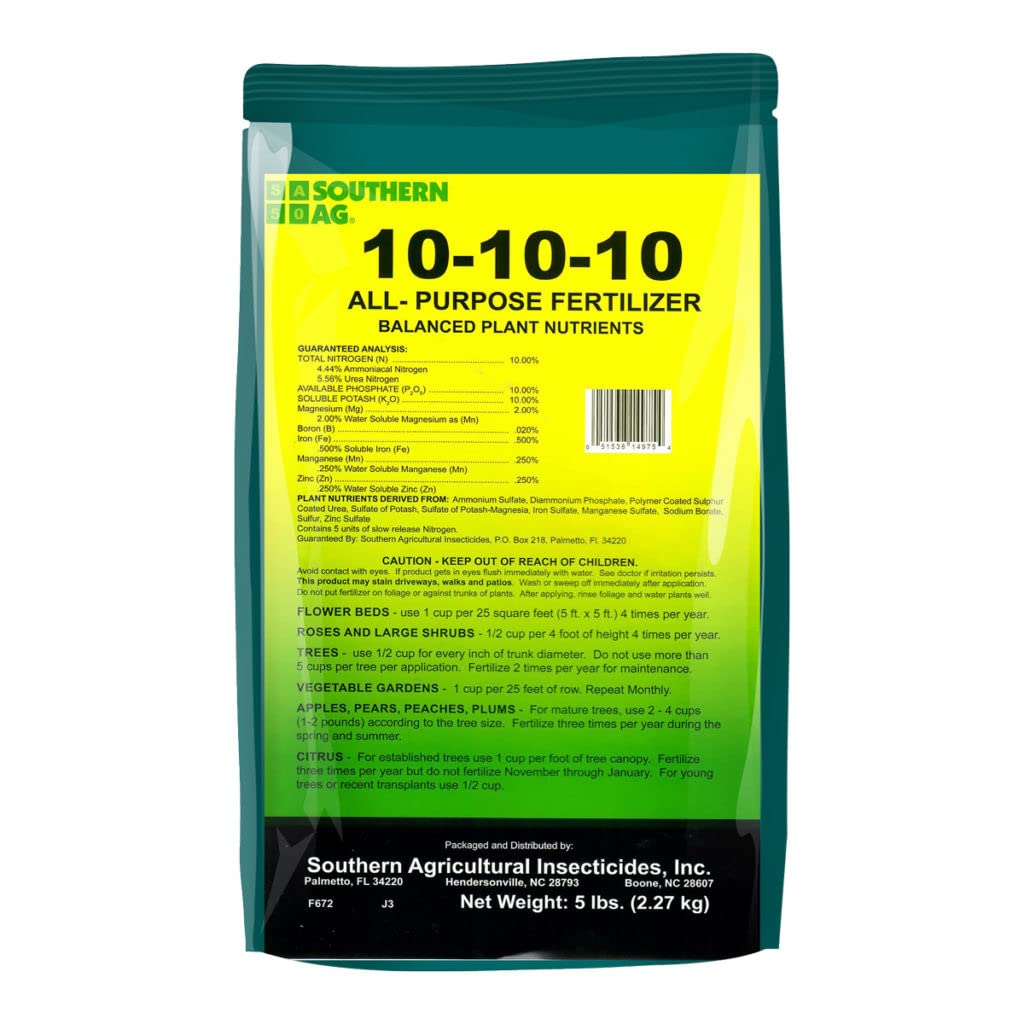
Southern Ag All Purpose Granular Fertilizer 10-10-10, 5 lb
| Item Form | Granules |
|---|---|
| Specific Uses For Product | Citrus and Fruit Trees, Flowerbeds, Roses, Large Shrubs, Vegetable Gardens |
| Application Method | Broadcast evenly over area and water in. |
| Mixing Ratio | 10:10:10 |
This Southern Ag 10-10-10 granular fertilizer is a straightforward all-purpose feed for lawns, vegetables, flowers, shrubs, and fruit trees. It is applied by broadcasting over the target area and watering in, with clear coverage guidance for beds, shrubs, and trees. The balanced 10-10-10 analysis and included minor elements like iron and zinc make it suitable for general maintenance and for correcting mild nutrient deficiencies without tailoring fertilizer blends to specific plant stages. Because it comes in a 5 pound bag and is granular, it is easy to measure and store and works well for small yards or spot treatments. Limitations are that it is not slow-release and does not target turf-specific nitrogen schedules for high-performance lawn greening, so you will need repeat applications according to the label for sustained results. Also take care to avoid contact with foliage or hard surfaces and follow safety directions to prevent staining and runoff. For gardeners seeking a low-cost, multipurpose feed for routine maintenance, this provides a predictable, no-frills option.
Best for: Buyers who want an affordable, easy-to-use, general-purpose fertilizer for routine maintenance of small lawns, beds, and garden plants and who prefer straightforward application instructions.
Less Ideal for: Those seeking a turf-specific, high-nitrogen program for rapid lawn greening or a slow-release product for low-maintenance, long-acting feeding.
- Balanced 10-10-10 formulation suitable for a wide range of plants
- Simple granular form that is easy to measure and broadcast
- Includes minor elements (iron, manganese, zinc, boron) to support general plant nutrition
- Clear application rates for flowerbeds, shrubs, trees, and vegetable gardens
- Not a slow-release fertilizer so nutrients may require more frequent reapplication
- Small 5 lb bag may be insufficient for larger lawns or repeated seasonal use
Verdict: A cost-conscious, no-frills 10-10-10 granular fertilizer that makes routine feeding simple for small gardens and mixed plantings.
The Andersons PGF Balanced 10-10-10 Granular Fertilizer with Micronutrients and 2% Iron (18 lb)

| NPK | 10-10-10 |
|---|---|
| Form | Granules |
| Application method | Spreader |
| Coverage | 5000 square feet |
| Contains | Micronutrients and 2% iron |
The Andersons PGF Balanced is a professional-style 10-10-10 granular fertilizer designed to give even feeding across lawns, gardens, trees and shrubs. Its notably fine particle size increases spreader coverage versus typical pebble-size granules, so applications tend to be more uniform and reduce missed spots. It supplies quick-release nitrogen for immediate green-up and includes micronutrients plus 2% iron for deeper greening. Use it with a broadcast or drop spreader, apply to dry foliage, sweep paved areas clear, then water in to activate the nutrients. One 18 lb bag covers up to 5,000 sq ft, making it suitable for routine spring and fall feeding or for mixing into garden beds at planting. Limitations to consider are that it is a quick-release formula, so it requires more frequent reapplication than slow-release products, and the iron can stain sidewalks if not cleaned promptly. Store unused product sealed and dry to preserve effectiveness.
Best for: Buyers who prioritize predictable, fast green-up and even coverage for lawns and mixed garden plantings and who plan routine seasonal feedings.
Less Ideal for: Gardeners seeking long-duration, low-maintenance feeding or those who prefer a slow-release organic option should consider alternatives.
- Very fine particle size for more even coverage and fewer missed spots
- Contains micronutrients plus 2% iron for improved greening
- Quick-release formula delivers fast-visible results
- Covers up to 5,000 sq ft from one 18 lb bag when applied as directed
- Quick-release nutrients require more frequent applications compared with slow-release fertilizers
- Iron content can leave rust stains on hard surfaces if not swept or washed off promptly
Verdict: Choose this product when you want reliable, fast green-up and highly even nutrient coverage for lawns and gardens.
Scotts Turf Builder WinterGuard Fall Lawn Food, 10 lb

| Item Form | Granules |
|---|---|
| Specific Uses For Product | Lawn Fertilizer |
| Application Method | spread |
| Coverage | 4000 |
| Target Species | lawn grasses |
Scotts Turf Builder WinterGuard Fall Lawn Food is a ready-to-use granular fertilizer intended for a fall application to strengthen grass before winter. You spread it with a broadcast or drop spreader across your lawn; one 10 lb bag covers about 4,000 sq. ft. The formula is designed to rebuild roots and help turf recover from summer heat, drought, and heavy use, and it works on any grass type. It is easy to apply to a wet or dry lawn and does not strictly require watering-in, though light watering speeds results. The product is practical for homeowners who want a simple seasonal feed without mixing or special equipment beyond a spreader. Limitations include single-season, single-bag coverage for small to medium lawns and no integrated weed or insect control in this formulation, so it should be part of a broader lawn plan if you need weed or pest management.
Best for: Homeowners seeking a simple, evidence-backed fall feed to strengthen roots and help lawns recover from summer stress who prefer an easy-to-apply granular product with broad compatibility.
Less Ideal for: People who want combined weed or insect control in a single step or who need to treat very large lawns with a single purchase should consider other products or larger sizes.
- Formulated for fall use to promote deeper roots and winter hardiness
- Easy broadcast or drop spreader application to wet or dry lawns
- Covers approximately 4,000 sq. ft. per 10 lb bag for straightforward planning
- Suitable for all grass types
- Contains only fertilizer nutrients with no weed or insect control included
- One 10 lb bag only covers moderate area so larger lawns require multiple bags
Verdict: Use this easy-to-apply fall lawn food when you want a reliable seasonal feed that builds stronger roots and helps your grass recover from summer stress.
Scotts Green Max Lawn Food, 16.67 lb (covers 5,000 sq. ft.)

| Item Form | Granules |
|---|---|
| Coverage | 5000 square feet |
| Specific Uses For Product | Lawn |
| Target Species | lawn grass |
| Unit Count | 266.67 Ounce |
Scotts Green Max Lawn Food is a granular lawn fertilizer formulated to feed grass and deliver noticeable greening within days thanks to a 2-in-1 formula that includes 5% iron. It is intended for homeowners to apply with a broadcast or drop spreader across any grass type in spring, summer, or fall; one 16.67 lb bag covers about 5,000 sq. ft. The granules are described as concentrated nutrition without filler and the label gives specific spreader settings to help ensure an even application. Practical benefits include quick visual improvement in color, easy cleanup because the product is guaranteed not to stain when used as directed, and immediate re-entry of the lawn by people and pets after application. Limitations are that you must follow spreader settings and watering recommendations to avoid uneven feeding and results will depend on existing soil fertility and mowing practices. This product is not a weed control or long-term fertility plan by itself, so expect to use it as one component of regular lawn care rather than a single-season cure-all.
Best for: Buyers who want a straightforward, low-risk way to quickly improve lawn color and expect clear application guidance and fast visible results.
Less Ideal for: Gardeners who need weed or pest control, those seeking a full-season fertility program in one product, or users unwilling to calibrate and use a spreader.
- Fast greening effect from added iron that can be seen in about three days when used as directed
- Covers 5,000 sq. ft. from one bag, simplifying treatment for mid‑sized yards
- Clear application instructions and spreader settings reduce guesswork for even coverage
- Manufactured granules with no filler for consistent nutrient delivery
- Safe to re-enter the lawn immediately after application
- Not formulated to control weeds or address pest issues
- Results depend on correct spreader calibration and follow-up watering
- Single application is not a complete yearlong fertility program
Verdict: Choose this if you want an easy, fast-acting lawn food that reliably deepens green color on mid-sized lawns when applied correctly.
Choosing the Right Fertilizer for Green Grass: Key Factors to Consider
Nutrient Ratio and Analysis
The guaranteed analysis on a fertilizer label tells you the percentages of nitrogen, phosphorus, and potassium and guides what the product will do for color and root growth. For greener turf, nitrogen is the primary driver of leaf color, but the right balance with phosphorus and potassium prevents weakness and supports stress tolerance. A product labeled with clear percentages lets you calculate application rates precisely and avoid overfeeding.
Knowing the ratio helps you match a fertilizer to soil test results. If your soil already has adequate phosphorus, choose a formula that emphasizes nitrogen. Conversely, if roots are thin or the lawn will be overseeded, prioritize a blend with some phosphorus to support establishment.
Nitrogen Release Type
How nitrogen becomes available matters for both results and maintenance. Quick-release nitrogen delivers a rapid color boost within days but can burn if overapplied and often requires more frequent feeding. Slow-release or controlled-release nitrogen provides steadier greening over weeks and reduces risk of scorch and nutrient loss to runoff.
Consider your schedule and climate when choosing release type. If you need a quick green-up for an event, a fast-acting product can work. For routine lawn health and less frequent applications, a slow-release formula helps maintain even growth and reduces mowing frequency.
Application Method and Ease
Practical application affects whether you get even results. Granular fertilizers require a compatible spreader and correct setting for uniform coverage. Liquids and hose-end options can be faster for small yards but need proper mixing and consistent watering afterwards. Ease of application also includes packaging size and handling: heavy bags should be manageable and liquid concentrates should have clear measuring instructions.
Look for products with published spreader settings or clear instructions for common spreader models, and consider whether you prefer the precision of a broadcast spreader or the convenience of liquid application.
Coverage Rates and Calculations
Understanding coverage per bag or bottle prevents under- or overapplication and wasted product. Labels that list square footage per package at a recommended rate make planning straightforward. Granular products often state coverage for common application rates in pounds of nitrogen per 1,000 square feet, which helps you align with local turf fertility recommendations.
Accurate coverage guidance also reduces the risk of streaking from uneven spreader settings. When coverage information is vague, you will spend time recalculating and risk mistakes that affect appearance and plant health.
Environmental Impact and Runoff Risk
Fertilizer misapplication can contribute to nutrient runoff that harms waterways. Products with stabilized nitrogen forms, urease or nitrification inhibitors, or slow-release matrices lower the potential for leaching and runoff. Clear labeling on timing and maximum seasonal application rates helps you comply with local regulations and protect waterways.
Selecting a product with stewardship guidance and following label restrictions reduces environmental impact while still achieving a green lawn. Consider timing applications outside of heavy rain forecasts and using slow-release formulations where runoff risk is higher.
Compatibility with Grass Type and Climate
Different turfgrasses and climates respond differently to feeding. Cool-season grasses often benefit from higher fall and spring nitrogen programs, while warm-season grasses respond best with feeding timed to active summer growth. Some fertilizers are formulated for general lawns, while others emphasize features for specific grass types.
Choose a product whose recommended timing and feeding rate align with your grass species and regional growing season. Using a product outside its intended climate guidance can reduce uptake efficiency and performance.
When to Fertilize for Best Color
Timing your applications around peak growth maximizes green-up while avoiding wasted nutrients. For cool-season grasses, early spring and early fall are prime windows when roots can take up nutrients efficiently. Warm-season grasses benefit from a mid-spring through summer schedule when the plant is actively growing.
Avoid applying high-nitrogen products before a heatwave or heavy rain. Instead, favor slow-release formulations if you must fertilize during uncertain weather to reduce stress and nutrient loss.
- Apply in active growth periods for the specific grass type
- Use slow-release nitrogen when rain is likely
- Follow label timing to reduce environmental risk
Interpreting Soil Test Results
A soil test provides the clearest direction for what your lawn actually needs. Tests reveal pH and available nutrients, which influence both the fertilizer ratio you should choose and whether soil amendments are necessary for uptake. If pH is off, even the best fertilizer will not be fully available to grass roots.
Adjust fertilizer choice based on test results rather than defaulting to high-nitrogen mixes every season. Matching product selection to measured deficiencies saves money and prevents unnecessary nutrient buildup.
- Test every 2 to 3 years for most lawns
- Match nitrogen rates to turfgrass needs, not package hype
- Correct pH before major fertilizer programs when possible
Watering After Application
Proper watering after applying fertilizer helps move nutrients into the root zone and reduces the risk of granule carry-off. For most granular products, a light irrigation within 24 to 48 hours activates nutrients. For liquid treatments, water-in requirements vary by formulation and should follow label instructions.
Avoid heavy irrigation immediately after application if rain is forecast, as that can wash nutrients away. Instead, split applications or choose slow-release formulas in high-runoff situations.
- Light irrigation usually activates granules without runoff
- Follow label water-in recommendations for liquids
- Delay watering if heavy rain is imminent to avoid loss
Combining Fertilizer with Weed and Pest Control
Many turf programs mix fertility with weed control in the same season, but timing matters. Pre-emergent herbicides and certain pest treatments interact with soil and turf physiology and can affect when it is best to fertilize. In some cases, applying a fertilizer too close to a herbicide date can stress grass or reduce herbicide efficacy.
Plan a calendar that staggers fertility and control treatments according to product guidance and the life cycles of weeds or pests in your area. When in doubt, follow label intervals and avoid overlapping treatments without clear compatibility instructions.
- Check label compatibility before combining treatments
- Space major treatments to monitor turf response
- Consider professional guidance for heavy pest or weed pressure
Using Organic Versus Synthetic Options
Organic fertilizers release nutrients more slowly and often improve soil structure over time, but they can provide a milder immediate color response than synthetic quick-release nitrogen. They are useful where long-term soil health is a priority or where slow, steady feeding is preferred.
Synthetic options typically give faster, more visible green-up and can be easier to calculate for exact nitrogen rates. Many gardeners blend approaches: using organic amendments in fall to build soil while applying targeted synthetic feeds during peak green-up windows.
- Organics improve soil over time but act slower
- Synthetic products give faster color response
- Consider a combined program for balanced results
How We Chose the Best Fertilizer for Green Grass
We prioritized fertilizers that specifically support vigorous, green turf through measurable nutrient profiles and predictable release behavior. Included products show clear nitrogen, phosphorus, and potassium ratios aligned with common turf goals, and include options with both quick-acting and slow-release nitrogen to match different timing strategies. We checked label transparency to ensure guaranteed analysis and clear application rates so gardeners can match product strength to lawn size. Application practicality was another filter: easy broadcast or hose-end compatibility, clear spreader settings, and manageable granule or liquid handling mattered because real yards need products you will actually apply correctly. Environmental considerations shaped exclusions; we omitted products that lacked clear instructions to prevent overapplication or that relied solely on non-replicable organic claims without nutrient guarantees. Finally, we considered adaptability across common cool- and warm-season turfgrasses so the list serves a broad range of lawns.
FAQ
How often should I apply fertilizer for the greenest lawn?
It depends on the product type and grass species. Slow-release fertilizers are often applied two to four times per growing season, while quick-release products may be used more frequently. Follow label rate guidance and adjust timing for cool- or warm-season grasses.
Can I get a green lawn without using synthetic fertilizers?
Yes, organic fertilizers and soil-building practices can produce a healthy, green lawn over time, but they usually act more slowly. Combining organic amendments with targeted feeding windows gives both long-term soil benefits and timely color improvements.
Will too much fertilizer make my grass greener?
Excess nitrogen can cause rapid but weak growth, increase disease risk, and lead to runoff problems. More is not always better. Stick to recommended nitrogen rates per 1,000 square feet and base rates on soil tests and turf needs.
What is the best time of day to fertilize and water?
Apply fertilizer during a period when the lawn is dry and no rain is forecast for the next day or two. Watering lightly after application helps move nutrients into the root zone. Avoid late-afternoon watering that leaves foliage wet overnight and can promote disease.
How do I avoid streaks or uneven color after applying granules?
Use a calibrated spreader with the manufacturer-recommended setting and overlap passes slightly for even coverage. Check spreader calibration on a small trial area and adjust settings based on measured coverage to prevent striping.
Final Verdict
Choosing the right fertilizer for green grass means balancing nutrient needs, release timing, and practical application. Prioritize products with the right nitrogen profile for your turf, clear coverage guidance, and a release type that matches your watering and maintenance schedule. Weigh tradeoffs between quick color boosts and steady, slow-release feeding, and let soil tests guide your ratio choice. With a plan that fits your grass species and site conditions, you can achieve consistent, healthy green color while minimizing environmental risk.
