

Note: This article contains affiliate links. If you click on these links and make a purchase, I may earn a small commission at no extra cost to you. This helps support my research and content. Read my full affiliate disclosure here.
Establishing a new lawn starts with the right fertilizer and timing. When you seed or sod, young grass needs a nutrient balance that encourages quick germination, healthy root development, and steady leaf growth without burning delicate seedlings. The wrong product or application rate can stunt roots or create uneven color that becomes hard to fix later. This guide looks at seven top fertilizer options suited for establishing new grass. We shortlisted products that perform well in real garden conditions and evaluated them using practical criteria gardeners care about, including nutrient ratios, application safety for seedlings, and how easily the product can be applied to a fresh lawn. Read on to see which approaches best match your soil and seeding method, then choose the option that fits your site and schedule.
Top Picks at a Glance
| Best Overall The best all-around choice for most situations | Scotts Turf Builder Triple Action Built for Seeding, 4.3 lb |  |
| Best Quality Built to a higher standard if you want something more solid | Lawn Synergy Starter Fertilizer 15-20-10 (18 lb) for New Seed and Sod |  |
| Best Value The sweet spot between price and what you get | GreenView Solutions Starter Fertilizer, 48 lb |  |
| Best Budget The cheapest option that still gets the job done reliably | Greenview Starter Fertilizer 10-18-10, 8 lb (covers 2,500 sq. ft.) |  |
| Highest Rated A top-rated pick with lots of positive feedback | Espoma Turf-Tone Lawn Starter Organic 4-6-3 Fertilizer, 30 lb |  |
| Most Popular A crowd favorite that many people choose with confidence | Scotts Turf Builder Starter Food for New Grass, 15 lb |  |
| Best Seller A high-volume bestseller chosen again and again | The Andersons Premium New Lawn Starter Fertilizer (20-27-5), 18 lb |  |
Scotts Turf Builder Triple Action Built for Seeding, 4.3 lb

| Item Form | Granules |
|---|---|
| Coverage | 1,000 sq. ft. |
| Specific Uses For Product | Lawn |
| Target Species | Lawn Grass |
Scotts Turf Builder Triple Action Built for Seeding is a granular lawn treatment made to use right after planting new grass or overseeding. You broadcast it over a dry seeded area, then water lightly to activate; the formula is intended to prevent crabgrass, dandelions and several other common weed seedlings for up to six weeks while supplying nutrients that help young grass develop thicker and quicker. It lists compatible grass types including Kentucky bluegrass, tall fescue, perennial ryegrass, centipedegrass, and fine fescues and is sized to cover roughly 1,000 square feet per 4.3 lb. bag. The practical benefit is a simplified one-step product for DIY seeding projects that both protects seedling emergence from certain weeds and gives early nutrition to speed establishment. Limitations are that it will not kill existing weeds, it must be applied within the specified temperature range and watered after application, and coverage requires reapplication or larger packages for bigger lawns.
Best for: Homeowners doing small-area seeding or overseeding who want a straightforward, combined weed-preventer and starter feed to protect and speed establishment without juggling multiple products.
Less Ideal for: People with large lawns who need wide coverage per application or anyone who needs a post-emergent weed killer for existing weed problems.
- Combines pre-emergent weed prevention with starter fertilizer in one granular product
- Formulated for use immediately after seeding to help seedlings establish thicker and quicker
- Prevents a range of common lawn weeds for up to six weeks without harming new grass
- Clear application guidance and spreader settings for easy DIY use
- Does not kill existing weeds, only prevents new weed seedlings
- One 4.3 lb. bag only covers about 1,000 sq. ft., requiring multiple bags for larger areas
Verdict: A convenient single-step product for small seeding projects that protects new seedlings from common weed competition while feeding young grass to speed establishment.
Lawn Synergy Starter Fertilizer 15-20-10 (18 lb) for New Seed and Sod

| NPK | 15-20-10 |
|---|---|
| Form | Granules |
| Coverage | Up to 4,500 sq.ft. |
| Unit Count | 3600 Square Feet |
| Slow-Release Content | 20% XCU slow-release |
This starter fertilizer is designed for establishing new turf from seed or fresh sod. The 15-20-10 NPK blend supplies higher phosphorus to encourage root formation while a dual-source nitrogen system (XCU slow-release plus ammonium sulfate) delivers both an immediate green-up and steady feeding over several weeks. Granular prills are easy to spread with a broadcast or rotary spreader and the manufacturer recommends about 5 lb per 1,000 sq ft for new seed. Practical benefits include targeted nutrition for young grass, micronutrients for more even color and stress tolerance, and a slow-release coating that reduces frequency of applications. Important limitations are that it is a professional-grade product that requires careful handling and precise application rates for best results, and it is intended specifically for establishment rather than routine maintenance feeding. Users should follow safety guidance and water lightly after application to move nutrients into the root zone.
Best for: Gardeners and homeowners who prioritize fast, reliable establishment of new lawns or sod and want a performance-oriented starter that combines immediate and extended nutrition.
Less Ideal for: If you only need routine feeding for an established lawn or prefer an all-purpose maintenance product, this specialized starter formula is not the best choice.
- Starter-focused 15-20-10 ratio to promote root development and seedling establishment
- Dual-source nitrogen (XCU slow-release plus ammonium sulfate) for immediate color and extended feeding
- Includes micronutrients to support even color and stress resistance during establishment
- Clean, consistent granules that flow well through common spreaders for even coverage
- Professional-grade formulation requires careful handling and protective equipment
- Formulated for establishment so it is not intended as a regular maintenance fertilizer
Verdict: Choose this starter fertilizer when you want a performance-focused blend that speeds germination and builds strong roots for new seed or sod.
GreenView Solutions Starter Fertilizer, 48 lb

| NPK | 10-18-10 |
|---|---|
| Item Form | Granules |
| Specific Uses For Product | Root Development, Seed Development |
| Coverage Area | 15,000 sq. ft. |
GreenView Solutions Starter Fertilizer is a granular starter fertilizer designed for establishing new lawns and repairing bare spots. It delivers a 10-18-10 NPK formulation with a high phosphorus content to accelerate root development while slow-release nitrogen provides steady feeding for up to eight weeks. Typical use is: clear the seeding area, spread seed, apply this product, then water to activate nutrients. The product covers large areas and is aimed at homeowners seeding lawns or spot-repairing worn turf. Notable features include a formulation without microplastic coatings and an emphasis on steady, even growth rather than rapid surges that increase mowing. In practical terms that means stronger root systems, improved seedling vigor, and less frequent feeding during the initial establishment phase. Limitations are that it is a starter formula rather than an all-season maintenance fertilizer and the large 48 pound bag may be bulky for small properties or gardeners who prefer smaller, easier-to-handle packages.
Best for: Homeowners seeding a new lawn or repairing bare patches who want a focused starter fertilizer that supports root development and reduces repeat feedings during establishment.
Less Ideal for: Gardeners looking for a year-round maintenance fertilizer or those with very small lawns who prefer smaller, easier-to-handle packages.
- High phosphorus (18%) to promote rapid root establishment for new seed and bare spots
- Slow-release nitrogen feeds for up to eight weeks, reducing immediate reapplication needs
- No microplastic coatings, reducing plastic residues in the lawn
- Formulated specifically for lawn grass and seed establishment
- Designed as a starter product so it does not replace regular maintenance fertilizers
- Large 48 lb bag can be cumbersome for small-scale or container gardeners
Verdict: Pick this starter fertilizer when you need a seed-focused formula that builds strong roots and feeds new grass steadily through the critical establishment period.
Greenview Starter Fertilizer 10-18-10, 8 lb (covers 2,500 sq. ft.)

| Item Form | Granules |
|---|---|
| Application Method | broadcast or drop spreader |
| Coverage | 2,500 sq. ft. |
| Specific Uses For Product | Plant Growth, Root Development, Seed Development, Soil Conditioning |
| Mixing Ratio | 10-18-10 |
Greenview Starter Fertilizer is formulated for establishing new lawns and repairing bare spots by supplying a high-phosphorus blend that encourages root development and seed germination. It is broadcast or drop-spreader friendly and intended to be applied just before or after seeding, then lightly raked into the topsoil so seed can make contact with nutrients. The mix delivers both immediate and time-released nitrogen for up to eight weeks of feeding, which helps young grass get through the critical first mows. Practical benefits include clear application guidance and coverage sized to treat roughly 2,500 square feet from an 8 pound bag, making it convenient for small yards and patch jobs. Limitations are that it is designed as a one-time starter application rather than an ongoing lawn program, and users must avoid hand spreading and follow safety storage recommendations. Also it does not replace post-establishment fertilization or weed control once the lawn is mature.
Best for: Budget-minded gardeners establishing a new lawn or repairing small bare spots who want a straightforward, single-application starter fertilizer that covers a modest area.
Less Ideal for: Homeowners managing large lawns who need multi-application programs or combined weed-and-feed products should consider larger-capacity or more comprehensive lawn fertilizers.
- High phosphorus ratio (10-18-10) to support seed germination and root development
- Includes both quick-release and time-release nitrogen for continuous feeding up to eight weeks
- Formulated for use with broadcast or drop spreaders for even application
- Covers about 2,500 sq. ft. from a single 8 lb bag, useful for small lawns and spot repairs
- Intended as a single starter application and not a complete ongoing fertilization program
- Not suitable for hand spreading and requires care in storage and handling
Verdict: A simple, budget-friendly starter fertilizer that delivers a high-phosphorus 10-18-10 formula and short-term feeding to help new grass seedlings establish quickly.
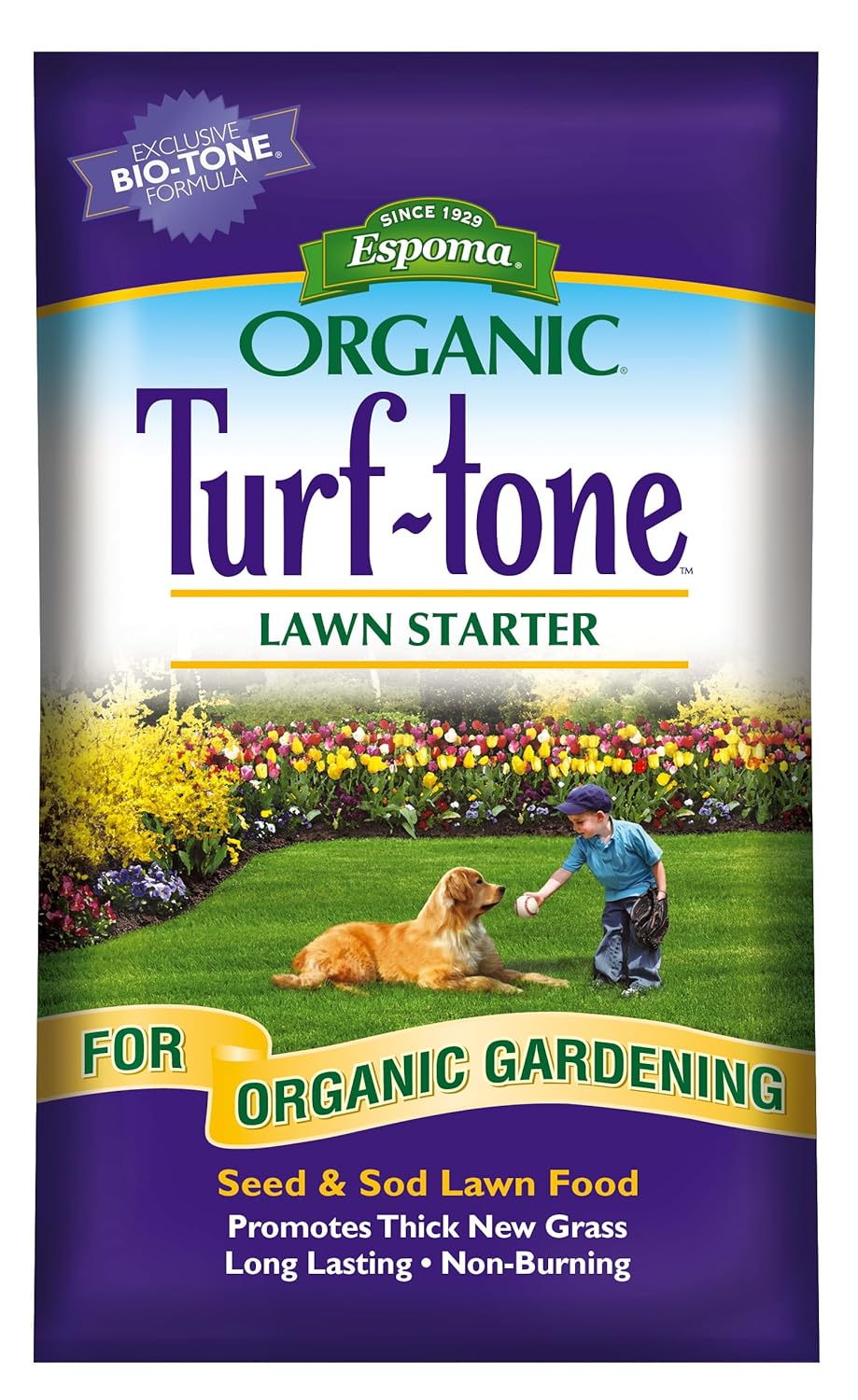
Espoma Turf-Tone Lawn Starter Organic 4-6-3 Fertilizer, 30 lb
| Item Form | Granules |
|---|---|
| Application Method | Apply with a drop or broadcast spreader. |
| Target Species | Lawn Grass |
| Mixing Ratio | 4:6:3 |
Espoma Turf-Tone Lawn Starter is an organic granular starter fertilizer designed for establishing new turf, overseeding, or laying sod. It is applied with a drop or broadcast spreader and supplies a 4-6-3 ratio that emphasizes phosphorus for root development while providing long-lasting nitrogen and Espoma's Bio-tone formula to support early growth. Practical benefits include organic nutrient sources such as feather meal and poultry manure, predictable coverage for moderate-sized yards, and simple application instructions tailored to new turf situations. For reliability-minded buyers this product reduces the risk of starter burn that can come from high-soluble synthetic starters and supports steady root establishment. Limitations are that it is a starter formula intended for new or recently seeded turf rather than routine maintenance feeding, and application timing and rates matter to avoid wasting product. Expect good early root development on warm-season grasses when used as directed, but plan a separate maintenance program for long-term fertility needs.
Best for: Homeowners installing new turf, overseeding thin areas, or laying sod who prioritize dependable, gentler organic nutrition that supports early root development.
Less Ideal for: People looking for an all-season maintenance fertilizer or quick greening treatments for established lawns should choose a regular maintenance formula instead.
- Organic ingredients (feather meal and poultry manure) that feed soil biology
- Starter-specific 4-6-3 analysis to promote root establishment and early growth
- Applied with standard drop or broadcast spreaders for even coverage
- Formulated to reduce risk of seedling burn compared with high-salt synthetic starters
- Designed for new lawns and overseeding rather than ongoing maintenance feeding
Verdict: A reliable organic starter fertilizer that helps new or overseeded lawns establish strong roots without the harshness of high-salt synthetic starters.
Scotts Turf Builder Starter Food for New Grass, 15 lb

| Item Form | Powder |
|---|---|
| Application Method | spreader |
| Specific Uses For Product | Starting |
| Coverage | 5000 square feet |
| Mixing Ratio | 24-25-4 |
Scotts Turf Builder Starter Food for New Grass is a powder starter fertilizer with a 24-25-4 NPK formulated specifically for new lawns. It is applied with a broadcast or drop spreader at planting and again 2 to 4 weeks later to encourage root development and faster, thicker turf. The high phosphate content is intended to fuel early root growth, which helps seedlings and newly laid sod establish more reliably than seed alone. Practical benefits include clear application guidance for Scotts spreaders, coverage of roughly 5,000 square feet per 15 lb bag, and compatibility with all grass types. Users should plan two timed applications and maintain consistent watering until seedlings are 2 inches tall, so it works best for owners willing to follow a short feeding schedule. Limitations are that it is a starter-only formula meant for initial establishment rather than ongoing maintenance and that proper spreader settings and watering are important for results, otherwise performance will be diminished.
Best for: Homeowners starting a lawn or reseeding patches who want a proven, easy-to-follow starter fertilizer to improve root establishment and germination success.
Less Ideal for: Gardeners looking for a year-round fertilizer or a combined weed-and-feed product should consider maintenance blends or targeted weed control options instead.
- High phosphate 24-25-4 formula designed to promote early root development
- Covers up to 5,000 sq. ft. per 15 lb bag, suitable for modest lawns
- Clear instructions for spreader settings and a recommended two-application schedule
- Safe for use on any grass type and applicable to seed, sod, plugs, or sprigs
- Starter-only formula so you must switch to a maintenance fertilizer after establishment
- Requires careful spreading and consistent watering to realize the claimed results
Verdict: Use this starter fertilizer if you want a straightforward, phosphate-rich feed to help new seed or sod establish stronger roots and fill in faster.
The Andersons Premium New Lawn Starter Fertilizer (20-27-5), 18 lb

| Item Form | Granules |
|---|---|
| Specific Uses For Product | Lawn |
| Coverage | 5000 |
| Mixing Ratio | 20:27:5 |
This starter fertilizer is made specifically for establishing new lawns and is formulated to encourage seedling vigor and root development. You apply it before seeding or laying sod, working it into the top few inches of soil and keeping the area moist until germination. The 20-27-5 analysis means it supplies extra phosphorus for strong root growth while the blend of quick- and slow-release nitrogen gives an initial boost and continued feeding. It also includes micronutrients and a small amount of iron for improved greening. The granular form and 5,000 sq ft coverage make it practical for mid-sized yards, and directions note it is best used in spring or fall when conditions favor establishment. Important limitations are that it must be incorporated into soil and kept moist for best results and that it is a starter product rather than a routine maintenance fertilizer, so additional feedings will be needed later in the season.
Best for: Homeowners installing new sod or seed who want a purpose-built starter fertilizer to encourage fast germination and strong root establishment.
Less Ideal for: Those looking for an all-season maintenance fertilizer or a liquid feed system should consider other products tailored to ongoing lawn care or different application methods.
- High phosphorus ratio to promote root development in new lawns
- Combination of quick- and slow-release nitrogen for both immediate and sustained feeding
- Granular form with coverage up to 5,000 sq ft simplifies application for mid-sized yards
- Includes micronutrients and 1% iron for healthier, deeper greening
- Designed as a starter product so it does not replace regular maintenance fertilization
Verdict: Choose this starter fertilizer when you need a phosphorus-rich, granular product to jump-start root development and establishment in new lawns.
Choosing the Right Fertilizer for Growing New Grass: Key Factors to Consider
Starter Nutrient Ratio
New grass benefits from a fertilizer formulation that prioritizes phosphorus and nitrogen in a starter-friendly ratio to promote root development and early leaf growth. While modern regulations and soil testing may limit phosphorus use in some areas, a product that supplies accessible phosphorus or alternative root-stimulating nutrients can help seedlings establish quickly.
Choosing the right ratio matters because too much nitrogen drives top growth at the expense of roots, while too little phosphorus (or its substitute) can leave young plants with shallow, fragile roots. Consider the nutrient needs specific to your seed type and perform a soil test to adjust your choice accordingly.
Release Profile and Solubility
The release profile determines how quickly nutrients become available. Fast-release fertilizers provide an immediate nutrient boost that aids germination, but they can also raise burn risk and require repeated applications. Controlled-release or slow-release formulas smooth feeding over several weeks, reducing the need for repeat applications and lowering salt stress on seedlings.
For newly seeded areas, many gardeners choose a blend approach: an initial quick-release component to assist germination followed by a slow-release fraction to maintain steady growth. Understanding the solubility and expected feeding window helps you plan follow-up feeding and irrigation.
Application Method and Coverage
How a fertilizer gets onto the soil matters for coverage and seedling safety. Granular broadcast spreaders provide even distribution on larger areas, while drop spreaders, handheld spreaders, or starter spreader settings can improve accuracy for small lawns or narrow strips. Liquid starters applied with a hose-end sprayer or backpack sprayer give uniform coverage but require mixing accuracy.
Application method affects how close nutrients contact tiny seeds and roots. Overlapping spreads or concentrated drifts can burn young grass, so choose a product and tool that match the size of the job and your comfort level with calibration.
Salt Index and Seedling Burn Risk
Salt index measures the osmotic strength of a fertilizer; high-salt products increase the chance of drawing moisture away from seeds and tender roots, causing burn or reduced germination. Lower-salt formulas or those designed specifically for new turf are gentler and reduce transplant or seeding stress.
When establishing new grass, err on the side of lower salt index and follow recommended rates and irrigation practices. If your soil is already dry or marginal, water in gently after application to move nutrients into the root zone without displacing seed.
Compatibility With Soil Type and pH
Soil texture and pH influence nutrient availability and how fertilizer behaves after application. Sandy soils drain quickly and may require more frequent feeding or slow-release formulations to avoid leaching. Clay soils hold nutrients but can bind certain elements, making starter phosphorus less available; in that case, an organic amendment or chelated forms can help.
Testing soil pH and basic nutrient levels before fertilizing helps you choose a product that will perform as intended and avoid overapplication. Adjusting pH or adding organic matter may be necessary to get the best result when starting new turf.
Environmental Considerations
Fertilizer choices affect nearby plants, waterways, and long-term soil health. Products that minimize soluble phosphorus runoff, have low leaching potential, or include slow-release nitrogen reduce environmental risk. Look for clear labeling on application rates and runoff precautions if you have slopes, hard surfaces, or water features nearby.
Responsible application timing, buffer strips, and avoiding overwatering after application are practical steps gardeners can take to limit nutrient loss while still getting the benefits needed for new grass establishment.
Timing Fertilizer With Seeding and Sodding
Timing determines whether the fertilizer supports germination or primarily nourishes young grass. For seed, apply a starter fertilizer at seeding time either mixed into the topsoil lightly or applied as a topdress and watered in so nutrients reach the seed zone. For sod, apply a starter that promotes root rooting immediately before or right after laying, following product guidance for post-install watering.
Avoid applying high-rate granular products too early or too heavily, since concentrated nutrients can scorch new roots. If weather forecasts call for heavy rain, postpone application until you can control runoff and watering.
- Apply starter fertilizer at or within a few days of seeding for best root support.
- For sod, follow product guidance for pre- or post-install application and water to settle roots.
How Soil Preparation Affects Fertilizer Choice
Proper soil preparation reduces the amount of starter fertilizer needed and improves establishment. Raking, loosening compacted soil, and adding a thin layer of topsoil or compost create a hospitable seedbed that retains moisture and nutrients without concentrating them around delicate roots.
If your soil test shows deficiencies, pick a fertilizer that fills those gaps rather than applying a generic high-rate starter. Amending the soil with organic matter can also moderate nutrient release and reduce burn risk.
- Loosen compacted areas before seeding to enable roots to penetrate.
- Use soil test results to guide whether a phosphorus-containing starter is necessary.
Watering Strategy After Fertilizer Application
Watering is as important as the fertilizer itself. After applying a starter, shallow and frequent irrigation helps keep seed moist and moves nutrients into the germination zone. Once seedlings are established, transition to deeper, less frequent watering to encourage root depth.
Avoid heavy single soakings immediately after applying high-salt products. Instead, use light waterings to prevent runoff and to reduce osmotic stress on seeds.
- Keep the topsoil consistently moist until seedlings reach mowing height.
- Gradually reduce frequency and increase duration of waterings as roots deepen.
Organic Vs Synthetic Starters
Organic starter fertilizers release nutrients more slowly and add organic matter, which benefits soil structure and microbial life. They are gentler on seedlings and lower in soluble salts, but they often act slower and may not provide the rapid nutrient flush that some seed mixes need for quick green-up.
Synthetic starters supply plant-available nutrients immediately and can be formulated for precise starter ratios. They are effective for fast germination but require careful rate control to avoid burning. Many gardeners use a combined approach: a light synthetic starter for early growth followed by an organic topdress to sustain soil health.
- Consider organic starters for improving soil long term and reducing burn risk.
- Use synthetic starters when quick establishment and predictable nutrient levels are priorities.
Adjusting for Seed Type and Climate
Cool-season and warm-season grasses have different nutrient timing and starter needs. Cool-season species often benefit from early-season feeding to build roots before summer, while warm-season grasses may require starter timing aligned with active growth in late spring or early summer.
Local climate and length of the germination window affect choices as well. In hot, dry areas choose lower-salt products and plan watering to reduce heat stress; in cooler regions a fast-release starter can take advantage of moist, moderate conditions for rapid germination.
- Match starter timing to the growth cycle of your grass species.
- Plan for local weather and irrigation constraints when selecting a product.
How We Chose the Best Fertilizer for Growing New Grass
We evaluated fertilizers that are appropriate for establishing new grass with criteria that reflect real-world lawn starts. Key dimensions included nutrient formulation, focusing on starter ratios and the presence of phosphorus or phosphorus alternatives for root growth; solubility and release profile, distinguishing fast-release formulas for germination from controlled-release options that feed over weeks; safety and burn risk at recommended seeding and sod rates; application method compatibility with common tools like spreaders and sprayers; and ease of use, including clear labeling and mixing instructions for gardeners new to lawn establishment. We also considered environmental impact indicators such as measured salt index and whether the product is suitable for use near waterways or in tight urban yards. Products were excluded if they were labeled only for established lawns, required specialty equipment most homeowners do not have, or lacked clear guidance for seeding or sodding rates. The final list focuses on options that balance quick seed-start nutrition with manageable application and low seedling stress.
FAQ
When should I apply fertilizer relative to sowing seed?
Apply a starter fertilizer at the time of seeding or within a few days after. Light incorporation or watering in places nutrients in the seed zone. Avoid heavy pre-seeding applications that concentrate salts near the seed.
Do all new lawns need phosphorus in the starter?
Not always. Soil tests often show sufficient phosphorus, and some regions restrict phosphorus use. If your test shows low phosphorus or your seed has poor root vigor, a starter with phosphorus or a root-stimulating alternative can be helpful.
Can I use a regular lawn fertilizer on newly seeded areas?
Regular maintenance fertilizers are often higher in nitrogen and formulated for established turf, which can overstimulate shoots or increase burn risk on seedlings. Choose a product labeled for new turf or use reduced rates and water carefully if you use a general fertilizer.
How soon can I mow after applying starter fertilizer?
Mow when seedlings reach the recommended height for your grass type, usually after several weeks. Mowing timing depends more on plant height than fertilizer timing. Avoid heavy mowing during the first few cuts so roots can continue developing.
Will a slow-release starter delay germination?
Slow-release components do not delay seed germination, but they may not supply the immediate soluble nutrients that speed visible green-up. Blends that include a small fast-release fraction alongside slow-release carriers give immediate feed while maintaining longer-term nutrition.
How do I avoid runoff or nutrient loss after application?
Avoid applying before heavy rain, use buffer strips near drains or water features, and irrigate lightly after application to move nutrients into the soil without causing runoff. Choosing slow-release formulas reduces the risk of leaching in sandy soils.
Final Verdict
Start by matching fertilizer choice and timing to your seeding method, soil test results, and local climate. Prioritize starter nutrient balance and a release profile that supports early root growth while keeping salt levels low enough to protect seedlings. Application accuracy and proper watering are equally important to translate fertilizer into healthy roots rather than superficial top growth. Focus on the tradeoffs that matter to your site: quick green-up versus long-term feed, synthetic precision versus organic soil benefits, and coverage method that fits the lawn size. Use the evaluation criteria above to pick the option that fits your soil and schedule, and apply conservatively with appropriate watering to set new grass up for strong establishment.
