

Note: This article contains affiliate links. If you click on these links and make a purchase, I may earn a small commission at no extra cost to you. This helps support my research and content. Read my full affiliate disclosure here.
If you grow lemon trees in a yard, patio container, or greenhouse, the right fertilizer makes a big difference in bloom set, fruit size, and overall tree vigor. Lemon trees need predictable levels of nitrogen, accessible micronutrients, and timing that matches spring growth and fruit development. This guide covers seven top fertilizer options for lemons chosen for their nutrient profiles, release characteristics, and gardener-friendly application. Below we outline what mattered in our shortlist and how each product handles feeding rhythm, micronutrient support, and suitability for containers or in-ground trees.
Top Picks at a Glance
| Best Overall The best all-around choice for most situations | Farmer's Secret Citrus Tree Booster Liquid Fertilizer (8 oz) |  |
| Best Quality Built to a higher standard if you want something more solid | Espoma Citrus-Tone Organic 5-2-6 Fertilizer for Citrus, Avocado & Fruit Trees, 4 lb |  |
| Best Value The sweet spot between price and what you get | Jobe's Organics Granular Fruit & Citrus Fertilizer, 4 lb |  |
| Best Budget The cheapest option that still gets the job done reliably | GrowThrive Lemon Tree Liquid Fertilizer (10 oz) |  |
| Highest Rated A top-rated pick with lots of positive feedback | Leaves & Soul Lemon Tree Liquid Fertilizer, 6-4-6, 8 oz |  |
| Most Popular A crowd favorite that many people choose with confidence | TPS Nutrients Lemon Tree Fertilizer, Liquid Plant Food, 8 fl oz |  |
| Best Seller A high-volume bestseller chosen again and again | Miracle-Gro Shake 'N Feed Citrus, Avocado & Mango Plant Food (4.5 lb) |  |
Farmer's Secret Citrus Tree Booster Liquid Fertilizer (8 oz)

| Item Form | Liquid |
|---|---|
| Specific Uses For Product | Tree Growth |
| Target Species | Citrus Trees (Lemons, Limes, Oranges) |
| Unit Count | 8 Fluid Ounces |
| Mixing Ratio | 1:128 (1 teaspoon per gallon) |
Farmer's Secret Citrus Tree Booster is a concentrated liquid feed made specifically for lemons, limes, oranges and other citrus, and it is meant to be diluted and applied weekly along the drip line or as a foliar spray. The formula is highly concentrated so one 8 fl oz bottle produces many gallons of ready‑to‑use solution using the recommended 1 teaspoon per gallon mixing ratio. Directions cover young, mature and container trees with reduced frequency or dosage for indoor use. Practical benefits include easy measuring, flexibility to use in soil or foliar applications, and a small bottle that is simple to store. Because it is a targeted citrus formulation developed by agronomists, it can help support growth and fruiting when used as part of a regular feeding schedule. Limitations are that nutrient analysis numbers are not listed on the product page so you cannot compare exact N‑P‑K ratios, and concentrated liquids require careful dilution and safe handling to avoid skin or eye contact.
Best for: A gardener who wants a simple, professional citrus feed to use weekly on backyard lemon trees and container citrus, and who values concentrated products that minimize storage and frequent repurchasing.
Less Ideal for: Growers who need exact nutrient analysis for precision fertilizing or organic-only gardeners seeking certified organic inputs should look at alternative products.
- Very concentrated formula stretches a small bottle into many gallons of feed
- Formulated specifically for citrus trees and suitable for soil or foliar application
- Clear dosing guidance for young, mature and container trees makes routine feeding simple
- Made in the USA and developed with agronomist input
- No explicit N‑P‑K or micronutrient breakdown provided on the product details
- Requires careful dilution and safety precautions due to concentrated liquid form
Verdict: If you want an easy, concentrated weekly feed tailored to lemons and other citrus, this small bottle delivers many gallons of ready‑to‑use fertilizer.
Espoma Citrus-Tone Organic 5-2-6 Fertilizer for Citrus, Avocado & Fruit Trees, 4 lb

| Item Form | Granules |
|---|---|
| Specific Uses For Product | Gardening, Organic, Plant Food |
| Coverage | Medium |
| Target Species | Citrus, avocado, fruit and nut trees |
| Unit Count | 64 Ounce |
Espoma Citrus-Tone is a ready-to-use granular organic fertilizer designed specifically for citrus, avocado and other fruit and nut trees. You apply it to the soil around the drip line and water in; recommended timings are late winter pre-bloom, spring post-bloom and in fall. The 5-2-6 analysis with 5% calcium and Bio-tone microbial formula aims to support flowering, fruit set and overall tree vigor while supplying calcium to reduce blossom-end disorders. As an organic input it contains natural ingredients rather than synthetic salts, which suits long-term soil health and gardens managed organically. Because it is granular and medium coverage, it is easy to broadcast by hand around individual trees but may require multiple applications for larger orchards. It does not need mixing, but specific application rates are not provided on the available listing so you should follow label directions included with the package for correct dosing. For growers seeking steady, organic nutrition tailored to citrus, this product provides a practical, low-maintenance option.
Best for: Buyers who want an organic, citrus-focused fertilizer that supports flowering and fruit production with minimal fuss and regular seasonal applications.
Less Ideal for: Those managing large commercial orchards who need concentrated, fast-release synthetic fertilizers or liquid feeds for rapid correction or for whom precise per-acre dosing information is essential.
- Formulated specifically for citrus, avocado and fruit/nut trees
- Organic granular formula supports long-term soil health and is certified for organic gardening
- Includes 5% calcium to help reduce blossom-end problems and support fruit quality
- Ready to use with no mixing required and clear seasonal timing recommendations
- Application rates are not listed in the provided product details which may require consulting the package label for exact dosing
Verdict: If you want an easy, organic fertilizer tuned for lemons and other citrus that supports fruiting and soil health, this is a solid, low-maintenance choice.
Jobe's Organics Granular Fruit & Citrus Fertilizer, 4 lb

| NPK | 3-5-5 |
|---|---|
| Item Form | Granules |
| Unit Count | 64 Ounce |
| OMRI Listed | Yes |
Jobe's Organics Granular Fruit & Citrus Fertilizer is a slow-release granular formula designed specifically for fruit and citrus trees and plants. You apply measured amounts around the base of trees, water in, and repeat every 4–8 weeks during the growing season. The 3-5-5 NPK mix emphasizes phosphorus and potassium to support bloom set and fruit development while providing moderate nitrogen for foliage. Ingredients like feather meal, bone meal and processed poultry manure supply organic nutrients and the product is OMRI listed for organic gardening, making it suitable for edible lemon trees. Practical benefits include ease of application, reduced risk of overfeeding compared with soluble fertilizers, and a resealable bag for tidy storage. Limitations are that results are gradual because nutrients release slowly and the granular form requires regular reapplication during the season rather than a one-time concentrated feed. Also gardeners who need an immediate foliar boost or precise soluble feeding schedule may prefer a liquid fertilizer instead.
Best for: Home gardeners with lemon trees who value organic inputs and steady, low-maintenance feeding to support blooms and fruiting across the season.
Less Ideal for: Growers needing quick corrective feeding, immediate leaf greening, or precise nutrient control for high-performance or potted citrus should consider soluble or liquid fertilizers instead.
- OMRI listed organic formula suitable for edible fruit and citrus plants
- Balanced 3-5-5 NPK that supports bloom and fruit development
- Slow-release granules reduce risk of overfertilizing and require less frequent dosing
- Made from natural sources such as feather meal and bone meal
- Resealable bag keeps product fresh and minimizes mess
- Slow-release action means benefits appear gradually rather than immediately
- Granular form requires spreading and watering in rather than simple foliar application
Verdict: A dependable organic slow-release granular that makes steady, low-effort feeding for lemon trees simple and safe.
GrowThrive Lemon Tree Liquid Fertilizer (10 oz)

| Item Form | Liquid |
|---|---|
| Specific Uses For Product | Plant Growth, Root Development, Seed Development, Soil Conditioning |
| Application Method | Watering water, Soil, Leaves |
| Mixing Ratio | 1:400 |
| Target Species | Lemon Tree, Lime Tree, Olive Tree, Apple Tree, Mango Tree, Orange, Peach, Avocado Tree, Citrus |
This 10 oz GrowThrive liquid fertilizer is a concentrated, organic-style plant food aimed at citrus and other fruit trees for both indoor and outdoor use. Mixes at 1:400 and can be applied to the soil, roots, or as a foliar spray so you can treat seedlings, potted lemon trees, or established specimens. The formula emphasizes organic micro-nutrients and enzymes designed to improve soil biology, encourage stronger roots, greener foliage, and better fruit set. Practical benefits include a low-risk slow-release profile that reduces seedling burn and simple dilution instructions for routine feeding. It covers a modest volume per bottle, so it is best for small gardens or container-grown citrus rather than large orchards. Users should follow the mixing ratios closely because the concentrate requires careful dilution and the 10 oz size will need frequent repurchasing if used across several plants.
Best for: Budget-focused home gardeners with one or two potted or backyard citrus trees who want an easy-to-mix, organic-style feed to maintain foliage and fruiting.
Less Ideal for: Growers managing multiple full-size orchard trees or large landscapes who need high-volume coverage and a clearly specified NPK fertilizer.
- Concentrated formula with clear 1:400 mixing ratio for flexible application methods
- Organic micro-nutrients and enzymes to support soil biology and reduce over-fertilization risk
- Can be used as foliar spray or soil drench so it fits indoor pots and outdoor plantings
- Small 10 oz bottle covers limited plants so frequent repurchasing is likely for multiple trees
- No NPK breakdown provided on listing so exact nutrient ratios are not clear
Verdict: A concentrated, easy-to-dilute organic-style liquid that keeps one or two lemon trees healthy without complicated feeding schedules.
Leaves & Soul Lemon Tree Liquid Fertilizer, 6-4-6, 8 oz

| Item Form | Liquid |
|---|---|
| Application Method | Watering can, Sprinkler, Drip irrigation |
| Target Species | Citrus |
| Liquid Volume | 8 fluid ounces |
Leaves & Soul Lemon Tree Liquid Fertilizer is a concentrated 6-4-6 NPK plant food designed to be diluted and applied with watering to support lemon tree roots, foliage, flowering, and fruiting. Typical use is simple: shake, mix 2 tablespoons per gallon of water, then apply the diluted solution to the soil every 2–4 weeks (monthly in cooler months). Notable features include a fast-absorbing liquid format for even nutrient delivery, added micronutrients and natural additives for broader support, and compatibility with watering cans, sprinklers, or drip systems. Practical benefits are predictable, measured feeding for container or ground-grown lemon trees and an easy schedule that fits into routine watering. Important limitations are the small 8 oz bottle size for anyone feeding multiple trees or large specimens and the low stated coverage, which means frequent mixing if you have several plants. Also, balanced nutrition helps many deficiencies but will not correct problems caused by pests, poor drainage, or incorrect light.
Best for: Home gardeners who want a straightforward, regular feeding routine for one or a few lemon trees and value a predictable, easy-to-measure liquid fertilizer.
Less Ideal for: Owners of large orchards or multiple mature trees who need bulk coverage or long‑interval feeding should consider larger volume or slow‑release options.
- Balanced 6-4-6 NPK formula tailored for citrus nutrition
- Concentrated liquid mixes with water for quick root-zone absorption
- Includes micronutrients and natural additives for broader plant support
- Works with watering can, sprinkler, or drip irrigation for flexible application
- 8 oz size offers limited coverage for multiple trees or large specimens
- Label indicates low coverage so frequent mixing is needed for several plants
Verdict: A reliable, easy-to-mix 6-4-6 liquid fertilizer that delivers measured citrus nutrition for home lemon trees.
TPS Nutrients Lemon Tree Fertilizer, Liquid Plant Food, 8 fl oz

| Item Form | Liquid |
|---|---|
| Application Method | Watering can, hose end sprayer, or leaf misting |
| Target Species | Lemon Trees |
| Mixing Ratio | 1:200 |
| Unit Count | 8 Fluid Ounces |
This 8 fl oz liquid fertilizer from TPS Nutrients is formulated for lemon and other citrus trees and comes ready to dilute at a 1:200 mixing ratio for straightforward feeding. It is applied via watering can, hose-end sprayer, or foliar misting, so you can use it on both in-ground and container trees. The formula is positioned to promote healthy root growth, stronger shoots and stems, and improved fruit set, which makes it useful through the growing season and when pushing new growth. Because it is a medium-coverage liquid, a single bottle treats multiple feedings for small to medium trees or several potted specimens. Limitations to note are the small 8 oz size, which requires repurchasing for larger plantings, and that the label does not list a full nutrient analysis on the product details provided, so precise N-P-K expectations require trusting the brand guidance. For homeowners with a few lemon trees who prefer a liquid, easily applied feed timed with watering, this product is an easy-to-use option.
Best for: Home gardeners who keep one to a few lemon or dwarf citrus trees and want an easy-to-apply liquid fertilizer for regular feeding and bloom support.
Less Ideal for: Large-scale growers or orchards that need bulk quantities and a clearly stated complete nutrient analysis should consider commercial-size or fully labeled formulations instead.
- Formulated specifically for lemon and citrus trees to support fruiting and vegetative growth
- Multiple application methods: watering can, hose-end sprayer, or foliar misting
- Fast-absorption liquid form for quicker nutrient availability
- Suitable for both in-ground and container lemon trees
- Small 8 fl oz bottle means frequent replacement for larger gardens
- Product details do not include a full N-P-K breakdown in the provided information
Verdict: A convenient, citrus-targeted liquid feed that makes regular nutrient boosts for home lemon trees quick and simple.
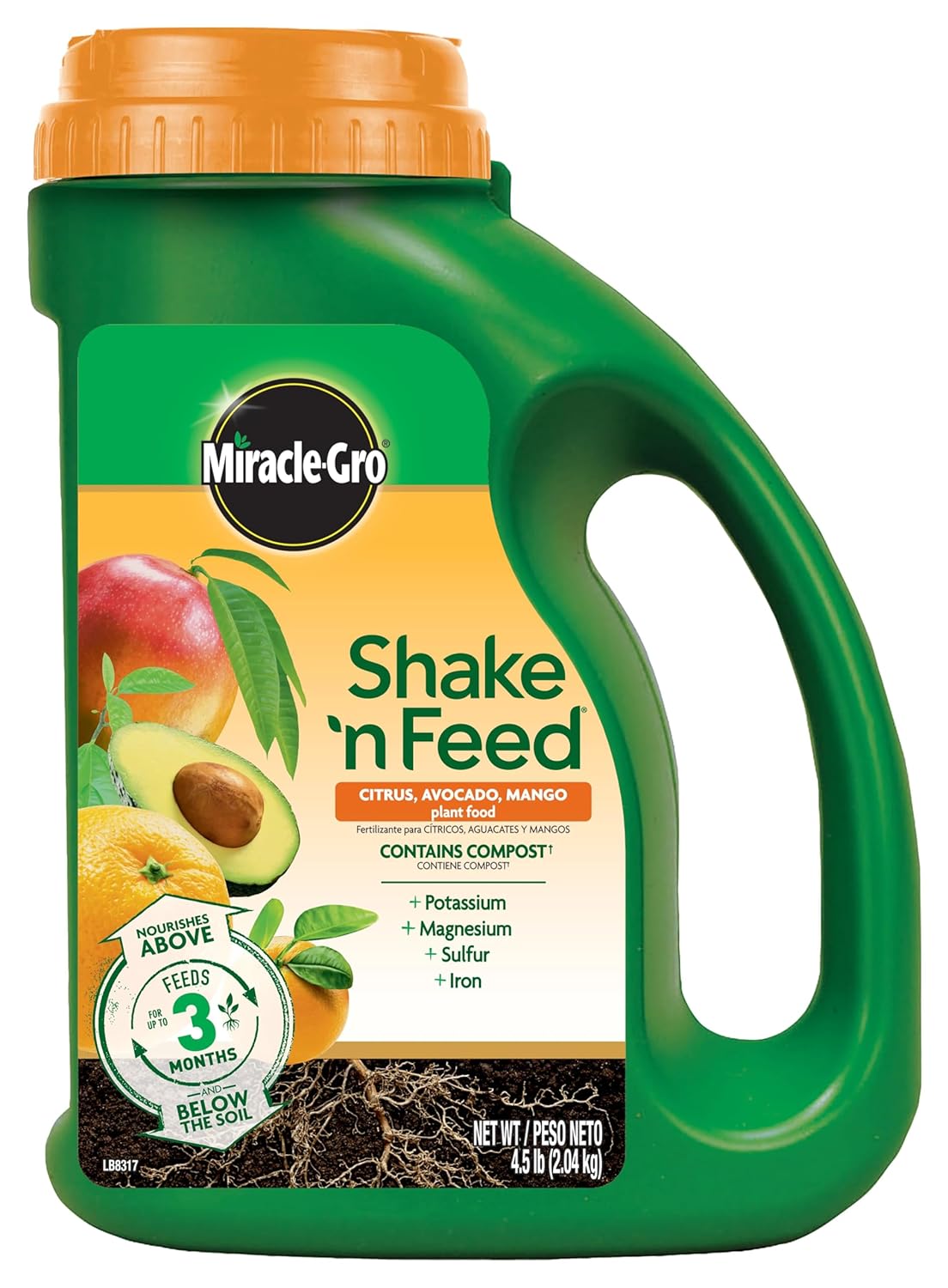
Miracle-Gro Shake 'N Feed Citrus, Avocado & Mango Plant Food (4.5 lb)
| Item Form | Granules |
|---|---|
| Application Method | Shake evenly onto soil |
| Target Species | citrus, avocado, mango |
| Mixing Ratio | 8-2-10 |
This granular Shake 'N Feed formula is made to nourish citrus, avocado, and mango trees in containers or in the ground. You apply it by shaking or sprinkling evenly onto the soil within the tree's drip line, lightly working the granules into the top inch or two of soil and watering to activate feeding. The 8-2-10 NPK mix plus added micronutrients such as potassium, magnesium, sulfur, and iron targets common deficiencies in fruit trees and the manufacturer states it feeds for up to three months through slow-release and microbe-assisted nutrient breakdown. For a risk-averse gardener this product is straightforward to use, requires infrequent reapplication, and is easy to dose at planting or for established trees. Limitations to consider are that it is a general-purpose citrus formula rather than a specialty lemon-specific feed and granular application requires care to avoid trunk contact and to ensure even coverage. It also does not replace a soil test if your tree has a specific deficiency that needs targeted correction.
Best for: Home gardeners who want a low-maintenance, easy-to-apply fertilizer for citrus and other tropical fruit trees and prefer predictable, infrequent feeding.
Less Ideal for: Growers seeking a fertilizer tailored specifically to lemon tree chemistry or those who need to correct a single identified soil deficiency should look at more specialized or test-guided options.
- Slow-release granules feed up to three months, reducing application frequency
- Formulated for citrus and similar fruit trees with added micronutrients (K, Mg, S, Fe)
- Simple shake-and-water application works for both in-ground and container trees
- Not formulated specifically for lemons so may be less precise than lemon-tailored feeds
- Requires even spreading and avoidance of trunk or foliage contact when applying
Verdict: A simple, slow-release granular feed that keeps citrus and similar fruit trees fed for months with minimal fuss.
Choosing the Right Fertilizer for Lemons: Key Factors to Consider
Nutrient Ratio and Timing
Lemon trees rely on a steady supply of nitrogen for leafy growth and a measured balance of phosphorus and potassium to support flowering and fruit development. Look for fertilizers with a slightly higher nitrogen component early in the growing season and formulas that allow for increased potassium during fruit set. The timing of feedings matters: a fertilizer's label should explain when to apply for bloom, fruit set, and post-harvest maintenance.
A product that provides clear guidance on seasonal adjustments reduces the risk of overfeeding or nutrient imbalances that can lead to leaf burn or poor fruiting.
Micronutrients and Chlorosis Prevention
Citrus commonly shows deficiencies in iron, manganese, zinc, and magnesium, especially in alkaline soils or when grown in containers. Fertilizers that include chelated forms of iron and other trace elements help prevent yellowing between leaf veins and support steady photosynthesis. For potted lemons, micronutrient availability is especially important because potting mixes can bind some elements.
Choosing a fertilizer with documented micronutrient content or the option to supplement foliar feeds helps you address early deficiency signs without abrupt changes to the soil chemistry.
Release Mechanism and Feeding Frequency
Fertilizers come in quick-release forms that feed immediately and slow-release or controlled-release forms that feed over weeks or months. Quick-release water-soluble fertilizers are useful for correcting deficiencies fast or for foliar feeding, while slow-release granules reduce the chance of rapid nutrient spikes and decrease the number of applications. Slow-release is often preferable for established trees and for gardeners who want set-and-forget convenience, whereas newly planted or stressed trees may benefit from targeted soluble feeding.
Consider how often you want to apply fertilizer and whether you need immediate correction versus long-term steady nutrition when choosing the release type.
Soil Type and pH Interaction
Soil pH affects nutrient availability for lemons. In alkaline soils certain micronutrients, particularly iron, become less available even if present in the mix. Choose fertilizers and supplemental treatments that account for your soil pH. Acidifying fertilizers or amendments can improve uptake where pH is high, while neutral to slightly acidic formulations work well in typical potting mixes.
Testing soil or potting medium pH before selecting a long-term feeding plan prevents misdiagnosis of nutrient problems and helps you pick a fertilizer that will actually deliver usable nutrients.
Container Versus In-ground Needs
Container-grown lemons have different feeding patterns than in-ground trees because pots restrict root volume and can accumulate salts. Container fertilizers should be lower-risk for salt buildup and offer soluble or slow-release options designed for pots. In-ground lemons benefit from deeper root access and usually tolerate broader product choices, but they still need consideration for leaching and feeding cadence.
Pay attention to application rates for containers versus landscape plantings and choose products with clear container-specific instructions to avoid root burn.
Application Method and Practicality
How you apply fertilizer matters for uptake and convenience. Granules require light incorporation into topsoil and watering to activate; spikes or stakes give steady release but may not distribute nutrients evenly in large root zones. Liquid concentrates and water-soluble powders provide quick results and precise control for foliar spray or soil drench applications. Consider the tools you already use and the time you can commit to feeding when selecting a product.
A practical, easy-to-follow application regimen reduces mistakes and improves consistency in tree performance over multiple seasons.
Feeding Schedule by Tree Age
Young lemon trees need more frequent, lighter feedings to support root establishment and steady foliage growth. For the first year or two, plan on a higher-frequency schedule with milder concentrations to avoid root shock.
Mature trees benefit from a seasonally adjusted program: heavier feeding in early spring, maintenance applications through summer, and a reduced or halted program in late fall and winter. Adjust timing based on bloom and fruit set in your local climate.
- Seedlings and newly planted trees: small, frequent feeds
- Established trees: seasonal boost in spring, maintenance midseason
- Reduce feeding during dormancy or slow growth periods
How to Spot Nutrient Deficiencies
Yellowing between the veins often indicates iron or manganese deficiency. Overall pale foliage with stunted growth points to nitrogen shortage. Brown leaf edges can suggest potassium deficiency or salt stress.
When you spot symptoms, verify soil moisture and pH before changing fertilizer. Sometimes watering practices or root problems mimic nutrient issues; a soil test helps pinpoint the correct corrective action.
- Interveinal chlorosis: likely iron or manganese
- General pale leaves and poor growth: check nitrogen
- Leaf scorch or brown margins: consider potassium or salt buildup
Balancing Fertilizer with Mulch and Watering
Mulch conserves moisture and moderates soil temperature, both important for steady nutrient uptake. Keep mulch a few inches away from the trunk to avoid collar rot, but maintain a 2 to 4 inch layer further out to protect feeder roots.
Irrigation pattern affects fertilizer performance. Regular, deep waterings encourage roots to explore and access distributed nutrients, while irregular watering can concentrate salts and limit uptake. Match fertilizer type and schedule to your watering routine.
- Use mulch to stabilize soil moisture and temperature
- Avoid piling mulch against the trunk
- Water deeply and consistently to move nutrients to root zones
Organic Versus Synthetic Options
Organic fertilizers release nutrients as soil biology breaks down material; they improve soil structure and feed microbial life but release nutrients more slowly and less predictably. Synthetic fertilizers offer precise nutrient ratios and faster availability, which is useful when correcting specific deficiencies quickly.
Many gardeners combine both approaches: organic amendments for long-term soil health and targeted synthetic feeds when trees need a quick correction. Consider your goals for soil health, frequency of maintenance, and the speed of results you expect.
- Organic feeds support soil biology and structure
- Synthetic feeds provide quick, predictable nutrient delivery
- Combined approaches balance long-term health with short-term needs
Safety and Environmental Considerations
Avoid overapplication which can lead to nutrient runoff and salt buildup in soil. Follow label rates carefully and adjust based on tree response and local conditions. For container trees, flush pots occasionally to prevent salt accumulation.
Choose products with minimal water-soluble salt concentration when concerned about nearby waterways or when planting near sensitive vegetation. Proper storage and handling reduce accidental spills and preserve product integrity.
- Follow label rates to prevent runoff and salt issues
- Flush container soil periodically to remove excess salts
- Store fertilizers dry and sealed away from children and pets
How We Chose the Best Fertilizer for Lemons
We selected fertilizers that match the specific nutritional needs and seasonal demands of lemon trees. Evaluation focused on nutrient ratio and balance, the presence and bioavailability of key micronutrients like iron and magnesium, and release mechanism so feeding matches bloom and fruit set. We examined application flexibility for both in-ground and container lemon trees, including granules, spikes, water-soluble formulas, and slow-release coatings. Ease of use and clarity of application rates were considered so home gardeners can follow feeding schedules without guesswork. Safety and soil health impact were reviewed, prioritizing products with minimal salt buildup and options compatible with common soil mixes. We excluded general-purpose lawn products and mixes lacking complete N-P-K or missing crucial micronutrients. The final list highlights fertilizers that perform well across those measurable criteria and suit common lemon-growing situations.
FAQ
How often should I fertilize a lemon tree?
It depends on tree age and fertilizer type. Young trees often need small, frequent feedings, while established trees do well with seasonal boosts in spring and maintenance through summer. Slow-release products reduce application frequency.
What N-P-K ratio is best for lemons?
A slightly higher nitrogen ratio early in the season supports leafy growth, while balanced phosphorus and potassium help bloom and fruit development. Look for products labeled for citrus or those with clear seasonal application guidance.
Can I use organic fertilizer on lemon trees?
Yes. Organic fertilizers improve soil structure and feed beneficial microbes, but they release nutrients more slowly. Combining organic amendments with targeted soluble feeding can give both soil health and timely nutrient corrections.
How do I correct iron chlorosis in citrus?
First check soil pH and confirm the deficiency. Iron chelates applied to the soil or as a foliar spray are commonly used to correct interveinal chlorosis. Adjusting soil pH can also improve iron availability over time.
Do container lemon trees need different fertilizer than in-ground trees?
Yes. Pots restrict root volume and can accumulate salts, so container fertilizers should be lower risk for buildup and have container-specific dosing. More frequent, lighter feedings are often safer for potted trees.
Final Verdict
Choosing the right fertilizer for lemons means balancing nutrient ratio, micronutrient availability, and release pattern with your tree's age and planting situation. Prioritize products that supply key trace elements and match your preferred application rhythm. For container trees, reduce salt risk with formulations designed for pots or by flushing soil periodically. Overall, focus on predictable feeding and monitoring tree response rather than chasing one-size-fits-all solutions to keep lemon trees productive and healthy.
