

Note: This article contains affiliate links. If you click on these links and make a purchase, I may earn a small commission at no extra cost to you. This helps support my research and content. Read my full affiliate disclosure here.
Pampas grass responds predictably to the right feeding plan. The right fertilizer affects plume size, foliage density, winter hardiness, and how quickly a planting fills a border or screen. This guide shortlists top options suited to pampas grass growing situations and evaluates them for nutrient balance, application method, and seasonality. You will get concise notes on why each product made the list and straightforward guidance on matching a fertilizer to your soil, climate, and maintenance style. Read on for a practical evaluation and easy next steps to feed pampas grass effectively.
Top Picks at a Glance
| Best Overall The best all-around choice for most situations | Foliage-Pro Liquid Plant Food 9-3-6 (32 fl oz) |  |
| Best Quality Built to a higher standard if you want something more solid | The Andersons Professional PGF Complete 16-4-8 Fertilizer with Humic (40 lb) |  |
| Best Value The sweet spot between price and what you get | Milorganite Slow-Release Organic Fertilizer, 5 lb |  |
| Highest Rated A top-rated pick with lots of positive feedback | Miracle-Gro Water Soluble All Purpose Plant Food, 1.5 lb |  |
| Most Popular A crowd favorite that many people choose with confidence | Miracle-Gro Water Soluble All Purpose Plant Food, 3 lb |  |
| Best Seller A high-volume bestseller chosen again and again | Nelson NutriStar Palm Plant Food, 2 lb. |  |
Foliage-Pro Liquid Plant Food 9-3-6 (32 fl oz)

| Brand | Foliage-Pro |
|---|---|
| Model Number | 9-3-6 |
| Item Form | Liquid |
| Target Species | foliage plants |
| Mixing Ratio | 1 gallon : 1/4 – 1/2 tsp |
Foliage-Pro 9-3-6 is a concentrated liquid fertilizer designed for foliage-focused houseplants like Alocasia. It mixes at a very low rate (about 1 gallon to 1/4–1/2 teaspoon), so a single 32 fl oz bottle yields many feedings and is easy to dose for frequent watering schedules. The NPK formula favors nitrogen to support lush leaf growth while offering potassium for overall plant vigor and modest phosphorus. In practice it is applied as a regular feed during the growing season and can be used diluted at each watering or as a periodic supplement. The liquid form dissolves completely, avoiding gritty residue in pots or emitters. Buyers should note this is a general foliage fertilizer rather than an Alocasia-specific formulation, so results depend on correct dilution and consistent feeding; overuse of any concentrated feed can cause salt buildup if not flushed occasionally. For users seeking simple, reliable nourishment for leafy tropicals, this delivers predictable, easy-to-control nutrition.
Best for: Buyers who prioritize reliable, easy-to-dose nutrition for tropical foliage plants and want a concentrated product that stretches over many feedings.
Less Ideal for: Growers seeking a fertilizer tailored specifically to address Alocasia nutrient deficiencies or those who want a slow-release granular option for low-maintenance feeding.
- Concentrated liquid mixes at very low rates for economical, frequent feeding
- NPK 9-3-6 favors foliage growth which suits leaf-focused plants
- Dissolves fully so it does not clog drippers or leave grit in potting mix
- Not formulated specifically for Alocasia so it lacks micronutrient tailoring for that genus
Verdict: A concentrated, easy-to-dose liquid fertilizer that reliably encourages lush foliage growth in leafy tropicals like Alocasia.
The Andersons Professional PGF Complete 16-4-8 Fertilizer with Humic (40 lb)

| N-P-K | 16-4-8 |
|---|---|
| Item Form | Granules |
| Specific Uses For Product | Lawn Care |
| Target Species | lawn grasses |
| Coverage | 40 |
This 40 lb bag of The Andersons Professional PGF Complete is a granular 16-4-8 lawn fertilizer designed to deliver both immediate and extended feeding for turf. It combines quick- and slow-release nitrogen so you get a mid-season green-up plus continued nutrition for up to eight weeks, while iron and micronutrients help deepen color. The super-fine particle size promotes even spread when applied with a broadcast or drop spreader and the included humic DG supports soil biology and nutrient uptake. Typical use is a spring application on established cool-season grasses like fescue, followed by watering to activate the granules. Practical benefits are consistent coverage, longer feeding intervals between applications, and visible color improvement. Important limitations are the strong safety warnings for eye and skin irritation and that the 16-4-8 ratio is a high-nitrogen formula best suited for growth and color rather than slow, low-nitrogen maintenance. It is not formulated for sale in certain states and requires careful handling and correct spreader settings to avoid overapplication.
Best for: Gardeners who prioritize strong, visible spring performance and want a product that delivers both immediate and sustained feeding for established fescue lawns.
Less Ideal for: People managing newly seeded turf, low-nitrogen maintenance programs, or those who prefer organic fertilizers should consider gentler or alternative products.
- Balanced quick- and slow-release nitrogen delivers immediate green-up plus up to eight weeks of feeding
- Includes iron, micronutrients, and humic DG to improve color and nutrient uptake
- Super-fine granules enable more even distribution with a spreader
- Large 40 lb bag covers significant lawn area between applications
- Causes skin, respiratory and serious eye irritation and requires protective handling
- High nitrogen ratio may be too strong for fine maintenance or newly seeded lawns
Verdict: Choose this product when you want a performance-focused spring fertilizer that gives fast green-up plus extended feeding for established fescue.
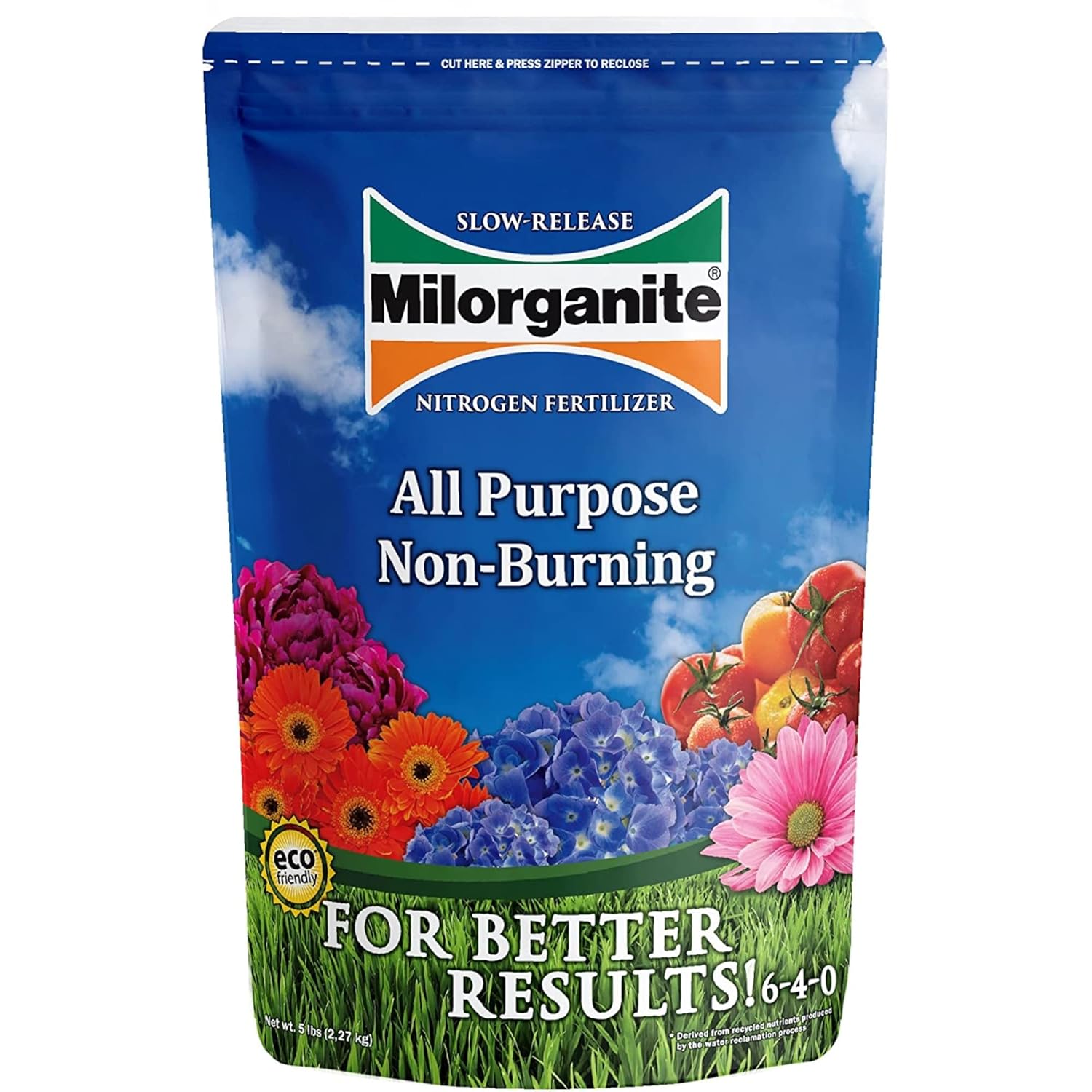
Milorganite Slow-Release Organic Fertilizer, 5 lb
| Item Form | Granules |
|---|---|
| Specific Uses For Product | Lawns, Flowers and Gardens |
| Coverage | 390 Square Feet |
| Ingredients | Nitrogen |
Milorganite is a granular, slow-release organic fertilizer formulated to feed lawns and garden plants for about 8 to 10 weeks per application. It is typically broadcast by hand or with a spreader and does not require immediate watering in, making it easy to fit into routine maintenance. Notable features include a low-salt formula that greatly reduces the risk of burning turf, organically complex iron that greens grass without staining hard surfaces, and about 85% organic matter that helps improve soil structure over time. The product covers roughly 390 square feet from a 5 pound bag and is positioned as safe for use on lawns, shrubs, flowers, trees, and edible gardens. Limitations are that nutrient release is gradual, so it is not a quick fix for severe nitrogen deficiency, and the bag has an earthy odor at first that some pets may find attractive until it dissipates or is watered in. For someone managing Empire Zoysia, use on the recommended schedule and expect steady, low-risk green-up rather than instant color change.
Best for: Gardeners who prioritize steady, low-risk nutrient delivery and soil health and who prefer a hands-off feeding schedule for fine-textured lawns like Empire Zoysia.
Less Ideal for: Homeowners wanting rapid color correction or fast-acting synthetic nitrogen boosts should choose a quick-release fertilizer instead.
- Slow-release nitrogen feeds lawns for 8–10 weeks reducing application frequency
- Low salt formulation minimizes risk of burning sensitive turf like Zoysia
- Provides organically complex iron that greens grass without staining concrete
- High organic matter improves soil structure and water retention over time
- Slow-release action means it will not correct severe yellowing immediately
- Initial earthy odor that may attract some pets until it is watered in or dissipates
Verdict: Choose Milorganite for Empire Zoysia when you want a safe, slow-release organic feed that greens turf steadily without burning or staining.
Miracle-Gro Water Soluble All Purpose Plant Food, 1.5 lb

| Item Form | Powder |
|---|---|
| Application Method | Watering Can |
| Target Species | For all flowers, vegetables, trees, shrubs and houseplants |
| Mixing Ratio | 24-8-16 |
Miracle-Gro Water Soluble All Purpose Plant Food is a powder concentrate you mix with water to give a quick nutrient boost to flowers, vegetables, houseplants, shrubs and trees. It is typically dissolved in a watering can or used with a compatible garden feeder to soak soil at the base of plants, delivering nitrogen-heavy nutrition that shows effects faster than granular fertilizers. Notable features include an easy scooping method for indoor and outdoor dosing, compatibility with containers and in-ground planting, and clear directions for feeding every one to two weeks. In practice this makes the product a convenient option when you want visible growth and greener foliage quickly, and the 1.5 lb container covers roughly 600 sq. ft. Important limitations are that it is a fast-release, high-nitrogen formula best used as a regular quick feed rather than a long-term slow-release solution, and it requires careful measuring to avoid overfeeding. For routine maintenance combine with good watering and follow the label to avoid nutrient imbalance.
Best for: Buyers who prefer proven, easy-to-use feeding routines and want noticeable growth quickly for a variety of garden and houseplants, guided by established usage directions and broad user experience.
Less Ideal for: Gardeners seeking a single, long-term slow-release solution or those who prefer organic or low-nitrogen fertilizers for sensitive plantings should consider alternative products.
- Water-soluble powder starts working quickly at the roots when mixed and applied
- Clear, simple dosing for indoor and outdoor use with included scoop guidance
- Suitable for a wide range of plants including vegetables, flowers, shrubs and houseplants
- Covers a large area from a small container (about 600 sq. ft. per 1.5 lb)
- Fast-release formula means benefits are short-term compared with slow-release granular fertilizers
- Requires precise measuring and regular reapplication to avoid overfeeding
Verdict: A reliable, fast-acting water-soluble plant food for gardeners who want easy, repeatable feeding and quick visible results.
Miracle-Gro Water Soluble All Purpose Plant Food, 3 lb

| Item Form | Powder |
|---|---|
| Application Method | Mix with water in a watering can |
| Fertilizer Analysis (N‑P‑K) | 24-8-16 |
| Unit Count | 48 Ounce |
| Coverage | Feeds approximately 1,200 sq. ft. |
Miracle‑Gro Water Soluble All Purpose Plant Food is a powdered NPK 24‑8‑16 formula that dissolves in water to give plants a quick nutrient boost. You mix measured scoops into a watering can and apply to the soil at the base of plants every 7–14 days for outdoor use or every 14 days for houseplants. Notable features include a high nitrogen content for leafy growth, compatibility with containers and in‑ground beds, and guidance for use with a Miracle‑Gro Garden Feeder for larger areas. In practical terms this is a fast‑acting feed that encourages bigger, greener foliage and works well in regular maintenance of perennials like hostas. Limitations are that it is a fast‑release fertilizer rather than a slow‑release option, so it requires regular reapplication and careful measuring to avoid overfeeding. Also, the 24‑8‑16 balance is geared toward vegetative growth, so it is not optimized if you want to prioritize flowering or bloom boosting.
Best for: Buyers who want a reliable, fast‑acting feed to maintain lush, leafy perennials and container plants and who value proven products with broad user endorsement.
Less Ideal for: Gardeners seeking a single, long‑lasting granular fertilizer or a bloom‑focused formula should consider alternative slow‑release or high‑phosphorus products.
- Water‑soluble powder mixes easily for quick uptake by roots
- High nitrogen formula promotes robust leafy growth ideal for shade plants
- Clear mixing and application instructions for both indoor and outdoor use
- Suitable for containers and in‑ground gardens and compatible with garden feeders
- Requires frequent applications so it is not a low‑maintenance, slow‑release option
- High nitrogen ratio is less suitable when the primary goal is more flowers than foliage
Verdict: A fast‑acting, water‑soluble fertilizer that reliably produces bigger, greener hosta leaves when used as directed.
Nelson NutriStar Palm Plant Food, 2 lb.

| Item Form | Powder |
|---|---|
| Application Method | Soil application and Foliar feeding |
| Mixing Ratio | 11:4:6 |
| Unit Count | 32 Fluid Ounces |
Nelson NutriStar Palm is a powdered, slow-release palm fertilizer designed to be applied to the soil or used as a foliar feed to support palms and large ornamental grasses. Its formula emphasizes low salt and predominantly slow-release nitrogen that relies on soil microbes to convert nutrients over time, plus elemental sulfur to help create an acidic soil environment favorable to palms. You would typically broadcast the powder around the root zone and water it in or mix per the label for foliar sprays; the package gives a mixing ratio for precise dosing. Practical benefits include steady nutrient availability that reduces burn risk compared with high-analysis feeds and a micronutrient suite that addresses common palm deficiencies. Limitations are that results depend on active soil biology and regular monthly applications during the growing season, and it is a powder that requires careful measuring and mixing rather than a ready-to-use liquid or granular spike.
Best for: Buyers who want a conservative, low-salt fertilizer that delivers steady, landscaper-style feeding for palms and tall ornamental grasses and are willing to follow label mixing and monthly application guidance.
Less Ideal for: Gardeners who need immediate, fast-acting results or who prefer ready-to-use liquids, spikes, or pre-measured granular options for convenience.
- High proportion of slow-release nitrogen for steady feeding and lower burn risk
- Formulated for acidic soil conditions with elemental sulfur to improve nutrient availability
- Includes a broad range of micronutrients to correct common palm and grass deficiencies
- Can be applied to soil or used as a foliar feed for flexible use
- Requires active soil microbial activity to release most nitrogen, so effects are slower in poor soils or cold conditions
- Powder form needs measuring and mixing which is less convenient than pre-measured products
Verdict: A cautious, low-salt slow-release palm fertilizer that provides steady, landscaper-style nutrition for pampas grass and palms when applied monthly.
Choosing the Right Fertilizer for Pampas Grass: Key Factors to Consider
Nutrient Ratio and Timing
Pampas grass benefits from a fertilizer that supports steady foliage growth and plume formation without forcing weak, floppy shoots. A moderate nitrogen level in early spring encourages leaf production, while adequate phosphorus and potassium help develop strong stems and fuller plumes later in the season.
Timing matters because feeding too late in the growing season can stimulate tender growth that will not harden off before cold weather. Plan applications to coincide with the grass's active growth window: a spring application to start growth and an optional midseason feed if the foliage looks pale or the plumes are small.
Release Type and Predictability
Slow-release granular fertilizers give steady nutrition over weeks to months and reduce the risk of a sudden nitrogen spike that can lead to floppy leaves. They are useful for low-maintenance plantings where you want consistent growth without frequent reapplication.
Water-soluble or liquid feeds provide quick correction for nutrient deficiencies and can be used for a targeted boost when plumes are forming. Consider whether you prefer a one-off granular application or more control with periodic liquid feeds.
Application Method and Coverage
How you apply fertilizer affects how evenly the pampas clump will respond. Broadcast granular spreaders make sense for large plantings but can waste product on non-target areas. Banding or scattering granules around the dripline focuses nutrients where roots will take them up and reduces runoff.
Liquid sprays or foliar feeds are useful for smaller specimens or container-grown pampas grass. Think about access, equipment you already own, and whether you need a product that dissolves quickly versus one that works with broadcast application.
Soil Type and Salt Sensitivity
Pampas grass tolerates a range of soils but will suffer if fertilizers leave a heavy salt residue in the root zone. Low-salt-index formulations and controlled-release products reduce the risk of root burn in sandy or shallow soils. In clay soils, consider a product that will not concentrate salts around the crown.
If your soil tests show existing nutrient levels, match fertilizer strength to those results. Overfeeding in fertile soils can cause lush foliage at the expense of blooms, while poor soils may need a more complete nutrient profile.
Plume Development and Plant Age
Young pampas plantings require different feeding than established clumps. Newly planted divisions need gentler nutrition to encourage root establishment rather than top growth. Mature clumps can tolerate stronger feeds aimed at supporting larger plumes.
If your goal is showy, long plumes, prioritize phosphorus and potassium in midseason applications while avoiding excessive late-season nitrogen that could delay hardening off before cold weather.
Environmental Impact and Runoff Risk
Fertilizer runoff can affect nearby plants and waterways, so choose formulas and application techniques that minimize leaching. Slow-release products and correct placement of granules reduce runoff risk, as does avoiding feeding before heavy rain.
For slopes or plantings near water features, use lower-solubility options and apply smaller doses more often rather than a large single application. Organic amendments can improve soil structure over time and reduce the need for frequent synthetic feeding.
When to Feed Pampas Grass During the Year
Feed pampas grass when new growth begins in spring and before the main plume development window. A single well-timed application in early spring is sufficient for many gardens, but you can add a light midseason boost if growth looks weak or blooms are undersized.
Avoid late-summer or fall fertilizing that encourages new tender shoots which will not mature before frost. If you live in a warm region with a long growing season, adjust timing so the final feed allows plants to harden off before cold weather arrives.
- Early spring: promote leafy growth and establish nutrient reserves.
- Midseason: optional low-dose boost for plume size and stem strength.
- Avoid feeding in late summer or fall to prevent late tender growth.
Organic Vs Synthetic Options
Organic fertilizers release nutrients more slowly and contribute to soil health, which helps long-term vigor in pampas plantings. They can improve microbial activity and soil structure, but the nutrient concentration is typically lower than synthetic products so results appear more gradually.
Synthetic fertilizers deliver predictable nutrient ratios and quick responses, which is useful when you need a measurable improvement in foliage or plume development within weeks. Consider combining approaches: build soil with organic matter and use targeted synthetic feeds for seasonal correction.
- Organics: steady release, soil-building, lower immediate nutrient punch.
- Synthetics: precise ratios, faster visible results, higher control over timing.
Feeding Pampas Grass in Containers and Small Beds
Pampas grass grown in containers needs more frequent, lighter feeding because nutrients wash out faster from potting mixes. Use diluted liquid feeds on a regular schedule or choose a low-dose slow-release pellet made for containers.
Monitor container-grown pampas closely for signs of overfeeding such as scorched leaf tips or unusually soft growth. Repotting with fresh mix and organic matter each few years helps maintain root health and reduces reliance on heavy feeding.
- Use diluted liquid feeds every 2 to 4 weeks during active growth for containers.
- Opt for lower-salt formulas and monitor leaf tips for salt burn.
Practical Application Tips
Place granular fertilizer around the dripline rather than against the crown and water it in thoroughly to move nutrients into the root zone. For large clumps, divide the application into several small rings to ensure even uptake.
When using liquid feeds, apply on calm, dry days and follow label dilution rates closely. Avoid foliar sprays in very hot weather to prevent leaf scorch and aim to apply in the morning so foliage dries quickly.
- Broadcast for large beds, band or ring-apply around individual clumps.
- Water after applying granular feed to activate release and reduce burn risk.
- Follow label instructions for dilution and safety when using concentrated liquids.
Addressing Common Nutrient Deficiencies
Pale or yellowing leaves often indicate nitrogen deficiency and respond to a balanced nitrogen feed. Stunted growth or poor plume development can signal low phosphorus or potassium, especially in older or depleted soils.
A soil test is the best way to identify specific deficiencies. If testing is not possible, start with a balanced, low-salt formula and adjust based on how the grass responds over a growing season.
- Yellowing leaves: consider a nitrogen boost.
- Small or missing plumes: check phosphorus and potassium levels.
- Soil test: the most accurate way to plan feeding and avoid overapplication.
How We Chose the Best Fertilizer for Pampas Grass
We focused on fertilizers that match the growth pattern and needs of pampas grass rather than general lawn or annual formulas. Primary evaluation criteria were nutrient ratio and release type, application method and coverage, salt index and winter safety, and how fertilizer use affects plume development and foliage vigor. We favored products that provide predictable nitrogen for spring growth without encouraging excessive weak shoots, and formulas that include phosphorus and potassium levels appropriate for blooming and root strength. We excluded granular lawn-only blends with high salt indexes and fertilizers that require complex mixing unsuitable for typical garden use. Our short list emphasizes options that balance ease of application with reliable results in a garden or border setting and that fit common gardener workflows like broadcast, granular spot feeding, or liquid foliar applications.
FAQ
How often should I fertilize pampas grass?
Most gardens need a single application in early spring, with an optional light midseason feed if growth is weak. Frequency depends on soil fertility, plant age, and whether the grass is in a container.
Can I use lawn fertilizer on pampas grass?
You can use some lawn fertilizers, but many lawn formulas are designed for turf and may be higher in salts or formulated for frequent application. Choose a balanced, low-salt product and avoid heavy nitrogen rates that encourage floppy growth.
Will feeding make pampas grass produce bigger plumes?
Appropriate feeding can improve plume size by supporting stronger stems and healthier foliage. Phosphorus and potassium are particularly important for bloom development, while controlled nitrogen supports steady growth without excessive softness.
Is organic fertilizer good enough for pampas grass?
Organic fertilizers improve soil health and provide steady nutrition, which benefits long-term vigor. They often act more slowly than synthetic options, so combine soil-building organic amendments with targeted feeds when a quicker response is needed.
Can I fertilize pampas grass in containers the same way as garden plants?
Container-grown pampas needs lighter, more frequent feeding because nutrients leach faster from potting mixes. Use diluted liquid feeds or low-dose slow-release pellets and monitor plants closely for signs of over- or underfeeding.
Final Verdict
Choose a fertilizer strategy that matches your soil, plant age, and maintenance style. Prioritize a nutrient ratio and release type that supports plume formation without encouraging weak, late-season growth. For most gardeners, a balanced early-spring feed and careful midseason adjustments deliver the best combination of fuller plumes and sturdy foliage. Match application method to scale and container use, and rely on soil tests to refine feeding over time.
