

Note: This article contains affiliate links. If you click on these links and make a purchase, I may earn a small commission at no extra cost to you. This helps support my research and content. Read my full affiliate disclosure here.
Getting fertilizer right when planting fruit trees makes a big difference in early survival, root establishment, and the timing of first fruiting. Young trees have different nutrient needs than mature specimens: they need support for root growth and steady, predictable nitrogen without the salt stress that can damage tender roots. This guide shortlists six top fertilizers suited for planting fruit trees and explains how we judged them on nutrient balance, application method, and root-safe formulation. Read on to understand the practical tradeoffs so you can pick the best option for your planting site and tree type.
Top Picks at a Glance
| Best Overall The best all-around choice for most situations | Espoma Citrus-Tone Organic Fertilizer (4 lb) |  |
| Best Quality Built to a higher standard if you want something more solid | Espoma Organic Citrus-Tone 5-2-6 Organic Fertilizer for Citrus, Fruit, Nut & Avocado Trees, 4 lb |  |
| Best Value The sweet spot between price and what you get | Miracle-Gro Shake 'N Feed Citrus, Avocado, Mango Plant Food, 4.5 lb |  |
| Best Budget The cheapest option that still gets the job done reliably | Jobe's Organics Granular Fruit & Citrus Fertilizer, 4 lb |  |
| Highest Rated A top-rated pick with lots of positive feedback | Osmocote Smart‑Release Plant Food Plus Outdoor & Indoor, 2 lb |  |
| Most Popular A crowd favorite that many people choose with confidence | Miracle-Gro Fruit & Citrus Plant Food Spikes (12-count) |  |
Espoma Citrus-Tone Organic Fertilizer (4 lb)

| Item Form | Granules |
|---|---|
| Application Method | Apply to the soil around the drip line of the tree |
| Target Species | citrus, avocado, fruit and nut trees |
| Mixing Ratio | No mixing required |
Espoma Citrus-Tone is a ready-to-use granular organic fertilizer designed for citrus and similar fruit trees. You broadcast or sprinkle it around the tree drip line and water it in; no mixing is required. The 5-2-6 NPK balance with 5 percent calcium and organic feedstocks supports foliage growth, bloom set and fruit development, making it suitable for pre-bloom, post-bloom and fall feedings. Because it is an organic, slow-release formula it supplies nutrients steadily instead of a rapid spike, which helps avoid salt buildup and reduces risk of leaf burn when used as directed. It is registered for organic production and uses natural ingredients rather than synthetic fillers. The main limitations are that it is a medium-coverage, small 4 pound bag so it may require more frequent purchases for larger trees or orchards, and results develop over weeks rather than days which is typical for organic fertilizers.
Best for: Gardeners who prioritize steady, long-term performance for lemon and other citrus trees and prefer organic inputs that support bloom and fruit set.
Less Ideal for: People who need rapid greening or fast corrective feeding for nutrient-deficient trees or those managing large orchards where a bulk commercial fertilizer would be more practical.
- Formulated specifically for citrus and similar fruit and nut trees
- Organic, slow-release granular formula that reduces risk of burn
- Contains 5% calcium which supports fruit quality and reduces blossom drop
- Ready to use with no mixing required and simple drip-line application
- Small 4 lb bag provides only medium coverage and may not be economical for multiple large trees
- Slow-release action means visible results take weeks rather than days
Verdict: For lemon growers seeking an organic, calcium-containing slow-release fertilizer tuned to support bloom and fruit development, Citrus-Tone delivers reliable, tree-focused performance.
Espoma Organic Citrus-Tone 5-2-6 Organic Fertilizer for Citrus, Fruit, Nut & Avocado Trees, 4 lb

| Item Form | Granules |
|---|---|
| Specific Uses For Product | Agriculture,Gardening,Plant Growth |
| Application Method | Spread evenly over the entire tree or plant area |
| Target Species | Citrus, Fruit Trees, Nut Trees, Avocado |
Espoma Citrus-Tone is a ready-to-use granular organic fertilizer designed specifically for citrus and other fruit and nut trees, including avocados. You apply it by spreading the measured amount around the tree drip line and watering it in; the product requires no mixing. The 5-2-6 NPK formula with 5% calcium and the Bio-tone microbial blend supports steady vegetative growth, flowering and fruit set while feeding soil biology. As a granular, slow-release option it is convenient for seasonal feedings in late winter, after bloom and in fall. It is certified for organic production and contains no inert sludges or fillers, so it fits an organic care program. Limitations are the small 4 lb package size for larger trees or multiple specimens and the need to reapply seasonally rather than provide continuous feeding like some slow-release spikes or timed-release products. For home gardeners managing a few avocado trees this product gives targeted, organic nutrition in an easy-to-apply format.
Best for: Home gardeners who want an organic, easy-to-apply fertilizer to support flowering and fruiting on one or a few avocado trees and who prefer simple seasonal feedings.
Less Ideal for: Large-scale growers or anyone seeking a single-season, low-maintenance slow-release system for many large trees should consider higher-capacity or different delivery formats.
- Organic, certified input suitable for organic avocado production
- 5-2-6 NPK with 5% calcium supports fruit set and overall tree health
- Ready-to-use granules require no mixing and are simple to apply
- Includes Bio-tone microbial blend to support soil biology
- Small 4 lb bag may be insufficient for large mature trees or multi-tree yards
- Granular application requires seasonal reapplication rather than long-term timed release
Verdict: A compact, certified organic granular fertilizer that delivers targeted nutrition and soil biology support for home avocado trees in a simple seasonal application.
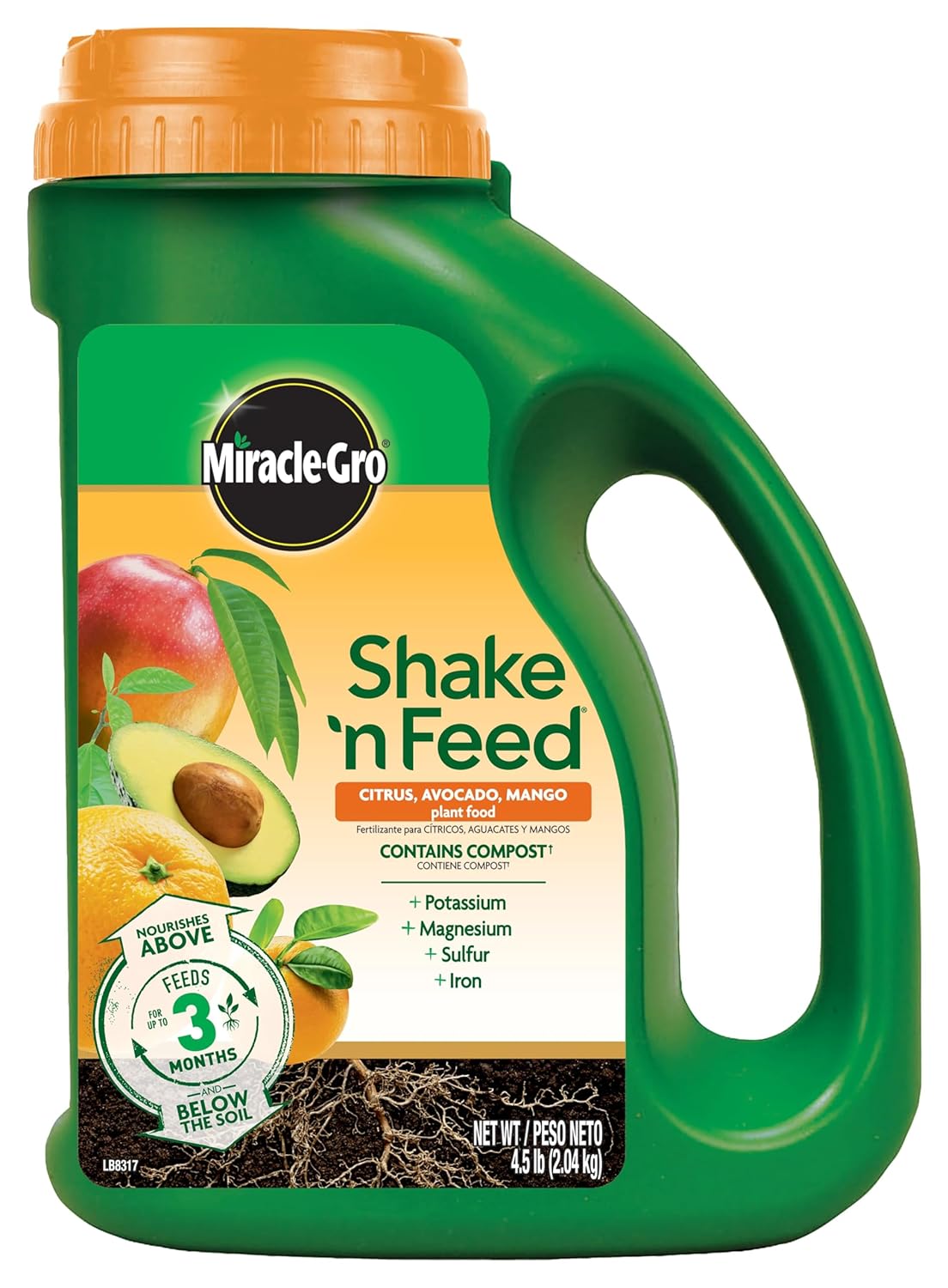
Miracle-Gro Shake 'N Feed Citrus, Avocado, Mango Plant Food, 4.5 lb
| Item Form | Granules |
|---|---|
| Application Method | Shake evenly onto soil |
| Target Species | citrus, avocado, mango |
| Mixing Ratio | 8-2-10 |
| Coverage | Medium |
This Shake 'N Feed formula is a granular, slow-release fertilizer made for citrus, avocado and mango trees in containers or in-ground. You shake the granules evenly onto the soil within the branch spread or mix into potting mix at planting, then water to start feeding; one application feeds plants for up to three months. The N-P-K listed (8-2-10) and added micronutrients such as potassium, magnesium, sulfur and iron help correct common deficiencies and support root development through microbes in the mix. It is practical for seasonal feeding and reduces the frequency of applications compared with quick-release fertilizers. Limitations include that it is a general fruit-tree feed rather than a lemon-specific formula and needs correct placement to avoid contact with trunks or foliage. For established trees you must follow label rates to avoid overfeeding and reapply every three months to maintain nutrition through the growing season.
Best for: Practical gardeners who want an easy, low-maintenance feeding schedule for lemon and other citrus trees and prefer a single product that works in pots and beds.
Less Ideal for: Growers who need a custom nutrient program based on soil tests or who want a fast-acting liquid feed for quick corrections should consider more targeted products.
- Slow-release formula provides up to 3 months of feeding per application
- Contains N-P-K 8-2-10 plus micronutrients to address common deficiencies
- Works for both container and in-ground citrus and other fruit trees
- Easy shake-and-feed application that reduces application frequency
- Not a lemon-specific formulation so may lack tailor-made ratios for particular soil tests
- Requires careful placement and incorporation to avoid trunk or foliage contact
Verdict: Use this to keep lemon trees consistently fed with a convenient, three-month slow-release granular fertilizer.
Jobe's Organics Granular Fruit & Citrus Fertilizer, 4 lb

| Item Form | Granules |
|---|---|
| Specific Uses For Product | Plant Growth, Root Development, Seed Development, Soil Conditioning |
| Application Method | Spread evenly around base |
| NPK | 3-5-5 |
| OMRI Listed | Yes |
This granular Jobe's Organics fertilizer is designed to feed fruit and citrus trees with a slow-release, root-targeted NPK of 3-5-5. It is typically applied by measuring and spreading the granules evenly around the base of the tree, then watering in; applications are recommended every 4 to 8 weeks during the growing season. Notable features include OMRI listing for organic gardening, a blend of feather meal, bone meal and processed poultry manure for organic nutrient sources, and a resealable bag for convenient storage. In practice the formula supports root development and fruit set without synthetic chemicals, and the slow-release nature reduces the need for very frequent feeding. Limitations are that the lower nitrogen level makes it better suited for fruiting and flowering stage nutrition rather than rapid leafy growth, and larger trees will require repeated applications or larger quantities. For gardeners aiming for an organic, low-fuss feed for citrus, this provides predictable, targeted nutrition, but it is not a quick-fix soluble feed for immediate green-up.
Best for: Gardeners who prefer organic, low-maintenance feeding for citrus and fruit trees and want a slow-release product that focuses on fruit and root health.
Less Ideal for: Growers needing fast, high-nitrogen correction or a soluble foliar feed; landscapers managing many mature trees who need bulk quantities more often.
- OMRI listed organic formula suitable for certified organic gardens
- Balanced 3-5-5 NPK aimed at improving flowering and fruit production
- Slow-release granules that feed roots over time and reduce application frequency
- Resealable packaging keeps product fresh between uses
- Lower nitrogen content means it will not rapidly promote leafy growth
- 4 lb bag may be insufficient for mature trees or larger plantings
Verdict: A reliable OMRI-listed granular fertilizer that delivers slow-release, fruit-focused nutrition for organic citrus gardeners.
Osmocote Smart‑Release Plant Food Plus Outdoor & Indoor, 2 lb

| Item Form | Granules |
|---|---|
| Application Method | Sprinkle |
| Target Species | All plants |
| Mixing Ratio | 1 capful (3 tablespoons) per 2 gallons soil or per 4 sq. ft. |
| Unit Count | 32 Ounce |
Osmocote Smart‑Release Plant Food Plus is a granular, resin‑coated fertilizer designed to feed flowers and other plants steadily for up to six months with 11 essential nutrients. You apply it by sprinkling the recommended amount into the top inch or two of potting mix or garden soil, watering it in, and reapplying every six months; indoor plants use about half the outdoor rate. The resin coating times nutrient release to moisture and temperature, which reduces the need for frequent feedings and lowers the risk of fertilizer burn when used as directed. It works across containers, raised beds, and in‑ground flower beds and covers up to roughly 75 square feet per 2 lb container. Limitations are that a single 2 lb container is only enough for small gardens or several pots, and the slow‑release formula is not suitable when an immediate corrective boost is needed for acute nutrient deficiencies. For gardeners focused on steady, maintenance feeding for flowering plants this is an easy, low‑effort option.
Best for: Gardeners who want reliable, low‑maintenance feeding for flowers and mixed plantings and prefer a consistent supply of nutrients over months rather than frequent liquid feedings.
Less Ideal for: Growers who need fast corrective feeding for visible nutrient deficiencies or those managing very large beds who want bulk fertilizer options to reduce trips to reapply.
- Feeds continuously up to six months with a single application
- Resin coating times nutrient release to plant needs based on moisture and temperature
- Formulated with 11 essential nutrients suitable for a wide range of flowering plants
- No-burn pledge when used as directed reduces risk of overfeeding
- 2 lb container only covers about 75 sq. ft., so frequent repurchase is needed for larger gardens
- Slow‑release formulation does not provide a rapid corrective nutrient boost
Verdict: Choose this product if you want a hands-off, long‑lasting fertilizer that keeps flowering plants fed for months with a single application.
Miracle-Gro Fruit & Citrus Plant Food Spikes (12-count)

| Item Form | Sticks |
|---|---|
| Specific Uses For Product | Fruit & Citrus Tree Care |
| Application Method | Insert spikes into the ground |
| Mixing Ratio | 10:15:15 |
| Number of Items | 12 |
These Miracle-Gro Fruit & Citrus Plant Food Spikes are pre-measured, slow-release sticks designed to feed in-ground fruit and citrus trees, including avocados, with a 10-15-15 NPK formula. Use is simple: water the soil to soften it, place spikes around the tree drip line according to the label chart, then drive them below the soil surface with a mallet or by stepping on them. The spikes deliver nutrients directly to the root zone, which reduces mess compared with granular feeding and eliminates monthly mixing. They are intended for a twice-yearly schedule, one application in early spring and another in mid-fall, so maintenance is low. Because the spikes are targeted and contain a balanced NPK higher in phosphorus and potassium, they can support flowering and fruit set for productive trees. Limitations to note are the infrequent feeding schedule and fixed nutrient ratio, so if your soil test shows different needs or you prefer monthly liquid feeding you may need supplemental products. Very compact root zones or heavy clay that stays hard when wet can make insertion difficult without extra effort or tools.
Best for: Home gardeners who want a low-effort, seasonal fertilizer for established avocado and other fruit trees and who prefer a simple apply-twice-a-year routine backed by broad user experience.
Less Ideal for: Growers who rely on frequent liquid feeding, need a customized nutrient program from soil tests, or work exclusively with container-grown trees.
- Direct root-zone delivery reduces surface runoff and mess compared with broadcast granules
- Pre-measured spikes make seasonal feeding fast and low-effort
- 10-15-15 NPK supports flowering and fruit development useful for fruiting trees
- Works on a range of trees listed for the product including avocado and palm
- Fixed NPK ratio and twice-yearly schedule may not match specific soil test recommendations
- May be hard to insert in very compacted or rocky soils without a mallet or tool
Verdict: A low-maintenance, targeted fertilizer solution that makes seasonal feeding of avocado and other fruit trees quick and reliable.
Choosing the Right Fertilizer for Planting Fruit Trees: Key Factors to Consider
Nutrient Ratio and Release Profile
The immediate nutrient needs of a newly planted fruit tree differ from those of a mature, fruiting tree. A fertilizer formulated for planting should provide a modest, steady supply of nitrogen to encourage leaf and shoot growth while offering phosphorus and potassium that support root development and stress tolerance. Slow-release or controlled-release forms reduce the risk of a nitrogen flush that can push top growth at the expense of roots and can lower the chance of nutrient leaching in sandy soils.
When selecting a product, look for clear N-P-K numbers and an explanation of how quickly those nutrients become available. Granular slow-release options and coated prills behave differently from soluble starter fertilizers and will affect how often you need to reapply in the first season.
Root Safety and Salt Content
New roots are sensitive to high soluble salt concentrations and concentrated starter blends. Products with a high salt index can draw moisture away from tender root hairs or cause localized burn in the planting hole. This is especially important for container-grown trees where the planting mix may already hold higher soluble salts.
Choose formulations with low to moderate soluble salt ratings and avoid placing undiluted fertilizer in direct contact with roots. Some manufacturers provide salt index or conductivity data; where that is absent, prefer slower-release or lower-salt starter blends and consider pre-mixing granular fertilizer into backfill at dilute rates.
Application Method and Practicality
How a fertilizer is applied at planting affects accuracy and root safety. Options include granules worked into backfill, a ring-applied band around the rootball, water-soluble starters applied as a root drench, or in-row bands for multiple trees. Each method has pros and cons: drench applications distribute nutrients quickly but risk concentration, while banding or mixing into planting soil spreads nutrients more evenly.
Think about how you will plant: if you are installing many trees in a row, a packaged granular you can measure and broadcast may be faster. For single specimen plantings, a small-portion liquid or diluted starter lets you target the root zone precisely. Clear dosing instructions and easy-to-measure packaging reduce application errors.
Soil Type and Existing Fertility
Soil texture and existing nutrient levels change how a fertilizer behaves. Sandy soils leach nutrients faster and often benefit from slow-release formulations or repeated light applications. Heavy clay soils hold nutrients but can tie up phosphorus, making starter phosphate less available. A pre-plant soil test gives information on pH, phosphorus availability, and baseline fertility to guide fertilizer choice and whether additional lime or organic matter is needed.
If you cannot test, assume average urban soil and favor moderate-release formulations and pairing fertilizer with compost or organic matter to improve structure and microbial activity.
Compatibility With Soil Amendments and Microbes
Many gardeners add compost, mycorrhizal inoculants, or biofertilizers at planting. Some fertilizers play nicely with those amendments, while highly soluble salts or acidic blends can reduce microbial survival. Products that advertise compatibility with beneficial microbes or are low in harsh salts help establish a healthy root microbiome, which in turn improves nutrient uptake and drought resilience.
If you plan to add starter mycorrhizae or compost, choose a fertilizer with neutral pH and low salt index, or apply microbial inoculants separately from concentrated fertilizers to avoid killing beneficial organisms.
Dosage Clarity and Packaging Size
Accurate dosing matters because overapplication at planting can stunt roots or create nutrient imbalances. Packaging that includes planting-specific measurement guides or marked scoops helps prevent mistakes. Small-batch packaging is useful for single-tree plantings to avoid long-term storage issues, while bulk packaging benefits larger plantings but requires careful measurement tools.
Also consider storage stability and whether the product is easy to pour, scoop, or dilute. Clear labeling that lists grams or teaspoons per tree at various planting hole sizes is a practical time-saver in the field.
Preparing the Planting Hole
Dig a hole slightly wider than the rootball but no deeper than the root flare to avoid settling and root suffocation. Loosen the surrounding soil to allow roots to extend into less compacted earth and avoid placing granular fertilizer in direct contact with roots.
Mix any chosen granular planting fertilizer into the backfill at recommended dilute rates rather than packing it against the rootball. If using a liquid starter, apply as a root drench after the tree is positioned and backfill is partially in place to help distribute nutrients evenly.
- Measure fertilizer accurately to the planting hole size
- Avoid concentrated piles of fertilizer touching roots
- Consider a shallow band around the rootball rather than deep placement
Pairing Fertilizer With Soil Amendments
Compost, aged wood chips, and well-mixed topsoil improve structure and nutrient-holding capacity. Combine modest amounts of organic matter with fertilizer to create a hospitable root environment.
If adding mycorrhizal inoculants or beneficial microbes, keep them separate from concentrated fertilizers during application. Apply microbes to the root surface or backfill and then water in, which helps the organisms establish before encountering higher nutrient concentrations.
- Use compost to buffer nutrient release
- Apply microbes directly to roots, not mixed with dry chemical fertilizer
- Adjust amendment amounts based on soil texture
Timing First Feedings After Planting
A single planting-time application may be sufficient for slow-release products, while soluble starters may require follow-up feedings. Delay aggressive high-nitrogen treatments until the root system is established, usually several months after planting.
Monitor aboveground growth and leaf color to time repeat applications. Pale leaves often indicate nitrogen deficiency, while overly lush top growth with weak wood can indicate too much nitrogen relative to root growth.
- Wait several weeks before strong feeds if roots were disturbed
- Use light, frequent applications in sandy soils
- Record application dates to avoid overfeeding
Adjusting for Container-Grown Versus Bare-Root Trees
Container-grown trees often carry a potting mix with higher soluble salts, so choose low-salt fertilizers and avoid high-concentration starters. Rinse or tease roots gently if the rootball is root-bound before planting.
Bare-root trees are planted without soil around their roots and benefit from a gentle starter solution and close attention to moisture. Apply fertilizer sparingly and focus first on ensuring good root-to-soil contact and steady moisture before adding nutrients.
- Rinse factory potting mix if salts are suspected
- For bare-root trees, prioritize contact and moisture over early feeding
- Match fertilizer form to planting material
Sustainable and Organic Options
Organic and slow-release mineral options reduce the risk of leaching and support soil life. Compost-based starters and low-solubility rock phosphates provide long-term benefits but may release available nutrients more slowly, which is fine if the goal is steady establishment rather than an immediate growth spurt.
Consider the long-term fertility plan: organic materials build soil structure and microbiology over years, while some synthetic starters give a predictable early nutrient boost. Many gardeners choose a hybrid approach at planting, combining a modest starter with organic matter.
- Organic inputs improve soil life but act slowly
- Combine short-term soluble options with organic matter for balance
- Check for compatibility when mixing organic and synthetic products
How We Chose the Best Fertilizer for Planting Fruit Trees
We focused on the formulations and characteristics that actually matter when planting fruit trees rather than broad, generic claims. Key evaluation criteria were nutrient ratio and release profile, because the right balance of nitrogen, phosphorus, and potassium and a predictable release prevent root burn and support establishment. Application method and ease were assessed to reflect how homeowners, small-scale orchardists, and planting crews actually apply fertilizer at planting time. Root safety and salt index were examined since high soluble salts or aggressive starters can injure new roots. Soil compatibility and amendment needs were included because many planting sites require pairing fertilizer with lime, compost, or starter mycorrhizae. Finally, packaging and measurement clarity were considered so gardeners can dose accurately at planting. We excluded products intended only for foliar feeding, blossom-stage feeding, or long-term maintenance that do not provide a planting-stage formulation. We also excluded fertilizers with unclear nutrient guarantees or vague instructions. The final shortlist contains options with clear N-P-K analysis, stated release behavior, and practical application guidance for planting fruit trees.
FAQ
When should I first apply fertilizer after planting a fruit tree?
Often a small starter dose at planting is used, followed by lighter feeds once new roots begin to grow, typically several weeks to a few months. The exact timing depends on the fertilizer type and how disturbed the roots were.
Is a high-phosphorus 'starter' fertilizer necessary for fruit tree planting?
Starter fertilizers with available phosphorus can support root development, but excessive phosphorus is rarely needed unless a soil test shows deficiency. Moderation and correct placement are more important than high phosphorus content.
Can I use the same fertilizer for planting and later maintenance?
It depends. Some slow-release formulas work for both planting and early maintenance, but many planting-stage products prioritize root safety and steady release, while maintenance feeds target fruiting and annual growth needs.
How do I avoid burning roots when applying fertilizer at planting?
Avoid placing concentrated fertilizer in direct contact with roots, follow label dilution guidelines, use low-salt formulations for sensitive plantings, and mix granular products into backfill rather than packing them against the rootball.
Should I change fertilizer choice based on soil type?
Yes. Sandy soils benefit from slow-release or split applications because of leaching, while clay soils may need amendments to improve phosphorus availability. A soil test will help tailor your choice.
Are organic fertilizers effective for newly planted fruit trees?
Organic fertilizers can be effective and improve soil life, but they usually release nutrients more slowly. They are a good option for long-term soil health and work well when paired with a modest starter nutrient source if quick growth is desired.
Final Verdict
When planting fruit trees, prioritize formulations and application methods that support root establishment rather than forcing rapid top growth. Focus on balanced nutrient ratios, low salt content, and clear dosing instructions to avoid root burn and nutrient imbalances. Match the fertilizer form to your soil texture and planting material, and combine modest starter feeding with organic amendments if you want both short-term support and long-term soil improvement. Following these priorities helps ensure young trees establish a healthy root system and reach productive maturity reliably.
