

Note: This article contains affiliate links. If you click on these links and make a purchase, I may earn a small commission at no extra cost to you. This helps support my research and content. Read my full affiliate disclosure here.
Healthy roots are the foundation of vigorous plants, whether you are starting seedlings, establishing new transplants, or rehabilitating long-neglected beds. The right fertilizer for root growth supplies the nutrients and support that stimulate root branching, increase root hair density, and improve establishment without forcing excessive top growth. In this guide we shortlist six top options suited specifically for encouraging roots in garden beds, containers, and new plantings. Each pick was evaluated for nutrient balance, delivery method, and real-world ease of use so you can quickly identify which style fits your garden routine. Read on to understand the tradeoffs between quick-acting solutions and longer-term soil builders before checking the product list below.
Top Picks at a Glance
| Best Overall The best all-around choice for most situations | Bonide Root & Grow Concentrate 32 oz |  |
| Best Quality Built to a higher standard if you want something more solid | Clonex Clone Solution Plant Nutrient, 1 Quart |  |
| Best Value The sweet spot between price and what you get | Xtreme Gardening Mykos Granular Mycorrhizal Inoculant (2.2 lb) |  |
| Best Budget The cheapest option that still gets the job done reliably | Bonide Bontone II Rooting Powder, 1.25 oz |  |
| Highest Rated A top-rated pick with lots of positive feedback | Herrdemia Rhizophagus irregularis Mycorrhizal Fungi Granules, 4 oz |  |
| Most Popular A crowd favorite that many people choose with confidence | TPS NUTRIENTS Indoor Plant Food Liquid Fertilizer, 8 fl oz |  |
Bonide Root & Grow Concentrate 32 oz
| Item Form | Liquid |
|---|---|
| Specific Uses For Product | Root Development |
| Application Method | Pouring directly onto the soil and roots |
| Target Species | fruit, vegetables, flowers, trees, and bedding plants |
| Mixing Ratio | 4:10:3 |
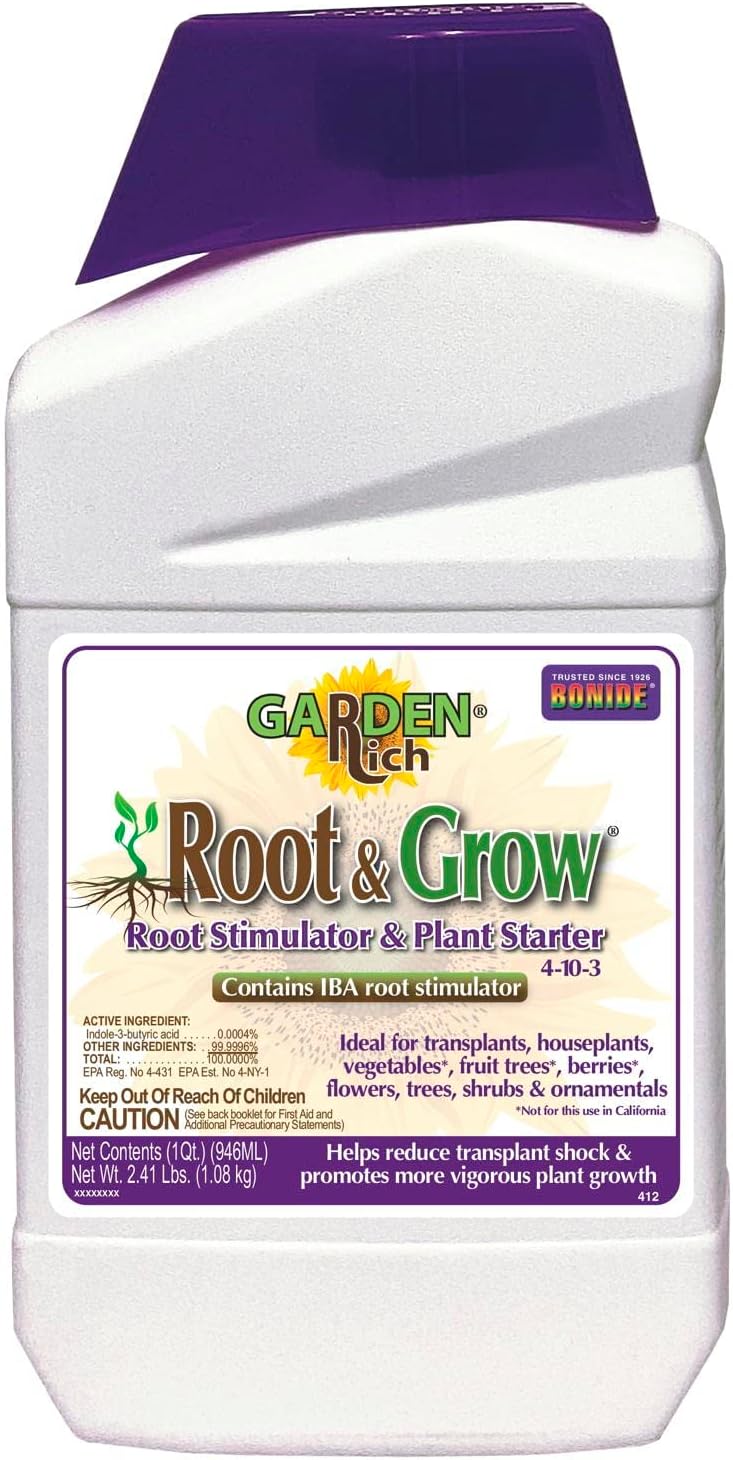
Bonide Root & Grow is a liquid concentrate designed for use when seeding or transplanting to speed early root formation and help plants establish. You dilute the concentrate per label instructions and pour the solution onto soil and roots when potting seedlings, transplanting plugs, or setting out young vegetables and ornamentals. Notable features include an active IBA rooting hormone and a 4-10-3 nutrient ratio that supplies extra phosphorus to support root growth. In practice it can reduce transplant shock and promote quicker, stronger root systems, which is useful for both container-grown seedlings and recently set out bedding plants. Because it is a concentrate, a single 32 oz bottle yields multiple applications, which stretches a limited budget. Important limitations are that it is a specialized root stimulator rather than an all-purpose feed for ongoing growth and it requires careful dilution and label compliance to avoid overapplication.
Best for: Buyers wanting an affordable, concentrated product to give seedlings and recent transplants a stronger start and who prioritize preventing transplant shock over routine feeding.
Less Ideal for: Gardeners looking for a general weekly fertilizer or a balanced feed for mature plants should choose a different product.
- Contains IBA rooting hormone to stimulate root initiation
- 4-10-3 fertilizer ratio provides extra phosphorus for root development
- Concentrated 32 oz bottle yields many applications, good for tight budgets
- Easy to apply by diluting and pouring directly onto soil and roots
- Formulated mainly for root stimulation so not ideal as a regular all-purpose feed
- Requires careful mixing and label reading to use safely and effectively
Verdict: A budget-friendly concentrated root stimulator that helps seedlings and transplants establish faster by combining IBA with a phosphorus‑rich fertilizer.
Clonex Clone Solution Plant Nutrient, 1 Quart

| Item Form | Liquid |
|---|---|
| Specific Uses For Product | Root Development, Cloning |
| Coverage | Medium |
| Mixing Ratio | 1:0.4 |
| Unit Count | 32 Fluid Ounces |
Clonex Clone Solution is a concentrated liquid nutrient designed specifically for cloning and young plants to kickstart root formation and reduce transplant shock. It is typically used as a medium soak or as a root feed once initial roots appear, and the label-recommended mixing ratio (1:0.4) makes dosing straightforward. The formula includes vitamin B1 and root-enhancing agents that help initiate new root cells and support vigorous early growth, which is useful when pairing with Clonex Rooting Gel or other rooting aids. In real-world use it speeds up the progression from cutting to rooted plant and can be applied with irrigation or hand watering during the early stages. Practical benefits include compatibility with common propagation workflows, a concentrated quart size that covers multiple uses, and clear safety guidance for handling. Limitations are that it is a propagation-focused nutrient rather than a complete long-term fertilizer and proper dilution and handling are required to avoid overfeeding young roots.
Best for: Growers focused on fast, reliable propagation who want a specialized nutrient to accelerate rooting in cuttings and seedlings.
Less Ideal for: Gardeners seeking an all-purpose fertilizer for mature plants or those who prefer granular slow-release feeding methods.
- Formulated specifically to promote root development in cuttings and seedlings
- Contains vitamin B1 and root-enhancing agents to reduce transplant shock
- Concentrated liquid with a clear mixing ratio for predictable dosing
- Compatible with Clonex Rooting Gel and other common rooting products
- Not intended as a complete, long-term fertilizer for established plants
- Requires careful dilution and handling to avoid overfeeding young roots
Verdict: Use this concentrated, propagation-focused nutrient when you need a targeted product to speed root formation in cuttings and seedlings.
Xtreme Gardening Mykos Granular Mycorrhizal Inoculant (2.2 lb)

| Item Form | Granules |
|---|---|
| Coverage | 4 cubic feet |
| Specific Uses For Product | Gardening,Growth |
| Target Species | Pumpkin |
Xtreme Gardening Mykos is a granular mycorrhizal inoculant intended to increase the symbiotic fungi around plant roots so they absorb water and nutrients more efficiently. It is applied directly to root zones, planting holes, or mixed into growing media, with dosing guidelines for starts, transplants and established plants. The product is OMRI listed and comes in a 2.2 pound granular form that claims coverage of about 4 cubic feet of soil, which makes it convenient for targeted applications in beds, containers, and vegetable patches. Practical benefits include easier establishment of transplants, improved nutrient access that can support bigger, healthier plants, and suitability for a wide range of plant types from herbs to trees. Limitations are that this is a biological amendment rather than a complete fertilizer so it does not supply NPK on its own, and results depend on proper placement and compatible soil conditions. Users should follow protective handling instructions to avoid inhalation or skin contact.
Best for: Gardeners who prioritize practical, science-backed amendments to improve root establishment and nutrient uptake for vegetables, ornamentals, and container plants.
Less Ideal for: Buyers looking for an all-in-one fertilizer or immediate nutrient correction should choose a balanced NPK fertilizer instead.
- OMRI listed organic mycorrhizal fungi that support natural root colonization
- Granular form is easy to apply to planting holes, root zones, or mix into media
- Clear dosing guidance for cuttings, transplants and established plants
- Claims coverage of roughly 4 cubic feet, useful for targeted bed and container work
- Does not contain complete fertilizer nutrients so it must be paired with an NPK source
- Effectiveness depends on soil conditions and proper application for root contact
Verdict: Use Mykos when you want a reliable organic root inoculant to improve root development and long-term nutrient and water uptake in beds and containers.
Bonide Bontone II Rooting Powder, 1.25 oz

| Item Form | Powder |
|---|---|
| Specific Uses For Product | Root Development |
| Application Method | dip and shake |
| Target Species | azaleas, mums, geraniums, pachysandra, poinsettias and others |
| Unit Count | 1.25 Ounce |
Bonide Bontone II is a classic IBA-based rooting powder sold in a small 1.25 oz dust jar for home gardeners and hobbyists. You apply it by dipping a cutting’s wound into the powder, shaking off excess, and planting into moist media; it can also be used to coat seeds or bulbs in a bag before planting. The product’s straightforward formulation of indole-3-butyric acid targets root initiation and is effective on both softwood and hardwood cuttings as well as many ornamentals and vegetables. In practice the powder is convenient to use, has a medium coverage per package, and reduces the time and failure rate for many common cuttings. Limitations are the small unit size if you plan to take large numbers of cuttings, and because it is a dry powder it can be messier to apply than gel alternatives. Safety precautions are also reasonable to follow since it is a plant hormone rather than an inert filler.
Best for: Gardeners who want a reliable, easy-to-use rooting hormone backed by long-standing use and positive user feedback and who take a cautious approach to selecting proven products for their cuttings.
Less Ideal for: Propagation professionals or growers who take very large numbers of cuttings and need bulk quantities or who prefer the tidier application of gels or liquid dilutions.
- Contains indole-3-butyric acid (IBA), a proven rooting hormone for cuttings
- Ready-to-use powder that is simple to apply by dip and shake
- Versatile for cuttings, seeds, bulbs, and transplants across many ornamental and edible plants
- Compact jar size convenient for occasional home garden use
- Small 1.25 oz package may not be economical for frequent or large-scale propagation
- Powder form can be messier and harder to control than gel or liquid formulations
Verdict: A proven, ready-to-use IBA powder that reliably speeds rooting for home gardeners focused on successful cuttings.
Herrdemia Rhizophagus irregularis Mycorrhizal Fungi Granules, 4 oz

| Item Form | Granules |
|---|---|
| Specific Uses For Product | Indoor House Plants, Root Development, Soil Conditioning |
| Application Method | Soluble Granules |
| Target Species | Houseplants |
| Ingredients | Rhizophagus irregularis |
This product supplies a lab‑grade strain of Arbuscular Mycorrhizal Fungi (Rhizophagus irregularis) in soluble granule form to boost root growth and nutrient absorption for houseplants and small indoor systems. You use it by dissolving the granules in water and applying via hand‑watering, drip lines, or hydroponic reservoirs; the brand emphasizes a low‑temperature cold‑press process and added fulvic acid and fructose to help colonization. Practical benefits include broader root absorption area that can reduce transplant shock and improve drought resilience, and a soluble formula that will not clog irrigation lines. The 4 oz package is concentrated so a small dose treats many plants, which suits steady maintenance routines. Limitations are that this is a single‑strain biological amendment, so results depend on plant species and existing soil life, and benefits usually appear over weeks rather than immediately; it is not a complete fertilizer so you still need to supply macro nutrients separately. For indoor growers seeking a reliable biological root booster this is straightforward to use, but expect gradual improvement rather than instant greening or growth spurts.
Best for: Indoor plant owners who prioritize reliable, science‑based biological amendments and want a low‑maintenance way to strengthen roots and reduce transplant shock.
Less Ideal for: People seeking an all‑in‑one fast‑acting fertilizer or immediate visual results, or growers who prefer chemical fertilizers over biological soil amendments.
- Contains a well‑documented AMF species (Rhizophagus irregularis) known to improve nutrient uptake
- Water‑soluble granules suitable for hand watering, drip irrigation, and hydroponics without clogging lines
- Concentrated formula where small amounts treat many plants, economical for regular use
- Includes fulvic acid and other carriers to aid fungal colonization and root establishment
- Not a complete fertilizer so additional NPK feeding is required
- Effects are biological and develop over weeks so benefits are not immediate
Verdict: A dependable, concentrated mycorrhizal granule designed to strengthen roots and improve nutrient uptake for indoor plant care.
TPS NUTRIENTS Indoor Plant Food Liquid Fertilizer, 8 fl oz

| Item Form | Liquid |
|---|---|
| Specific Uses For Product | Plant Food |
| Application Method | Watering can |
| Mixing Ratio | 2:1 (oz/gallon) or 1:64 (tbsp/gallon) |
TPS NUTRIENTS Indoor Plant Food is a concentrated liquid fertilizer made for regular use with houseplants. You mix the measured dose into water and apply it with your usual watering can; the label gives an easy mixing ratio for household use. Its kelp-enriched formula is pitched at improving leaf color, encouraging steady new growth, and supporting root health, so expect glossier foliage and more frequent leaf production when plants are fed consistently. The 8 fl oz bottle is portable and fits on a plant shelf or utility area, and the liquid form dissolves readily for even application. It is intended for medium coverage and labeled as gentle for weekly feeding, which simplifies care for busy owners. Important limitations are that this is a small bottle meant for regular top-up feedings rather than long-term bulk use, and it assumes you will follow dilution directions to avoid overfeeding. Keep it away from children and pets and avoid skin or eye contact when handling.
Best for: Plant owners who want a simple, low-effort weekly fertilizer to keep indoor foliage vibrant and encourage steady new leaf growth. Good for people who prefer an easy liquid mix applied during regular watering routines.
Less Ideal for: Gardeners needing a bulk or multi-season fertilizer for outdoor beds or large collections should consider larger-capacity or specialized products instead.
- Liquid concentrate mixes easily for even application with a watering can
- Kelp-enriched formula aimed at improving foliage color and encouraging new growth
- Gentle enough for weekly feedings according to product guidance
- Clear mixing instructions for home use
- Small 8 fl oz volume limits how many plants you can feed before repurchasing
- Not formulated or labeled for outdoor or large-scale garden use
Verdict: A convenient kelp-enriched liquid concentrate that makes weekly feeding easy for anyone who wants healthier, more vibrant indoor foliage.
Choosing the Right Fertilizer for Root Growth: Key Factors to Consider
Nutrient Ratio and Phosphorus Role
The ratio of primary nutrients determines how a fertilizer influences root versus shoot growth. A product tailored for root development typically supplies adequate phosphorus because phosphorus supports root initiation, energy transfer, and early root branching. Nitrogen and potassium levels also matter: moderate nitrogen avoids forcing excessive leafy growth at the expense of roots, while potassium supports overall root health and stress resilience.
Understanding the label helps you match a product to your goal. High-phosphorus starter formulations are useful at planting and transplanting, while balanced low-salt feeds are preferable for regular root maintenance. Consider that some products list available phosphorus differently, so check manufacturer guidance and recommended application rates to avoid overfeeding.
Delivery Format and How It Affects Roots
Fertilizers come as granules, water-soluble powders, liquids, or concentrated starters; each format interacts with the soil and roots differently. Water-soluble and liquid formulas give a fast, localized nutrient pulse near young roots, which is helpful at planting or for a quick root response. Granules and slow-release formulations provide a steady supply over weeks, reducing the need for repeat applications and lowering burn risk.
For containers and seedling trays you will often prefer water-soluble or mild liquid starters for precise dosing. In garden beds or new planting holes, a gentle granular or slow-release root-friendly product can feed developing roots without repeated disturbance.
Salt Index and Root Safety
High salt concentrations can dehydrate tender roots and damage root hairs, undermining establishment. Root-focused fertilizers should have a low to moderate salt index or be formulated for rooting to minimize burn risk. This is especially important for seedlings, newly transplanted stock, and container-grown plants where root zones are confined.
If using a concentrated product, always dilute to the recommended strength and avoid applying to drought-stressed plants. Consider pairing a root-forming fertilizer with good watering practices and a buffer like compost to protect soil microbes and maintain safe osmotic conditions around the roots.
Microbial Compatibility and Soil Health
Root growth is not driven solely by nutrients; a healthy soil microbiome supports root hair development, nutrient uptake, and disease resistance. Choose fertilizers that do not contain high levels of biocidal additives or excessive salts that harm beneficial microbes. Products labeled as compatible with biological amendments or those designed to work alongside compost teas and inoculants preserve the balance of soil life.
Over time, feeding practices that build organic matter and support microbes promote deeper, more resilient root systems than repeated heavy mineral dosing. For long-term root vigor, plan a regimen that alternates targeted root stimulants with organic soil-building feeds.
Timing and Frequency of Application
When you apply a root-targeted fertilizer affects how roots respond. At planting or transplant time, an initial, mild starter feed placed near the root ball encourages new root proliferation into surrounding soil. After establishment, lighter, more frequent feedings often maintain root activity without causing shoot surges that outpace root support.
Avoid heavy applications during heat stress or drought when roots are less able to take up nutrients. Follow recommended intervals for each product format: liquids and water-solubles are useful for short-term work and more frequent treatments, while granular and slow-release products lower maintenance but take longer to influence root architecture.
Compatibility With Plants and Growing Situation
Different plant groups and growing situations have varied root needs. Seedlings and cuttings need gentle, low-salt starter feeds and sometimes added rooting hormones. Woody shrubs and trees benefit from root establishment products applied at planting, combined with good backfill and mulching. Vegetable transplants will respond to a starter formulation that provides an early root boost without stimulating excessive top growth.
Also consider the growing environment: containers concentrate salts and nutrients, so dilute strength and choose low-salt or organic-compatible options. In raised beds or heavy clay, select formulations that improve soil structure indirectly or that are safe to use with soil amendments to avoid nutrient tie-up or runoff problems.
When Root Growth Matters Most
Certain garden tasks rely heavily on rapid and healthy root development. Transplanting nursery stock, establishing bare-root trees, starting cuttings, and setting out vegetable transplants are all moments when encouraging roots directly improves survival and early-season vigor. Even established plants benefit from occasional root-targeted feeding after disturbance or stress to speed recovery.
- Planting and transplanting: apply a starter or localized feed to encourage roots to explore backfill
- Cuttings and propagation: use gentle, low-salt formats and consider pairing with rooting hormone
- Recovering from stress: a mild root tonic can aid recovery after drought, pruning, or pest pressure
Best Practices for Applying Root Fertilizers
Place fertilizers where new roots will grow rather than broadcasting them over the entire bed. For transplants, side-dress or mix a small amount into backfill at planting depth. For containers, apply via the irrigation water or dilute a water-soluble feed to prevent salt buildup. Always water thoroughly after application to move nutrients into the root zone and avoid concentrating salts at root surfaces.
- Measure doses carefully and err on the low side for seedlings and cuttings
- Space granular feeds away from direct contact with tender roots unless the product is labeled safe for that use
- Record applications so you do not overfeed
Combining Root Fertilizers With Soil Amendments
Root fertilizers can be used alongside compost, mycorrhizal inoculants, and organic matter to create a synergy between nutrients and soil biology. Compost improves structure and moisture retention, which magnifies the benefits of nutrient inputs. Mycorrhizal fungi can extend root reach and help plants access phosphorus and other immobile nutrients more efficiently, amplifying the effects of a root-targeted feed.
- Apply inoculants according to label instructions and avoid products with strong biocidal ingredients around application time
- Use compost as a buffer when applying concentrated starters to reduce burn risk
- Stagger biological and mineral inputs so microbes have time to establish before high-dose mineral feeding
Adjusting Strategy by Plant Type
Annual vegetables, perennials, shrubs, and trees do not all need the same root-feeding strategy. Shallow-rooted annuals benefit from more frequent, mild applications, while woody plants prefer an initial establishment feed and slower-release nutrition. Pay attention to the crop's root architecture and adjust frequency, formulation, and placement accordingly.
- For seedlings and annuals: use dilute liquid starters and frequent light feedings
- For shrubs and trees: apply a targeted planting dose and rely on soil amendments for long-term support
- For containers: prefer low-salt, soluble formulations and flush periodically to prevent salt buildup
How We Chose the Best Fertilizer for Root Growth
We focused on attributes that directly affect root development and practical garden use. Selection criteria included nutrient formulation, with attention to phosphorus and supporting micronutrients known to encourage root initiation and branching. We evaluated delivery format because granular, liquid, and concentrated root stimulants behave very differently in beds and containers. Application flexibility was another filter, favoring products that can be used at planting, as a starter, or as an ongoing root tonic. Safety and soil health were considered, prioritizing options with minimal salt burn risk and compatibility with common soil biology. Longevity of effect was reviewed so gardeners get either a quick establishment boost or steady feeding over weeks. Finally, we considered clear usage instructions and predictability in typical home garden conditions. We excluded products aimed primarily at foliar feeding without root benefits and any formulations designed mainly for non-plant uses. The final short list balances immediate root stimulation with longer-term soil-friendly feeding.
FAQ
How soon will I see root growth after applying a root-focused fertilizer?
Response time varies by format and conditions. Liquids and water-soluble feeds often produce measurable root activity within a couple of weeks, while granular and slow-release products influence root architecture over several weeks to months. Soil temperature, moisture, and plant health also affect how quickly roots respond.
Can I use root fertilizers on all plants?
Most root-focused fertilizers are safe for a wide range of plants, but strength and placement should vary. Seedlings and cuttings need gentler, low-salt formulations. Woody trees and shrubs can tolerate starter applications at planting, while salt-sensitive species require milder options. Always follow label guidance and adjust strength for confined root zones like containers.
Should I apply root fertilizer with every watering?
Not usually. Frequent application of concentrated products risks salt accumulation. Water-soluble and liquid formulas can be used more often at dilute strengths, while granular or slow-release products are applied less frequently. Match frequency to the product type and your soil's nutrient-holding capacity.
Do root fertilizers replace compost and good soil practices?
No. Root fertilizers support establishment, but they work best alongside compost, proper soil preparation, and good watering practices. Organic matter improves structure and water retention, which helps roots take up nutrients and promotes longer-term vigor beyond the immediate boost from fertilizer.
Final Verdict
For gardeners focused on stronger roots and better transplant success, prioritize the nutrient profile, delivery format, and salt safety of any fertilizer you choose. Decide whether you need a quick liquid starter at planting or a slower, steady feed for ongoing root development, and match application method to your growing situation. Combining targeted root feeds with compost and microbial support yields the most durable results. With those tradeoffs in mind, pick the formulation that fits your timing, plant type, and maintenance plan to achieve reliable root establishment.
