

Note: This article contains affiliate links. If you click on these links and make a purchase, I may earn a small commission at no extra cost to you. This helps support my research and content. Read my full affiliate disclosure here.
Getting the right fertilizer for squash makes a tangible difference in how quickly vines establish, how many flowers set, and how large fruits grow. Squash responds to specific nutrient balances at different stages, so choosing a product that matches your soil, planting time, and maintenance routine matters in a real garden. This guide shortlists seven top options for growing squash and explains why each type made the cut. We evaluate nutrient formulas, ease of use, and suitability for common garden situations so you can pick the feed that fits your soil and schedule.
Top Picks at a Glance
| Best Overall The best all-around choice for most situations | Greenway Biotech Cucumber Fertilizer 8-16-36 (1 lb) |  |
| Best Quality Built to a higher standard if you want something more solid | FoxFarm Happy Frog Tomato & Vegetable Fertilizer, 5-7-3, 4 lb |  |
| Best Value The sweet spot between price and what you get | ASTEVORA (Gardenwise) 10-10-10 All-Purpose Liquid Plant Fertilizer, 8 oz |  |
| Best Budget The cheapest option that still gets the job done reliably | Miracle-Gro Shake 'N Feed Tomato, Fruit & Vegetable Plant Food, 1 lb |  |
| Highest Rated A top-rated pick with lots of positive feedback | FoxFarm Grow Big Liquid Plant Food, 6-4-4 Quart Concentrate |  |
| Most Popular A crowd favorite that many people choose with confidence | Dr. Earth Organic Tomato, Vegetable & Herb Fertilizer (4 lb) |  |
| Best Seller A high-volume bestseller chosen again and again | Miracle-Gro Water Soluble All Purpose Plant Food, 3 lb |  |
Greenway Biotech Cucumber Fertilizer 8-16-36 (1 lb)

| Item Form | Powder |
|---|---|
| Specific Uses For Product | Hydroponics, Plant Food, Plant Growth, Root Development, Soil |
| Coverage | 100 Square Feet |
| Target Species | cucumbers, summer squash varieties |
| Unit Count | 16 Ounce |
This 8-16-36 powder is designed specifically for cucumbers, squash, pumpkins and other vine crops and is sold as a concentrated, water-soluble feed for soil, foliar spray, and hydroponic systems. It supplies a high potassium ratio aimed at fruit quality and to reduce bitterness while the chelated iron, manganese, zinc and copper help prevent micronutrient lockout across a wide pH range. You can side-dress individual plants with a measured 1/2 teaspoon every 4 to 6 weeks, mix a foliar spray for faster leaf uptake, or add a maintenance dose to a reservoir for hydroponics. The powder dissolves cleanly so it will not clog sprayers or drip lines and each batch is tested for low heavy-metal content. Important limitations are that it is a targeted cucurbit formula so it is not a general all-purpose fertilizer and accurate measuring is required because of the product concentration; users must also follow safety guidance to avoid skin or eye contact.
Best for: Gardeners growing squash, zucchini, pumpkins or other vine crops who want a crop-specific feed to improve fruit quality and reduce bitterness while using soil, foliar, or hydroponic methods.
Less Ideal for: Home gardeners seeking a one-size-fits-all fertilizer for mixed bed plantings or beginners who prefer premeasured, low-concentration feeds.
- High potassium N-P-K (8-16-36) tuned for fruit set and quality in squash and other cucurbits
- Chelated micronutrient package (Fe, Mn, Zn, Cu, B, Mo) to reduce nutrient lockout across pH 4-9
- 100% water soluble powder that dissolves cleanly and is safe for drip lines and sprayers
- Versatile application: side-dress, foliar spray, and hydroponic dosing with clear mix rates
- Independently tested and CDFA-registered with low heavy-metal content
- Formulated specifically for cucurbits so it is less suitable as a general-purpose garden fertilizer
- Requires careful measuring and dilution because of concentrated formulation
Verdict: If you grow squash or other cucurbits and want a concentrated, water-soluble formula to boost fruit set and quality, this chelated 8-16-36 fertilizer is a targeted, reliable choice.
FoxFarm Happy Frog Tomato & Vegetable Fertilizer, 5-7-3, 4 lb

| Item Form | Granules |
|---|---|
| Specific Uses For Product | Vegetables, Tomatoes, Soft Fruits, and Berries |
| Mixing Ratio | 5:7:3 |
| Unit Count | 64 Ounce |
This granular fertilizer is formulated to support vigorous feeders such as tomatoes, vegetables, berries and will work well for fruiting squash varieties. It supplies a 5-7-3 NPK blend aimed at encouraging vegetative growth and abundant fruit set, and includes calcium to help reduce blossom end rot plus mycorrhizal fungi to improve root nutrient and water uptake. Application is straightforward for containers, in-ground beds, or rows, and the OMRI listing makes it suitable for organic-minded vegetable growers. For squash growers focused on performance, the higher middle number supports flowering and fruit development so plants set and fill out quickly. Limitations to note are that it is a granular dry feed so you must follow mixing or top-dress instructions and water in properly for even distribution, and it does not replace targeted micronutrient or soil pH management that specific soils may need.
Best for: Growers who prioritize strong yields and reliable fruit set in summer vegetables and want an organic-friendly feed that supports flowering and root function.
Less Ideal for: Gardeners seeking a liquid feed for quick foliar applications or those who need a fertilizer formulated for leaf-only crops rather than fruiting vegetables.
- Balanced 5-7-3 NPK favors flowering and fruit development in squash
- Contains calcium which can help prevent blossom end rot on fruiting crops
- Includes mycorrhizal fungi to improve root efficiency and nutrient uptake
- OMRI listed for organic gardening and suitable for containers or in-ground use
- Granular form requires proper mixing or watering in to avoid uneven application
- Does not provide detailed micronutrient breakdown for addressing specific deficiencies
Verdict: Choose this granular, OMRI-listed 5-7-3 fertilizer when you want an organic-friendly feed that promotes flowering and heavy fruiting in squash and other vigorous vegetable crops.
ASTEVORA (Gardenwise) 10-10-10 All-Purpose Liquid Plant Fertilizer, 8 oz

| Item Form | Liquid |
|---|---|
| Specific Uses For Product | Lawns, Vegetables, Indoor Plants, Outdoor Plants, Flowers, Trees, Shrubs, Houseplants, Garden |
| Application Method | Watering can or hose-end sprayer |
| Mixing Ratio | 1:320 or 1:160 |
| Ingredients | Nitrogen 10%, Phosphorus 10%, Potassium 10%, Seaweed Kelp Extract, Chelated Iron 6% |
This 8 oz ASTEVORA 10-10-10 liquid fertilizer is a ready-to-mix, all-purpose plant food aimed at routine feeding for a wide range of plants including vegetables such as squash. It supplies equal parts nitrogen, phosphorus, and potassium for leaf growth, root development, and overall plant vigor, and includes seaweed kelp extract to support root health and stress tolerance. The formula also contains 6% chelated iron to help correct or prevent chlorosis in iron-poor soils. You apply it diluted in water (mixing ratios given as 1:320 or 1:160, and brand directions note 0.5–1 oz per gallon), using a watering can or hose-end sprayer for quick uptake. Practical gardeners will appreciate the versatility for foliar or soil feeding and the rapid absorption of a liquid product. Limitations are the small 8 oz bottle size for larger squash patches and the lack of detailed crop-specific feeding schedules on the label, so you may need to plan quantities and timing if treating multiple heavy-feeding plants.
Best for: Gardeners who prioritize efficient, multipurpose feeding and want a single product to maintain foliage, roots, and blooms across a small vegetable patch or mixed garden.
Less Ideal for: Large-scale growers or those managing extensive squash plantings who need bulk fertilizer or more crop-specific high-phosphorus formulations.
- Balanced 10-10-10 NPK formula suitable for general feeding across plant types
- Includes seaweed kelp extract to improve root health and stress resilience
- Contains 6% chelated iron to address or prevent iron deficiency in foliage
- Liquid form mixes easily for quick uptake via soil or foliage applications
- Small 8 oz volume may require multiple bottles for medium to large vegetable beds
Verdict: A versatile, easy-to-use 10-10-10 liquid fertilizer boosted with seaweed and chelated iron that fits well as the go-to maintenance feed for small squash patches and mixed gardens.
Miracle-Gro Shake 'N Feed Tomato, Fruit & Vegetable Plant Food, 1 lb

| Item Form | Granules |
|---|---|
| Unit Count | 16 Ounce |
| Item Type Name | Continuous Release Plant Food Plus Calcium |
| Target Species | Tomato, Fruit & Vegetable Plant Food |
| Feeds up to | 3 Months |
Miracle-Gro Shake 'N Feed Tomato, Fruit & Vegetable Plant Food is a granular, slow-release fertilizer designed for in-ground beds and containers. You apply it dry by shaking or working it into the top inch or two of soil at planting or around established plants, then water to activate feeding that lasts up to three months. The formula includes N-P-K balanced for fruiting vegetables and added calcium to help prevent blossom-end rot and improve fruit firmness. Because it contains natural ingredients to feed soil microbes, it can improve root activity and water efficiency over time. Its main practical benefits are convenience and long feeding intervals, which reduce how often you need to reapply during the growing season. As a 1 lb unit it is easy to handle and suited for small gardens, but larger plots will need multiple packages. Also it is granular only and not intended to be mixed as a foliar feed, so gardeners wanting quick nutrient boosts or liquid feeding routines may prefer a soluble fertilizer instead.
Best for: Gardeners who want a low-effort, long-lasting fertilizer for small to medium squash plantings and prefer feeding that supports soil health over time.
Less Ideal for: Growers managing large-scale beds who need cost-per-area economy or gardeners who rely on quick-response liquid feeding programs.
- Continuous-release granules feed plants for up to three months reducing application frequency
- Contains calcium to help prevent common fruit disorders and improve fruit quality
- Formulated to support soil microbes which can enhance root health and water efficiency
- Suitable for both in-ground beds and container squash plants
- Small 1 lb unit requires multiple packages for larger squash patches
- Granular form provides slower nutrient uptake compared with water-soluble fertilizers
Verdict: A convenient, low-maintenance granular fertilizer that feeds squash and other fruiting vegetables for up to three months while adding calcium to improve fruit quality.
FoxFarm Grow Big Liquid Plant Food, 6-4-4 Quart Concentrate
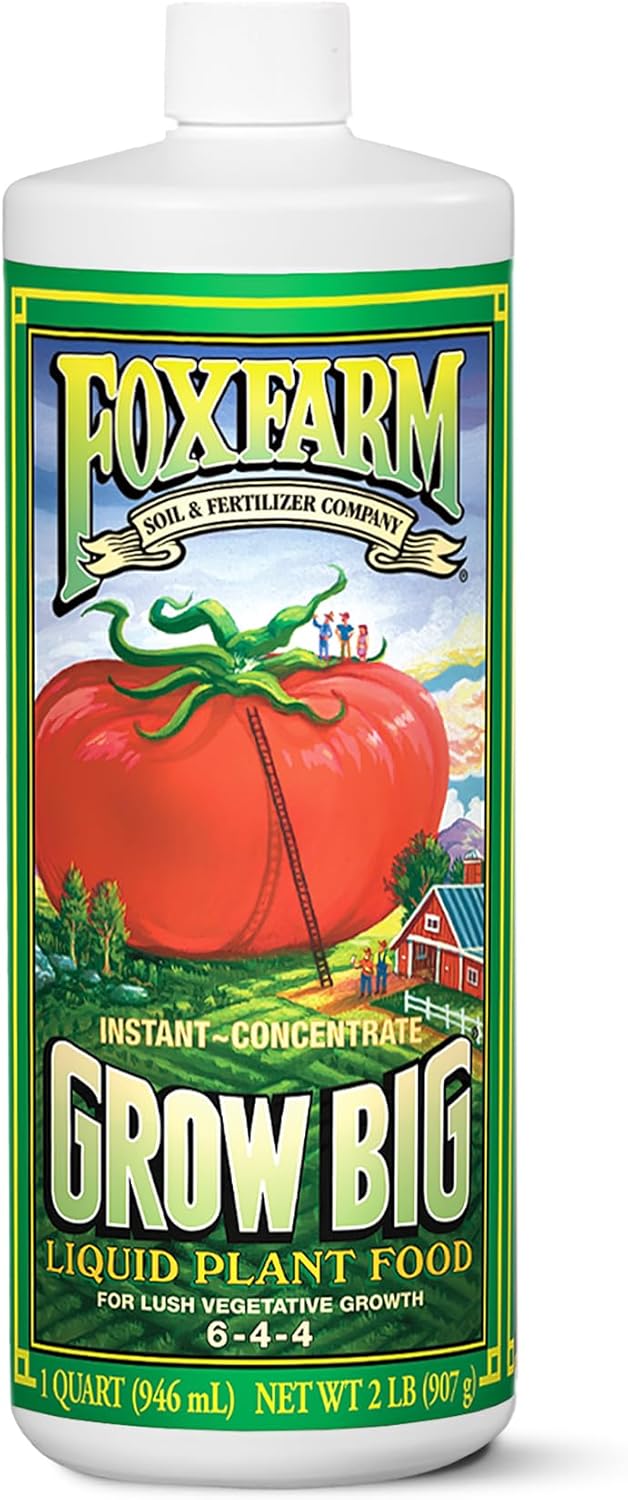
| N-P-K | 6-4-4 |
|---|---|
| Form | Liquid |
| Unit Count | 32 Fluid Ounces |
| Mixing Ratio | 2-3 teaspoons per gallon |
FoxFarm Grow Big is a 6-4-4 liquid concentrate made for fast nutrient uptake and leafy growth. You mix 2 to 3 teaspoons per gallon and apply through watering or foliar feeding, which makes it easy to use on squash seedlings and established vines to encourage larger plants and stronger stems. The low pH formula helps keep micronutrients stable so nutrients stay available after mixing. In practice this product is versatile for in-ground beds and containers where you want steady vegetative development before heavy fruiting. The concentrate format keeps storage and measuring simple and a quart yields many feedings for small plots. It does contain phosphorus so check local restrictions for turf or runoff-sensitive sites, and like other soluble feeds it requires consistent, moderate applications rather than a one-time fix for nutrient-poor soil. For gardeners prioritizing predictable, repeatable feeding, this is a straightforward liquid solution.
Best for: Gardeners who want a dependable, easy-to-dose liquid feed to encourage vigorous vegetative growth in squash and other vegetables and who follow a regular feeding schedule.
Less Ideal for: People seeking a single-application soil amendment for rebuilding depleted soils or those who must avoid phosphorus for regulatory or environmental reasons.
- Concentrated liquid formula mixes easily for foliar or soil application
- Low pH formula helps micronutrient stability and fast uptake
- Versatile for vegetables, houseplants, roses and containers
- Clear mixing instructions (2–3 teaspoons per gallon) for consistent dosing
- Contains phosphorus which may be restricted in some localities due to runoff concerns
- Requires recurring applications rather than correcting long-term soil deficiencies
Verdict: A reliable, easy-to-use liquid concentrate that supplies fast-acting nutrients to support vigorous squash vegetative growth.
Dr. Earth Organic Tomato, Vegetable & Herb Fertilizer (4 lb)

| Item Form | Granules |
|---|---|
| Specific Uses For Product | Organic |
| Coverage | Medium |
| Target Species | Herb |
| Unit Count | 64 Ounce |
This Dr. Earth organic granular fertilizer is designed for vegetable gardens, raised beds and containers and supplies a balanced nutrient boost without synthetic chemicals. It releases nutrients quickly and continues feeding for several months, so you can apply at planting or midseason and expect sustained support for fruiting crops. The formula includes multiple strains of beneficial microbes and both ecto- and endo-mycorrhizae, which can help root health, nutrient uptake and drought tolerance in heavy feeders like squash. It is easy to use as a top-dress or worked into planting holes, and the directions include repeat applications for containers every six weeks. Limitations are that it is a packaged, medium-coverage product best suited to home gardens rather than large acreage, and it contains phosphorus so local runoff rules should be checked before application. For gardeners who prefer an organic, microbe-rich fertilizer, this offers practical, proven benefits for squash and other vegetables.
Best for: Gardeners who want an organic, microbe-rich fertilizer to boost fruiting vegetables like squash and prefer proven product formulations backed by many user reviews.
Less Ideal for: Large-scale growers or landscapers needing bulk coverage or those who must avoid any phosphorus applications due to local regulations.
- Organic granular formula with natural ingredients and no GMOs or chicken manure
- Contains multiple beneficial microbial strains plus ecto- and endo-mycorrhizae to improve nutrient availability and root health
- Feeds quickly and continues to supply nutrients for several months after application
- Versatile for use in vegetable gardens, raised beds, planting holes and containers
- Medium coverage and 4 lb package size may not be economical for large gardens
- Contains phosphorus which may be restricted in some areas due to runoff rules
Verdict: A reliable organic granular fertilizer with beneficial microbes that helps improve root health and sustained feeding for home-grown squash and other vegetables.
Miracle-Gro Water Soluble All Purpose Plant Food, 3 lb

| Item Form | Powder |
|---|---|
| Application Method | Mix with water in a watering can |
| Specific Uses For Product | Plant Food |
| Fertilizer Analysis (N-P-K) | 24-8-16 |
Miracle-Gro Water Soluble All Purpose Plant Food is a powdered, water-soluble fertilizer designed to give plants a quick nutrient boost. It dissolves in watering cans or garden feeders and is intended for use on flowers, vegetables, houseplants, shrubs and trees. The 24-8-16 NPK balance supplies a high dose of nitrogen for rapid leafy growth, plus phosphorus and potassium to support blooms and root health. Typical use is mixing the scoop with the recommended volume of water and applying every 7 to 14 days for outdoor vegetables or every 14 days for houseplants. Practical benefits include fast uptake at the roots for noticeable growth, broad compatibility across plant types and a measured scoop for repeatable mixing. Limitations are the high nitrogen ratio which may favor foliage over fruit set if overapplied, and the need to follow dilution instructions to avoid overfeeding; it is not a slow-release option so it requires regular reapplication for sustained feeding.
Best for: Buyers who want a reliable, easy-to-use fertilizer that produces quick, visible growth for garden vegetables like squash and prefer a straightforward feeding routine.
Less Ideal for: Growers seeking a low-nitrogen or slow-release program focused solely on maximizing fruit set over foliage should consider a different fertilizer.
- Water-soluble powder for fast nutrient uptake
- Broadly labeled safe for indoor and outdoor plants including vegetables
- Includes scoop and clear mixing directions for repeatable application
- Feeds a large area from one container (approximate coverage listed)
- High nitrogen ratio may encourage leafy growth over fruiting if used too frequently
Verdict: A dependable, fast-acting water-soluble fertilizer that delivers quick, repeatable growth for squash and other garden vegetables.
Choosing the Right Fertilizer for Squash: Key Factors to Consider
Nutrient Ratio and Stage-Specific Needs
Squash plants have different nutrient needs as they progress from seedlings to flowering and fruiting. Early growth favors a slightly higher nitrogen level to build leafy vines, while bloom and fruit set benefit from increased phosphorus and potassium to support flower formation and fruit development. Choose a fertilizer with clear N-P-K ratios and consider switching or supplementing feeds when vines begin to flower.
Understanding stage-specific needs helps prevent excessive foliage at the expense of fruiting or conversely underfeeding that leads to poor flower production. For continuous harvests, look for feeding plans or products that provide balanced nutrition throughout the season.
Delivery Format and Application Method
Fertilizers come as granular, water-soluble, liquid concentrate, and slow-release formulations. Granular products are convenient for working into beds at planting or as side dressings. Water-soluble and liquid feeds deliver nutrients quickly and are useful for correcting deficiencies or feeding during bloom. Slow-release options reduce the need for frequent applications and are helpful for busy gardeners or container-grown squash where steady feeding is preferred.
Consider how each format fits your irrigation setup and how easy the product is to measure and apply evenly. Application instructions and the risk of overfeeding should guide your choice, especially if you prefer weekly water-soluble feeds or a single preplant incorporation.
Soil Type and pH Sensitivity
Soil texture and pH influence nutrient availability. Heavy clay holds more nutrients but may need improved drainage for squash; sandy soils leach nutrients and often require more frequent feeding. pH affects uptake of phosphorus and micronutrients; if your soil is very acidic or alkaline, some fertilizers will be less effective unless you address pH first.
Match fertilizer frequency and formulation to your soil. In sandy beds, choose products that release nutrients steadily or plan for more frequent, lighter applications. In heavier soils, incorporate organic matter and select blends that do not exacerbate salt buildup.
Rate Control and Risk of Burn
Squash plants are sensitive to over-application, which can cause leaf burn, reduced fruit set, or root stress. Look for products with clear application rates and dilution instructions. Slow-release and organic-based fertilizers typically lower burn risk, while highly concentrated soluble formulas require careful measurement and thorough watering after application.
Assess how forgiving a product is if you occasionally overapply and whether the instructions offer recovery steps. For new gardeners, options with wider safety margins reduce the chance of damaging young plants.
Secondary Nutrients and Micronutrients
Beyond N-P-K, squash benefits from calcium to reduce blossom-end rot risk and magnesium for healthy leaf color. Trace elements like iron, manganese, zinc, and boron support flowering and pollination. Fertilizers that include or pair easily with micronutrient supplements can prevent common deficiency symptoms that impair yield.
If your soil test shows specific deficiencies, choose a formula or supplemental feed that targets those gaps. For average soils, look for products that include a modest suite of secondary nutrients for robust plant performance.
Convenience and Garden Workflow
How a fertilizer fits into your routine matters as much as its composition. If you water by hand, a water-soluble feed that mixes in a watering can may be ideal. If you use drip irrigation, products labeled safe for fertigation or slow-release granules that can be top-dressed work better. Containers often need lighter but more frequent feeds, while in-ground beds tolerate larger, less frequent applications.
Consider storage, measuring tools, and whether the product can be applied safely around children and pets. Convenience influences how consistently you will feed squash through a growing season.
When to Start Feeding Squash
Begin fertilizing after seedlings are established and have true leaves, typically two to three weeks after transplanting. Preplant soil amendments are helpful, but in-season feeding corrects shortfalls and supports rapid canopy expansion.
Switch feeding approach once flowers appear: reduce high-nitrogen inputs and emphasize phosphorus and potassium to encourage blooms and fruit set. Regular light applications during bloom support consistent yields without promoting excessive leaf growth.
- Preplant: incorporate balanced granular amendment
- Early growth: moderate nitrogen for vine development
- Flowering and fruiting: increase phosphorus and potassium emphasis
Feeding Containers Versus In-Ground Plants
Containers dry and deplete nutrients faster than in-ground beds, so choose soluble or slow-release formulas suited to pots. Containers often need smaller, more frequent doses to avoid salt buildup and ensure roots always have available nutrients.
In-ground squash benefits from larger, less frequent feedings and soil amendments that improve water retention. When using concentrated soluble feeds in beds, water thoroughly after application to move nutrients into the root zone and avoid surface salt concentration.
- Containers: lighter, more frequent feedings
- In-ground: preplant amendment and periodic side-dressing
- Always water in after applying concentrated fertilizers
Organic Versus Synthetic Options
Organic fertilizers release nutrients more slowly and often supply beneficial organic matter that improves soil structure and microbial life. They are generally safer for frequent application and less likely to burn roots, but they may act more slowly when correcting acute deficiencies.
Synthetic feeds offer precise nutrient ratios and rapid uptake, which helps correct deficiencies during bloom. They require careful measurement and attention to application frequency to avoid overfeeding. Many gardeners use a hybrid approach: organic base amendments plus targeted synthetic foliar or water-soluble feeds when needed.
- Organic: slower release, builds soil health
- Synthetic: fast-acting, precise ratios
- Hybrid: use base organic soil improvement with targeted quick feeds
Reading Labels and N-P-K for Squash
Focus on the N-P-K ratio and the absolute amounts of each nutrient per application. Labels should also list secondary nutrients and recommended application timing. For squash, common advice is to avoid excessive nitrogen during flowering and to ensure adequate potassium for fruit quality.
Pay attention to directions for dilution, frequency, and maximum seasonal applications. Clear labeling reduces guesswork and helps prevent misuse that can harm plants or the soil ecosystem.
- Check guaranteed analysis and secondary nutrient listings
- Follow dilution and frequency guidance carefully
- Note application limits per season to avoid buildup
Addressing Common Nutrient Problems
Yellowing leaves, poor flowering, and blossom-end rot point to specific nutritional issues. Yellowing between veins often suggests magnesium or iron deficiency, while blossom-end rot links to calcium availability and inconsistent soil moisture. Identifying symptoms and matching them to appropriate amendments keeps vines productive.
Soil testing is the most reliable way to diagnose issues. Short-term fixes include foliar sprays or soluble supplements, but long-term health comes from correcting soil pH and organic matter content so nutrients remain available through the season.
- Blossom-end rot: check calcium and moisture consistency
- Interveinal chlorosis: consider magnesium or iron supplements
- Use soil tests to guide corrective actions
How We Chose the Best Fertilizer for Squash
We selected products that suit common squash-growing scenarios from small backyard beds to larger vegetable plots. Our editorial filters favored balanced nutrient profiles that support both early vegetative growth and later fruit development, clear application methods gardeners can follow, and product formats that match different maintenance styles such as granular soil amendments, water-soluble feeds, and slow-release blends. Evaluation criteria included guaranteed analysis and nutrient ratios appropriate for squash, clarity and flexibility of application rates and timing, delivery format and how it fits standard watering or irrigation practices, and ingredient transparency including any added secondary nutrients or organic sources. We also considered suitability across soil types and accessibility for container and in-ground plantings. We excluded products lacking clear nutrient labels, experimental blends without usage instructions for cucurbits, and fertilizers formulated for specialty turf or non-edible ornamental use. The resulting shortlist emphasizes practical, garden-ready options that let you tailor feeding to vine stage and site conditions.
FAQ
How often should I feed squash during the growing season?
It depends on the product. Slow-release blends may only need one preplant application, while water-soluble feeds are commonly applied every one to two weeks during active growth and flowering. Container plants generally require more frequent feeding than in-ground plants.
Can I use a general vegetable fertilizer on squash?
Often yes. General vegetable fertilizers with balanced N-P-K ratios are usually suitable for squash, provided you adjust timing to favor less nitrogen during fruiting. Check the label for recommended use on cucurbits and application rates.
Will too much nitrogen affect squash production?
Too much nitrogen can stimulate leafy growth at the expense of flowers and fruit set. If vines look lush but have few blossoms or set fruit poorly, reduce high-nitrogen inputs and switch to a feed with higher phosphorus and potassium.
Is foliar feeding effective for squash deficiencies?
Foliar feeding can provide a quick correction for certain micronutrient deficiencies and is useful when root uptake is limited. It is not a substitute for correcting soil pH or long-term nutrient imbalances, but it can quickly improve leaf color and vigor in the short term.
Should I adjust fertilizer use after heavy rain?
Yes. Heavy rain can leach nutrients from soil, especially in sandy beds, reducing their availability. After heavy rains, consider a light follow-up feeding or a soil test to determine whether additional nutrients are necessary.
Do container-grown squash need different fertilizer concentrations?
Container-grown squash often need lower concentration, more frequent feedings to prevent salt buildup and ensure steady nutrient supply. Use products formulated for containers or follow reduced dilution guidelines for soluble feeds.
Final Verdict
Choose a fertilizer for squash by matching nutrient ratios to plant stage and your garden workflow. Prioritize clear N-P-K labeling, an application format that fits your watering system, and inclusion of secondary nutrients when soil tests indicate a need. Balance the speed of nutrient delivery with risk of burn and the maintenance time you can commit. A practical approach is to start with a balanced base amendment, adjust feeding once flowers appear to favor phosphorus and potassium, and correct specific micronutrient gaps as they show. That strategy keeps vines vigorous and maximizes fruit set across different garden setups.
