

Note: This article contains affiliate links. If you click on these links and make a purchase, I may earn a small commission at no extra cost to you. This helps support my research and content. Read my full affiliate disclosure here.
Growing tomatoes and peppers in containers concentrates both the rewards and the risks. In pots, soil volume is limited so nutrient depletion, salt buildup, and irregular feeding show up fast. Choosing the right fertilizer for tomatoes and peppers in pots makes the difference between leggy plants with few fruits and compact, productive containers loaded with ripe peppers and tomatoes. This guide covers seven top fertilizers shortlisted for container tomato and pepper culture. We focus on how products deliver balanced nutrients, timing and frequency of feeding, application ease, and how they interact with potting mixes and watering routines. Read on to find the feeding approach that fits your container setup and gardening style.
Top Picks at a Glance
| Best Overall The best all-around choice for most situations | Jack's Classic 12-15-30 Veggie FeED Water‑Soluble Fertilizer (1.5 lb) |  |
| Best Quality Built to a higher standard if you want something more solid | FoxFarm Happy Frog Tomato & Vegetable Fertilizer, 5-7-3 Blend, 4 lb |  |
| Best Value The sweet spot between price and what you get | Miracle-Gro Liquid All Purpose Plant Food Concentrate, 32 oz |  |
| Best Budget The cheapest option that still gets the job done reliably | Jobe's Tomato Fertilizer Spikes, 18 Count |  |
| Highest Rated A top-rated pick with lots of positive feedback | FoxFarm Grow Big Liquid Plant Food, 6-4-4 Quart Concentrate |  |
| Most Popular A crowd favorite that many people choose with confidence | Miracle-Gro Water Soluble Tomato Plant Food, 1.5 lb |  |
| Best Seller A high-volume bestseller chosen again and again | Burpee Organic Tomato & Vegetable Granular Plant Food, 4 lb |  |
Jack's Classic 12-15-30 Veggie FeED Water‑Soluble Fertilizer (1.5 lb)

| Item Form | Powder |
|---|---|
| Specific Uses For Product | Fruit and Vegetable Production |
| Application Method | Spray or Mix with Water |
| Mixing Ratio | 12:15:30 |
Jack's Classic Veggie FeED is a concentrated, water‑soluble powder designed to feed fruiting vegetables through root drench or foliar spray. You mix the powder with water (the product includes a measuring spoon) and apply either every watering at a light rate or as a stronger feed every 7 to 14 days according to the label. The 12-15-30 analysis supplies higher potassium for flowering and fruit development while the included micronutrients and added calcium support overall plant health and reduce blossom problems. As a powdered formula it is economical because a small container yields many gallons of solution, and it works well in pots, raised beds, drip systems, or foliar applications. Limitations to note are that precise measuring and mixing are required to avoid overfeeding and that the product does not include specific pH adjustment; growers in hard water areas may need to monitor water chemistry separately. This is a straightforward, flexible fertilizer for gardeners who want professional‑grade soluble nutrition for tomatoes, peppers, and other fruiting vegetables in containers.
Best for: Gardeners growing tomatoes and peppers in pots who want a single, professional‑grade soluble feed to encourage strong vegetative growth and reliable fruiting, delivered by regular mixing and application.
Less Ideal for: Beginners who prefer pre‑measured liquid feeds or users who need a fertilizer that also conditions water pH should consider simpler or combined products instead.
- High potassium‑forward 12-15-30 formula that supports flowering and fruit set
- Includes micronutrients and added calcium to help reduce blossom problems
- Water‑soluble powder is concentrated and economical for making multiple gallons of feed
- Can be used as foliar spray or root drench and fits container, raised bed, and drip applications
- Requires careful measuring and mixing to avoid nutrient burn
- Does not include pH adjustment or conditioning for very hard or alkaline water
Verdict: A concentrated, micronutrient‑balanced soluble feed that gives potted tomatoes and peppers the potassium and trace elements they need for bigger yields.
FoxFarm Happy Frog Tomato & Vegetable Fertilizer, 5-7-3 Blend, 4 lb

| Item Form | Granules |
|---|---|
| Specific Uses For Product | Vegetables, Tomatoes, Soft Fruits, and Berries |
| Unit Count | 64 Ounce |
| Mixing Ratio | 5:7:3 |
| Target Species | Vegetables |
This granular FoxFarm Happy Frog fertilizer supplies a balanced 5-7-3 N-P-K blend designed to support leafy growth and plentiful fruit set, plus added calcium and mycorrhizal fungi to improve root uptake and reduce blossom end rot. It is applied to in-ground beds and containers following the package directions and is suitable across vegetable plantings. The OMRI listing means it fits organic-minded plots, and the inclusion of mycorrhizae can help young roots access nutrients and moisture more efficiently. For root crops such as turnips the moderate nitrogen level encourages healthy foliage without overly stimulating excessive top growth that can reduce root development when used at recommended rates. Practical limits are that it is a general vegetable formula rather than a turnip-specific mix, so tight control of nitrogen and timing is still needed for optimal root size, and application rates must be followed to avoid uneven root formation. The dry granules are easy to store and apply but require incorporation or watering in to activate nutrients.
Best for: Gardeners focused on reliable, performance-oriented nutrition for a variety of vegetable crops who want an organic-certified, all-purpose fertilizer that supports both roots and fruiting.
Less Ideal for: Growers seeking a specialized low-nitrogen or root-maximizing formula specifically for large-scale root vegetable production should consider a product formulated expressly for root crops.
- Balanced 5-7-3 N-P-K suited to vegetables that need both foliage and root development
- Contains calcium to help prevent blossom end rot and related fruiting issues
- Includes mycorrhizal fungi to improve root nutrient and water uptake
- OMRI listed, making it acceptable for organic gardens
- Granular form is simple to store, measure, and apply to containers or beds
- Not tailored specifically to root crops so growers may need to adjust application timing or rates for turnips
- Sold in a single size that may require multiple purchases for larger plots
Verdict: Choose this OMRI-listed 5-7-3 granular if you want a performance-oriented, organic-friendly fertilizer that supports healthy roots and reliable vegetable yields.
Miracle-Gro Liquid All Purpose Plant Food Concentrate, 32 oz

| Item Form | Liquid |
|---|---|
| Specific Uses For Product | Plant Growth, Root Development |
| Application Method | Mix with water in a watering can |
| Mixing Ratio | 1:10 (concentrate to water, estimate) |
Miracle-Gro Liquid All Purpose is a water-soluble concentrate you mix into a watering can and apply every 1 to 2 weeks to container and in-ground plants. It is formulated for general plant growth and root development and is marketed for flowers, vegetables, shrubs and houseplants, so it works as a straightforward feed for flowering bulbs like calla lilies. The bottle’s mixing guidance (cap measures for garden application and 1 teaspoon per gallon for containers) makes it easy to dose for pots or small beds. Practical benefits include fast uptake through the soil when applied as directed and compatibility with routine watering schedules. Limitations to note are that it is an all-purpose formula rather than a bloom-focused or calcium-rich fertilizer tailored specifically to calla lilies, so growers seeking targeted bloom enhancement or specialty nutrition may want a supplement. Also, frequent use at higher-than-recommended strength can risk fertilizer burn, so follow the mixing directions and schedule.
Best for: Buyers who want an affordable, easy-to-use liquid fertilizer to keep calla lilies and other flowering plants regularly fed without fuss.
Less Ideal for: Growers seeking a specialist bloom-boost or a fertilizer formulated for specific micronutrient needs should consider a targeted or bloom-specific product instead.
- Concentrated liquid mixes easily with water for quick application
- Clear dosing instructions for both garden beds and container plants
- Suitable for a wide range of plant types including flowering bulbs and houseplants
- General all-purpose formula not specifically formulated for enhancing blooms of calla lilies
Verdict: A budget-friendly, easy-to-use liquid concentrate that reliably feeds calla lilies and other common garden plants on a regular schedule.
Jobe's Tomato Fertilizer Spikes, 18 Count

| Unit Count | 18 Count |
|---|---|
| NPK | 6-18-6 |
| Application Method | Insert spikes around the plants |
| Target Species | Tomato |
Jobe's Tomato Fertilizer Spikes are simple root-feeding sticks designed to deliver balanced nutrients directly to tomato roots over several weeks. Use one or more spikes inserted into the soil around each plant at planting or early in the season and the slow-release formula releases phosphate-heavy nutrition aimed at supporting flowering and fruit set. The pre-measured spikes eliminate guesswork and reduce mess compared with granular or liquid feeds, and the waterproof pouch helps keep leftovers dry. Practical benefits include targeted feeding that is less likely to wash away and an easy schedule—reapply roughly every eight weeks during the growing season. Limitations are that spikes provide a fixed NPK (6-18-6) so you cannot fine-tune ratios mid-season, and the fixed dose may not match very large or very small plants exactly. Also phosphorus-containing fertilizers are regulated in some areas, so check local guidance before use.
Best for: Gardeners who want a low-effort, no-mess way to support tomato flowering and fruiting and who prefer simple, periodic feeding over frequent applications.
Less Ideal for: Growers who need precise control over nutrient ratios, those managing large-scale production, or gardeners in jurisdictions restricting phosphorus use.
- Slow-release spikes deliver nutrients directly to the root zone for up to eight weeks
- Pre-measured sticks remove mixing and measuring errors and reduce mess
- High phosphorus (18) supports flower development and fruit set
- Waterproof resealable packaging keeps unused spikes dry
- Fixed 6-18-6 formula does not allow adjusting nutrient ratios for specific plant needs
- Single-dose spikes may be too strong or too weak for unusually large or small plants
Verdict: An easy, budget-friendly root-feeding option that reliably boosts tomato flowering and fruit set with pre-measured slow-release spikes.
FoxFarm Grow Big Liquid Plant Food, 6-4-4 Quart Concentrate
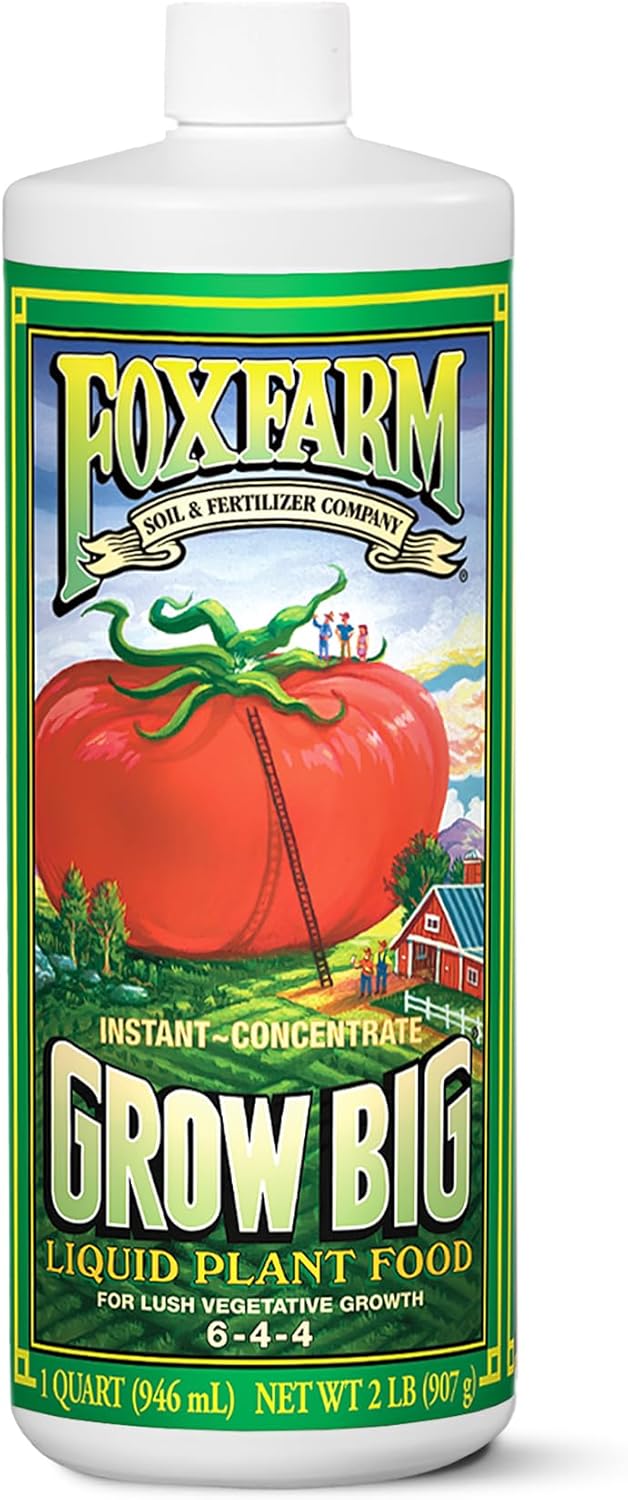
| N-P-K | 6-4-4 |
|---|---|
| Form | Liquid concentrate |
| Unit count | 32 Fluid Ounces |
| Mixing ratio | 2-3 teaspoons per gallon |
FoxFarm Grow Big is a water-soluble concentrate designed to boost vegetative growth and speed nutrient uptake in vegetable gardens and ornamentals. Mixed at 2 to 3 teaspoons per gallon, it can be applied through watering or foliar feeding to quickly deliver nitrogen-focused nutrition that supports larger plants and stronger stems. The low pH formula helps keep micronutrients stable so feedings remain effective, and the quart concentrate covers repeated applications for a small plot or a set of containers. Practical benefits include clear mixing instructions, versatility for both indoor and outdoor use, and a fast-acting effect when plants need a growth push. Limitations to note are the higher nitrogen emphasis, which favors leaf and stem growth over bloom or fruit set, and the presence of phosphorus in the formula that may be restricted in some local lawn rules. For gardeners who prioritize consistent, predictable feedings, this product is straightforward to measure and integrate into a regular watering schedule.
Best for: Gardeners who want a reliable, easy-to-dose liquid fertilizer to encourage rapid vegetative growth in vegetable beds, containers, and established plants and who value predictable results from each feeding.
Less Ideal for: Growers focused primarily on maximizing flowering or fruit set who need a bloom-boosting formula or those working under strict phosphorus-use restrictions in their area.
- Concentrated liquid formula for fast nutrient uptake and quick visible response
- Low pH formulation helps maintain micronutrient stability during storage and application
- Versatile application by watering or foliar feeding for indoor and outdoor use
- Clear mixing ratio (2–3 teaspoons per gallon) simplifies repeatable feedings
- Nutrient ratio (6-4-4) emphasizes vegetative growth rather than flowering or fruit production
- Contains phosphorus which may be restricted by local regulations for turf or non-agricultural use
Verdict: Choose this concentrate when you want a dependable, fast-acting liquid feed to promote vigorous leafy and structural growth in a vegetable garden.
Miracle-Gro Water Soluble Tomato Plant Food, 1.5 lb

| Item Form | Liquid |
|---|---|
| Application Method | Water Soluble |
| Target Species | Great for tomatoes and vegetables |
| Mixing Ratio | 18-18-21 |
Miracle-Gro Water Soluble Tomato Plant Food is a water-soluble fertilizer intended to boost vegetable growth by delivering nutrients quickly through a watering can or Miracle-Gro Garden Feeder. Its 18-18-21 mixing ratio supplies balanced nitrogen, phosphorus, and potassium so plants get a steady supply of the elements they need for leafy growth, flowering, and fruit set. Use it by mixing the recommended dose into a watering can for outdoor containers or in-ground beds and apply every 7 to 14 days during the growing season. The product works fast because it dissolves completely and can be applied directly to the root zone, which is useful for impatient gardeners trying to push tuber and foliage development in potatoes. On the downside it is a concentrated chemical fertilizer rather than an organic option and requires careful measuring to avoid overfeeding. Coverage notes from the brand indicate a small 1.5 lb package is meant to feed a modest area when used with the Garden Feeder, so larger plots will need multiple containers.
Best for: Ideal for gardeners on a budget who want a straightforward, fast-acting fertilizer to boost potato foliage and tuber development without complicated application methods.
Less Ideal for: Not the best choice for growers seeking organic or slow-release nutrition or for those managing large acreages who need bulk, long-lasting supplies.
- Water-soluble formula mixes easily for quick nutrient uptake
- Balanced NPK (18-18-21) supports foliage, flowers, and fruit development
- Designed for use with watering cans or the Miracle-Gro Garden Feeder for convenient application
- Feeds quickly when applied every 7 to 14 days during the growing season
- Concentrated synthetic formula, not an organic fertilizer
- 1.5 lb package is small for larger vegetable plots and will require frequent repurchasing
Verdict: A simple, fast-acting water-soluble fertilizer that gives budget-minded vegetable growers an easy way to boost potato growth and yields.
Burpee Organic Tomato & Vegetable Granular Plant Food, 4 lb

| Item Form | Granules |
|---|---|
| Specific Uses For Product | Gardening,Plant Growth,Root Development |
| Application Method | Sprinkle |
| Coverage | 160 Square Feet |
| Mixing Ratio | 3-6-4 |
This Burpee organic granular plant food is an all-purpose, OMRI-listed fertilizer designed for vegetable gardens, containers, and seed starting. You apply it by sprinkling the granules around the base of plants and watering in; the formula provides an initial boost of nutrients and a slow release that the manufacturer says lasts up to three months. The product lists a 3-6-4 mixing ratio and a coverage of about 160 square feet for the 4 lb bag, making it easy to estimate how much to use across beds or several containers. Practical benefits include simple dry application with no measuring or mixing required for spot feeding, organic certification for gardeners who prefer low-chemical inputs, and a nutrient blend that supports root development and steady growth through the season. Limitations are the fixed bag size and coverage, which may require multiple bags for larger plots, and the granular form means you must distribute it evenly and water thoroughly to activate nutrients. For cautious gardeners wanting organic, low-effort feeding for vegetables, this is a straightforward option.
Best for: Practical home gardeners who prioritize organic, low-chemical inputs and want a simple, no-fuss fertilizer to feed tomatoes and other vegetables through the season.
Less Ideal for: Gardeners managing large-scale vegetable beds who need higher-volume or custom nutrient programs should consider bulk or concentrated alternatives.
- OMRI-listed organic formula suitable for organic vegetable production
- Granular form is easy to apply by sprinkling around plants with no mixing
- Provides both immediate nutrients and slow release feeding for up to three months
- Clear application method and coverage guidance simplify use for new gardeners
- 4 lb bag covers a limited area and may not be economical for large vegetable plots
- Granules require even distribution and consistent watering to be effective
Verdict: A simple OMRI-listed granular fertilizer that gives organic gardeners an easy, season-long feed for tomatoes and vegetables.
Choosing the Right Fertilizer for Tomatoes and Peppers in Pots: Key Factors to Consider
Nutrient Balance and Stage-Specific Ratios
Tomatoes and peppers have shifting nutrient needs from seedling to fruiting. Young plants and transplants benefit from slightly higher nitrogen to support foliage and root growth. Once flowers form and fruit sets, a lower nitrogen and higher phosphorus and potassium ratio helps promote bloom retention, fruit development, and flavor. Micronutrients such as calcium, magnesium, and boron are important in containers because deficiencies show quickly in limited soil. Calcium, for example, reduces blossom end rot risk in tomatoes when it is available consistently. Choosing a fertilizer with stage-appropriate N-P-K or a plan to switch formulas mid-season helps avoid excess foliage at the expense of fruit.
Release Type and Predictability
Fertilizers for container use come as water-soluble concentrates, slow-release granules, or coated controlled-release pellets. Water-soluble feeds deliver nutrients fast and are useful for quick corrections or frequent fertigation but require regular application and careful dosing. Slow-release granules provide steadier delivery without frequent mixing but can vary in how long they last depending on temperature and watering. Predictability matters because pots dry and warm faster than in-ground beds, which can accelerate nutrient release and shorten the effective life of slow-release products. Match release type to how often you want to feed and how hands-on you are with watering and monitoring.
Salt Management and Root Safety
Salt accumulation is a major concern in containers because salts concentrate as water evaporates. High-salt fertilizers or over-application can cause root burn, reduced water uptake, and leaf scorch. Look for formulations that list low-salt indexes or are recommended for container use, and follow label rates carefully. Regular leaching by flushing pots with extra water during long dry spells helps prevent buildup. Also consider fertilizers with lower immediate salt impact, such as milder soluble feeds or slow-release options that release nutrients gradually to minimize spikes.
Compatibility With Your Watering and Feeding Routine
How you water and how frequently you can feed should influence product choice. If you irrigate daily or use wick or drip systems, a soluble feed integrated into the water can be efficient. If you water sporadically, a slow-release granule that lasts several weeks reduces the chance of missed feedings. Check whether a product is suitable for fertigation, foliar sprays, or top-dressing so it fits your existing routine. Also consider how easy it is to measure and apply the recommended dose, since small container volumes make over-application easier.
Longevity and Season Management
Container crops need consistent nutrition from transplant to harvest. Fertilizers vary in how long a single application lasts, from weekly soluble feeds to slow-release products that claim multiple months. In practice, temperature, pot size, and watering frequency shorten or lengthen effective longevity. Plan a feeding schedule that keeps nutrients steady through flowering and fruit set without overdosing during vegetative growth. Also plan for mid-season adjustments such as switching to a bloom/fruiting formula or adding calcium if blossom end rot symptoms appear.
Container Soil and Fertilizer Interactions
Potting mix composition affects how a fertilizer behaves. High peat or coir mixes hold moisture and nutrients differently from mixes with more perlite or pumice. A lightweight mix will dry faster and may require more frequent soluble feeding, while a heavier mix can retain nutrients longer but risk slower drainage. Consider the cation exchange capacity and organic matter level in your potting mix because they influence nutrient retention and leaching.
Adjust fertilizer frequency and strength to the mix. In mixes with a lot of compost or slow-release amendments, start with lower rates of supplemental fertilizer to avoid nutrient excess. In inert mixes, rely more on soluble feeds or a balanced slow-release program.
- Test how fast your pots dry in summer to estimate feed frequency.
- Reduce feed strength when using compost-amended mixes.
- Flush containers occasionally to remove accumulated salts.
Timing Feeding Around Flowering and Fruit Set
Shift feeding emphasis as plants move into bloom. Early-season nitrogen helps build foliage, but once flowers appear switch to a formula or schedule that supports fruit development with adequate phosphorus and potassium. Overfeeding nitrogen during bloom can reduce flower retention and delay fruiting.
For peppers, consistent moderate feeding during fruit fill helps size and color development. For tomatoes, steady potassium is particularly important during fruit ripening to support sugars and overall fruit quality.
- Begin switching focus when the first buds appear.
- Keep feeding consistent to reduce blossom drop.
- Supplement with calcium if you see early signs of blossom end rot.
Practical Application Methods for Busy Gardeners
Choose a method that fits how much time you have. If you prefer low-maintenance, a single application slow-release product at planting combined with a light mid-season boost may be the best fit. If you like hands-on care, water-soluble feeds allow precise control and quick correction of deficiencies.
For automated or drip systems, use soluble fertilizers labeled for fertigation and follow concentration guidelines closely. For foliar feeding, use light concentrations and apply in the cool part of the day to avoid leaf burn.
- Set calendar reminders for soluble feedings during active growth.
- Label pots with feed date and type to track what you applied.
- Use a measuring spoon or syringe for small container doses.
Addressing Common Problems in Container Tomatoes and Peppers
Symptom-driven adjustments are often the fastest way to correct issues. Yellowing older leaves and stunted growth can indicate nitrogen deficiency, while blossom end rot and brown spots on fruits point to inconsistent calcium availability or water stress. Leaf curling, tip burn, or browned leaf edges may signal salt stress from over-fertilization.
Before changing products, try adjusting feed frequency and flushing the potting mix. Often a lighter, more frequent feed or a thorough leach will resolve symptoms without switching fertilizer types.
- Confirm symptoms before changing nutrient plans.
- Flush if salts are suspected, then resume with a milder feed.
- Consider a foliar spray for quick micronutrient correction.
Scaling From Single Pots to Many Containers
If you maintain several tomato or pepper pots, consistency and ease of measurement become more important. Bulk-soluble concentrates can be efficient for multiple containers but require careful dilution to avoid overdosing small pots. Slow-release granules are convenient for large numbers of pots because one application can treat many plants for weeks.
Standardize pot sizes and potting mix across your collection to simplify feeding schedules. When sizes vary, create tiered dosing plans so larger containers receive proportionally more fertilizer without risking smaller pots.
- Group pots by size to streamline feeding.
- Use labeled jugs or dispensers with pre-measured mixes.
- Record results so you can refine dosing each season.
How We Chose the Best Fertilizer for Tomatoes and Peppers in Pots
We evaluated fertilizers specifically for container-grown tomatoes and peppers using criteria that reflect real pot-gardening challenges. Key criteria included nutrient balance and targeted N-P-K ratios suited to fruiting stage, the predictability of release (slow-release vs soluble feeds), and salt management to reduce the risk of root burn in small soil volumes. We also weighed application convenience and flexibility, such as compatibility with fertigation, foliar feeding, or simple mixing schedules. Longevity and refeed intervals mattered because frequent watering in pots leaches nutrients faster than in-ground beds. Finally, we considered formulation stability and clarity of instructions so gardeners can follow safe dosing. We excluded general-purpose lawn fertilizers and products intended only for large-scale field application that lack container dosing guidance. Products without clear nutrient analysis or feeding directions were removed from consideration. The short list reflects options that balance steady nutrition, ease of use, and low risk of salt buildup in container tomato and pepper culture.
FAQ
How often should I feed tomatoes and peppers in pots?
Frequency depends on the fertilizer type. Water-soluble feeds are often applied every 1 to 2 weeks during active growth. Slow-release products can last several weeks to months but perform differently based on temperature and watering. Monitor plant vigor and adjust frequency rather than relying on a fixed schedule.
Can I use garden fertilizer meant for beds in container tomatoes and peppers?
Garden formulations for in-ground use may be higher strength and designed for larger soil volumes. Containers need gentler, clearly dosed applications because salts build up more quickly. If using a garden product, reduce the rate and increase leaching frequency, or choose a product labeled for container use.
What signs indicate my pots have too much fertilizer?
Leaf browning at the edges, scorched leaf tips, slowed growth, and reduced flowering can indicate salt buildup or overfeeding. A white crust on the soil surface is another sign. If you see these, flush the container with plenty of water and cut back on feed strength or frequency.
Do tomatoes and peppers need different fertilizer ratios?
They have similar broad needs but slight differences in timing. Both benefit from higher nitrogen early and higher phosphorus and potassium during fruiting. Peppers are often more sensitive to nutrient swings, so steady, moderate feeding tends to work well for them.
Is foliar feeding useful for container-grown tomatoes and peppers?
Foliar sprays can quickly correct micronutrient deficiencies and are useful when root uptake is limited. Use light concentrations and apply during cool hours to avoid leaf burn. Foliar feeding is a supplement, not a replacement for a balanced root-feeding program.
Final Verdict
For container tomatoes and peppers, prioritize predictable nutrient delivery, salt control, and feeding methods that match your watering habits. Choose a fertilizer with the right stage-specific ratios or plan to switch formulas as plants move from vegetative growth to fruiting. Balance frequency and strength so that plants receive steady nutrients without salt stress. Ultimately, pick the feeding approach you will maintain consistently. Regular monitoring, occasional flushing, and small adjustments based on plant symptoms will produce the best fruit set and flavor in pots.
