

Note: This article contains affiliate links. If you click on these links and make a purchase, I may earn a small commission at no extra cost to you. This helps support my research and content. Read my full affiliate disclosure here.
Starting a new lawn in spring sets the tone for its health through the first growing season and beyond. The right fertilizer helps seedlings or newly laid sod develop strong roots, resist weeds, and build the carbohydrate reserves that support summer stress tolerance. This guide covers seven well-chosen fertilizer options suited for new lawns planted or established in spring, shortlisted for their appropriate nutrient ratios, delivery methods, and safety for young grass. You will find clear criteria we used to evaluate each product, plus practical advice on timing and application so you can pick the right feeding strategy for your soil and grass type.
Top Picks at a Glance
| Best Overall The best all-around choice for most situations | Scotts Turf Builder Liquid Starter Lawn Food, 32 fl. oz. |  |
| Best Quality Built to a higher standard if you want something more solid | The Andersons Premium New Lawn Starter Fertilizer (20-27-5), 18 lb |  |
| Best Value The sweet spot between price and what you get | Jonathan Green Green-Up Lawn Food for Seeding & Sodding (12-18-8), 5 lb |  |
| Best Budget The cheapest option that still gets the job done reliably | Ferti-lome New Lawn Starter Fertilizer 9-13-7, 4 lb |  |
| Highest Rated A top-rated pick with lots of positive feedback | Espoma Turf-Tone Lawn Starter Organic 4-6-3 Fertilizer, 30 lb |  |
| Most Popular A crowd favorite that many people choose with confidence | Scotts Turf Builder Starter Food for New Grass, 15 lb |  |
| Best Seller A high-volume bestseller chosen again and again | Scotts Turf Builder Triple Action Built for Seeding, 4.3 lb |  |
Scotts Turf Builder Liquid Starter Lawn Food, 32 fl. oz.

| Item Form | Liquid |
|---|---|
| Specific Uses For Product | Lawn Grass Seedling Establishment |
| Target Species | Lawn Grass |
| Unit Count | 32 Fluid Ounces |
| Item Highlight | Lawn Fertilizer for New Grass, 7-12-15 NPK |
This Scotts Turf Builder Liquid Starter Lawn Food is a ready-to-use hose-end fertilizer designed for establishing new lawns in spring. With an NPK ratio of 7-12-15 it emphasizes phosphorus to promote early root development while nitrogen aids greening and potassium supports turf resilience. Typical use is simple: attach the included reusable applicator to a garden hose and spray the lawn once the seedlings appear, repeating weekly for three weeks to cover about 600 sq. ft. per bottle. The translucent bottle and hose connection make application quick and easy, and the liquid format feeds and waters seedlings at the same time for faster, more uniform coverage than granular products. Limitations are that one 32 fl. oz. bottle only treats a modest area and you must follow the three-week schedule for best results; larger lawns will need multiple bottles or a different product. For gardeners who want a low-effort starter feed for spring seedings, this is a practical, user-friendly option.
Best for: Homeowners seeding or overseeding a small to medium spring lawn who want a simple, low-effort starter feed to speed establishment without specialized equipment.
Less Ideal for: Those with large lawns, commercial sites, or gardeners seeking a single-application granular fertilizer should consider higher-coverage or different-format options.
- Ready-to-spray hose-end applicator for fast, no-mess application
- Starter-focused NPK 7-12-15 promotes root development and early growth
- Translucent bottle allows visible control of application amount
- Liquid format simultaneously waters and feeds seedlings for even coverage
- 32 fl. oz. bottle covers only about 600 sq. ft. for the recommended three feedings
- Requires weekly applications for three consecutive weeks to be effective
Verdict: An easy, ready-to-spray starter fertilizer that makes quick work of feeding new spring lawns to encourage faster, thicker establishment.
The Andersons Premium New Lawn Starter Fertilizer (20-27-5), 18 lb

| Item Form | Granules |
|---|---|
| Specific Uses For Product | Lawn |
| Coverage | 5000 |
| Mixing Ratio | 20:27:5 |
This starter fertilizer is made specifically for establishing new lawns and is formulated to encourage seedling vigor and root development. You apply it before seeding or laying sod, working it into the top few inches of soil and keeping the area moist until germination. The 20-27-5 analysis means it supplies extra phosphorus for strong root growth while the blend of quick- and slow-release nitrogen gives an initial boost and continued feeding. It also includes micronutrients and a small amount of iron for improved greening. The granular form and 5,000 sq ft coverage make it practical for mid-sized yards, and directions note it is best used in spring or fall when conditions favor establishment. Important limitations are that it must be incorporated into soil and kept moist for best results and that it is a starter product rather than a routine maintenance fertilizer, so additional feedings will be needed later in the season.
Best for: Homeowners installing new sod or seed who want a purpose-built starter fertilizer to encourage fast germination and strong root establishment.
Less Ideal for: Those looking for an all-season maintenance fertilizer or a liquid feed system should consider other products tailored to ongoing lawn care or different application methods.
- High phosphorus ratio to promote root development in new lawns
- Combination of quick- and slow-release nitrogen for both immediate and sustained feeding
- Granular form with coverage up to 5,000 sq ft simplifies application for mid-sized yards
- Includes micronutrients and 1% iron for healthier, deeper greening
- Designed as a starter product so it does not replace regular maintenance fertilization
Verdict: Choose this starter fertilizer when you need a phosphorus-rich, granular product to jump-start root development and establishment in new lawns.
Jonathan Green Green-Up Lawn Food for Seeding & Sodding (12-18-8), 5 lb

| N-P-K | 12-18-8 |
|---|---|
| Item Form | Granules |
| Coverage | Up to 1,500 sq ft |
| Unit Count | 72 Ounce |
| Specific Uses For Product | Lawn (seeding & sodding) |
Jonathan Green Green-Up is a purpose-built starter fertilizer for new lawns and overseeding that pairs a high-phosphorus formula with slow-release nitrogen to help seedlings and sod develop strong roots and steady top growth. It is sold as a 5 lb granular bag that covers up to 1,500 square feet and is applied with a spreader the same day as seeding or sodding, then irrigated in. The 12-18-8 analysis emphasizes phosphorus to stimulate root establishment while humates and micronutrients improve nutrient availability. In practice this means faster root set, better sod take, and reduced risk of seedling burn compared with high-soluble nitrogen products. Practical users will appreciate the clear directions (3 lb per 1,000 sq ft) and compatibility with common cool- and warm-season grasses. The main limitations are that coverage is modest for larger yards and it is optimized for establishment rather than long-term feeding, so plan a follow-up maintenance fertilizer schedule after the first two months.
Best for: Homeowners seeding or laying sod in spring who want a straightforward, establishment-focused fertilizer to promote quick root set and dependable early growth.
Less Ideal for: People managing large acreage or those seeking an all-season feed solution; maintenance or slow-release landscape fertilizers are a better fit for long-term feeding.
- High phosphorus (18%) formulation to encourage root development in new seed and sod
- Slow-release nitrogen provides steady feeding and lowers burn risk for young grass
- Covers up to 1,500 sq ft from a single 5 lb bag for small to medium lawns
- Includes humates and micronutrients to improve nutrient availability and early vigor
- 5 lb bag provides limited coverage for larger yards, requiring multiple bags for big areas
- Formulated specifically for establishment so it does not replace regular maintenance fertilizer
Verdict: Choose this product when you need a reliable starter fertilizer that prioritizes root establishment for newly seeded or sodded lawns in spring.
Ferti-lome New Lawn Starter Fertilizer 9-13-7, 4 lb

| Mixing Ratio | 9:13:7 |
|---|---|
| Item Form | Granules |
| Application Method | Spread |
| Specific Uses For Product | Lawn |
| Coverage | 1 |
This 4 lb bag of Ferti-lome New Lawn Starter is a straightforward granular starter fertilizer with a 9-13-7 N-P-K balance designed for use when seeding or laying sod. It is applied with a drop or broadcast spreader at 4 lbs per 1,000 sq ft and can be worked lightly into the top couple inches of soil to encourage root establishment. The higher phosphate level supports early root development, which is the key goal for spring new lawn work, and the granule form makes it easy to spread evenly. Practical benefits include clear application instructions, coverage suitable for small lawns or patching, and compatibility with seeding or immediate post-seeding use. Limitations are the small bag size if you have more than 1,000 sq ft to cover and the single-duty formulation that is optimized for establishment rather than ongoing feeding, so you will need follow-up applications during the growing season.
Best for: Homeowners starting a small new lawn, overseeding patches, or installing sod who want a purpose-built starter fertilizer and clear application guidance while staying budget conscious.
Less Ideal for: Those seeding or renovating larger properties where a larger bag or bulk fertilizer would be more economical or people wanting an all-season feed in a single product.
- Starter-specific 9-13-7 formula that prioritizes root development for new seed and sod
- Granular form that spreads easily with a drop or broadcast spreader for uniform application
- Clear use instructions for rate and incorporation to help establish seedlings
- Coverage appropriate for small lawns or spot repairs when following the recommended rate
- 4 lb bag only covers about 1,000 sq ft at the recommended rate, so larger areas require multiple bags
- Formulation is intended for establishment and does not replace regular seasonal fertilization
Verdict: A simple, purpose-made starter fertilizer that gives new seed and sod the root-focused nutrients they need to establish in spring.
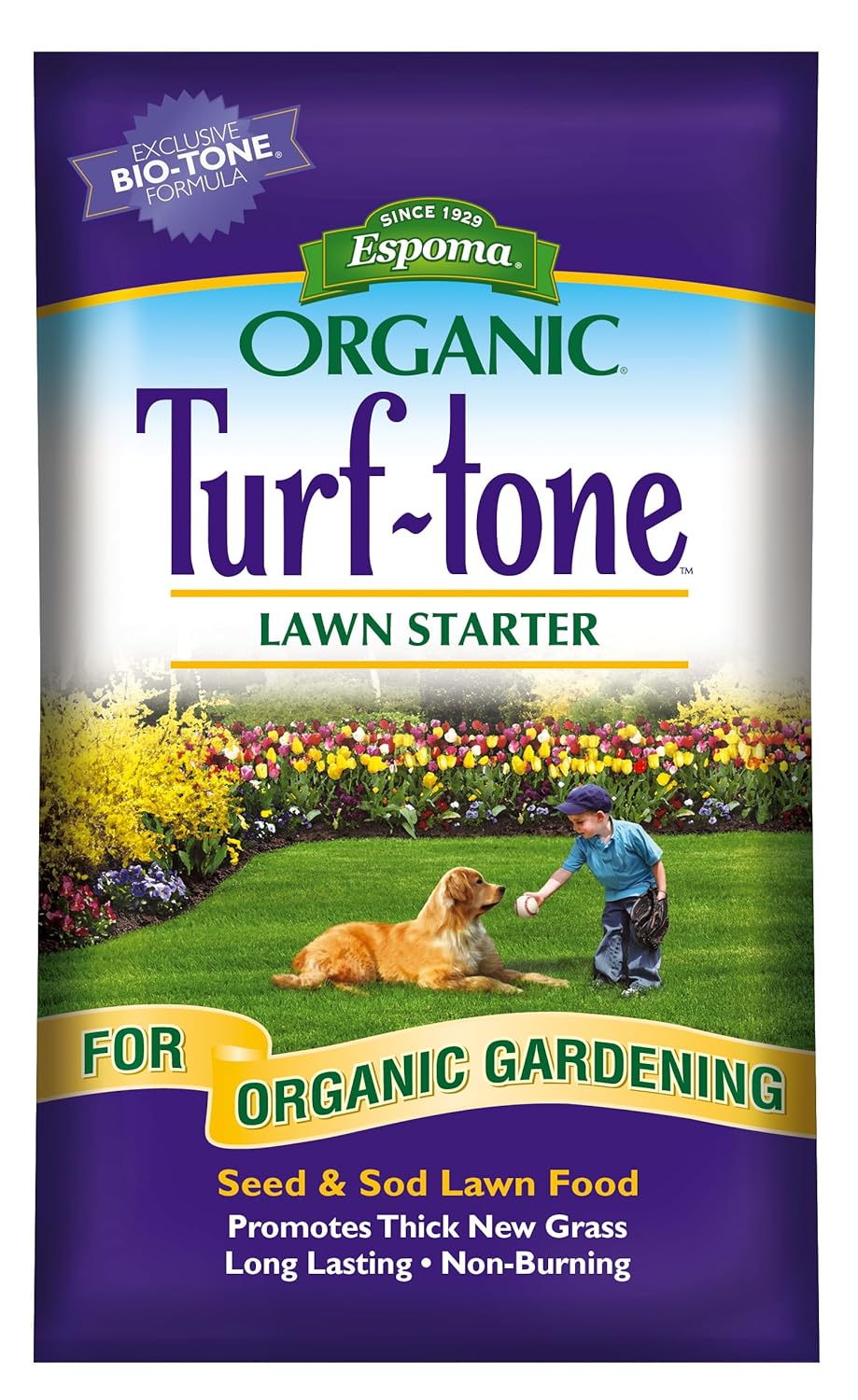
Espoma Turf-Tone Lawn Starter Organic 4-6-3 Fertilizer, 30 lb
| Item Form | Granules |
|---|---|
| Application Method | Apply with a drop or broadcast spreader. |
| Target Species | Lawn Grass |
| Mixing Ratio | 4:6:3 |
Espoma Turf-Tone Lawn Starter is an organic granular starter fertilizer designed for establishing new turf, overseeding, or laying sod. It is applied with a drop or broadcast spreader and supplies a 4-6-3 ratio that emphasizes phosphorus for root development while providing long-lasting nitrogen and Espoma's Bio-tone formula to support early growth. Practical benefits include organic nutrient sources such as feather meal and poultry manure, predictable coverage for moderate-sized yards, and simple application instructions tailored to new turf situations. For reliability-minded buyers this product reduces the risk of starter burn that can come from high-soluble synthetic starters and supports steady root establishment. Limitations are that it is a starter formula intended for new or recently seeded turf rather than routine maintenance feeding, and application timing and rates matter to avoid wasting product. Expect good early root development on warm-season grasses when used as directed, but plan a separate maintenance program for long-term fertility needs.
Best for: Homeowners installing new turf, overseeding thin areas, or laying sod who prioritize dependable, gentler organic nutrition that supports early root development.
Less Ideal for: People looking for an all-season maintenance fertilizer or quick greening treatments for established lawns should choose a regular maintenance formula instead.
- Organic ingredients (feather meal and poultry manure) that feed soil biology
- Starter-specific 4-6-3 analysis to promote root establishment and early growth
- Applied with standard drop or broadcast spreaders for even coverage
- Formulated to reduce risk of seedling burn compared with high-salt synthetic starters
- Designed for new lawns and overseeding rather than ongoing maintenance feeding
Verdict: A reliable organic starter fertilizer that helps new or overseeded lawns establish strong roots without the harshness of high-salt synthetic starters.
Scotts Turf Builder Starter Food for New Grass, 15 lb

| Item Form | Powder |
|---|---|
| Application Method | spreader |
| Specific Uses For Product | Starting |
| Coverage | 5000 square feet |
| Mixing Ratio | 24-25-4 |
Scotts Turf Builder Starter Food for New Grass is a powder starter fertilizer with a 24-25-4 NPK formulated specifically for new lawns. It is applied with a broadcast or drop spreader at planting and again 2 to 4 weeks later to encourage root development and faster, thicker turf. The high phosphate content is intended to fuel early root growth, which helps seedlings and newly laid sod establish more reliably than seed alone. Practical benefits include clear application guidance for Scotts spreaders, coverage of roughly 5,000 square feet per 15 lb bag, and compatibility with all grass types. Users should plan two timed applications and maintain consistent watering until seedlings are 2 inches tall, so it works best for owners willing to follow a short feeding schedule. Limitations are that it is a starter-only formula meant for initial establishment rather than ongoing maintenance and that proper spreader settings and watering are important for results, otherwise performance will be diminished.
Best for: Homeowners starting a lawn or reseeding patches who want a proven, easy-to-follow starter fertilizer to improve root establishment and germination success.
Less Ideal for: Gardeners looking for a year-round fertilizer or a combined weed-and-feed product should consider maintenance blends or targeted weed control options instead.
- High phosphate 24-25-4 formula designed to promote early root development
- Covers up to 5,000 sq. ft. per 15 lb bag, suitable for modest lawns
- Clear instructions for spreader settings and a recommended two-application schedule
- Safe for use on any grass type and applicable to seed, sod, plugs, or sprigs
- Starter-only formula so you must switch to a maintenance fertilizer after establishment
- Requires careful spreading and consistent watering to realize the claimed results
Verdict: Use this starter fertilizer if you want a straightforward, phosphate-rich feed to help new seed or sod establish stronger roots and fill in faster.
Scotts Turf Builder Triple Action Built for Seeding, 4.3 lb

| Item Form | Granules |
|---|---|
| Coverage | 1,000 sq. ft. |
| Specific Uses For Product | Lawn |
| Target Species | Lawn Grass |
Scotts Turf Builder Triple Action Built for Seeding is a granular lawn treatment made to use right after planting new grass or overseeding. You broadcast it over a dry seeded area, then water lightly to activate; the formula is intended to prevent crabgrass, dandelions and several other common weed seedlings for up to six weeks while supplying nutrients that help young grass develop thicker and quicker. It lists compatible grass types including Kentucky bluegrass, tall fescue, perennial ryegrass, centipedegrass, and fine fescues and is sized to cover roughly 1,000 square feet per 4.3 lb. bag. The practical benefit is a simplified one-step product for DIY seeding projects that both protects seedling emergence from certain weeds and gives early nutrition to speed establishment. Limitations are that it will not kill existing weeds, it must be applied within the specified temperature range and watered after application, and coverage requires reapplication or larger packages for bigger lawns.
Best for: Homeowners doing small-area seeding or overseeding who want a straightforward, combined weed-preventer and starter feed to protect and speed establishment without juggling multiple products.
Less Ideal for: People with large lawns who need wide coverage per application or anyone who needs a post-emergent weed killer for existing weed problems.
- Combines pre-emergent weed prevention with starter fertilizer in one granular product
- Formulated for use immediately after seeding to help seedlings establish thicker and quicker
- Prevents a range of common lawn weeds for up to six weeks without harming new grass
- Clear application guidance and spreader settings for easy DIY use
- Does not kill existing weeds, only prevents new weed seedlings
- One 4.3 lb. bag only covers about 1,000 sq. ft., requiring multiple bags for larger areas
Verdict: A convenient single-step product for small seeding projects that protects new seedlings from common weed competition while feeding young grass to speed establishment.
Choosing the Right Fertilizer for New Lawn in Spring: Key Factors to Consider
Nutrient Ratio and Starter Phosphorus
The N-P-K ratio matters because new lawns need nutrients that favor root establishment more than top growth. Phosphorus supports early root development, so a starter formula with a modest boost of available phosphorus can help seedlings and sod set roots quickly. Too much phosphorus is unnecessary and can be restricted in some areas, so check local guidelines and target a balance that favors root-building without excess.
Also consider secondary nutrients like potassium, calcium, and magnesium. Potassium improves turf stress tolerance once roots are established. A fertilizer that supplies a baseline of secondary nutrients will support steady growth without you needing multiple supplemental products early in the season.
Type of Nitrogen and Release Pattern
How nitrogen is delivered determines green-up speed and burn risk. Fast-release nitrogen gives quick color and early vigor but can scorch delicate seedlings and force top growth at the expense of roots. Controlled-release or slow-release nitrogen supplies a steadier feed that reduces burn risk and supports gradual root and shoot development.
For new lawns, a blend that combines a small immediate nitrogen portion with a larger controlled-release fraction often works best. That provides some early assistance to germination and establishment while avoiding nutrient spikes that can harm thin turf.
Formulation and Application Method
Fertilizers come as granular, water-soluble, or liquid formulations, and each behaves differently in a spring planting. Granular products are convenient and can be matched to spreader settings for even coverage. Water-soluble and liquid options allow precise application for small areas or for use with a hose-end sprayer, but they require accurate mixing and more frequent reapplication.
Consider what tools you already own and the size of the area. Granular starter feeds applied with a broadcast or drop spreader are efficient for larger new lawns, while liquids can be useful for patching areas or working around seedlings without disturbing soil.
Seedling Safety and Burn Potential
Young grass blades and emerging roots are sensitive to salt and high nutrient concentrations. Products that list seedling-safe application rates or have low soluble salt content reduce the chance of chemical burn. Always follow starter-rate directions and avoid overlapping applications.
If you plan to seed rather than sod, look for formulations explicitly recommending use at seeding times, or use half rates until shoots are a few inches tall. Watering in light after application helps move nutrients to the root zone and lowers surface salt concentration.
Timing Relative to Soil Temperature and Moisture
Spring timing should align with soil temperatures suitable for your grass species. Applying fertilizer before soils are consistently warm can waste nutrients or encourage disease in cool, wet conditions. Aim to feed when soil temperatures support active root growth and when you can maintain consistent moisture for germination.
Moisture management after application is essential. New lawns need regular light watering to keep seeds or sod moist. Fertilizer will be most effective when soil moisture moves nutrients into the root zone rather than sitting on the surface.
Environmental Impact and Runoff Risk
Fertilizers differ in their potential to leach or run off into waterways. Water-soluble quick-release products can move with surface water if heavy rain follows application, while controlled-release formulations reduce immediate availability and lower runoff risk. Use products with clear guidance on buffer zones near storm drains and water bodies.
Practices like applying on calm, dry days, avoiding application before heavy rain, and maintaining turf density to reduce erosion are as important as product choice for minimizing environmental impact.
When to Apply Fertilizer During Spring Establishment
Timing depends on whether you are seeding or laying sod and on your local climate. For cool-season grasses, wait until soil temperatures are consistently in the range that supports germination, typically early to mid-spring. For warm-season grasses, later spring when soils warm is better.
Apply a starter feed at seeding or immediately after laying sod to give roots an early nutrient boost. Avoid heavy follow-up nitrogen until the roots show progress; a second, controlled feeding several weeks later supports continued development without forcing excessive top growth.
- Seed: apply starter at the time of seeding or lightly at first mowing
- Sod: feed right after installation and water in to move nutrients to roots
- Follow-up: use controlled-release nitrogen 4-8 weeks after initial feed
Soil Testing and Adjusting Your Plan
A simple soil test before planting tells you pH and nutrient levels so you can match fertilizer choices to actual needs. If phosphorus is already adequate, choose a lower-phosphorus starter and focus on balanced nitrogen delivery. Lime or sulfur adjustments are sometimes necessary before fertilization if pH is outside the ideal range for your grass.
Testing helps avoid unnecessary applications that can harm the environment and waste resources. Repeat testing every few years to track changes and refine your fertilization schedule.
- Collect samples from several spots and use a local extension or test kit
- Adjust pH first if it's significantly off target, then apply starter nutrition
Applying Fertilizer Safely and Evenly
Even coverage prevents nutrient streaking and reduces burn risk. Calibrate spreader settings on a small test strip and follow label rates closely. For liquids, measure and mix carefully and apply at recommended spray volumes to get the right rate.
Take care around sidewalks, driveways, and planting beds. Sweep granules off hard surfaces into the lawn and avoid application before heavy rain. Water lightly after applying to move nutrients into the root zone but do not wash fertilizer off the lawn.
- Calibrate spreader and apply in overlapping passes for even coverage
- Water in lightly after application unless product directs otherwise
- Avoid applying before heavy rain to minimize runoff
Dealing with Patchy Germination or Thin Areas
If areas germinate unevenly, hold off on full-rate fertilization until seedlings reach a more robust stage. Use a light, soluble feed or a half-rate starter on thin spots to encourage catch-up without burning. For sod plugs or patch repairs, targeted liquid or granular feeds can help roots take hold faster.
Correct the underlying cause of patchiness as well. Compacted soil, poor seed-to-soil contact, and inadequate moisture are common problems that nutrition alone will not fix.
- Use light applications for spot treatments
- Address compaction and soil contact issues before re-seeding or patching
Common Mistakes to Avoid with New Lawn Fertilization
Over-fertilizing is a frequent mistake that leads to seedling scorch and excess top growth with weak roots. Follow starter rates and resist the temptation to increase application frequency for faster green-up. Another common error is applying at the wrong soil temperature, which wastes nutrients and can increase disease risk.
Also avoid applying broad high-nitrogen feeds meant for established turf. Those formulations can promote shoot growth at the expense of root development in new lawns and are more likely to cause burn and runoff.
- Do not exceed recommended starter rates
- Match fertilizer type to the stage of establishment
- Avoid application before forecasted heavy rain
How We Chose the Best Fertilizer for New Lawn in Spring
We shortlisted fertilizers that provide the right balance of nutrients and release characteristics gardeners need when establishing a new lawn in spring. Selection focused on nutrient formulation, release type, and safety for seedlings or freshly laid sod. We prioritized formulations with higher phosphorus or starter blends that support root growth when appropriate, plus options with controlled-release nitrogen to avoid burning delicate turf. Application ease and equipment compatibility were important. We favored products that can be applied accurately with common spreaders or sprayers and that include clear coverage instructions. Environmental impact and runoff potential were evaluated by looking at fertilizer solubility and release mechanisms. Longevity and predictability of nutrient delivery were included so gardeners can plan fewer but effective feedings. Products were excluded if they were formulated only for established turf, contained unbalanced extreme nutrient loads unsuitable for seedlings, or lacked clear usage guidance for new lawns. The final list reflects a balance of starter nutrition, safe nitrogen delivery, application practicality, and environmental considerations.
FAQ
Can I use a regular lawn fertilizer on newly seeded areas?
Often regular lawn fertilizers contain higher quick-release nitrogen that can stress seedlings. It depends on the formulation. Use starter-specific directions or apply at reduced rates and choose a product with low burn potential until roots are established.
How soon after seeding should I fertilize?
Apply a starter fertilizer at the time of seeding or immediately after laying sod. Wait to apply heavier nitrogen until seedlings have several true leaves or the sod has rooted, usually 4 to 8 weeks depending on conditions.
Is phosphorus necessary for all new lawns?
Phosphorus supports root development, but not every site needs extra phosphorus. A soil test will show existing levels. If phosphorus is adequate, choose a balanced or low-phosphorus option and focus on proper nitrogen timing and soil health.
What is the risk of fertilizing too early in spring?
Applying too early when soils are cold and wet can delay germination, promote disease, and cause nutrients to leach. Wait until soil temperatures support active root growth and you can keep soil moisture consistent.
How should I water after applying fertilizer to a new lawn?
Lightly water after application to move nutrients into the root zone without washing them away. For seed, maintain frequent light watering to keep seedbeds moist. For sod, water deeply to encourage root contact with the soil.
Final Verdict
For a new lawn in spring, prioritize starter nutrition and safe nitrogen delivery over heavy quick-green formulas. Focus on products that support root establishment, offer controlled nitrogen release, and match your application method and equipment. Balance timing with soil temperature and moisture to get nutrients into the root zone when grass is actively growing. Weigh the tradeoffs between fast green-up and seedling safety. When in doubt, use a starter formulation at recommended rates, follow soil-test guidance, and plan a gentle follow-up feed once roots are established to keep the lawn on a steady path to dense, healthy turf.
