

Note: This article contains affiliate links. If you click on these links and make a purchase, I may earn a small commission at no extra cost to you. This helps support my research and content. Read my full affiliate disclosure here.
If you maintain a compact yard, the right fertilizer spreader saves time and prevents patchy growth. For small lawns you need a tool that meters product accurately, maneuvers easily around beds and obstacles, and cleans up without fuss. This guide shortlists seven top options suited to compact turf areas and evaluates them on the practical criteria that matter to homeowners and small-property gardeners. Expect clear notes on spread consistency, handling, capacity, and cleanup so you can pick a spreader that fits your routine and lawn size. Below are our top picks and the factors we used to evaluate them.
Top Picks at a Glance
| Best Overall The best all-around choice for most situations | Gardena Kleinstreuer S Handheld Spreader (3255-20) |  |
| Best Quality Built to a higher standard if you want something more solid | Scotts Whirl Hand-Powered Spreader |  |
| Best Value The sweet spot between price and what you get | PERSZEN Handheld Seed and Salt Spreader (up to 80 oz) |  |
| Best Budget The cheapest option that still gets the job done reliably | ZXJ Handheld Seed Shaker Hand Spreader — 90 oz Capacity |  |
| Highest Rated A top-rated pick with lots of positive feedback | Apujent Handheld Broadcast Spreader (hand-crank) |  |
| Most Popular A crowd favorite that many people choose with confidence | Scotts Turf Builder EdgeGuard Mini Broadcast Spreader |  |
| Best Seller A high-volume bestseller chosen again and again | Yhtpouqe Handheld Spreader for Seed, Fertilizer and Ice Melt (80 oz) |  |
Gardena Kleinstreuer S Handheld Spreader (3255-20)

| Capacity (sand) | ≈1.7 kg |
|---|---|
| Capacity (road salt) | ≈1.4 kg |
| Capacity (fertilizer) | ≈1.3 kg |
| Delivery system | 3 setting points adjustable |
The Gardena Kleinstreuer S is a small handheld spreader designed for spot‑treating paths in winter and feeding or seeding small lawn patches in warmer months. It holds modest quantities (about 1.3–1.7 kg depending on material) and uses a three‑position adjustable delivery system so you can change the flow without complicated settings. In use it is simple: fill the container, set the dosing, then sweep or walk while tipping the unit to distribute material. The ergonomic handle and low weight make it easy to carry and control during short jobs, and the bayonet lock opens and closes quickly for refills and cleaning. Because the hopper is small this is best for targeted jobs rather than broadcast feeding of an entire lawn, and the plastic construction means you should rinse it after corrosive salt use to prolong life. It does the job reliably for homeowners who need a precise, low‑effort tool for small areas and seasonal spot treatments.
Best for: Homeowners with small lawns or hard‑scape areas who want a simple, precise tool for spot fertilizing, seeding, or winter grit/salt application without heavy equipment.
Less Ideal for: People who need to cover large lawns quickly or prefer a tow‑behind or broadcast spreader for high‑capacity, uniform application should consider larger models.
- Three‑position dosing system for simple, variable flow control
- Compact, lightweight design for easy one‑handed use and carrying
- Quick bayonet lock for fast opening, filling, and cleaning
- Suitable for multiple materials: sand, salt, grit, fertilizer, and seed
- Small hopper capacity limits use to spot treatments rather than feeding larger lawns
- Plastic parts can require rinsing after salt use to avoid corrosion or residue buildup
Verdict: A lightweight, easy‑to‑use handheld spreader that gives precise control for spot fertilizing, seeding, and winter grit on small lawns and paths.
Scotts Whirl Hand-Powered Spreader

| Material Type | Metal, Plastic |
|---|---|
| Handle Material | Rubber |
| Capacity Coverage | Up to 1,500 sq. ft. |
| Additional Features | Adjustable Arm Support, Smooth Even Coverage |
The Scotts Whirl is a compact, hand-powered spreader built for small lawns and spot treatments. It comes ready to use and is designed to distribute grass seed, granular fertilizer, ice melt, or salt with an agitator that promotes smooth, even coverage. Its adjustable arm support and light weight make it comfortable for short jobs like overseeding patches, treating narrow strips, or spreading ice melt on walkways. Because it is hand-held and intended for up to 1,500 square feet, it delivers control and reduced waste compared with tossing product by hand. The main limitation is capacity and speed: for larger lawns you will need a wheeled spreader or multiple refills, and fine-tuning the setting for very light seed rates can take a few test passes. Materials are basic metal and plastic with a rubber handle, so it is practical for seasonal use rather than heavy commercial work.
Best for: Homeowners with small lawns or those who need precise control for patch seeding, fertilizing, or winter ice-melting, who prioritize reliability and simplicity over high capacity.
Less Ideal for: Owners of medium to large lawns who need fast coverage or professional users who require higher durability and throughput.
- Compact handheld design ideal for small yards and spot treatments
- Engineered to deliver smooth, even product coverage across application area
- Adjustable arm support increases comfort during use
- Ready to use out of the box with simple hand-powered operation
- Limited capacity suitable only up to about 1,500 sq. ft., requiring frequent refills for larger lawns
- Not ideal for high-volume or commercial spreading tasks
Verdict: A simple, reliable handheld spreader that gives risk-averse homeowners controlled, even application for small lawns and spot jobs.
PERSZEN Handheld Seed and Salt Spreader (up to 80 oz)

| Capacity | Up to 80 oz |
|---|---|
| Adjustable openings | 3 sizes |
| Material | High quality plastic |
| Manufacturer | PERSZEN |
This handheld PERSZEN spreader is a simple, no-frills tool for broadcasting grass seed, fertilizer, ice melt, or salt across small areas. You fill the wide-mouth hopper, select one of three adjustable opening sizes on the lid, then walk and shake or gently tilt the unit to release granules evenly. Its 80 oz capacity reduces refills for typical yard patches and sidewalks, and the ergonomic handle makes extended use easier on the wrist. The plastic construction keeps the tool light and easy to clean, though it is not as rugged as metal alternatives and will wear faster under heavy, frequent use. The adjustable lid and controlled front opening help prevent over-application compared with scooping or hand throwing, so you can get a more uniform spread for overseeding or deicing. Because it is manual, it is best suited to small lawns, raised beds, pathways, and spot applications rather than large properties where a push spreader would be faster.
Best for: Buyers who want a compact, efficient tool to evenly apply seed, fertilizer, or ice melt on small to medium outdoor areas and value ease of use and minimal storage space.
Less Ideal for: Owners of large lawns or commercial maintenance operations that need faster coverage and greater durability should consider walk-behind or tow-behind spreaders.
- Adjustable three-size lid lets you control flow for fine seed or coarser materials
- Large 80 oz capacity reduces trips to refill during common yard tasks
- Ergonomic handle offers comfortable grip for extended use
- Lightweight plastic design is easy to carry and simple to clean
- Plastic construction is less durable than metal for heavy or commercial use
- Manual shaking limits coverage speed on large lawns
Verdict: A simple, lightweight handheld spreader that gives precise, controlled distribution for small yards and spot jobs.
ZXJ Handheld Seed Shaker Hand Spreader — 90 oz Capacity
| Capacity | 90 oz |
|---|---|
| Included accessory | Garden gloves |
| Material | Weather-resistant plastic |
| Adjustable openings | Three settings |
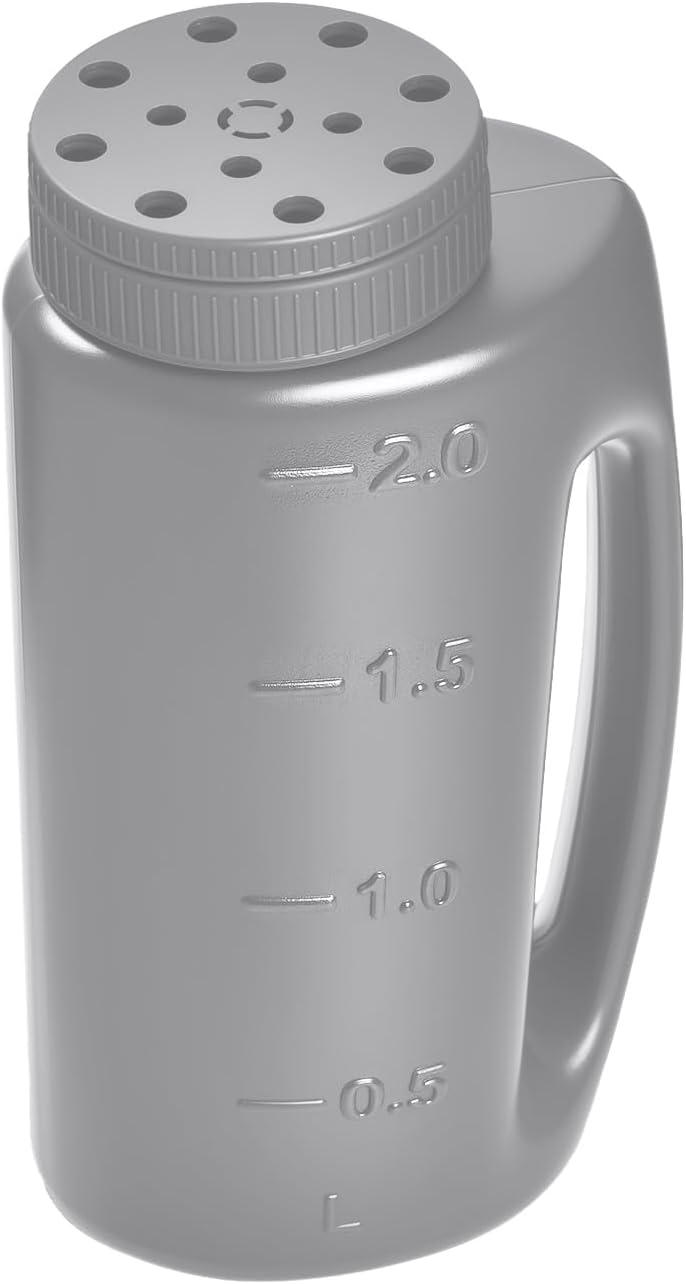
The ZXJ Handheld Seed Shaker is a compact broadcast spreader aimed at small to medium yard tasks. It uses a front-facing diffuser and three adjustable openings to control flow so you can switch between fine grass seed and coarser materials like ice melt. The 90 oz capacity reduces refills compared with tiny hand spreaders, and the included garden gloves and ergonomic handle make longer passes more comfortable. Built from weather-resistant plastic, it is lightweight and easy to rinse after use. Expect good uniformity on lawns and walkways when cranked to the right setting, but it lacks a motorized or hopper-agitation system so very damp or clumpy products may need pre-breaking. The unit is straightforward to operate and store, making it a practical, no-frills choice for routine lawn seeding, fertilizing small plots, or spreading salt in winter.
Best for: Homeowners who want an affordable, easy-to-use spreader for routine lawn seeding, fertilizing, and occasional ice-melt tasks and who prioritize simplicity and low maintenance.
Less Ideal for: Commercial landscapers or users who need to treat very large areas quickly or handle consistently wet, clumpy materials should choose a heavier-duty or motorized spreader.
- Large 90 oz hopper reduces trips to refill during small to medium jobs
- Three adjustable openings provide flow control for seeds, fertilizer, or ice melt
- Ergonomic handle and included gloves improve comfort during extended use
- Weather-resistant plastic construction is easy to clean and store
- No mechanical agitation or motor makes it less effective with damp or clumpy materials
- Lightweight plastic may feel less durable under heavy professional use
Verdict: A budget-friendly, easy-to-use handheld spreader that delivers good control and reduced refills for small to medium seasonal lawn and ice-melt tasks.
Apujent Handheld Broadcast Spreader (hand-crank)

| Material | ABS, PP |
|---|---|
| Item Weight | 420g |
| Product size | about 22.5x21x24cm/8.86×8.27×9.45 inches |
This compact hand-crank broadcast spreader is built for small lawns and garden plots where simple, reliable spreading is needed. You load seed, fertilizer, ice melt, or salt into the hopper and turn the ergonomic handle to meter material through an adjustable opening that aims to deliver even coverage without clumping. Its ABS and PP construction keeps it lightweight and resistant to cracking for routine outdoor use, and the no-power, low-maintenance design means it works whenever you need it with no batteries or motors to fail. The spreader is best for spot applications and narrow passes rather than large acreages, and its small capacity requires more frequent refills on bigger yards. Users should expect to walk and make overlapping passes for uniform results, and the manual feed rate means precision depends on a steady crank speed. For a reliability-minded gardener with a modest lawn, this tool offers straightforward, durable performance with minimal upkeep.
Best for: People who prioritize a durable, low-maintenance tool for routine spreading on small lawns or garden beds and prefer simple manual operation they can rely on.
Less Ideal for: Those who need to cover large properties quickly or want a high-capacity, motorized spreader for heavy commercial use should consider larger, powered models instead.
- Hand-powered design requires no batteries or motors so it is very dependable
- Adjustable feed control helps achieve more even distribution and reduces clumping
- Durable ABS and PP construction resists cracking and wear for repeated outdoor use
- Small hopper capacity means frequent refills on larger lawns
Verdict: A no-frills, hand-crank spreader that delivers reliable, low-maintenance performance for small lawns and routine lawn care tasks.
Scotts Turf Builder EdgeGuard Mini Broadcast Spreader
| Capacity | Up to 5,000 sq. ft. |
|---|---|
| Usage | Applies fertilizer, seed, granular weed control, salt, ice melt |
| Features | EdgeGuard side shield; dual-bladed agitator; fold-down handle |
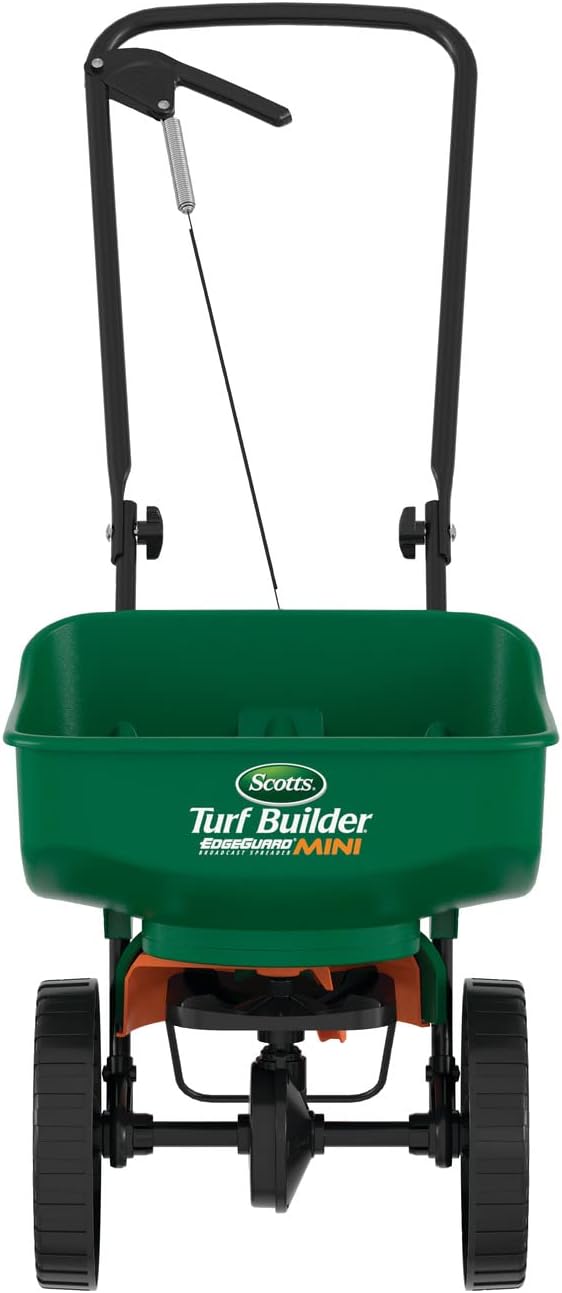
The Scotts Turf Builder EdgeGuard Mini is a ready-to-use broadcast spreader aimed at smaller lawns and targeted spot work. It comes pre-calibrated so you set the dial to the recommended setting, pour in fertilizer, seed, ice melt, or granular weed control, and walk the lawn for even coverage. The hopper and dual-bladed agitator are redesigned to funnel product smoothly and reduce clogging, while open-spoke wheels and a fold-down handle make it easy to maneuver and store. Scotts' EdgeGuard feature blocks product on the right side of the pattern, which helps avoid deposits on sidewalks and landscape beds when edging. Capacity is geared to yards up to about 5,000 sq ft, so it handles typical small properties without being bulky. The main limitations are its smaller coverage area and basic mechanical design compared with larger, more precise spreaders, so it may require more passes on bigger lawns and offers fewer fine-control adjustments for professional users.
Best for: Buyers who want a simple, reliable spreader for small to medium yards and who prioritize ease of use and avoiding overspread onto hard surfaces.
Less Ideal for: Professional landscapers or owners of large properties who need higher capacity and finer control should consider larger commercial-style spreaders.
- Pre-calibrated and ready to use for quick setup
- EdgeGuard side shield reduces product on driveways and sidewalks
- Redesigned hopper and dual-blade agitator for consistent flow
- Fold-down handle and compact size for easy storage and maneuvering
- Smaller capacity suited for lawns up to about 5,000 sq ft so larger lawns need more refills or a larger spreader
- Limited fine adjustment compared with premium or professional models
Verdict: A user-friendly mini broadcast spreader that delivers even coverage for small lawns while keeping product off sidewalks and driveways.
Yhtpouqe Handheld Spreader for Seed, Fertilizer and Ice Melt (80 oz)

| Capacity | 80 oz |
|---|---|
| Adjustable openings | Small, medium, large |
| Includes | Scooping tool and gloves |
| Manufacturer | Yhtpouqe |
The Yhtpouqe handheld spreader is a simple, one-handed tool for applying lawn seed, granular fertilizer, and winter salt to paths and driveways. You fill the 80-ounce hopper with the included scoop, set the lid to small, medium, or large openings, and squeeze while walking to lay down an even, controlled stream of material. The ergonomic handle and low weight make it easy to use for short-to-moderate jobs without straining the wrist, and the screw-top lid helps keep contents dry during storage. Practical benefits include fewer refills thanks to the larger capacity and better control over particle flow because of the three opening sizes. Limitations are its manual, walk-behind operation which is best for small lawns, patches, or sidewalks rather than whole-acre applications, and the plastic construction that, while lightweight, will not match the durability of heavy-duty metal spreaders under very frequent commercial use.
Best for: Homeowners who need a versatile, easy-to-use spreader for spot seeding, routine fertilizing, and occasional winter de-icing around small to medium yards and walkways.
Less Ideal for: People who need to cover large properties quickly or professionals who require industrial-grade, high-durability equipment.
- Generous 80-ounce (2.5 L) hopper reduces refill frequency for small- to medium-sized jobs
- Three adjustable opening sizes let you match flow to seeds, fertilizer granules, or rock salt
- Lightweight, ergonomic handle designed for comfortable one-handed operation
- Includes scoop and a pair of gloves for easier filling and cleaner handling
- Manual hand operation is slow for large lawns or commercial tasks
- Plastic construction may wear faster than metal spreaders with heavy use
Verdict: A practical, lightweight handheld spreader that delivers controlled, seasonal spreading for homeowners who want an easy all‑around tool for seed, fertilizer, and ice melt.
Choosing the Right Fertilizer Spreader for Small Lawns: Key Factors to Consider
Spread Consistency and Pattern
An even distribution of granules prevents streaking and uneven growth that are very noticeable on small lawns. Spread pattern matters because narrow swaths or uneven discharge at low walk speeds will create concentrated strips. Assess whether the spreader offers adjustable broadcast width or flow control so you can match the output to a small-lawn pace. Also consider how the unit behaves at the lower end of the output range since small lawns typically require less product and slower walking speeds.
Maneuverability and Weight
Small lawns often include landscape beds, trees, and patios that require frequent turns and precise movement. A spreader that is lightweight, has a tight turning radius, or features a comfortable handle will reduce fatigue and make it easier to work around obstacles. Balance matters: a very light hopper may be easy to push when empty but feel unstable when full. Check for features like ergonomic grips, swivel wheels, or a compact wheelbase that improve control in confined spaces.
Hopper Capacity Relative to Lawn Area
Capacity is a tradeoff between fewer refills and manageable weight. For small lawns you do not need large hoppers that become heavy once filled. A medium or small-capacity hopper can cover most yards in one or two fills while keeping the unit easy to handle. Consider typical bag sizes of fertilizer you use and whether you prefer filling once or topping up between passes. Smaller hoppers also reduce wasted product and make storage simpler.
Calibration, Flow Control, and Accuracy
Accurate application depends on simple, repeatable calibration and flow control. Look for spreaders with clear settings, indexed dials, or measured gates so you can set the output to the fertilizer label rate. For small lawns, being able to fine-tune the flow is more important than having very high maximum output. Easy-to-read markings and a straightforward method for testing coverage help avoid overapplication and lawn damage.
Durability and Weather Resistance
A spreader for seasonal lawn care should tolerate moisture, corrosion from fertilizers, and occasional knocks. Plastic hoppers and metal frames each have pros and cons: reinforced plastics resist rust and are lighter, while painted or powder-coated metal frames offer structural strength. Check the quality of the gearbox and axle components, since failures there render a spreader unusable. Rust-resistant fasteners and sealed bearings extend useful life for equipment stored in unheated spaces.
Cleaning, Maintenance, and Storage
Fertilizer granules can be corrosive and leave residues that attract moisture, so cleaning and draining are essential. A spreader with easy-drain geometry, removable parts, or accessible gearbox access points simplifies post-use maintenance. Compact foldability or a small footprint helps with off-season storage in sheds or garages. Consider how easy it is to winterize the unit and whether replacement parts are straightforward to access.
Best Spreader Types for Small Lawns
Several spreader styles work well for compact turf. Handheld and small push broadcast spreaders are common because they balance control and coverage. Handheld models are very portable for tight spots but can be tiring on larger quarter-acre lots. Push broadcast spreaders offer a wider pattern and less strain for moderate walkways while staying compact enough to maneuver.
Drop-style spreaders give pinpoint application, useful when you need to avoid beds or apply starter fertilizer in specific strips. However, drop spreaders require more passes for full coverage and are slower on open areas. Think about the layout of your yard and whether precision or speed is the priority.
- Handheld: Best for very small, segmented lawns and spot treatments.
- Push broadcast: Balanced choice for small to medium lawns with open areas.
- Drop spreader: Use where edge control matters more than speed.
How to Calibrate for Correct Application Rates
Calibration ensures you apply the fertilizer rate recommended on the product label. The process typically involves measuring the amount dispensed over a fixed distance and adjusting the setting until the rate matches the label. For small lawns, do a short test pass across a measured strip and weigh or collect the discharged granules to verify output.
Adjust settings gradually and retest at the walking speed you will use. Mark a preferred setting for common fertilizers you use so you can replicate results season to season. Calibration reduces waste, prevents lawn burn, and keeps feeding consistent across the yard.
- Measure a set distance and collect output for a test run.
- Adjust flow in small increments and retest at working speed.
- Record settings for frequently used products.
Routine Care to Extend Spreader Life
After each use, empty remaining product and blow or brush residue from the hopper and spreader plate. Rinse with water if the manufacturer guidance allows, then dry thoroughly to prevent corrosion. Lubricate moving parts lightly and check fasteners periodically to ensure the gearbox and axle remain secure.
Store the spreader under cover and off concrete floors to limit moisture exposure. For winter storage, remove small parts to avoid freeze damage and keep calibration markings legible. These simple steps keep a spreader functioning reliably for many seasons.
- Empty and clean hopper after each use.
- Dry and lightly lubricate moving parts.
- Store indoors or under cover, off bare ground.
Common Mistakes Small-Lawn Owners Make
Overfilling a large hopper for a small lawn increases weight and makes tight maneuvers harder. It also encourages walking too fast, which alters application rates. Instead, fill to a level that keeps the spreader balanced and comfortable to push or carry.
Another frequent error is skipping calibration. Assuming factory settings are correct for every product leads to inconsistent results. Finally, neglecting cleanup accelerates rust and gearbox wear, shortening the unit's useful life. Address these habits to maintain consistent results and extend equipment longevity.
- Do not overfill the hopper for the task size.
- Always calibrate for each fertilizer and walking speed.
- Clean thoroughly after each use to avoid corrosion.
Safety and Environmental Considerations
Protect surrounding beds and water features by using deflectors or switching to a drop-style application near sensitive areas. Wear gloves and eye protection when handling concentrated fertilizers to avoid skin or eye irritation. Avoid applying before heavy rain to reduce runoff risk.
Consider the active ingredients and follow label directions to minimize environmental impact. Proper spreader calibration and careful application help prevent overuse that can harm plants and nearby waterways.
- Use deflectors or drop mode near beds and water.
- Wear protective gear when filling and calibrating.
- Avoid application before forecasted heavy rain.
How We Chose the Best Fertilizer Spreader for Small Lawns
We prioritized features that directly affect performance on small lawns and everyday handling. Key evaluation criteria included spread consistency, which measures how evenly a unit distributes granular fertilizer at low application rates; handling and maneuverability for working around flower beds, trees, and tight corners; hopper capacity relative to small-lawn workflows so you do fewer refills without carrying excessive weight; calibration and control options that let users dial in application rate without guesswork; durability of hopper and gearbox components to withstand seasonal use; and ease of cleaning and storage for equipment kept in a shed or garage. We tested the practicality of setup and adjustment steps against expected homeowner skill levels rather than professional installation. We excluded heavy commercial broadcast units and tow-behind spreaders designed for large acreage because their capacity and footprint are inappropriate for small yards. We also left out handheld drop-only devices when they could not provide consistent broadcast coverage across lawn surfaces. The final selection favors balanced combinations of accuracy, ease of use, and manageable capacity for small-lawn maintenance.
FAQ
What spreader type is easiest to use on a small, irregularly shaped lawn?
A compact push broadcast spreader often strikes the best balance. It covers more ground per pass than handheld models while remaining maneuverable in tight spaces. For very irregular edges, combine a small broadcast unit with a handheld or drop tool for precision.
How often should I calibrate my spreader?
Calibrate whenever you switch fertilizer products or change walking speed. Many gardeners also check calibration at the start of each season to account for any wear that affects flow rate. Quick test runs over a measured distance will verify accuracy.
Can I use a large-capacity spreader on a small lawn?
You can, but large hoppers become heavier and harder to control when partly full. They also take up more storage space. For small lawns, a modest-capacity unit usually reduces refills without adding unnecessary bulk or weight.
Is a drop spreader better for avoiding fertilizer on flower beds?
Drop spreaders offer precise placement and minimize overspray, making them useful near beds and hard edges. They are slower for open areas, so many gardeners use a drop approach along borders and a small broadcast unit for the main turf.
How should I clean my spreader after applying fertilizer?
Empty the hopper and brush or blow out remaining granules, then rinse if the design allows and dry thoroughly. Lubricate moving parts lightly and store under cover. Prompt cleaning prevents corrosion and keeps calibration reliable.
Will walking speed really change application rate on a spreader?
Yes. Most broadcast spreaders apply product per unit of time, so walking faster reduces the applied rate per area. Calibrate at the walking speed you will use, and use a measured test run to confirm the actual application rate.
Final Verdict
For small lawns, prioritize spread consistency, manageable hopper size, and easy maneuverability. Those factors reduce wasted product, limit strain while working around tight landscaping, and deliver an even, healthy lawn. Focus on a spreader that is simple to calibrate and maintain so you can achieve repeatable results season after season. With the right balance of control and capacity, you will get reliable coverage without unnecessary bulk or complexity.
