

Note: This article contains affiliate links. If you click on these links and make a purchase, I may earn a small commission at no extra cost to you. This helps support my research and content. Read my full affiliate disclosure here.
When you camp, flies do more than annoy – they can carry disease, contaminate food, and ruin meal times. Picking the right fly repellent for camping matters because you need protection that holds up through sweat, heat, and long evenings outdoors. This guide covers seven shortlisted fly repellents selected for real campsite use and different comfort priorities. We evaluated options based on how well they work in the field and how easy they are to use while camping. Read on to find repellents that match your tolerance for reapplication, preferences for natural or synthetic ingredients, and the type of coverage you need at your tent or picnic area.
Top Picks at a Glance
| Best Overall The best all-around choice for most situations | Repel 100 Insect Repellent Pump Spray, 4 oz (98% DEET) |  |
| Best Quality Built to a higher standard if you want something more solid | Thermacell Fuel-ZoneGuard Extreme Fuel-Powered Mosquito Repeller |  |
| Best Value The sweet spot between price and what you get | Sawyer SP657 Permethrin Insect Repellent Spray for Clothing & Gear, 24 oz |  |
| Best Budget The cheapest option that still gets the job done reliably | Repel Outdoor Fogger Camp Fogger 16 oz |  |
| Highest Rated A top-rated pick with lots of positive feedback | Virine Rechargeable No‑Spray Mosquito Repeller with Plant‑Based Refills |  |
| Most Popular A crowd favorite that many people choose with confidence | OFF! Deep Woods Dry Insect & Mosquito Repellent Spray (2 x 4 oz) |  |
| Best Seller A high-volume bestseller chosen again and again | OFF! Clean Feel Picaridin Insect & Mosquito Repellent Spray, 5 oz |  |
Repel 100 Insect Repellent Pump Spray, 4 oz (98% DEET)

| Active ingredient | DEET 98.11% |
|---|---|
| Protection duration | Up to 10 hours |
| Volume | 4 oz pump spray |
| Intended use | Repels mosquitoes, ticks, biting flies, gnats, chiggers, fleas |
Repel 100 is a small, high-strength DEET pump spray formulated for extended protection in severe insect conditions. You use it like a typical body repellent: apply to exposed skin and clothing (avoiding face and sensitive areas) and allow it to dry before activity. The product’s standout feature is the very high DEET concentration, which translates to up to 10 hours of protection against mosquitoes that can transmit Zika, West Nile, Dengue and other diseases, and good efficacy versus ticks, gnats, biting flies, chiggers and fleas. The 4-ounce pump fits easily into daypacks and travel kits and avoids aerosol propellants. Important practical considerations are the strong DEET content, which can damage some plastics, painted surfaces and certain fabrics and requires careful application around children and gear. Also you need to wash treated skin and clothing after returning indoors. For people who need confident, long-duration protection during extended outdoor exposure, this is a straightforward, high-performance option.
Best for: Buyers who prioritize maximum, long-duration insect protection for prolonged outdoor activity and who are comfortable with careful handling of a potent repellent.
Less Ideal for: People seeking natural or low-DEET alternatives, frequent indoor users, or anyone who needs a product that is safe to apply liberally around young children without supervision.
- Very high DEET concentration for long-lasting protection up to 10 hours
- Effective against a broad range of biting insects including mosquitoes and ticks
- Compact 4 oz pump format is easy to carry and store
- Pump spray avoids aerosol propellants and allows targeted application
- High DEET content can damage plastics, painted surfaces and some fabrics
- Requires careful application around children and on the face and ears
Verdict: Choose Repel 100 when you need compact, no-nonsense, long-lasting DEET protection for extended time outdoors.
Thermacell Fuel-ZoneGuard Extreme Fuel-Powered Mosquito Repeller
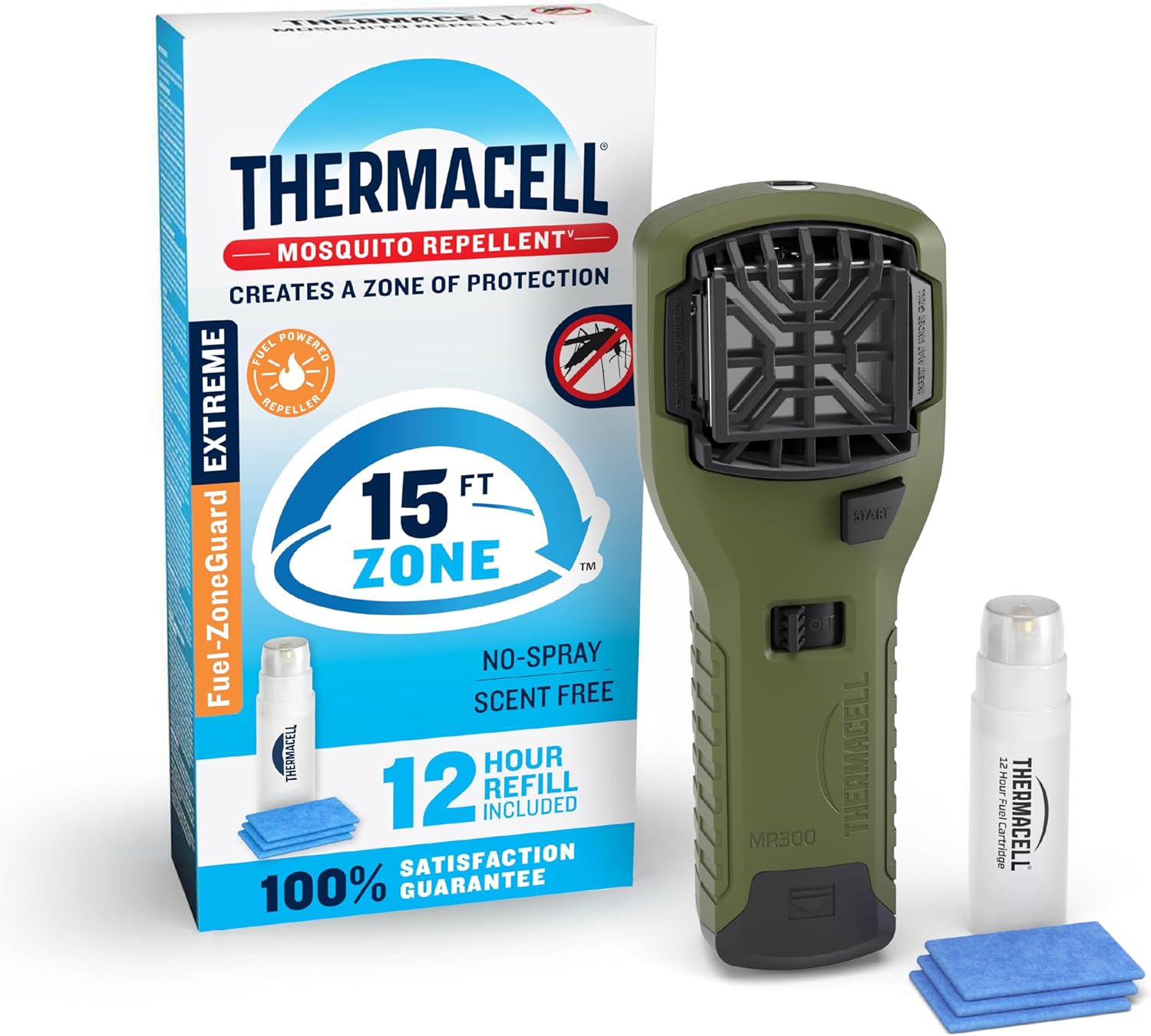
| Protection Zone | 15 Feet |
|---|---|
| Refill Hours | 12 Hours |
| Scent Name | Scent Free |
| Target Species | Mosquito |
| Included Components | Fuel Cartridge, Mat |
The Thermacell Fuel-ZoneGuard Extreme is a compact, fuel-powered mosquito repeller designed for outdoor use like camping, hunting, and fishing. It heats a scented-free repellent mat with a 12-hour fuel cartridge to produce an invisible protection zone roughly 15 feet across, letting you avoid sprays and DEET on skin. Setup is simple: insert the fuel cartridge and mat, light to activate, and the device produces protection within about 15 minutes. Practical benefits include portability and quiet operation so it does not disturb a campsite or alert wildlife, plus mats that change color to show when they need replacing. Limitations are that its protection is localized to the immediate area and can be affected by wind or open terrain, it requires replacement fuel cartridges and mats for continued use, and it is for outdoor use only. Safety guidance recommends keeping it away from children and pets. For campers who prioritize proven, hands-free bite protection without sprays, this is a highly usable option.
Best for: Campers and outdoor enthusiasts who want hands-free, performance-focused mosquito protection at a campsite or hunting spot without applying sprays or using batteries.
Less Ideal for: People who need large-area or whole-yard mosquito control or who prefer non-consumable electronic solutions should consider other options.
- Creates a roughly 15-foot protection zone for localized mosquito control
- Fuel-powered operation with up to 12 hours per cartridge avoids batteries or cords
- Scent-free repellent that eliminates the need for DEET or skin-applied sprays
- Compact and rugged design suited to camping and hunting without making noise
- Mats visually indicate when they need replacement for simple maintenance
- Effectiveness is limited to a localized area and reduced in windy or open conditions
- Requires consumable fuel cartridges and repellent mats to maintain protection
Verdict: If you want reliable, hands-free mosquito protection at a campsite without sprays or batteries, this fuel-powered repeller delivers focused, portable performance.
Sawyer SP657 Permethrin Insect Repellent Spray for Clothing & Gear, 24 oz

| Active ingredient | 0.5% Permethrin |
|---|---|
| Application type | Trigger Spray |
| Duration | Up to 6 weeks or 6 washings |
| Item model number | SP657 |
This Sawyer SP657 permethrin spray is made to add a protective layer to clothing and outdoor gear rather than to be applied to skin. You spray garments, socks, shoes, sleeping bags, or tents from about 6 to 8 inches away and let them dry; the active ingredient bonds to fabric fibers and remains effective for up to six weeks or six washings. In practice it is useful for camping, backpacking, hunting, and backyard use because it targets ticks and mosquitoes and is formulated not to stain or damage fabrics. Notable features include an odorless finish after drying and clear application directions with an EPA-recommended amount per outfit. The main limitation is that it treats fabrics only and must be reapplied after the stated time or laundering; it also degrades with UV exposure so heavy sun can shorten protection. For those wanting comprehensive bite protection you will still want a skin-applied repellent in addition to treating gear.
Best for: Buyers who prioritize proven, gear-focused protection against ticks and mosquitoes and want an evidence-backed way to reduce bite risk while spending time outdoors.
Less Ideal for: People who need an on-skin repellent or a solution that provides continuous protection without periodic re-treatment of clothing and gear.
- Bonds to fabric fibers for up to six weeks or six washings, providing long-lasting protection on treated gear
- Formulated not to stain or damage clothing, tents, or outdoor equipment
- Odorless after drying, so treated items do not carry a strong scent
- Effective against ticks, mosquitoes, and more than 55 other insect types according to product description
- Only for use on clothing and gear, not for direct application to skin
- Protection degrades with UV exposure and requires reapplication after laundering or the six-week window
Verdict: Treat clothing and gear with this permethrin spray for a proven, long-lasting layer of protection against ticks and mosquitoes during outdoor activities.
Repel Outdoor Fogger Camp Fogger 16 oz

| Item Volume | 16 fluid ounces |
|---|---|
| Item Form | Aerosol |
| Indoor Outdoor Usage | Outdoor |
| Target Species | Mosquito |
The Repel Outdoor Fogger is a 16-ounce aerosol designed to quickly knock down mosquitoes and a range of other flying and crawling insects around campsites, patios and picnic areas. You use it by spraying when the air is calm or with the wind if there is a breeze, holding the can slightly downward and allowing a few minutes for the spray to take effect. The formula lists active ingredients tetramethrin and phenothrin and is intended for outdoor spot treatments where fast control is needed. Practical benefits include rapid results, compact portable packaging that is easy to throw in a camping kit, and a broad target list that covers gnats, flies, wasps and some ants. Important limitations are that it is for outdoor use only, treatments should not exceed once per day, and the product contains chemicals that carry a California health warning for reproductive harm and cancer, so users should follow label precautions and avoid repeated exposure. This works best as an occasional quick-response solution rather than a long-term landscape treatment.
Best for: Buyers who want an inexpensive, portable spray to get rapid temporary relief from mosquitoes and flies during outdoor activities like camping, picnics or backyard gatherings.
Less Ideal for: People seeking continuous, long-term yard protection or those who prefer non-chemical or low-toxicity pest control methods should consider alternate approaches.
- Fast knockdown of mosquitoes and many common outdoor insects
- Portable 16-ounce aerosol is easy to carry for camping and outings
- Simple application instructions suitable for quick spot treatments
- Broad target list includes flying and crawling pests commonly found at outdoor gatherings
- Contains chemicals with a state health warning which requires careful use and avoidance of repeated exposure
- Not intended for daily or long-term landscape pest control
Verdict: A low-cost, portable aerosol fogger that delivers quick on-contact control of mosquitoes and common outdoor flies for short-term outdoor use.
Virine Rechargeable No‑Spray Mosquito Repeller with Plant‑Based Refills

| Target Species | Mosquito |
|---|---|
| Power Source | Battery Powered |
| Number of Pieces | 1 |
| Included Refills | 2 ten‑day cartridges |
The Virine rechargeable mosquito repeller is a portable, battery‑powered device designed for outdoor use around patios, campsites and decks. You charge it with the included UL 5V adapter and USB‑C cable, insert a plant‑based refill pad, and the internal fan disperses the natural repellent for an advertised effective range up to about 30 feet. Controls let you run the repeller, the night light, both, or set an 8‑hour daily cycle that remembers the last setting. The kit ships with one device and two 10‑day refill cartridges, which makes it ready for short trips. Practical benefits are low odor compared with aerosol sprays, simple one‑button operation, and USB charging for campsite power banks. Important limitations are that coverage will depend on wind and open‑air conditions and that protection relies on refills so you need spares for multi‑night camping; avoid using high‑voltage fast chargers. For campers who prioritize an easy, no‑spray option and predictable charging, the Virine is a sensible lightweight choice.
Best for: Campers and outdoor hosts who want a low‑maintenance, no‑spray mosquito solution that charges from USB and is easy to deploy around a campsite or patio.
Less Ideal for: People needing full protection in large open fields, high‑wind sites, or multi‑night expeditions without access to refill cartridges or ability to carry spares.
- Rechargeable with included UL 5V adapter and USB‑C cable for reliable charging
- Plant‑based refill pads provide a no‑spray alternative to topical repellents
- Compact, travel‑friendly design easy to pack for camping and patios
- Simple one‑button controls plus an 8‑hour memory cycle for set‑and‑forget use
- Effectiveness is reduced in windy or very open environments since it disperses repellent passively
- Requires replacement refill cartridges for continued protection
Verdict: A compact, rechargeable no‑spray repeller that gives easy USB‑powered mosquito protection for short camping trips and patio evenings.
OFF! Deep Woods Dry Insect & Mosquito Repellent Spray (2 x 4 oz)

| Active ingredient | DEET 25% |
|---|---|
| Formulation | Aerosol spray (dry, non-greasy) |
| Intended use | Repels mosquitoes, ticks, biting flies, gnats, chiggers |
| Duration | Up to 8 hours (label claim) |
OFF! Deep Woods Dry is a portable aerosol repellent formulated with 25% DEET to protect against mosquitoes, ticks, biting flies, gnats, and chiggers during outdoor activities like hiking, fishing, and camping. You spray it 6 to 8 inches from exposed skin or clothing and it goes on powder-dry rather than greasy, which makes it comfortable for all-day wear and convenient for layering over shirts or hats. The label indicates up to eight hours of protection in typical conditions and notes effective use on outer clothing for added tick defense. Important practical points: the aerosol is extremely flammable and should not be used near heat or open flame, and it should not be applied to damaged or synthetic fabrics listed on the label. For families, the directions emphasize applying repellent to an adult’s hands first before using on children and washing treated skin after returning indoors. If you want straightforward, long-lasting insect protection for active outdoor use, this product delivers; just follow label precautions and avoid use on sensitive areas or inappropriate materials.
Best for: Buyers who prioritize reliable, evidence-backed protection for active outdoor use and want a non-greasy spray they can apply quickly before hiking, fishing, or hunting.
Less Ideal for: People seeking fragrance-free or non-DEET alternatives for everyday yard use or parents who prefer repellent types specifically labeled for direct application to very young children.
- Contains 25% DEET for proven, long-lasting repellency against mosquitoes, ticks, and biting flies.
- Powder-dry, non-greasy aerosol formula that is comfortable to wear and does not leave an oily residue.
- Works on outer clothing as well as skin, helping reduce tick exposure around cuffs and openings.
- Compact 4 oz cans in a two-pack provide portable protection for multi-day outdoor trips.
- Aerosol formulation is extremely flammable and must be kept away from heat and open flames.
- Not suitable for application on certain synthetics, leather, plastics, or near painted surfaces as directed on the label.
Verdict: A compact, powder-dry DEET spray that delivers reliable, long-lasting insect protection for active outdoor adventures.
OFF! Clean Feel Picaridin Insect & Mosquito Repellent Spray, 5 oz

| Active ingredient | Picaridin 20% |
|---|---|
| Form | Aerosol spray |
| Protection claim | Up to 8 hours |
| Fragrance | Fragrance-free |
OFF! Clean Feel is a lightweight, fragrance-free aerosol repellent that uses 20% picaridin to protect against mosquitoes, ticks, and biting flies. It is intended for everyday outdoor use: shake, spray from about 6 to 8 inches onto exposed skin, then spread evenly with your hands. The formula goes on clear, dries quickly, and is described as non-greasy and non-sticky, so it is comfortable for yard work, walks, or social outdoor time. The aerosol delivery makes coverage fast and convenient for adults. Manufacturer directions recommend reapplying about every 90 minutes as needed, and the product claims up to eight hours of protection in typical use. Important practical limits are typical aerosol considerations: avoid inhaling the spray, do not apply directly to the face, and it is not for children under six months. People with very sensitive skin should patch test first since prolonged contact can cause reactions in some individuals.
Best for: Adults who want an easy-to-apply, DEET-free repellent that feels light on skin and provides reliable everyday protection during outdoor activities.
Less Ideal for: People shopping for repellent for infants or those who prefer pump sprays or lotions for precise application should consider other formats.
- Uses 20% picaridin, an effective DEET-free active ingredient against mosquitoes, ticks, and biting flies
- Fragrance-free, non-greasy formula that dries quickly and goes on clear
- Aerosol spray covers skin evenly and is quick to apply for everyday outdoor activities
- Aerosol format requires care to avoid inhalation or overspray and is not suitable for direct face application
- Contains ingredients that may cause skin irritation or allergic reactions in some users
Verdict: A dependable, fragrance-free picaridin aerosol that delivers long-lasting, easy-to-apply protection for adults seeking a low-feel alternative to DEET.
Choosing the Right Fly Repellent for Camping: Key Factors to Consider
Type of Application
Different application styles change how you use a fly repellent at camp. Personal sprays and lotions protect individual campers and require direct skin application, so you need to follow label guidance and reapply after sweating or swimming. Area treatments such as lantern-style diffusers, passive mats, or perimeter sprays treat a zone around a table or tent and can reduce the number of flies in a shared space without direct skin contact.
Think about whether you need point protection for meals and faces, or broader zone control. For multi-day trips, area treatments can reduce repeated skin applications, but they may require more product to be effective across an entire campsite. Balance convenience, coverage, and the types of activities you will do at camp when choosing an application type.
Active Ingredient and Effectiveness
Active ingredients determine how reliably a repellent deters flies and how long that protection lasts. Synthetic actives typically offer longer-lasting protection and a stronger deterrent effect, while some botanical or oil-based formulas may give shorter protection windows but are preferred by campers seeking fewer synthetic chemicals.
Check labels for the active ingredient type and the suggested reapplication interval. Real-world effectiveness depends on heat, humidity, and fly pressure at the campsite. A product rated for multiple hours in lab tests can perform less consistently in hot, sweaty conditions, so plan for more frequent reapplication in challenging environments.
Duration and Reapplication Needs
Duration between applications affects how often you will interrupt camp activities to reapply. Longer-lasting formulas reduce interruption but may be heavier or contain more potent actives. Short-duration options require frequent reapplication, which can be impractical during hiking, meal prep, or overnight sleeping.
Consider whether you will have the time and water to reapply during a trip. For extended stays or multi-day backcountry trips, prioritize longevity and easy-to-carry formats. For short overnight trips, a quick spray or wipe might be sufficient and more convenient.
Safety Around Food and Children
At camp you often prepare and eat food outdoors, and children or pets may be nearby. Safety for use around food prep areas and on younger skin is a major practical concern. Some repellents are labelled for direct skin application and list age limits or require avoidance of hands and faces, while area treatments may advise keeping food covered or removing treated items.
Read and follow safety instructions carefully. Prefer formats and ingredients that minimize contamination risk for cooking surfaces and utensils. If you camp with children, choose products with clear age guidance and methods that limit direct application to young skin.
Portability and Packability
How easy a repellent is to pack affects what you actually bring. Bulky aerosol cans, electric devices, or heavy liquid containers are less suited to minimalist trips. Lightweight wipes, compact sprays, small pump bottles, and foldable passive mats are easier to carry and store.
Also consider how the product fares during transport. Liquids in hot car trunks can leak or degrade. Choose leakproof containers and formats that tolerate temperature swings typical of camping. For backpackers, weight and volume are decisive factors; for car campers, convenience and coverage may be more important.
Environmental and Non-target Considerations
Repellents applied in outdoor settings interact with local plants, pollinators, and water. Some formulations can harm beneficial insects or persist on foliage. If you camp near streams, ponds, or sensitive habitats, prefer products with minimal runoff risk and clear guidance on environmental safety.
Consider using targeted applications rather than blanket sprays and avoid treatments that leave residues on food-prep surfaces. Biodegradable or low-toxicity options may reduce environmental impact, but they may also require more frequent reapplication.
Formats That Work Best at Camp
Sprays are the most common campsite choice because they allow quick coverage of skin or gear. Pump sprays minimize propellants and are easier to carry than full-size aerosols. Wipes give precise application and are handy for quick meal-area touch-ups without carrying a bottle.
Area-focused formats include passive mats, hanging strips, and small propane or battery diffusers. These are useful when you want a protected zone around a table or tent without everyone applying skin product. Keep in mind that area devices vary in power and coverage area, so choose a size that matches your campsite footprint.
- Pump sprays: compact, refillable, good for targeted application
- Wipes: convenient for handling food prep and quick re-treats
- Passive mats or strips: hands-off zone protection for shared spaces
- Diffusers: useful for longer sessions but require a power source or fuel
Using Repellent Safely Around Food
When preparing food at camp, use repellent methods that avoid direct contact with utensils, plates, and open dishes. Apply personal repellents before starting food prep and keep hands away from the face when applying. Cover dishes and rotate treated zones so food does not sit in a freshly sprayed area.
If using area sprays near where food is prepared, wait for the spray to settle or ventilate the area before placing uncovered food back on a table. Consider designating a separate treated eating area and a clean cooking zone to limit cross-contamination.
- Apply body repellent before touching food and wash hands after reapplication
- Keep covered containers or coolers in untreated pockets of the campsite
- Avoid spraying directly over tables or cookware
Strategies for High Fly Pressure
In wet or livestock-heavy areas, fly numbers can surge and a single strategy will not be enough. Combine personal repellents with one area control method to reduce overall numbers. Use physical barriers like screened tents and food covers to complement chemical or natural repellents.
For longer trips in high-pressure spots, plan for more product and more frequent applications. Rotate application zones and keep waste sealed to avoid attracting more flies.
- Pair personal protection with an area treatment for layered defense
- Keep food waste sealed and away from sleeping or dining areas
- Use screens, netting, or mesh food covers to physically block flies
Natural Options and Tradeoffs
Botanical repellents and essential oil blends appeal to campers seeking fewer synthetic chemicals. They can reduce fly bother for short periods and are often more pleasant smelling than strong synthetic formulations. However, natural options usually require more frequent reapplication and may offer inconsistent protection in high-heat or humid conditions.
If you prefer a natural approach, supplement it with physical barriers, area traps, or strategic campsite hygiene to keep fly pressure manageable. Expect to reapply more often and to monitor performance during the heat of the day.
- Natural repellents: softer scent, shorter duration
- Best used with physical barriers and good campsite sanitation
- Not ideal as the only defense in heavy fly conditions
Packing and Transport Tips
Pack repellents in leakproof bags and keep them accessible for quick reapplication. Small refillable bottles let you decant larger containers into travel-safe sizes. Store aerosol cans upright and avoid high-heat exposure to reduce the risk of rupture or leakage.
Label travel containers clearly if you carry multiple formulations and keep wipes in resealable pouches to prevent drying out. For flights or multi-modal travel, follow transport rules for liquids and aerosols and plan alternatives like wipes or solid formulations.
- Use leakproof pouches and small refillable bottles
- Keep wipes sealed to retain moisture
- Avoid storing aerosols in hot vehicles or direct sun
How We Chose the Best Fly Repellent for Camping
We limited candidates to products intended for outdoor human use and formulations commonly used at campsites. Our selection focused on repellents with documented active ingredients known to deter flies and on formats practical for camping, such as sprays, wipes, and area treatments. We excluded products made only for livestock, sticky traps designed exclusively for indoor use, and devices that require continuous mains power. Primary evaluation criteria included measured effectiveness against flies in field conditions, longevity between applications, ease and safety of campsite application, ingredient profile and suitability for skin or food-preparation areas, and portability for backpacking or car camping. We also considered how visible or intrusive the product is at camp, how it performs in heat or humidity, and whether the delivery format supports quick spot treatment versus area coverage. Products that failed basic safety labeling for outdoor human use or that depended on a fixed power source were not considered.
FAQ
Are natural fly repellents effective for camping?
Natural repellents can reduce fly annoyance for short periods and are often preferred for their milder scent. They usually require more frequent reapplication and may be less reliable in heavy fly pressure or extreme heat.
How often should I reapply repellent while camping?
Reapplication depends on the product and conditions. Many formulas recommend every few hours, but sweating, swimming, and high temperatures shorten protection. Check the label and plan for additional reapplications in hot or active conditions.
Can I use area treatments near my cooking area?
You can use area treatments, but avoid spraying directly over food or cookware. Allow treated areas to settle and keep food covered. When in doubt, position area devices so airflow carries chemicals away from food prep surfaces.
What is the safest way to protect children from flies at camp?
Follow product age guidance and use formulations labelled safe for children. Use physical barriers like screens and food covers, apply repellents sparingly to exposed skin, and prefer wipes or lower-concentration options for quick touch-ups.
Do repellents affect pollinators or nearby water?
Some repellents can harm beneficial insects or run off into water, depending on the formulation. Use targeted applications, avoid spraying flowering plants, and follow label instructions to minimize environmental impact.
Final Verdict
When choosing a fly repellent for camping, prioritize how you will use it at the campsite: personal protection, area coverage, or a mix of both. Weigh the tradeoffs between long-lasting synthetic formulas and shorter-duration natural options, and factor in safety near food and children. Select a format that matches your trip style and pack constraints, plan for reapplication in hot or active conditions, and combine repellents with physical barriers and good sanitation for the best results. That approach helps you keep flies at bay while preserving comfort and safety on the trail or at the campsite.
