

Note: This article contains affiliate links. If you click on these links and make a purchase, I may earn a small commission at no extra cost to you. This helps support my research and content. Read my full affiliate disclosure here.
If you manage a barn, stable, or livestock shelter, the right fly spray can make the difference between calm animals and constant stress. Effective sprays reduce biting insect pressure, cut disease risk, and limit flies landing on feed or animals. This guide covers seven shortlisted fly sprays for barns selected for reliable knockdown, lasting residual activity, and practical safety considerations for animals and barn staff. We evaluate each product on factors that matter in real barn use, including how quickly it stops flies, how long protection lasts, and how easy it is to apply safely around animals. Read on for practical guidance to match a spray to your barn size, animals, and management style.
Top Picks at a Glance
| Best Overall The best all-around choice for most situations | Pyranha Wipe N' Spray for Horses, Gallon |  |
| Best Quality Built to a higher standard if you want something more solid | PYRANHA 1-10 HP Concentrate Refill 2.5 Gallon for 55 Gal Automatic Spray Systems |  |
| Best Value The sweet spot between price and what you get | Farnam Bronco E Citronella Fly Spray for Horses and Dogs, 128 oz |  |
| Best Budget The cheapest option that still gets the job done reliably | Farnam Repel-X Ready-to-Use Fly Spray for Horses, 32 fl oz |  |
| Highest Rated A top-rated pick with lots of positive feedback | Country Vet Metered Insecticide Fly Spray, 6.4 oz (Case of 12) |  |
| Most Popular A crowd favorite that many people choose with confidence | Absorbine UltraShield EX Insecticide & Repellent, 32 fl oz Sprayer |  |
| Best Seller A high-volume bestseller chosen again and again | Absorbine UltraShield EX Insecticide & Repellent, 1 Gallon |  |
Pyranha Wipe N' Spray for Horses, Gallon

| Unit Count | 128 Fluid Ounces |
|---|---|
| Item Form | Liquid |
| Scent Name | citronella |
| Target Species | Horse |
| Active Ingredients | Permethrin |
Pyranha Wipe N' Spray is an oil-based fly spray designed for heavy-duty barn use and multi-horse operations. It applies directly to the horse and uses a pyrethrin-based formula with Pyranha Suspension Technology to remain effective through sweat and light moisture. Typical use is as a daily or as-needed spray during fly season, and the gallon size makes it convenient for large barns or frequent riders. Notable features include an oil formulation for longer-lasting protection, a citronella scent, and lanolin to help condition the coat and add shine. Practical benefits are fewer re-applications compared with lighter water-based sprays and a single product that both repels insects and helps the coat look presentable. Important limitations are that it is oil-based so it can feel heavier on the coat and may transfer to tack or clothing, and it contains permethrin/pyrethrins so users should follow safety directions around sensitive animals and people. For barn managers who need durable, straightforward fly control, this product is built for regular, large-scale use rather than occasional spot treatments.
Best for: Barn owners and riders who need reliable, long-lasting fly control for multiple horses and prefer a product that also improves coat appearance.
Less Ideal for: Riders or owners who want a lightweight, quick-dry or all-natural spray for occasional use or for animals and handlers sensitive to pyrethrins should consider alternatives.
- Gallon volume suited to large barns or multiple horses
- Oil-based formula designed to last through sweat and light moisture
- Contains lanolin to condition coat and leave a glossy finish
- Proven active ingredients (permethrin/pyrethrins) that target many biting pests
- Oil base can transfer to tack and may feel heavy on the coat
- Contains pyrethrins/permethrin which require following safety and application guidance
Verdict: Choose this gallon oil-based spray when you need durable, barn-scale fly protection that also conditions horses' coats.
PYRANHA 1-10 HP Concentrate Refill 2.5 Gallon for 55 Gal Automatic Spray Systems

| Item Form | Liquid |
|---|---|
| Volume | 2.5 gallons |
| Active Ingredients | pyrethroids |
| Scent Name | unscented |
| Target Species | Insects |
The PYRANHA 1-10 HP concentrate is a professional-grade insecticide refill designed for automatic 55-gallon spray systems in horse barns. It is mixed into an automatic misting setup to deliver continuous knockdown and residual control against horn flies, stable flies, horse flies, face flies, mosquitoes and midges. The formulation uses pyrethroids, which provide fast initial knockdown and sustained protection between sprays, reducing fly pressure on animals and in barn spaces. Because it is a concentrate for large-capacity systems, it is best suited to commercial or large private barns where consistent, hands-off delivery matters. Important limitations are that it is a concentrated chemical product meant for system use rather than direct on-animal daily application and it requires correct dilution and handling to be safe and effective. The product is unscented and intended as a refill for compatible automatic spray systems rather than a standalone aerosol or pump bottle, so installation and system maintenance remain necessary responsibilities for reliable performance.
Best for: Barn managers and horse owners who prioritize high-performance, continuous fly control delivered through automatic spray systems for large or busy stables.
Less Ideal for: People with small stalls, infrequent fly problems, or those who need a ready-to-use spray or on-animal daily product should consider simpler, lower-volume options instead.
- Formulated for automatic 55-gallon barn spray systems for continuous, hands-off control
- Broad-spectrum activity against common barn flies and biting insects
- Pyrethroid concentrate delivers rapid knockdown and lasting residual effect
- Large 2.5 gallon volume suitable for frequent use in large barns
- Requires proper dilution and compatible automatic spray system for use
- Contains pyrethroids so users must follow safety and handling precautions
Verdict: Buy this concentrate if you need proven, professional-grade automatic spray system protection to quickly knock down and continuously repel flies in large barns.
Farnam Bronco E Citronella Fly Spray for Horses and Dogs, 128 oz

| Unit Count | 128 Fluid Ounces |
|---|---|
| Item Form | Liquid |
| Scent Name | Citronella |
| Pet Type | Dog, Horse |
| Active Ingredients | Permethrin |
Farnam Bronco E is a gallon refill of citronella-scented fly spray designed for use on horses, foals and dogs and as a premises spray in barns, stalls, trailers and kennels. It combines permethrin, prallethrin and piperonyl butoxide in a water-based, non-greasy formula that can be applied as a light mist for full-body coverage or wiped on with a cloth for faces and sensitive areas. In practice it serves two roles: direct protection for animals and area control around doorways, windows and stalls where flies congregate. Notable features include knockdown and repellent activity against six fly types plus mosquitoes, ticks and fleas, an easy-to-use spray or wipe application, and instructions for surface and space spraying for larger areas. Important limitations are the pesticide precautions and PPE recommendations required during application, and that it is not for use on cats or on horses intended for slaughter, so handlers must follow safety and reentry instructions carefully.
Best for: Buyers who want an efficient, multi-purpose barn fly control product that covers animals and surrounding areas and who prioritize straightforward, refillable solutions for regular seasonal use.
Less Ideal for: People seeking an all-natural or fragrance-free insect control for pets, or those who cannot follow the PPE and reentry safety steps required for pesticide products.
- Water-based non-oily formula that does not leave greasy residue on coats or tack
- Broad-spectrum activity that kills and repels multiple flies, mosquitoes, ticks, fleas and gnats
- Flexible application: spray mist for whole-body coverage or wipe-on for faces and sensitive areas
- Large 128 fl oz refill size suited for frequent barn and premises use
- Contains permethrin and other insecticides so personal protective equipment and ventilation are required during application
- Not labeled for use on cats or horses intended for slaughter
Verdict: A tough, non-oily barn and animal fly spray built for frequent, area-plus-animal use that keeps flies and ticks off horses and premises.
Farnam Repel-X Ready-to-Use Fly Spray for Horses, 32 fl oz

| Item Volume | 32 fluid ounces |
|---|---|
| Item Form | Liquid |
| Target Species | Equine |
| Scent Name | Pleasant |
Farnam Repel-X Ready-to-Use Fly Spray is a 32 fl oz spray formulated for everyday barn and pasture use to reduce flies and other biting insects on horses and dogs. It is applied directly as a mist or wiped on with a sponge for targeted coverage of legs, belly, neck and face; the label recommends repeat use every three to four days during peak season or as needed. The formula contains permethrin with pyrethrins and piperonyl butoxide so it kills on contact and helps repel a broad list of pests including stable flies, horse flies, mosquitoes and ticks. Packaged in a trigger-spray bottle, it is convenient for quick application before turnout, grooming, or riding and can also be used around stalls, tack rooms and corrals. Important limitations are the active ingredients, which require following label safety directions, avoiding use on foals under three months and keeping away from eyes and mucous membranes. For comprehensive control you may still need complementary measures such as masks, feed-through products, or traps in heavy-infestation situations.
Best for: Practical horse owners and barn managers who need an affordable, easy-to-use spray for regular fly control during fly season and want a product that works for horses and companion dogs around the property.
Less Ideal for: Owners of very young foals or people seeking non-chemical or organic pest control methods should consider alternatives.
- Ready-to-use trigger bottle for quick application without mixing
- Broad-spectrum formula that kills and repels multiple biting insects
- Can be applied as a spray or wipe for flexible, targeted use
- Suitable for use around barns, pastures and on dogs as well as horses
- Contains pyrethrins and permethrin so users must follow safety directions and avoid sensitive animals
Verdict: A convenient, broad-spectrum ready-to-use fly spray that delivers reliable barn and pasture insect control with minimal fuss.
Country Vet Metered Insecticide Fly Spray, 6.4 oz (Case of 12)

| Pack quantity | Case of 12 |
|---|---|
| Net weight per can | 6.4 oz |
| Intended use | Automatic dispensers in barns and facilities |
| Dispenser interval | Metered sprays every 15 minutes |
This Country Vet metered insecticide is a refill aerosol designed for automatic dispensers to provide continuous, hands-off fly control in barns and livestock areas. The can is intended to work with a timed dispenser that releases measured sprays roughly every 15 minutes, so it keeps insect pressure down across large, open spaces without frequent manual spraying. Practical benefits include targeted airborne control of flies, gnats, and small moths and the convenience of placing dispensers high and where airflow distributes the spray. The product description also calls out specific safety practices for dairy and milking areas and warns against spraying near drains or water. Limitations to consider are that it is a dispenser refill only so you must have a compatible automatic unit, and it is not a surface residual spray for long-lasting contact kill on walls or animals. For barn use it is best suited as part of an integrated plan with traps, sanitation, and perimeter control rather than a standalone solution.
Best for: Barn and stable managers who prioritize dependable, low-maintenance fly suppression and want an automatic, continuous delivery method to reduce daily pest management tasks.
Less Ideal for: People who need immediate knockdown for isolated spots, require surface residual treatment, or who do not have an automatic dispenser system already installed.
- Formulated specifically for automatic metered dispensers to provide consistent, timed releases
- Targets flying pests such as flies, gnats, and small moths where airborne control is effective
- Convenient case pack reduces frequency of repurchasing for large or commercial barns
- Requires a compatible automatic dispenser; not useful as a standalone spray can
- Does not provide long-lasting residual kill on surfaces or animals
Verdict: Choose this metered refill when you want reliable, continuous automatic fly control in barns with minimal daily effort.
Absorbine UltraShield EX Insecticide & Repellent, 32 fl oz Sprayer
| Unit Count | 32 Fluid Ounces |
|---|---|
| Item Form | Liquid |
| Scent Name | Unscented |
| Active Ingredients | Pyrethrins |
| Recommended Uses For Product | Fly Control |
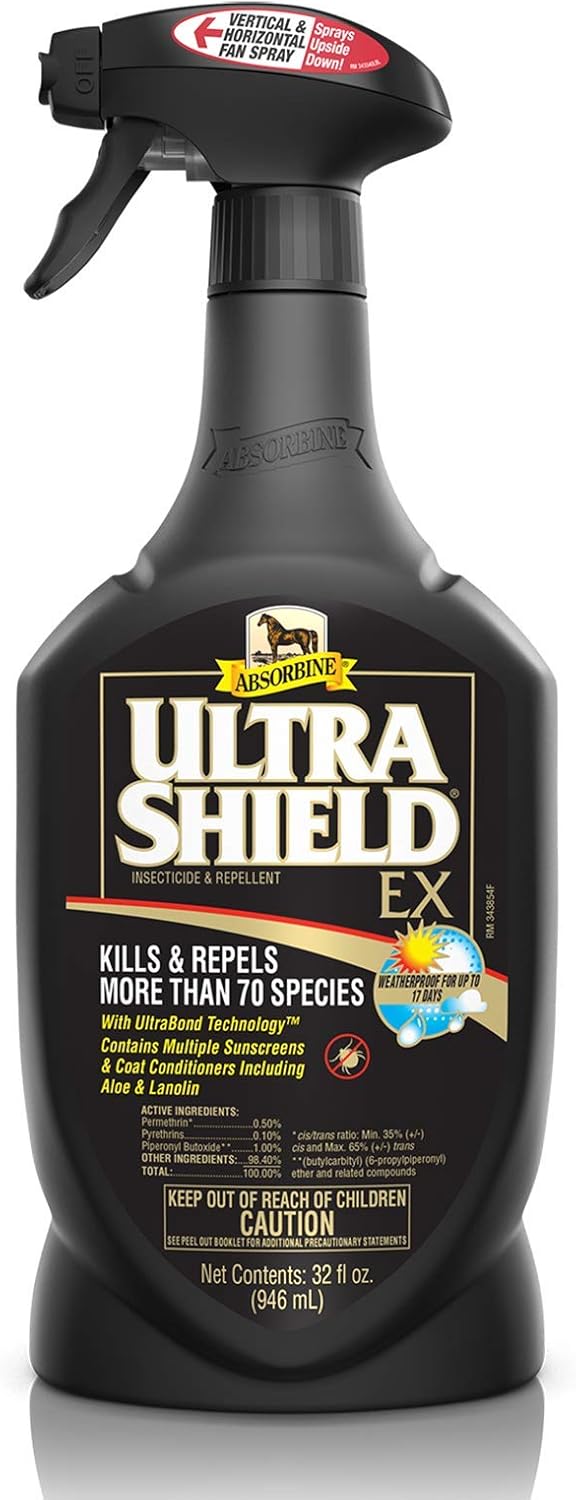
Absorbine UltraShield EX is a 32-ounce, ready-to-use spray designed for broad insect control around horses, barns, and outdoor areas. The water-based formula combines pyrethrins, piperonyl butoxide, and permethrin to kill and repel more than 70 species of pests while leaving no greasy residue. It is applied directly to animal coats or used as a premise spray and is intended to stick to hair and surfaces when applied to a clean coat. Notable features include weatherproof UltraBond Technology that can extend protection up to 17 days in some conditions and added sunscreens and coat conditioners for UV and coat care. Practical benefits are straightforward: no mixing, multi-species control including ticks, and suitability for spot-treating stalls, doorways, and tack areas as well as animals. Important limitations are that the product label emphasizes use on horses and premises and that some ingredients are insecticides requiring careful adherence to safety directions; it is not universally approved for all species and users should follow label precautions for application frequency and treated animals.
Best for: Buyers who prioritize robust, long-lasting insect control for horses, stalls, and outdoor areas and want a ready-to-use spray that reduces reapplication frequency.
Less Ideal for: Owners exclusively seeking a dog-specific repellent or those who prefer natural, non-pyrethroid formulations should consider alternatives tailored to dogs or gentler ingredient lists.
- Ready-to-use water-based formula requires no mixing and leaves little to no greasy residue
- EPA-approved actives that kill and repel over 70 insect species including ticks
- UltraBond Technology offers weatherproof protection that can last up to 17 days in some conditions
- Contains sunscreens and coat conditioners to help protect and maintain animal coats
- Label and ingredient profile require careful reading and safety precautions during application
- Primary registration and marketing focus is on horses and premises which limits direct claims for other pets
Verdict: Choose UltraShield EX if you need a ready-to-use, performance-oriented spray that kills and repels a wide range of pests and provides long-lasting protection for horses and outdoor areas.
Absorbine UltraShield EX Insecticide & Repellent, 1 Gallon

| Unit Count | 128 Ounce |
|---|---|
| Item Form | Liquid |
| Scent Name | Unscented |
| Recommended Uses For Product | Fly Control |
| Active Ingredients | Pyrethrins |
Absorbine UltraShield EX is a water-based, ready-to-use fly spray formulated to kill and repel more than 70 insect species while conditioning the coat and offering sun protection. It is typically applied directly to animal coats and around barns or doorways as a premise spray; the label gives guidance on application rate and safety. Notable features include UltraBond Technology for weatherproof protection up to 17 days, active ingredients that include pyrethrins and permethrin, and conditioning additives such as aloe and sunscreens. In practice that means fewer reapplications in dry or variable conditions and a non-greasy finish that leaves hair damp rather than oily. Because it is labeled for both horses and dogs (EX is approved for dogs), it covers multiple animals on a small farm or property. Important limitations are that it contains pyrethrins/permethrin so users must follow label precautions for people, animals, and environment, and some formulas in the UltraShield line differ in species approvals and reapplication intervals so check the bottle for the right use. For someone focused on dependable tick and fly control, this is a practical, long-lasting option when used as directed.
Best for: Buyers who prioritize reliable, low-effort pest control for horses and dogs and want a product with proven, longer-lasting protection that reduces application frequency.
Less Ideal for: People seeking completely natural, pesticide-free repellents or those who prefer daily, mild treatments for very young or chemically sensitive animals should consider alternative products.
- Ready-to-use water-based formula requires no mixing and leaves no greasy residue
- Weatherproof UltraBond Technology can provide protection up to 17 days between applications
- Kills and repels a broad spectrum of pests including flies and ticks as listed on the label
- Includes coat conditioners and sunscreens to protect and improve animal coat appearance
- Contains insecticidal actives (pyrethrins and permethrin) that require careful adherence to label safety instructions
Verdict: Choose UltraShield EX when you want a ready-to-use, weatherproof spray that reliably kills and repels ticks and flies with fewer reapplications.
Choosing the Right Fly Spray for Barns: Key Factors to Consider
Knockdown Speed
How quickly a spray disables or kills flies matters for immediate relief in high-traffic barn areas. Fast knockdown reduces the number of active biting flies around animals and handlers, lowering stress and the chance of disease transmission.
A spray's active ingredient and formulation determine knockdown. Pyrethroid-based products often act quickly, while some other chemistries can be slower but offer longer protection. Consider whether you need immediate control for peak fly times or whether steady suppression is acceptable.
Residual Control Duration
Residual control describes how long treated surfaces continue to repel or kill flies after application. Longer residuals reduce application frequency and labor, which is valuable in large barns or facilities without daily application capacity.
Residual performance depends on formulation, surface type, and environmental factors such as dust, rain, and sunlight exposure in open-sided barns. Plan for reapplication intervals that match your barn's microclimate and cleanliness routines to keep control consistent.
Livestock Safety and Label Directions
Safety for animals and handlers is a top priority. Always follow label directions about species-specific use, withdrawal times for food animals if applicable, and required reentry intervals. Some products are labeled for use on animals and surfaces, while others are for perimeter or surface application only.
Labels also specify required personal protective equipment and mixing instructions. Choose products whose safety profile and instructions fit your animal types and the level of training of staff who will apply the spray.
Application Method and Practicality
How a spray is applied affects coverage and convenience in a barn. Aerosols and ready-to-use trigger bottles are useful for spot treatments in stalls, while concentrates for dilution and backpack sprayers are better for treating large surfaces and perimeter areas.
Consider storage, mixing accuracy, and whether staff can safely operate the delivery equipment. The right method reduces waste, improves coverage uniformity, and lowers the risk of accidental overexposure to animals and people.
Coverage Efficiency and Cost of Use
Coverage efficiency measures how much area a given volume of product treats at effective rates. Concentrates that cover large areas per gallon are often more efficient for big barns, while small operations might value convenience over dilution economics.
Think about how frequently you will treat the barn and whether bulk packaging, dilution rates, or ready-to-use sizes fit your routine. Efficient coverage minimizes downtime and labor while maintaining consistent fly pressure control.
Environmental and Residue Considerations
Consider how formulations behave in and around the barn environment. Some sprays leave residues on feed bunks, bedding, or water troughs if misapplied. Others break down quickly and are safer for open-sided barns where runoff and non-target exposure are concerns.
Match the product's environmental profile to your barn layout, drainage, and proximity to pastures or waterways. Good application practices reduce unwanted residues and protect beneficial insects outside the barn.
Choosing the Right Formulation for Your Barn
Formulation type affects where and how you can use a fly spray in a barn. Ready-to-use trigger bottles and aerosols are convenient for spot control in stalls and around animal faces where precise application matters. Concentrates diluted in backpack or pump sprayers are more efficient for treating larger surfaces, rafters, and perimeter areas.
Also consider whether you need a spray labeled for direct animal contact or one intended only for surfaces. If animals will be in treated areas shortly after application, choose a product and application method with appropriate reentry intervals and label guidance.
- Trigger sprayers for quick spot treatment
- Aerosols for targeted knockdown in localized areas
- Concentrates for large-area coverage with backpack sprayers
- Surface-only formulas when direct animal contact is restricted
Application Timing and Barn Routines
Timing applications to barn routines increases effectiveness and safety. Treat surfaces and perimeter areas during low-activity periods to minimize animal disturbance and allow sprays to settle. For products with short reentry intervals, plan treatments when animals can be moved or when staff can supervise safe reentry.
Regular cleaning and manure management complement sprays. Reducing breeding sites lowers overall fly pressure, meaning sprays work better and less frequently.
- Apply during low-traffic times for better settling
- Coordinate with daily cleaning schedules
- Target manure areas and feed handling zones for best effect
Integration With Other Fly Management Methods
No single product eliminates all flies. Integrate sprays with sanitation, manure management, trapping, and physical barriers for the best results. Traps can reduce adult populations in hot spots, while sanitation removes breeding substrates so residual sprays remain effective.
Consider rotational use of different control tactics to reduce reliance on one chemistry, which can help delay resistance development in fly populations.
- Combine chemical and nonchemical methods
- Use traps to target hot spots and reduce adult pressure
- Maintain regular manure removal to cut breeding
Protecting Non-Target Animals and Beneficials
Protecting barn dogs, cats, and beneficial insects matters when selecting and applying fly sprays. Follow label restrictions for animals that may be more sensitive and avoid spray drift onto pollinator habitat or forage. Use spot treatments and targeted applications to limit exposure of non-targets.
When possible, choose application techniques that minimize overspray and runoff, and remove feed or water sources from treatment areas until the product dries or the label allows reaccess.
- Keep companion animals out of treatment zones
- Avoid spraying flowering plants or pasture margins
- Contain runoff to prevent exposure of beneficial insects
Storage, Mixing, and On-Farm Safety
Safe storage and mixing practices reduce risk to people and animals. Store concentrates in labeled, secure containers away from feed and animal areas. Mix products in well-ventilated spaces with appropriate protective equipment and clearly marked dosing tools.
Train all staff on label instructions, emergency procedures, and proper disposal of leftover solution or empty containers to maintain a safe barn environment.
- Keep concentrates locked and labeled
- Use correct PPE and measuring devices
- Dispose of containers and leftover mix responsibly
How We Chose the Best Fly Spray for Barns
We focused on attributes that determine real-world performance and safety in barn settings. Key evaluation criteria included knockdown speed, residual control duration, formulation safety for common barn animals, and application practicality for stalls and larger spaces. We also considered formulation type because ready-to-use sprays, concentrate-for-dilution, and aerosol options behave differently in a barn environment. Packaging and delivery method were reviewed for ease of targeted applications versus broadcast treatments. We prioritized products with clear label directions for use around livestock and those that offered flexible application rates for different barn sizes. Exclusions: we excluded consumer sprays intended only for household indoor use, products labeled solely for pets without barn-livestock instructions, and any formulation lacking explicit animal-safety directions. Our aim was to surface options suited to day-to-day barn management rather than one-off homeowner treatments.
FAQ
How often should I apply fly spray in a busy barn?
Frequency depends on the product's residual label and your barn's fly pressure. High-traffic barns may need weekly treatments with short-residual products, while longer-residual options can stretch to several weeks. Combine sprays with sanitation to reduce application frequency.
Can I use the same spray on animals and surfaces?
Not always. Some formulations are labeled for direct animal application, others are for surfaces only. Always follow the label for species-specific use, reentry intervals, and any withdrawal instructions for food-producing animals.
Are there safer options for barns with young or pregnant animals?
Yes. Look for products with clear livestock safety statements and minimal required reentry intervals. Spot treatments and surface applications that avoid direct contact reduce exposure. Consult your veterinarian for specific concerns about young or pregnant animals.
Will repeated use of one spray cause resistance in flies?
Repeated use of a single active chemistry can contribute to resistance over time. Rotating among products with different modes of action and integrating nonchemical controls helps manage resistance and maintain control efficacy.
How should I treat manure areas to reduce fly breeding?
Regular manure removal and proper composting or storage reduce fly breeding sites. Surface treatments with residual sprays can help while you remove material, but prevention through timely cleanout is the most effective long-term approach.
Final Verdict
Choose a fly spray based on the balance of immediate knockdown and how long protection needs to last in your barn. Prioritize products with clear livestock-safe labeling and application methods that fit your barn layout and staff capabilities. Pair chemical control with strong sanitation and trapping to reduce resistance and achieve dependable, long-term fly suppression. Make decisions around animal safety, application practicality, and reapplication intervals rather than convenience alone. That approach gives you effective control while protecting animals and maintaining routine barn operations.
