

Note: This article contains affiliate links. If you click on these links and make a purchase, I may earn a small commission at no extra cost to you. This helps support my research and content. Read my full affiliate disclosure here.
Picking the right full spectrum LED grow light bulb matters for any indoor gardener because the wrong bulb can stunt growth, waste energy, or overheat small spaces. Whether you are growing seedlings on a windowsill, supplementing a balcony tomato crop, or running a compact grow box, the bulb you choose directly affects light intensity, spectral balance, and thermal behavior in the actual growing area. This guide lists seven carefully shortlisted full spectrum LED grow light bulbs that suit common indoor situations and fixture types. We evaluated output, heat, and fit so you can match a bulb to your plants and space with confidence. Read on for the factors we used and practical tips for installation.
Top Picks at a Glance
| Best Overall The best all-around choice for most situations | GE BR30 Balanced Spectrum LED Grow Light Bulbs (2-Pack) |  |
| Best Quality Built to a higher standard if you want something more solid | Hywyimlait PAR30 22W Full Spectrum 4000K LED Grow Light Bulb (E27) |  |
| Best Value The sweet spot between price and what you get | Wiyifada A19 Full Spectrum Dimmable LED Grow Light Bulb, 9W (E26) |  |
| Best Budget The cheapest option that still gets the job done reliably | mfxmf A19 Full-Spectrum LED Grow Light Bulb, 9W (2-Pack) |  |
| Highest Rated A top-rated pick with lots of positive feedback | GISMIOSY 20W Full Spectrum LED Grow Light Bulb with Built‑in Plant Fan (E26, 6000K) |  |
| Most Popular A crowd favorite that many people choose with confidence | Briignite A19 Full Spectrum LED Grow Light Bulb (2-Pack) |  |
| Best Seller A high-volume bestseller chosen again and again | Briignite A19 Full-Spectrum LED Grow Light Bulbs (4-pack) |  |
GE BR30 Balanced Spectrum LED Grow Light Bulbs (2-Pack)

| Wattage | 9 watts |
|---|---|
| Bulb Base | E26 Medium |
| Light Color | Blue, Red |
| Light Source Operating Life | 25000 hours |
| PPF Value | 15-16 micromoles per second |
These GE BR30 grow bulbs are designed as an easy, low‑heat option for indoor gardeners who want natural-looking light while supporting photosynthesis. Each bulb runs at 9 watts and produces a balanced red and blue spectrum with a stated PPF of about 15–16 micromoles per second, which is appropriate for seedlings, leafy greens, herbs, and light-flowering plants. The BR30 shape and E26 base make them simple to screw into standard fixtures or reflectors so you can add supplemental light without a specialized fixture. Other practical benefits include a high CRI of 90 for pleasing color rendering, a long rated life of up to 25,000 hours, and low energy use and heat output compared with traditional grow lamps. Limitations are the modest PPF, which means they are best for small setups, low- to medium-light crops, or supplemental lighting rather than powering a high‑intensity flowering room. App control and USB connectivity are noted but expect basic functionality rather than advanced scheduling found on dedicated grow fixtures.
Best for: Buyers who want a simple, low‑maintenance grow light that blends into living spaces and supports seedlings, herbs, and everyday greens without complicated setup.
Less Ideal for: Growers who need high-intensity lighting for large flowering or fruiting crops or who want advanced fixture controls and wide uniform coverage.
- Balanced red-blue spectrum suitable for seedlings, herbs, and leafy greens
- Low power draw (9 watts) with low heat output for safe close mounting
- High color rendering index (CRI 90) so plants and room colors appear natural
- Long rated lifespan (up to 25,000 hours) reduces replacement frequency
- PPF (~15–16 μmol/s) is modest and not ideal as the sole light for high‑demand flowering or large fruiting plants
- BR30 form factor concentrates light; coverage area is limited compared with linear or multi‑LED fixtures
Verdict: A convenient, low‑heat LED bulb that provides natural-looking balanced spectrum lighting for seedlings, herbs, and everyday indoor greens.
Hywyimlait PAR30 22W Full Spectrum 4000K LED Grow Light Bulb (E27)

| Wattage | 22 watts |
|---|---|
| Base Type | E27 |
| Color Temperature | 4000 Kelvin |
| Light Type | LED |
| Specific Uses For Product | Plant Growing |
This Hywyimlait PAR30 22W grow bulb is a screw-in LED designed to replace a small fixture for seedling and vegetative growth through to flowering. It produces a 4000K full spectrum across 400–780nm with a CRI above 95, which makes light look natural and supports all growth stages. The PAR30 shape and built-in aluminum heat fins keep the lamp running cooler than simple plastic bulbs, and the E27 base means installation is as simple as screwing it into a standard lamp, pendant, or fixture. The listing emphasizes high PPFD and energy efficiency at about 22 watts, so you can run multiple bulbs with modest power draw for denser coverage. Limitations include the single fixed output and spectrum with no built-in dimming or timing controls, so you will need external timers or dimmable fixtures for schedules and light intensity control; placement and number of bulbs determine usable coverage and final yield. For growers who want plug-and-play full-spectrum light with good color rendering, this is a practical low-maintenance option.
Best for: Growers who prioritize light quality and measurable performance and want a plug-and-play full-spectrum bulb to support seedlings through flowering without complex setup.
Less Ideal for: People who need adjustable intensity, programmable schedules, or wide-area commercial coverage without using many individual bulbs.
- Full-life-cycle full spectrum (400–780nm) suitable for all growth stages
- High CRI (95+) gives accurate color rendering for plant inspection
- Standard E27 base for easy screw-in installation in lamps and fixtures
- Built-in aluminum heat fins improve heat dissipation and longevity
- Relatively low power draw (22W) with claimed high PPFD for efficient light delivery
- No integrated dimming, schedule, or controller functions
- Single fixed spectrum and output require planning number and placement for coverage
Verdict: Choose this bulb if you want a high-CRI, full-spectrum screw-in grow light that delivers efficient, plug-and-play performance for indoor plant growth.
Wiyifada A19 Full Spectrum Dimmable LED Grow Light Bulb, 9W (E26)

| Wattage | 9 watts |
|---|---|
| Bulb Base | E26 |
| Light Color | Full Spectrum |
| White Brightness | 1000 lumens |
| Light Source Operating Life | 20000 hours |
This Wiyifada A19 grow bulb is a simple drop-in LED solution for houseplants that need supplemental light. It screws into any standard E26 socket and delivers a full spectrum (400–740 nm) output at 9 watts while claiming an equivalent to a 100W incandescent, so it provides usable plant light without a heavy electricity burden. The bulb is dimmable and rated at about 1,000 lumens with a CRI of 90, which helps render plant colors naturally and supports multiple growth stages. It is intended for continuous indoor use with an estimated 20,000-hour life and a plastic plus aluminum body for basic heat management. Practical benefits include easy installation, broad-spectrum light suitable for seedlings through vegetative growth, and low running cost. Limitations are the modest claimed lifespan compared with higher-end grow LEDs and the single-bulb form factor, which may require multiple bulbs or closer placement for larger or light-hungry plants. There is also no integrated mounting or reflector, so performance depends on your fixture and placement.
Best for: Houseplant owners who want a low-cost, easy-to-install supplemental light for seedlings, herbs, and small to medium foliage plants and who prioritize straightforward setup and energy efficiency.
Less Ideal for: Growers needing high-intensity lighting for fruiting or large canopy crops or those wanting advanced features like built-in reflectors, wireless control, or longer rated lifespans.
- Full spectrum output (400–740 nm) suitable for all plant growth stages
- Low power consumption at 9 watts while replacing up to 100W incandescent
- Dimmable control for adjusting light intensity to match plant needs
- Standard E26 base for plug-and-play installation in common fixtures
- High CRI (90) for natural color rendering of plants
- Rated life of 20,000 hours is shorter than many premium grow LEDs
- No integrated reflector or mounting, so placement affects effectiveness
- Single A19 bulb may not provide enough light for large or high-light plants
Verdict: A simple, energy-efficient full-spectrum A19 bulb that lets practical houseplant owners add effective supplemental light with no special fixture needed.
mfxmf A19 Full-Spectrum LED Grow Light Bulb, 9W (2-Pack)

| Wattage | 9 watts |
|---|---|
| Bulb Base | E26 |
| Incandescent Equivalent Wattage | 100 watts |
| Light Color | Red/Blue |
| White Brightness | 1600 lumens |
These mfxmf A19 grow bulbs are straightforward plug-and-play LEDs that aim to replace a 100W incandescent while using only 9W each. Screw them into any standard E26 socket and position 2–4 feet above seedlings, herbs, or potted vegetables to provide a mix of red (630 nm) and blue (460 nm) wavelengths plus broad spectrum output for general growth. Notable features include 1600 lumens white-brightness equivalent, a claimed 20,000-hour life, and a plastic and aluminum cooling structure to manage heat during long runs. Because they are standard bulb shape and voltage compatible with household fixtures, they work well in small grow tents, windowsill setups, and kitchen herb stations without extra hardware. Limitations are typical for A19 bulbs: light is directional and less intense than purpose-built panel fixtures for dense canopies, and the plastic construction is not as rugged as commercial units. These are a practical, low-energy option when you need simple supplemental lighting or a budget first step into indoor growing.
Best for: Buyers who want an inexpensive, easy-to-install way to add supplemental or starter grow lighting for herbs, seedlings, and small indoor plants without changing fixtures.
Less Ideal for: Users planning a larger canopy, multi-tier grow tent, or high-light crops who need higher intensity, uniform coverage should choose purpose-built grow panels instead.
- Full-spectrum output with dedicated red and blue wavelengths suitable for all growth stages
- E26 A19 form factor installs in standard household sockets with no extra fixtures
- Low power draw at 9W while advertising a 100W incandescent equivalent for energy savings
- Claimed 20,000-hour lifetime and cooling elements to support longer continuous use
- Less concentrated light output than dedicated LED panels, so multiple bulbs needed for larger or dense plantings
- Plastic construction is less durable than metal-bodied professional grow lights
Verdict: A low-cost, easy-to-use full-spectrum bulb solution for beginners and anyone needing simple supplemental indoor lighting.
GISMIOSY 20W Full Spectrum LED Grow Light Bulb with Built‑in Plant Fan (E26, 6000K)
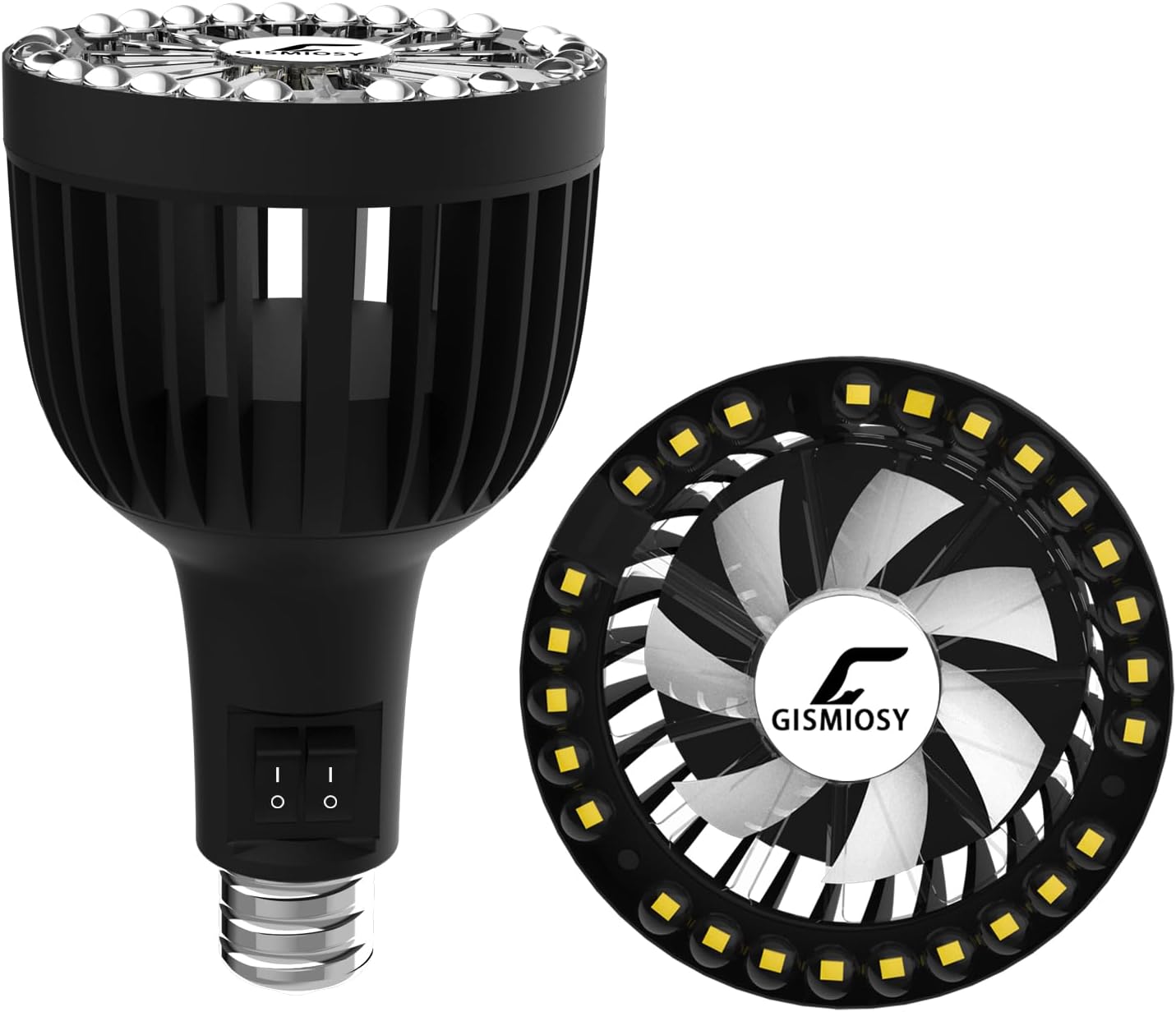
| Wattage | 20 watts |
|---|---|
| Bulb Base | E26 |
| Color Temperature | 6000 Kelvin |
| Power Source | Electric |
| Material Type | Aluminum |
This GISMIOSY grow light bulb combines a 20W full spectrum LED array with a built‑in plant fan to provide both concentrated light and gentle airflow for indoor plants. It installs like a regular E26 bulb, so you can use it in lamps, shelves, or small grow tents without extra hardware. The 6000K daylight spectrum with high CRI makes it easy to monitor plant health under natural‑looking white light rather than purple LEDs. The manufacturer reports high PPFD at short distance, which is useful for seedlings, propagation, herbs and compact vegetable setups when mounted close to the canopy. Independent controls let you run the fan separately to improve air movement and reduce heat buildup around the plant tips. Practical limitations are the recommended close mounting distance for peak PPFD and that a single bulb is best for small setups or spot lighting rather than whole-room coverage. The aluminum construction and active cooling support sustained output, making it a straightforward, no‑fuss option for reliable everyday indoor growing.
Best for: Buyers who want a simple, dependable grow solution that installs like a normal bulb and prioritizes steady performance and plant health for small indoor setups such as propagation stations, shelves, or desktop displays.
Less Ideal for: Growers planning to light large cabinets, multiple full‑shelf layers, or whole-room canopies should look for multi‑unit fixtures or higher‑output panels instead.
- Full spectrum 6000K LED with high CRI for natural white light and easy plant inspection
- Integrated fan with independent control improves airflow and reduces local heat
- Standard E26 base for tool‑free installation in common household fixtures
- Reported high PPFD at short distance suitable for seedlings and propagation
- Aluminum construction and active cooling designed to support stable long‑term performance
- High PPFD performance requires close placement to the canopy, limiting coverage area
- Single 20W bulb is best for spot treatments rather than lighting larger gardens
Verdict: A reliable, easy‑to‑install full‑spectrum grow bulb with built‑in fan ideal for steady, small‑scale indoor plant lighting.
Briignite A19 Full Spectrum LED Grow Light Bulb (2-Pack)

| Light Type | LED |
|---|---|
| Additional Features | Full Spectrum |
| Bulb Base | E26 |
| Light Output Maximum | 1000 lumens |
| Light Source Operating Life | 30000 hours |
These Briignite A19 grow bulbs are full-spectrum LED replacements that screw into any standard E26 fixture to give indoor plants consistent, natural-looking light. Each bulb outputs about 1000 lumens at roughly 11 to 12 watts, so they act like a 60 to 100 watt incandescent while using far less energy, which is handy for running multiple bulbs on a budget. The 3500–4000K warm daylight color and high CRI make foliage colors appear normal rather than the purple hue of some grow lights, so they work well in living spaces and plant shelves. Built-in features include app control and push-button options and an advertised 25,000 to 30,000 hour operating life. Limitations to note are modest reported PPF compared with purpose-built high‑output grow fixtures and the 180 degree beam, which is better for general room lighting than targeted canopy penetration for dense or tall plants. For small collections, seed starting, or supplementing light in low-light rooms these bulbs are an economical, easy-to-install choice.
Best for: Houseplant owners who need an affordable, plug-and-play light to supplement natural light for a few pots, seedlings, or a small indoor garden while keeping energy costs low.
Less Ideal for: Growers aiming to flower large or dense canopy crops or outfitting multi-tiered grow racks will want higher‑PPF, purpose-built fixtures instead.
- Full spectrum output that looks like natural white light and preserves true foliage color
- Low power draw (around 11–12W) with 1000 lumens brightness for energy-efficient continuous use
- Standard E26 base fits common fixtures for tool-free installation
- High CRI of 90 helps accurate color rendering in living spaces
- Beam angle and lumen-focused design give less concentrated PAR/PPF than dedicated high‑output grow fixtures
- App and push-button controls are basic compared with advanced programmable controllers
Verdict: A low-cost, easy-to-install full-spectrum LED bulb that gives natural-looking light and energy savings for small indoor plant collections.
Briignite A19 Full-Spectrum LED Grow Light Bulbs (4-pack)

| Light Type | LED |
|---|---|
| Wattage | 11 watts |
| Bulb Base | E26 |
| Color Temperature | 3500 Kelvin |
| Light Output Maximum | 1000 lumens |
These Briignite A19 grow bulbs are standard E26 LED replacements that deliver a full-spectrum light (listed at 3500–4000K appearance) and roughly 1000 lumens at 11 watts, so they run cool and are energy efficient compared with incandescent equivalents. They screw into any standard lamp or fixture and are typically used to supplement light for leafy houseplants, herbs, and fruiting vegetables in low-light rooms or during short winter days. Notable features include full-spectrum output that avoids the purple look of many grow lamps, a wide 180 degree beam for even coverage, and an advertised long operating life around 25,000 to 50,000 hours. Practical benefits are simple plug-and-play installation, lower electricity use, and a natural-looking light that blends with home lighting. Important limitations are that these bulbs are non-dimmable and have no built-in timer or adjustable spectrum, so they are best for basic supplemental use rather than a full controlled grow setup; the stated PAR/PPF figures are modest and may not be enough for heavy fruiting or larger grow tents.
Best for: Buyers who want a low-risk, easy-to-use grow light to keep houseplants, herbs, or small veggie starts healthy without rewiring or specialty fixtures.
Less Ideal for: Serious hobbyists or small-scale growers who need dimming, timed cycles, or higher-intensity lights for full-cycle fruiting and larger grow tents should consider purpose-built fixtures instead.
- Full-spectrum output that appears natural indoors rather than purple grow light
- Standard E26 A19 base for easy plug-and-play installation in household fixtures
- High lumen output (about 1000 lm) at low power draw (11 W) for energy savings
- Wide 180 degree beam angle for even coverage across small plant groups
- Non-dimmable and no built-in timer or spectrum control
- Advertised PAR/PPF is modest and may be insufficient for heavy fruiting or dense canopy setups
Verdict: A simple, energy-efficient full-spectrum A19 bulb that lets you supplement houseplant light with minimal setup and a natural-looking output.
Choosing the Right Full Spectrum LED Grow Light Bulb: Key Factors to Consider
Spectrum Balance and Plant Stage
Spectrum balance determines how light supports photosynthesis, leaf development, and flowering. Blue wavelengths encourage compact vegetative growth and strong leaf structure, while red wavelengths trigger flowering and fruiting responses. A true full spectrum bulb provides useful amounts of both, often with a visible white light appearance that also supports human visibility in indoor spaces.
When choosing a bulb, think about the primary crop and growth stage you want to support. Seedlings and leafy greens benefit from a cooler, blue-leaning full spectrum, while budding or fruiting plants need stronger red content. Bulbs advertised with measured spectral distribution or specific blue/red ratios are easier to match to plant needs than those using vague marketing language.
Light Intensity and Coverage
Light intensity, expressed as lumens or PPFD, determines how close a bulb must be to plants and how many bulbs are needed to cover a given area. Higher-output bulbs can hang farther from the canopy and cover more plants, while lower-output bulbs work best for single pots or micro-propagation setups.
Consider the footprint of your growing area and the typical hanging or fixture height. For a small tray of seedlings, a bulb with moderate output placed 6 to 12 inches away may be sufficient. For larger clusters or fruiting plants, plan for higher PPFD values and either multiple bulbs or a closer mounting distance to reach the needed light levels.
Heat Generation and Thermal Safety
Even LED bulbs produce heat, and in confined indoor setups heat can raise canopy temperature and stress plants. Effective heat dissipation through integrated heat sinks or passive cooling keeps bulb surface temperatures lower and helps maintain stable ambient conditions in small cabinets or near delicate seedlings.
Assess how the bulb will operate inside your chosen fixture. Bulbs with limited airflow around them can run hotter, so look for thermal ratings or operating temperatures. If you plan to use bulbs in enclosed fixtures or close to plastic trays, choose options designed for restricted airflow and monitor canopy temperature after installation.
Fixture and Socket Compatibility
Bulb shape, base type, and physical length determine whether a candidate bulb fits your lamp or enclosure. Many indoor gardeners repurpose clamp lamps, ceramic sockets, or enclosed fixtures, so matching base type and overall bulb dimensions matters more than raw output on paper.
Check whether a bulb is rated for enclosed fixtures if you plan to use it inside a hood or a small grow box. Also verify the socket type and any tilt or reflector needs. A bulb that fits snugly in a reflective clamp lamp will behave differently than the same bulb mounted inside a vented, directional fixture.
Energy Use and Operating Hours
Energy efficiency affects long-term cost and heat output. Look at wattage relative to light output; a lower-wattage bulb that produces comparable PPFD is preferable for many indoor gardeners because it reduces electricity use and heat burden.
Consider how many hours per day the bulb will run. Seedlings often need 14 to 18 hours of light, while flowering plants may use 12 hours on a bloom cycle. Multiply expected daily run time by wattage to estimate energy use and to plan a realistic operating schedule that matches plant needs without oversupplying light.
Lifespan, Durability, and Warranty
LED bulbs are marketed for long lifespans, but actual run hours and environmental conditions influence real-world durability. A bulb that maintains output for tens of thousands of hours offers better long-term value and reduces the frequency of replacement in multi-bulb setups.
Look for clear rated operating hours, claims about lumen maintenance, and any warranty coverage. Durable construction, good heat-sinking, and moisture resistance help bulbs last in humid grow tents or greenhouse-adjacent indoor spaces where condensation can occur.
Matching Bulb Output to Common Indoor Setups
Different indoor setups require different levels of light intensity. For a single seedling tray or small herb pot, a lower-output full spectrum bulb that can be positioned close to the plants will typically suffice. For multi-pot arrangements or fruiting plants, plan for higher PPFD and either multiple bulbs or a bulb designed for broader coverage.
Measure or estimate the canopy area and think about mounting height. A focused bulb mounted low works well for single shelves, whereas a wider-distribution bulb is better for table-top clusters.
- Seedlings and clones: moderate output, close placement
- Leafy greens: steady moderate intensity with longer daily hours
- Flowering/fruiting plants: higher PPFD, wider coverage or multiple bulbs
Mounting, Reflectors, and Light Directionality
How you mount the bulb and whether you use reflectors affects effective light delivery. A bulb placed inside a small reflector or a hood will concentrate light and increase PPFD at the canopy, while an unshaded bulb distributes light more widely but at lower intensity.
For small cabinets, a directional bulb in a reflective fixture is often the most efficient configuration. In open rooms or near windows, choose a bulb with a comfortable spread so neighboring plants receive even illumination.
- Use reflectors to boost intensity for a given bulb
- Leave clearance for airflow to reduce heat buildup
- Consider adjustable mounts to tune distance as plants grow
Color Rendering and Visual Comfort
Full spectrum bulbs often produce a neutral white light that helps you inspect plants for pests, nutrient issues, and leaf color. High color rendering index (CRI) makes it easier to spot subtle problems without switching to a handheld light.
If you work frequently around your grow area, prioritize bulbs that deliver natural-looking light. That visual comfort does not replace measurements like PPFD, but it adds real practical value during routine checks and maintenance.
- High CRI aids plant inspection
- Neutral white helps with long work sessions
- Balance CRI with spectral needs for growth stages
Using Timers, Dimmers, and Light Schedules
Automating daily light cycles with a timer or digital controller ensures consistent photoperiods, which is critical for many crops. Some bulbs are dimmable and let you tailor intensity across stages, reducing stress during transplanting or seedling phases.
When integrating timers or dimmers, check compatibility and whether the bulb requires a specific driver. Simple mechanical timers work with most basic bulbs, but dimming functions often need compatible electronics to avoid flicker or premature failure.
- Use timers to maintain consistent photoperiods
- Dimming can ease seedlings into higher light
- Confirm electrical compatibility before adding dimmers
Safety and Ventilation in Small Grow Spaces
Safety is a practical concern when adding any electrical lighting to an indoor gardening setup. Ensure fixtures and bulbs are rated for the environment, especially in humid tents or near water sources. Maintain clearances around bulbs for airflow and prevent contact with plastic sheeting or flammable materials.
If ventilation is limited, choose bulbs with better heat-sinking and consider adding passive vents or a small fan to exchange hot air. Regularly inspect sockets and cords for wear and avoid overloading circuits with multiple high-wattage bulbs.
- Keep bulbs away from direct contact with plastic and soil moisture
- Provide airflow in enclosed cabinets to control temperature
- Check electrical ratings and avoid daisy-chaining multiple fixtures
How We Chose the Best Full Spectrum LED Grow Light Bulb
We focused on attributes that matter in hands-on indoor gardening and excluded fixtures or lamps that are not standard bulb replacements. Selection began by identifying bulbs with explicit full-spectrum claims and measurable output specifications suitable for plant use. Key evaluation criteria included light spectrum balance across blue and red wavelengths for different growth stages, photosynthetic photon flux density (PPFD) or lumen output relative to recommended levels, heat generation at typical operating distances, and compatibility with common sockets and enclosures. We also checked build and electrical safety features such as rated operating hours, heat sinks, and passive cooling to ensure bulbs are safe in small grow cabinets and near heat-sensitive plants. Ease of installation and physical fit mattered because many growers use existing lamps or small fixtures. We excluded specialty horticultural fixtures that require custom mounting or drivers, and we excluded products lacking clear spectral or output data. The resulting shortlist reflects bulbs that perform reliably across spectrum, output, thermal control, run-time, and practical fit for indoor gardeners.
FAQ
How close should I place a full spectrum LED grow light bulb to seedlings?
It depends on the bulb output, but seedlings generally do well with bulbs 6 to 12 inches away. Start at the higher end of that range and move the bulb closer if plants stretch. Watch for leaf curling or bleaching as signs the bulb is too close.
Can I use a full spectrum bulb in a regular household lamp?
Often you can if the base and physical size match, but check whether the lamp is rated for continuous horticultural use and whether the bulb is safe in enclosed fixtures. Avoid using bulbs in lamps that trap heat without ventilation.
Do full spectrum bulbs need to be on for fewer hours than other grow lights?
No. Daily hours depend on the crop and growth stage rather than the bulb type. Seedlings may require 14 to 18 hours, while flowering plants often use a 12-hour photoperiod. Adjust duration to plant needs, not bulb marketing.
Will a full spectrum LED bulb replace natural sunlight entirely?
Full spectrum bulbs provide the wavelengths plants need for growth, but sunlight includes a broader and stronger irradiance profile. For many crops, bulbs can fully support growth indoors when sized correctly, though some intense sun-loving plants may need higher PPFD than typical household bulbs provide.
How do I know if a bulb is too hot for my grow box?
Check the bulb surface temperature and monitor canopy temperature after a few hours of operation. If temperatures rise above your plant's ideal range or if plastic trays warp or produce condensation, the bulb may be generating excessive heat or the ventilation is insufficient.
Final Verdict
When choosing a full spectrum LED grow light bulb, prioritize spectrum balance for the growth stage you plan to support, appropriate light intensity for your canopy area, and thermal characteristics that match your fixture and ventilation. Consider socket and physical fit, energy use over expected daily hours, and the bulb's rated lifespan. Tight spaces favor bulbs with good heat-sinking and directional options, while larger groupings benefit from higher-output bulbs or multiple lamps. Balance these tradeoffs against how you work in the space to pick a bulb that delivers the right light with minimal heat and maintenance.
