

Note: This article contains affiliate links. If you click on these links and make a purchase, I may earn a small commission at no extra cost to you. This helps support my research and content. Read my full affiliate disclosure here.
When citrus leaves go spotted or fruits develop blemishes, choosing the right fungicide for lemon tree care can save a season of harvest. You need treatments that stop active infections, protect new growth, and fit into a routine you can manage on a patio tree or backyard grove. This guide shortlists the top options for treating common fungal problems on lemon trees and explains the practical reasons each type made the list. We evaluate broad factors like coverage, systemic versus contact action, phytotoxicity risk, and ease of repeating applications. Read on to see the picks and the criteria used to compare them.
Top Picks at a Glance
| Best Overall The best all-around choice for most situations | BioAdvanced 3-in-1 Fruit, Citrus & Nut Tree Spray, 32 oz |  |
| Best Quality Built to a higher standard if you want something more solid | BioAdvanced 3-in-1 Insect, Disease & Mite Control Spray, 32 fl oz |  |
| Best Value The sweet spot between price and what you get | Bonide Captain Jack's Fruit Tree Spray Concentrate, 32 oz |  |
| Best Budget The cheapest option that still gets the job done reliably | Garden Safe Fungicide3 Ready-to-Use Trigger Spray (32 fl oz) |  |
| Highest Rated A top-rated pick with lots of positive feedback | Monterey Fungi-Max Systemic Fungicide, 16 oz (with Measuring Spoon) |  |
| Most Popular A crowd favorite that many people choose with confidence | Bonide Captain Jack's Liquid Copper Fungicide Ready-to-Use, 32 oz |  |
BioAdvanced 3-in-1 Fruit, Citrus & Nut Tree Spray, 32 oz

| Item Form | Liquid |
|---|---|
| Target Species | Insects |
| Included Components | 32 Oz Fruit & Nut Tree Care |
This ready-to-spray 3-in-1 formulation gives lemon tree owners a single product to tackle common fungal diseases and the insects that spread or worsen them. You attach a garden hose to the bottle nozzle and thoroughly spray foliage and new growth until dripping, which makes coverage quick for medium to large trees. The formula lists control for black spot, powdery mildew, and rust as well as pests like aphids, caterpillars, and mites, and the label permits use up to the day before harvest when applied as directed. Practical benefits include no measuring or mixing, broad-spectrum activity that reduces the need for separate products, and a hose-end application that speeds treatment of multiple trees. Important limitations are that it is a contact product so thorough coverage is required for effectiveness, it may need repeat applications for heavy infestations or persistent disease pressure, and users should follow label safety and reentry instructions for edible crops.
Best for: Home gardeners with lemon trees who want a single, easy-to-apply solution for common fungal diseases and the insects that damage fruit and foliage.
Less Ideal for: Organic growers or those seeking systemic long‑term protection should consider certified organic or systemic alternatives instead.
- Ready-to-spray hose-end nozzle requires no mixing or measuring
- Combines insect, mite, and fungal disease control in one product
- Label allows use up to the day before harvest for edible trees
- Covers foliage and new shoots quickly for larger or multiple trees
- Works by contact so it requires thorough coverage and may miss pests or spores not reached by spray
- May need repeated treatments under heavy pest or disease pressure
Verdict: A convenient hose‑end 3‑in‑1 spray that simplifies control of common fungal diseases and pests on lemon trees.
BioAdvanced 3-in-1 Insect, Disease & Mite Control Spray, 32 fl oz
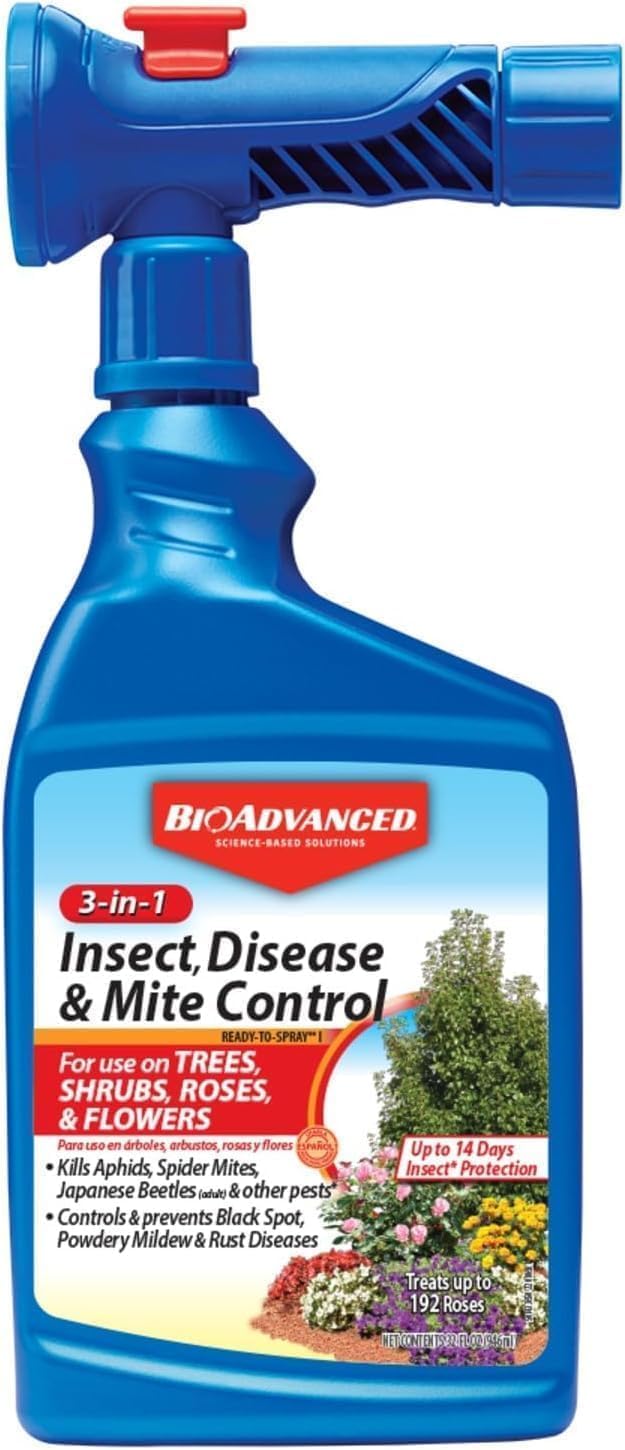
| Unit Count | 32 Fluid Ounces |
|---|---|
| Item Form | Spray |
| Target Species | Aphids, caterpillars, leafminers, whiteflies and other listed pests |
| Active Ingredients | Tau-fluvalinate 0.61%, Tebuconazole 0.65% |
This BioAdvanced 3-in-1 spray is a performance-focused ready-to-use treatment that kills common pests on contact while also preventing and curing listed fungal diseases and controlling spider mites. It attaches to a garden hose for broad, even coverage and is labeled to treat up to 192 rose bushes, making it practical for medium to large beds and multiple shrubs. Key features include systemic ingredients plus contact control, rainproof protection lasting up to 14 to 30 days depending on labeled claims, and active ingredients targeting aphids, caterpillars, whiteflies, and mites. In use you spray foliage including undersides, and the product provides both immediate knockdown of insects and longer residual control so follow-up applications are less frequent. Limitations: it is a chemical treatment so users must follow safety directions and keep children and pets away until treated areas have dried, and it is not sold for use in New York. For someone prioritizing reliable, one-step control of aphids and associated fungal problems on roses and ornamentals, this bottle delivers convenient, broad-spectrum protection.
Best for: Gardeners who want a fast, high-performance one-step solution to control aphids and related pests while also preventing common fungal diseases on roses and ornamental plants.
Less Ideal for: Organic gardeners or those seeking nonchemical options should look for botanical or soap-based aphid controls instead.
- Combines insecticide, fungicide, and miticide in one ready-to-use formula for streamlined treatment
- Attaches to a garden hose for fast coverage of many plants including up to 192 roses
- Provides knockdown on contact and residual protection between labeled reapplications
- Controls a wide list of pests including aphids, spider mites, whiteflies, and caterpillars
- Contains chemical active ingredients that require careful handling and adherence to safety directions
- Not approved for sale in all states which limits availability for some users
Verdict: For gardeners focused on performance, this ready-to-spray 3-in-1 formula delivers fast aphid knockdown plus disease prevention in one convenient application.
Bonide Captain Jack's Fruit Tree Spray Concentrate, 32 oz

| Item Form | Spray |
|---|---|
| Target Species | Fungus |
| Liquid Volume | 32 fluid ounces |
| Active Ingredients | Neem Oil |
Bonide Captain Jack’s Fruit Tree Spray is a concentrated neem oil formulation designed to protect fruit trees and garden plants from a wide range of pests and fungal diseases. Mixed with water, it is applied as a foliar spray or soil drench every 10 to 14 days to prevent and manage issues such as powdery mildew, blight, rust and common insects like aphids, caterpillars and spider mites. The product is approved for organic gardening and can be used up to the day of harvest, which makes it useful for edible plantings. One quart of concentrate dilutes into a large volume of spray, so a single bottle covers multiple applications across an orchard or several mature trees. Practical limitations are that it is preventative rather than a rapid curative for severe infestations and it requires regular reapplication and thorough coverage to be effective. Users should follow label mixing and safety instructions and apply before pests or disease become widespread for best results.
Best for: Home orchard owners and gardeners who want a single organic-approved product to manage both common fungal diseases and a broad spectrum of insect pests across fruit trees and mixed plantings.
Less Ideal for: People needing an immediate knockdown for a severe, widespread infestation or those who prefer single-target synthetic treatments with faster contact kill.
- 4-in-1 action: functions as a fungicide, insecticide, miticide and nematicide
- Contains cold-pressed neem oil and is approved for organic gardening and use up to harvest
- Concentrated formula: one quart dilutes to a large volume of spray for multiple applications
- Versatile application as foliar spray or soil drench for trees, shrubs, vegetables and ornamentals
- Works best as a preventative and may not eliminate heavy, established infestations quickly
- Requires regular applications and thorough coverage to maintain control
Verdict: A concentrated, organic-approved neem spray that gives balanced preventive control of common fungal diseases and many insects on fruit trees and garden plants.
Garden Safe Fungicide3 Ready-to-Use Trigger Spray (32 fl oz)

| Unit Count | 32 Fluid Ounces |
|---|---|
| Item Form | Spray |
| Target Species | Fungus |
| Active Ingredients | Clarified Hydrophobic Extract Of Neem Oil 0.9% |
Garden Safe Fungicide3 is a multipurpose ready-to-use spray built around a clarified hydrophobic neem oil extract that treats fungal problems and some insect and mite pests on landscape and edible plants. In practice you spray foliage for coverage when disease or pests first appear or use it preventatively on roses, ornamentals, houseplants and fruit trees like lemons. Notable features are the triple-action formula (fungicide, insecticide, miticide) and an easy trigger bottle for spot or whole-plant applications. Practical benefits include broad-spectrum control of powdery mildew, black spot and rust plus suppression of aphids, whiteflies and spider mites without mixing concentrates. Important limitations are that it is oil-based so it can cause leaf burn on stressed or tender plants and directions require applications in early morning or late evening; the active ingredient concentration is relatively low so severe infestations may need follow-up treatments or a stronger product.
Best for: Gardeners who want an easy, all-purpose spray to protect small to medium lemon trees and other home garden plants without mixing concentrates and who prioritize convenience and organic-friendly ingredients.
Less Ideal for: Commercial growers, large orchards, or those facing severe fungal outbreaks who need higher-strength professional treatments or systemic products.
- Three-in-one action controls fungi, listed insects and mites without separate products
- Ready-to-use trigger bottle requires no mixing for quick spot or foliar treatments
- Contains neem oil extract suitable for organic-style home gardens
- Clear directions and usage guidance for timing to reduce leaf burn
- Oil-based formula can cause leaf burn on stressed or tender foliage if applied in heat or strong sun
- Active ingredient concentration is modest so may be slower or require repeat treatments on heavy infestations
Verdict: A convenient neem-oil ready spray that gives budget-minded home gardeners broad, organic-friendly protection for lemon trees and other garden plants.
Monterey Fungi-Max Systemic Fungicide, 16 oz (with Measuring Spoon)

| Item Form | Liquid |
|---|---|
| Application Method | Spray |
| Coverage | Wide range of plants and plant types |
| Target Species | Flowers, Vegetables, Trees, Lawn Grass |
| Liquid Volume | 16 fluid ounces |
Monterey Fungi-Max is a concentrated liquid fungicide that you dilute and apply with a sprayer to prevent and control many common plant diseases. It is used outdoors on flowers, shrubs, trees, lawns and edible plants including vegetables and fruiting trees; for tomato growers it is intended to control leaf spots, blights and powdery mildew when applied at the first sign of disease. The product’s systemic action means it is absorbed and provides residual protection for up to two weeks, which reduces how often you need to spray during an outbreak. A measuring spoon is included to help with mixing and the spray application method works with standard pump or backpack sprayers. Important limitations are that it must be mixed and applied correctly according to the label and it is not listed as organic, so it may not suit organic-certified operations; also coverage on large plantings requires multiple bottles. For gardeners who want a reliable, easy-to-use fungicide to protect tomatoes and other outdoor plants, Fungi-Max delivers predictable, short-term disease control when applied promptly.
Best for: Gardeners who prioritize reliable, fast-acting disease control for outdoor tomato beds and mixed orchards and who want a product that gives measurable residual protection between applications.
Less Ideal for: Growers who require organic-certified products or those managing very large commercial tomato plantings where bulk coverage and cost per acre are primary concerns.
- Systemic action provides plant uptake and up to two weeks of protection per application.
- Broad labeled coverage for many plant types including vegetables and fruit trees.
- Liquid concentrate mixes for use with standard spray equipment for even coverage.
- Includes a measuring spoon to simplify accurate dilution amounts.
- Not listed as organic so unsuitable for certified organic production.
- One bottle may not cover large tomato plantings without repeated purchases.
Verdict: For home tomato growers seeking dependable, systemic disease control that reduces spray frequency, Monterey Fungi-Max is a practical, easy-to-use choice.
Bonide Captain Jack's Liquid Copper Fungicide Ready-to-Use, 32 oz

| Item Form | Spray |
|---|---|
| Unit Count | 32 Ounce |
| Active Ingredients | copper |
Bonide Captain Jack’s Liquid Copper Fungicide is a trigger-spray, ready-to-use copper treatment designed to control common fungal diseases such as black spot, powdery mildew, blight and peach leaf curl. It is applied by shaking and thoroughly spraying tops and undersides of leaves every 7 to 10 days or as needed, and the label allows application up to the day of harvest on listed edible plants. The product’s copper active ingredient makes it broadly effective against many foliar diseases and the convenient spray bottle removes the need to mix concentrates. Practical benefits include organic approval for many uses and clear directions for repeat treatments, which helps with consistent disease management. Important limitations are that it is a contact-style copper spray rather than a systemic cure, so thorough coverage and repeated applications are required for control, and care must be taken to follow label directions to avoid phytotoxicity on sensitive varieties.
Best for: Gardeners who prioritize established, proven solutions and want an organic-approved spray that controls common foliar diseases on roses and other plants with minimal setup.
Less Ideal for: Growers looking for a systemic fungicide or a single-application cure for long-term prevention should consider alternatives with systemic activity.
- Ready-to-use trigger spray for easy application without measuring or mixing
- Approved for organic gardening and label allows use up to day of harvest on listed edibles
- Effective copper active ingredient against a wide range of foliar fungal diseases including black spot
- Clear instructions for treatment interval make follow-up applications straightforward
- Contact-action copper requires thorough coverage and repeat sprays rather than a one-time systemic fix
- Potential for phytotoxicity on some sensitive plants if label directions are not followed
Verdict: A ready-to-use, organic-approved copper spray that provides reliable contact control of black spot and other foliar diseases when applied thoroughly and on schedule.
Choosing the Right Fungicide for Lemon Tree: Key Factors to Consider
Mode of Action: Systemic or Contact
Whether a fungicide acts systemically or only on contact changes how you use it. Systemic products are absorbed and move through leaf tissue to protect new growth and can halt infections already inside tissue. Contact fungicides coat surfaces and kill spores on contact, but they do not protect growth that emerges after application.
For lemon trees, use systemic action when you have recurring or internal infections and contact products for rapid knockdown of surface spores. Alternating modes of action across applications reduces resistance risk and extends effective control.
Coverage and Spray Penetration
Good coverage is crucial because many citrus fungal pathogens start in the canopy or underside of leaves. Spray droplet size, nozzle type, and thoroughness matter more than small differences in active ingredient concentration. Ensure the chosen product has formulations compatible with hobby sprayers and includes guidance for hitting undersides of leaves and inner canopy.
Penetrating oil adjuvants or wetting agents can improve coverage but check label compatibility. Inadequate coverage often looks like uneven control across the tree rather than product failure.
Phytotoxicity Risks and Weather Constraints
Some fungicides can cause leaf burn or fruit spotting if applied in hot sun, at high concentrations, or too frequently. Lemon trees are sensitive to sprays during heat waves and when humidity is high. Read label cautions on temperature and sunlight exposure windows and consider testing a small branch before full-coverage sprays.
Timing applications for cooler parts of the day and avoiding combinations with incompatible products reduce risk. Also factor in reentry intervals and harvest pre-harvest intervals for edible fruit when planning treatments.
Residual Protection and Reapplication Interval
Residual protection determines how often you must retreat the tree. Products with longer residual activity reduce labor and disturbance but may be more likely to select for resistant strains. Shorter-residual contact treatments need regular reapplications during high disease pressure but can be effective if timed to vulnerable growth flushes.
Plan a spray schedule that matches local disease pressure and the tree's growth cycle. During wet seasons or active outbreaks, shorter intervals and a mix of systemic and contact measures often work best.
Compatibility With Organic Practices
If you prefer organic or low-toxicity gardening, look for fungicide options and adjuvants approved for organic use. Many organic products rely on surface action and need careful timing and thorough coverage to perform well. They often have lower residual protection, so integration with cultural controls like pruning and sanitation is important.
For organic growers, weigh the need for rapid control against the limits of permitted materials and plan complementary cultural steps to reduce inoculum and humidity in the canopy.
Ease of Mixing, Application, and Safety
Practical use matters: concentrated formulations that require exact measuring, frequent agitation, or special PPE make routine sprays harder to sustain. Look for products with clear mixing instructions, labels that describe nozzle and pressure recommendations, and realistic safety guidance for home gardeners.
Consider how easy it is to rinse equipment, whether the product clogs sprayer lines, and the required protective equipment. Simpler application lowers the chance of dosing mistakes that can harm the tree or the applicator.
Common Fungal Problems on Lemon Trees
Lemon trees are susceptible to a handful of recurring fungal issues that show up as leaf spots, greasy lesions, black specks, or fruit blemishes. Identifying whether the trouble stems from leaf pathogens, fruit scab, or post-harvest molds helps narrow the right treatment approach.
Cultural signs such as wet canopy, poor air circulation, and high humidity often precede disease outbreaks. Addressing these conditions alongside fungicide use improves long-term control and reduces the number of chemical applications required.
- Leaf spot diseases produce small round or angular lesions on upper and lower leaf surfaces.
- Greasy spot appears as yellow-brown oily patches and can lead to premature leaf drop.
- Fruit scab and melanose create corky or pitted blemishes that affect marketability more than tree health.
Timing Treatments Around Growth Flushes
Lemon trees often produce bursts of growth when conditions are favorable. These flushes are highly susceptible to infection because new tissue is tender and unprotected. Scheduling fungicide applications to protect new shoots and young leaves maximizes product effectiveness.
For systemic products, apply shortly before or at the start of a flush to allow absorption. For contact products, plan follow-up sprays through the flush period to maintain a protective barrier on expanding tissue.
- Monitor for flowering and new shoot emergence to time preventive sprays.
- Increase frequency during wet seasons or after extended irrigation events.
Cultural Controls That Complement Fungicides
Fungicides work best as part of an integrated plan that reduces disease pressure. Pruning to open the canopy, removing fallen diseased leaves, and avoiding overhead irrigation cut inoculum sources and lower humidity.
Mulching and careful fertilization keep trees vigorous without encouraging excessive succulent growth that is vulnerable to infection. Combining sanitation with targeted spray schedules can cut the number of needed applications and improve long-term orchard health.
- Sanitize pruning tools between cuts to prevent moving spores.
- Rake and remove or compost fallen leaves away from the tree base.
- Use drip irrigation or direct water to the root zone to keep foliage drier.
Application Tools and Spray Technique
The right spray equipment makes a big difference. Handheld pump sprayers, backpack sprayers, and hose-end sprayers each produce different droplet sizes and coverage patterns. Choose a nozzle and pressure that produce fine, even droplets without creating drift.
Spray both upper and lower leaf surfaces and the inner canopy. Work methodically around the tree and avoid spraying in windy conditions. After application, clean equipment thoroughly to prevent residue build-up that can interfere with later mixes.
- Use a fan or cone nozzle for even coverage of foliage.
- Test spray patterns on a spare branch before treating the whole tree.
- Label the sprayer with the product used to avoid accidental cross-contamination.
Rotation and Resistance Management
Repeated use of fungicides with the same mode of action encourages resistant pathogen strains. Rotate chemistry classes and alternate systemic and contact products according to label guidance to maintain long-term efficacy.
Keep records of application dates, product classes, and observed disease pressure. If control seems to decline, review rotation strategy and focus more on cultural measures to reduce pathogen load.
- Avoid back-to-back treatments from the same chemical family.
- Follow label limits on the number of consecutive applications for a given mode of action.
How We Chose the Best Fungicide for Lemon Tree
We focused on products and product types that are appropriate for citrus and specifically for lemon trees in home and small-scale garden settings. Selection began with treatments documented to work on common citrus diseases such as greasy spot, melanose, scab, and anthracnose. We prioritized modes of action that either stop active infections quickly or provide ongoing protection for new growth. Important evaluation criteria included spray coverage and formulation, systemic versus contact activity, phytotoxicity and temperature restrictions, ease of mixing and application, and residual duration between treatments. We excluded treatments intended solely for large-scale commercial citrus operations, experimental compounds without practical home-garden guidance, and products lacking clear instructions for use on edible fruit. Final choices balanced efficacy, gardener safety in handling and reentry, and realistic application schedules for a home lemon tree.
FAQ
How often should I spray a lemon tree during wet seasons?
Frequency depends on product residual and disease pressure. Contact products often need reapplication every 7 to 14 days in wet conditions, while systemic options may allow longer intervals. Increase monitoring and follow label recommendations for intervals during rainy periods.
Can I use fungicides while the tree is flowering?
Some fungicides are safe during bloom but many labels advise avoiding sprays that could harm pollinators or cause phytotoxicity. If treatment is necessary, choose options labeled for use during bloom and apply in the evening when pollinator activity is lower.
Will treating once get rid of a long-standing infection?
Single treatments rarely clear entrenched infections. Systemic products can suppress internal infections and contact products reduce surface inoculum, but established disease often requires a series of applications combined with cultural sanitation to fully recover tree health.
Are organic fungicides effective for lemon trees?
Organic materials can work, especially as preventive measures and in low-to-moderate disease pressure. They typically provide shorter protection and need excellent coverage and timely reapplication. Pair organic sprays with pruning and sanitation for best results.
How do I avoid spray damage to foliage and fruit?
Avoid spraying in hot, sunny conditions and follow label dilution and temperature cautions. Test a small section of the canopy if unsure, and do not exceed recommended application rates or frequency.
Can I tank-mix fungicides with fertilizers or insecticides?
Tank-mixing should only be done if labels for all products explicitly allow it. Some combinations increase phytotoxicity risk or reduce effectiveness. When in doubt, separate applications by a day or two and perform a jar test for compatibility.
Final Verdict
Choose a fungicide strategy that matches the type of fungal problem, your tolerance for reapplication, and any organic preferences. Prioritize products and schedules that protect new growth, minimize phytotoxic risk, and fit into a rotation of different modes of action. Pair chemical treatments with pruning, sanitation, and irrigation changes to lower disease pressure and reduce long-term reliance on sprays. With an integrated plan and attention to timing and coverage, you can protect fruit quality and keep your lemon tree productive.
