

Note: This article contains affiliate links. If you click on these links and make a purchase, I may earn a small commission at no extra cost to you. This helps support my research and content. Read my full affiliate disclosure here.
Peach trees are vulnerable to several fungal diseases that can reduce yield, disfigure fruit, and weaken branches over time. Choosing the right fungicide for peach trees matters because timing, coverage, and active ingredient determine whether treatments prevent infections or only suppress symptoms. This guide covers seven top fungicide options shortlisted for use on peach trees and explains the factors that matter for backyard and small-acreage growers. We evaluate product safety for fruit-bearing trees, disease spectrum, and how easy each treatment is to apply and integrate into a seasonal program. Read on to understand which traits matter most for your orchard or home yard.
Top Picks at a Glance
| Best Overall The best all-around choice for most situations | Bonide Captain Jack's Citrus, Fruit & Nut Orchard Spray Concentrate, 32 oz |  |
| Best Quality Built to a higher standard if you want something more solid | Bonide Fruit Tree and Plant Guard Concentrate (16 oz) |  |
| Best Value The sweet spot between price and what you get | Bonide Captain Jack's Fruit Tree Spray Concentrate, 16 oz |  |
| Best Budget The cheapest option that still gets the job done reliably | Bonide Copper Fungicide Ready-to-Use Spray or Dust, 16 oz |  |
| Highest Rated A top-rated pick with lots of positive feedback | Monterey Fungi-Max Systemic Fungicide, 16 fl oz |  |
| Most Popular A crowd favorite that many people choose with confidence | Bonide Captain Jack's Liquid Copper Fungicide Ready-to-Use, 32 oz |  |
| Best Seller A high-volume bestseller chosen again and again | BioAdvanced 3-in-1 Insect, Disease & Mite Control Spray, 32 fl oz |  |
Bonide Captain Jack's Citrus, Fruit & Nut Orchard Spray Concentrate, 32 oz

| Unit Count | 32 Ounce |
|---|---|
| Item Form | Spray |
| Target Species | Fungicide, Insecticide and Miticide |
| Liquid Volume | 32 fluid ounces |
| Active Ingredients | lemon |
Bonide Captain Jack's Orchard Spray is a 32-ounce concentrate formulated to control a broad set of fungal diseases and insect pests on fruit trees and other garden plants. Mixable with water for use in a hose-end or tank sprayer, the concentrate makes several gallons of finished spray so it is practical for treating multiple peach trees or a small orchard. It targets common orchard problems such as powdery mildew, blight, leaf spots and pests like caterpillars, mites, scale and fruit flies, and is labeled for use up to the day before harvest which is useful when timing sprays through the season. The product is easy to store and measure for repeat applications, but because it is a broad-spectrum formulation users should follow label directions to avoid off-target effects and to observe preharvest intervals. It is not an organic-certified product despite botanical-sounding marketing, and repeated use should be integrated with cultural controls and resistant-variety choices for the best long-term disease management.
Best for: Gardeners managing a few peach trees or a small orchard who want a single, easy-to-mix product to control both fungal diseases and common pests during the growing season.
Less Ideal for: Growers seeking an organic-certified or single-purpose treatment should consider dedicated organic fungicides or targeted insect controls instead.
- Broad activity that combines fungicide, insecticide and miticide functions in one concentrate
- Can be used up to the day before harvest for rapid protection late in the season
- Concentrated formula yields multiple gallons of finished spray, making it economical for several trees
- Suitable for use with common application equipment such as hose-end or tank sprayers
- Not labeled or presented as an organic-certified product despite natural-sounding ingredients
- Broad-spectrum action means careful application and adherence to label directions to avoid harming beneficial insects
Verdict: A concentrated, all-in-one spray that gives peach tree owners a convenient way to control both common fungal diseases and orchard pests.
Bonide Fruit Tree and Plant Guard Concentrate (16 oz)

| Item Form | Beans |
|---|---|
| Item Type Name | Bonide Chemical 2021 Fruit Tree and Plant Guard Concentrate |
| Unit Count | 1 Count |
Bonide Fruit Tree and Plant Guard is a multi-purpose, water-based concentrate formulated to protect fruit trees and garden plants from common fungal diseases and insect pests. It is mixed into spray solution (typical rate 2 oz per gallon for many uses) and applied to foliage to control issues such as powdery mildew, apple scab, flyspeck, and common chewing and sucking insects. The formula includes insecticidal, fungicidal, miticidal, aphicidal, and scalicidal activity, so a single product covers several problems hobby orchardists face. Practical benefits include broad-spectrum coverage that reduces the need to switch products mid-season and an economical concentrate format that treats many plants from one bottle. Important limitations are that it arrives as a concentrate and requires careful dilution and label reading for correct rates on specific crops, and it is a synthetic control so users wanting strictly organic inputs will need alternatives. For performance-focused growers managing peach trees, it provides a convenient, wide-reaching option for routine disease and pest control when used according to label directions.
Best for: Gardeners and small-scale orchardists who prioritize reliable, performance-oriented disease and pest control for fruit trees and want one product to handle multiple common problems.
Less Ideal for: Growers seeking certified organic or single-target biological controls should look for alternatives tailored to organic or species-specific management.
- Broad-spectrum formula that combines insecticide and fungicide activity in one concentrate
- Economical concentrate: low application rate treats many trees and plants
- Designed for foliage application on a wide range of fruit trees and ornamentals
- Controls both common fungal diseases affecting stone fruits and multiple insect pests
- Requires dilution and careful adherence to label rates for different crops
- Not marketed as an organic product, so not suitable for strictly organic growers
Verdict: A versatile, performance-focused concentrate that gives peach and other fruit tree growers broad-spectrum protection against common fungal diseases and insects.
Bonide Captain Jack's Fruit Tree Spray Concentrate, 16 oz

| Unit Count | 16 Ounce |
|---|---|
| Item Form | Spray concentrate |
| Target Species | Insects |
| Liquid Volume | 16 fluid ounces |
Bonide Captain Jack's Fruit Tree Spray is a concentrated neem oil formulation intended as a multipurpose protectant for fruit trees and other garden plants. You mix the concentrate with water to make a foliar spray or soil drench and apply every 10 to 14 days as needed. The product is presented as a combined biological fungicide, insecticide, miticide and nematicide, so it targets common orchard pests such as aphids, caterpillars, leafminers and spider mites while helping prevent fungal problems like powdery mildew and blight. Because it is plant-based and labeled for organic gardening, it can be used up to the day of harvest, which is useful when managing edible trees. Practical benefits include a single treatment that covers multiple problems and a concentrate that makes a lot of finished spray from one bottle. Important limitations are that preventive timing is key for fungal control and heavy or established infestations may need additional mechanical or targeted treatments; users must follow label rates and safety directions when mixing and applying.
Best for: Home orchard keepers who want a single, plant-based product to prevent and manage common pests and fungal issues on peach and other fruit trees while keeping harvests safe for consumption.
Less Ideal for: Those needing a fast-acting solution for severe, established infestations or who require a highly specific targeted pesticide for a single pest species.
- 4-in-1 action as biological fungicide, insecticide, miticide and nematicide
- Approved for organic gardening and allowed up to time of harvest
- Concentrate mixes with water so one bottle makes a large volume of spray
- Useful for both foliar spray and soil drench applications
- Best used preventively; less effective against heavy established infestations
Verdict: A practical organic-approved neem concentrate that gives peach tree growers a single preventive treatment for both common pests and fungal problems.
Bonide Copper Fungicide Ready-to-Use Spray or Dust, 16 oz

| Unit Count | 16 Ounce |
|---|---|
| Item Form | Spray |
| Target Species | Plants |
| Special Features | organic |
Bonide Copper Fungicide is a ready-to-use spray or dust that helps control powdery mildew, leaf spot, blight, peach leaf curl, rust, and other common fungal diseases on fruit trees and garden plants. It comes formulated with a copper active ingredient that mixes instantly with water for application via hose-end or tank sprayer, or can be applied as a dust for quick spot treatment. For peach trees specifically, it functions as a modern Bordeaux-style protectant that can be applied during vulnerable periods to prevent peach leaf curl and related fungal infections. Practical benefits include organic approval for use up to the day of harvest and flexible application options for small and medium home orchards. Limitations to consider are that it is a contact protectant rather than a systemic cure so it requires timely and sometimes repeated applications for season-long control, and copper products can build up in soil if overused, so following label rates is important.
Best for: Home orchard owners who need an affordable, organic-approved protectant to prevent common fungal diseases on peach trees and other fruiting plants and who prefer simple ready-to-use options.
Less Ideal for: Gardeners seeking systemic fungicides that cure established infections or commercial growers who require high-volume concentrated formulations and strict soil-metal management plans.
- Ready-to-use formula requires no measuring or mixing for basic applications
- Approved for organic gardening and can be used up to the day of harvest
- Works as both a spray and a dust for flexible application approaches
- Controls a wide range of common fungal diseases including peach leaf curl
- Provides contact protection only and must be applied preventively and reapplied as directed
- Repeated seasonal use can lead to copper accumulation in soil if label rates are ignored
Verdict: A cost-conscious, organic-ready protectant that gives home peach-tree growers an easy-to-use way to prevent common fungal problems.
Monterey Fungi-Max Systemic Fungicide, 16 fl oz

| Item Form | Liquid |
|---|---|
| Application Method | Spray |
| Coverage | Wide range of plants and plant types |
| Target Species | Flowers, Vegetables, Trees, Lawn Grass |
| Liquid Volume | 16 fluid ounces |
Monterey Fungi-Max is a concentrated liquid fungicide formulated for home garden and landscape use to prevent and control common fungal diseases. You mix the product with water and apply it with a spray tank or pump sprayer; it works systemically so the active ingredient moves into plant tissue to protect leaves, stems, and roots. The label cites control for problems like powdery mildew, rust, leaf spots, crown rot, and several turf diseases, and the manufacturer says one application can protect plants for up to two weeks. Because it covers flowers, shrubs, fruit and nut trees, vegetables, and lawns, it is useful for mixed gardens where multiple plant types need disease management. Practical benefits include broad-spectrum disease coverage, systemic action that reaches new growth, and straightforward dilution and spray application. Important limitations are the need to follow label directions carefully for timing and mixing, potential incompatibility with certain sprayers or tank mixes, and the fact that repeat applications may be required for ongoing pressure or severe outbreaks.
Best for: Home gardeners and property owners who prioritize dependable, proactive disease control across mixed plantings and want a product that reaches plant tissue rather than only contact protection.
Less Ideal for: Organic gardeners or those seeking a contact-only, ready-to-use spray should consider alternatives designed for certified organic use or simpler ready-mix formulations.
- Systemic action that protects new growth after application
- Broad listed coverage for ornamentals, vegetables, fruit trees and turf
- Suitable for spray-tank or pump-sprayer application for yard-scale use
- One application offers up to two weeks of protection under normal conditions
- Not an organic or OMRI-listed product, so not suited for certified organic production
- Requires careful dilution and label reading to avoid misuse
Verdict: Choose Monterey Fungi-Max when you need a reliable, systemic fungicide that provides broad disease protection across a diverse home garden.
Bonide Captain Jack's Liquid Copper Fungicide Ready-to-Use, 32 oz

| Unit Count | 32 Ounce |
|---|---|
| Item Form | Spray |
| Active Ingredients | copper |
Bonide Captain Jack’s Liquid Copper Fungicide is a trigger-spray, ready-to-use copper solution designed to prevent and treat common fungal diseases on fruits, vegetables, nuts, herbs and ornamentals. It is applied by shaking the bottle and thoroughly spraying tops and undersides of leaves, with repeat applications every 7 to 10 days or as needed. The product is labeled for organic gardening and can be used up to the day of harvest, making it practical for vegetable beds and fruit trees where residue concerns matter. Notable features include its broad-spectrum activity against powdery mildew, leaf spot, blight and peach leaf curl, and the convenience of a pre-mixed spray bottle that removes measuring or mixing. Limitations are inherent to copper products: it treats fungal problems but does not replace cultural controls like good airflow and sanitation, and overuse of copper can accumulate in soil so following label directions is important. As a ready-to-use option, it is best for gardeners who want a simple, approved solution for recurring fungal issues without handling concentrates.
Best for: Gardeners who prioritize proven, labeled products and want an easy-to-use organic-approved fungicide for edible beds and ornamentals based on real-world effectiveness and peer recommendations.
Less Ideal for: Gardeners seeking an all-in-one pest control product or those who prefer to avoid any copper-based treatments should look at non-copper alternatives or integrated disease-management approaches.
- Ready-to-use trigger spray requires no mixing or measuring
- Approved for organic gardening and can be applied up to day of harvest
- Effective against a broad range of common fungal diseases
- Convenient repeat-application interval (7–10 days) for ongoing control
- Contains copper which can build up in soil with excessive use
- Does not address non-fungal problems like insects or bacterial diseases
Verdict: A convenient, ready-to-use copper fungicide for gardeners who want an effective organic-approved spray to manage common fungal diseases.
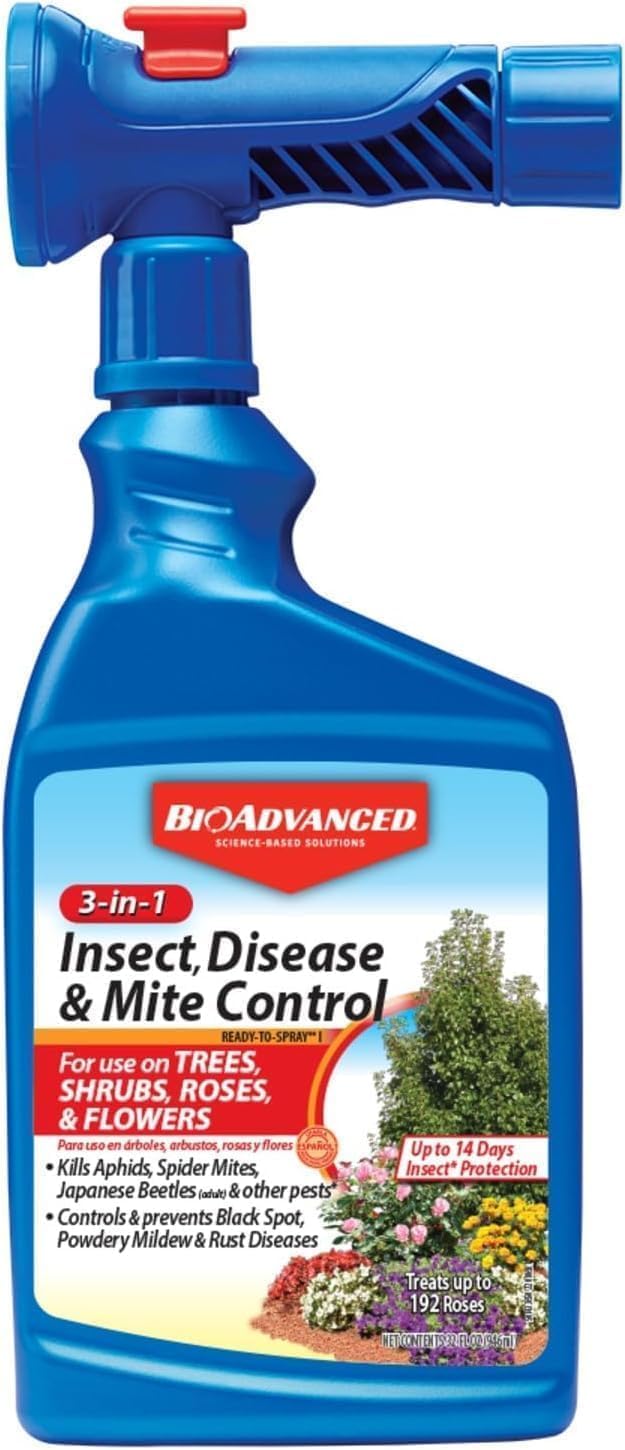
BioAdvanced 3-in-1 Insect, Disease & Mite Control Spray, 32 fl oz
| Unit Count | 32 Fluid Ounces |
|---|---|
| Item Form | Spray |
| Target Species | Aphids, caterpillars, leafminers, whiteflies and other listed pests |
| Active Ingredients | Tau-fluvalinate 0.61%, Tebuconazole 0.65% |
This BioAdvanced 3-in-1 spray is a performance-focused ready-to-use treatment that kills common pests on contact while also preventing and curing listed fungal diseases and controlling spider mites. It attaches to a garden hose for broad, even coverage and is labeled to treat up to 192 rose bushes, making it practical for medium to large beds and multiple shrubs. Key features include systemic ingredients plus contact control, rainproof protection lasting up to 14 to 30 days depending on labeled claims, and active ingredients targeting aphids, caterpillars, whiteflies, and mites. In use you spray foliage including undersides, and the product provides both immediate knockdown of insects and longer residual control so follow-up applications are less frequent. Limitations: it is a chemical treatment so users must follow safety directions and keep children and pets away until treated areas have dried, and it is not sold for use in New York. For someone prioritizing reliable, one-step control of aphids and associated fungal problems on roses and ornamentals, this bottle delivers convenient, broad-spectrum protection.
Best for: Gardeners who want a fast, high-performance one-step solution to control aphids and related pests while also preventing common fungal diseases on roses and ornamental plants.
Less Ideal for: Organic gardeners or those seeking nonchemical options should look for botanical or soap-based aphid controls instead.
- Combines insecticide, fungicide, and miticide in one ready-to-use formula for streamlined treatment
- Attaches to a garden hose for fast coverage of many plants including up to 192 roses
- Provides knockdown on contact and residual protection between labeled reapplications
- Controls a wide list of pests including aphids, spider mites, whiteflies, and caterpillars
- Contains chemical active ingredients that require careful handling and adherence to safety directions
- Not approved for sale in all states which limits availability for some users
Verdict: For gardeners focused on performance, this ready-to-spray 3-in-1 formula delivers fast aphid knockdown plus disease prevention in one convenient application.
Choosing the Right Fungicide for Peach Trees: Key Factors to Consider
Spectrum of Disease Control
Peach trees are susceptible to multiple fungal pathogens that require different chemistries to control. A product with broad-spectrum activity can address issues such as brown rot on fruit, leaf curl on foliage, and scab on shoots. Knowing which diseases are most likely in your region helps you prioritize an active ingredient that targets those pathogens.
Relying on a single narrow-spectrum material can leave gaps in protection, so consider how a chosen fungicide fits into a seasonal program with complementary products or cultural practices.
Timing and Application Windows
Timing is critical for effective disease control on peach trees. Many infections establish during bloom or immediately after petal fall, so products labeled for those windows are more useful to home growers. Read the product directions for recommended intervals between sprays and the number of allowable applications per season.
Also consider preharvest intervals and whether the label permits use up to a certain number of days before picking. A product that requires long wait times before harvest may be impractical if you want to treat late-season problems close to ripening.
Coverage and Spray Method
Fungal control depends on good coverage of flowers, fruit and leaves. Some fungicides work best as dilute sprays that coat the canopy, while others are used as concentrates with specific nozzle recommendations. Assess whether you have the sprayer capacity and equipment to achieve the coverage the label recommends.
For small trees, a handheld pump sprayer may suffice. Larger trees or multiple specimens can require backpack or wheeled sprayers to ensure even coverage. Proper droplet size and thorough wetting of the fruit and underside of leaves make treatments more effective.
Persistence and Rainfastness
How long a fungicide remains effective after application affects how often you must reapply, especially in rainy climates. Rainfast products adhere to plant surfaces and maintain activity after light rain, reducing lost applications. Residual activity varies by chemistry; some materials provide days of protection while others act only as protectants until washed off.
Consider local weather patterns and choose materials that match how often you can realistically spray. In wet seasons, favor formulations with proven rainfast characteristics or plan shorter spray intervals.
Fruit Safety and Preharvest Intervals
When treating fruit trees, fruit safety is a top priority. Labels specify preharvest intervals and maximum seasonal application rates to keep residues within allowed limits. Some fungicides are approved for use up to a few days before harvest, while others require longer wait periods.
If you plan to sell or preserve fruit, choose products with clear, short PHIs and follow label directions for the number of applications permitted in a season. Also observe any instructions about not using certain materials during bloom if pollinators are active.
Compatibility With Other Treatments
Integrated disease management often relies on tank mixes or alternating products to delay resistance. Check compatibility notes and avoid mixing products that react or reduce efficacy. Some active ingredients are safe to alternate, while others should not be combined.
If you use insecticides, fertilizers, or adjuvants on the same schedule, ensure timing and label instructions allow for combined programs. Compatibility reduces the number of separate spray days and can improve adherence to protective schedules.
Common Fungal Threats to Peach Trees
Peach trees face a predictable set of fungal problems that vary by climate and regional disease pressure. Brown rot attacks blossoms and ripening fruit, often accelerating rot as warm, humid weather arrives. Peach leaf curl produces distorted, colored leaves in spring and can severely reduce vigor if left unchecked. Scab causes dark lesions on fruit and shoots, lowering marketability and fruit quality.
Understanding each disease's life cycle helps you time treatments and choose chemistries that interrupt infection before symptoms appear. Cultural controls such as pruning for air circulation, cleaning up fallen fruit, and selective thinning reduce pathogen reservoirs and improve fungicide performance.
- Brown rot: blossom infection and fruit rot in warm, humid conditions
- Peach leaf curl: early-season leaf deformation that weakens trees
- Scab: lesions on fruit and shoots, favored by wet springs
Seasonal Spray Schedule Basics
A seasonal plan for peach trees typically starts with dormant or delayed-dormant applications to reduce overwintering spores, followed by protectant sprays at green tip, bloom, and petal fall depending on label instructions. Postbloom sprays may be needed during wet periods to protect developing fruit.
Match the spray schedule to the labels of the products you use. Some treatments are intended as prebloom protectants, while others are formulated for fruit protection during ripening. Maintain records of application dates and weather to refine timing in subsequent seasons.
- Dormant or delayed-dormant sprays reduce overwintering inoculum
- Protectant sprays at bloom and petal fall target critical infection windows
- Follow shorter intervals in rainy periods to maintain protection
Organic and Conventional Options
Both organic and conventional fungicides have roles in peach disease programs. Organic materials often have lower residual activity and require more frequent applications or stronger reliance on cultural controls. Conventional chemistries can offer longer residual protection and broader coverage for multiple pathogens.
Select products consistent with your production goals. Certified organic growers must follow allowed materials lists and may need to combine cultural practices more intensively. Home gardeners seeking minimal chemical inputs can still manage many problems with timely copper or sulfur sprays plus sanitation.
- Organic materials: may require more frequent applications and careful timing
- Conventional materials: generally broader activity and longer residual
- Sanitation and pruning improve outcomes for all program types
Minimizing Resistance and Rotating Modes of Action
Repeated use of the same active ingredient encourages pathogen resistance. Rotate materials with different modes of action across the season to slow resistance development. Labels and extension resources typically list mode of action groups to guide rotations.
Use protectant fungicides during high-risk windows and reserve systemic or single-site materials for targeted interventions. Integrate nonchemical practices to reduce reliance on any single chemistry and preserve options for future seasons.
- Alternate modes of action between applications
- Prefer protectants for regular coverage and systemics for targeted control
- Record treatments to avoid accidental repeats of the same chemistry
Safe Handling and Application Tips
Read and follow label instructions for mixing, personal protective equipment, and sprayer cleanup. Proper PPE protects you and prevents contamination of nearby plants or water sources. Measure accurately and avoid overconcentrating mixes.
Calibrate sprayers so recommended rates provide adequate canopy coverage. Clean equipment after use to prevent residues from affecting later applications. Dispose of unused product or rinsate according to local regulations.
- Wear recommended PPE and follow mixing instructions
- Calibrate sprayers for thorough, even coverage
- Rinse and store equipment to prevent cross-contamination
How We Chose the Best Fungicide for Peach Trees
We focused on attributes that directly affect disease control and practical use in orchards and backyard peach trees. Key evaluation dimensions included spectrum of disease control, since peach trees commonly face brown rot, peach leaf curl, and scab; application method and timing to reflect how easy it is to get consistent coverage during bloom and preharvest windows; persistence and rainfastness to measure how likely a product is to remain effective through weather events; safety on fruiting trees and preharvest intervals to ensure treatments fit fruit harvest schedules; and tank-mix compatibility and label flexibility for integrated programs. Products were excluded if labels did not explicitly permit use on peach trees or if required application windows conflicted with typical home orchard practices. We also deprioritized options with extremely limited disease lists or that demanded commercial-only equipment. The remaining selections represent treatments that combine relevant active ingredients, clear application guidance for peaches, and manageable handling for homeowners and small-scale growers.
FAQ
When should I start spraying fungicide on peach trees?
Begin treatments at the timing recommended on the label, often starting with a dormant or delayed-dormant spray, followed by protectant applications at green tip, bloom, and petal fall. Local disease pressure and weather can shift this schedule, so adjust for wet springs.
Can I use the same fungicide all season on my peach trees?
Using one fungicide repeatedly increases resistance risk. Rotate products with different modes of action and use protectants for routine coverage while reserving systemic materials for targeted control.
Are there fungicides that are safe to use close to harvest?
Some materials have short preharvest intervals and are labeled for late-season use, while others require longer wait times. Check the label for the specific preharvest interval and follow it to protect fruit safety.
How does rain affect my fungicide applications?
Rain can wash off protectant materials and shorten protection. Choose rainfast formulations when possible and reapply after heavy rain according to label directions. Timing sprays during dry windows improves effectiveness.
Do organic fungicides work on severe peach diseases?
Organic options can reduce disease pressure and are helpful in integrated programs, but they often have shorter residual activity and may be less effective against severe outbreaks. Combine organic treatments with sanitation and timely sprays for best results.
Can I tank-mix fungicide with other orchard sprays?
Tank-mix compatibility depends on the specific products and labels. Check compatibility statements and consider small-scale tests before full-volume mixing. Avoid mixes that the labels prohibit and follow recommended sequencing when applying multiple products.
Final Verdict
Choose a fungicide for peach trees based on the specific diseases you face, how often you can spray, and the label restrictions for fruit safety. Prioritize broad disease coverage for regions with multiple threats, and favor products with manageable preharvest intervals if you need to treat near harvest. Balance chemistry selection with cultural practices and rotate modes of action to limit resistance. With a seasonal plan that matches local weather and your equipment capability, you can protect fruit quality while keeping applications practical and safe.
