

Note: This article contains affiliate links. If you click on these links and make a purchase, I may earn a small commission at no extra cost to you. This helps support my research and content. Read my full affiliate disclosure here.
Root rot can silently weaken or kill plants long before symptoms appear above ground. Picking an appropriate fungicide for root rot matters because correct active ingredients, application method, and soil contact determine whether treatments reach infected roots and limit spread. This guide covers six shortlisted options chosen for different garden situations, from potted ornamentals to in-ground beds and containers. We evaluate each product on how easy it is to apply, how well it controls root-infecting pathogens, and how safe it is around soil life and nearby plants. Read on to find a treatment approach suited to your growing situation and the evaluation criteria used.
Top Picks at a Glance
| Best Overall The best all-around choice for most situations | Monterey Fungi-Max Systemic Fungicide, 16 fl oz |  |
| Best Quality Built to a higher standard if you want something more solid | Monterey Garden Phos Systemic Fungicide, 16 fl oz (with Measuring Spoon) |  |
| Best Value The sweet spot between price and what you get | VivaGrow Quest Reliant Systemic Fungicide, 32 oz |  |
| Best Budget The cheapest option that still gets the job done reliably | Grower's Ally Fungicide Concentrate for Plants, 8 oz (makes 5 gallons) |  |
| Highest Rated A top-rated pick with lots of positive feedback | BioWorks RootShield Plus WP Biological Fungicide, 3 lb |  |
| Most Popular A crowd favorite that many people choose with confidence | Arber Organic Bio Fungicide Concentrate, 16 fl oz |  |
Monterey Fungi-Max Systemic Fungicide, 16 fl oz
| Item Form | Liquid |
|---|---|
| Application Method | Spray |
| Coverage | Wide range of plants and plant types |
| Target Species | Flowers, Vegetables, Trees, Lawn Grass |
| Liquid Volume | 16 fluid ounces |
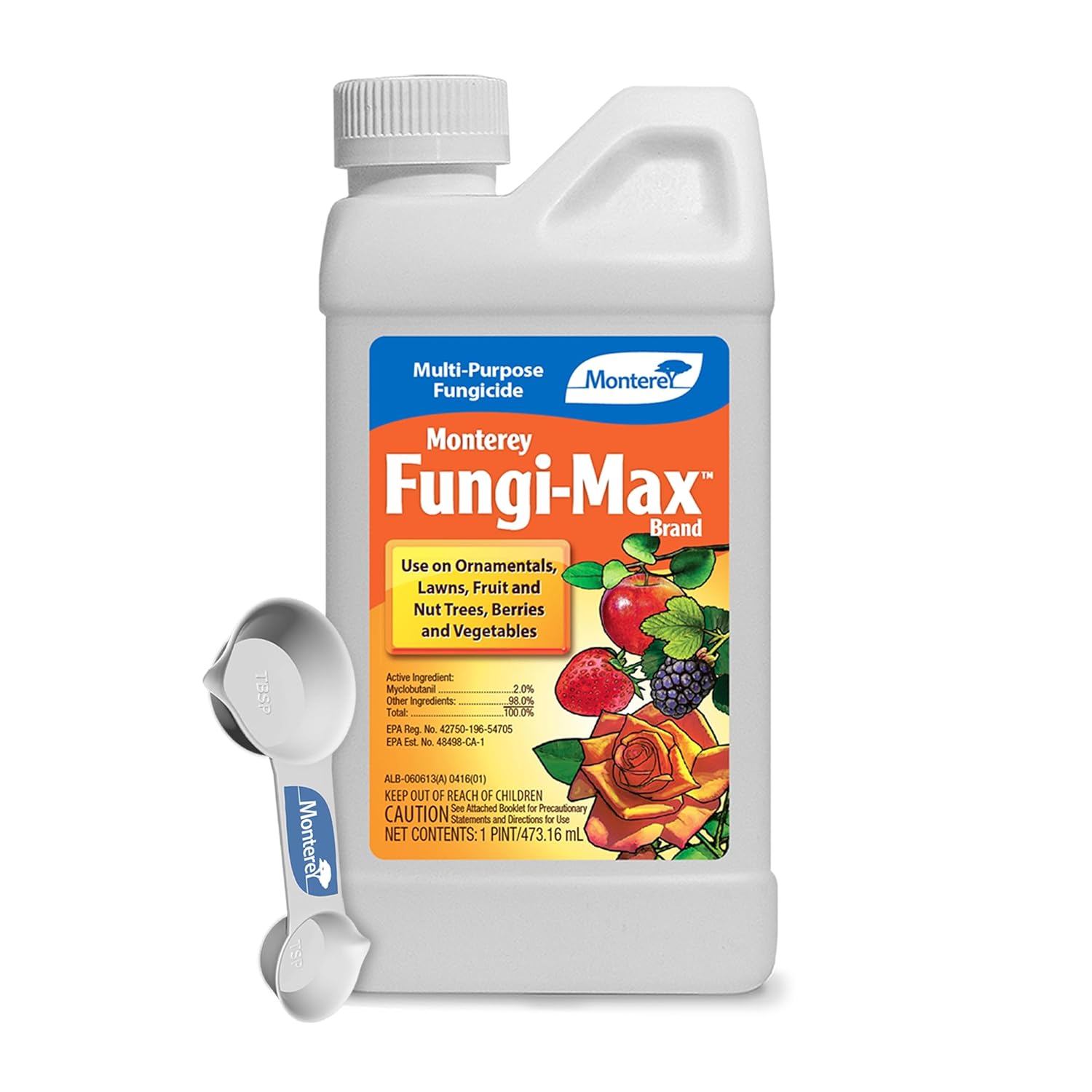
Monterey Fungi-Max is a concentrated liquid fungicide formulated for home garden and landscape use to prevent and control common fungal diseases. You mix the product with water and apply it with a spray tank or pump sprayer; it works systemically so the active ingredient moves into plant tissue to protect leaves, stems, and roots. The label cites control for problems like powdery mildew, rust, leaf spots, crown rot, and several turf diseases, and the manufacturer says one application can protect plants for up to two weeks. Because it covers flowers, shrubs, fruit and nut trees, vegetables, and lawns, it is useful for mixed gardens where multiple plant types need disease management. Practical benefits include broad-spectrum disease coverage, systemic action that reaches new growth, and straightforward dilution and spray application. Important limitations are the need to follow label directions carefully for timing and mixing, potential incompatibility with certain sprayers or tank mixes, and the fact that repeat applications may be required for ongoing pressure or severe outbreaks.
Best for: Home gardeners and property owners who prioritize dependable, proactive disease control across mixed plantings and want a product that reaches plant tissue rather than only contact protection.
Less Ideal for: Organic gardeners or those seeking a contact-only, ready-to-use spray should consider alternatives designed for certified organic use or simpler ready-mix formulations.
- Systemic action that protects new growth after application
- Broad listed coverage for ornamentals, vegetables, fruit trees and turf
- Suitable for spray-tank or pump-sprayer application for yard-scale use
- One application offers up to two weeks of protection under normal conditions
- Not an organic or OMRI-listed product, so not suited for certified organic production
- Requires careful dilution and label reading to avoid misuse
Verdict: Choose Monterey Fungi-Max when you need a reliable, systemic fungicide that provides broad disease protection across a diverse home garden.
Monterey Garden Phos Systemic Fungicide, 16 fl oz (with Measuring Spoon)

| Volume | 16 fl oz |
|---|---|
| Use types | Soil drench, foliar spray, basal bark |
| Target diseases | Root rot, downy mildew, fire blight, phytophthora, pythium |
| Suitable plants | Ornamentals, trees, vegetables, fruits, bedding plants |
Monterey Garden Phos is a concentrated systemic fungicide designed to treat root rot, collar rot, downy mildew, fire blight, phytophthora and pythium on ornamentals, trees, vegetables and fruits. It is mixed and applied with a pump sprayer and can be used as a soil drench for root problems, a foliar spray for leaf diseases, or a basal bark application for trunk infections. The product description and label directions emphasize coverage and following mixing rates to avoid phytotoxicity, and the included measuring spoon helps get doses right. Practical benefits include flexibility of application method and systemic activity that moves through the plant to reach roots and collars where soil-borne pathogens persist. Important limitations are that accurate mixing and a pump sprayer are required, initial tests on a few plants are recommended to check for sensitivity, and label restrictions such as state-specific rules must be observed. This works best as part of an integrated approach with cultural controls and proper drainage for managing chronic root rot problems.
Best for: Gardeners who prioritize reliable control of root and collar rots and want a product they can apply as a soil drench or basal bark treatment to rescue infected ornamentals, trees, or edibles.
Less Ideal for: Those who prefer ready-to-use sprays or avoid handling concentrated chemicals should consider alternatives designed for low-effort or organic-only approaches.
- Systemic action that can reach soil-borne pathogens through soil drench and basal bark applications
- Multiple application methods: soil drench, foliar spray, and basal bark for diverse disease scenarios
- Comes with a measuring spoon to help ensure accurate mixing
- Intended for home garden use across ornamentals, vegetables, fruits and trees
- Requires pump sprayer and careful mixing to avoid plant damage
- Label advises testing on a few plants first because some species may show phytotoxicity
Verdict: Choose Monterey Garden Phos when you need a flexible systemic fungicide that can be applied as a soil drench or basal bark treatment to tackle persistent root and collar rot problems.
VivaGrow Quest Reliant Systemic Fungicide, 32 oz

| Item Form | Liquid |
|---|---|
| Special Features | organic |
| Manufacturer | Quest Products Corporation |
Reliant is a concentrated systemic fungicide formulated for use as a foliar spray or soil drench to control many diseases including root rots, blights, mildews and leaf spots. It is quickly absorbed through foliage and roots and moves throughout the plant, activating natural defense responses and offering both curative action on existing infections and protection for new growth. The product mixes with water for straightforward application and its EPA biopesticide approval indicates reduced environmental impact compared with many synthetic chemistries. In practice it is useful in agricultural, nursery, greenhouse and landscape settings where persistent or hard-to-reach infections require systemic activity rather than contact control. Important limitations are that it must be mixed and applied correctly to reach root systems when used as a drench and label directions and safety precautions should be followed because it is still a pesticide. It is not a one-time fix for severely compromised plants and repeated or integrated disease-management steps are often needed for long-term control.
Best for: Buyers who want a science-backed, plant-wide fungicide to treat and protect ornamentals, turf and nursery stock and who plan to follow label directions and integrate other cultural controls.
Less Ideal for: Gardeners seeking a simple contact spray for occasional surface issues or those unwilling to follow pesticide label instructions should consider alternative preventive products or cultural fixes.
- Systemic activity absorbed by foliage and roots for whole-plant protection
- Curative and protective action against a broad list of pathogens including root rots
- Concentrated liquid that mixes with water for foliar spray or drench applications
- EPA Biopesticide Division approval indicating lower environmental impact than many conventional fungicides
- Requires correct mixing and application technique to be effective, especially for drenches targeting roots
- Not a standalone long-term solution for severely infected or poorly drained sites
Verdict: Choose Reliant when you need a systemic, curative fungicide that reaches roots and foliage to manage root rot and other persistent diseases.
Grower's Ally Fungicide Concentrate for Plants, 8 oz (makes 5 gallons)

| Unit Count | 8 Fluid Ounces |
|---|---|
| Item Form | Liquid |
| Target Species | Insects |
| Specification Met | OMRI |
| Active Ingredients | Citric Acid |
Grower's Ally fungicide concentrate is a citric-acid based treatment designed to control common fungal problems such as powdery mildew, crown rot, stem rot and root rot when used as directed. The 8-ounce concentrate dilutes to several gallons of spray, so it is typically mixed into a pump sprayer for preventative or curative foliar and soil applications in outdoor, greenhouse, and indoor settings. Notable features include an OMRI listing for organic gardening, FIFRA 25(b) exempt status, and a formulation described as residue-free and bee-safe, which makes it appropriate around children and pets. Practical benefits are that it can be applied up to the day of harvest, requires minimal personal protective equipment, and leaves no synthetic pesticide residues. Limitations are that active ingredient is citric acid, so it works best as a preventive barrier and disinfectant rather than a systemic cure for severe, established root disease, and repeated applications may be needed for persistent infections.
Best for: Gardeners seeking an affordable, organic-friendly preventative and surface treatment for common fungal issues who prioritize low-toxicity, residue-free products for mixed home or small-scale grows.
Less Ideal for: Growers dealing with advanced systemic root diseases who need strong systemic fungicides or professional soil drenches should consider alternative products or integrated cultural controls.
- OMRI listed and FIFRA 25(b) exempt, suitable for organic gardening
- Concentrated 8 oz bottle dilutes to multiple gallons for economical coverage
- Residue-free formula that can be applied up to harvest and is bee-safe
- Simple, food-grade citric acid active ingredient reduces bacterial and fungal surface growth
- Citric acid is primarily a surface disinfectant and may be less effective on severe systemic root rot
- May require repeated applications for persistent or heavy infections
Verdict: A budget-friendly, OMRI-listed citric-acid concentrate that gives low-toxicity, residue-free protection against common fungal problems when used preventatively.
BioWorks RootShield Plus WP Biological Fungicide, 3 lb

| Item Form | Powder |
|---|---|
| Target Species | Pythium, Rhizoctionia, Fusarium, Thielaviopsis, Cylindrocladium |
| Special Features | organic |
| Liquid Volume | 100 gallons |
RootShield Plus WP is a preventative biological fungicide supplied as a powder that is mixed into water and applied as a soil drench, potting amendment, or broadcast to protect roots from common pathogens. It contains Trichoderma harzianum T-22 and Trichoderma virens G-41 and is used in greenhouse, nursery and field planting situations by suspending 3 to 8 ounces per 100 gallons of water and keeping the mix agitated during application. The formula is intended to colonize the root zone and reduce diseases caused by Pythium, Rhizoctonia, Fusarium and related fungi, which makes it useful when establishing seedlings, repotting ornamentals, or treating at-risk containers. Important practical notes are its refrigerated storage requirement, short labeled reentry interval for worker safety, and the need to check compatibility with other fungicides or specific crops. For gardeners seeking a non-chemical, biology-based preventive for root rot, this product offers a targeted option, but it requires careful measuring, mixing, and label compliance to get reliable results.
Best for: Growers who prioritize consistent, biology-based prevention of root diseases and are willing to follow label rates and storage guidance to maintain product viability.
Less Ideal for: Casual gardeners who want a simple, ready-to-use chemical spray or those unwilling to handle measured mixing and refrigerated storage.
- Contains two proven Trichoderma strains that target common root pathogens
- Designed for multiple application methods including drench, soil incorporation and broadcast
- Effective as a preventive measure for seedlings, containers and nursery stock
- Concentrated 3 lb package covers large dilution volumes (label gives up to 100 gallons)
- Requires refrigeration and attention to expiration for biological viability
- Performance depends on correct mixing, agitation and timing rather than a single-use spray
Verdict: Choose RootShield Plus WP if you want a proven, biology-based preventive for root rot that integrates into nursery and container production when mixed and applied according to the label.
Arber Organic Bio Fungicide Concentrate, 16 fl oz

| Form | Liquid concentrate |
|---|---|
| Net volume | 16 fl oz |
| Coverage | Makes up to 16 gallons finished spray |
| Intended use | Indoor and outdoor plants |
Arber Bio Fungicide is a liquid concentrate formulated from beneficial microbes that you dilute and apply as a foliar spray to prevent fungal diseases on houseplants and landscape plants. You mix the concentrate per label directions, shake, then spray leaves and stems with a pump or trigger sprayer every 7–10 days or during high disease pressure. Notable features include organic biological ingredients that leave no visible residue, coverage that protects both foliage and root surfaces, and compatibility with indoor use on houseplants and greenhouse environments. Practical benefits are preventative disease control for powdery mildew, botrytis, rust and leaf spots, plus a long shelf life and enough concentrate to make multiple gallons of spray. Important limitations are that it works best as a preventive measure rather than a cure for heavy active infections and requires repeated applications and dry weather after spraying for best efficacy. Users should follow label directions and spray in calm conditions to allow the biologicals to establish on plant surfaces.
Best for: Houseplant owners and indoor gardeners who prioritize biological, preventive disease control and are willing to schedule regular weekly treatments during the growing season.
Less Ideal for: People looking for a fast-acting cure for heavy, established fungal outbreaks or users who need a single-shot chemical solution.
- Uses beneficial microbes so no visible residue on foliage
- Concentrate makes up to about 16 gallons of finished spray, suitable for repeated preventive treatments
- Labeled for indoor use on houseplants and for a wide range of plant types
- Long shelf life when stored properly
- Designed primarily for prevention and less effective at reversing severe established infections
- Requires regular reapplication and spraying in calm, dry conditions to be effective
Verdict: Choose this biological concentrate if you want an organic, preventive spray for houseplants that protects leaves and roots without leaving a visible residue.
Choosing the Right Fungicide for Root Rot: Key Factors to Consider
Active Ingredient and Mode of Action
Choose a fungicide with an active ingredient known to target soilborne pathogens that cause root rot. Different chemistries work in different ways: some are systemic and move into plant tissues to protect new root growth, while others are contact or protectant agents that reduce pathogen survival in the soil. Knowing the mode of action helps you match treatment to the pathogen type and reduces the risk of resistance developing.
Active ingredient also affects application timing and frequency. Systemic materials may provide longer protection with fewer applications, while contact products may require repeated soil drenches. This matters for management plans in pots and beds where reapplication schedules and plant sensitivity differ.
Formulation and Application Method
The formulation determines how effectively the product reaches the roots. Water-soluble concentrates and wettable powders are often mixed for soil drenches, while granular formulations can be incorporated into potting mixes or topdressed around established plants. Choose a formulation compatible with the way you usually apply treatments, whether that is hand watering, soil injection, or through-irrigation systems.
Application instructions also vary in concentration, contact time, and required protective equipment. Ease of measuring and mixing can influence how consistently a gardener will follow label directions, which in turn affects treatment success.
Plant Safety and Crop Compatibility
Not all fungicides are safe on every species. Some active ingredients can stress tender roots or must not be used on edible crops close to harvest. Check for label guidance on ornamentals, vegetables, and established versus newly transplanted seedlings. Plant safety considerations determine whether a product is suitable for container-grown houseplants, landscape ornamentals, or vegetable beds.
For mixed plantings, prioritize products labeled for the most sensitive species present, or choose treatment timing that reduces exposure to sensitive crops.
Impact on Soil Life and Beneficials
Soil health depends on beneficial fungi, bacteria, and invertebrates. Some fungicides are broad-spectrum and can harm non-target soil organisms that aid nutrient cycling and disease suppression. Others have a narrower activity window that minimizes disruption. Evaluate the product's label for notes on beneficial organism safety and consider integrated practices like reducing frequency, using targeted spot treatments, or combining with cultural controls to protect soil biology.
Long-term garden resilience is improved by products and practices that preserve beneficial soil communities while controlling pathogens.
Residual Protection and Reapplication Frequency
Residual activity tells you how long the product will continue to suppress root pathogens after application. Longer residual protection can reduce the need for repeated treatments but may increase exposure risk to non-target organisms. Shorter-lived materials might require more frequent applications, which affects labor and cost over a season.
Consider your climate and moisture patterns; wet, cool conditions often favor root rot and may require a different reapplication schedule than drier climates. Match the expected protection window to how often you can realistically reapply.
Identifying Root Rot Before Treatment
Early identification improves treatment outcomes. Look for wilting that does not respond to watering, yellowing lower leaves, stunted growth, and dark, mushy roots when you gently inspect the root ball. In containers, a foul odor and soil that stays saturated are strong indicators of root rot.
Confirming that a soilborne fungus is the cause is helpful but not always necessary for immediate action. If a plant shows classic root-rot symptoms, start with cultural corrections such as improving drainage and reducing irrigation frequency while selecting a root-targeted fungicide.
- Inspect roots: pale healthy roots versus dark brown or black mushy roots
- Check soil moisture and drainage patterns
- Note recent repotting or overwatering events that could have triggered symptoms
Cultural Controls to Use Alongside Chemical Treatment
Fungicides work best when paired with cultural controls that remove the conditions pathogens favor. Improve drainage in pots by using fast-draining mixes, add grit or perlite to heavy soils, and avoid waterlogged low spots in beds. Reducing irrigation frequency and allowing the top soil to dry slightly can limit pathogen activity.
Sanitation is also important. Remove heavily infected plants and dispose of them away from the garden, clean tools between plants to avoid spreading pathogen-laden soil, and avoid reusing contaminated potting mix without sterilizing or replacing it.
- Repot with fresh, well-draining mix for container plants
- Amend heavy garden soils to improve porosity
- Isolate affected plants to prevent spread
Timing Treatments and Seasonal Considerations
Apply fungicide treatments at times when root activity is high and label directions allow. For many perennials and ornamentals, early spring and the start of active root growth are sensible windows. In potted plants with rapidly cycling roots, prompt treatment as soon as symptoms appear helps preserve finer roots.
Consider seasonal moisture patterns. Persistent wet weather increases pathogen pressure and may require a different strategy than a season with sporadic rain. Always follow label directions about retreatment intervals and avoid applications when heavy rain is expected unless the product is intended for soil incorporation or repeated drenches.
- Schedule drench applications during active root growth
- Delay treatment if severe weather will wash products away
- Follow label reapplication intervals to avoid under- or over-treatment
Applying Soil Drenches Safely
Soil drenches deliver active ingredient directly into the root zone and are commonly used against root rot. Mix solutions carefully, measure accurately, and apply the drench so the root ball and surrounding soil are saturated to the recommended depth. Avoid over-concentrating the mix to prevent root burn.
Use protective gear as specified on the label and keep treated soil away from runoff paths that could carry chemicals into storm drains or sensitive plantings. For containers, apply slowly so the solution penetrates rather than simply running out the drain holes.
- Saturate the root ball evenly for best contact
- Apply at label-recommended rates to avoid phytotoxicity
- Monitor plants after treatment for signs of stress
When to Seek Diagnostic Help
If symptoms persist after cultural corrections and targeted treatments, or if whole sections of a garden are affected, get a diagnostic test from a local extension service or plant clinic. Lab diagnosis can identify the specific pathogen and indicate whether a chemical treatment is likely to succeed.
Diagnostics are also useful when managing valuable or large plantings where blind applications would be costly or risky. A confirmed diagnosis supports targeted, effective management and informs longer-term cultural changes.
- Use diagnostics for repeated failures or widespread outbreaks
- Provide clear symptom and site history to the diagnostic lab
- Combine lab results with practical cultural changes for best outcomes
How We Chose the Best Fungicide for Root Rot
We focused on products and formulations that are specifically effective against soilborne root pathogens and practical for real garden use. Selection prioritized active ingredients with documented activity against common root-rot organisms, application methods that deliver contact to the root zone, and formulations suitable for typical garden environments such as pots, raised beds, and in-ground plantings. We also considered systemic versus contact chemistry to balance speed of action with persistence in soil. Ease of use was measured by mixing and application requirements and whether the product works with watering systems or routine soil drenches. Safety and environmental profile were factored in by checking label guidance for ornamentals, edibles, and beneficial soil organisms. Finally we excluded broad, non-specific treatments that lack guidance for root applications or that are only designed for foliar diseases. The result is a curated list that emphasizes root-targeted efficacy, practical application, gardener safety, and compatibility with common garden practices.
FAQ
Can I treat root rot in potted plants without removing the plant?
Often you can treat container-grown plants with a soil drench if the root ball is accessible and symptoms are caught early. Apply the drench according to label directions and improve drainage and potting mix structure. Severe cases with heavily rotted roots may still require repotting and removal of dead tissue.
How soon should I see improvement after applying a fungicide for root rot?
Improvement varies. Some systemic products can show reduced decline within a couple of weeks as the plant regrows roots, while protectant products reduce pathogen pressure more slowly. Cultural corrections like better drainage may produce rapid visual improvement in foliage if waterlogging was the main cause.
Are fungicides safe to use around vegetable crops?
Some fungicides are labeled for use on edible crops and include pre-harvest interval instructions. Others are restricted to ornamentals or have safety restrictions. Always read and follow the label for crop compatibility and waiting periods before harvest.
Will repeated fungicide use harm beneficial soil organisms?
It depends on the chemistry and frequency. Broad-spectrum soil treatments used repeatedly can disrupt beneficial fungi and bacteria. To minimize impact, use targeted applications, choose products with narrower activity where possible, and combine chemical control with cultural practices that reduce the need for repeated treatments.
Can improving drainage alone cure root rot?
Improving drainage is a critical step and can resolve mild cases caused primarily by waterlogging. However, if a pathogen is established in the root zone, drainage alone may not eliminate the infection and may need to be paired with a targeted fungicide and removal of badly infected tissue.
Final Verdict
Treating root rot successfully requires targeting the root zone with a product and approach that matches the pathogen pressure and the gardening situation. Prioritize active ingredients and formulations that reach roots, balance protection duration against effects on soil life, and always pair chemical treatments with cultural fixes like better drainage and sanitation. With those tradeoffs in mind, choose the option that fits your planting type and reapplication capacity to restore root health and reduce future outbreaks.
