

Note: This article contains affiliate links. If you click on these links and make a purchase, I may earn a small commission at no extra cost to you. This helps support my research and content. Read my full affiliate disclosure here.
If you grow Zoysia turf, fungal diseases can quickly thin the sward and leave thin, brown patches at the peak of the season. Choosing the right fungicide matters because Zoysia responds differently than cool-season grasses and because timing, product safety, and application rate determine how fast the lawn recovers. This guide shortlists the seven best fungicides for Zoysia Grass and explains how each option handles common turf pathogens, application windows, and safety for active lawns. We evaluate products on disease control, turf safety, residual activity, and ease of use to help you pick the right treatment for your lawn conditions. Read on for practical guidance before you spray.
Top Picks at a Glance
| Best Overall The best all-around choice for most situations | Quali-Pro Propiconazole 14.3% Systemic Turf & Ornamental Fungicide (Gallon) |  |
| Best Quality Built to a higher standard if you want something more solid | Atticus Artavia 2 SC Azoxystrobin Fungicide (16 oz) |  |
| Best Value The sweet spot between price and what you get | BioAdvanced Fungus Control for Lawns, 32 fl oz |  |
| Best Budget The cheapest option that still gets the job done reliably | Spectracide Immunox Fungus Plus Insect Control for Lawns, 32 oz |  |
| Highest Rated A top-rated pick with lots of positive feedback | Monterey Fungi-Max Systemic Fungicide, 16 fl oz |  |
| Most Popular A crowd favorite that many people choose with confidence | Scotts DiseaseEx Lawn Fungicide, 10 lb |  |
| Best Seller A high-volume bestseller chosen again and again | BioAdvanced Fungus Control for Lawns Granules, 10 lb |  |
Quali-Pro Propiconazole 14.3% Systemic Turf & Ornamental Fungicide (Gallon)

| Unit Count | 320 Fluid Ounces |
|---|---|
| Item Form | Liquid |
| Target Species | Fungus |
| Active Ingredients | Propiconazole 14.3% |
Quali-Pro Propiconazole 14.3 is a microemulsion systemic fungicide designed to control a wide range of turf and ornamental diseases. It is typically diluted and applied as a foliar spray to lawns, golf course turf, nursery stock, trees and shrubs to prevent and suppress diseases such as dollar spot, brown patch, gray leaf spot, zoysia patch and powdery mildew. The microemulsion formulation reduces odor, improves tank stability and helps deliver even plant coverage while the locally systemic action moves the active ingredient into tissue for longer-lasting control. It mixes readily with many other fungicides, making it useful in rotation or tank-mix programs. Because this is a concentrated product intended for professional or experienced home applicators, proper measuring, dilution and timing are important and protective equipment is recommended. It is not a one-time cure for heavily established infections and should be used as part of an integrated disease management plan.
Best for: Gardeners and turf managers who want a dependable, broad-spectrum systemic fungicide for preventive and routine disease control on zoysia and mixed turf areas and who are comfortable following label directions for concentrated products.
Less Ideal for: Casual users seeking an off-the-shelf, low-handling solution or those unwilling to follow mixing and safety instructions should consider simpler, ready-to-use options instead.
- Broad-spectrum control of common turf diseases including zoysia patch, dollar spot and brown patch
- Locally systemic action provides longer residual activity than contact fungicides
- Microemulsion formulation offers improved tank stability and reduced odor
- Compatible with many other fungicides for tank-mix flexibility
- Designed for professional or experienced users and requires careful dilution and protective equipment
- Not an immediate curative for severe, established infections and works best as part of a preventative program
Verdict: A concentrated, professional-grade systemic fungicide that gives reliable preventive and season-long disease control for zoysia and other turf when applied correctly.
Atticus Artavia 2 SC Azoxystrobin Fungicide (16 oz)

| Item Form | Liquid |
|---|---|
| Target Species | Fungus |
| Special Features | organic |
| Active Ingredients | Azoxystrobin |
| Liquid Volume | 16 fluid ounces |
Artavia 2 SC is a liquid, professional-style fungicide that uses azoxystrobin to provide root-to-leaf protection for turf and ornamentals. It is typically mixed at low rates into spray water and applied to lawns, including zoysia, landscapes, and greenhouse or nursery stock on a 14 to 28 day schedule for preventive control. The formulation is labeled to control a wide range of turf diseases such as anthracnose, brown patch, and take-all patch and also covers many ornamental leaf spots and mildews. Practical benefits include systemic movement in the plant for protection of new growth, relatively long control intervals that reduce application frequency, and a convenient measure-and-pour bottle for accurate small-volume mixing. Important limitations are that it is a chemical-specific mode of action so growers should rotate with other groups to limit resistance, and mixed spray solutions should be used the same day and not stored. Users also need to follow label timing and temperature guidance for best preventive results.
Best for: Serious turf managers and homeowners who prioritize strong, preventive disease control on lawns like zoysia and want a product that gives systemic protection with fewer applications.
Less Ideal for: Casual gardeners who prefer non-chemical or organic-only approaches or those unwilling to follow label mixing and reentry instructions should consider other options.
- High azoxystrobin concentration (22.9%) for systemic, root-to-leaf protection
- Broad-spectrum label covering 20+ turf and 30+ ornamental diseases including anthracnose and brown patch
- Application interval up to 28 days reduces how often you need to spray
- Ready-to-measure Tip N' Measure bottle simplifies accurate small-batch mixing
- Single active ingredient class requires rotation with other fungicide groups to manage resistance
- Spray solutions cannot be stored and must be prepared fresh for same-day use
Verdict: Choose Artavia 2 SC when you need a high-strength, systemic fungicide to prevent and control major diseases on zoysia with longer intervals between applications.
BioAdvanced Fungus Control for Lawns, 32 fl oz

| Unit Count | 32 Fluid Ounces |
|---|---|
| Liquid Volume | 32 fluid ounces |
| Active Ingredients | Propiconazole 2.42% |
| Specification Met | EPA |
BioAdvanced Fungus Control for Lawns is a 32-ounce, ready-to-spray liquid fungicide designed to cure and prevent common turf diseases. You connect the bottle to a garden hose and apply it across the lawn for quick coverage; a single bottle claims to treat up to 5,000 square feet. The active ingredient propiconazole is systemic, so it is taken up by grass blades and provides rainproof protection that does not wash away with watering. It lists control for brown patch, dollar spot, rusts, red thread and several other common diseases and is intended for routine spot treatments or broader lawn applications during disease outbreaks. Practical benefits include easy hose-attachment application, broad disease coverage, and roughly month-long protection, which reduces repeat treatments through a season. Important limitations are that it is a chemical fungicide so users must follow safety directions and avoid contact with skin and eyes, and it is formulated only for lawns so it should not be used on ornamentals or vegetables.
Best for: Homeowners who want a simple, low-effort way to treat and prevent common turf diseases across a typical yard and prefer a hose-applied, systemic product that lasts about a month per application.
Less Ideal for: Gardeners seeking organic, non-chemical solutions or those who need a fungicide labeled for use on vegetables, flowers, or non-turf plants should consider other products.
- Ready-to-use hose-end bottle for fast, even application
- Systemic propiconazole formula provides up to 30 days of rainproof protection
- Covers common lawn diseases such as brown patch, dollar spot, rusts and red thread
- One 32 oz bottle claims coverage up to 5,000 square feet
- Designed only for lawns and not suitable for ornamentals or edible plants
- Contains a chemical fungicide that requires protective handling and strict adherence to label safety instructions
Verdict: A convenient hose-end systemic fungicide that treats and prevents common lawn diseases with about 30 days of rainproof protection.
Spectracide Immunox Fungus Plus Insect Control for Lawns, 32 oz

| Unit Count | 32 Fluid Ounces |
|---|---|
| Item Form | Spray |
| Target Species | Insects |
| Active Ingredients | Propiconazole, Lambda-cyhalothrin |
| Coverage | Covers 2,500 square feet |
Spectracide Immunox combines a fungicide and insecticide in a single ready-to-spray 32 oz bottle that attaches to your garden hose for easy application. The QuickFlip hose-end sprayer lets you cover turf quickly by spraying until the lawn is wet, and one bottle treats up to about 2,500 square feet. Its formula targets common lawn diseases such as brown patch, rust, powdery mildew and black spot while also killing listed insects like ants, sod webworms, fleas and ticks. The product becomes rainproof within hours, so treatments are not easily washed away, and the directions recommend beginning applications in spring and repeating about every two weeks for best prevention. Important limitations are that it only controls the diseases and insects specifically listed on the label and that it is a chemical treatment, so users should keep people and pets off the treated area until dry and follow safety instructions carefully. For routine, broad-spectrum maintenance on a budget this is an efficient, easy-to-use option.
Best for: Homeowners who want a low-effort, cost-conscious way to prevent common lawn diseases and control routine insect pests with an all-in-one product.
Less Ideal for: People seeking organic or non-chemical disease control or intensive treatment for pests and diseases not listed on the label should choose a different solution.
- Dual-action formula treats listed lawn diseases and kills listed lawn insects with one product
- Ready-to-spray hose-end applicator speeds coverage and treats up to about 2,500 sq ft per 32 oz bottle
- Becomes rainproof within hours so applications are not easily washed away
- QuickFlip sprayer is simple to attach and activates with a single switch
- Only effective for the specific diseases and insects listed on the label
- Requires safety precautions and reentry restrictions until the lawn is dry
Verdict: If you want an inexpensive, easy-to-use product that prevents common lawn fungi and controls routine lawn insects with one hose-end application, this is a practical pick.
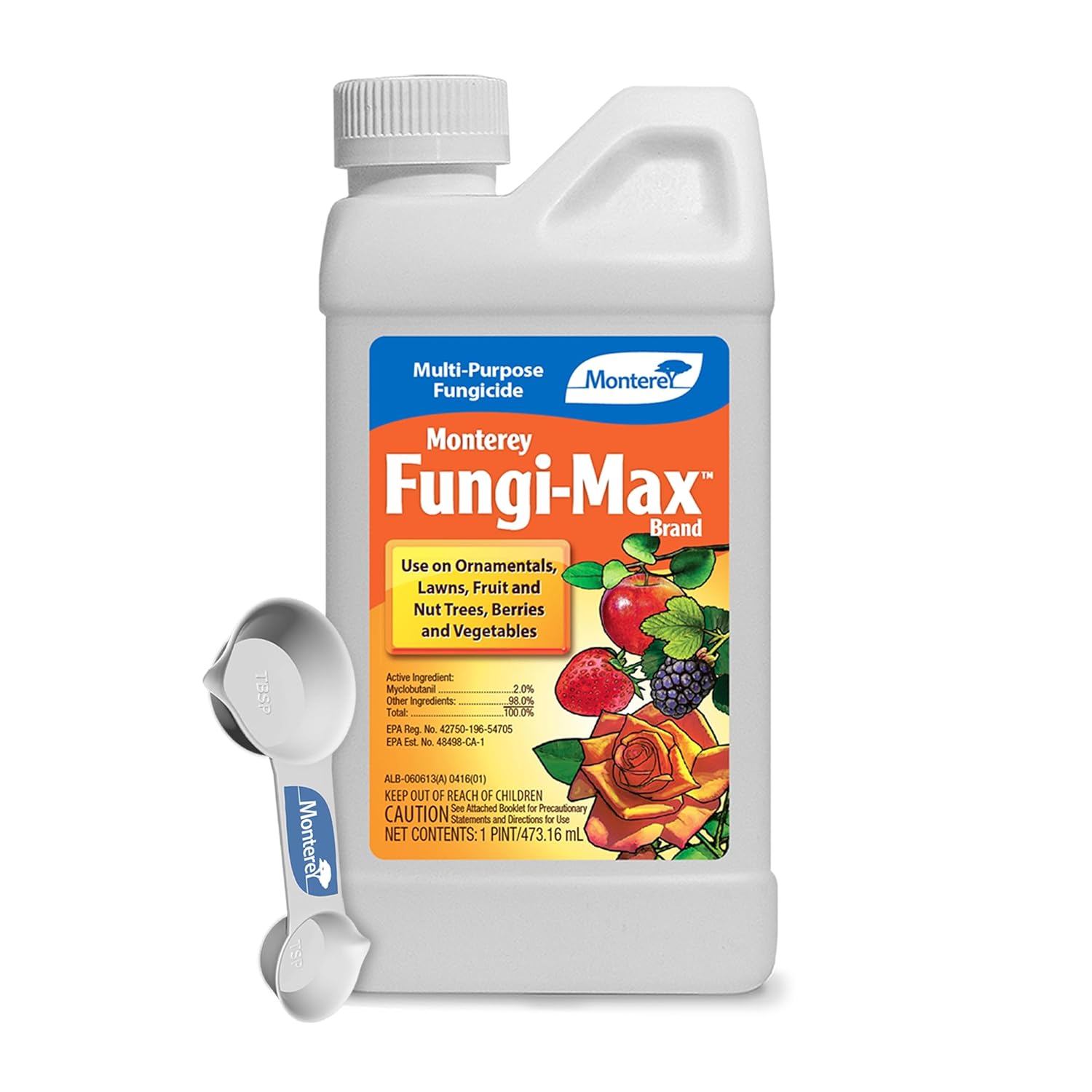
Monterey Fungi-Max Systemic Fungicide, 16 fl oz
| Item Form | Liquid |
|---|---|
| Application Method | Spray |
| Coverage | Wide range of plants and plant types |
| Target Species | Flowers, Vegetables, Trees, Lawn Grass |
| Liquid Volume | 16 fluid ounces |
Monterey Fungi-Max is a concentrated liquid fungicide formulated for home garden and landscape use to prevent and control common fungal diseases. You mix the product with water and apply it with a spray tank or pump sprayer; it works systemically so the active ingredient moves into plant tissue to protect leaves, stems, and roots. The label cites control for problems like powdery mildew, rust, leaf spots, crown rot, and several turf diseases, and the manufacturer says one application can protect plants for up to two weeks. Because it covers flowers, shrubs, fruit and nut trees, vegetables, and lawns, it is useful for mixed gardens where multiple plant types need disease management. Practical benefits include broad-spectrum disease coverage, systemic action that reaches new growth, and straightforward dilution and spray application. Important limitations are the need to follow label directions carefully for timing and mixing, potential incompatibility with certain sprayers or tank mixes, and the fact that repeat applications may be required for ongoing pressure or severe outbreaks.
Best for: Home gardeners and property owners who prioritize dependable, proactive disease control across mixed plantings and want a product that reaches plant tissue rather than only contact protection.
Less Ideal for: Organic gardeners or those seeking a contact-only, ready-to-use spray should consider alternatives designed for certified organic use or simpler ready-mix formulations.
- Systemic action that protects new growth after application
- Broad listed coverage for ornamentals, vegetables, fruit trees and turf
- Suitable for spray-tank or pump-sprayer application for yard-scale use
- One application offers up to two weeks of protection under normal conditions
- Not an organic or OMRI-listed product, so not suited for certified organic production
- Requires careful dilution and label reading to avoid misuse
Verdict: Choose Monterey Fungi-Max when you need a reliable, systemic fungicide that provides broad disease protection across a diverse home garden.
Scotts DiseaseEx Lawn Fungicide, 10 lb

| Unit Count | 160 Ounce |
|---|---|
| Item Type Name | Scotts DiseaseEx For All Grass Types 10lb PACK OF 4 |
| Active Ingredients | Azoxystrobin |
Scotts DiseaseEx is a granular fungicide intended for homeowners who want to prevent and treat common lawn diseases. It is applied with a broadcast or drop spreader and the label lists specific spreader settings for both preventative and curative rates, which helps get an even application. The product controls 26 listed diseases, including brown patch, powdery mildew, necrotic ring spot, and rust, and the manufacturer says it begins working within 24 hours and protects up to four weeks per application. One 10 lb bag covers roughly 5,000 sq. ft. and can be reapplied every 14 to 28 days if needed. Important practical considerations: it contains azoxystrobin, so you must follow the safety directions about keeping people, pets, and water bodies away from treated areas and avoid overapplication for the year. It is formulated for routine preventive maintenance as well as curative use at first signs of disease, but correct spreader calibration and timing are necessary to get the claimed coverage and consistent control.
Best for: Homeowners who prioritize proven, brand-backed disease control and want a preventative product they can apply during routine lawn maintenance.
Less Ideal for: People who need an organic or non-chemical solution or who have lawns adjacent to sensitive ponds or waterways where runoff risk is unacceptable.
- Controls a broad spectrum of turf diseases (26 listed) including brown patch and powdery mildew
- Begins working within 24 hours and provides up to four weeks of protection per application
- Clear spreader settings provided for both broadcast and drop spreaders to aid even coverage
- One 10 lb bag treats up to 5,000 sq. ft., suitable for small to medium lawns
- Contains azoxystrobin which is toxic to aquatic life so care is needed to avoid runoff
- Requires accurate spreader calibration and careful timing to achieve effective, uniform control
Verdict: Choose Scotts DiseaseEx when you want a fast-acting, broad-spectrum granular fungicide for routine preventive and early curative lawn care.
BioAdvanced Fungus Control for Lawns Granules, 10 lb

| Unit Count | 160 Ounce |
|---|---|
| Item Form | Granules |
| Target Species | Fungus |
| Active Ingredients | 0.51% Propiconazole |
| Specification Met | EPA |
BioAdvanced Fungus Control is a granular, systemic fungicide intended to cure and prevent common turf diseases across a lawn. You spread the granules over affected or at-risk turf and the active ingredient, propiconazole, is taken up by grass blades to provide rainproof protection for up to 30 days. The product is aimed at treating issues such as brown patch, dollar spot, rusts and anthracnose and the 10 lb bag is stated to cover about 5,000 sq ft, so a single application can treat a typical medium yard. Practical benefits include systemic action that resists wash-off after rain and a one-step granular format that does not require mixing. Important limitations are that it is a targeted fungicide rather than a fertilizer or broad-spectrum turf treatment and it requires following safety instructions during application to protect children and pets. Frequent or unnecessary applications should be avoided to limit chemical exposure and to follow labeled directions for the specific disease and turf type.
Best for: Buyers who want a straightforward, proven fungicide to treat and prevent common lawn diseases with minimal reapplication and who prioritize reliable, science-based control.
Less Ideal for: Gardeners looking for organic or non-chemical disease control or those who prefer combined products that also fertilize or control weeds should consider other options.
- Systemic formula absorbed by grass for root-to-blade protection
- Rainproof once absorbed so protection persists through watering or light rain
- Covers a large area per bag (listed coverage ~5,000 sq ft)
- Controls a wide list of common lawn diseases including brown patch, dollar spot and rusts
- Contains a synthetic fungicide (propiconazole) so protective clothing and safe handling are required
- Not a multi-purpose product — it treats fungal diseases only and does not fertilize or control weeds
Verdict: A simple, rainproof granular fungicide that delivers month-long systemic protection against common lawn diseases.
Choosing the Right Fungicide for Zoysia Grass: Key Factors to Consider
Target Pathogens and Labeled Uses
Different fungicides are effective against specific groups of fungi. Identify the common pathogens in your area and check that the product lists those diseases on the label. Brown patch, dollar spot, and large patch show different symptom patterns and respond to different active ingredients.
Buying a fungicide labeled for the exact diseases you are seeing reduces guesswork and increases the chance of recovery. Labels also indicate whether a product is preventive, curative, or both, which affects when you should apply during disease development.
Turf Safety and Heat Tolerance
Zoysia is a warm-season grass that can be sensitive to certain chemistries, especially under heat or drought stress. Choose products with an established safety record on Zoysia and follow label rates closely to avoid turf injury.
Consider recent weather and irrigation patterns before applying. Avoid applications during extreme heat or just after drought stress. Some fungicides are formulated to be gentler and can be used when recovery speed is important, while stronger curatives may carry a higher burn risk if misapplied.
Residual Activity and Reapplication Interval
Residual activity determines how long a single application suppresses disease pressure. Longer residuals reduce the frequency of re-treatment, which is useful for large lawns or repetitive problems.
Shorter residuals can still be effective in targeted spot treatments or when you prefer to limit chemical exposure. Match the reapplication interval to disease pressure and seasonal risk to maintain control without unnecessary repeat use.
Mode of Action and Resistance Management
Fungicides work through different modes of action. Repeated use of the same mode of action increases the chance that pathogen populations will develop resistance. Rotate active ingredients with different modes of action across applications or integrate non-chemical practices to slow resistance development.
Look for products that list their mode of action group and plan a treatment schedule that alternates groups when managing chronic disease problems. Combining cultural controls with chemical rotation keeps treatments effective longer.
Application Method and Equipment Needs
Some fungicides come as ready-to-use sprays, others as concentrates that require accurate measuring and tank mixing. The application method affects how evenly the product covers turf and whether you can treat large areas efficiently.
Consider the equipment you have available and your comfort with mixing and calibrating spreader-sprayers. Pick products with label instructions that match your application capability to ensure uniform coverage and correct dosage.
Environmental and Safety Considerations
Check restrictions on use near water bodies, gardens, and ornamental beds. Some active ingredients carry buffer zone requirements or specific runoff precautions. Follow personal protective equipment guidance on the label to minimize exposure to applicators and pets.
Prefer products with clear safety instructions and manageable environmental profiles when treating lawns near sensitive areas. Also consider reentry intervals and how soon children or pets can access treated turf.
When To Treat Zoysia Turf
Timing is critical for effective disease control. Preventive applications at the start of a known disease window often work better than waiting until symptoms are widespread. For Zoysia, disease activity tends to increase during warm, humid periods, so monitor weather and early symptoms closely.
For curative treatments, apply at the first sign of active lesions and follow label directions on reapplication intervals. Spot-treating small patches can limit spread while you prepare a broader program if needed.
- Start preventative programs before prolonged warm, wet periods.
- Apply curative treatments when lesions are fresh and actively expanding.
- Combine spot treatment with cultural fixes like improved drainage and reduced thatch.
Cultural Practices That Reduce Fungus Pressure
Chemical control is only one part of an effective plan. Adjust mowing height, irrigation timing, and thatch management to create less favorable conditions for pathogens. Raise mowing height slightly to reduce stress on Zoysia, and water in the early morning so turf dries faster.
Improve airflow with selective pruning and avoid excessive fertilization with high nitrogen in disease-prone periods. Thatch removal and aeration help soil dry and reduce pathogen survival, lowering the need for repeated fungicide use.
- Mow at recommended heights for Zoysia to promote healthy, dense turf.
- Irrigate early and deeply rather than frequent shallow watering.
- Aerate and dethatch to improve rooting and drainage.
Application Tips to Maximize Effectiveness
Uniform coverage and correct dilution are essential. Calibrate sprayers before treating and follow label mixing instructions precisely. Over- or under-application can reduce efficacy or increase the risk of turf injury.
Avoid applying during the heat of the day and respect rainfast periods listed on the label. Record application dates and active ingredients to maintain a rotation plan and to avoid resistance buildup.
- Calibrate your sprayer for the lawn size and follow label rates.
- Do not apply when rain is expected within the rainfast window.
- Keep records of active ingredients and dates for rotation planning.
Spot Treatment and Large-Area Programs
For isolated patches, spot-treating reduces chemical use and focuses control where needed. Use a targeted application or a handheld sprayer for small areas, and observe results before expanding treatment.
For widespread disease, use a program approach with scheduled preventive applications and cultural practices. Coordinate product rotation and timing to maintain control throughout the season without over-relying on a single active ingredient.
- Start with spot treatment when disease is limited to a few patches.
- Switch to program applications only if disease becomes widespread or recurrent.
Safety and Post-Application Care
Follow label instructions for reentry intervals and pet access to treated turf. Keep children and pets off lawns until the product has dried and the label permits access. Proper storage and disposal of any unused product prevents accidental exposure.
If irrigation is needed after application, check label guidance for rainfast times and reapplication rules. Many labels specify how soon turf can be mowed or watered following treatment to avoid reducing efficacy.
- Observe reentry intervals and keep pets away until safe.
- Store and dispose of chemicals according to label instructions.
How We Chose the Best Fungicide for Zoysia Grass
We selected products that deliver reliable control of the fungal diseases most often affecting warm-season Zoysia, using criteria that reflect real lawn care decisions. Primary evaluation metrics included documented efficacy against common pathogens that affect Zoysia, such as brown patch and large patch. Turf safety under recommended label rates was essential, since Zoysia can scorch or thin with harsh chemistries. Residual activity and re-treatment interval were measured to estimate how long a product keeps disease pressure down. Ease of application and label clarity were considered to reduce user error when treating established turf. We also looked for products with flexible application windows that fit summer disease cycles and that are suitable for both spot treatments and preventive programs. We excluded products with limited or unclear labeled use on Zoysia, formulations intended only for non-turf uses, and options lacking clear application guidance for residential lawns. The short list emphasizes fungicides that combine proven efficacy with safe use instructions and realistic re-treatment schedules that match homeowner and professional lawn care routines.
FAQ
Can I use the same fungicide on Zoysia every season?
You can use the same product occasionally, but repeated use of one mode of action increases resistance risk. Rotate active ingredients and integrate cultural controls to keep treatments effective over multiple seasons.
Will a fungicide repair dead patches immediately?
Fungicides stop or slow the pathogen but do not instantly regrow turf. Recovery depends on turf health, timing of application, and follow-up cultural practices. Expect gradual green-up over weeks rather than overnight repair.
Are there low-toxicity options suitable for home lawns?
There are formulations with lower toxicity profiles and shorter reentry intervals, but suitability depends on the labeled use for Zoysia and the target disease. Always follow label safety instructions and local regulations.
How soon after application can I water or mow?
Timing varies by product. Many labels recommend waiting until spray has dried and observing a specified rainfast period. Check the product label for exact wait times before watering or mowing to avoid reducing effectiveness.
Can I mix a fungicide with fertilizer or herbicide in the same tank?
Tank mixing can be done with compatible products, but compatibility and label permissions vary. Test a small area first and follow label guidance; when in doubt, apply separately to avoid unexpected turf injury.
Final Verdict
Pick a fungicide that matches the pathogens you are dealing with, and prioritize products with proven safety on Zoysia and clear application instructions. Balance residual control and rotation needs against the lawn size and your application equipment. Combine timely fungicide use with cultural practices to reduce repeat treatments. With the right timing, product choice, and maintenance plan, you can control disease pressure and help Zoysia recover more quickly.
