

Note: This article contains affiliate links. If you click on these links and make a purchase, I may earn a small commission at no extra cost to you. This helps support my research and content. Read my full affiliate disclosure here.
Soil pH controls which nutrients are available to plants and how well amendments and fertilizers work. Choosing the right garden lime makes it easier to correct acidic soils, improve root growth, and raise the long-term fertility of lawns, vegetable beds, and ornamental borders. This guide covers six shortlisted garden lime options chosen for common yard and garden situations, from small raised beds to large turf areas. We evaluate how quickly liming takes effect and how easy each product is to apply, plus practical considerations like particle size, longevity in the soil, and safety for nearby plants. Read on to understand the key tradeoffs and how to match a lime product to your soil test results and garden setup before the product list below.
Top Picks at a Glance
| Best Overall The best all-around choice for most situations | Down To Earth Dolomite Lime (5 lb) |  |
| Best Quality Built to a higher standard if you want something more solid | Cz Garden Supply Dolomite Lime, 10 lb, OMRI Listed |  |
| Best Value The sweet spot between price and what you get | CountryMax Fine Ground Limestone Powder (50 lb) |  |
| Best Budget The cheapest option that still gets the job done reliably | Hoffman Pelletized Garden Lime, 8 lb |  |
| Highest Rated A top-rated pick with lots of positive feedback | Home and Country USA Pulverized Garden Limestone 12 lb Pail |  |
| Best Seller A high-volume bestseller chosen again and again | Jobe's Organics Garden Lime Granules, 6 lb |  |
Down To Earth Dolomite Lime (5 lb)

| Item Form | Granules |
|---|---|
| Specific Uses For Product | Plant Growth |
| Coverage | Medium |
| Target Species | lawns, vegetable gardens & flower beds, trees & shrubs |
This 5 lb bag of Down To Earth dolomite lime is a ready-to-use soil amendment for correcting acidic soils and adding calcium and magnesium. The prilled granules spread easily and dissolve into the soil to raise pH gradually, which improves nutrient availability and supports stronger root and cell development. It is OMRI listed so it fits into organic vegetable, flower and lawn routines, and the medium coverage makes a single bag useful for small beds, container gardens or spot treatments. Practical benefits include improved soil structure and microbial activity that help with water retention and root penetration. Limitations are that lime works slowly so expect results over weeks to months and you should test soil pH first to avoid overapplication; this product does not supply nitrogen, phosphorus or potassium so it is a corrective amendment rather than an all-purpose fertilizer. For even distribution on larger areas you will need a spreader or repeated passes by hand.
Best for: Gardeners who want a reliable organic way to correct acidic soil and improve soil structure for vegetables, flowers and lawns, and who plan applications based on soil test results.
Less Ideal for: People needing a fast-release fertility boost or an all-in-one fertilizer for nutrient-deficient soils should choose a balanced fertilizer or combined amendment instead.
- Prilled granules for easy, uniform spreading
- Supplies calcium and magnesium to support root and cell strength
- OMRI listed for use in organic gardening
- Improves soil structure and microbial activity
- Acts gradually so pH adjustment is not immediate
- Does not provide primary macronutrients like N-P-K
Verdict: A practical OMRI-listed dolomite lime that quietly raises pH and adds calcium and magnesium for gardeners prioritizing organic soil correction.
Cz Garden Supply Dolomite Lime, 10 lb, OMRI Listed

| OMRI Listed | Yes |
|---|---|
| Unit Count | 160 Ounce |
| Country of Origin | USA |
This 10 lb bag of Cz Garden dolomite lime is a finely milled, OMRI-listed soil amendment designed to correct acidic soils and supply calcium and magnesium for healthier plants. It is typically broadcast into garden beds, mixed into potting mixes, or added to containers like EarthBoxes to prevent blossom end rot in tomatoes and peppers and to improve overall nutrient uptake. The ultra-fine powder speeds reaction time compared with coarse lime, and the resealable heavy-duty pouch makes measuring and storage straightforward. Being OMRI listed makes it suitable for organic production. Practical benefits include more stable soil pH over time, a source of two essential nutrients, and an easy-to-apply form for both in-ground and container gardens. Important limitations are that lime works slowly and requires prior soil pH testing to avoid overapplication, and it does not supply other macronutrients such as nitrogen or phosphorus.
Best for: Gardeners seeking a performance-focused, organic-approved lime to reliably raise and stabilize pH and correct calcium or magnesium shortages in beds and containers.
Less Ideal for: Gardeners who need fast-acting nutrient fixes or a complete fertilizer blend that supplies nitrogen and phosphorus as well as pH correction.
- OMRI listed for use in certified organic production
- Ultra-fine powder for faster incorporation and reaction in soil
- Provides both calcium and magnesium to address common deficiencies
- Resealable heavy-duty pouch for easy measuring and storage
- Acts slowly and needs proper timing relative to planting
- Requires soil pH testing to apply accurately
Verdict: Choose this OMRI-listed, finely ground dolomite lime when you want a reliable organic solution to raise and stabilize soil pH while supplying calcium and magnesium.
CountryMax Fine Ground Limestone Powder (50 lb)

| Item Form | Powder |
|---|---|
| Specific Uses For Product | Soil Acidity Reducer, Soil Conditioning, Chicken Coop Odor Control |
| Coverage | About 1/4 inch on bedding areas to absorb moisture and neutralize odors |
| Unit Count | 800 Ounce |
| Ingredients | Calcium Carbonate |
CountryMax Fine Ground Limestone is a 50 lb bag of finely ground calcium carbonate intended as a multipurpose garden lime and odor control amendment. Gardeners typically broadcast or incorporate it into topsoil and compost to raise pH in acidic lawns, vegetable beds, and flower borders or sprinkle a quarter-inch over bedding in coops and stalls to absorb moisture and neutralize ammonia odors. The powder form and fine grind make it easy to spread by hand or with a rotary spreader and to mix into soil for faster reaction than coarse lime. Because it is pure calcium carbonate, it supplies calcium without added nutrients or synthetic additives, so it works predictably as a pH balancer and soil conditioner. Limitations are that it changes pH gradually versus quick-acting chemical liming agents and you must test soil pH first to avoid over-application; it also does not supply nitrogen, phosphorus, or potassium, so plan fertilizer applications separately.
Best for: Gardeners who prioritize practical, predictable soil pH correction and want a single, all-natural product that handles both lawn and coop odor issues with straightforward application.
Less Ideal for: Growers who need fast pH correction, a complete fertilizer, or tailored nutrient mixes for intensive vegetable production should consider specialized products instead.
- Finely ground powder spreads and mixes easily for quicker soil contact.
- Pure calcium carbonate provides reliable pH adjustment without synthetic additives.
- Versatile for lawns, vegetable gardens, flower beds, and animal bedding odor control.
- Large 50 lb bag suits homeowners, small farms, and repeat seasonal applications.
- Works gradually so multiple applications or time are needed to change soil pH noticeably.
- Does not provide primary plant nutrients like N, P, or K so additional fertilization is required.
Verdict: Choose this fine-ground, all-natural lime when you want a dependable, easy-to-apply product to correct acidic soils and control coop odors.
Hoffman Pelletized Garden Lime, 8 lb

| Item Type Name | Plant Supplement |
|---|---|
| Unit Count | 128 Ounce |
| Volume | 8 liters |
| Brand Name | Hoffman |
Hoffman Pelletized Garden Lime is a simple, budget-friendly soil amendment for correcting acidic garden soils. It comes as easy-to-spread pellets intended for lawns, flower beds, and vegetable gardens to raise pH and make nutrients more available to roots. The pelletized form is less dusty than powdered lime and spreads more evenly with a broadcast spreader or by hand; safety guidance recommends gloves and eye protection during handling. Because it is not a fertilizer, it does not supply nutrients directly but improves the soil chemistry so existing fertilizers and soil reserves work better. The package size suits small to medium raised beds or patches of lawn and stores easily in a dry place. Limitations are that results take time as lime reacts slowly with soil and application rates should follow a soil test to avoid overapplication. For gardeners on a tight budget who need a straightforward pH correction method, this product delivers predictable, low-tech performance.
Best for: Gardeners who need an inexpensive, low-effort way to correct acidic soil in garden beds or small lawns and who plan to follow a soil test or basic pH guidance.
Less Ideal for: Those needing rapid pH adjustment, a combined fertilizer-plus-lime product, or large-acreage applications where bulk agricultural lime would be more economical.
- Pelletized form spreads evenly and generates less dust than powdered lime
- Specifically formulated to raise soil pH and improve nutrient availability
- Suitable for lawns, flower beds, and vegetable gardens
- Affordable 8 pound package that is easy to store
- Acts slowly so pH changes are not immediate
- Not a fertilizer and does not add nutrients directly
Verdict: An affordable, easy-to-spread pelletized lime that reliably raises soil pH in garden beds and small lawns.
Home and Country USA Pulverized Garden Limestone 12 lb Pail

| Item Form | Powder |
|---|---|
| Application Method | Incorporate into soil |
| Coverage | Full |
| Target Species | various plants |
| Unit Count | 192 Ounce |
This pulverized garden limestone is a straightforward soil amendment for correcting acidity and supplying calcium and magnesium to support root development. It is used by broadcasting or incorporating the powder into beds, vegetable plots, lawns, or flower borders before planting or during soil preparation. The 12 pound pail is easy to handle and the fine powder form helps it mix into soil and begin altering pH more uniformly than coarse rock. Practical benefits include improved soil structure for heavier soils, better aeration and water penetration, and enhanced nutrient availability for a wide range of plants. It contains only limestone so there are no added fertilizers or fillers to worry about. Limitations are that it addresses pH slowly versus fast-acting products and it requires soil testing to apply the correct amount; it will not supply quick-release nutrients if plants need an immediate boost.
Best for: Gardeners who prioritize predictable, long-term soil correction and want a single-ingredient lime product to reliably raise pH and supply calcium and magnesium during routine soil preparation.
Less Ideal for: People who need immediate nutrient delivery or rapid pH change for distressed plants should choose a fast-acting amendment or a combined fertilizer instead.
- Fine pulverized powder mixes into soil for more uniform pH adjustment
- Supplies calcium and magnesium to support root strength and plant structure
- Helps loosen heavy soils to improve aeration and water penetration
- Single-ingredient limestone with no added fertilizers or fillers
- Works gradually and is not a source of quick-release nutrients
- Requires a soil test and correct application rate to be effective
Verdict: Choose this pulverized limestone when you want a reliable, single-ingredient lime to gradually correct soil acidity and boost calcium and magnesium for healthier plants.
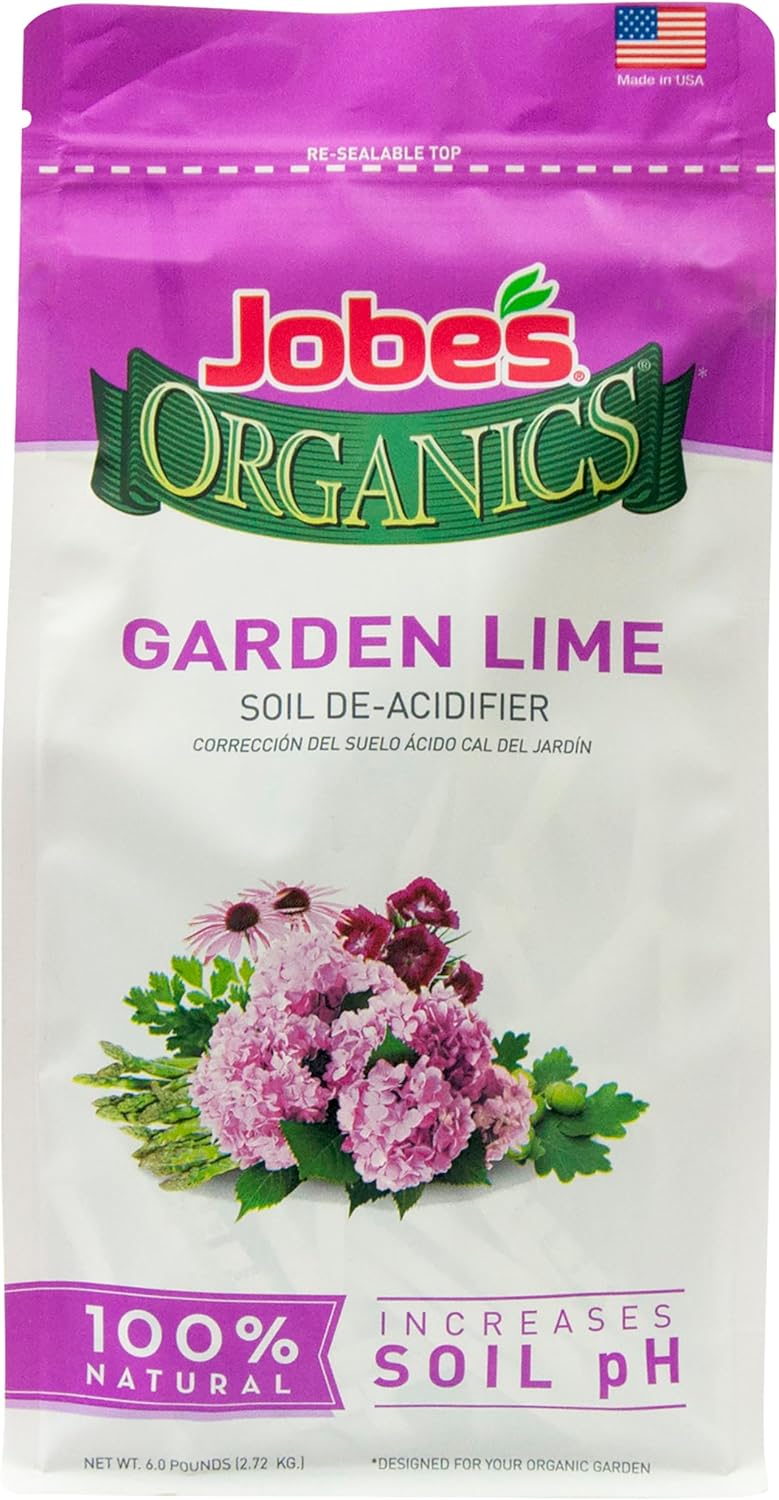
Jobe's Organics Garden Lime Granules, 6 lb
| Item Form | Granules |
|---|---|
| Specific Uses For Product | Plant Growth, Root Development, Seed Development, Soil Conditioning |
| Coverage | Medium |
| Target Species | Hydrangeas |
| Mixing Ratio | 2-14-0 |
Jobe's Organics Garden Lime is a granular soil de-acidifier formulated to raise soil pH and make nutrients more available to plants. It is typically broadcast at planting and then reapplied two to three times a year to maintain the desired pH. The product is OMRI listed for organic use and contains high calcium content with small amounts of magnesium, so it both neutralizes acidity and supports soil structure without synthetic chemicals. Because it is in granule form it spreads easily and can be incorporated into topsoil or mixed into planting holes. Practical benefits include improving fertilizer response, reducing nutrient lockup in acidic soils, and shifting hydrangea color toward pink when desired. Limitations are that lime works slowly and must be applied based on a soil test to avoid over-application, and results depend on soil type and existing pH so multiple applications or heavier rates may be required for very acidic soils.
Best for: Buyers who prioritize low-risk, organic soil care and want a straightforward, easy-to-apply product to correct mildly acidic soils and improve overall plant health.
Less Ideal for: Gardeners needing a fast pH correction for severely acidic soils or those who prefer liquid, immediate-acting amendments should consider alternative treatments.
- OMRI listed for organic gardening, so it fits organic practice
- Granular form is easy to spread and mix into soil or planting holes
- High calcium content effectively raises soil pH and improves nutrient availability
- Safe to use around children and pets when applied as directed
- Acts slowly so pH changes may take time and need repeated applications
- Effectiveness varies with soil type and existing pH, requiring a soil test to set rates
Verdict: A safe, organic granular lime that steadily raises pH and improves nutrient uptake for gardeners who prefer low-risk, easy-to-use soil amendments.
Choosing the Right Garden Lime: Key Factors to Consider
Soil pH and Target Adjustment
A soil test is the starting point because garden lime is used to raise pH from acidic toward neutral. The current pH and the desired target determine how much lime you need. Small changes in pH require precise application rates, while large corrections need proportionally more material.
Applying too little lime will not correct deficiencies, while applying too much can push soil alkaline and lock out micronutrients. Rate calculations often reference neutralizing value and pounds per 1,000 square feet or per cubic yard for beds. Knowing the soil texture and buffering capacity helps refine the amount because heavier clays require more lime than sandy soils to achieve the same pH shift.
Neutralizing Value and Purity
Neutralizing value, often expressed as calcium carbonate equivalent or lime requirement per unit, tells you how effective a product is at changing pH. Higher neutralizing values mean you need less product to get the same pH adjustment. Purity matters because contaminants can introduce unwanted salts or trace elements that affect sensitive crops.
Check the analysis on the label or product data to compare neutralizing potential. For gardeners, using a product with a clearly stated neutralizing value simplifies rate calculations and reduces guesswork when treating vegetable beds, lawns, or flower borders.
Particle Size and Reactivity
Particle size controls how quickly lime reacts with the soil. Finer particles expose more surface area and raise pH faster, which is useful when you need quicker correction before a planting. Coarser agricultural grades act more slowly but can provide a longer-lasting slow change.
Consider whether you need a rapid short-term change or a gradual long-term correction. Finer lime may require more careful handling because it generates dust, while pelletized or dolomitic variants can be easier to spread with less drift.
Application Method and Ease
How you plan to apply lime shapes the choice. Gardeners using walk-behind spreaders or handheld applicators need granular or pelletized products that flow well. For small beds, lime that can be mixed into potting soil or worked in with hand tools is preferable.
Ease of application also includes how well the material resists wind drift, how evenly it distributes, and whether it is compatible with standard spreader settings. Products labeled for turf vs. beds may have different recommended application techniques.
Timing and Persistence
Timing lime applications to fallow periods, cool seasons, or before major plantings affects effectiveness. Lime reacts slowly in cool, dry conditions and more quickly in warm, moist soil. Persistence describes how long the pH change remains stable; this depends on soil type, cropping intensity, and rainfall.
If you expect heavy leaching or plan frequent soil disturbance, you may need to recheck pH more often and plan follow-up applications. A one-time application can last multiple seasons in low-disturbance beds, but lawns with high nutrient inputs might need more frequent adjustments.
Crop Sensitivity and Nutrient Interactions
Different plants have different pH preferences. Blueberries and azaleas, for example, favor acidic soils, so liming near those plants should be avoided. Raising pH can also change availability of micronutrients like iron and manganese, so consider the plants you grow before altering soil chemistry.
If you maintain mixed plantings, use targeted applications and physical barriers to protect acid-loving species. Also factor in how lime interacts with fertilizers; some nutrient formulations work best within a certain pH window, and adjusting pH can improve overall fertilizer efficiency.
When to Test and Reapply
Test soil pH in early spring or late fall for the most representative readings. Take samples from several locations and mix them for a composite test that reflects the entire bed or lawn. Repeat testing every one to three years depending on soil type and cropping intensity.
If your initial application does not reach the target pH, wait several months for a fine lime to react before adding more. For coarse agricultural lime, allow a full season and re-test before repeating. Reapplication frequency should follow measured changes, not fixed timelines.
- Test multiple spots and mix for a composite sample
- Re-test annually in intensive vegetable gardens
- Allow 3 to 6 months for fine lime to show effect
Pelletized Vs. Ground Lime: Practical Differences
Pelletized lime is typically easier to spread with less dust and more uniform distribution, making it a good choice for small yards and around patios. Ground lime has variable particle sizes; very fine ground lime reacts faster but creates dust and requires more careful handling.
Choose pelletized forms when you need cleanliness and precise spreader behavior. Use fine ground lime when speed of reaction is the priority and you can manage dust or incorporate it into soil.
- Pelletized: cleaner, spreader-friendly, slower initial reaction
- Fine ground: faster reaction, dustier, may require watering in
Applying Lime Safely Around Plants
Avoid direct contact between high concentrations of lime and plant stems or roots. Broadcast evenly and water lightly to move lime into the soil. When liming near acid-loving plants, create physical barriers or limit the treatment radius to avoid inadvertent pH increases.
Wear basic protective gear to limit dust inhalation and wash hands after handling. Keep children and pets away from freshly applied lime until it has been incorporated or watered in.
- Broadcast evenly, then water to start reaction
- Keep lime away from roots of acid-loving plants
- Wear dust protection and gloves during application
Calculating Application Rates
Application rates depend on neutralizing value, current pH, target pH, and soil texture. Use manufacturer or extension service rate charts as a starting point, then adjust for neutralizing value. For raised beds measured by volume, convert pounds per square foot or cubic yard accordingly.
If you lack a lab result for neutralizing value, use conservative, lower rates and re-test before repeating. Over-application is harder to reverse than under-application, so gradual correction is often safer for mixed plantings.
- Consult extension charts for pH change by soil type
- Convert rates from area to volume for deep beds
- When in doubt, apply smaller amounts and retest
Storing and Handling Garden Lime
Keep lime dry in a sealed container or under cover to preserve reactivity and prevent clumping. Store away from fertilizers and garden chemicals to avoid cross-contamination. For long-term storage of pelletized lime, check packaging for moisture barriers.
Label containers with product analysis and purchase date. When transferring to a spreader hopper, do so outdoors and avoid breathing dust. Dispose of empty bags according to local waste guidelines.
- Store in a dry, ventilated spot
- Keep separate from fertilizers and pesticides
- Record product analysis and purchase date on containers
How We Chose the Best Garden Lime
We shortlisted garden lime products based on the specific ways lime behaves in garden soils and how gardeners use it. Primary evaluation metrics were neutralizing power, which measures calcium carbonate equivalent and determines how much product is needed to raise pH; particle size and reactivity, which affect how quickly the lime dissolves and changes soil chemistry; application ease, including spreader compatibility and dust control; and persistence, meaning how long the pH change typically lasts under local rainfall and cropping. We also considered handling safety and impurity limits to avoid introducing salts or heavy metals that could harm sensitive plants. Excluded from consideration were products intended primarily as fertilizer carriers with only trace liming effect, experimental formulations without established soil test data, and blends with complex additives that obscure the lime's pure neutralizing capacity. Our filters favored products with transparent analysis information and typical availability in home-garden formats. The scoring criteria below reflect the dimensions that genuinely affect a gardener's choice and on-the-ground results.
FAQ
How soon will I see changes after applying garden lime?
It depends on particle size and soil conditions. Fine lime can begin to affect pH within weeks under warm, moist conditions. Coarser agricultural grades may take several months to a year to show full effect, so re-test before reapplying.
Can I lime around acid-loving plants safely?
Usually you should avoid liming directly around acid-loving plants. Use targeted applications away from their root zones and consider physical barriers or separate mulched zones to protect sensitive species.
How much lime does a vegetable bed need?
Required amounts depend on the bed size, current soil pH, target pH, soil texture, and the neutralizing power of the lime. Start with a soil test and consult extension service tables; if uncertain, apply conservative doses and retest after a few months.
Is pelletized lime better for small urban gardens?
Pelletized lime often works better in small gardens because it is less dusty and spreads more evenly with common handheld or walk-behind spreaders. It may react more slowly than very fine ground lime but offers easier handling.
Will liming affect fertilizer performance?
Yes. Raising soil pH changes nutrient availability and can make some fertilizers more effective by improving nutrient uptake. Test soil pH before major fertilizer applications so you can match fertilizer choices to the new pH range.
Final Verdict
Match your lime choice to the soil test, garden size, and timing needs. Prioritize neutralizing power and particle reactivity when you need fast correction, and favor ease of application and lower dust for small yards or sensitive plantings. Remember that correction is often gradual; plan by measuring soil pH, applying a calculated rate, and re-testing after several months to avoid overcorrection. A careful, measurement-driven approach reduces risk and gives you steady improvements in nutrient availability and plant health. Focus on the tradeoffs described here to pick the type of garden lime that fits your soil, equipment, and plants.
