

Note: This article contains affiliate links. If you click on these links and make a purchase, I may earn a small commission at no extra cost to you. This helps support my research and content. Read my full affiliate disclosure here.
If you need a dependable way to apply weed killer, the right garden sprayer makes the job faster, cleaner, and more accurate. A sprayer that resists herbicide damage, holds pressure, and delivers an adjustable spray pattern keeps chemicals where you want them and reduces waste. This guide covers seven shortlisted garden sprayers for weed killer across typical yard and garden situations, from small beds to larger lawns. We evaluated units for tank material, sealing against corrosive formulations, nozzle versatility, and ease of use in real garden workflows. Below are the top picks and the decision factors to help you choose the best sprayer for your weed-control needs.
Top Picks at a Glance
| Best Overall The best all-around choice for most situations | Roundup 190260 2-Gallon Lawn and Garden Sprayer |  |
| Best Quality Built to a higher standard if you want something more solid | Field King Professionals 4-Gallon Battery Backpack Sprayer |  |
| Best Value The sweet spot between price and what you get | PetraTools HD101 1‑Gallon Garden Pump Sprayer with 52‑in Hose and 2 Nozzles |  |
| Best Budget The cheapest option that still gets the job done reliably | Flo-Master by Hudson 1-Gallon Lawn and Garden Tank Sprayer |  |
| Highest Rated A top-rated pick with lots of positive feedback | SOLO 418 One-Hand 2-Liter Pressure Sprayer |  |
| Most Popular A crowd favorite that many people choose with confidence | CHAPIN 20004 1-Gallon Pump Sprayer |  |
| Best Seller A high-volume bestseller chosen again and again | Ortho Dial N Spray Hose-End Sprayer |  |
Roundup 190260 2-Gallon Lawn and Garden Sprayer

| Tank Volume | 2 gallons |
|---|---|
| Hose Length | 36 inches |
| Material Type | Poly |
| Power Source | Manual |
The Roundup 190260 is a straightforward 2‑gallon manual sprayer designed for home lawn and garden tasks like spot treating weeds, applying insecticides, or rinsing decking and siding. It assembles in one step and uses a hand pump to pressurize the tank; a pressure‑release cap vents safely before opening. The aluminum wand has a comfort‑grip shut‑off with a lock for continuous spraying and convenient clips to store the wand on the tank. Included are three nozzles — adjustable poly (stream to mist), high‑volume flat fan, and a foaming nozzle — which cover spot treatments, broader coverage, and visual tracking of application. Premium seals and a wide funnel top help reduce spills and leaks and make filling easier. Because it is manual, it is light and simple but requires pumping to build pressure and is best for small to medium jobs rather than commercial-scale spraying. Follow safety guidance for chemical use and rinse thoroughly after each session to protect seals and prevent cross-contamination.
Best for: A practical homeowner who needs a reliable, easy‑to‑use sprayer for spot weed control, garden pest treatments, and occasional cleaning tasks around the yard.
Less Ideal for: Not a good fit for commercial applicators or those who need to cover very large areas without frequent re‑pressurizing or electric assistance.
- Three nozzles included (adjustable, high‑volume fan, foaming) for versatile spray patterns
- Comfort‑grip shut‑off with lock for continuous spraying
- Pressure‑release cap reduces risk when opening the tank
- Wide funnel top and wand storage make filling and transport easier
- Manual pump requires repeated strokes to pressurize, which can be tiring on larger jobs
- Not intended for flammable or caustic liquids according to safety guidance
Verdict: Pick this sprayer if you want a simple, versatile 2‑gallon manual unit with multiple nozzles and safety features for effective home weed‑killer and garden treatment jobs.
Field King Professionals 4-Gallon Battery Backpack Sprayer
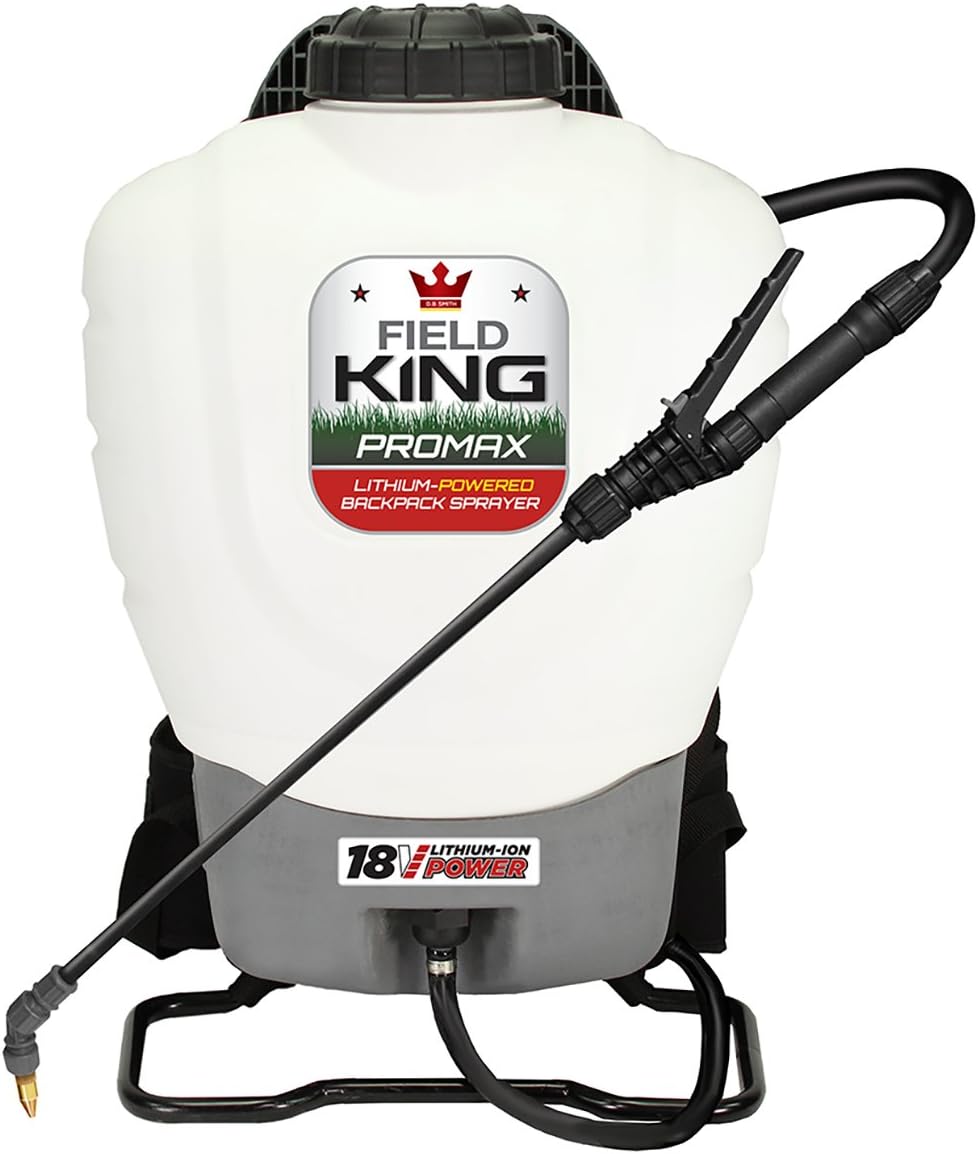
| Tank Volume | 4 gallons |
|---|---|
| Power Source | Battery Powered |
| Battery | 18 V Lithium-Ion, 2.1 Ah |
| Maximum Pressure | 40 psi |
| Hose Length | 50 inches |
The Field King Professionals 4-gallon battery backpack sprayer is built for multiplier tasks like applying herbicides, insecticides, fungicides, and liquid fertilizers across lawns and beds. The 18 V lithium-ion battery delivers up to four hours or roughly 50 gallons of spray per charge, eliminating manual pumping and letting you cover large areas with steady pressure. It ships with an adjustable brass nozzle plus low- and high-volume flat fans and a foaming nozzle, so you can switch from targeted foliar work to broad lawn coverage quickly. The unit has a lockable shut-off and inline filtration to reduce clogging and hand fatigue, and Viton seals for improved chemical resistance. Practical benefits include the padded harness and waist/ chest straps for extended wear and built-in wand storage for transport. Important limitations are the 4 gallon tank capacity, which will require refills on very large properties, and it is not intended for wettable powders. For someone focused on consistent, high-performance liquid applications, this sprayer speeds work and improves nozzle versatility.
Best for: Gardeners and landscape pros who prioritize steady, hands-free spraying and need a versatile sprayer for herbicides and broad liquid applications across medium-sized yards.
Less Ideal for: People who need to treat very large acreage without stopping for refills or who must apply wettable powder formulations should consider different equipment.
- Battery power provides up to four hours or about 50 gallons of spray per charge, removing the need for manual pumping
- Multiple nozzles including adjustable brass, low- and high-volume flat fans and a foaming nozzle for versatile application patterns
- Lockable shut-off and inline filtration reduce hand fatigue and clogging during extended use
- Padded harness with waist and chest straps plus built-in wand storage improves comfort and transport
- Four-gallon tank means more frequent refills on very large properties
- Not suitable for wettable powders
Verdict: Choose this sprayer if you want a high-performance, battery-powered backpack unit that delivers steady pressure and versatile nozzle options for efficient weed and pest liquid applications.
PetraTools HD101 1‑Gallon Garden Pump Sprayer with 52‑in Hose and 2 Nozzles

| Tank Volume | 1 gallons |
|---|---|
| Hose Length | 52 inches |
| Material Type | Plastic |
| Maximum Pressure | 30 psi |
The PetraTools HD101 is a straightforward, reliability‑oriented 1‑gallon pump sprayer for common garden jobs like weed control, fertilizing, and applying mulch glue. You pressurize the translucent tank by hand and use the 52‑inch hose plus the 14–16‑inch wand to reach borders and under shrubs without moving the tank frequently. It ships with an adjustable nozzle and a fan tip so you can switch between a targeted jet and wider coverage, and built‑in filters help reduce nozzle clogs when using outdoor liquids. The large ergonomic handle, funnel‑style opening, and pressure release valve make filling, carrying, and safe depressurizing easier during routine use. Expect consistent performance for typical liquids if you avoid acidic or highly viscous mixtures and clean the filters after each use. The sprayer is plastic and hand‑powered, so it is best for small jobs and occasional use rather than continuous commercial work or very large areas where a battery or backpack unit would save time.
Best for: Buyers who prioritize a dependable, no‑frills sprayer for routine home gardening and small lawn tasks and who want simple, low‑maintenance gear that performs consistently.
Less Ideal for: People who need high‑capacity or continuous heavy‑duty spraying for large properties or professional landscaping should consider backpack or battery models instead.
- Compact 1‑gallon tank suited to small lawns and garden beds
- Long 52‑inch hose and wand improve reach without moving the tank
- Adjustable nozzle plus fan tip cover both pinpoint and wide applications
- Built‑in filters reduce nozzle clogging with outdoor solutions
- Safety pressure release valve and ergonomic handle simplify filling and transport
- Plastic construction and manual pump limit durability and throughput for heavy professional use
- Not rated for acidic or very thick/creamy solutions
Verdict: A dependable, easy‑to‑use 1‑gallon pump sprayer that delivers reliable, clog‑resistant performance for routine home garden and lawn tasks.
Flo-Master by Hudson 1-Gallon Lawn and Garden Tank Sprayer

| Tank Volume | 1 gallons |
|---|---|
| Hose Length | 34 inches |
| Material Type | Plastic, Polypropylene (PP) |
| Power Source | Manual |
The Flo-Master 1-gallon tank sprayer is a simple, manual pump-pressure unit intended for small garden tasks like spot weed control, applying liquid fertilizers, and watering containers. You fill the wide-mouthed translucent bottle, pressurize by hand, then use the 12-inch poly wand and adjustable cone nozzle to switch between mist and stream. A 34-inch anti-kink hose and thumb-operated shutoff make continuous spraying easier, while the comfortable grip handle and light plastic construction keep it easy to carry around the yard. The clear tank with fill markings helps avoid overmixing and makes refills straightforward. Expect this sprayer to handle occasional household and garden chemicals, but the plastic construction and manual pump mean it is best for lighter-duty use rather than heavy professional jobs. Cleaning is easy thanks to the wide opening, but durability will be lower than metal or high-end commercial sprayers and the pressure capacity is limited by manual pumping.
Best for: Gardeners who want a low-cost, easy-to-use sprayer for occasional spot treatments, container watering, and small beds where portability and simple operation matter.
Less Ideal for: Commercial users or those who need to cover large areas frequently should consider heavier-duty or higher-capacity sprayers instead.
- Compact 1-gallon size that is easy to carry and refill
- Translucent tank with fill markings for accurate mixing
- Adjustable poly cone nozzle for mist-to-stream versatility
- Comfort-grip handle, thumb shutoff, and 12-inch wand improve control and reach
- All-plastic construction is less durable than metal alternatives and better suited to light use
- Manual pump limits sustained high-pressure spraying for large areas
Verdict: A straightforward, budget-friendly handheld sprayer that delivers versatile mist-to-stream spraying for small garden tasks.
SOLO 418 One-Hand 2-Liter Pressure Sprayer

| Tank Volume | 2 liters |
|---|---|
| Material Type | High Density Polyethylene (HDPE) |
| Power Source | Manual |
| Maximum Pressure | 40 psi |
The SOLO 418 is a compact 2-liter one-hand pressure sprayer built for routine gardening, spot weed control, and light cleaning tasks. You pump the handle to pressurize the HDPE tank (about 2 liters), then hold the ergonomic grip and use the lock-on trigger for continuous spraying to reduce hand fatigue. Notable features include Viton gaskets and O-rings for chemical resistance, a multi-angle adjustable nozzle for flat or cone spray patterns, an in-tank filter and a drift/drip guard for more controlled application. In practice it is easy to carry between beds or around a car and provides consistent spray at the manufacturer pressure range up to about 40 psi when pumped properly. Limitations are the small tank capacity, which requires frequent refills for large areas, and the manual pumping effort needed to maintain pressure for extended use. The sprayer is straightforward to clean and works with common herbicides, fertilizers, and cleaners, making it a dependable tool for regular home garden upkeep where reliability and chemical compatibility matter.
Best for: Buyers who want a compact, dependable handheld sprayer for routine garden maintenance and occasional cleaning tasks and who prioritize durability and chemical compatibility over large capacity.
Less Ideal for: Not a good fit for users who need to cover large lawns or commercial areas without frequent refills or who prefer battery-powered continuous spraying for extended sessions.
- Chemical-resistant Viton seals and O-rings for durability with harsher solutions
- Lock-on trigger for continuous spraying and reduced hand fatigue
- Adjustable multi-angle nozzle for versatile spray patterns and under-leaf access
- Lightweight 2-liter HDPE tank that is easy to carry and maneuver around beds
- Small 2-liter capacity means frequent refills for larger gardens
- Requires manual pumping to build and maintain pressure during use
Verdict: A durable, chemically compatible one-hand sprayer that delivers reliable, comfortable spraying for small- to medium-scale garden and cleaning jobs.
CHAPIN 20004 1-Gallon Pump Sprayer

| Tank Volume | 1 gallons |
|---|---|
| Hose Length | 34 inches |
| Material Type | Polyethylene (PE) |
| Maximum Pressure | 60 psi |
The CHAPIN 20004 is a straightforward 1-gallon pump sprayer for spot treatments around the yard. You pressurize the translucent polyethylene tank by hand with the ergonomic pump handle, then apply product through an adjustable cone nozzle or the included poly extension wand and 34-inch hose for better reach into flower beds or under shrubs. The funnel-style top and clear tank make filling and monitoring fluid level quick and less messy, and the modular design allows cleaning and seal replacement to reduce leaks over time. It delivers up to 60 psi, which is adequate for fertilizers, pesticides, and general spot-spraying tasks but not for high-pressure commercial work. Because it is manual and lightweight, it is easy to carry for short jobs but requires periodic pumping for sustained spraying. For homeowners wanting a reliable, no-frills sprayer for occasional use, it balances utility with simple maintenance; power users needing longer run time or larger capacity should consider a motorized or larger-capacity model.
Best for: Gardeners who need a dependable, compact sprayer for occasional spot treatments and prefer simple, proven designs supported by broad customer use.
Less Ideal for: Large properties, commercial landscapers, or anyone who wants long continuous spray time without manual pumping should choose a powered or higher-capacity sprayer instead.
- Translucent funnel-top tank for easy, low-mess filling and fluid-level checks
- Ergonomic pump handle reduces fatigue during short jobs
- Adjustable cone nozzle plus 34-inch hose and extension wand for flexible reach and targeted or broad spray
- Modular design that lets you clean and replace seals to help prevent and fix leaks
- Manual operation requires repeated pumping for extended use
- 1-gallon capacity limits continuous coverage for larger lawns
Verdict: A reliable, easy-to-use 1-gallon manual sprayer that is ideal for homeowners doing spot treatments and small garden tasks.
Ortho Dial N Spray Hose-End Sprayer

| Included Components | Spray Bottle, Applicator, 3 Spray Pattern Attachments |
|---|---|
| Liquid Volume | 2 gallons |
| Special Features | adjustable |
| Target Species | Insects, Fungi |
The Ortho Dial N Spray is a hose-end sprayer designed to apply liquid concentrates—weed killers, insecticides, fungicides and fertilizers—without measuring or premixing. You screw the sealed applicator jar onto the unit, attach a standard garden hose, set one of 14 dilution rates and choose from three spray patterns (broadcast, jet, shower) to match the task. In practice it delivers steady coverage at roughly 2 gallons per minute, the jet reaches taller targets and the shower pattern is gentle enough for flower beds. The ergonomically shaped trigger and extended grip make it comfortable for routine yard work, and the built-in anti-backflow device protects household water. It is ideal for treating lawns and driveways quickly, but because it is an applicator rather than a powered sprayer it depends on water pressure and requires following label directions for each concentrate. Users should also rinse the jar and lines carefully between products to avoid cross-contamination. For homeowners who want precise dilution without mixing, this is a straightforward, low-fuss option.
Best for: Homeowners who want a low-risk, easy-to-use way to apply weed killer and other garden concentrates with accurate dilution and minimal mixing.
Less Ideal for: Users who need battery-powered high-pressure or pump sprayers for professional-scale coverage or who prefer a tank-style handheld sprayer for spot treatments.
- Automatic dilution with 14 settings for precise application without measuring
- Three spray patterns (broadcast, jet, shower) for wide areas, spot reaching, or delicate plants
- Comfort-focused design with extended grip and easy-trigger operation
- Integrated anti-backflow device protects home water system
- Compatible with standard garden hoses and most Ortho concentrates
- Performance depends on household water pressure which can affect coverage uniformity
- Requires careful rinsing between different products to prevent contamination
Verdict: If you want simple, reliable dilution and versatile spray patterns for household weed control, this hose-end applicator delivers precise results with minimal fuss.
Choosing the Right Garden Sprayer for Weed Killer: Key Factors to Consider
Chemical Resistance and Seal Materials
Herbicides and some weed control formulations can degrade ordinary plastics and rubbers. Choose a sprayer with tank and seal materials rated for herbicide contact. Polyethylene tanks are common, but look for explicitly chemical-resistant grades or tanks labeled for herbicide use. Likewise, check that gaskets, O-rings, and pump seals are made from materials such as viton or EPDM that resist swelling and breakdown.
Using a sprayer with compatible materials reduces the risk of leaks and contamination between applications. It also extends the life of the sprayer and keeps replacement parts easier to find.
Nozzle Types and Spray Pattern Control
Nozzle versatility affects how precisely you can target weeds and how quickly you can cover larger areas. Adjustable nozzles that offer fine mist, cone, and straight-stream settings allow spot treatment of individual weeds and broader passes for patchy infestations. Interchangeable tips provide greater flexibility for different herbicide viscosities and applicator preferences.
A nozzle that clogs easily or lacks a shutoff makes accurate application harder and increases chemical wastage. Look for models with easy-to-clean tips and available replacement nozzles.
Pressure System and Retention
The sprayer's pressure system determines spray consistency and how much effort you expend. Pump-up sprayers are common: a sprayer that maintains pressure for longer reduces the need for frequent re-pumping, which matters during larger jobs. Battery-powered or compression systems can offer steadier output but add complexity and weight.
Consider how often you will treat weeds and the terrain you will cover. If you have larger beds or uneven ground, pressure retention becomes more important to avoid interrupting work to re-pump frequently.
Tank Capacity Versus Portability
Tank size affects how much area you can treat between refills. Small handheld sprayers work for spot applications but force frequent refills for larger beds. Backpack or larger pump-up tanks let you cover more ground without stopping, but they add weight and may require shoulder straps or harnesses designed for comfort.
Balance capacity with the scale of your tasks. For occasional spot treatments, a compact unit is easier to manage. For routine weed control across larger areas, a bigger tank with comfortable carrying systems will save time and fatigue.
Wand Reach, Hose Length, and Control
Wand length and hose flexibility determine how easily you can reach under shrubs, between plants, and along hard-to-access edges. A longer wand or hose reduces the need to bend and move the tank, which is especially helpful near delicate plantings. Anti-drip shutoffs and ergonomic grips improve accuracy and reduce unintended splatter.
Consider whether you need extension wands or quick-disconnect fittings to swap tips and maintain flow. A well-balanced wand reduces wrist strain during extended use.
Maintenance, Parts Availability, and Cleaning
Herbicide residues can build up and clog nozzles or damage seals if not cleaned properly. Choose a sprayer designed for easy disassembly and routine flushing. Tanks with wide mouths simplify mixing and rinsing, and replaceable parts reduce long-term costs.
Regular maintenance extends the life of the sprayer and helps prevent cross-contamination between different chemicals. Access to spare nozzles, seals, and hoses is important if you plan to use the unit season after season.
Best Sprayer Types for Different Garden Sizes
Small patios and container gardens usually benefit from compact handheld sprayers that are lightweight and quick to operate. These are easiest for spot treatments and when you only need to target a handful of problem plants.
Medium beds and mixed borders often work well with a medium-capacity pump-up sprayer or a small backpack unit. They balance refill frequency with portability and let you reach into beds without moving the tank constantly.
Large lawns or commercial-scale plots call for higher-capacity backpack or tow-behind sprayers with longer wands and robust pumps. For most home gardeners tackling large areas, a backpack sprayer with good straps and pressure retention offers the best tradeoff between coverage and maneuverability.
- Handheld sprayers: best for spot treatments and container gardens
- Pump-up tanks: versatile for medium-sized beds
- Backpack sprayers: better for larger areas and longer sessions
Safe Handling and Application Techniques
Always mix herbicide to label directions and use personal protective equipment appropriate to the chemical, such as gloves and eye protection. Avoid spraying on windy days to reduce drift onto desirable plants and neighboring properties.
Keep the nozzle low and aim away from non-target plants. Use lower-pressure, coarse droplets when possible to reduce drift, and pause pump action while crossing hard surfaces or pathways to avoid accidental application.
- Wear protective gloves and eyewear
- Avoid spraying in wind or high heat
- Flush the sprayer after use to prevent residue build-up
Maintenance Checklist for Longevity
After each use, flush the tank and lines with clean water. For stubborn residues follow label recommendations for neutralizing agents or rinsing procedures. Remove and clean nozzles to prevent clogging and inspect O-rings and seals for wear.
Store the sprayer with all components dry and away from direct sunlight to slow material degradation. Keep a small kit of replacement seals and a spare nozzle on hand, especially if you use aggressive herbicides frequently.
- Flush tank and lines after every use
- Inspect seals and replace if worn
- Store dry and out of UV exposure
Mixing and Dilution Tips for Accurate Application
Measure herbicide concentrates carefully and add them to water in the tank according to the product label. Use the tank's volume markings if present to ensure correct dilution. Mixing in a dedicated measuring container reduces the chance of overdosing.
Swirl or gently agitate the tank to ensure even distribution before pressurizing. If you will switch chemistries between sessions, triple-rinse the tank and run clean water through the wand and nozzle to avoid cross-contamination.
- Use measuring tools for accurate dilution
- Agitate the solution before pressurizing
- Triple-rinse when changing chemicals
When to Choose Battery-Assisted Sprayers
Battery-assisted sprayers reduce manual pumping effort and can provide a steady, adjustable pressure for uniform coverage. They are helpful if you have limited upper-body strength or need consistent output over large areas.
Keep in mind battery weight and run time. For longer sessions consider models with removable batteries or fast charge options. Confirm the electrical components are rated for use with the chemicals you apply and follow all safety precautions for wet environments.
- Good for reduced pumping effort
- Check run time and battery weight
- Ensure electrical components are safe for herbicide use
How We Chose the Best Garden Sprayer for Weed Killer
We shortlisted products that meet practical gardener needs for applying herbicides and selective weed treatments. Evaluation focused on performance attributes that affect safety, durability, and control in typical garden use: resistance to chemical degradation, consistent spray patterns, pressure hold time, and ergonomic handling for extended tasks. We also considered tank capacity relative to common yard sizes, hose and wand reach for accessing borders and undergrowth, and nozzle adjustability for switching between spot treatments and wider broadcast sprays. Excluded were units clearly intended only for non-chemical uses, such as mister sprayers for foliar feeding or purely ornamental misting devices. We also filtered out handheld bottles with insufficient capacity for larger jobs and any designs lacking replaceable seals or nozzles. The final list emphasizes sprayers that balance durable materials with usable controls and reasonable carrying or pumping effort. Where applicable we favored designs with serviceable parts and clear marking for dilution to reduce user error. Scoring prioritized long-term reliability under herbicide exposure and practical handling in real garden conditions.
FAQ
How do I prevent nozzle clogging when using herbicides?
Clogs are usually caused by residue buildup or undissolved concentrate. Mix solutions thoroughly and strain if needed before filling the tank. After use, remove and soak nozzles in clean water and flush the line; replacing tips periodically helps maintain consistent flow.
What personal protective equipment should I wear when spraying weed killer?
Wear chemical-resistant gloves, eye protection, and long sleeves. Depending on the herbicide, a respirator or mask may be recommended. Always follow the product label for specific PPE requirements.
Can I use the same sprayer for different chemicals?
You can, but you must clean the sprayer thoroughly between uses. Triple-rinse the tank and run water through the wand and nozzle to prevent cross-contamination. Replace seals if they show signs of degradation before switching to incompatible chemistries.
Is a backpack sprayer worth it for a medium-sized yard?
Often yes. For medium yards a backpack unit reduces refill interruptions and improves mobility compared with handheld tanks. However, consider your comfort with carrying weight and choose a model with comfortable straps and balanced design.
How often should I replace seals and O-rings?
Replace seals and O-rings when you notice leaks, pressure loss, or visible swelling and cracking. For frequent herbicide users, inspect seals after every season and keep spares on hand to avoid downtime.
Final Verdict
Select a garden sprayer that balances chemical resistance, spray control, and comfortable handling for the scale of your weed-control tasks. Prioritize materials and seals rated for herbicides, nozzles that let you switch between spot and broadcast sprays, and a pressure system that matches how much ground you plan to cover. For smaller, occasional jobs a compact pump-up unit is usually sufficient, while larger areas benefit from higher-capacity or battery-assisted designs. Weigh the tradeoffs between capacity and portability, and maintain the sprayer with regular cleaning and spare parts to extend its useful life. Choosing with those priorities in mind will keep your applications accurate and safer for plants and people.
