

Note: This article contains affiliate links. If you click on these links and make a purchase, I may earn a small commission at no extra cost to you. This helps support my research and content. Read my full affiliate disclosure here.
A properly matched sprinkler makes the difference between patchy turf and a thick, even lawn. When you are focused on growing grass, irrigation needs are specific: young seedlings and sod demand gentle, uniform water application while established lawns tolerate stronger streams and longer cycles. This guide presents seven shortlisted garden sprinklers for growing grass that suit a range of yard sizes and soil types. We evaluated each option on spray uniformity, durability, and ease of adjustment so you can match a sprinkler to your lawn's needed coverage and schedule. Read on to see which types perform best in common grass-establishment situations.
Top Picks at a Glance
| Best Overall The best all-around choice for most situations | Aqua Joe Indestructible Metal Base Oscillating Sprinkler with 16 Clog-Resistant Nozzles |  |
| Best Quality Built to a higher standard if you want something more solid | Eden 94110 Heavy-Duty Metal Oscillating Sprinkler with Quick Connect Set |  |
| Best Value The sweet spot between price and what you get | Melnor MiniMax Turbo Oscillating Sprinkler with Metal Spike |  |
| Best Budget The cheapest option that still gets the job done reliably | Rocky Mountain Goods Rotary Circle Sprinkler (plastic) |  |
| Highest Rated A top-rated pick with lots of positive feedback | AIPER IrriSense 2 Smart Sprinkler System |  |
| Most Popular A crowd favorite that many people choose with confidence | Eden Weighted Essential Oscillating Sprinkler with Quick Connect Starter Set |  |
| Best Seller A high-volume bestseller chosen again and again | Joeys Garden 360° Rotary Lawn Sprinkler with Weighted Base |  |
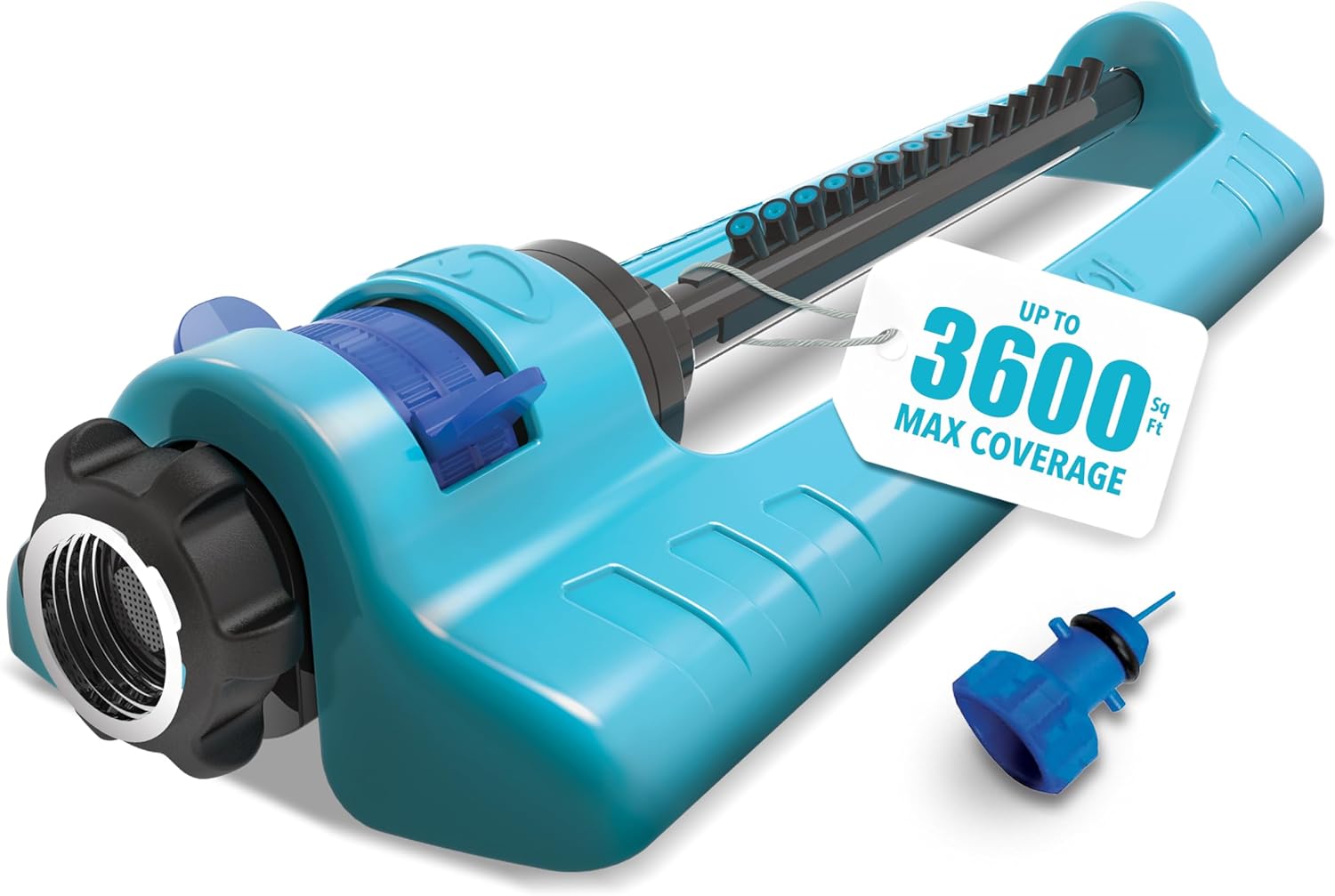
Aqua Joe Indestructible Metal Base Oscillating Sprinkler with 16 Clog-Resistant Nozzles
| Material Type | Metal |
|---|---|
| Maximum Pressure | 120 psi |
| Maximum Flow Rate | 6.65 gpm |
| Number of Nozzles | 16 |
| Coverage | Up to 3,600 sq ft |
This Aqua Joe oscillating sprinkler is a straightforward, durable option for watering medium to large lawns. It connects to a standard garden hose and the sealed turbo gear-driven unit powers a 16-nozzle bar that you can adjust for width and range, making it easy to target flower beds or sweep a broad lawn. The extra-large solid metal base gives the unit good stability on uneven ground and the built-in clean-out tool helps clear nozzle clogs without disassembly. Practical benefits include predictable, even coverage across up to roughly 3,600 square feet and a design meant to stand up to regular seasonal use. Limitations to note are that it is a manual, stationary sprinkler so it does not rotate or move on its own beyond the oscillation, and setup requires positioning and occasional adjustment to avoid overspray near sidewalks or flowerbeds. For most homeowners wanting a reliable, no-frills portable sprinkler, this model strikes a sensible balance of durability and performance.
Best for: Homeowners who want a dependable, no-fuss portable sprinkler that balances durability and flexible coverage for medium to large yards.
Less Ideal for: People seeking automated moving sprinklers, programmable timers, or very small container gardens where a compact rotary or drip system would be more appropriate.
- Solid metal base provides strong stability and durability in the yard
- 16 clog-resistant nozzles with built-in clean-out tool for consistent spray
- Sealed turbo gear-driven unit offers reliable performance season after season
- Adjustable width and range allow targeted coverage up to 3,600 sq ft
- Oscillating motion is fixed and does not self-translate to cover irregular shapes
- Requires manual positioning and adjustments to avoid overspray
Verdict: A durable, easy-to-use oscillating sprinkler that delivers reliable, adjustable coverage for most medium to large lawns.
Eden 94110 Heavy-Duty Metal Oscillating Sprinkler with Quick Connect Set

| Material Type | Aluminum |
|---|---|
| Maximum Pressure | 100 psi |
| Maximum Flow Rate | 30 gpm |
| Number of Nozzles | 18 |
| Coverage | Up to 3,315 sq. ft. |
The Eden 94110 is a performance-focused oscillating sprinkler built around a sturdy aluminum base and a turbo drive motor that keeps the spray consistent across varying household water pressures. It uses 18 precision, clog-resistant nozzles and an adjustable sliding range control so you can shape a rectangular pattern and water up to about 3,315 sq. ft. under ideal conditions. The metal base and anti-rust coating give the unit stability on the lawn and help it withstand season-to-season use, while a built-in nozzle cleaning tool makes maintenance straightforward. The included quick connect starter set adds a water-stop feature and secure twist-and-lock adapters so you can swap hoses or nozzles without shutting off the tap and avoid hose twisting with the 360 degree swivel. Expect reliable, even coverage for vegetable beds, flower borders, and medium to large lawns, though actual reach depends on your water pressure and wind; very irregular terrain may still need multiple positions for uniform watering.
Best for: Buyers who prioritize reliable, uniform watering performance for medium to large lawns or productive garden beds and want a durable, serviceable sprinkler they can depend on season after season.
Less Ideal for: Not the best choice for very small patios, narrow strips, or highly irregular landscapes where targeted hand-watering or drip irrigation is more efficient.
- Durable metal base with anti-rust coating for stable, long-lasting use.
- Eighteen precision, clog-resistant nozzles deliver even coverage across a rectangular area.
- Turbo drive motor maintains smooth operation and improves gear life under varying pressures.
- Quick Connect Starter Set with water-stop and twist-lock makes tool changes fast and leak-resistant.
- Built-in nozzle cleaning tool simplifies maintenance and restores spray performance.
- Coverage claim (3,315 sq. ft.) depends on ideal water pressure and calm conditions so real-world range may be less.
- Made for flat lawns and gardens so irregular slopes or obstacles may require repositioning for full coverage.
Verdict: Choose this sprinkler if you want a durable, performance-oriented oscillating sprinkler that delivers even coverage and fast tool changes for medium to large lawns.
Melnor MiniMax Turbo Oscillating Sprinkler with Metal Spike

| Maximum Flow Rate | 15 gpm |
|---|---|
| Material Type | Plastic |
| Coverage | 4,000 sq. ft. |
| Features | Dirt-Resistant Drive, 360° Adjustability, QuickConnect Set |
The Melnor MiniMax Turbo is a compact oscillating sprinkler built to give the control of a larger unit in a smaller footprint. It mounts on a metal step spike so you can position it quickly in new sod or garden beds and adjust width, range, and flow to match the area you need to keep moist. The sprinkler covers up to 4,000 sq. ft. and includes a 360 degree top that lets you redirect spray without moving the spike. Practical features include a dirt-resistant drive that tolerates grit in well water and a flow-through base so multiple units can be linked for continuous coverage. The QuickConnect starter set makes swapping hoses and tools fast. Expect reliable, customizable watering for establishing new sod, but be aware the unit is plastic-bodied so long-term durability will depend on care and storage; it also lacks fine mist settings for very delicate seedlings. For homeowners who want precise coverage and easy repositioning, this delivers sensible performance without unnecessary complexity.
Best for: Homeowners who want efficient, adjustable coverage to establish new sod and prefer tools that are easy to position and tune for different lawn shapes.
Less Ideal for: Gardeners needing a gentle mist for very young seedlings or those seeking an all-metal, heavy-duty permanent fixture for commercial use.
- Adjustable width, range, and flow for tailored watering of new sod
- Covers up to 4,000 sq. ft. so fewer units are needed for medium lawns
- Metal step spike holds the sprinkler steady in turf and beds
- Dirt-resistant drive keeps it operating reliably with gritty water
- Flo-through base and QuickConnect make linking and swapping hoses easy
- Primarily plastic construction that can degrade if left in sun or freezing conditions
- No very fine mist option for extremely delicate seedings or seedlings
Verdict: Choose this sprinkler if you want precise, adjustable coverage to get new sod established with minimal repositioning and easy hose hookups.
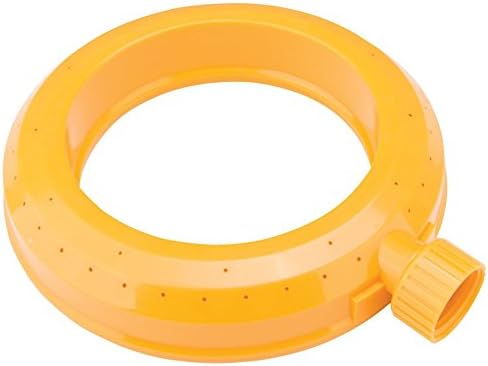
Rocky Mountain Goods Rotary Circle Sprinkler (plastic)
| Material Type | Plastic |
|---|---|
| Maximum Flow Rate | 2 gpm |
| Style Name | Rotary |
This rotary circle sprinkler is a basic, budget-friendly option for watering new sod and medium-sized lawns. Made from high-impact plastic, it is lightweight and easy to move so you can position it where young grass needs the most attention. The sprinkler throws water up to about 30 feet across, producing a fixed, consistent spray pattern that helps establish even moisture without complicated settings. It is rated to run with both low and high household water pressure and has a modest maximum flow rate of 2 gpm, which helps keep water use reasonable. Because it is a straightforward rotary head with no adjustable diffusers or multiple spray modes, you trade advanced customization for simplicity and reliability. Expect good performance for regular coverage on a budget, but plan to reposition it for irregular lawn shapes or to avoid overwatering in one spot.
Best for: Homeowners laying or caring for new sod who want an inexpensive, no-frills sprinkler that is easy to move and use regularly.
Less Ideal for: People with large or unusually shaped lawns who need adjustable spray patterns or automated coverage should consider more versatile sprinkler heads or timed systems.
- Covers up to 30 foot diameter suitable for establishing new sod
- High-impact plastic resists outdoor wear while keeping cost low
- Works with low and high household water pressure for flexible use
- Fixed spray style with no adjustable patterns limits fine-tuning of coverage
Verdict: A low-cost, easy-to-use rotary sprinkler that reliably wets new sod across a roughly 30-foot area without fuss.
AIPER IrriSense 2 Smart Sprinkler System

| Maximum Flow Rate | 6.8 gpm |
|---|---|
| Model Number | WAW1 |
| Number of Packs | 1 |
The IrriSense 2 combines a controller, sprinkler, electric valve, and nutrient feeder into a single unit designed to cover up to 4,800 sq. ft. It is typically used as a stand-alone smart irrigation solution for lawns, beds, and small garden plots where you want precise, plant-specific watering without installing a full in-ground system. Key features include on-device mapping for up to 10 irrigation zones, EvenRain technology for uniform gentle spray, weather-adaptive scheduling with rain detection, and a built-in nutrient solution compartment. In practice the device simplifies setup and daily operation: the 15-minute install and app-driven maps let you target thirsty areas or reduce soak time for delicate beds, and the weather-adaptive logic helps cut water use. Limitations to consider are dependence on local water pressure to reach the stated range and a single integrated unit rather than separate fixed heads, which makes it best for portable or temporary setups rather than hardwired permanent systems.
Best for: Gardeners who prioritize performance and precision watering for lawns and mixed planting areas and who want fast installation and app-driven control rather than a full in-ground system.
Less Ideal for: Homeowners seeking a permanent, hardwired irrigation network with multiple fixed heads or those with consistently low municipal water pressure are better served by a traditional installed system.
- All-in-one design replaces controller, valve, sprinkler, and feeder for quick 15-minute setup
- Plant-specific multi-zone mapping for up to 10 custom irrigation maps
- EvenRain technology provides gentle, uniform spray that improves absorption
- Weather-adaptive scheduling with built-in rain detection reduces unnecessary watering
- Maximum spray range and performance depend on site water pressure and wind conditions
- Single integrated unit is less suitable for permanent underground sprinkler systems
Verdict: Buy the IrriSense 2 if you want a high-performance, plug-and-play smart sprinkler that delivers precise, plant-specific multi-zone watering with weather-adaptive controls.
Eden Weighted Essential Oscillating Sprinkler with Quick Connect Starter Set

| Maximum Pressure | 60 psi |
|---|---|
| Maximum Flow Rate | 30 gpm |
| Nozzle Count | 16 precision nozzles |
| Coverage | Up to 3,600 sq. ft. |
The Eden Weighted Essential Oscillating Sprinkler delivers steady, even watering across mid‑to‑large lawns and garden beds up to about 3,600 square feet. It mounts on a weighted base so it stays put while a sealed turbo drive motor oscillates a bar with 16 precision nozzles for consistent spray distribution. Sliding range tabs let you limit how wide the spray is, and a built‑in nozzle cleaning tool helps clear clogs without disassembly. The included quick connect starter set and stainless steel filter washers simplify hookups and let you swap tools without shutting off the water. In practice this model is quiet, simple to position, and keeps water patterns uniform on level turf. Expect best results on relatively flat lawns where the coverage matches the stated footprint; very large properties will need multiple units or a different sprinkler type to avoid gaps. The unit is plastic, so durability under heavy seasonal use may lag behind metal alternatives, but the design and filters reduce maintenance and leaks for routine garden watering needs.
Best for: Buyers who want a reliable, easy‑to‑use sprinkler that produces uniform coverage for medium to large lawns and value social proof and low maintenance features when choosing a dependable product.
Less Ideal for: Not a great choice for very large estates or professional irrigation needs where metal, higher‑capacity, or multi‑zone systems are preferred.
- Even coverage from 16 precision nozzles for consistent watering patterns
- Weighted base provides stability during operation
- Adjustable range tabs allow precise area control to target lawns or beds
- Quick connect starter set and stainless steel filters simplify hookups and reduce leaks
- Built‑in nozzle cleaning tool makes maintenance fast and simple
- Plastic construction may wear faster than metal sprinklers under heavy seasonal use
- Coverage limited to about 3,600 sq. ft., so large properties may need multiple units
Verdict: A user‑friendly oscillating sprinkler that combines even coverage, a stable weighted base, and quick‑connect hookups for dependable mid‑sized lawn watering.
Joeys Garden 360° Rotary Lawn Sprinkler with Weighted Base

| Material Type | Plastic |
|---|---|
| Maximum Pressure | 80 psi |
| Inlet Connection Size | 0.5 inches |
| Number of Packs | 1 |
This Joeys Garden rotary sprinkler spins three adjustable arms through a true 360 degree rotation to deliver even coverage across round or irregular lawns. It connects to a standard garden hose with a screw-on 0.5 inch inlet and is built from ABS plastic with a weighted base so it stays put on grass, patio, or gravel even at higher household water pressures. The spray arms are adjustable for range and pattern and you can daisy-chain multiple units to cover larger properties. Typical use is simple: attach to a hose, set arm angles for desired reach, and place in the center of the area to avoid dry strips common with oscillating heads. Practical benefits include easy, tool-free setup, steady placement without staking, and scalable coverage by linking units. Limitations are that plastic construction may not match metal units for extreme longevity and performance depends on sufficient home water pressure for maximum distance.
Best for: Buyers who want a reliable, easy-to-use sprinkler that delivers even coverage and can be expanded across larger lawns without complicated setup.
Less Ideal for: Those seeking a heavy-duty commercial-grade metal sprinkler or users with very low water pressure who need specialized low-pressure irrigation solutions.
- True 360° rotary action for even coverage with fewer dry strips
- Weighted base helps unit remain stable on grass, patio, or gravel
- Standard screw-on 0.5 inch hose connection for tool-free setup
- Adjustable arms let you control spray distance and pattern
- Can be daisy-chained to expand coverage for larger areas
- Plastic ABS construction is less durable than metal alternatives
- Performance relies on steady household water pressure for best range
Verdict: A simple, stable rotary sprinkler that delivers consistent 360° coverage and is easy to set up and expand for larger yards.
Choosing the Right Garden Sprinkler for Growing Grass: Key Factors to Consider
Spray Uniformity and Pattern Coverage
How evenly a sprinkler distributes water determines if grass germinates and grows uniformly. Puddling and dry rings are often caused by uneven pattern overlap or concentrated streams. Evaluate whether a sprinkler has multiple pattern options, adjustable arcs, or rotating heads that create consistent overlap across the target area.
For establishing new grass, choose a sprinkler that can deliver gentle, fine droplets across the entire planting area. For spot repair or narrow strips, a directional pattern or oscillating band that concentrates water where needed will reduce wasted runoff. Consider adjusting spacing and runtime so patterns overlap slightly to avoid thin seams between coverage zones.
Durability and Material Construction
Sprinklers live outdoors and face sun, grit, and occasional impacts from tools or lawn equipment. Plastic components vary widely in UV and impact resistance, and metal parts can corrode if not stainless or brass. Durable construction reduces leaks, wobble, and the need for replacement during the critical first season of grass establishment.
Assess the quality of connectors, seals, and moving parts. Look for sturdy stakes or weighted bases that hold heads level, and replaceable nozzles or parts so you can service a unit rather than discard it. Longevity matters because a failing sprinkler can leave recently seeded turf vulnerable to drying out at a crucial stage.
Adjustment Options and Pattern Control
Ability to fine-tune arc, range, and droplet size makes it easier to match the sprinkler to soil type, seed depth, and grass variety. Adjustable arc and range let you reduce spray distance for small beds or extend it for larger lawns without changing equipment. Nozzle variety or flow restrictors help convert a single sprinkler to multiple tasks, from moistening seedbeds to daily maintenance watering.
Simple, reliable controls are best for home gardeners. Complex adjustments that require tools or precise calibration are less practical for routine use. Evaluate how easily you can change settings while the unit is running and how stable those settings remain.
Water Efficiency and Flow Rate Compatibility
Most residential water systems have limited flow and pressure. A sprinkler that needs higher flow than your supply can deliver will create weak coverage or uneven patterns. Conversely, a low-flow design can be ideal for small properties and for reducing runoff on compacted soils.
Check the sprinkler's recommended flow and pressure range against your tap or hose supply. Features like low-flow nozzles, adjustable flow, and pulse settings can improve efficiency. Efficient spray patterns and droplet size also reduce evaporation, a key benefit when establishing grass during warm, windy conditions.
Installation Flexibility and Footprint
How you place a sprinkler affects coverage and convenience. Some units mount on stakes and stay in the lawn, others sit on adjustable bases or attach to pop-up risers. Consider how much area each placement covers, whether the unit interferes with mowing, and how easy it is to move between zones as watering needs change.
A compact footprint is useful for narrow strips and landscaped edges, while broader rotating heads suit open lawns. Ease of connecting hoses, swapping connectors, and storing units off-season should factor into your decision because frequent reconfiguration is common during seed establishment and patch work.
Maintenance and Repairability
Routine care keeps sprinklers performing through the grass-establishment period. Simple designs with accessible nozzles and common replacement parts are easier to service. Consider how easy it is to clear clogs, replace seals, or swap a worn nozzle without specialized tools.
Regular maintenance tasks include flushing debris, checking for leaks at fittings, and winterizing if you live in a freeze zone. A sprinkler that is easy to maintain prevents unexpected failures that can stress new grass during dry spells.
Types of Sprinklers and When to Use Them
Different sprinkler styles suit distinct grass-establishment tasks. Oscillating sprinklers deliver a rectangular band of water and are excellent for evenly moistening seedbeds and narrow lawns. Rotating impact-style or rotary sprinklers create circular coverage and work well for larger, open lawns where a single unit can reach far distances.
Stationary or fixed-pattern sprinklers are useful for spot repairs and edges where precise water placement matters. Adjustable nozzle heads and multi-pattern units provide versatility, letting you adapt one sprinkler to several tasks without buying specialty equipment.
- Oscillating: best for rectangular lawns and seedbeds.
- Rotary: good for large, open lawns with higher reach.
- Stationary: ideal for edges, strips, and targeted repairs.
- Multi-pattern: versatile for mixed garden shapes.
Matching Sprinkler Choice to Soil and Grass Type
Soil texture and grass species influence the ideal droplet size and watering schedule. Sandy soils drain quickly and benefit from shorter, more frequent cycles to avoid leaching nutrients. Clay soils absorb slowly and need gentler sprays to prevent runoff and pooling.
Fine fescues and bentgrasses often prefer lighter, more frequent watering when new, while perennial ryegrass and tall fescues can tolerate slightly larger single applications. Adjust sprinkler range and run time to match soil infiltration rate and seed requirements rather than watering on a fixed clock.
- Sandy soil: short cycles, smaller droplets, frequent runs.
- Clay soil: gentle sprays, longer soak periods, avoid runoff.
- New seed: light, frequent moisture to keep surface damp.
- Sod: slightly longer applications to wet root zone uniformly.
Setting Up Effective Coverage Patterns
Plan placements so spray patterns overlap by 10 to 20 percent. Overlap compensates for fringe coverage loss at the edges of each sprinkler's reach and prevents striping or dry seams. Walk the lawn during a short test run and mark weak spots to adjust placement or run time.
Use temporary stakes or markers for initial runs and measure average throw distances at your household pressure. If a pattern leaves a dry patch, either reduce spacing between sprinklers or shorten the range and add another unit to improve uniformity.
- Test-run each unit and mark coverage limits.
- Aim for slight overlap between adjacent patterns.
- Adjust nozzle or arc to minimize water hitting hard surfaces.
Watering Schedules for Establishing and Maintaining Grass
When germinating seed, short frequent cycles are best to keep the seedbed surface continuously moist without creating runoff. As seedlings emerge, gradually lengthen cycles and reduce frequency to encourage deeper root growth. A transition plan from surface moisture to deeper, less frequent watering improves turf drought tolerance.
For established lawns, fewer longer cycles are usually more beneficial than daily light watering. Water early in the morning to reduce evaporation and fungal disease risk. Monitor weather and adjust schedules for rain, high heat, or wind.
- Seedbed: multiple short runs per day to keep surface damp.
- New seedlings: shift to longer, less frequent runs after germination.
- Established turf: deeper, infrequent watering early in the day.
Troubleshooting Common Coverage Problems
If you notice striping or dry bands, check for clogged nozzles, uneven pressure, or incorrect spacing. Minor clogs can be cleared with a small pick or by soaking nozzles in vinegar to dissolve mineral deposits. Pressure issues may require adjusting the flow setting or using a nozzle with a different flow specification.
If runoff occurs on compacted or sloped areas, break watering into shorter pulses with soak intervals. For inconsistent rotation or wobble, inspect stakes, bases, and bearings for wear. Simple maintenance often restores even performance without replacing the unit.
- Clear nozzles and filters to fix low-flow spots.
- Adjust spacing to remove dry seams.
- Use pulse watering on slopes and compacted soil.
How We Chose the Best Garden Sprinkler for Growing Grass
We selected products that address common needs for establishing and maintaining lawns, prioritizing measurable features gardeners can verify in use. Evaluation focused on spray uniformity and pattern control, because even distribution prevents dry spots and overwatering young grass. Durability and material quality were assessed to ensure reliable performance through repeated seasonal use and exposure to sun and moisture. Ease of adjustment and range control were included so sprinklers can be tuned for seedlings, sod, and mature turf without frequent replacement. Water efficiency and flow-rate compatibility were checked to match typical residential water pressure and irrigation timers. Lastly, installation flexibility and footprint were reviewed so options fit small yards, large lawns, and irregular zones. We excluded specialty landscape irrigation systems and any products that require complex installation or professional setup. Simple to moderately adjustable sprinklers that a weekend gardener can install and maintain were favored. The scoring criteria reflect the practical dimensions above: spray uniformity, durability, adjustment controls, water compatibility, and ease of setup and maintenance.
FAQ
How often should I run a sprinkler to establish new grass seed?
Often run multiple short cycles per day to keep the seedbed surface consistently moist without causing runoff. As seedlings emerge, gradually lengthen cycles and reduce frequency to encourage deeper root development.
Can I use the same sprinkler for both seed and established lawn watering?
Usually yes if the sprinkler has adjustable range and pattern settings. Use gentle, fine-spray settings for seedbeds and wider, longer runs for established turf. Ensure the unit can be easily tuned and holds adjustments reliably.
What pressure or flow should I check before buying a sprinkler?
Check your household water pressure and typical flow from the hose bib. Pick a sprinkler rated for that pressure range or with adjustable nozzles. Matching flow prevents weak coverage and ensures the pattern performs as expected.
How do I prevent runoff when watering newly seeded areas?
Prevent runoff by using gentler spray patterns, shorter cycles with soak intervals, and reducing flow rate. Improve soil infiltration by lightly raking to loosen compacted topsoil before seeding so water soaks in rather than running off.
Is it better to water in the morning or evening?
Morning watering is usually better because it reduces evaporation and gives grass time to dry before nightfall, lowering fungal disease risk. Evening watering can increase disease pressure, especially when combined with cool, damp conditions.
Final Verdict
Prioritize even coverage and reliable adjustment when choosing a sprinkler for growing grass. Spray uniformity, durable construction, and compatibility with your household flow rate have the biggest impact on seed germination and early root development. Balance ease of setup and maintenance against the irrigation footprint you need to cover. Choose a sprinkler that you can tune for both gentle seedbed moisture and the deeper, less frequent cycles required by established turf to confidently support a healthy lawn.
