

Note: This article contains affiliate links. If you click on these links and make a purchase, I may earn a small commission at no extra cost to you. This helps support my research and content. Read my full affiliate disclosure here.
New sod needs steady, gentle watering to root in without washing out soil or creating puddles. The right garden sprinkler delivers uniform coverage, adjustable flow and pattern control, and a soft spray that mimics natural rain so tender roots establish quickly. This guide highlights five shortlisted sprinklers suited to watering new sod and explains the features that matter for healthy turf establishment. We evaluate each option for spray uniformity, flow control, and ease of placement so you can pick the best fit for your lawn layout and watering schedule.
Top Picks at a Glance
| Best Overall The best all-around choice for most situations | Eden Adjustable 4-Way Mini Turbo Oscillating Sprinkler with Quick Connect Starter Set |  |
| Best Value The sweet spot between price and what you get | Melnor Turbo Oscillating Sprinkler — 2,800 sq. ft., 16 Precision Nozzles |  |
| Best Budget The cheapest option that still gets the job done reliably | Gilmour Circle Pattern Spot Sprinkler |  |
| Most Popular A crowd favorite that many people choose with confidence | Eden Weighted Essential Oscillating Sprinkler with Quick Connect Starter Set |  |
| Best Seller A high-volume bestseller chosen again and again | Aqua Joe Indestructible Metal Base Oscillating Sprinkler with 16 Clog-Resistant Nozzles |  |
Eden Adjustable 4-Way Mini Turbo Oscillating Sprinkler with Quick Connect Starter Set

| Maximum Pressure | 125 psi |
|---|---|
| Maximum Flow Rate | 12.56 liters per minute |
| Inlet Connection Size | 0.5 inches |
| Material Type | Acrylonitrile Styrene |
This Eden mini turbo oscillating sprinkler brings the performance of a larger oscillating head into a compact, easy-to-position unit. It sprays from a set of 16 clog-resistant nozzles and is adjustable in four ways: width, length, flow, and a full 360 degree rotation so you can target narrow strips or broad lawn areas up to roughly 4,069 sq. ft. The turbo-drive motor maintains smooth operation across low and high water pressures while the integrated flow control dial lets you fine-tune output to avoid runoff or overspray. Practical touches include a heavy weighted H-shaped base for stability, a water filter to reduce nozzle clogs, and a quick-connect starter kit with a swivel to prevent hose kinks and allow fast tool swaps. Because the body is molded ABS plastic, it is lightweight and rustproof but not as heavy-duty as metal-drive commercial heads, so it is best for residential yards rather than heavy professional use. The included quick-connect and replacement filter make maintenance straightforward for regular seasonal watering routines.
Best for: Home gardeners who want precise, easy-to-adjust watering for mixed lawns, flower beds, and narrow strips and who value straightforward setup and low maintenance guided by other shoppers' positive experiences.
Less Ideal for: Large commercial lawns or contractors who need metal gear-drive durability and maximum long-term wear resistance.
- Adjustable width, length, flow, and 360° rotation for precise coverage of different lawn shapes
- Turbo-drive motor for consistent operation at low and high water pressures
- Includes quick-connect starter set and swivel to prevent hose kinks and simplify tool changes
- Weighted H-shaped base and impact-resistant ABS shell provide stable, rustproof performance
- Inline filter and clog-resistant nozzles reduce maintenance and nozzle blockages
- Plastic construction is less durable than metal gear-drive sprinklers for heavy commercial use
- Coverage claims apply under ideal conditions and may be lower on low-pressure systems
Verdict: Choose this Eden mini turbo oscillating sprinkler if you want a compact, highly adjustable residential sprinkler with reliable performance and easy quick-connect setup.
Melnor Turbo Oscillating Sprinkler — 2,800 sq. ft., 16 Precision Nozzles

| Maximum Pressure | 80 psi |
|---|---|
| Maximum Flow Rate | 30 gpm |
| Inlet Connection Size | 0.75 inches |
| Material Type | ABS Plastic |
The Melnor Turbo Oscillating Sprinkler is designed to give even, controllable watering across medium lawns and garden beds up to about 2,800 square feet. It uses 16 precision nozzles and a geared InfinityDrive turbo motor to produce a steady oscillating pattern, while sliding range adjusters let you limit spray to specific zones to reduce overspray onto paths and driveways. The included quick connect starter set makes attaching and detaching hose accessories faster when you swap tools. In use the sprinkler produces consistent coverage at typical household water pressures and the plastic ABS body keeps it lightweight and easy to move. Important limitations are that it requires a compatible 3/4 inch inlet and performance depends on your water pressure and flow rate; very low-pressure systems will reduce coverage. The plastic construction is fine for seasonal use but may not match the longevity of heavier metal models in harsh climates. For routine lawn watering this sprinkler balances adjustability, coverage, and convenience.
Best for: Gardeners who want a reliable, adjustable sprinkler to optimize water delivery across a medium lawn while minimizing wasted spray and time spent adjusting coverage.
Less Ideal for: Homeowners with very low water pressure or who need an ultra-heavy-duty, long-lasting metal sprinkler for commercial or extreme outdoor use.
- Covers up to 2,800 sq. ft. with 16 precision nozzles for consistent watering
- Sliding range adjusters allow targeted watering to reduce overspray
- InfinityDrive turbo motor provides smooth oscillation for even coverage
- Quick Connect starter set speeds attachment and removal of hose accessories
- ABS plastic body is lighter but less durable than metal alternatives
- Requires adequate household water pressure and a 0.75 inch inlet for full coverage
Verdict: A practical, adjustable oscillating sprinkler that delivers even coverage and simple setup for medium-sized lawns.
Gilmour Circle Pattern Spot Sprinkler

| Material Type | Metal |
|---|---|
| Maximum Flow Rate | 3 gpm |
| Inlet Connection Size | 1.5 inches |
The Gilmour Circle Pattern Spot Sprinkler is a simple stationary sprinkler built for targeted watering of small or trouble areas on lawns. It produces a gentle, fountain-like spray that reaches about a 30 foot diameter and is useful for new seed, sod patches, or isolated dry spots where a full-coverage sprinkler is wasteful. Its metal construction gives the unit stability and durability compared with plastic minisprinklers, and the 1.5 inch inlet fits common hose or fitting setups while handling up to 3 gpm of flow. Because it is stationary, you position it where you need coverage and leave it to run rather than oscillate or rotate, which makes it easy to control watering of compact spaces. The main limitations are its fixed pattern and lack of adjustable arc or throw control, so it is not suited to irregular shapes or replacing a lawn-wide sprinkler head. Expect a reliable, low-tech tool for spot treatments rather than a replacement for an adjustable or rotary system.
Best for: Buyers who want a dependable, low-maintenance sprinkler to treat specific patches, seed beds, or small lawn areas without overwatering larger sections.
Less Ideal for: Homeowners needing adjustable arcs, rotating coverage, or equipment to water irregularly shaped or whole lawns should consider a different sprinkler type.
- Heavy-duty metal construction for durability and stability
- Gentle fountain-like spray ideal for new seed and localized watering
- 30 ft diameter coverage suitable for small lawns and trouble spots
- Works at low water pressure and accepts common 1.5 inch inlet connections
- Stationary fixed pattern with no adjustable arc or customizable spray shape
- Not intended as a full-lawn solution due to limited coverage and lack of rotation
Verdict: A durable, no-frills spot sprinkler that reliably treats small lawn areas and trouble spots without wasting water.
Eden Weighted Essential Oscillating Sprinkler with Quick Connect Starter Set

| Maximum Pressure | 60 psi |
|---|---|
| Maximum Flow Rate | 30 gpm |
| Nozzle Count | 16 precision nozzles |
| Coverage | Up to 3,600 sq. ft. |
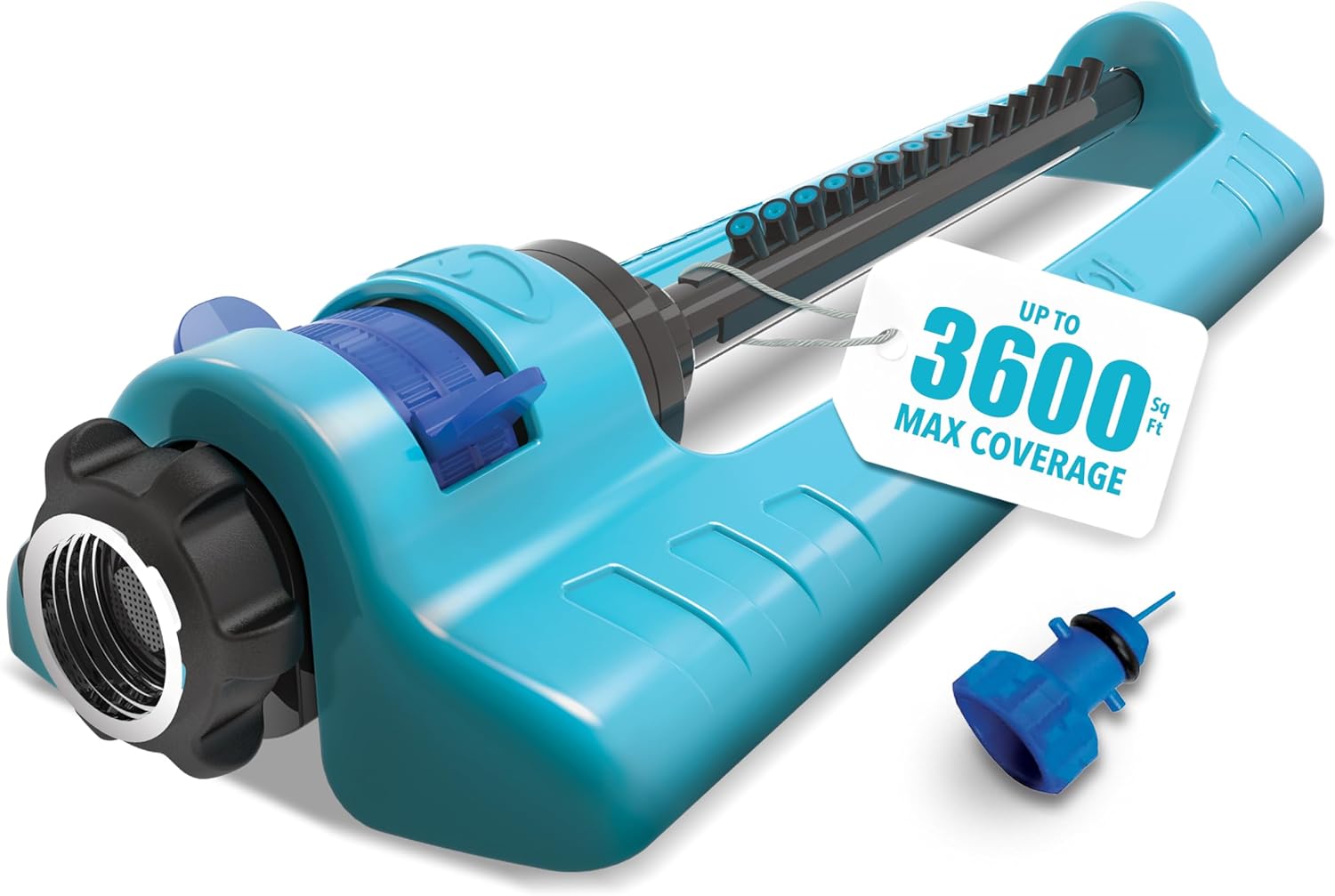
The Eden Weighted Essential Oscillating Sprinkler delivers steady, even watering across mid‑to‑large lawns and garden beds up to about 3,600 square feet. It mounts on a weighted base so it stays put while a sealed turbo drive motor oscillates a bar with 16 precision nozzles for consistent spray distribution. Sliding range tabs let you limit how wide the spray is, and a built‑in nozzle cleaning tool helps clear clogs without disassembly. The included quick connect starter set and stainless steel filter washers simplify hookups and let you swap tools without shutting off the water. In practice this model is quiet, simple to position, and keeps water patterns uniform on level turf. Expect best results on relatively flat lawns where the coverage matches the stated footprint; very large properties will need multiple units or a different sprinkler type to avoid gaps. The unit is plastic, so durability under heavy seasonal use may lag behind metal alternatives, but the design and filters reduce maintenance and leaks for routine garden watering needs.
Best for: Buyers who want a reliable, easy‑to‑use sprinkler that produces uniform coverage for medium to large lawns and value social proof and low maintenance features when choosing a dependable product.
Less Ideal for: Not a great choice for very large estates or professional irrigation needs where metal, higher‑capacity, or multi‑zone systems are preferred.
- Even coverage from 16 precision nozzles for consistent watering patterns
- Weighted base provides stability during operation
- Adjustable range tabs allow precise area control to target lawns or beds
- Quick connect starter set and stainless steel filters simplify hookups and reduce leaks
- Built‑in nozzle cleaning tool makes maintenance fast and simple
- Plastic construction may wear faster than metal sprinklers under heavy seasonal use
- Coverage limited to about 3,600 sq. ft., so large properties may need multiple units
Verdict: A user‑friendly oscillating sprinkler that combines even coverage, a stable weighted base, and quick‑connect hookups for dependable mid‑sized lawn watering.
Aqua Joe Indestructible Metal Base Oscillating Sprinkler with 16 Clog-Resistant Nozzles
| Material Type | Metal |
|---|---|
| Maximum Pressure | 120 psi |
| Maximum Flow Rate | 6.65 gpm |
| Number of Nozzles | 16 |
| Coverage | Up to 3,600 sq ft |
This Aqua Joe oscillating sprinkler is a straightforward, durable option for watering medium to large lawns. It connects to a standard garden hose and the sealed turbo gear-driven unit powers a 16-nozzle bar that you can adjust for width and range, making it easy to target flower beds or sweep a broad lawn. The extra-large solid metal base gives the unit good stability on uneven ground and the built-in clean-out tool helps clear nozzle clogs without disassembly. Practical benefits include predictable, even coverage across up to roughly 3,600 square feet and a design meant to stand up to regular seasonal use. Limitations to note are that it is a manual, stationary sprinkler so it does not rotate or move on its own beyond the oscillation, and setup requires positioning and occasional adjustment to avoid overspray near sidewalks or flowerbeds. For most homeowners wanting a reliable, no-frills portable sprinkler, this model strikes a sensible balance of durability and performance.
Best for: Homeowners who want a dependable, no-fuss portable sprinkler that balances durability and flexible coverage for medium to large yards.
Less Ideal for: People seeking automated moving sprinklers, programmable timers, or very small container gardens where a compact rotary or drip system would be more appropriate.
- Solid metal base provides strong stability and durability in the yard
- 16 clog-resistant nozzles with built-in clean-out tool for consistent spray
- Sealed turbo gear-driven unit offers reliable performance season after season
- Adjustable width and range allow targeted coverage up to 3,600 sq ft
- Oscillating motion is fixed and does not self-translate to cover irregular shapes
- Requires manual positioning and adjustments to avoid overspray
Verdict: A durable, easy-to-use oscillating sprinkler that delivers reliable, adjustable coverage for most medium to large lawns.
Choosing the Right Garden Sprinkler to Water New Sod: Key Factors to Consider
Spray Pattern and Coverage
How a sprinkler distributes water is the first consideration when you are establishing new sod. Uniform overlapping coverage prevents dry spots and avoids channeling water into small ruts that can wash soil away. Look for adjustable patterns that let you switch between full-circle, half-circle, and sector coverage so you can match the spray to lawn shape.
Pattern size affects how long you need to run the sprinkler. A wider reach reduces the number of placements but can increase wind drift. For new sod, smaller, softer patterns that allow multiple passes are often safer because they deliver gentler, more controlled moisture without saturating one area.
Flow Rate and Pressure Control
New turf roots are shallow and sensitive to high-pressure jets that create uneven saturation. A sprinkler with a variable flow control or adjustable nozzle helps you reduce output for gentler delivery, especially during the first two weeks after laying sod. Matching the sprinkler to your water pressure avoids misting or overly concentrated streams that can damage topsoil.
Flow rate also determines soak time. Lower flow output means longer runtimes to achieve the same total water depth, which can be preferable for promoting gradual infiltration. Conversely, very high flow units can lead to runoff on compacted or sloped areas, so pressure reduction options are valuable for controlling soak and runoff.
Spray Height and Droplet Size
Droplet size influences how water interacts with bare soil and young roots. Fine misting produces small droplets that are prone to wind drift and evaporation, reducing effective watering. Coarser, rainlike droplets fall more directly and infiltrate the soil better without displacing topsoil.
Adjustable spray height is useful when you need low, gentle coverage close to the turf surface during establishment, then higher coverage once grass is established. Choose a sprinkler that offers nozzle or head adjustments to modulate droplet size and trajectory.
Stability and Ground Contact
Freshly laid sod sits on soil that may be soft from recent grading or watering. A sprinkler that sinks, tips, or shifts will change coverage and can create concentrated wet spots. Stability features such as broad bases, stakes, or low center-of-gravity designs help maintain even coverage across run times.
Consider how the sprinkler contacts the ground and whether stakes or anchors are needed. Models that grip the soil without compacting it are preferable because they prevent wheel tracks or depressions that hold excess water and impede root contact with the soil.
Ease of Placement and Adjustment
You will likely move sprinklers multiple times while the sod roots. Lightweight, quick-connect units that clip or screw onto standard hoses reduce setup time and lower the risk of disturbing the turf during repositioning. Simple angle and range adjustments let you tune coverage on the fly without tools.
Clear adjustment markings or indexed settings help with repeatable placement, which is useful when you follow a watering schedule that alternates positions. Also check whether the sprinkler can be used with a timer or connected to temporary irrigation piping if you plan automated short runs.
Durability and Maintenance
A sprinkler used on new sod will see frequent repositioning and exposure to garden debris. Corrosion-resistant fittings, easily cleaned nozzles, and replaceable parts extend service life and keep spray patterns consistent. Plastic components should be robust enough to resist cracking in sun-exposed yards.
Maintenance considerations also include the ability to flush debris if flow is reduced and whether spare nozzles or seals are available. Simple disassembly for cleaning prevents clogging that would otherwise lead to uneven watering of delicate turf.
Watering Schedule for New Sod
Establishing new sod requires frequent, short waterings at first to keep the soil surface consistently moist without becoming waterlogged. Early days often call for multiple daily runs of 10 to 20 minutes depending on heat, wind, and soil type rather than a single long soak. Shorter, repeatable cycles encourage roots to grow downward toward moisture.
As roots develop, gradually lengthen run times and reduce frequency. Transition to deeper, less frequent watering once the sod resists lifting when you tug at the grass blades. A sprinkler with easy flow adjustment helps you follow this shifting schedule while maintaining proper coverage.
- Morning watering reduces evaporation and disease risk compared with evening runs
- Adjust runtimes for sandy versus clay soils to avoid quick drainage or surface pooling
- Move sprinklers gradually across the lawn to achieve overlapping coverage without over-watering edges
Setting Up Overlapping Coverage
Overlapping spray patterns eliminate dry seams between placement spots. Plan placements so each sprinkler's outer edges overlap slightly with the next unit's spray. This technique evens out variations caused by wind, nozzle wear, or slight pressure differences from your hose.
Use temporary markers or lawn flags to record placement positions during the first day of watering. Once you find an effective layout, repeatable adjustments make future waterings quicker and more consistent as the grass establishes.
- Aim for 10 to 20 percent overlap between adjacent placements
- Test patterns at low pressure to verify actual coverage footprint
- Account for obstacles such as trees, flower beds, and slopes
Managing Water on Slopes and Uneven Ground
Sloped sections of a new lawn are prone to runoff if water is applied too quickly. On slopes, reduce flow or use smaller patterns and increase cycle frequency to allow water to soak in without flowing downhill. Low-height, wide-droplet patterns work better than high, forceful jets on incline.
For terraces or stepped lawns, place sprinklers on level sections and avoid directing spray directly downhill. Stabilize sprinkler bases and consider temporary edging to slow sheet flow until roots develop enough to hold soil.
- Run shorter cycles with pauses for infiltration on moderate slopes
- Stabilize units with stakes or sandbags if soil is very soft
- Monitor runoff during the first few waterings and adjust flow accordingly
Keeping Nozzles Clean to Maintain Gentle Spray
Debris and mineral buildup change droplet size and pattern, often creating stronger streams that can displace soil. Regularly inspect and flush nozzles, particularly after initial installs when soil may wash into fittings. Simple removable nozzles are easier to service in the field.
If you notice a sudden change in coverage, stop and clean the head rather than increasing run time. Restoring the intended spray shape is more effective than compensating for a clogged nozzle with longer watering that can cause puddles.
- Carry a small brush or compressed air tool when moving sprinklers
- Turn off water and disconnect before cleaning to avoid spraying soil
- Replace worn seals promptly to prevent pressure spikes
Using Timers and Automation Carefully
Timers let you automate frequent short runs without manual intervention, which is convenient during the first establishment phase. Program short cycles during low-wind morning hours and avoid long continuous runs that can saturate the surface. If using multiple positions, cycle them sequentially rather than simultaneously when water pressure is limited.
Automation is most effective when combined with a sprinkler that offers reliable, repeatable settings. Confirm that any timer or inline valve works with the sprinkler's flow profile so cycles deliver the intended depth.
- Set timers for short, repeatable bursts during the first two weeks
- Stagger automated positions to avoid large instantaneous demand on your supply
- Check operations daily after initial setup to verify coverage and adjust runtimes
How We Chose the Best Garden Sprinkler to Water New Sod
We narrowed the field to sprinklers that handle the specific needs of freshly laid sod rather than mature lawn maintenance. Selection began with technical suitability: systems had to offer adjustable flow or pressure control, a gentle spray pattern or nozzle options, and the ability to cover typical residential turf areas without creating concentrated jets that disturb soil. Practical durability and ease of use were next: we favored designs that stay stable on soft ground, attach cleanly to standard hoses, and allow quick pattern changes in the field. Water efficiency and distribution were assessed through manufacturer flow ranges and pattern specifications, emphasizing even coverage and minimal runoff. Finally, installation and placement flexibility mattered for irregular lawns and for creating overlapping coverage without over-watering edges. We excluded garden sprinklers intended only for high-pressure irrigation, decorative lawn ornaments, or specialty systems incompatible with standard hose setups. The final list balances gentle watering performance, coverage control, durability, and user ergonomics.
FAQ
How often should I water new sod with a sprinkler?
Usually you should water new sod several times per day with short cycles to keep the surface consistently moist. Frequency depends on temperature, wind, and soil type; reduce cycles as roots establish and increase duration rather than frequency.
What spray pattern is best for freshly laid turf?
Low, wide-droplet patterns that mimic gentle rain are best because they infiltrate without displacing topsoil. Adjustable sector or half-circle settings help target edges and avoid wasting water on paths or beds.
Can I leave a sprinkler on overnight for new sod?
It is better to water in the early morning. Overnight watering increases the risk of fungal disease because moisture sits on grass blades for longer. Short morning cycles reduce evaporation and disease risk while delivering needed moisture.
How do I avoid washing soil when watering new sod?
Use low pressure or reduced flow settings and shorter run times to prevent soil displacement. Position sprinklers closer to the turf with a softer spray and move them in overlapping increments rather than using a single high-output placement.
When can I mow after installing sod that I watered with a sprinkler?
Wait until the sod has rooted enough to resist lifting, usually two to three weeks depending on conditions. Mow on a high setting initially to avoid stressing shallow roots, and ensure the lawn is not overly wet before mowing to prevent tearing.
Final Verdict
Prioritize gentle, even delivery and control when choosing a sprinkler to water new sod. Focus on units that offer adjustable flow and pattern settings, stable placement on soft ground, and nozzle designs that produce rainlike droplets. Balance coverage reach with the need to avoid runoff or soil displacement, and plan for frequent short cycles during the first weeks. Choosing a sprinkler that makes it easy to fine-tune spray and repeat placements will simplify the establishment process. Emphasize simplicity of adjustment, durability, and consistent distribution so you can steadily transition from frequent short runs to longer, deeper soakings as the turf matures.
