

Note: This article contains affiliate links. If you click on these links and make a purchase, I may earn a small commission at no extra cost to you. This helps support my research and content. Read my full affiliate disclosure here.
If you keep trees on your property, a gas chainsaw for homeowners gives the power and runtime needed for pruning, storm cleanup, and cutting firewood. Picking the right saw matters because residential chainsaw use is different from professional arborist work: you need enough cutting power without an overly heavy tool, predictable maintenance, and safety features suited to intermittent use. This guide covers our shortlisted picks for homeowners and explains the practical criteria we used to evaluate them, including engine performance and serviceability. Read on to understand which saws fit specific yard tasks and homeowner skill levels before the product list.
Top Picks at a Glance
| Best Overall The best all-around choice for most situations | Husqvarna 120 Mark III 16-inch Gas Chainsaw |  |
| Best Quality Built to a higher standard if you want something more solid | Husqvarna 455 Rancher Gas Chainsaw, 20-inch, 3.5-HP |  |
| Best Value The sweet spot between price and what you get | JPNTECH J-880 62cc Gas Chainsaw with 20" Bar |  |
| Best Budget The cheapest option that still gets the job done reliably | GTHAN STORE 62cc Gas-Powered Chainsaw with 20" Guide Bar |  |
| Highest Rated A top-rated pick with lots of positive feedback | Snoonwee 58cc Gas Chainsaw with 18" and 20" Bars |  |
| Most Popular A crowd favorite that many people choose with confidence | VEVOR 62CC Gas-Powered Chainsaw, 20-inch Bar |  |
| Best Seller A high-volume bestseller chosen again and again | NEO-TEC 62cc Gas Chainsaw with 20/22-inch Guide Bar |  |
Husqvarna 120 Mark III 16-inch Gas Chainsaw

| Power Source | Gas Powered |
|---|---|
| Horsepower | 1.88 hp |
| Chain Length | 16 inches |
The Husqvarna 120 Mark III is a homeowner-focused gas chainsaw built to handle firewood cutting, light felling and pruning without complicated setup. It uses a 38-cc X-Torq two-stroke engine that delivers about 1.88 hp, a 16-inch chain and automatic oiler so you can get straight to work and keep the chain lubricated during use. Practical features include an air purge for easier starting, a combined choke/stop control to reduce flooding, a simple chain tensioning system for quick adjustments and an inertia-activated chain brake for added safety. LowVib dampening reduces operator fatigue and the Air Injection centrifugal cleaning helps keep large debris out of the air filter to extend service intervals. For a typical homeowner this saw offers a good balance of starting reliability, manageable power and comfortable handling. It is not aimed at heavy professional use and the user should be prepared for routine two-stroke maintenance and fuel mixing.
Best for: Homeowners who need a dependable, easy-to-start gas chainsaw for firewood, limb work and occasional small felling and who value manageable weight and user-friendly controls.
Less Ideal for: People who need a high-hour professional saw for commercial logging or landscapers who prefer electric models for low maintenance and quieter operation.
- Efficient 38-cc X-Torq engine provides reliable power for common homeowner tasks
- Air purge and combined choke/stop control make cold starts and restarting easier
- LowVib system reduces vibration for more comfortable handling during longer jobs
- Air Injection centrifugal system helps keep large debris out of the air filter to reduce maintenance
- Simple chain tensioning and automatic oiler make upkeep and on-the-job adjustments quick
- Designed for light to moderate work so it is not intended for prolonged professional logging
- Requires two-stroke fuel mixing and regular maintenance common to gas chainsaws
Verdict: A balanced, easy-to-start 16-inch gas chainsaw that suits homeowners who want reliable power and comfortable handling for routine yard work.
Husqvarna 455 Rancher Gas Chainsaw, 20-inch, 3.5-HP

| Power Source | Gas Powered |
|---|---|
| Horsepower | 3.5 hp |
| Chain Length | 20 inches |
| Manufacturer Warranty Description | 2 years |
The Husqvarna 455 Rancher is a workhorse gas chainsaw designed for homeowners who need pro-level performance around large properties. Its 3.5-HP X-Torq engine and 20-inch bar make quick work of medium to large limbs, felling small trees, and cutting firewood. Practical features that aid real-world use include Smart Start for easier ignition, an automatic oiler for consistent chain lubrication, side-mounted chain tensioning for fast adjustments, and Air Injection that reduces debris reaching the air filter to lower maintenance frequency. LowVib dampeners and an ergonomically offset front handle improve comfort during extended jobs. Important limitations are the typical upkeep of a two-stroke gas engine and the added weight and noise compared with cordless or electric saws, which may matter for infrequent or close-quarters use. This saw excels when you need reliable, sustained cutting power for regular heavy-duty yard work rather than occasional light trimming.
Best for: Homeowners and landowners who regularly tackle heavy yard work, storm cleanup, or firewood cutting and prioritize sustained cutting power and durability over light-duty convenience.
Less Ideal for: People who only need an occasional light pruner or who prefer low-noise, low-maintenance cordless or electric options for small yards or frequent close-to-house use.
- High 3.5-HP X-Torq engine provides strong cutting power for large limbs and firewood
- Smart Start and inertia-activated chain brake simplify starting and improve safety
- Air Injection centrifugal system reduces filter cleanings and extends engine life
- Side-mounted tensioning and automatic oiler make chain maintenance quicker
- LowVib handle design improves comfort during extended use
- Requires routine two-stroke fuel mixing and engine maintenance inherent to gas saws
- Heavier and louder than electric or battery chainsaws, which can limit use in noise-sensitive areas
Verdict: Choose the 455 Rancher when you need professional-level gas power and durability for frequent heavy-duty homeowner cutting tasks.
JPNTECH J-880 62cc Gas Chainsaw with 20" Bar

| Power Source | Gas Powered |
|---|---|
| Horsepower | 4.2 hp |
| Chain Speed | 8500 Rpm/Min |
| Chain Length | 20 inches |
The JPNTECH J-880 is a gas-powered 62cc, 2-cycle chainsaw built for homeowners who need a capable tool for firewood preparation, log cutting, and clearing fallen limbs. Its 20-inch guide bar gives extended reach for larger cuts, and the 4.2 hp engine delivers the torque to handle thicker rounds that smaller saws struggle with. Controls are laid out around the engine with a wrap-around front handle and a rear handle for two-handed operation, which helps with balance and control during sustained jobs. The saw ships with a spare spark plug, a tool kit, and a 2L fuel-mixing bottle to simplify first-time setup and maintenance. Expect solid cutting power and versatility, but also the usual commitments of a gas saw: fuel mixing, louder operation, and more maintenance than battery models. It is a practical choice when corded power is not available and when you need a longer bar for larger pieces of wood rather than light pruning or occasional trimming.
Best for: Homeowners and property owners who regularly cut firewood or clear medium to large fallen limbs and prioritize raw cutting power and longer bar reach over low maintenance.
Less Ideal for: Casual gardeners who only need occasional light pruning or users who prefer quieter, low-maintenance battery or electric options.
- Powerful 62cc, 4.2 hp engine suitable for medium to large cutting tasks
- 20-inch guide bar extends reach for logs and larger limbs
- Two-handed wrap-around handle and balanced layout improve control during cuts
- Includes useful starter accessories such as fuel mixing bottle, tool kit, and spare spark plug
- Requires regular fuel mixing and maintenance typical of 2-cycle gas engines
- Heavier and louder than battery-powered alternatives
Verdict: Buy this chainsaw if you need a robust gas-powered tool with a 20-inch bar for routine firewood cutting and larger property maintenance jobs.
GTHAN STORE 62cc Gas-Powered Chainsaw with 20" Guide Bar

| Power Source | Gas Powered |
|---|---|
| Horsepower | 4.2 hp |
| Chain Speed | 8500 Rpm/Min |
| Chain Length | 20 inches |
This GTHAN STORE chainsaw pairs a 62cc 2-cycle engine and 4.2 horsepower with a 20-inch bar to handle large branches, firewood, and small tree felling around a property. It is used like a conventional gas saw: mix fuel, prime and choke for cold starts, and employ the chain brake and throttle lockout for safe operation. Notable features include a high chain speed rating, a long 20-inch cutting capacity for bigger jobs, and an included toolkit, spark plug, and mixing bottle to get started. For homeowners it provides the raw power needed for occasional heavy cutting without relying on extension cords or battery charge cycles. Expect louder operation, routine two-stroke fueling and basic maintenance such as bar and chain tensioning and spark plug checks, and a learning curve for reliable starting technique described in the manual. It is a practical choice when you need strong, portable cutting performance rather than a lighter or quieter tool.
Best for: Homeowners and property owners who need a budget-minded gas saw capable of tackling large logs, storm cleanup, and firewood cutting and who are comfortable with basic engine maintenance.
Less Ideal for: Those who prioritize low noise, low maintenance, or lightweight tools for small trimming jobs should consider electric or battery chainsaws instead.
- Powerful 62cc 2-cycle engine delivering 4.2 hp for cutting thick logs and large branches
- 20-inch guide bar provides long reach and large cutting capacity for heavy-duty homeowner tasks
- Includes starter toolkit, spark plug, and fuel mixing bottle so you can start setup and basic maintenance immediately
- High chain speed for faster cutting and a hardened bar and chain designed for wear resistance
- Requires two-stroke fuel mixing and regular maintenance typical of gas chainsaws
- Heavier and louder than electric or battery alternatives which may limit frequent use in close neighborhoods
Verdict: A powerful, no-frills gas chainsaw that gives homeowners the cutting capacity needed for large jobs without extra bells and whistles.
Snoonwee 58cc Gas Chainsaw with 18" and 20" Bars
| Power Source | Gas Powered |
|---|---|
| Horsepower | 3.6 hp |
| Chain Speed | 91 fg/s |
| Included Components | Two guide bars, two chains, tool kit |
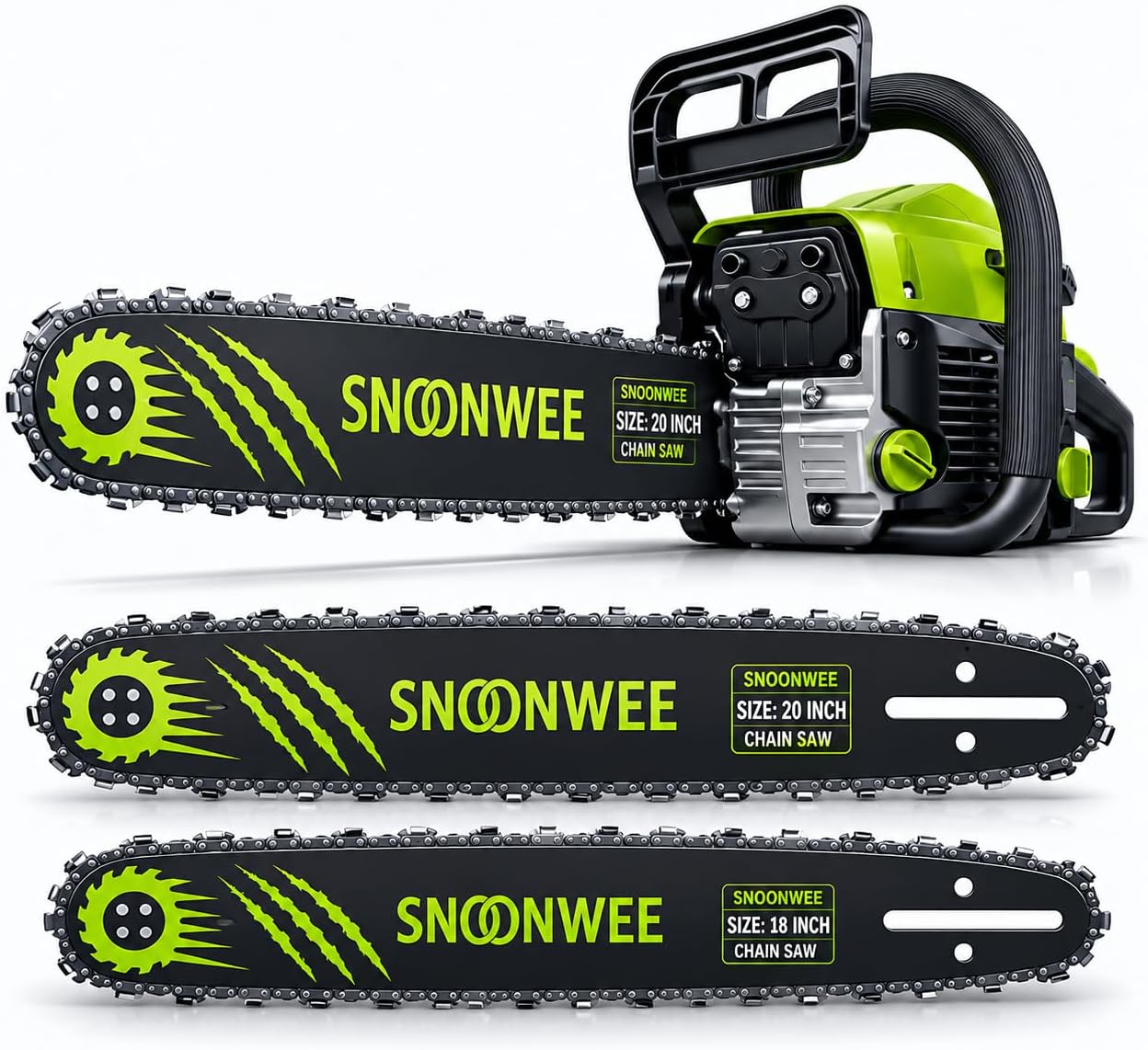
This Snoonwee 58cc gas chainsaw is built for household woodcutting tasks like limb removal, cutting firewood, and storm cleanup. It pairs a 3.6 HP, 2-stroke engine that revs to 9,000 RPM with a stated chain speed of 91 ft/s and includes both 18- and 20-inch guide bars and chains so you can match bar length to the job. Practical features aimed at easier use include an easy-start recoil, cruise-control throttle for sustained cuts, a quick-stop chain brake, and an automatic bar-and-chain oiler. The saw lists low-frequency vibration reduction to improve comfort during longer sessions and comes with two chains, two guide bars, and a small tool kit. Expect solid cutting power and fewer interruptions thanks to the cruise-control and auto-oiler, but remember this is a gas two-stroke tool so it requires fuel mixing, routine maintenance, and noise and exhaust management compared with electric alternatives. For homeowners who need dependable, versatile gas power for occasional heavy cuts, this model covers the basics well.
Best for: Homeowners who prioritize dependable gas power for felling limbs, cutting firewood, or storm cleanup and want a saw that reduces startup and throttle fatigue during longer sessions.
Less Ideal for: People who need a lightweight, low-noise option for close-in yard work or those unwilling to perform routine 2-stroke engine maintenance should consider electric alternatives.
- Two included bar lengths (18" and 20") let you switch size to match the job.
- Strong claimed powertrain: 58cc, 3.6 HP engine with 91 ft/s chain speed for efficient cutting.
- Easy-start recoil and cruise-control throttle reduce user fatigue and make startup and sustained cuts simpler.
- Automatic bar-and-chain oiler and included tool kit simplify routine upkeep and chain care.
- As a 2-stroke gas saw it requires fuel mixing and regular engine maintenance.
- Noise, exhaust, and vibration will be higher than battery or corded electric alternatives.
Verdict: A practical, reliability-minded gas chainsaw that gives homeowners strong cutting power plus two bar options and user-friendly features for longer, dependable use.
VEVOR 62CC Gas-Powered Chainsaw, 20-inch Bar

| Engine displacement | 62CC |
|---|---|
| Horsepower | 3.8 hp |
| Chain pitch/links | 0.325 in / 76 links |
| Fuel tank | 550 ml |
| Chain oil tank | 260 ml |
The VEVOR 62cc gas chainsaw is a heavy-duty homeowner tool built to tackle large trunks and thick limbs with its 20-inch guide bar and 3.8 hp two-stroke engine. It is typically used for felling medium trees, bucking logs and clearing overgrown areas; the 20-inch bar is rated to cut up to about an 18-inch diameter. Notable features include cold and hot start controls, an extended pull rope for easier starting, an emergency stop lever, and dual fuel and chain oil tanks sized for longer runtime between refills. The PA6+30%GP composite body and corrosion-resistant guide bar are intended to resist impact and high temperatures, while the 0.325-inch chain pitch and 76 links provide standard cutting performance for its class. Practical benefits are strong cutting power for demanding yard work and user-focused controls for safer operation. Important limitations are that it is a two-stroke gas machine so it requires fuel mixing, regular chain maintenance, and more noise and vibration than battery or electric options, and it is heavier and less maneuverable for light pruning or tight jobs.
Best for: Homeowners who need a powerful, gas-driven saw for felling medium trees, cutting firewood, and clearing land and who prioritize cutting performance and runtime over low-noise or low-maintenance operation.
Less Ideal for: Gardeners who mainly do light pruning, tight detail work, or who prefer low-noise low-maintenance battery or corded electric saws should consider smaller or electric models instead.
- High cutting capacity from a 62cc engine and 20-inch bar for large-diameter logs
- Durable composite body designed to resist impact and high temperatures
- Cold and hot start options plus extended pull rope to simplify starting in varied conditions
- Emergency stop and guarded design to reduce flying debris and improve safety
- Relatively large fuel and chain oil tanks for longer continuous use between refills
- Requires mixed two-stroke fuel and routine chain maintenance
- Heavier and louder than electric or battery alternatives, making it less comfortable for extended handheld use
Verdict: Choose this VEVOR 62cc chainsaw if you need maximum gas-powered cutting power and longer runtime for heavy home logging and land-clearing jobs.
NEO-TEC 62cc Gas Chainsaw with 20/22-inch Guide Bar

| Power Source | Gas Powered |
|---|---|
| Horsepower | 3.5 hp |
| Item Highlight | 2-Stroke Petrol, 25:1 Fuel-Oil Mix, 0.325" Pitch |
This NEO-TEC 62cc gas chainsaw is built for demanding homeowner work like cutting large branches, felling small trees, and preparing firewood. It uses a 2-stroke engine rated at 3.5 HP with a top speed around 7,500 RPM and offers either a 20- or 22-inch guide bar so you can match bar length to the job. Practical features include a dual-tank design to reduce leaks, clearly marked fuel-oil mixing ratios, a side-mounted tool-free chain tensioner for quick adjustments, and an extended pull rope plus an optimized cold/hot start system to make starting easier. Anti-vibration mounts and an ergonomic non-slip handle improve comfort during longer sessions. The package includes spare bars/chains, oils, gloves, and basic tools, which helps get you cutting right away. Keep in mind this is a two-stroke gasoline tool so it requires mixing fuel and performing routine maintenance and it will be louder and heavier than battery options, which may matter for neighborhood use and storage.
Best for: Practical homeowners who need a robust, gas-powered saw for occasional to frequent heavy cutting and who prefer a ready-to-use package with tools and spare parts.
Less Ideal for: Residents in noise-restricted neighborhoods or those who prefer low-maintenance, emission-free battery tools should consider alternatives.
- Powerful 3.5 HP 62cc two-stroke engine suitable for large branches and small trunks
- Option of 20- or 22-inch guide bar to match cutting needs
- Dual-tank design and clear fuel-oil markings reduce leakage and make refueling straightforward
- Tool-free side chain tensioner and included toolkit simplify maintenance on the job
- Anti-vibration system and ergonomic non-slip handle for more comfortable, controlled use
- Requires 2-stroke fuel mixing and regular maintenance common to gas saws
- Heavier and noisier than comparable battery models
Verdict: A strong, well-equipped gas chainsaw that gives homeowners professional-level cutting power and the accessories needed to start work immediately.
Choosing the Right Gas Chainsaw for Homeowners: Key Factors to Consider
Engine Power and Torque
Engine output determines how well a chainsaw slices through different wood types. For homeowners, you want enough torque to cut through medium-diameter hardwood and wet limbs without repeatedly stalling or bogging down. Higher peak power helps with larger cuts but often comes with more vibration and weight.
Consider the typical diameter of wood you will cut. If you mostly prune small branches and occasional limb removal, a mid-range displacement engine is usually sufficient. If you plan to cut a lot of fuelwood from mature trees, prioritize torque in the midrange RPMs to reduce tiring resawing and increase effective cutting speed.
Starting System and Cold-Weather Reliability
How easily a saw starts affects how often you will use it. Homeowners appreciate simple, dependable starting systems and features that reduce prime pulls. Look for saws with user-friendly choke/primer arrangements and designs that minimize hard starting after winter storage.
Cold-weather performance matters if you live in a chilly climate. A saw that requires dozens of pulls when cold can turn a small task into a frustrating chore. Consider whether the model has cold-start features or a reputation for consistent starting across temperature ranges.
Ease of Maintenance and Serviceability
Gas chainsaws require routine maintenance like air filter cleaning, spark plug checks, chain sharpening, and bar maintenance. For homeowners, ease of access to service points reduces downtime and the chance of neglect. Features that help include tool-free air filter covers, side-access chain tensioners, and clear maintenance instructions.
Also think about replacement parts availability and how easily common consumables can be installed. A saw that is simple to maintain will last longer and remain safer to operate for occasional users who may not be mechanically inclined.
Safety Features and Ergonomics
Safety matters every time you start a chainsaw. Important safety features for homeowners include an effective chain brake, responsive throttle cutoff, anti-kickback chain designs, and low-vibration handles. Ergonomics such as a comfortable front and rear handle grip, good sightlines to the bar tip, and reasonable weight distribution reduce fatigue and help maintain control on awkward cuts.
Because homeowners often work alone or sporadically, intuitive controls and predictable machine behavior make slips and misuse less likely. Assess how the saw feels in both hands and whether the controls are reachable with gloved hands.
Weight, Balance, and Handling
A saw that is too heavy or poorly balanced will make even short jobs tiring and can increase the risk of mistakes. Homeowner chainsaws should strike a balance between enough engine size for the job and a weight you can handle for the typical duration you will use it.
Balance is as important as raw weight. A lighter saw that is nose-heavy can be harder to control than a slightly heavier unit with neutral balance. Try to imagine the specific tasks you will perform and prioritize a saw that feels stable during felling, limbing, and bucking motions.
Fuel Efficiency and Runtime
Fuel efficiency determines how long you can work between refills, which matters if you plan to spend hours clearing fallen timber or cutting firewood. A more efficient engine reduces the time you spend mixing fuel and refueling during a session, and may run cooler and cleaner with less maintenance.
Consider also the size of the fuel tank versus the saw's consumption. A very large tank on a small engine adds unnecessary weight, while a tiny tank on a powerful engine will force frequent stops. Match expected usage patterns to a combination of efficiency and tank size that suits your typical yard work.
Selecting Bar Length for Home Use
Bar length strongly affects what you can cut safely and efficiently. Homeowners are best served by bar lengths that match the diameter of the wood they will encounter most often. Shorter bars are lighter and easier to handle for pruning and small logs, while longer bars let you cut larger rounds without multiple cuts.
When choosing a bar length, balance the need to cut larger logs with the practicalities of handling and kickback risk. If you plan occasional larger cuts, you can work with an extension bar when needed, but frequent large-diameter work usually favors a longer-bar saw.
- 20 inches and under: suited for pruning and small to medium logs
- 20 to 24 inches: better for regular firewood cutting of moderate-sized trees
- Over 24 inches: typically more than most homeowners need and adds weight
Maintaining the Chain and Guide Bar
A sharp, properly tensioned chain and a straight bar are essential for safe, efficient cutting. Homeowners should learn to inspect and sharpen the chain, check depth gauges, and adjust tension after the chain heats up. Small maintenance habits prevent faster wear and reduce the chance of kickback.
Keep spare chains and a basic sharpening file or bench-mounted sharpener on hand. Regular cleaning of the bar groove and oil ports also extends component life and improves cutting performance.
- Check chain tension when cold and again after a few cuts
- Sharpen at regular intervals rather than waiting for a dull chain
- Keep bar rails and oil holes clear of debris
Fuel and Oil Mix Tips for Reliable Operation
Gas chainsaws require the correct fuel-oil mix and clean fuel storage to run well. Use the manufacturer-recommended fuel-to-oil ratio for two-stroke engines and avoid old gasoline that can clog carburetors. For seasonal storage, use a fuel stabilizer or drain the tank to prevent varnishing.
Proper bar and chain oiling is also critical. Check that the automatic oiler is functioning and that you are using bar oil suitable for the climate. Insufficient lubrication increases wear and heat, shortening the life of the chain and bar.
- Mix fresh fuel in small batches for seasonal use
- Verify bar oil feed before starting a cutting session
- Store the saw with minimal fuel or with stabilizer added
Noise, Emissions, and Neighbor Considerations
Gas chainsaws are louder and produce more exhaust than battery or electric options. Think about where and when you will use the saw to avoid disturbing neighbors or violating local noise ordinances. Early-morning or late-evening cutting is often best avoided.
If emissions are a concern, look for engines with cleaner-running carburetion and service them regularly to reduce smoke. Routine maintenance helps minimize visible exhaust and keeps the engine running efficiently.
- Run work sessions during reasonable daytime hours
- Keep muffler and air intake clean to reduce noise and smoke
- Use hearing protection and limit exposure time
Storage and Winterizing Your Chainsaw
Proper storage extends the life of a gas chainsaw. Before storing for long periods, clean debris from the saw, drain or stabilize fuel, and protect the chain and bar with oil to prevent rust. Remove the spark plug or follow the owner's manual for winterizing steps.
Storing the saw indoors in a dry place at moderate temperature reduces condensation and corrosion. A protective case or cover helps prevent dust buildup between seasonal uses.
- Clean saw and check for damage before storage
- Drain fuel or add stabilizer to prevent carburetor issues
- Loosen chain tension slightly to relieve spring stress
How We Chose the Best Gas Chainsaw for Homeowners
We focused on features that matter for typical homeowner chainsaw tasks rather than professional workloads. We evaluated engine power and torque to ensure a saw can cut through medium-diameter hardwood and greenwood without bogging down. We checked starting systems and carburetion design for reliable cold- and warm-weather starts and lower fuss during seasonal use. Serviceability was important: we prioritized designs with easy air filter access, user-replaceable parts, and straightforward chain tensioning. Runtime and fuel efficiency were included to reflect how long a homeowner can work before refueling. Safety and ergonomic features such as chain brake response, anti-vibration systems, and handle layout were assessed because occasional users need forgiving, comfortable tools. We also considered weight and balance for realistic one-person handling around the yard. We excluded professional-grade saws with extremely high power and specialized attachments that increase complexity and cost beyond typical homeowner needs. We did not include electric or battery saws in this selection because the scope is gas-powered models. Final picks met our minimums across the above dimensions and represented practical choices for residential use.
FAQ
What bar length is best for average homeowner chores?
Most homeowners find a 16- to 20-inch bar is a good compromise between cutting capacity and manageability. Shorter bars are easier for pruning and one-handed tasks, while a 20-inch bar handles medium firewood comfortably.
How often should I sharpen the chain?
Sharpen the chain whenever it shows signs of bogging, uneven cutting, or fine sawdust instead of coarse chips. For regular seasonal use, many homeowners sharpen after every few hours of cutting or keep a spare chain ready to swap.
Can I store mixed fuel in the saw over winter?
Storing mixed fuel long-term is not recommended. Gasoline degrades and varnishes carburetor parts. Either drain the tank or add a quality fuel stabilizer and run the engine briefly so stabilized fuel circulates through the system before storage.
Are anti-vibration features worth paying attention to?
Yes. Anti-vibration systems reduce hand and arm fatigue during longer sessions and make the saw feel more stable. For homeowners who use a saw intermittently, reduced vibration also improves control and diminishes the chance of accidental slips.
How do I reduce kickback risk while cutting?
Use proper cutting techniques, keep the tip of the bar clear of contact when cutting, and maintain a sharp chain with correct depth gauges. Choose chains and bars with lower kickback profiles and rely on the chain brake for sudden stops.
Final Verdict
Homeowner chainsaws require a different balance of attributes than professional tools. Prioritize reliable starting, manageable weight, ease of maintenance, and safety features over raw, excess power. Match bar length and torque to the common diameters you will cut and make maintenance habits part of regular use. By focusing on engine behavior, serviceability, ergonomics, and runtime, you can choose a gas chainsaw that handles your yard tasks without unnecessary complexity. Pick the combination of features that best fits how often and how intensively you plan to use the saw, and maintain it regularly for safe, trouble-free performance.
