

Note: This article contains affiliate links. If you click on these links and make a purchase, I may earn a small commission at no extra cost to you. This helps support my research and content. Read my full affiliate disclosure here.
If you manage a yard, vegetable patch, or hardscape with recurring weeds, choosing the right glyphosate weed killer matters for timing, safety, and future planting plans. Different formulations act at different speeds, persist in plant tissue differently, and require different application routines in a typical home garden. This guide covers seven shortlisted options suited to general garden use. We evaluated products for how quickly they kill weeds, how long residues or re-sprouting risks last, and how they behave when you need to replant or protect nearby desirable plants. Below are the editorial criteria and practical guidance to help you pick the most useful glyphosate solution for your situation.
Top Picks at a Glance
| Best Overall The best all-around choice for most situations | Roundup Pro Concentrate Herbicide, 2.5 gal |  |
| Best Quality Built to a higher standard if you want something more solid | RM43 43% Glyphosate Plus Weed Preventer Total Vegetation Control, 2.5-Gallon |  |
| Best Value The sweet spot between price and what you get | Compare-N-Save 75324 Concentrated Glyphosate Herbicide, 1‑Gallon |  |
| Best Budget The cheapest option that still gets the job done reliably | Compare-N-Save Glyphosate Concentrate Grass & Weed Killer, 16 oz |  |
| Highest Rated A top-rated pick with lots of positive feedback | Honcho K6 Glyphosate Herbicide Concentrate, 2.5 Gallon |  |
| Most Popular A crowd favorite that many people choose with confidence | Roundup Weed & Grass Killer with Comfort Wand, 1.33 gal. |  |
Roundup Pro Concentrate Herbicide, 2.5 gal

| Unit Count | 300 Fluid Ounces |
|---|---|
| Liquid Volume | 2.5 gallons |
| Item Form | Liquid |
| Coverage | Up to 435,600 sq. ft |
Roundup Pro Concentrate is a professional-strength glyphosate herbicide packaged as a 2.5 gallon concentrate intended for dilution and spray application over large areas. Mix rates vary by target species, typically 1 to 10.5 ounces per gallon of water, and it is applied with standard stainless steel or plastic sprayers. Its PROformance technology claims fast rainfastness and broad-spectrum control of weeds and brush, and the listed coverage makes it practical for lawns, driveways, fence lines, and larger turf or commercial sites. The concentrate format keeps storage footprint small compared with ready-to-use products and lowers cost per treated area when you have many weeds to manage. Important limitations are the need to dilute and handle a concentrated herbicide safely, observe application restrictions (do not apply near water or where runoff is likely), and avoid contact with desirable plants since it is nonselective. For those prepared to follow safety directions and use appropriate application equipment, this product is an efficient option for extensive glyphosate-based weed control.
Best for: Gardeners, property managers, or small-acreage owners who need an economical, high-capacity glyphosate solution for treating large infestations and are comfortable with concentrated chemical handling.
Less Ideal for: Casual gardeners wanting spot-treatment or those who prefer ready-to-use, selective, or nonchemical options for small ornamental beds or areas near water.
- High-concentrate format reduces cost per treated area for large properties
- Broad-spectrum control effective on grasses, broadleaf weeds, and brush
- Fast rainfast claim allows treatment to withstand light rain after about one hour
- Works with standard stainless steel or plastic sprayers for flexible application
- Nonselective herbicide will damage any desirable vegetation it contacts
- Requires careful mixing, proper protective equipment, and safe handling
Verdict: Buy this if you need an economical, professional-strength glyphosate concentrate to treat large areas efficiently.
RM43 43% Glyphosate Plus Weed Preventer Total Vegetation Control, 2.5-Gallon
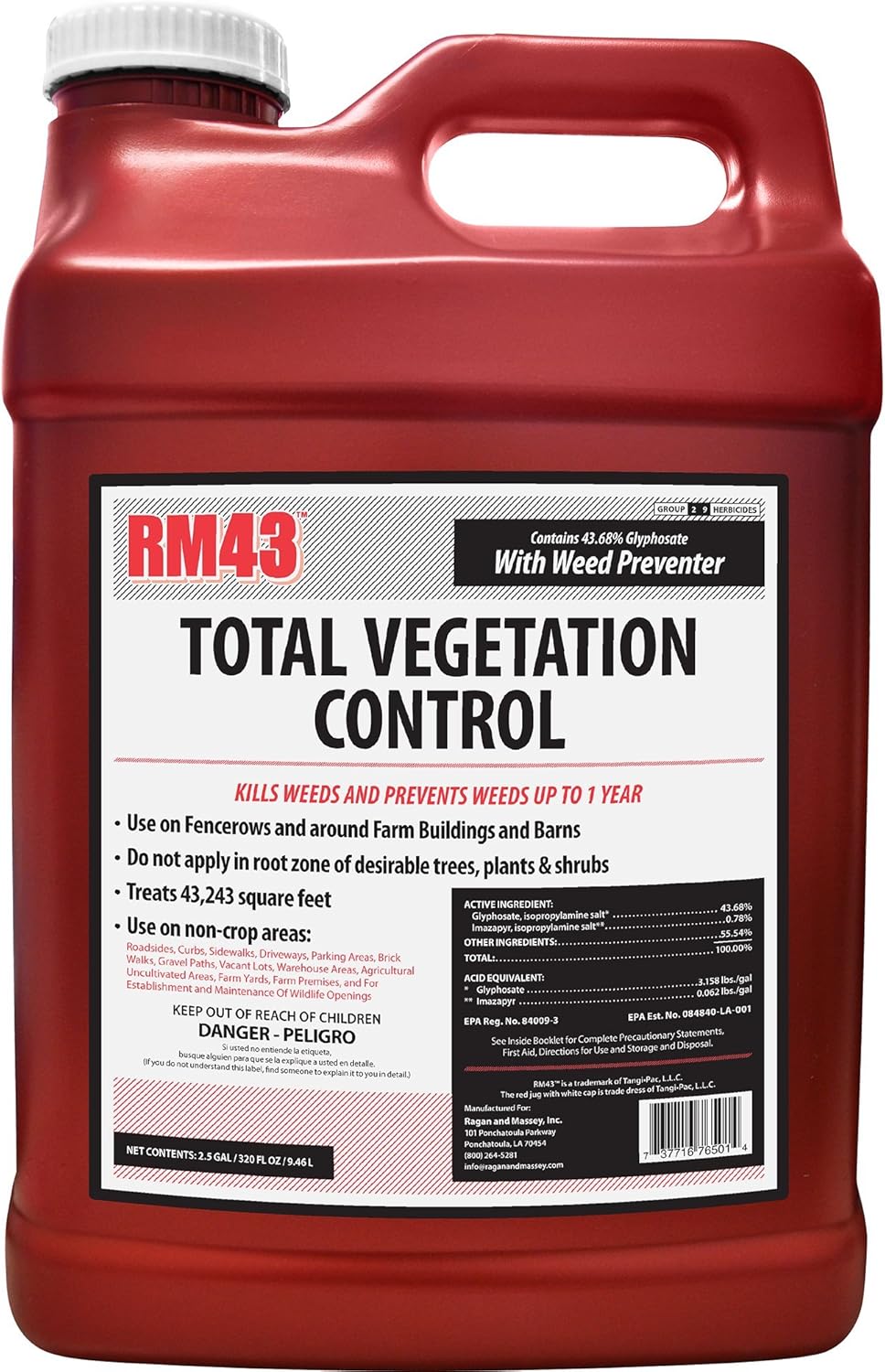
| Unit Count | 320 Fluid Ounces |
|---|---|
| Liquid Volume | 320 fluid ounces |
| Coverage | 43,243 square feet |
| Active Ingredients | Glyphosate isopropylamine salt, Imazapyr isopropylamine salt |
| Item Form | Liquid |
RM43 Total Vegetation Control is a high-concentration herbicide blend of glyphosate and imazapyr formulated for one-and-done vegetation control on non-crop sites. It is typically mixed into spray solution and applied to fence rows, driveways, gravel paths, building perimeters, and other areas where you want no regrowth for up to a year. Notable features include a concentrated 43 percent glyphosate blend, a second active ingredient (imazapyr) to extend control, and a fast rainfast time of about two hours so treated areas are less likely to be washed out. In practice the product kills grasses, broadleaf weeds, vines, brush, and small trees when applied as directed, and a single 2.5-gallon bottle covers a large area suitable for farm or large-property maintenance. Important limitations are that it is for non-crop use only and will damage desirable plants if sprayed over roots or foliage, and because it contains persistent chemistry it is not appropriate near turf or garden beds where reseeding or planting is planned soon after treatment.
Best for: Buyers who need a powerful, long-lasting solution for clearing and keeping large non-crop areas vegetation-free, such as farmsteads, driveways, fence lines, and gravel lots.
Less Ideal for: Home gardeners who want to preserve turf, plant beds, or who plan to reseed or replant soon after treatment should choose a more selective or short-residual option.
- High-concentration formula combines glyphosate and imazapyr for broad, long-lasting control
- Covers a large area from one container, suitable for fence lines, driveways, and farm perimeters
- Rainfast within about two hours, reducing the chance of wash-off after application
- Effective on a wide range of targets including grasses, weeds, vines, brush, and small trees
- Not selective and will kill desirable plants if applied near root zones or foliage
- Contains persistent active ingredients that restrict use near areas intended for replanting
Verdict: Choose RM43 when you need a concentrated, long-lasting herbicide to reliably clear and prevent regrowth on large non-crop areas.
Compare-N-Save 75324 Concentrated Glyphosate Herbicide, 1‑Gallon

| Active Ingredients | glyphosate |
|---|---|
| Liquid Volume | 1 gallons |
| Item Form | Spray |
| Coverage | 25000 square_feet |
This 1-gallon Compare-N-Save concentrate contains glyphosate and is intended for killing unwanted weeds and grasses by spraying foliage so the active ingredient moves to the roots. It mixes easily with water and yields a high volume of ready-to-use spray, making it practical for treating driveways, walkways, fence lines, garden prep, brush control, and lawn renovation. The label gives clear application rates for light and tough growth and advises timing applications on warm, calm days; treated weeds show visible decline in 2 to 4 days and areas are rainproof in about two hours. Because glyphosate is non-residual, you can replant many ornamentals quickly after treatment, but the product will kill any green plant it contacts so careful spraying and protective equipment are necessary. This concentrated format is efficient for homeowners who want coverage without carrying dozens of ready-to-use bottles, but it requires measuring and safe handling practices.
Best for: Homeowners and property stewards who prioritize efficient, cost-effective broad weed control across driveways, beds, and large patches and are comfortable measuring and handling a concentrated herbicide with proper safety precautions.
Less Ideal for: People who need a selective product for lawns or who prefer ready-to-use bottles to avoid mixing and concentrated chemical handling should consider other options.
- Concentrated formula makes up to 85 gallons of ready-to-use spray for broad coverage
- Glyphosate active ingredient translocates to roots for effective kill of annual and perennial weeds
- Fast visible results in 2 to 4 days and rainproof within about two hours
- Clear mixing rates for general and tougher weed control allow dose adjustment
- Non-selective herbicide will kill any green plant it contacts, requiring careful application
- Contains 41% glyphosate which requires protective gear and careful storage and disposal
Verdict: Choose this concentrated glyphosate herbicide when you want high-coverage, economical weed and grass control and are prepared to mix and handle a non-selective chemical safely.
Compare-N-Save Glyphosate Concentrate Grass & Weed Killer, 16 oz

| Unit Count | 16 Fluid Ounces |
|---|---|
| Coverage | 3000 square feet |
| Active Ingredients | Glyphosate |
| Makes | Up to 10 gallons of spray |
This 16-ounce Compare-N-Save concentrate contains glyphosate and is formulated to be diluted into a ready-to-use spray for killing annual and perennial weeds and grasses. Typical use is mixing a few tablespoons per gallon of water and applying with a standard garden sprayer to foliage on a dry, warm day; the product becomes rainproof in about two hours and can show visible dieback in two to four days. The bottle treats up to 3,000 square feet and is useful for clearing driveways, walkways, fence lines, flower-bed edges, garden plot preparation, and lawn renovation where you want total vegetation control. Because it is a concentrate, it stretches farther than ready-to-use bottles and reduces the number of containers you need to buy for seasonal cleanup. Important limitations are that glyphosate will kill any green plant it contacts so careful spot application and protective gear are required, and it has no residual preemergent activity so repeat treatments or follow-up seeding may be needed for long-term control.
Best for: Buyers looking to control large patches of unwanted weeds and grasses on a tight budget who are comfortable mixing and applying concentrated herbicides safely for occasional or seasonal cleanup.
Less Ideal for: Home gardeners who need a selective lawn-safe product, people who want long-lasting preemergent control, or those unwilling to handle concentrated chemicals and follow safety precautions.
- Concentrated formula yields up to 10 gallons of ready-to-use spray for extended coverage
- Contains glyphosate which is absorbed through foliage to kill to the root
- Rainproof in about two hours so application window is manageable
- Covers up to 3,000 square feet per bottle for broad-area treatment
- Nonselective herbicide that will damage or kill any green plant it contacts
- No residual activity so it will not prevent future weed germination
Verdict: A cost-effective glyphosate concentrate for budget-minded gardeners who need broad, no-nonsense weed and grass removal across large areas.
Honcho K6 Glyphosate Herbicide Concentrate, 2.5 Gallon

| Unit Count | 320 Fluid Ounces |
|---|---|
| Liquid Volume | 2.5 gallons |
| Item Form | Liquid |
| Active Ingredients | Glyphosate (potassium salt) 48.7% |
Honcho K6 is a high-load potassium glyphosate concentrate intended for post-emergence, systemic control of a wide range of weeds and woody plants. It is applied by mixing with water or other carriers and spraying onto foliage, where built-in surfactant helps uptake and translocation to roots for complete plant kill with no soil residual activity. The 2.5 gallon jug supplies enough product for multiple applications across fence lines, shrub beds, turf renovation, and farmstead sites and is compatible with Roundup Ready cropping systems when used per label. Practical benefits include consistent performance on annuals and perennials, flexibility to use with industrial or field sprayers, and reduced need for repeat spot treatments because it moves through the plant. Important limitations are that it is a nonselective herbicide that will damage desirable plants if oversprayed and it carries regulatory restrictions in certain states, so users must follow label directions and wear protective equipment when handling and applying.
Best for: Buyers who prioritize a dependable, professional-strength herbicide for broad-spectrum weed and brush control across property and farm areas and who follow label safety and application protocols.
Less Ideal for: Casual gardeners who need selective spot treatment around desirable plants or users unwilling to follow protective equipment and legal restrictions.
- High-concentration glyphosate formula for reliable systemic control of many annual and perennial weeds
- Built-in surfactant improves leaf coverage and uptake for consistent results
- Large 2.5 gallon jug supports multiple applications for yard or farm use
- Suitable for use with industrial and field sprayers for broader application options
- Nonselective and will kill desirable vegetation if contacted
- Not allowed for use in certain states and requires strict adherence to label safety directions
Verdict: If you need a reliable, concentrated systemic glyphosate for large-scale or repeated weed and brush control, this 2.5 gallon Honcho K6 jug delivers professional-grade performance.
Roundup Weed & Grass Killer with Comfort Wand, 1.33 gal.

| Item Form | Liquid |
|---|---|
| Coverage | 400 sq. ft. |
| Liquid Volume | 1.33 gallons |
This 1.33 gallon Roundup Weed & Grass Killer is a liquid glyphosate herbicide supplied with a Comfort Wand for one-touch continuous spray, making spot treatments straightforward. It is formulated to kill common broadleaf weeds and grasses down to the root, including dandelion, crabgrass, poison ivy, clover, and spurge. In practice you spray actively growing weeds on calm days, the formula begins showing visible effect in hours and becomes rainproof in about 30 minutes, and treated areas can be replanted within the product's stated window. The wand simplifies coverage around beds, driveways, fences, and hardscape edges without mixing in a separate sprayer. Important limitations to note are the usual safety precautions for glyphosate products: avoid drift to desirable plants, keep people and pets away until spray is dry, and follow replanting intervals on the label. Also this is a non-selective herbicide so precision is required to protect ornamentals and turf you want to keep.
Best for: Buyers who want a convenient, ready-to-use glyphosate solution for spot removal and perimeter weed control and who prioritize straightforward application and dependable, fast results.
Less Ideal for: People who need a selective lawn-safe product or those unwilling to follow herbicide safety and drift-avoidance practices should consider alternative, more targeted options.
- Integrated Comfort Wand for one-touch continuous spraying reduces hand fatigue and improves control during spot applications.
- Fast-acting formula with visible results in hours and rainproof protection in about 30 minutes.
- Effective on a wide range of common broadleaf weeds and grasses to the root.
- Covers up to 400 sq. ft. from a single 1.33 gallon container for typical spot and perimeter work.
- Non-selective glyphosate formula can damage desirable plants if spray drifts or contacts foliage.
- Requires careful timing and application to meet replanting windows and local safety guidance.
Verdict: Choose this ready-to-use glyphosate kit when you want a fast, reliable spot-and-edge weed killer with an integrated wand for easy, controlled application.
Choosing the Right Glyphosate Weed Killer: Key Factors to Consider
Active Ingredient Concentration
Concentration directly affects how much boost a product gives per application. Higher concentrations often speed visible dieback, reducing the need for retreatment on established perennial weeds. In a home garden, higher concentration also increases the risk to desirable plants if spray drifts or splashes, so you must weigh control power against safety in mixed beds.
For small jobs, diluted formulations let you control the dose more precisely. Always follow label dilution rates because under-dosing can encourage regrowth while over-dosing raises the chance of off-target damage and conflicts with replanting timelines.
Kill Speed and Visible Control
How quickly a weed shows injury after treatment changes when you can tidy up, till, or replant. Fast-acting mixes produce visible browning in days but may not fully translocate to roots on large perennials. Slower-acting systemic formulations can take longer to show symptoms but are often more effective at killing deep-rooted or perennial species.
Plan treatments around weather and garden tasks. If you need to replant shortly after removal, choose products and timing that minimize lingering effects. Expect variability by species, season, and plant vigor.
Residual Activity and Replanting Interval
Glyphosate itself binds to plant tissues and is not typically persistent in soil like some other herbicides, but treated residues and root material can influence how soon you can safely replant certain crops. Labels often state replanting windows or recommend removing dead material before establishing new plants.
Understanding the expected residual behavior helps you avoid planting sensitive seedlings too soon and reduces the risk of poor establishment. In heavy mulches or dense root mats, physical removal after chemical desiccation can speed the timeline for replanting.
Sprayer Compatibility and Application Ease
Practical adoption depends on whether a product is ready-to-use or requires dilution and whether it works well with handheld sprayers, pump-up sprayers, or backpack units common in small gardens. Ease of measurement, mixing instructions, and nozzle compatibility affect accuracy and reduce accidental over-application.
A formulation that sprays cleanly and wets foliage without excessive drift will give more predictable results and lower the chance of off-target damage to ornamentals or vegetables.
Non-target Safety and Label Instructions
Labels provide critical directions on buffer distances, drift management, protective equipment, and restrictions near water or desirable plants. For gardeners working in mixed beds, these rules determine what you can safely treat and how to protect nearby crops or pollinator-friendly plantings.
Prioritize products with clear, practical label guidance and realistic application windows. Good labels also outline steps for accidental exposure and cleanup, which matters when working around pets or children.
Target Weed Spectrum
Different formulations perform differently on annual grasses, broadleaf weeds, and stubborn perennials. Knowing the typical weeds in your yard helps you pick a product suited to those species. Some mixes include additives that improve uptake on waxy leaves or on grassy weeds, while others rely on the basic systemic action of the active ingredient.
Survey your space before buying so you match product strengths to common targets. That reduces repeated applications and helps you build a seasonal control plan.
When to Use Glyphosate in a Home Garden
Use glyphosate-based weed control when you need broad-spectrum, systemic suppression of weeds before tilling, replanting, or installing new beds. It is most effective on actively growing plants and is commonly used to clear unwanted vegetation from paths, building perimeters, and prepping ground for new plantings.
Avoid using it around desirable plants that reproduce by suckers or layered stems unless you can protect them from spray. Plan applications on calm days to reduce drift and follow label directions for buffer zones near water and pollinator plantings.
- Target actively growing weeds for best uptake
- Apply in calm weather to limit drift
- Allow sufficient time before replanting per label guidance
Application Techniques for Better Control
Spray coverage matters more than volume. Thoroughly wet leaf surfaces without running off so the active ingredient can be absorbed. For dense or tall weeds, treat in phases: knock back heavy growth with careful trimming before spraying to improve contact.
Spot-treating reduces non-target exposure and saves product. Use shielded spray nozzles or a handheld applicator for precise placement in beds with nearby ornamentals.
- Use fine to medium spray patterns for foliage wetting
- Consider a follow-up spot treatment on surviving regrowth
- Rinse sprayers and follow disposal rules in the label
Timing Treatments Around Planting and Landscaping
Coordinate herbicide use with your planting calendar. For bed renovations, treat existing vegetation, wait the recommended interval for residue decline if specified, remove dead material, then prepare soil and plant. For hardscapes or gravel areas, apply when weeds are actively growing for fastest results.
If you need to plant shortly after treatment, choose products and application methods that minimize soil interference and follow label replanting guidance closely. In many home garden contexts, mechanical removal after chemical desiccation speeds the timeline for replanting.
- Treat several weeks before major planting when possible
- Remove heavy dead growth to speed soil preparation
- Check label for crop-specific replant intervals
Protecting Desirable Plants and Pollinators
Physical barriers, careful nozzle choice, and application timing reduce accidental damage to ornamentals and pollinator-friendly plantings. Avoid spraying when pollinators are actively foraging and do not apply directly to flowering plants you want to keep.
When treating near vegetables or shrubs, use a shield or targeted wand and consider hand-pulling small patches to preserve surrounding plants.
- Work early or late in the day away from peak pollinator activity
- Use shields to block drift near desirable plants
- Trim and remove treated material to prevent accidental contact
Combining Chemical and Cultural Control
Glyphosate is a tool, not a standalone solution. Integrate it with mulching, improved soil health, and manual removal to reduce long-term weed pressure. After clearing an area, installing a weed-suppressing mulch or landscape fabric can reduce re-invasion without repeated chemical use.
Rotate control strategies across seasons to manage persistent perennials and to avoid relying exclusively on chemical control. Cultural steps like improving drainage and reducing bare soil reduce the conditions that favor weeds.
- Use targeted herbicide only where cultural control is impractical
- Follow-up with mulches or groundcover to prevent re-establishment
- Monitor treated areas for regrowth and spot-treat as needed
How We Chose the Best Glyphosate Weed Killer
We shortlisted products that fit common home and small-plot gardening needs and then filtered options by concrete, gardener-relevant criteria. First, we focused on active ingredient concentration and formulation type because these determine how fast weeds wilt and whether contact or systemic activity dominates. We considered kill speed and visible control time to help gardeners plan spot treatments, maintenance windows, and replanting schedules. Second, we evaluated persistence and translocation characteristics to estimate how long treated vegetation and nearby soil might influence follow-up plantings. Third, ease of application and compatibility with common spray equipment mattered, including whether ready-to-use or dilution is typical and whether mixing instructions are straightforward for small plots. Fourth, label instructions for buffer zones, non-target plant protection, and replanting intervals were weighted to reflect safety in mixed gardens. We excluded concentrated industrial formulations intended for large-acreage or commercial applicators and any product with label restrictions that make typical garden use impractical. Our focus was on options that provide predictable control, clear application guidance, and realistic replanting windows for home gardeners.
FAQ
How long after applying glyphosate can I replant vegetables?
Replanting intervals vary by formulation and label instructions. Many glyphosate-based products do not persist in soil long, but label guidance on specific crop replanting windows should be followed. If the label is unclear, wait several weeks and remove dead material before planting to reduce the risk of poor establishment.
Will glyphosate kill perennial weeds with deep roots?
Glyphosate is systemic and can move to roots, so it can control many perennials if spray is applied when plants are actively transporting sugars. Very large or stressed perennials may need repeated treatments or a combined approach with mechanical removal for full control.
Can I use glyphosate around newly planted shrubs or trees?
You can use it if you protect the foliage and root zones from spray and follow label buffer instructions. Avoid spraying when wind or drift could carry spray onto desirable plants. Using spot applications and shields reduces accidental exposure.
Is rain shortly after application a problem?
Rain within a few hours can reduce foliar uptake and lower effectiveness. Most labels specify rainfastness windows. Apply when a dry period is expected to allow adequate absorption.
Are there restrictions for use near water or pollinator plantings?
Yes. Labels include guidance on buffer zones and restrictions near water, and they recommend avoiding applications to blooming plants that attract pollinators. Always read and follow label directions to protect waterways and beneficial insects.
How often should I expect to re-treat a persistent patch of weeds?
Persistent patches often require multiple spot treatments spaced several weeks apart, timed when regrowth is actively growing. Combining chemical treatment with physical removal or smothering reduces the number of repeat applications needed.
Final Verdict
Choose a glyphosate weed killer that matches the weeds you face and the timeline for planting or landscaping work. Prioritize formulations that offer clear label guidance on replanting and non-target protection if you work in mixed beds or near pollinator plantings. Accept tradeoffs: faster visible control may be useful for quick prep, while products emphasizing translocation reduce regrowth on deep-rooted perennials. With careful application technique and integration of cultural practices, you can reliably clear areas while minimizing harm to desirable plants and reducing the need for repeat treatments.
