

Note: This article contains affiliate links. If you click on these links and make a purchase, I may earn a small commission at no extra cost to you. This helps support my research and content. Read my full affiliate disclosure here.
If you want a mower that maps and navigates your yard with minimal supervision, a GPS lawn mower can transform routine maintenance into a mostly automated task. The right GPS-equipped mower matters because navigation accuracy and reliable power determine how well it handles complex boundaries, narrow passes, and scheduled runs in varied weather. This guide covers seven shortlisted GPS lawn mowers that perform well for typical residential lawns. We evaluated options on navigation precision, battery life, cut quality, durability, and safety features to help you pick the best fit for your yard and routine.
Top Picks at a Glance
| Best Overall The best all-around choice for most situations | HOOKII Neomow X2 3D LiDAR Robot Lawn Mower (Wire‑Free, 1 Acre, 13Ah) |  |
| Best Quality Built to a higher standard if you want something more solid | YARBO Y40 Core Robot Lawn Mower Pro (20" Cutting Width, NetRTK + Vision) |  |
| Best Value The sweet spot between price and what you get | ECOVACS GOAT O1000 RTK Care Robot Lawn Mower (Wire-Free, RTK Navigation) |  |
| Best Budget The cheapest option that still gets the job done reliably | RoboUP Raccoon 2 SE Robot Lawn Mower (Wire-Free, for up to 0.15 Acre) |  |
| Highest Rated A top-rated pick with lots of positive feedback | HOOKII Neomow X2 Pro Robotic Lawn Mower with 3D LiDAR and Triple Vision, 17.5Ah Battery |  |
| Most Popular A crowd favorite that many people choose with confidence | Segway Navimow i110N Robot Lawn Mower (Wire-free, RTK+Vision) |  |
| Best Seller A high-volume bestseller chosen again and again | WORX Landroid Vision Cloud 4WD Robot Lawn Mower (WR344) |  |
HOOKII Neomow X2 3D LiDAR Robot Lawn Mower (Wire‑Free, 1 Acre, 13Ah)

| Max. Mowing Area | 1 Acre |
|---|---|
| Positioning & Navigation | 3D LiDAR & AI Single Vision |
| Battery Capacity / Voltage | 13 Ah / 18 V |
| Waterproof Level | IPX6 |
| Cutting Height | 1.18 ~ 3.35 in |
The HOOKII Neomow X2 is a wire‑free robotic mower built around 360° 3D LiDAR SLAM and AI vision to map yards and mow with minimal setup. Typical use is hands‑off: place the charging base, configure maps and schedules in the app, and the mower navigates multiple zones, returns to charge, and resumes where it left off. Notable features include inch‑level positioning without an RTK antenna, a 13Ah battery that extends runtime to roughly 120–150 minutes, IPX6 water resistance for wet conditions, and app control via Wi‑Fi, Bluetooth or built‑in 4G. Practical benefits are precise obstacle avoidance, reliable night and low‑light operation, multi‑zone map management, and automated anti‑theft alerts with GPS tracking. Important limitations are the premium price bracket and relatively narrow 11‑inch cutting width, which means longer mowing times on very large lawns; complex installation of the optional triple‑vision module is required for some advanced functions. The mower favors users who want advanced autonomous navigation and detailed map control rather than the simplest, lowest‑cost robotic solution.
Best for: A buyer who wants a capable, mostly hands‑off robotic mower with high‑precision navigation and detailed map and zone control for a varied yard layout. Ideal for owners who prioritize autonomous performance and safety features over lowest cost.
Less Ideal for: Not a great fit for buyers with simple, small lawns who prefer a low‑cost, no‑frills mower or for those who need very wide cutting decks to minimize run time.
- 360° 3D LiDAR SLAM plus AI vision enables precise, wire‑free mapping and reliable navigation day or night
- 13Ah battery with extended runtime and automatic return-to-charge and resume behavior
- IPX6 waterproofing allows rinsing the unit and use in wet conditions
- App control with Wi‑Fi, Bluetooth and 4G plus cloud map backup and multi‑zone scheduling
- Built‑in anti‑theft features with GPS tracking and audible alarm
- 11‑inch cutting width can increase runtime on larger properties
- Advanced features like the triple‑vision module are sold separately and require installation
- Higher complexity and feature set place it in a premium category compared with basic robot mowers
Verdict: Buy this if you want a wire‑free, high‑precision robotic mower that reliably maps and manages complex lawns with advanced navigation and remote control.
YARBO Y40 Core Robot Lawn Mower Pro (20" Cutting Width, NetRTK + Vision)

| Cutting width | 20 inches |
|---|---|
| Maximum Adjustable Cutting Height | 4 inches |
| Battery Average Life | 120 minutes |
| Max. Climbing Ability | 70% (35°) |
The YARBO Y40 Core Robot Lawn Mower Pro is built for large, performance-driven properties where long runtime and precise navigation matter. It uses NetRTK/RTK plus binocular vision and multiple sensors to map lawns and avoid obstacles while handling steep slopes up to 70 percent. Twin 300W motors, selectable straight or razor blades, and a 20-inch cutting width let it cut dense, wet, or overgrown grass and eject clippings efficiently to reduce clogging and stops. Battery runtime is listed at about 120 minutes, and the mower supports adjustable heights from 0.8 to 4.0 inches to suit different turf types. Practical benefits for acreage owners include modular options for future attachments, strong traction on uneven or muddy terrain, and largely hands-off operation once set up. Important limitations are the mower's very large physical size and weight that demand two people for assembly and a clear sky view for its RTK data setup, and the complexity of initial installation and mapping compared with simple boundary cable systems.
Best for: Buyers who manage multiple acres or premium properties and prioritize robust cutting power, high-precision navigation, and hands-off, year-round lawn care.
Less Ideal for: Small-lot owners or those who want a simple plug-and-play robot mower without a technical installation process should consider lighter, simpler models instead.
- NetRTK + RTK + binocular vision and multi-sensor navigation for highly accurate mapping and obstacle avoidance
- Dual 300W motors with 20" cutting width suitable for thick, wet, or overgrown grass
- Supports steep slopes up to 70% for use on hilly or uneven acreage
- Adjustable cutting height from 0.8" to 4.0" and two blade types for different turf conditions
- Large, heavy unit that requires two people to assemble and may be difficult to move
- Initial setup requires good sky visibility and more technical configuration than basic robotic mowers
Verdict: If you need a high-performance, RTK-guided robotic mower that can handle steep, rough acreage and heavy grass with minimal supervision, the YARBO Y40 Core Pro is a top choice.
ECOVACS GOAT O1000 RTK Care Robot Lawn Mower (Wire-Free, RTK Navigation)

| Power Source | Battery Powered |
|---|---|
| Operation Mode | Automatic |
| Battery Average Life | 90 minutes |
| Maximum Adjustable Cutting Height | 3.2 inches |
| Minimum Adjustable Cutting Height | 1.2 inches |
The ECOVACS GOAT O1000 RTK Care is a wire-free robot mower designed to replace routine mowing on small suburban lawns. It uses RTK satellite positioning to follow efficient, systematic paths rather than random wandering, which yields cleaner lines and consistent coverage without perimeter wires. Setup centers on placing the RTK antenna and using the included extension cable for stronger signal in yards with trees or structures, then mapping zones in the app to schedule automatic mowing and recharging. Practical benefits include quiet operation at about 62 dB, adjustable cutting height between 1.2 and 3.2 inches, and a CARE bundle that supplies 36 extra replacement blades to reduce maintenance trips. Battery runtime is listed at about 90 minutes, which is suitable for many quarter-acre properties but may require recharges on larger or dense lawns. The mower is plastic-bodied and relatively heavy, so occasional manual handling for transport or cleaning is needed. It is best for homeowners who value set-and-forget convenience and precise navigation in a small to medium yard.
Best for: Homeowners who want reliable, low-effort lawn maintenance for a small to medium yard and who prefer precise navigation and app control over fiddly perimeter wiring.
Less Ideal for: People with large lawns well above a quarter acre, very steep or highly irregular terrain, or those who need an ultra-light unit for frequent manual carrying.
- RTK navigation provides centimeter-level positioning for systematic, accurate mowing without boundary wires
- Wire-free operation simplifies installation compared with perimeter-cable systems
- Includes 36 extra blades to extend maintenance intervals and keep cutting performance consistent
- App-based auto mapping and multi-zone scheduling make hands-off lawn management straightforward
- Relatively quiet at around 62 dB for minimal neighborhood disturbance
- Battery runtime of about 90 minutes may require returns to dock on larger or dense yards
- Plastic construction and 44.5 lb weight mean occasional effort is required to move or service the unit
Verdict: Choose this mower if you want a wire-free, RTK-guided robot that delivers precise, low-maintenance mowing and includes extra blades for long-term upkeep.
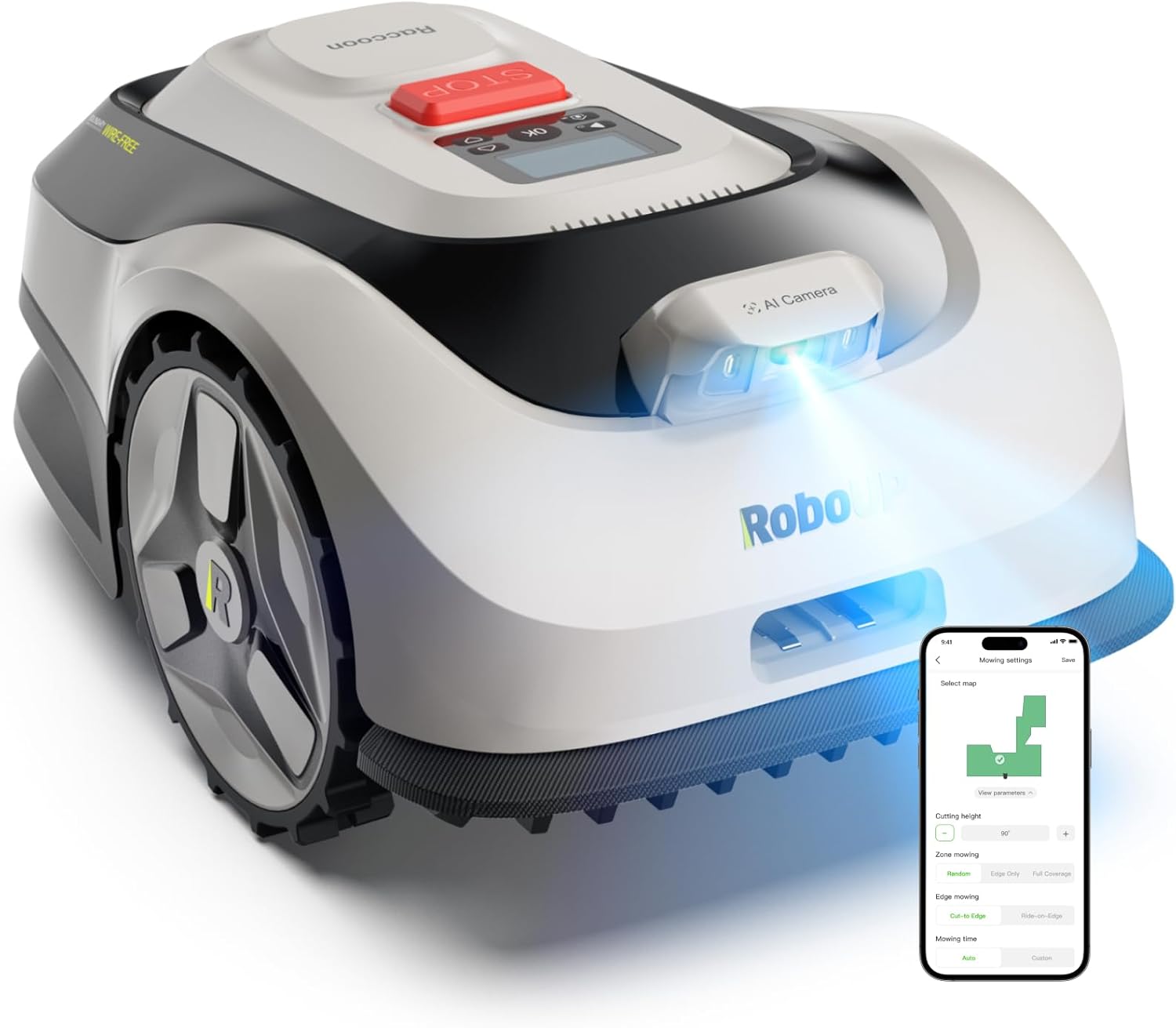
RoboUP Raccoon 2 SE Robot Lawn Mower (Wire-Free, for up to 0.15 Acre)
| Power Source | Battery Powered |
|---|---|
| Operation Mode | Automatic |
| Maximum Adjustable Cutting Height | 3.15 inches |
| Minimum Adjustable Cutting Height | 1.18 inches |
| Number of Positions | 5 |
The Raccoon 2 SE is a wire‑free robot mower built for small yards and straightforward layouts. It auto‑maps your lawn and can start with a single button press or be managed via app, offering scheduled mowing, multi‑zone support and electric height adjustment for a cleaner, more consistent cut. The mower uses AI vision and bumper sensors to avoid people, pets and common obstacles, handles slopes up to 36 percent, and will climb modest obstacles and navigate narrow passages. A 5Ah battery delivers long runtime and fast 70‑minute recharge cycles while the unit automatically returns to its dock when the battery is low or rain is detected. Practical benefits include quiet operation, OTA updates, and safety features such as lift and tilt detection and IPX6 water protection. Limitations to consider are the small coverage area limited to about 0.15 acre, the relatively narrow 7.9‑inch cutting width which increases run time on larger lawns, and the expectation that clearly defined boundaries or optional stakes are needed for optimal guidance on open edges.
Best for: Buyers who want a budget‑minded, low‑effort upgrade from push mowers for a small, well‑defined yard and value simple setup, quiet operation and app scheduling.
Less Ideal for: Owners of larger, irregular or heavily landscaped properties who need wider cutting decks, higher coverage area, or advanced RTK navigation for complex boundaries.
- Wire‑free auto mapping and one‑touch start for quick setup on simple lawns
- AI vision plus bumper sensors for obstacle avoidance and safe operation
- Long runtime from a 5Ah battery with 70‑minute fast recharge
- Handles steep slopes up to 36 percent and can climb small obstacles
- App control, scheduling and OTA updates for ongoing improvements
- Designed for small lawns only with a maximum recommended area of about 0.15 acre
- Narrow 7.9‑inch cutting width increases time needed on larger or complex yards
- May require optional boundary stakes for reliable edge control in open areas
Verdict: A practical, feature‑focused robotic mower for small yards that minimizes setup and hands‑on mowing while delivering quiet, app‑controlled performance.
HOOKII Neomow X2 Pro Robotic Lawn Mower with 3D LiDAR and Triple Vision, 17.5Ah Battery

| Max. Mowing Area | 1.5 Acre |
|---|---|
| Battery Capacity / Voltage | 17.5 Ah / 18 V |
| Mowing Area Per Charge | 0.25 Acre / 1000 ㎡ |
| Waterproof Level | IPX6 |
| Cutting Height | 1.18 ~ 3.35 in |
The Neomow X2 Pro is designed as a hands-off robotic mower for large yards where dependable, autonomous operation matters. It combines a 360° LiDAR scanner with a triple AI vision system to create detailed maps, recognize obstacles, and plan efficient mowing routes without a perimeter wire. Typical use is: place the charging base, start auto-mapping in the app, set no-go zones or schedules, and let the mower run repeatedly—its 17.5Ah battery delivers roughly 180–200 minutes and about 0.25 acre per charge. Notable features include multi-zone management (up to 120 zones), dual-map cloud backup, multiple connectivity options (Wi-Fi, Bluetooth, 4G), GPS tracking and anti-theft alarms, and an IPX6 rating for outdoor durability. In practice this means minimal setup, reliable navigation day or night, and fewer interruptions from small obstacles or low light. Important limitations are the premium price bracket and the need to plan charging placement and app setup for full coverage; very complex steep slopes or extremely cluttered yards may still require occasional intervention.
Best for: Buyers who prioritize reliable, autonomous lawn care for larger properties and want a mower that maps and navigates accurately with minimal manual boundary setup.
Less Ideal for: People with very small yards who prefer a budget solution or users who need a simple, low-tech push mower for occasional use.
- 360° 3D LiDAR plus triple AI vision enables robust mapping and obstacle recognition without perimeter wire
- Large-capacity 17.5Ah battery yields about 180–200 minutes runtime and roughly 0.25 acre per charge
- Supports up to 120 custom zones, dual-map backup, and multi-zone scheduling for complex yards
- IPX6 waterproof rating and GPS anti-theft with alarm and remote tracking increase outdoor reliability
- High-end feature set and capabilities are paired with a premium cost
- Performance in extremely cluttered, very steep, or highly irregular terrain may still need occasional human intervention
Verdict: If you need a dependable, perimeter-wire-free robot mower for larger lawns, the Neomow X2 Pro delivers advanced LiDAR navigation and long runtime for hands-off, accurate mowing.
Segway Navimow i110N Robot Lawn Mower (Wire-free, RTK+Vision)

| Power Source | Battery Powered |
|---|---|
| Battery Average Life | 60 minutes |
| Maximum Adjustable Cutting Height | 2 inches |
| Cutting width | 25 centimeters |
The Navimow i110N is a perimeter-wire-free robotic mower designed for homeowners who want automated, hands-off lawn care on small to mid-size yards. Setup relies on AI-assisted mapping through the app so you can define virtual boundaries instead of running a boundary wire. The unit uses EFLS 2.0 (RTK enhanced with Visual SLAM) and a front-facing camera to build a centimetre-accurate map, plan efficient mowing routes, and avoid more than 150 object types. In practice it delivers quiet, scheduled mowing with adaptive edge modes for a cleaner perimeter and automatic recharging when the battery runs low. A 60-minute average battery life and three selectable cutting positions cover typical weekly maintenance, while IP66 protection helps in wet conditions. Important limits to note are the 0.25 acre capacity and the modest maximum cutting height, so very large properties or extremely tall grasses will need different equipment. Also some advanced features such as 4G anti-theft require optional accessories.
Best for: Homeowners who want a low-intervention, wire-free robotic mower for a small to mid-size lawn and who prioritize reliable obstacle avoidance and mapping over raw runtime.
Less Ideal for: Owners of large properties, commercial turf managers, or gardeners who need to cut very tall or heavy grass should consider higher-capacity mowers or traditional equipment.
- Wire-free AI-assisted mapping makes setup fast and avoids trenching for boundary wire
- RTK plus vision (EFLS 2.0) provides centimetre-level positioning for reliable navigation
- VisionFence camera identifies and avoids over 150 common obstacle types
- Quiet operation around 58 dB(A) and automatic recharge/scheduled mowing reduce yard disturbance
- Battery life around 60 minutes limits continuous mowing time and suits smaller lawns
- Designed for up to 0.25 acre so not appropriate for larger properties
Verdict: If you want a quiet, wire-free robotic mower with advanced RTK+vision mapping and strong obstacle avoidance for a quarter-acre or smaller yard, the Navimow i110N is a top choice.
WORX Landroid Vision Cloud 4WD Robot Lawn Mower (WR344)

| Max. Coverage Area | 1 Acre |
|---|---|
| Drive System | All-Wheel Drive |
| Cutting width | 8.7 Inches |
| Battery Runtime | 50 min |
| Operation Mode | Automatic |
The WORX Landroid Vision Cloud 4WD WR344 is a high-end robotic mower built to manage complex yards up to about one acre. It uses RTK cloud positioning plus Vision AI and V‑SLAM sensor fusion to create automatic maps, avoid and classify obstacles, and mow precise patterns with cut-to-zero edge trimming. Typical use is hands-off: set zones and schedules in the app, let the mower handle slopes and uneven terrain, and check status or change modes remotely. Notable features include four-wheel drive for traction on steep grades, multiple cutting heights, centimeter-level navigation accuracy without installing local antennas, and a night-mowing light. Practical benefits are reduced manual trimming, reliable boundary tracking in shade, and secure GPS tracking if the unit is moved. Important limitations are the product complexity and the likely need for occasional software updates and support to tune maps and zones, plus the initial setup learning curve for optimal app configuration. The mower is optimized for owners who want precision, edge performance, and minimal day-to-day lawn work but expect to spend some time on initial configuration and maintenance.
Best for: Buyers who prioritize reliable, precision GPS navigation and want a mostly hands-off solution for a complex or sloped yard up to about an acre, with app control and strong security features.
Less Ideal for: People with very small yards, those who prefer a simple push mower with no connectivity, or buyers who do not want to manage software updates or app setup.
- RTK cloud navigation gives centimeter-level positioning without a local antenna
- Vision AI with obstacle avoidance and V‑SLAM improves navigation in shade and around objects
- 4WD chassis and front steering provide stable traction on steep or uneven terrain
- Auto mapping and app control let you create zones, schedules, and mowing patterns remotely
- High system complexity may require firmware updates and occasional troubleshooting
- Large, feature-rich unit likely needs an initial learning curve to optimize maps and settings
Verdict: Choose this mower if you want centimeter‑level GPS accuracy, Vision AI obstacle avoidance, and 4WD traction to automate mowing on a complex or steep lawn.
Choosing the Right Gps Lawn Mower: Key Factors to Consider
Navigation Accuracy and Mapping
GPS precision affects how consistently a mower covers the entire lawn and avoids missed strips. A unit with strong satellite reception, good antenna placement, and reliable map locking will follow scheduled paths closely and reduce repeated passes that waste battery.
Mapping features also matter because boundary setup and virtual fencing determine whether the mower respects no-go zones, flower beds, and walkways. Consider whether the system supports on-device mapping, an app with visual editing, or cloud-based updates depending on how much control you want to exert.
Battery Size and Real-World Runtime
Battery capacity and how efficiently a mower uses power dictate how much area it can cut per charge and how often you must interrupt mowing for recharging. Look for realistic runtime estimates rather than optimistic lab numbers, and understand whether the mower scales runtime based on cut height, grass density, and terrain.
Also factor in charging speed and whether the mower supports partial-charge scheduling. For larger yards, greater battery capacity or quick charging reduces the need for frequent manual intervention or multiple run cycles.
Cutting System and Grass Handling
Blade type, deck width, and how the deck channels clippings determine cut quality and the mower's ability to handle varied grass lengths. Wider decks cover more ground but may struggle in tight areas; smaller decks maneuver better but increase run time.
Look for adjustable cutting heights and blade designs that resist clogging. Consider how the mower handles thatch and slightly damp grass, since wet conditions increase load and drain battery faster.
Durability and Weather Resistance
Mowers live outdoors and endure moisture, temperature swings, and UV exposure. Materials and protective coatings affect long-term reliability. A well-sealed electrical system and corrosion-resistant chassis extend service life and reduce maintenance.
Check recommended storage practices and whether the mower can tolerate light rain or needs to be sheltered. Robust wheels and reliable suspension help maintain consistent deck height across uneven terrain, improving cut evenness.
Safety Features and Obstacle Handling
Because GPS mowers operate with limited direct supervision, safety systems are essential. Look for reliable lift and tilt sensors, audible alerts, and automatic stop routines when unexpected obstacles or people are detected.
Obstacle detection and avoidance strategies reduce collisions with garden features and pets. Geofencing accuracy and easy-to-set no-go zones prevent damage to delicate plantings and hardscape. Consider how the mower signals errors and whether remote alerts are provided.
Control Interface and Scheduling Flexibility
The control method-on-device console, mobile app, or web portal-affects ease of use and how quickly you can update boundaries or schedules. An intuitive app with map editing simplifies the process of excluding new flower beds or adding temporary restrictions.
Scheduling flexibility matters for noise-sensitive neighborhoods and for matching mowing to grass growth cycles. Look for multiple daily schedules, sensor-driven runs based on turf conditions, and the ability to pause or manually steer the mower if necessary.
Preparing Your Yard for GPS Mowing
Before you rely on a GPS mower, prepare the landscape to minimize surprises. Remove low garden debris, secure loose irrigation heads, and trim vegetation that could confuse sensors or snag blades. Clear temporary items like toys and hoses before scheduled runs.
- Inspect and fasten loose edging materials that could trip wheels.
- Keep low-growing plants and groundcover away from the primary mowing path.
- Mark or remove small decorative stones and lawn ornaments that sit in the turf.
Setting Boundaries and Virtual Fences
Most GPS mowers let you draw virtual boundaries in an app or on a connected console. Spend time creating precise maps that exclude beds, ponds, and play areas. When boundaries are accurate, the mower avoids frequent corrections and reduces wear on the drive system.
- Use clear satellite or aerial view imagery when available to trace edges.
- Create buffer zones near delicate plantings to account for GPS drift.
- Update boundary maps after landscaping changes or new hardscape installations.
Routine Maintenance and Seasonal Care
Regular maintenance keeps a GPS mower reliable. Clean clippings from the deck and sensor housings after runs, check blade sharpness every few weeks during peak growth, and inspect wheels and seals for wear. Replace worn components before they affect navigation or cut quality. For seasonal care, follow manufacturer guidance for long-term storage and battery management. Charge batteries to recommended levels before winter storage and keep the mower in a dry, moderate-temperature location to preserve battery life and electronics.
- Wipe down GPS antenna and sensor lenses to maintain signal quality.
- Sharpen or replace blades at the first sign of dulling to avoid tearing grass.
- Schedule periodic firmware updates if available to improve navigation and diagnostics.
Managing Complex Yards and Obstacles
Yards with narrow passages, multiple terraces, or many tree trunks require careful planning. Break the yard into manageable mowing zones and use the mower's map tools to define how it should approach tight areas. In some layouts, manual intervention to reposition the mower may still be necessary for the first few runs. For frequent obstacles like kids' playsets or dog runs, create permanent exclusion zones in the map and add physical markers where GPS can struggle, such as dense shrub lines or under heavy tree canopy.
- Define separate schedules for different zones to avoid repeated navigation through narrow choke points.
- Use temporary physical barriers when training a new mower to learn yard geometry.
- Consider supplemental perimeter markers where GPS signal degrades under dense tree cover.
Integrating with Smart Yard Systems
Many GPS mowers can tie into broader smart yard setups, including irrigation schedules and weather sensors. Integration helps avoid mowing during irrigation cycles and can pause runs during heavy rain. When available, enable sensor-driven logic so the mower adjusts to current conditions rather than a fixed calendar. Protect any networked equipment by using strong passwords and keeping firmware current. Also plan for local control options if you lose remote connectivity so basic functions remain available.
- Sync mowing times with irrigation to prevent wet-cutting issues.
- Enable weather-based postponement features to reduce turf stress.
- Keep a manual override method in case of temporary app or network outages.
How We Chose the Best Gps Lawn Mower
Our selection focused on real-world mowing needs and measurable performance characteristics for GPS lawn mowers. We prioritized systems with high navigation accuracy and robust obstacle-handling logic because these directly affect coverage consistency and the amount of human intervention required. Battery capacity and charging efficiency were weighed heavily to ensure runtime matches common yard sizes and to reduce downtime on repeated runs. Cutting system effectiveness and deck design were evaluated for even clippings and reliable striping or pass overlap. We also assessed build quality and weather resistance so a mower can withstand seasonal outdoor storage and regular use. Safety systems, including emergency shutoff, lift sensors, and clear geofencing controls, were required for inclusion. We excluded models that rely solely on perimeter wire setups or that lacked on-device or app-based GPS mapping. We also filtered out units without documented obstacle strategies or minimal battery specifications. The final list balances navigation precision, energy management, cut quality, durability, and safety controls.
FAQ
How accurate are GPS lawn mowers at keeping to boundaries?
GPS accuracy has improved but still depends on satellite reception and antenna placement. Most systems maintain coverage precise enough for residential boundaries if you allow reasonable buffer zones and use app-based mapping to fine-tune edges.
Can a GPS mower handle steep slopes or terraces?
It depends on the model and slope rating. Many GPS mowers manage gentle slopes fine, but very steep inclines or abrupt terraces can exceed drive or safety limits. Check the mower's maximum slope specification and plan to mow terraces separately if needed.
What happens to the mower during heavy rain?
Many units will pause or return to a safe location when sensors detect heavy moisture, while others rely on scheduling to avoid known wet periods. Expect reduced traction and cut quality in wet grass, so avoid mowing during or immediately after heavy rain when possible.
How do GPS mowers detect and avoid obstacles?
They combine GPS mapping with onboard sensors such as bump sensors, ultrasonic detectors, or stereo cameras. The system typically slows, reroutes, or stops when an obstacle is detected. For small or low objects, physical markers or exclusion zones provide extra protection.
Will a GPS mower work under dense tree canopy?
Dense canopy can degrade satellite signals, causing occasional drift or mapping inaccuracies. In heavily shaded yards, supplement GPS with manual boundaries or perimeter markers and expect to spend more time refining maps.
How often should I update maps or firmware?
Update maps when you add hardscape, new beds, or make layout changes. Firmware updates should be applied when released to benefit from navigation improvements and bug fixes, but follow the maker's instructions for timing and prerequisites.
Final Verdict
Choose a GPS lawn mower by prioritizing navigation accuracy and battery runtime that match your yard size and shape. Balance deck width and cut system with maneuverability needs for narrow areas, and confirm the mower has durable construction and useful safety features for unsupervised runs. Expect to do some initial setup and periodic map adjustments, particularly in complex or heavily shaded yards. With the right focus on navigation, power management, and safety, a GPS mower can make lawn care far more automated and predictable.
