

Note: This article contains affiliate links. If you click on these links and make a purchase, I may earn a small commission at no extra cost to you. This helps support my research and content. Read my full affiliate disclosure here.
If you want a weed-free lawn all season, choosing the right granular crabgrass preventer makes a big difference in how your turf responds to spring germination. The wrong product or application timing can leave bare spots that invite more weeds and stress your grass. This guide looks at seven top granular crabgrass preventers shortlisted for their consistent coverage, residual control, and ease of application. We evaluate each option on how well it prevents crabgrass emergence, how long protection lasts, and how simple it is to spread and incorporate into your normal lawn care routine. Read on to find a granular option that fits your lawn type, application rhythm, and seasonal schedule.
Top Picks at a Glance
| Best Overall The best all-around choice for most situations | The Andersons Barricade DG Pro Pre-Emergent Granules (50 lb) |  |
| Best Quality Built to a higher standard if you want something more solid | The Andersons Barricade Professional-Grade Granular Pre-Emergent Weed Control (40 lb) |  |
| Best Value The sweet spot between price and what you get | Yard Mastery 0-0-7 Granular Prodiamine Pre-Emergent Herbicide, 45 lb |  |
| Best Budget The cheapest option that still gets the job done reliably | GreenView Crabgrass Control Plus Lawn Food, 13.5 lb |  |
| Highest Rated A top-rated pick with lots of positive feedback | LebanonTurf Prodiamine 0.58% Granular Pre-Emergent (covers 20,000 sq ft) |  |
| Most Popular A crowd favorite that many people choose with confidence | Scotts Halts Crabgrass & Grassy Weed Preventer, 10.06 lb. |  |
| Best Seller A high-volume bestseller chosen again and again | The Andersons Barricade Granular Pre-Emergent Weed Control (18 lb, covers 5,800 sq ft) |  |
The Andersons Barricade DG Pro Pre-Emergent Granules (50 lb)

| Item Form | Granule |
|---|---|
| Coverage | 14,200 square feet |
| Active Ingredients | prodiamine |
Barricade DG Pro is a granular pre-emergent intended to prevent weed seed germination across established turf, landscape beds, and large turf installations. You apply it evenly over the target area in early spring or fall then water it in to activate the prodiamine, which forms a barrier at the soil surface to stop weed seedlings. The DG Pro granule formulation is designed to deliver more particles per square inch, improving coverage and consistency across the labeled 14,200 sq ft coverage. Practical benefits include long-lasting prevention of over 30 common grass and broadleaf weeds and a formulation trusted by turf professionals for large lawns, sports fields, and sod farms. Limitations are that it will not control weeds that are already established and it requires careful timing and follow-up watering to be effective; protective clothing is recommended during application because of the active ingredient. For homeowners focused on performance, it offers professional-level results when used as directed.
Best for: Buyers who prioritize turf performance and long-term weed prevention for large lawns, sports fields, or professional turf areas and who follow seasonal application schedules.
Less Ideal for: Not a good choice for gardeners seeking a quick fix for existing weed patches or for very small container or indoor plantings.
- Professional-grade active ingredient prodiamine for reliable pre-emergent control
- Granular DG formulation provides higher particle count for more uniform coverage
- Labeled coverage large enough for big lawns and turf areas (14,200 sq ft)
- Effective against over 30 common grassy and broadleaf weeds when applied correctly
- Does not kill existing weeds so requires pre-emptive timing and planning
- Requires watering after application to activate which adds a step to treatment
Verdict: Choose Barricade DG Pro when you want a professional-grade pre-emergent that delivers broad, long-lasting weed prevention across large turf areas.
The Andersons Barricade Professional-Grade Granular Pre-Emergent Weed Control (40 lb)

| Item Form | Granule |
|---|---|
| Coverage | 12880 square_feet |
| Active Ingredients | Herbicide (prodiamine 0.48%) |
| Unit Count | 640 Ounce |
The Andersons Barricade is a granular pre-emergent designed to stop common weeds before they emerge rather than kill existing plants. It contains 0.48% prodiamine and uses a dispersible granule formulation that dissolves quickly with watering so the active ingredient moves into the soil where seeds germinate. Typical use is a broadcast application across established turf and ornamental beds in early spring or fall following label rates to cover up to the listed square footage. Notable features include small particle granules for broader coverage and a professional-strength active ingredient used to prevent crabgrass, poa annua, goosegrass and many broadleaf weeds. The practical benefits are long-lasting prevention when timed correctly and efficient coverage for larger yards thanks to the 40 lb bag. Limitations to plan for are that it will not remove existing weeds, it requires precise application timing and watering to activate, and safety precautions are necessary because the product is harmful if ingested or contacts skin.
Best for: Buyers who prioritize proven, professional-strength prevention for medium to large lawns and want a product backed by many user reviews and established performance.
Less Ideal for: Gardeners who need to eliminate established weeds, have very small yards where large-volume packaging is impractical, or prefer non-chemical weed control methods.
- Dispersible granule formula that dissolves quickly with water to move the active ingredient into the soil
- Professional-grade active ingredient prodiamine effective against common grassy and broadleaf weeds
- Small particle size for broader coverage per square inch
- Large 40 lb bag intended to cover a wide area without frequent repurchasing
- Does not control or kill existing weeds, only prevents new ones
- Requires correct timing and follow-up watering to be effective
- Contains herbicide active ingredients that require careful handling and adherence to safety directions
Verdict: Choose Barricade when you need a reliable, professional-strength pre-emergent to prevent common lawn weeds across a large area.
Yard Mastery 0-0-7 Granular Prodiamine Pre-Emergent Herbicide, 45 lb

| Item Form | Granule |
|---|---|
| Coverage | 15,000 square feet |
| Active Ingredients | .37% Prodiamine |
| Unit Count | 720 Ounce |
This granular pre-emergent from Yard Mastery is designed to create a seasonal barrier that prevents crabgrass, poa annua, and several common lawn weeds from emerging. You apply it with a broadcast spreader at the recommended rate (commonly 3 lbs per 1,000 sq ft), water it in to activate the ingredient, and it provides roughly three months of protection when applied with soil temperatures between 55F and 70F. Notable features are the professional-strength active ingredient prodiamine at 0.37% and the large 45 lb bag that covers up to 15,000 sq ft at typical rates, which reduces the need for multiple purchases for mid-to-large yards. Practical benefits include straightforward granular application, broad weed-spectrum prevention, and compatibility with many common warm- and cool-season turfgrasses when used as directed. Limitations to consider are the need for accurate spreading and post-application watering to work effectively, adherence to annual maximum application rates, and the usual safety precautions required for concentrated herbicides around people and pets.
Best for: Homeowners who want a cost-effective, professional-strength pre-emergent to protect medium to large lawns and who prefer a granular product they can apply with a spreader.
Less Ideal for: Gardeners with very small lawns or ornamental beds that need spot treatment should consider smaller containers or targeted solutions instead.
- Professional-strength active ingredient (0.37% prodiamine) for effective pre-emergent control
- Large 45 lb bag covers up to 15,000 sq ft at recommended rates, suitable for mid-to-large lawns
- Granular formulation is easy to apply with a spreader and does not require mixing
- Provides about three months of pre-emergence protection when applied at recommended soil temperatures
- Requires precise spreading and watering to activate, otherwise efficacy can be reduced
- Contains a concentrated herbicide that requires protective gear and careful handling
Verdict: A large, pro-grade granular pre-emergent that gives homeowners an easy way to protect a medium to large lawn from crabgrass and other annual weeds.
GreenView Crabgrass Control Plus Lawn Food, 13.5 lb

| Coverage | 5000 sq ft |
|---|---|
| NPK | 26-0-4 |
| Form | Granules |
| Controlled release duration | Up to 8 weeks |
GreenView Crabgrass Control Plus Lawn Food is a spring-focused granular product that combines pre-emergent crabgrass prevention with a slow-release 26-0-4 fertilizer to feed lawns for up to eight weeks. It is applied with a rotary or drop spreader to a dry lawn, then activated by rainfall or irrigation; follow label timing by applying before crabgrass germinates or within four weeks after germination. The MESA controlled-release nitrogen helps steady green-up without causing a surge of growth and supports deeper root development for improved drought tolerance. Practical benefits include one-pass coverage for about 5,000 square feet and a zero-phosphate formula to reduce runoff concerns. Important limitations are that it must be watered in to perform reliably and you should avoid reseeding or overseeding for at least 10 weeks after application, so it is not suitable when establishing new turf. For gardeners who want simple spring crabgrass prevention and steady feeding in established lawns, this product simplifies the job, but timing and activation by rain or irrigation are essential for effectiveness.
Best for: Homeowners with an established lawn who want a budget-friendly, single-application spring product that prevents crabgrass while providing multiweek feeding.
Less Ideal for: People establishing new lawns, frequently overseeding, or those who need immediate post-application germination for seed; also not the best choice if you cannot water the lawn after application.
- Pre-emergent crabgrass control combined with fertilizer for one-step spring treatment
- Controlled-release MESA nitrogen feeds the lawn for up to 8 weeks for steady green-up
- Covers up to 5,000 sq ft, suitable for medium to large established lawns
- Zero phosphate formula reduces risk of nutrient runoff impacting waterways
- Requires activation by rainfall or irrigation for reliable weed control
- Not safe to use when reseeding or overseeding for at least 10 weeks
Verdict: A cost-effective one-step crabgrass preventer and slow-release lawn food for established lawns needing simple spring weed control and steady feeding.
LebanonTurf Prodiamine 0.58% Granular Pre-Emergent (covers 20,000 sq ft)

| Item Form | Granule |
|---|---|
| Coverage | 20,000 sq. ft. |
| Active Ingredients | Prodiamine |
This granular pre-emergent uses 0.58% prodiamine on a BIODAC carrier to stop crabgrass and many grassy weeds from germinating across lawns and landscaped areas. It is applied with a broadcast spreader in early spring, with a recommended follow-up in late May or early June; the manufacturer warns not to overseed for three to four months after application. The product covers a large area per unit, making it suitable for whole-yard preventive programs and for professional maintenance of turf, trees, shrubs, and flowers. Its granular form simplifies handling compared with liquids and reduces immediate runoff risk, while the prodiamine chemistry provides season-long residual control when applied correctly. Limitations include the planting restriction after application and that it prevents seed germination so it cannot be used where you plan to establish new lawn from seed shortly after treatment. Also availability is restricted in several states, so check local regulations before planning use.
Best for: Buyers who prioritize a dependable, season-long preventive approach to crabgrass control and want a product that fits routine lawn maintenance schedules used by homeowners or pros.
Less Ideal for: Gardeners planning to establish new lawns from seed shortly after treatment or those needing an option legal in excluded states should consider alternatives.
- Granular formula on BIODAC carrier for easy broadcast spreading
- Contains 0.58% prodiamine, a proven pre-emergent for crabgrass and grassy weeds
- Large coverage of 20,000 sq. ft. per unit reduces application frequency
- Suitable for use across lawns and landscaped beds to protect turf and plantings
- Prevents seed germination so you cannot overseed or plant grass seed for 3–4 months after application
- Not labeled for sale or use in a number of states, limiting availability and compliance
Verdict: Choose this granular 0.58% prodiamine product when you need a reliable, large‑area pre-emergent to prevent crabgrass and other grassy weeds.
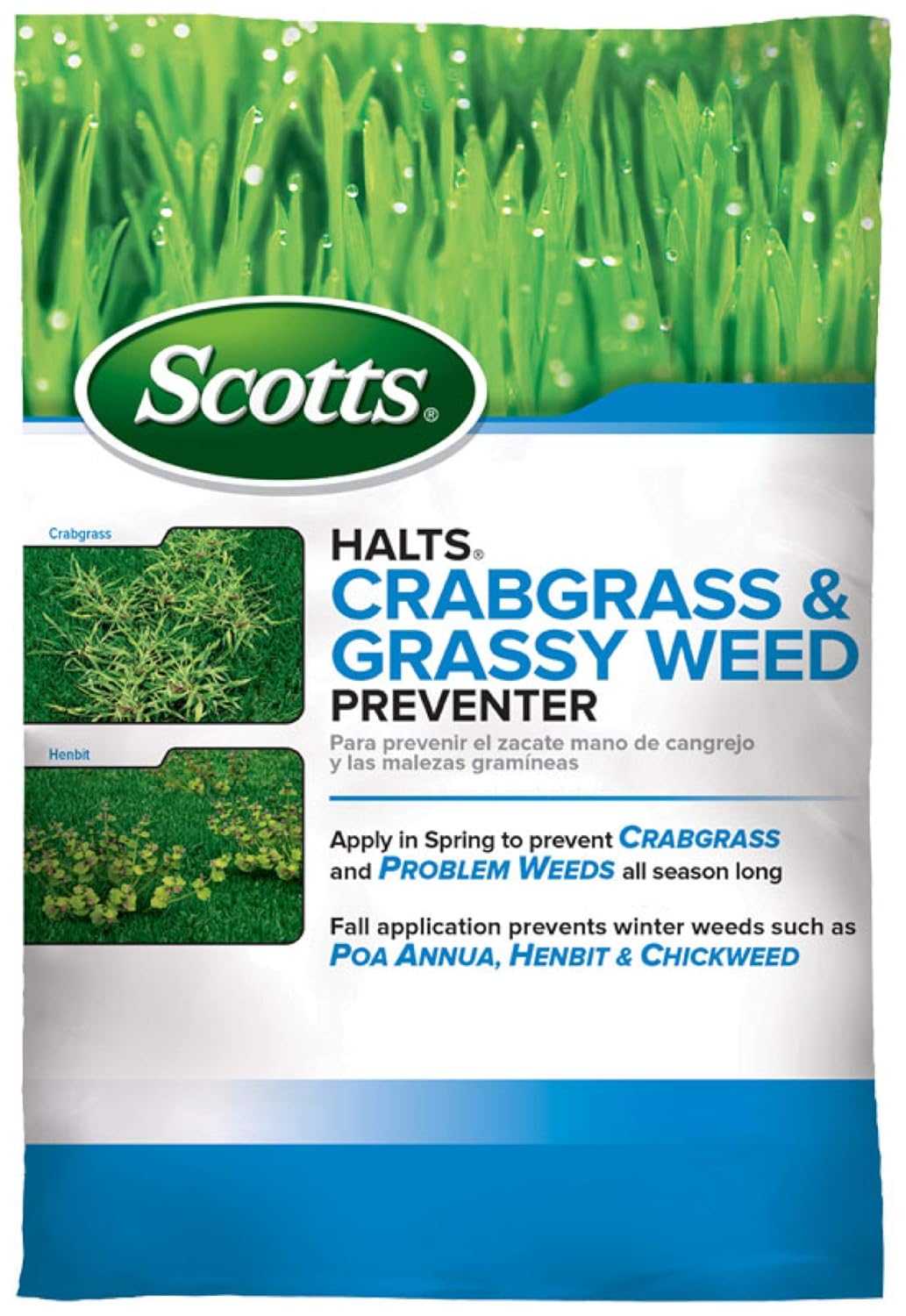
Scotts Halts Crabgrass & Grassy Weed Preventer, 10.06 lb.
| Item Form | Granule |
|---|---|
| Coverage | 5000 square_feet |
| Active Ingredients | Pendimethalin 1.71% |
Scotts Halts is a granular pre-emergent formulated to stop crabgrass and seeded grassy weeds from germinating across established lawns. You apply it dry with a broadcast spreader in early spring or fall, then water it in as directed; the active ingredient pendimethalin forms a soil barrier that prevents weed seedlings from emerging and is advertised as resistant to rain, snow, or freezing after application. This bag treats up to 5,000 square feet and is intended for use on most turf types except Dichondra and Bentgrass. The practical benefits are straightforward: a single timed application protects turf from several common annual weeds without needing spot herbicide treatments, and the granule form makes even coverage with a spreader easy. Important limitations are that it does not kill existing mature weeds and cannot be used on newly seeded or sprigged areas until months later, so timing and measuring lawn area matter. Also repeat applications for certain weeds like goosegrass may be necessary according to label instructions.
Best for: Homeowners who plan lawn care around seasonal timing and want a preventive, low-effort way to stop annual grassy weeds before they emerge.
Less Ideal for: People needing to remove existing weed infestations, those reseeding or establishing new turf within months, or gardeners who require immediate weed knockdown.
- Pre-emergent action prevents crabgrass and listed grassy weeds before they germinate
- Covers up to 5,000 sq ft per bag for single-application protection
- Granule form designed for even spreader application and easy watering activation
- Rain, snow, or freezing after application will not reduce effectiveness
- Does not control existing mature weeds so not useful for established infestations
- Not safe for newly seeded or freshly sprigged lawns for several months
Verdict: Use this granular pre-emergent if you want a seasonal, preventative barrier against crabgrass and common grassy weeds on an established lawn up to 5,000 sq ft.
The Andersons Barricade Granular Pre-Emergent Weed Control (18 lb, covers 5,800 sq ft)

| Item Form | Granule |
|---|---|
| Coverage | 5800 square feet |
| Unit Count | 288 Ounce |
| Active Ingredients | Prodiamine 0.48% |
Barricade is a granular pre-emergent that stops common lawn weeds before they emerge, using 0.48% prodiamine in a dispersible granule formula. You apply it across the lawn in early spring or fall and water it in so the small DG Technology particles dissolve and move the active ingredient into the soil. That combination gives broader, more even coverage per square inch and is especially aimed at preventing crabgrass, poa annua and other annual grassy and broadleaf weeds across up to 5,800 square feet from a single 18 pound bag. The product is straightforward to use with a spreader and fits routine seasonal maintenance plans. Important limits are that it will not kill weeds already established and must be timed correctly for best effect. Also, because it is a professional-strength herbicide buyers should follow safety directions closely and keep pets and children off treated areas until safe.
Best for: Homeowners who plan seasonal lawn maintenance and want a single, high-coverage pre-emergent to prevent crabgrass and common annual weeds across medium to large yards.
Less Ideal for: People needing a post-emergent solution for existing weeds, or gardeners who prefer non-chemical weed control methods.
- Designed to prevent both grassy and broadleaf annual weeds including crabgrass and poa annua
- DG Technology dispersible granules dissolve quickly when watered for consistent soil incorporation
- Covers up to 5,800 square feet from a single 18 pound bag, suitable for typical residential lawns
- Contains professional-grade active ingredient prodiamine for season-long pre-emergent control
- Will not control weeds that are already established in the lawn
- Must be applied in the correct seasonal window (early spring or fall) to be effective
- Requires watering after application and careful safety handling around children and pets
Verdict: Pick Barricade when you want a professional-strength, high-coverage pre-emergent that reliably prevents crabgrass and other annual weeds across a typical residential lawn.
Choosing the Right Granular Crabgrass Preventer: Key Factors to Consider
Active Ingredient and Label Use
Active ingredient determines which grass types and crabgrass life stages the product prevents. Different preemergent chemicals have different modes of action and labeled grass compatibilities, so matching the active ingredient to your lawn species reduces the risk of turf injury. Read label directions to confirm whether a product is safe for cool-season grasses, warm-season grasses, or both.
Label use also specifies application windows and maximum rates. Applying at a rate higher than labeled can harm turf and the environment. Choosing a formulation with a clear, turf-appropriate label simplifies timing and reduces the chance of misuse.
Residual Control Length
Residual control is how long the granular preventer inhibits crabgrass germination after application. Longer residual periods provide protection through the critical germination window but may limit the timing for seeding or overseeding. Consider whether you need multi-month protection or a shorter residual so you can reseed later in the season.
Residual length also affects reapplication timing. If your lawn experiences prolonged warm, wet conditions that favor crabgrass, a product with longer persistence can reduce the need for a second application, provided label limits are not exceeded.
Application Ease and Spreadability
How smoothly a granule flows through a broadcast or drop spreader affects coverage uniformity. Granules that resist caking and disperse evenly make it easier to hit label rates and avoid streaks or untreated patches where crabgrass can take hold. Some formulations are designed for low dust and consistent particle size to improve spread pattern.
Also consider packaging and granule size if you plan to use a handheld spreader or have tight spaces to treat. A product that is easy to measure and calibrate reduces guesswork and helps maintain turf safety.
Timing and Watering Requirements
Preemergent products are time-sensitive and often need activation by light watering or rainfall. The ideal window is before soil temperatures reach crabgrass germination levels for several consecutive days. Products vary in how quickly they require activation and how tolerant they are of delayed watering.
If your region has unpredictable spring rains, choose a formulation with some flexibility on activation timing. Follow label guidance on mowing and irrigation after application to avoid washing granules off the turf or causing uneven activation.
Turf Compatibility and Overseeding Constraints
Some granular preemergents can prevent seed germination of desirable turf as well as weeds. If you plan to overseed or repair thin patches, the product's label will specify waiting periods before seeding. Knowing these constraints ahead of time affects when you schedule prevention versus renovation.
For lawns in active renovation cycles, opt for a product with a shorter restriction window or plan applications around seeding to avoid unintentionally delaying grass establishment.
Environmental Impact and Safety
Consider how the formulation interacts with nearby planting beds, water features, and pollinator areas. Granular products reduce drift risk compared with sprays, but runoff and misapplication can still move active ingredients off-target. Look for label instructions on buffer zones near water and guidance on safe application near ornamentals.
Also review protective equipment recommendations and storage guidance. Safe handling and responsible use minimize risk to people, pets, and beneficial insects while maintaining lawn health.
When to Apply Granular Crabgrass Preventer
Timing is the single most important practical decision for preemergent products. Apply when soil temperatures consistently hit the threshold that triggers crabgrass germination for your region. Gardeners typically monitor soil thermometers or follow local extension recommendations rather than calendar dates to time application precisely.
Apply before germination begins and allow a short activation period with light irrigation or expected rainfall. Avoid applying during extreme drought or heavy wind that can cause uneven distribution. Planning application around your normal spring lawn care chores makes it easier to integrate prevention into your seasonal routine.
- Use a soil thermometer at 1 to 2 inches depth to check germination temperature trends.
- Calibrate your spreader and practice overlapping passes to prevent streaks.
- Water lightly after application if no rain is expected within 48 hours.
Spreader Calibration and Application Tips
Accurate spreading ensures the labeled rate reaches turf uniformly. Calibrating a broadcast or drop spreader with a dry run and measuring output over a set area prevents over-application and patchy protection. Many gardeners test spreader settings with inexpensive materials before applying the product.
Walk at a steady pace and use an overlapping pattern so each pass slightly covers the previous one. For small or irregular areas, consider a handheld spreader for better control. Clean spreader parts after use to avoid residue affecting future applications.
- Perform a practice spread with the empty bag contents to set the spreader dial.
- Keep a consistent walking speed and overlapping pattern for even coverage.
- Store leftover product in a dry place and seal the bag to prevent caking.
Integrating Preemergents with Lawn Care Tasks
Coordinate preemergent application with mowing, fertilization, and watering to avoid conflicts. Mowing height and timing generally do not interfere with granular preemergents, but heavy fertilization or lime applications sometimes coincide with seeding windows, which may require postponing preemergent use.
If you plan spring fertilization, apply preemergent either before or after based on label guidance. Avoid reseeding immediately after many preemergent products, and schedule renovation tasks in the appropriate window to prevent seedling suppression.
- Do not overseed within the restriction window specified on the product label.
- Plan fertilizer and irrigation around activation instructions to maintain turf vigor.
Managing Expectations and Troubleshooting
No preemergent eliminates every seed bank. Expect reduced crabgrass pressure rather than absolute eradication, especially in lawns with heavy existing infestations or areas missed during application. Persistent or late-germinating weeds may still appear and require spot treatment.
If you notice streaks of poor control, check spreader calibration and application pattern. For unexpected turf injury, review the label for rate and grass-type restrictions and contact local extension services for diagnosis before repeating treatment.
- Address localized failures with targeted post-emergent options labeled for use over treated turf when necessary.
- Keep records of application dates, spreader settings, and weather conditions to refine timing in future seasons.
Safe Storage and Handling
Store granular products in a cool, dry place away from children and pets. Keep the original label and closed packaging to preserve instructions and safety information. Avoid storing near food, seed, or animal feed.
When applying, wear recommended protective equipment on the label and avoid windy application days. Clean application tools and spreaders after use to prevent cross-contamination with other lawn products or seed.
- Keep a spill kit or materials on hand to quickly clean accidental releases.
- Dispose of empty or unneeded product according to local hazardous-waste guidance if the label requires special disposal.
How We Chose the Best Granular Crabgrass Preventer
Our selection focused on granular formulations designed specifically to prevent crabgrass in home lawns. We prioritized products with active ingredients and labeled use that match common lawn grass types and seasonal windows. Key evaluation criteria included coverage uniformity, length of residual control, ease of application with common spreaders, and turf safety when used at labeled rates. We also considered how forgiving each product is with timing and watering, and whether the formulation minimized dust and clumping during spreading. Exclusions included liquid-only herbicide systems, post-emergent-only crabgrass killers, and products labeled only for non-turf uses. We did not include options with restricted professional use or incomplete label guidance. In short, the list favors granular preventers that homeowners and lawn-care enthusiasts can apply accurately, that provide reliable residual control, and that have clear instructions to reduce risk to desirable grasses.
FAQ
Can I apply granular preemergent and overseed at the same time?
Usually not. Most granular preemergents prevent seed germination, so seeding should be done outside the restriction window specified on the label. If overseeding is planned, choose timing or a product with a shorter waiting period between application and seeding.
How soon after application does a granular preventer need watering?
It depends on the formulation. Many products require light irrigation or natural rainfall within a few days to activate. Check the label for the recommended activation timeframe and avoid heavy watering that could wash granules off the turf.
Will a granular preemergent harm my ornamental beds or vegetable garden?
Granular preemergents are intended for turf labeled on the product. Avoid applying directly to planting beds and follow label instructions about buffer zones near ornamentals and water. Misapplication and runoff can affect non-target plants.
How often should I reapply during a long growing season?
Reapplication frequency depends on residual duration and label limits. Some formulations provide multi-month control and do not require follow-up, while others may allow a second application within the season if label maximums are not exceeded. Always follow the product label for timing and total annual rate.
Can I use a granular preemergent on all grass types?
Not always. Products differ in turf compatibility. Verify the label for cool-season versus warm-season grass recommendations and any specific grass species cautions to avoid turf injury.
What should I do if I see crabgrass despite applying a preventer?
Small, isolated patches can be removed by hand or treated with a labeled post-emergent for crabgrass that is safe for treated turf. Investigate application uniformity, timing, and weather conditions from the application period to pinpoint why control was incomplete.
Final Verdict
Choose a granular crabgrass preventer that matches your lawn species, fits your seasonal schedule, and provides the right balance of residual control versus seeding flexibility. Prioritize accurate application with a calibrated spreader and follow label directions for watering and safety to reduce the chance of missed patches or turf injury. With correct timing and consistent technique, granular preemergents are an effective tool to reduce crabgrass pressure and keep lawns dense and healthy.
