

Note: This article contains affiliate links. If you click on these links and make a purchase, I may earn a small commission at no extra cost to you. This helps support my research and content. Read my full affiliate disclosure here.
If you need reliable, low-maintenance weed control for a lawn, landscape bed, gravel path, or around ornamentals, choosing the right granular herbicide makes a practical difference. Granular formulations can be easier to apply evenly, reduce drift risk, and often provide sustained activity compared with sprays. This guide covers seven top granular herbicides shortlisted for different garden situations and application needs. We evaluate each pick for coverage consistency, selectivity toward desirable plants, and user safety so you can match a product to the size and sensitivity of your planting areas.
Top Picks at a Glance
| Best Overall The best all-around choice for most situations | The Andersons Barricade DG Pro Granular Pre-Emergent Herbicide, 50 lb |  |
| Best Quality Built to a higher standard if you want something more solid | Dimension DG Pro Granular Pre-Emergent Herbicide, 50 lb |  |
| Best Value The sweet spot between price and what you get | Yard Mastery 0-0-7 Granular Prodiamine Pre-Emergent Herbicide, 45 lb |  |
| Best Budget The cheapest option that still gets the job done reliably | Roundup Weed Barrier Granules, 5.37 lb |  |
| Highest Rated A top-rated pick with lots of positive feedback | Casoron 4G Granular Herbicide, 50 lb |  |
| Most Popular A crowd favorite that many people choose with confidence | The Andersons Barricade Granular Pre-Emergent Weed Control (40 lb) |  |
| Best Seller A high-volume bestseller chosen again and again | Preen Extended Control Weed Preventer, 13.75 lb. |  |
The Andersons Barricade DG Pro Granular Pre-Emergent Herbicide, 50 lb

| Item Form | Granule |
|---|---|
| Coverage | 14,200 square feet |
| Active Ingredients | prodiamine |
Barricade DG Pro is a granular pre-emergent herbicide that prevents weed seedlings from establishing in lawns, sports fields, and ornamental beds when applied in early spring or fall. The DG (dispersible granule) formulation increases particle count and promotes more uniform coverage across large areas, making it practical for treating entire yards or commercial turf. It contains prodiamine as the active ingredient and is labeled to protect against more than 30 grass and broadleaf weeds; after application you water the area to activate the product. Practical benefits include long-lasting prevention compared with many contact herbicides and a format that is easy to broadcast with a spreader. Important limitations are that it does not kill existing weeds and must be timed correctly for pre-emergent activity, and protective gear is recommended during handling because it is an outdoor-use chemical.
Best for: Homeowners or groundskeepers who need reliable, long-lasting pre-emergent control across large lawns or commercial turf and who plan seasonal preventive applications.
Less Ideal for: Gardeners seeking a quick solution for existing weed problems or those who only need spot treatment for small beds should consider other post-emergent options.
- DG granule formulation increases particle count for more even coverage
- Labeled to prevent over 30 grass and broadleaf weeds
- Suitable for large areas with a single 50 lb bag covering up to 14,200 sq ft
- Contains prodiamine, a professional-grade pre-emergent used by turf managers
- Does not control weeds that are already established
- Requires precise seasonal timing and watering to be effective
Verdict: Choose Barricade DG Pro when you want a professional-strength granular pre-emergent that reliably prevents a wide range of turf weeds over large areas.
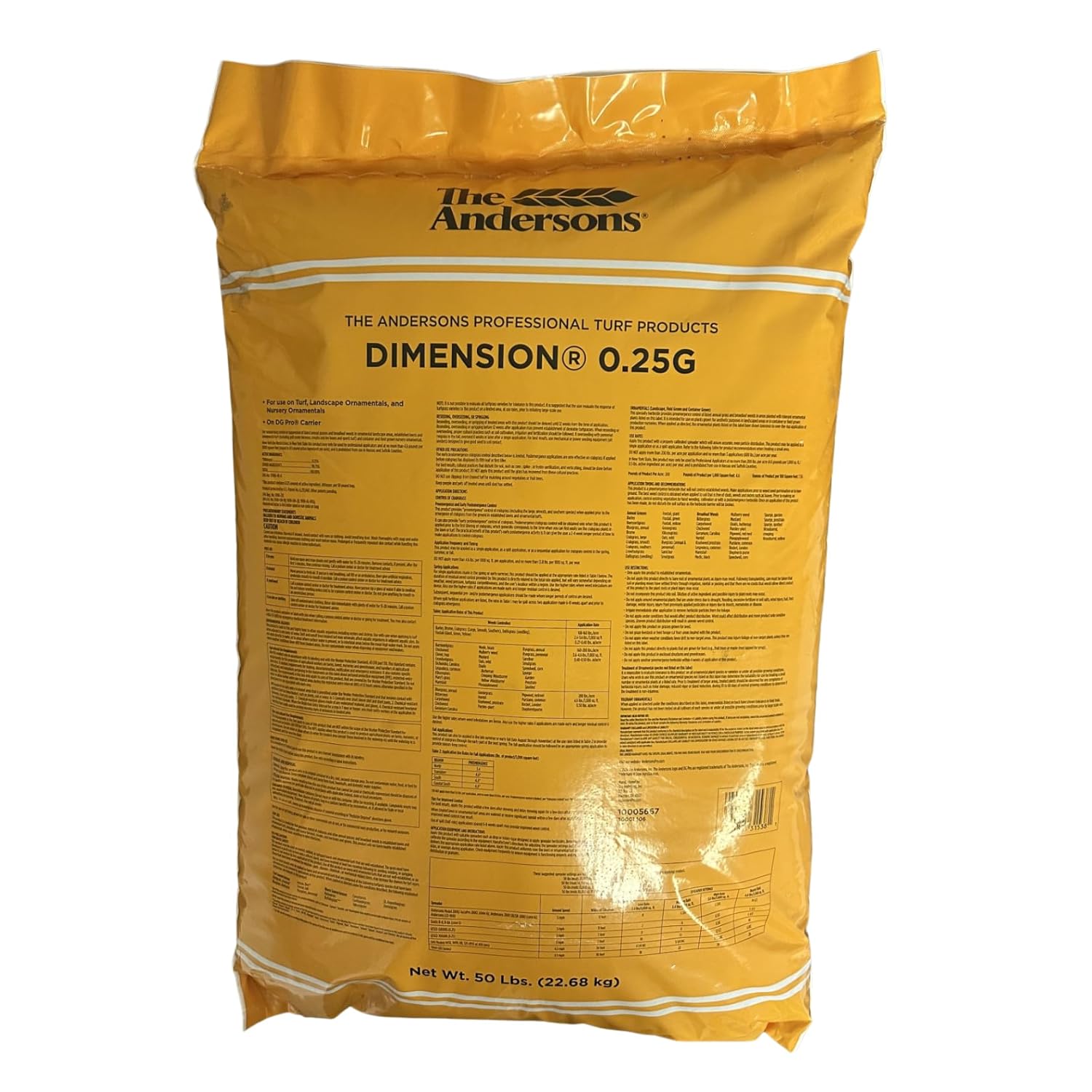
Dimension DG Pro Granular Pre-Emergent Herbicide, 50 lb
| Item Form | Granule |
|---|---|
| Coverage | 10000 square feet to 14000 square feet |
| Active Ingredients | Dithiopyr, Herbicide |
| Unit Count | 800 Ounce |
Dimension DG Pro is a professional-style granular pre-emergent that prevents germination of many annual grasses and broadleaf weeds and offers limited early post-emergent control of young crabgrass. It is applied by broadcasting across lawns, turf, and ornamental landscapes; one 50 lb bag treats roughly 10,000 to 14,000 sq ft depending on the application rate. Key features include a small-particle formulation for more even distribution and 0.25% dithiopyr active ingredient for season-long control of listed weeds such as crabgrass, chickweed, dandelion, and poa annua. Practically, the product reduces the need for repeated spot treatments during the growing season and is suitable for large yards, sports turf, and professional crews. Important limitations are that it is a preventative product so it will not remove established broadleaf weeds and safety precautions are required around children, pets, and desirable plants; follow label directions for rates and timing to avoid turf injury.
Best for: Buyers who prioritize strong pre-emergent performance for large lawns, sports turf, or professional maintenance crews and want a product that reduces repeat spot treatments during the season.
Less Ideal for: Casual gardeners with small yards who need a quick curative weed killer or those who prefer liquid or ready-to-use products for spot treatment.
- Large 50 lb supply treats a substantial area per application
- Small particle formulation promotes more even spread and product dispersibility
- Contains dithiopyr for season-long pre-emergent control and early crabgrass suppression
- Label lists control of over 40 grass and broadleaf weeds, useful for diverse turf problems
- Pre-emergent action will not kill established mature weeds
- Requires careful timing and correct application rate for effective control
Verdict: Choose Dimension DG Pro when you need a concentrated, season-long granular pre-emergent that covers large areas and delivers professional-strength prevention of common annual turf weeds.
Yard Mastery 0-0-7 Granular Prodiamine Pre-Emergent Herbicide, 45 lb

| Item Form | Granule |
|---|---|
| Coverage | 15,000 square feet |
| Active Ingredients | .37% Prodiamine |
| Unit Count | 720 Ounce |
This granular pre-emergent from Yard Mastery is designed to create a seasonal barrier that prevents crabgrass, poa annua, and several common lawn weeds from emerging. You apply it with a broadcast spreader at the recommended rate (commonly 3 lbs per 1,000 sq ft), water it in to activate the ingredient, and it provides roughly three months of protection when applied with soil temperatures between 55F and 70F. Notable features are the professional-strength active ingredient prodiamine at 0.37% and the large 45 lb bag that covers up to 15,000 sq ft at typical rates, which reduces the need for multiple purchases for mid-to-large yards. Practical benefits include straightforward granular application, broad weed-spectrum prevention, and compatibility with many common warm- and cool-season turfgrasses when used as directed. Limitations to consider are the need for accurate spreading and post-application watering to work effectively, adherence to annual maximum application rates, and the usual safety precautions required for concentrated herbicides around people and pets.
Best for: Homeowners who want a cost-effective, professional-strength pre-emergent to protect medium to large lawns and who prefer a granular product they can apply with a spreader.
Less Ideal for: Gardeners with very small lawns or ornamental beds that need spot treatment should consider smaller containers or targeted solutions instead.
- Professional-strength active ingredient (0.37% prodiamine) for effective pre-emergent control
- Large 45 lb bag covers up to 15,000 sq ft at recommended rates, suitable for mid-to-large lawns
- Granular formulation is easy to apply with a spreader and does not require mixing
- Provides about three months of pre-emergence protection when applied at recommended soil temperatures
- Requires precise spreading and watering to activate, otherwise efficacy can be reduced
- Contains a concentrated herbicide that requires protective gear and careful handling
Verdict: A large, pro-grade granular pre-emergent that gives homeowners an easy way to protect a medium to large lawn from crabgrass and other annual weeds.
Roundup Weed Barrier Granules, 5.37 lb

| Item Form | Granule |
|---|---|
| Coverage | 1000 square feet |
| Item Highlight | Weed Preventer for Landscapes, Up to 8 Months Protection, Built-In Applicator |
Roundup Weed Barrier Granules is a ready-to-use granular herbicide formulated to prevent weeds and grasses from emerging in ornamental beds and around established landscape plants. You apply it by sprinkling around plants at the recommended rate, raking it into the top inch of soil, then lightly watering to activate. The product includes a built-in applicator for more even distribution and the manufacturer claims protection lasting up to eight months when applied as directed. In practice it simplifies seasonal bed prep because it can be applied in spring before mulching and avoids the need for repeated hand-pulling. Important limitations are that it must be kept off leaves and porous surfaces to avoid damage or staining and it is not for use in edible gardens. Performance can vary with extreme weather that affects seed germination, and coverage requires careful measuring to reach the stated area. For gardeners on a budget it offers an easy, low-effort option to reduce weed emergence in ornamental areas.
Best for: Gardeners looking for an inexpensive, low-effort way to prevent weed emergence in ornamental beds and around established shrubs and perennials.
Less Ideal for: People who want a product approved for edible gardens or who need a contact weed killer for existing, established weeds rather than preemergent control.
- Ready-to-use granular formula with a built-in applicator for even coverage
- Designed to prevent weeds and grasses for up to eight months when used as directed
- Can be applied around established ornamentals without harming them when label instructions are followed
- Covers up to 1,000 square feet per bag, reducing frequency of purchases
- Not safe for use in edible fruit, vegetable, or herb areas
- Can stain porous surfaces and can damage plant foliage if granules make contact
- Effectiveness can be reduced by unusually wet, dry, or cold conditions that alter germination
Verdict: A straightforward, budget-friendly granular preventer that simplifies seasonal weed control around ornamental plants for up to eight months.
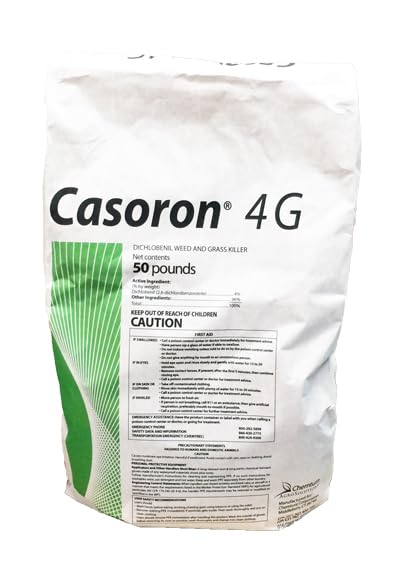
Casoron 4G Granular Herbicide, 50 lb
| Unit Count | 800 Ounce |
|---|---|
| Item Form | Granule |
| Coverage | non-selective broad spectrum coverage |
| Active Ingredients | Dichlobenil |
Casoron 4G is a granular, pre-emergent herbicide that forms an herbicidal vapor barrier in the soil when activated by rainfall or irrigation, preventing weed seeds and shallow roots from emerging. It is typically broadcast over beds and bare soil around ornamentals and non-crop areas and then watered in to activate the dichlobenil ingredient. The product is designed for long-lasting, non-selective, broad-spectrum control of germinating weeds and can reduce the need for repeated spot treatments. Practical benefits include simple application with a spreader, effective control of shallow and newly germinating weeds, and suitability for use where maintaining a weed-free planting zone is important. Important limitations are that it is non-selective so desirable seedlings will also be affected, it works as a pre-emergent rather than eradicating established deep-rooted plants, and it requires proper timing and activation by moisture to be effective.
Best for: Buyers who prioritize reliable, long-duration pre-emergent control for large beds or non-crop areas and want a product that reduces recurring weed maintenance.
Less Ideal for: Gardeners who need selective post-emergent control of existing broadleaf or deep-rooted perennials or who frequently plant seedlings into treated soil.
- Forms a long‑lasting vapor barrier to stop weed seeds from germinating
- Granular form is easy to broadcast and water in for activation
- Non-selective broad-spectrum control reduces need for frequent spot treatments
- Large 50 lb quantity covers extensive areas without frequent repurchasing
- Does not control established deep-rooted perennial weeds
- Non-selective action can damage desirable seedlings or newly planted annuals
Verdict: Choose Casoron 4G when you want dependable, large‑area pre-emergent protection that reduces future weed work.
The Andersons Barricade Granular Pre-Emergent Weed Control (40 lb)

| Item Form | Granule |
|---|---|
| Coverage | 12880 square_feet |
| Active Ingredients | Herbicide |
The Andersons Barricade is a 40 lb granular pre-emergent formulated with 0.48% prodiamine to prevent common weeds like crabgrass, poa annua, goosegrass and henbit across lawns and landscape beds. It is applied to established turf or ornamentals before weed seeds germinate and is most effective when watered in so the dispersible granules dissolve and move the active ingredient into the soil. The bag’s coverage claim makes it suitable for treating large areas without frequent repurchasing. Practical benefits include the small particle DG Technology for quick dissolution and more even coverage per square inch, which helps reduce missed patches when spread correctly. Important limitations are that it does not control existing weeds and must be applied at the right timing and rate to avoid ineffective results; users also need to follow safety guidance to avoid skin or eye exposure. For those who maintain large lawns and plan seasonal preventive treatments, this product offers a straightforward way to reduce future weed pressure.
Best for: Homeowners and groundskeepers who prioritize proven, professional‑grade prevention and want a single product to treat large turf areas on a seasonal schedule.
Less Ideal for: Gardeners needing a post‑emergent solution for current weed infestations or those with small container gardens where a granular lawn treatment is unnecessary.
- Formulated with prodiamine for long‑lasting pre-emergent weed prevention
- Dispersible granule (DG) technology that dissolves quickly when watered in
- Large 40 lb bag provides coverage for very large lawns and reduces refill frequency
- Not effective on existing weeds because it is a preventive product
- Requires correct timing and watering to activate and achieve expected results
Verdict: Choose this product if you want a professional‑grade pre-emergent that covers large lawns and relies on fast‑dissolving granules for reliable preventive weed control.
Preen Extended Control Weed Preventer, 13.75 lb.

| Item Form | Granule |
|---|---|
| Coverage | 2,245 sq. ft |
| Active Ingredients | Isoxaben, trifluralin |
| Item Highlight | Pre-emergent herbicide prevents weeds up to 6 months |
Preen Extended Control is a ready-to-use granular pre-emergent designed to prevent more than 125 broadleaf and grassy weeds before they sprout. You apply it to dry mulch or soil, water it in to activate the active ingredients isoxaben and trifluralin, and the product forms an invisible barrier that stops weed seeds from germinating for up to six months. It is most useful in landscape beds, around established perennials, shrubs, and trees and covers about 2,245 square feet from a single 13.75 lb drum. The flip-top applicator and granular format make distribution straightforward with minimal mixing, and the extended protection reduces the number of reapplications needed during the growing season. Important limitations: it will not kill existing weeds so you must remove those first, and it is not for use on lawns, vegetable gardens, flower seeds, or other food-producing areas. Follow label directions carefully to avoid contact with desirable plants and to comply with safety guidance.
Best for: Home gardeners who want a low-effort, long-lasting way to keep landscape beds and established plantings largely weed-free without repeated spot weeding.
Less Ideal for: People who need a product to remove existing weeds, treat lawns, or use around vegetables and flower seed plantings should choose a different solution.
- Provides up to six months of pre-emergent weed prevention per application
- Covers approximately 2,245 sq ft from a single 13.75 lb container
- Granular formula with flip-top applicator makes even distribution simple
- Safe to use around many established perennials, shrubs, and trees when used as directed
- Does not kill existing weeds so weeds must be removed before application
- Not labeled for use on lawns, vegetable gardens, flower seeds, or food-producing plants
Verdict: Buy this if you want an easy, long-duration granular pre-emergent to prevent weeds in landscape beds with minimal repeat applications.
Choosing the Right Granular Herbicide: Key Factors to Consider
Active Ingredient and Weed Spectrum
The active ingredient determines which weed species the product controls and whether it works preemergence or postemergence. Some actives are broad-spectrum and address many annual weeds, while others target specific grassy or broadleaf species.
Matching the active ingredient to your dominant weed problems reduces repeat applications and prevents wasted treatments. Also consider whether the product is intended for preemergence use to prevent seedlings or for postemergence control of established plants.
Selectivity and Plant Safety
Selectivity tells you how likely the herbicide is to harm turfgrass, ornamentals, or nearby desirable plants. Nonselective granular herbicides will damage or kill most green plants and are appropriate only for bare ground, gravel, or weed patches where no desirable plants are present.
If you are treating lawns or mixed beds, choose a selective granular option labeled safe for your turf species or specific ornamentals. Read label instructions on buffer zones and application rates to avoid injury to sensitive plantings.
Application Method and Equipment Compatibility
Granular herbicides are usually applied with broadcast spreaders or hand spreaders. The product particle size and recommended spreader settings affect how evenly granules lay down. Some formulations flow better than others and work with a wider range of consumer spreaders.
Consider whether you need a product that can be calibrated for small patches versus a large broadcast application. Ease of calibration and clear spreader settings save time and reduce overlap or missed strips.
Residual Duration and Reapplication Needs
Residual activity determines how long the herbicide remains active in the soil to prevent new weed emergence. Longer residual products reduce the frequency of follow-up treatments but can also restrict planting of desirable seeds or transplants for a period.
Check label statements about how long treated areas remain protected and any planting or re-seeding intervals. For beds where you plan to plant annuals or vegetables, choose products with short residuals or labeled compatibility with upcoming planting schedules.
Environmental Considerations and Runoff Risk
Granular formulations can reduce drift compared with sprays, but they still pose risks if applied before heavy rain or on slopes leading to water bodies. Some active ingredients have higher mobility in soil and can leach toward waterways or sensitive habitats.
Use label guidance on rainfall windows, buffer distances from wells and streams, and recommended best practices to minimize runoff. Consider nonchemical controls for areas adjacent to sensitive sites.
Storage, Handling, and Safety Instructions
How a product is packaged and the clarity of safety instructions affect real-world usability. Granules stored in resealable, durable packaging are easier to handle and keep dry. Clear PPE recommendations, reentry intervals, and instructions for cleanup reduce accidental exposure.
Assess whether the product's application rate and unit size match how much you need. Large bags may be economical but harder to store safely for homeowners with limited, dry storage space.
Best Uses by Garden Situation
Different granular herbicides are designed for distinct settings: lawn spot treatment, large turf areas, landscape beds, gravel or impervious surfaces, and bare-ground preemergence use. Identify where you intend to apply the product first, then match the labeled use. For example, a granular product labeled for turf should specify which turf species are safe and how soon you can overseed after application.
For narrow situations like pathways or gravel driveways, nonselective formulations can be appropriate. In mixed ornamental beds, favor products labeled as selective or use physical removal and targeted spot treatments to avoid harm to desirable plants.
- Lawns: use selective granular formulas labeled for your grass type.
- Landscape beds: choose selective or spot-apply nonselective products away from desirable plants.
- Bare ground and gravel: nonselective residual granules are often effective.
- Prevention: preemergence granules help stop annual weeds before they sprout.
Application Timing and Weather Windows
Timing matters for both preemergence and postemergence granular herbicides. Preemergence products work best when applied before weed seeds germinate, usually in early spring or fall depending on the species. Postemergence granules need active growth to be effective and often perform better when soil moisture is adequate.
Avoid applications immediately before heavy rain unless the label specifies rainfast periods. Light irrigation may be recommended to move granules into the soil, but excessive runoff can transport active ingredients away from the target area.
- Check local weed calendars to time preemergence treatments.
- Apply postemergence granules when weeds are actively growing and temperatures are within label ranges.
- Follow irrigation guidance on the label to activate residual products without causing runoff.
Calibrating Your Spreader for Even Results
Proper spreader calibration reduces overlap and gaps that lead to inconsistent control. Many granular herbicides provide recommended spreader settings and application rates based on area. Measure a test strip and weigh or count granules to confirm the output before treating the full area.
For small patches, a hand spreader or scoop with measured turns gives more control than a large broadcast spreader. Keep spreader speed and walking pace consistent to maintain even distribution.
- Test a small swath and adjust settings before full application.
- Walk at a steady pace and avoid stopping or turning sharply over treated zones.
- Store leftover product in its original container and label for future calibration.
Protecting Non-target Plants and Pollinators
Granular herbicides can drift less than sprays, but particles can still move if spilled or applied carelessly. Avoid applying on windy days, and shield desirable plants with physical barriers if spraying or spreading nearby. Be mindful of flowering ornamentals where pollinators forage; avoid treating blooms and follow label guidance about pollinator protection.
When treating near vegetable gardens, check planting interval restrictions. For pollinator protection, do not apply during bloom and ensure any treated area has dried or been irrigated per label before allowing pollinators back into the space.
- Keep a buffer between treated zones and flowering plants.
- Clean spreader equipment after applying nonselective products to prevent unintended contamination.
- Follow label reentry and pollinator guidance closely.
Combining Cultural Controls with Chemical Options
Relying solely on herbicides rarely eliminates recurring weed pressure. Integrate cultural practices like improving turf density, mulching beds, hand-pulling flowering weeds before seed set, and correcting soil compaction to reduce the weed seed bank and improve long-term results.
Use granular herbicides as part of a larger strategy: spot-treat established infestations and use preemergence granules seasonally to prevent new flushes. That balanced approach minimizes repeated chemical use and helps maintain planting health.
- Overseed thin lawn areas to crowd out weeds after any required waiting period.
- Apply mulch in beds to suppress seedlings, supplementing preemergence protection where appropriate.
- Rotate control methods to avoid dependence on a single active ingredient when labels allow.
How We Chose the Best Granular Herbicide
We focused on real-world gardener priorities that determine whether a granular herbicide will work in typical yard and garden situations. Our selection filters emphasized coverage consistency, active ingredient suitability for common weeds, application flexibility across spreader types, labeled use on target surfaces like turf or ornamental beds, and safety instructions relevant to homeowners. We excluded products lacking clear homeowner labeling, those restricted to commercial applicators, or formulations unsuitable for typical residential spreaders. Evaluation criteria included: how evenly the granules distribute and cover a given area, the spectrum of weeds controlled and whether the active ingredients match common species, the level of selectivity so desirable turf or plants are less affected, clarity and practicality of label directions and reentry intervals, and storage and handling safety. These dimensions align with the scoring metrics below and reflect what gardeners actually check before applying a granular herbicide.
FAQ
Can I use a granular herbicide on newly seeded lawn?
It depends on the product. Many granular herbicides with residual activity restrict seeding for a defined interval. Check the label for the safe waiting period before seeding or overseeding and follow those timelines to avoid injuring new grass.
How soon after application can I water or mow treated areas?
Label instructions vary. Some granules require light irrigation to activate while others advise waiting a set number of hours for granules to settle. Mowing is usually safe after the herbicide has settled and labels often specify reentry or activity windows.
Will granular herbicides harm nearby ornamental plants?
They can if the product is nonselective or if granules are applied too close to roots or foliage. Use selective products when treating near ornamentals and maintain recommended buffer distances. Avoid scattering granules onto desirable plants and clean equipment to prevent cross-contamination.
Are granular herbicides safer for windy conditions than sprays?
Granules reduce drift risk compared with liquid sprays, but wind can still carry fine particles during application. Apply on calm days and use spreader shields or manual placement for precision in windy locations.
How often will I need to reapply a granular herbicide?
Reapplication frequency depends on the product's residual duration and the severity of weed pressure. Some preemergence granules offer protection for several months, while postemergence treatments may need repeat applications until the infestation is controlled. Follow label intervals for safe reapplication.
Can I use granular herbicide around vegetable beds?
Many granular herbicides are not labeled for use directly in vegetable beds or may impose long waiting periods before planting edibles. Always check the label for food crop restrictions and recommended planting intervals to avoid contaminating produce.
Final Verdict
Choose a granular herbicide by first defining where you will apply it and which weeds you need to control. Prioritize active ingredients that match your target species, selectivity for desirable turf or ornamentals, and clear label instructions for timing and safety. Balance residual protection against planting plans and environmental sensitivity. When used carefully with proper calibration, timing, and cultural practices, granular herbicides are a practical tool for managing weeds in lawns, beds, and hardscape areas. Focus on matching product labels to your garden situation and apply conservatively to achieve dependable results while minimizing risk.
