

Note: This article contains affiliate links. If you click on these links and make a purchase, I may earn a small commission at no extra cost to you. This helps support my research and content. Read my full affiliate disclosure here.
A well-chosen grass garden spreader makes routine lawn care faster and reduces the common problems of streaks, missed patches, and uneven fertilizer. You want a tool that meters material consistently, handles the rate ranges you use, and is simple to load and clean. This guide shortlists seven top-performing spreaders that suit typical lawn sizes and maintenance styles, and it explains the practical strengths gardeners should weigh. We evaluated each unit for distribution consistency, hopper and flow control, build durability, and ease of use so you can match a spreader to your yard and materials. Read on for the criteria that mattered and how to pick the right option for your lawn tasks.
Top Picks at a Glance
| Best Overall The best all-around choice for most situations | Scotts Turf Builder EdgeGuard DLX Broadcast Spreader |  |
| Best Quality Built to a higher standard if you want something more solid | EarthWay 2030P-Plus 65 lb Walk-Behind Broadcast Spreader |  |
| Best Value The sweet spot between price and what you get | Scotts Whirl Hand-Powered Handheld Spreader |  |
| Best Budget The cheapest option that still gets the job done reliably | CHAPIN 8740A 64 oz Hand Shaker Spreader |  |
| Highest Rated A top-rated pick with lots of positive feedback | John Deere 130 lb Push Broadcast Spreader |  |
| Most Popular A crowd favorite that many people choose with confidence | Scotts Turf Builder EdgeGuard Mini Broadcast Spreader |  |
| Best Seller A high-volume bestseller chosen again and again | Scotts Whirl Hand-Powered Spreader |  |
Scotts Turf Builder EdgeGuard DLX Broadcast Spreader

| Capacity coverage | Holds up to 15,000 sq. ft. of Scotts product |
|---|---|
| Additional features | EdgeGuard Technology, Pre-calibrated |
| Included components | Scotts – 76232 |
| Brand | Scotts |
The Scotts Turf Builder EdgeGuard DLX is a ready-to-use broadcast spreader built for routine lawn care and seasonal tasks. It is commonly used to apply granular fertilizer, grass seed, weed control products and even ice melt or salt on driveways. Notable features include Scotts pre-calibrated settings so you can match product recommendations quickly, a curved hopper and dual-bladed agitator that help keep granules flowing for consistent coverage, and an EdgeGuard side shield that blocks material from drifting onto sidewalks and beds. Practical benefits are straightforward: faster, more even application than hand-spreading, simpler setup for common Scotts products, and the ability to handle both lawn and winter chores with the same tool. Expect simple operation but keep in mind it is a broadcast-style spreader, so exact micro-adjustment or precision banding is not its strength and bulky or unusually shaped materials may not feed as smoothly. For typical home lawns up to the stated coverage it saves time and reduces missed spots compared with manual methods.
Best for: Homeowners who want a reliable, no-fuss spreader for routine lawn applications and occasional winter use and who value even coverage and simplicity over precision dispensing.
Less Ideal for: Landscape professionals or gardeners needing highly accurate, narrow-strip applications or specialized dispensing for unusual granular products should consider a different, more precise spreader.
- Pre-calibrated settings for easy matching to product directions
- EdgeGuard side shield reduces overspray onto sidewalks and beds
- Curved hopper and dual-bladed agitator promote steady, consistent flow
- Can be used year-round for fertilizer, seed, salt, and ice melt
- Broadcast design is not ideal for precision spot or banded applications
- May struggle with very coarse or irregularly sized materials
Verdict: If you want a straightforward, pre-calibrated spreader that delivers even coverage across a typical home lawn and keeps product off sidewalks, this is a practical all-around choice.
EarthWay 2030P-Plus 65 lb Walk-Behind Broadcast Spreader

| Brand | EarthWay |
|---|---|
| Model Number | 2030P-Plus |
| Capacity | 65 LB (29 KG) |
| Item Form | Granules |
| Tire Type | Pneumatic |
The EarthWay 2030P-Plus is a large-capacity walk-behind broadcast spreader built for heavy-duty lawn applications. It holds up to 65 pounds in a rustproof poly hopper and uses EarthWay's 3-hole drop system plus side-spread control to deliver an even pattern and feathered edging near beds and walkways. The variable flow and top-of-handle rate control make it easy to dial in application rates while pushing, and the pneumatic tires on poly rims smooth the ride over rough or rocky turf. This model arrives mostly assembled so setup is quick. Practical benefits include fewer hopper refills on larger lawns and better placement accuracy on edges and around landscaping. Important limitations are that it is a manual push unit so it requires physical effort on large properties and it is specialized for granular products only. Buyers should also allow for occasional maintenance of the gearbox and tires to keep the unit running season after season.
Best for: Gardeners and small commercial operators who prioritize consistent, professional-grade spread patterns and need a high-capacity unit for regular turf maintenance.
Less Ideal for: People who need a motorized or tow-behind solution for several acres or those who require spreading of non-granular products.
- Large 65 lb rustproof poly hopper reduces trips to refill on bigger lawns
- Even-spread 3-hole drop system and side-spread control for accurate placement and feathered edges
- Top-mounted variable flow rate control for easy adjustments while operating
- Pneumatic tires on poly rims roll well over uneven or rocky turf
- Manual push design can be tiring on very large properties
- Designed only for granular materials so not suitable for liquids or slurry applications
Verdict: Choose the EarthWay 2030P-Plus when you want a rugged, high-capacity broadcast spreader that delivers consistent professional-grade distribution across larger lawns.
Scotts Whirl Hand-Powered Handheld Spreader

| Material Type | Poly |
|---|---|
| Capacity coverage | Up to 1,500 sq. ft. |
| Included Components | Scotts – 71060 |
The Scotts Whirl is a simple, hand-powered spreader designed for small yards and spot treatments. It delivers smooth, even coverage of grass seed, fertilizer, salt, or ice melt by turning a small spreader wheel as you walk. Its ergonomic, adjustable arm support makes repeated passes more comfortable than basic handheld scoops, and the unit arrives fully assembled so you can use it right away. With a capacity rated up to 1,500 square feet it is best for modest lawns, beds, and patch repairs rather than large properties. Construction is lightweight poly, which keeps it easy to carry and maneuver but means it is not as rugged as metal commercial units. The straightforward mechanical design keeps maintenance trivial and there are no batteries or power hooks to worry about. If you want a low-cost, low-effort tool to improve distribution and avoid clumping during seeding or fertilizing, this does the job well, but those needing heavy-duty durability or very large coverage will want a larger tow-behind or broadcast spreader.
Best for: Buyers who want a practical, no-frills tool to improve distribution for routine lawn care on small to medium yards and value ease of use and low maintenance.
Less Ideal for: Homeowners with large lawns, commercial landscapers, or anyone needing a heavy-duty, high-capacity spreader should consider larger tow-behind or broadcast models.
- Provides smooth, even coverage for seed, fertilizer, salt, and ice melt
- Ergonomic adjustable arm support for more comfortable use during extended passes
- Lightweight poly construction makes it easy to carry and maneuver
- Comes fully assembled so it is ready to use out of the box
- Poly construction is less durable than metal alternatives for heavy or commercial use
- Capacity is limited to small lawns and spot treatments, not appropriate for large properties
Verdict: A lightweight, ready-to-use handheld spreader that delivers even coverage for small lawns and routine spot treatments.
CHAPIN 8740A 64 oz Hand Shaker Spreader

| Capacity | 1.8 kg |
|---|---|
| Bottle Type | Shaker Bottle |
| Reusability | Reusable |
| Material Type | Plastic |
The CHAPIN 8740A is a no-frills 64-ounce hand shaker designed for year-round spot spreading of seed, fertilizer, salt and ice melt. It is used by filling the wide-mouth bottle, selecting one of three twist-to-open lid positions and shaking the material across small patches, walkways, steps or shaded turf areas where a walk-behind spreader cannot reach. Notable features include a large handle that fits hands with gloves, three lid openings sized for fine to coarse particulates, and a tall, upright bottle that stores easily on a shelf. In practice this makes it quick to apply small, targeted amounts without the setup or footprint of larger spreaders. The trade-offs are obvious: being manual it is slower and less consistent for large lawns and it lacks adjustable spread width or metering beyond the three fixed openings. For budget-minded buyers who need an inexpensive tool for spot treatments, the Chapin shaker is practical and durable enough for seasonal use.
Best for: Buyers looking for an inexpensive, easy-to-use tool for spot-seeding, small lawn patches, sidewalks and winter salt runs who prioritize simplicity and low cost over speed.
Less Ideal for: Homeowners with medium to large lawns or those who need precise, uniform application across wide areas should choose a broadcast or push spreader instead.
- Wide screw-top opening makes filling and cleaning easy
- Three twist-to-select lid openings for different particulate sizes
- Large ergonomic handle usable with gloves for comfortable one-handed operation
- Reusable plastic bottle that stores upright and can hold a full season of spot product
- Manual shaking provides less even coverage and is slow on larger areas
- No adjustable metering or spread width for fine-tuning application rate
Verdict: A cheap, practical hand shaker that lets budget buyers quickly handle spot seeding and winter salt duties without needing a larger spreader.
John Deere 130 lb Push Broadcast Spreader

| Capacity | 130 lbs |
|---|---|
| Spread width | 10 – 12 ft |
| Wheels | 13" x 4" pneumatic tires |
| Control | Direct rod control |
The John Deere 130 lb Push Broadcast Spreader is built for reliable, larger-scale lawn care where fewer refills and consistent coverage matter. It uses a rust-proof poly hopper that holds 130 pounds of material, direct rod gate control with an adjustable flow stop for precise output, and a broadcast plate that can reach roughly 10 to 12 feet depending on walking speed and material. The enclosed gearbox with heat-treated bevel gears and large turf-tread pneumatic tires make it durable and easier to push across uneven turf. Typical uses are broadcasting fertilizer and seed over yards up to about half an acre or spreading ice melt in winter, cutting the number of passes compared with smaller units. Assembly is required and the unit is a walk-behind push design, so it is best for homeowners who can push a midweight machine across their lawn. If you prioritize steady, even application and fewer interruptions during medium-to-large jobs, this spreader delivers dependable performance, though it is bulkier than compact handheld or tow-behind options.
Best for: Homeowners who prioritize dependable, low-maintenance lawn coverage for medium to large yards and want consistent spreading performance with fewer refills.
Less Ideal for: People with very small lawns, limited storage space, or those who need a lightweight handheld spreader for spot treatments.
- Large 130 lb rust-proof poly hopper reduces refill frequency for up to 25,000 sq ft coverage
- Direct rod control with adjustable flow stop allows precise material output and less waste
- Enclosed gearbox with heat-treated bevel gears resists corrosive materials for long service life
- Wide broadcast spread pattern up to 12 ft speeds up coverage and improves evenness
- Turf-tread pneumatic tires improve maneuverability over uneven lawns
- Requires assembly and is heavier and bulkier than handheld or small push spreaders
- Not suitable for very small yards where a compact unit would be easier to store and handle
Verdict: Choose this spreader if you want a durable, high-capacity push broadcast unit that delivers consistent, wide coverage for medium to large lawns.
Scotts Turf Builder EdgeGuard Mini Broadcast Spreader
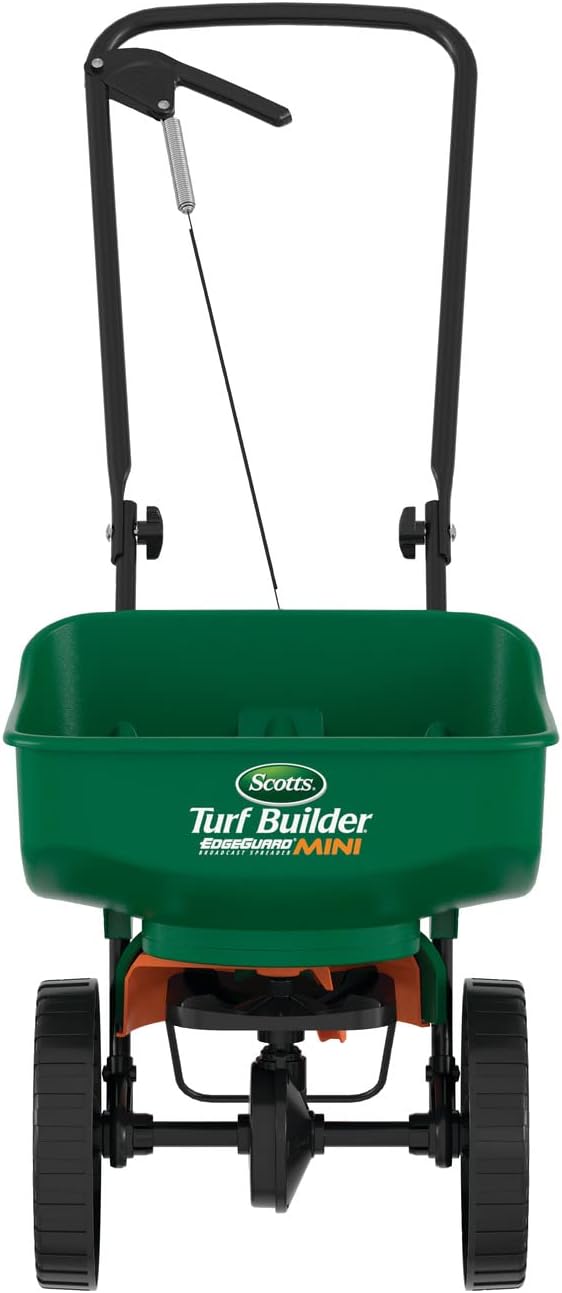
| Capacity | Up to 5,000 sq. ft. |
|---|---|
| Usage | Fertilizer, seed, granular weed control, salt, ice melt |
| Pre-calibrated | Yes |
| Handle | Fold-down for storage |
The Scotts Turf Builder EdgeGuard Mini is a small, ready-to-use broadcast spreader made for routine lawn care on smaller properties. It comes pre-calibrated with a curved hopper and dual-bladed agitator to keep granules flowing smoothly for consistent coverage up to about 5,000 sq. ft. The standout feature is Scotts EdgeGuard which shields driveways and sidewalks by blocking the right side of the spread pattern, making it easier to avoid waste and mess during application. Fold-down handle and durable open-spoke wheels simplify storage and movement across typical yard terrain. You can also use it year-round for ice melt and salt in winter. Limitations are its capacity and size: it is best for small yards and requires more frequent refills on larger properties, and the plastic construction means you should avoid heavy rough use. For homeowners who want a simple, low-effort way to get even granular coverage without frequent calibration, this is a practical choice.
Best for: Homeowners with small to medium lawns who prioritize straightforward, low-fuss application and want help avoiding product on hard surfaces.
Less Ideal for: Large properties, professional landscapers, or anyone who needs high-capacity, heavy-duty equipment for frequent commercial use.
- Pre-calibrated and ready to use for quick setup
- EdgeGuard side shield prevents product spreading onto sidewalks and driveways
- Curved hopper and dual-blade agitator for smooth, consistent flow
- Fold-down handle and compact size for easy storage and maneuvering
- Smaller hopper capacity means more frequent refills on larger lawns
- Plastic construction may wear faster under heavy or commercial use
Verdict: A compact, ready-to-use spreader that gives small-lawn owners consistent coverage and a built-in side shield to keep product off walkways.
Scotts Whirl Hand-Powered Spreader

| Material Type | Metal, Plastic |
|---|---|
| Handle Material | Rubber |
| Capacity Coverage | Up to 1,500 sq. ft. |
| Additional Features | Adjustable Arm Support, Smooth Even Coverage |
The Scotts Whirl is a compact, hand-powered spreader built for small lawns and spot treatments. It comes ready to use and is designed to distribute grass seed, granular fertilizer, ice melt, or salt with an agitator that promotes smooth, even coverage. Its adjustable arm support and light weight make it comfortable for short jobs like overseeding patches, treating narrow strips, or spreading ice melt on walkways. Because it is hand-held and intended for up to 1,500 square feet, it delivers control and reduced waste compared with tossing product by hand. The main limitation is capacity and speed: for larger lawns you will need a wheeled spreader or multiple refills, and fine-tuning the setting for very light seed rates can take a few test passes. Materials are basic metal and plastic with a rubber handle, so it is practical for seasonal use rather than heavy commercial work.
Best for: Homeowners with small lawns or those who need precise control for patch seeding, fertilizing, or winter ice-melting, who prioritize reliability and simplicity over high capacity.
Less Ideal for: Owners of medium to large lawns who need fast coverage or professional users who require higher durability and throughput.
- Compact handheld design ideal for small yards and spot treatments
- Engineered to deliver smooth, even product coverage across application area
- Adjustable arm support increases comfort during use
- Ready to use out of the box with simple hand-powered operation
- Limited capacity suitable only up to about 1,500 sq. ft., requiring frequent refills for larger lawns
- Not ideal for high-volume or commercial spreading tasks
Verdict: A simple, reliable handheld spreader that gives risk-averse homeowners controlled, even application for small lawns and spot jobs.
Choosing the Right Grass Garden Spreader: Key Factors to Consider
Distribution Consistency
Even coverage is the main purpose of a grass garden spreader. Uneven distribution leaves streaks that show up as overfed or underfed bands across the lawn. Check how well a spreader meters different particle sizes and whether its patter remains steady as you walk at typical lawn speeds.
Consistent flow reduces material waste and prevents concentrated spots that can burn turf or leave unsightly growth patterns. For seed work, a fine, even pattern matters more; for coarse amendments a spreader that keeps output steady under heavier granules is essential.
Rate Adjustment Accuracy
Accurate rate control lets you apply the correct amount of fertilizer or seed. Look for clearly marked settings and mechanisms that actually correlate to applied pounds per 1,000 square feet. A dial that slips or vague increments make it hard to hit manufacturer-recommended rates.
Reliable adjustment is also important when switching materials. You should be able to reduce flow for seed and raise it for bulk amendments without unpredictable jumps in output.
Spread Width and Pattern
Spread width determines how quickly you can cover a lawn. A wider effective swath means fewer passes, but only if the pattern overlaps cleanly without gaps or heavy center bands. Evaluate the recommended walking speed and how the pattern behaves at the edges.
Some spreaders offer adjustable deflectors or pattern controls to tune side-to-side spread. For narrow lawns or tight beds, a narrower but highly accurate pattern can be preferable to a wide, uneven throw.
Hopper Capacity and Handling
Hopper size affects how often you need to refill and how heavy the spreader is when full. For medium to large lawns a larger hopper reduces trips back to the bag. Consider how the hopper funnels material to the metering mechanism and whether the opening resists bridging and clogging.
Ergonomics matter too. Handles, wheel size, and hitching points affect how easy it is to push, pull, or tow the spreader across varied turf. A design that lowers strain will make frequent applications and repeat passes less tiring.
Durability and Weather Resistance
Spreaders live outdoors and get exposed to moisture, fertilizer salts, and UV. Materials and finishes that resist corrosion and wear lengthen useful life. Look at axle and wheel robustness plus whether plastic components are thick enough to avoid cracking under load.
Sealed or protected metering parts reduce grit and corrosion problems. Durability also ties to serviceability: units with replaceable nozzles, agitators, or wheels let you maintain consistent performance for more seasons.
Ease of Cleaning and Storage
Residues from fertilizer and seed can corrode parts or block flow if not removed. A spreader that disassembles easily or has smooth surfaces that rinse clean will save time and prevent long-term damage. Consider whether the hopper and metering can be flushed and whether parts are accessible for drying.
Storage ergonomics matter too. Foldable handles, compact footprints, and the ability to keep moving parts covered reduce the risk of winter damage and make seasonal storage simpler.
Matching Spreader Type to Lawn Size
Choose a spreader based on how much ground you need to cover regularly. For small lawns or tight urban yards a handheld or narrow-wheeled push spreader gives better maneuverability and control. Larger properties benefit from a tow-behind or wide broadcast type that covers more ground per pass.
Also factor in how frequently you apply materials. If you only broadcast fertilizer a few times a year, a smaller capacity unit might suffice. For seasonal projects like overseeding or topdressing, choose a unit that balances capacity with clean-up convenience so you spend less time refilling and more time working.
- Small yards: prioritize maneuverability and easy storage
- Medium yards: look for mid-size hoppers and consistent metering
- Large lawns: prefer wide spread patterns and larger capacity
Using Different Materials Safely
Granular fertilizers, grass seed, lime, and topdressings all behave differently. Fine seed can bridge or flow too quickly if the metering hole is too large. Coarse amendments may require a wider opening and stronger agitator to keep material moving. Check adjustable settings and whether the spreader includes an agitator or built-in vibration to prevent clogging.
When switching materials, clean the hopper and run a small test pass on an inconspicuous strip to confirm the rate and pattern. That avoids costly mistakes like overapplying fertilizer right next to newly seeded areas.
- Run a trial pass after material changes
- Use agitators or vibration settings for damp or clumpy materials
- Close and secure hopper during transport to avoid spills
Transport, Storage, and Winter Care
Consider how you will move a filled spreader to the lawn and where it will be stored between uses. Wheels that roll easily over turf and thresholds reduce strain. For tow-behind units, check coupling points and whether the design fits common garden carts or tractors.
Before winter storage, empty and clean the hopper, let all parts dry, and apply light protective sprays to metal components to prevent rust. Folding handles or compact footprints help keep a spreader out of the way in a shed or garage.
- Empty and rinse after use to reduce corrosion
- Store indoors or under cover to prolong life
- Check tire pressure or wheel bearings before season start
Maintenance Tips to Keep Spread Pattern Accurate
Regular maintenance preserves accuracy. Clean metering holes and agitators after each use to avoid buildup. Inspect wheels and axles for wear and ensure the rate control moves freely without play.
Replace worn nozzles and seals promptly so the calibration you set actually delivers the expected pounds per area. Small routine checks before each season prevent performance drift and uneven applications.
- Rinse hopper and metering components after every use
- Lubricate moving parts and tighten fasteners seasonally
- Keep spare nozzles or agitator parts on hand for common wear items
Safety and Environmental Considerations
Apply fertilizers and amendments according to label directions and local regulations to avoid runoff and environmental harm. Use spill-minimizing techniques when filling the hopper and keep a controlled walking speed to maintain even coverage.
Wear appropriate protective gear when handling dry or powdered materials and wash equipment before moving between treated and non-treated areas. Avoid spreading immediately before heavy rain to reduce nutrient wash-off.
- Follow label rates to prevent overapplication
- Avoid spreading before forecasted heavy rain
- Clean equipment to prevent cross-contamination between materials
How We Chose the Best Grass Garden Spreader
We focused on features that matter when spreading seed, fertilizer, and lawn amendments across typical yards. Key evaluation criteria were distribution consistency across a range of particle sizes, accuracy of the rate adjustment and hopper metering, spread width and pattern uniformity, ease of filling and cleaning, and overall durability for outdoor use. We also considered how manageable each spreader was when pushed or towed on different turf conditions and whether the design reduced clogging with damp or mixed materials. We excluded lightweight novelties and units clearly intended only for spot-treating very small plots. Products had to handle common granular materials, offer a repeatable rate control, and show reasonable build quality for at least seasonal use. The four to six criteria above were applied uniformly to create useful comparisons that reflect real garden handling, maintenance needs, and material compatibilities.
FAQ
What spreader setting should I use for lawn seed?
Settings vary by spreader and seed size, so start at the low end of the recommended range and make a test pass. Measure coverage on a small area and adjust gradually until you reach the target seeding rate.
Can I use the same spreader for fertilizer and lime?
Often yes, but lime is usually coarser and heavier so you may need a wider opening and a more robust agitator. Clean the hopper between materials and check the rate control after switching to ensure accurate application.
How wide should the spread pattern be for efficient coverage?
A wider swath speeds coverage but only if the pattern overlaps cleanly. For most walk-behind spreaders an effective width of 6 to 12 feet is common. Match your walking speed and overlap technique to the manufacturer guidance to avoid gaps.
How do I prevent clogging with damp materials?
Use an agitator or vibration feature if available, keep the hopper covered until just before use, and run smaller batches if materials are sticky. Regular cleaning and drying after use also reduce the chance of future clogs.
Is a tow-behind spreader worth it for medium-sized lawns?
It depends on how often you treat the lawn and whether you have a cart or mower to tow it. Tow-behinds cover ground faster and reduce physical strain, but they need storage space and may be overkill for small, tight yards.
How often should I calibrate my spreader?
Calibrate at the start of each season and whenever you change materials or notice coverage problems. Calibration is a quick test that verifies the setting correlates to the applied rate and prevents over- or under-application.
Final Verdict
Choosing the right grass garden spreader comes down to matching capacity, pattern control, and durability to your lawn size and the materials you apply. Prioritize consistent distribution and reliable rate adjustment if accuracy matters most; choose larger hoppers and wider patterns when coverage speed is the priority. Balance ergonomics and maintenance needs against how often you will use the tool. With the right tradeoffs-easy cleaning, dependable metering, and suitable spread width-you can maintain an even, healthy lawn with less effort and fewer repeat applications.
