

Note: This article contains affiliate links. If you click on these links and make a purchase, I may earn a small commission at no extra cost to you. This helps support my research and content. Read my full affiliate disclosure here.
Late summer is prime time for grub activity in many lawns because newly hatched larvae are small, close to the surface, and easier to control. Choosing the right grub killer at this stage affects how quickly you stop feeding damage, how much follow-up care your turf needs, and how safe treatments are for pets and beneficial insects. This guide shortlists the top options for late-summer application and explains the practical differences you should weigh in a real yard. Below you will find the best picks for late-summer control, plus clear criteria we used to evaluate them and the factors that matter when deciding which approach to use.
Top Picks at a Glance
| Best Quality Built to a higher standard if you want something more solid | The Andersons DuoCide Lawn Insect Control Granules (18 lb) |  |
| Best Value The sweet spot between price and what you get | Ortho BugClear Lawn Insect Killer, 20 lb. |  |
| Best Budget The cheapest option that still gets the job done reliably | Sevin Insect Killer Granules II, 10 lb |  |
| Highest Rated A top-rated pick with lots of positive feedback | Atticus Asenra G Granular Insect Control (25 lb) |  |
| Most Popular A crowd favorite that many people choose with confidence | Scotts GrubEx1 Season-Long Grub Killer (covers 5,000 sq. ft.) |  |
| Best Seller A high-volume bestseller chosen again and again | BioAdvanced 24-Hour Grub Killer Plus Granules, 10 lb |  |
The Andersons DuoCide Lawn Insect Control Granules (18 lb)

| Item Form | Granule |
|---|---|
| Coverage | 9000 sq ft |
| Active Ingredients | bifenthrin |
| Unit Count | 288 Ounce |
The Andersons DuoCide is a granular lawn insect control product designed to kill pests both above and below the turf with a single application. You spread the DG granules evenly over the lawn and water them in so the active ingredients move into the soil and the turf surface, which targets grubs, ticks, fleas, fire ants, mole crickets and many other listed pests. The formula combines bifenthrin and carbaryl, giving broad-spectrum knockdown and residual activity that suits season-long problem control when applied according to label directions. The 18 lb bag covers up to 9,000 square feet, so it is practical for large yards and properties where professional‑level performance is the priority. Important limitations are that it contains professional insecticides and requires careful handling and protective gear, and it is not labeled for sale in California, so users must follow all safety and local-use restrictions. Expect effective, long-lasting pest reduction when used as directed and integrated with proper watering and turf care.
Best for: Buyers who prioritize professional-grade, broad-spectrum pest control for medium to large lawns and want a single application solution for both surface and soil pests.
Less Ideal for: Homeowners seeking organic or low-toxicity pest control, owners of very small or containerized lawns, or anyone unable to follow safety precautions for concentrated insecticides.
- Broad-spectrum control targeting more than 50 common lawn pests including grubs, ticks and fire ants
- Dual active ingredients (bifenthrin and carbaryl) for contact and soil activity
- DG granule formulation disperses quickly and is moved into the soil with watering
- Large coverage per bag suitable for up to 9,000 sq ft, good for large lawns
- Contains strong insecticides that require protective equipment and careful handling
- Not available for sale in California
Verdict: Choose DuoCide when you need a single, professional‑strength granular treatment that controls a wide range of lawn pests across a large yard.
Ortho BugClear Lawn Insect Killer, 20 lb.

| Item Form | Granules |
|---|---|
| Target Species | Insects |
| Coverage | Treats up to 33,000 sq ft |
| Residual Control | Up to 6 months (ants), 3 months (other listed pests) |
Ortho BugClear Lawn Insect Killer is a 20 lb. granular treatment for lawns and landscape beds that targets ants, ticks, fleas, grubs, armyworms, and other listed pests. You apply it with a broadcast spreader, water it in, and the formula begins killing on contact within minutes for many pests while leaving a residual barrier that can last up to six months against ants and about three months for other insects. The product covers large areas—Ortho states this bag treats up to 33,000 sq ft—so it suits routine seasonal treatments on medium to large yards. Key practical benefits are simple application with a compatible spreader, quick knockdown of active insects, and multi-month protection that reduces how often you need to re-treat. Limitations to note are the granule format requires even spreading and immediate watering, performance varies by pest (some ants and fire ants are excluded) and it does not replace targeted grub-specific or professional treatments for heavy infestations.
Best for: Buyers who want an efficient, low-effort seasonal solution to reduce common lawn pests across large yards and minimize repeat treatments.
Less Ideal for: Homeowners needing a liquid or spot-treatment solution, those with small container or indoor gardens, or properties with severe, specialized infestations that need professional or targeted grub control.
- Fast contact kill for many listed lawn pests
- Long residual control up to 6 months for most ants and about 3 months for other insects
- Large coverage suitable for medium to very large yards
- Easy to apply using a standard broadcast spreader and water-in activation
- Does not control all ant species and excludes fire ants for fast action
- Granule format requires precise spreading and immediate watering to activate
Verdict: A practical, large-area granular treatment that quickly reduces common lawn pests and provides multi-month protection so you can treat less often.
Sevin Insect Killer Granules II, 10 lb

| Item Form | Granules |
|---|---|
| Target Species | Insects |
| Active Ingredients | Zeta-Cypermethrin, Bifenthrin |
| Item Weight | 10 pounds |
Sevin Insect Killer Granules II is a 10 pound granular insecticide designed for broadcast application to lawns, gardens, and around ornamental plants and edibles. You apply it with a broadcast or belly spreader, water it in immediately, and it works by contact to kill insects both above and below the soil surface, with protection that can last up to three months. The product lists active ingredients Zeta-Cypermethrin and Bifenthrin, and is labeled for use on a long list of fruits and vegetables plus turf, which makes it handy for one product to treat multiple areas. Its granular form is easy to spread and avoids mixing liquids, and the directions include specific rates so you can treat sized areas efficiently. Important limits are safety and pollinator concerns: do not spray open blooms and follow label precautions to avoid inhalation or skin contact. Also, it is a broad-spectrum synthetic insecticide, so gardeners seeking strictly organic or targeted beneficial-friendly options should consider alternatives.
Best for: Homeowners and lawn caretakers who want an affordable, easy-to-apply granular insecticide that protects turf and edible gardens with a single product.
Less Ideal for: Gardeners focused on organic or pollinator-friendly pest control or those who need ultra-targeted biological controls should look elsewhere.
- Covers lawns, ornamentals and 175+ listed fruits and vegetables with a single product
- Granular form is easy to apply with a broadcast or belly spreader and does not require mixing
- Provides contact kill against over 100 insect pests and can protect up to three months
- Clear application instructions and specified rates for treating defined square footage
- Contains synthetic pyrethroid active ingredients that can harm beneficial insects if used on open blooms
- Requires careful handling to avoid inhalation or skin contact and to protect children and pets
Verdict: A cost-conscious, easy-to-use granular insecticide that protects lawns and edible gardens from a wide range of common pests.
Atticus Asenra G Granular Insect Control (25 lb)

| Item Form | Granules |
|---|---|
| Included Components | 25 LB Bag of Asenra G |
| Active Ingredients | Chlorantraniliprole |
| Specification Met | EPA |
Asenra G is a granular, single-application insect control designed for lawns and landscapes that protects turf from white grubs and also reduces above-ground pests like billbugs and caterpillars. You apply it with a broadcast, drop, or handheld spreader in the recommended May to June window (or earlier in warmer areas) and the active ingredient, chlorantraniliprole, remains effective in the soil for up to 120 days. The granule form and wide application window make scheduling easy because immediate irrigation is not required to activate the product. It is labeled for residential, commercial, and recreational turf, and the manufacturer notes it is classified as reduced-risk for many beneficials such as honeybees and earthworms when used as directed. Important practical limits are that you must follow label directions carefully for timing and rates to get full grub control, and the product is not registered for sale or use in several U.S. jurisdictions, so verify local availability and legal use before planning an application.
Best for: Buyers who prioritize dependable, season-long protection for lawns and landscapes and want a low-maintenance granular option they can apply once and trust to control grubs and common turf pests.
Less Ideal for: Gardeners who need products registered in excluded states or who prefer liquid treatments or spot applications rather than broadcast granular application.
- Long-lasting control reported up to 120 days from a single application
- Granular formulation works with common broadcast, drop, or handheld spreaders
- Active ingredient chlorantraniliprole is EPA reduced-risk and gentle on honeybees and earthworms
- Flexible application timing so you can apply on your schedule before egg hatch
- Requires correct timing and labeled rates for effective grub control
- Not available for sale or registered for use in some states and territories
Verdict: If you want a reliable, low-effort granular product that delivers season-long grub and turf pest protection with a single application, Asenra G is a strong choice.
Scotts GrubEx1 Season-Long Grub Killer (covers 5,000 sq. ft.)

| Item Form | Granules |
|---|---|
| Target Species | Insects |
| Active Ingredients | Chlorantraniliprole |
| Unit Count | 229.6 Ounce |
Scotts GrubEx1 is a granular, season-long insecticide intended to protect turf by killing grubs and other soil-feeding larvae before they damage roots. It is applied to a dry lawn in spring or early summer using a broadcast or drop spreader and then watered in to carry the active ingredient into the root zone. The product lists chlorantraniliprole as the active ingredient and claims up to four months of control after one application, which makes it a low-maintenance option for routine lawn care. It also controls caterpillars, May/June beetle larvae, billbugs, and suppresses chinchbugs, so it addresses multiple common pests in one treatment. Practical benefits include one-year application limits and clear spreader settings recommended by the manufacturer, which simplify dosing. Limitations are that it must be watered in after application to activate, it is for an annual application only, and it targets soil-dwelling larvae rather than surface-feeding insects, so additional products may be needed for other pest problems.
Best for: Homeowners who prioritize predictable, low-effort grub prevention and want a reliable, season-long solution they can apply as part of routine lawn maintenance.
Less Ideal for: People needing immediate knockdown of active surface pests or those who prefer treatments that can be applied multiple times per season should consider alternate products.
- Single application provides up to four months of grub control
- Covers 5,000 sq. ft. per 14.35 lb. bag, suitable for typical residential lawns
- Targets multiple turf pests beyond grubs, including caterpillars and billbugs
- Manufacturer gives specific spreader settings to simplify correct application
- Requires watering in after application to activate protection
- Designed for one application per year so it is not a quick fix for active heavy infestations
Verdict: Choose this product if you want a straightforward, single-application granular treatment that prevents grubs and several other lawn larvae for an entire season.
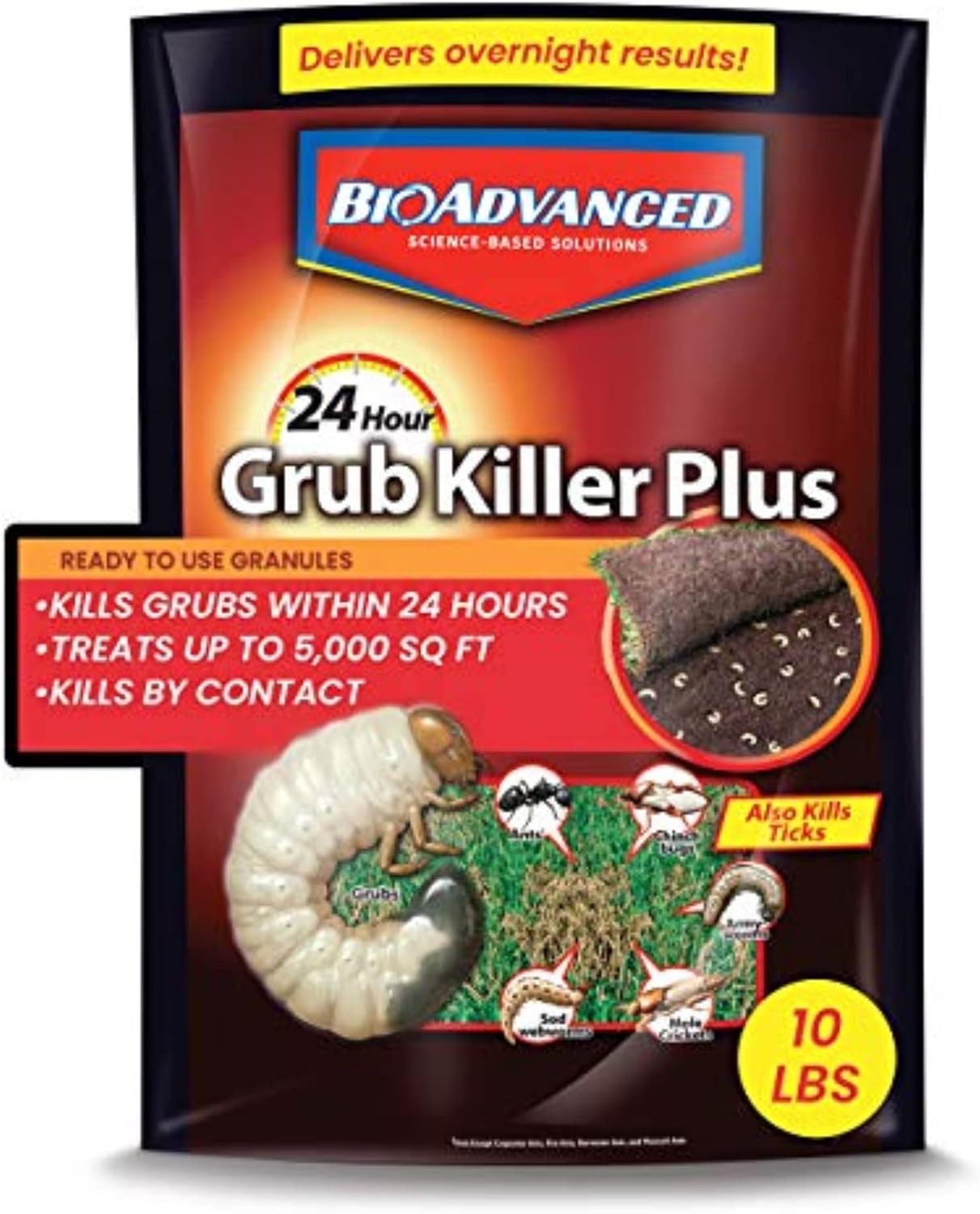
BioAdvanced 24-Hour Grub Killer Plus Granules, 10 lb
| Unit Count | 160 Ounce |
|---|---|
| Item Form | Granules |
| Target Species | Insects |
| Active Ingredients | Trichlorfon |
BioAdvanced 24-Hour Grub Killer Plus is a granular lawn insect treatment designed for quick knockdown of grubs and a long list of lawn pests. You apply the granules with a broadcast or drop spreader over the affected area and water them in to activate contact kill. The product highlights overnight results and is labelled to treat up to 5,000 square feet with a single 10 lb bag. It targets many turf pests including grubs, ticks, billbugs, chinch bugs, crickets, and sod webworms, so it works both for grub outbreaks and mixed pest problems. The practical benefits are straightforward: familiar spreader application, one-application coverage for a medium lawn, and a fast-acting active ingredient that reduces visible pest activity within a day. Important limitations are that it is a chemical treatment containing trichlorfon and must be used according to label restrictions, it excludes several ant species from control, and it is not sold in some states; safety and local regulatory compliance are considerations before use.
Best for: Homeowners who prioritize fast, practical pest control and want a single-application granular product to quickly stop grub-related lawn damage on a medium-sized yard.
Less Ideal for: People seeking organic or non-chemical grub solutions or those who prefer pesticide-free lawn care should look for alternative approaches.
- Fast-acting formula that claims visible results within 24 hours
- Covers up to 5,000 square feet from a single 10 lb bag
- Ready-to-spread granules compatible with broadcast or drop spreaders
- Effective against a broad list of turf pests beyond grubs
- Contains the organophosphate trichlorfon which requires careful handling and label compliance
- Not labeled to control several ant species and excludes some regional sales
Verdict: Choose this product when you need a fast, no-fuss granular treatment to quickly kill grubs and other common lawn pests across a medium-sized yard.
Choosing the Right Grub Killer for Late Summer: Key Factors to Consider
Active Ingredient and Target Life Stage
The active ingredient determines which grub life stage it controls best. Late summer treatments are most effective against first- and second-instar larvae that hatched earlier in the year. Some actives are fast-acting and kill feeding larvae quickly, while others work more slowly but provide longer residual protection. Knowing whether a product targets newly hatched grubs or larger, later-stage larvae affects both timing and expected results.
Match the product to the expected life stage in your region. If you apply too early or too late relative to peak hatching, you may miss the window when grubs are most vulnerable, reducing effectiveness and potentially leading to repeated treatments.
Speed of Control Versus Residual Protection
Speed of control matters when visible turf damage is progressing. Fast-acting options can reduce feeding in days, which helps salvage stressed grass. Longer-residual products release active ingredient slowly or persist in the root zone, protecting against additional hatchings but potentially keeping active chemistry in the soil longer.
Balance your need for a quick knockdown with whether you need ongoing protection through fall. In late summer, a product that combines reasonably fast action with a few weeks of residual control often gives the best practical outcome for homeowners.
Application Method and Coverage
How you apply a grub killer influences uniformity and results. Granular spreaders give even coverage over large lawns, while hose-end applicators and concentrates can be useful for spot treatment or irregular areas. Some formulations require incorporation with water or light irrigation to move the active ingredient into the root zone where grubs feed.
Consider the size and shape of your lawn, your spreader or sprayer equipment, and whether you prefer a one-time broadcast application or targeted spot treatments. Ease of achieving even coverage reduces the risk of untreated patches where grubs persist.
Turf Health and Recovery
Treating grubs is only part of returning a lawn to health. Products vary in how they affect grass during and after application. Some treatments can increase turf stress if not applied correctly or if combined with drought conditions. Late-summer timing means warm temperatures and, in many regions, limited rainfall; that amplifies the need for careful irrigation and follow-up care.
Plan to water appropriately after application if the label recommends it, and consider supplemental feeding or overseeding only after grub activity is controlled and turf is beginning to recover.
Pet, Wildlife, and Pollinator Safety
Residential lawns are shared spaces with pets and visiting wildlife, so safety is a top concern. Look for products with clear pet-safety instructions, label guidance on re-entry times, and recommendations for avoiding treated-clover or flowering weeds that attract pollinators. Some actives are more toxic to non-target insects and animals, which matters when you have bees, birds, or curious pets.
Follow label instructions for safe handling, and consider temporary barriers or timing applications when pets and pollinators are least active to reduce exposure risk.
Local Timing and Regulations
Regional differences in grub species and life cycles influence the ideal late-summer timing. The calendar date for effective late-summer control can vary by climate zone and grub species. Some municipalities also have restrictions on certain chemistries or application methods in residential areas.
Check local extension resources for expected grub activity in your area and confirm any local regulations before choosing a product to ensure legal and effective use.
Why Late Summer Is Often the Best Time to Treat
Many grub species hatch and enter feeding stages that are vulnerable in late summer. At this time larvae are small, feeding close to the surface, and easier for contact or systemic actives to reach. Treating too early risks degrading the active ingredient before peak feeding, while treating too late means larvae have grown larger and are harder to control.
Late-summer treatment also gives turf time to recover before colder weather, provided you follow label watering and recovery recommendations. This timing commonly reduces the need for multiple treatments if you choose an option with some residual activity.
- Targets newly hatched, shallow-feeding larvae
- Gives turf weeks to recover before fall dormancy
- Balancing fast knockdown with residual protection reduces retreatments
Granular Versus Liquid Applications
Granules are popular because they are easy to apply evenly with a spreader and are less likely to drift. They often require light watering to move the active ingredient into the root zone. Liquids and hose-end mixes can provide more uniform coverage in irregular spaces and are convenient for spot treatment, but they demand more care to calibrate rate and avoid runoff.
Choose the form that matches your equipment and lawn layout. For small patches, a liquid may be faster and more precise. For broad, uniform lawns, granules typically give consistent coverage with less fuss.
- Granules: easy spreader application and low drift
- Liquids: better for spot treatments and irregular shapes
- Follow irrigation guidance to move actives into the root zone
Combining Cultural Practices With Treatments
Treatments work best when combined with sound lawn care. Addressing thatch, improving soil drainage, and maintaining appropriate mowing height reduce stress that makes damage from grubs more visible. Aeration and light fertilization after grub control can speed recovery, but avoid heavy feeding until you see signs the grubs are no longer active.
Water management is also important. Many labels call for light irrigation after application to activate the product. Do not overwater and cause runoff. Planning irrigation and cultural steps around the label directions improves both efficacy and turf resilience.
- Use aeration to relieve compaction after grub control
- Time fertilization to turf recovery, not during active infestation
- Manage irrigation to follow product activation instructions
Spot Treatment Strategies for Small Infestations
If damage is limited to patches, spot treating reduces chemical use and limits exposure to non-target areas. Identify feeding hotspots by checking for loose turf and visible grubs in the root zone. Apply product according to label rates for spot areas and water in as recommended.
Rotate between monitoring and targeted follow-up rather than broadcasting over the entire lawn when infestation is patchy. This approach saves product, lowers risk to pollinators and pets, and can be combined with mechanical removal in small areas.
- Inspect turf to confirm grub presence before treating
- Apply spot rates carefully and water per label
- Monitor treated spots for recovery before expanding treatment
Organic and Biological Options to Consider
There are biological and reduced-risk options that are useful in late summer. Some rely on naturally occurring nematodes or microbial actives that attack grubs. Biological controls often require precise soil temperatures and moisture to establish and may act more slowly than conventional chemistries.
Consider these options if you prioritize lower non-target impacts or have pollinator or wildlife concerns. They can be a good part of an integrated plan but often need closer attention to application conditions for reliable results.
- Biologicals may require warm, moist soil for best performance
- Often slower acting but lower non-target risk
- Best used as part of an integrated strategy with monitoring
How We Chose the Best Grub Killer for Late Summer
We shortlisted products based on factors that matter for late-summer grub control: the active ingredient and its activity window against small, newly hatched larvae; speed of kill and residual control; application method and uniformity across turf; and product safety for pets, pollinators, and soil organisms. We prioritized products with clear, labeled instructions for late-summer timing and those that are compatible with common lawn care practices like spot treatment, broadcast application, and light irrigation after application. Our evaluation also considered product availability in common application formats gardeners use: spreadable granules, hose-end liquids, and ready-to-mix concentrates. We excluded products whose labels do not support late-summer targeting or that require off-season timing only. Also excluded were options designed exclusively for agricultural use or that have restricted application rules in typical residential settings. The criteria emphasized practical performance in a home lawn rather than laboratory-only efficacy, along with clear safety guidance and application flexibility.
FAQ
When exactly in late summer should I apply a grub treatment?
Timing depends on local climate and grub species, but aim for when larvae are newly hatched and feeding near the surface. Local extension services can give regional hatch timing. In many areas this means late summer through early fall.
Will treating in late summer harm my grass or delay recovery?
Most labeled late-summer treatments are designed to be safe when used as directed, but turf stress from heat or drought can compound effects. Follow watering and post-application care recommendations and avoid heavy fertilization until the lawn shows recovery.
Can I use a single treatment for season-long control?
Some products provide several weeks of residual activity and may reduce the need for repeat applications, but no treatment guarantees season-long protection against successive hatchings. Monitor your lawn and plan follow-up treatments if new feeding appears and the label allows.
Are biological or nematode-based grub controls effective in late summer?
They can be effective, especially for small infestations, but biologicals often require specific soil temperatures and moisture to work well. They tend to act more slowly than conventional chemistries and may be best used as part of an integrated approach.
How soon after application can pets use the lawn?
Re-entry intervals vary by product. Many granular and liquid formulations allow pet activity after the product has been watered in and the surface is dry, but always follow the label instructions for re-entry and pet safety to minimize exposure.
Should I fertilize or overseed immediately after treating for grubs?
Delay heavy fertilization and overseeding until you confirm grub activity has stopped and the turf shows signs of recovery. Light feeding and aeration can help recovery, but seeding is best done when the soil and turf are stable and pest pressure is resolved.
Final Verdict
For late-summer grub control, prioritize timing, larval kill timing, and application method. Choose a product that targets newly hatched larvae, fits your lawn size and equipment, and has clear safety guidance for pets and pollinators. Expect tradeoffs between fast knockdown and longer residual protection, and plan cultural follow-up like watering, aeration, and staged fertilization to help turf recover. With the right timing and care, you can stop feeding damage and restore lawn health before cooler weather.
