

Note: This article contains affiliate links. If you click on these links and make a purchase, I may earn a small commission at no extra cost to you. This helps support my research and content. Read my full affiliate disclosure here.
A reliable hand pole saw transforms how you manage tall trees and overgrown shrubs without climbing. The right saw gives you the reach to prune higher limbs, a comfortable handle for steady control, and a blade that slices cleanly to promote healthy tree healing. This guide covers seven shortlisted hand pole saws that excel in those real-garden tasks and compares how they perform in reach, cutting quality, and ease of use. Below you will find practical notes on what matters in the yard and the evaluation criteria we used to select these top picks.
Top Picks at a Glance
| Best Overall The best all-around choice for most situations | Grefinity 27 ft Extendable Manual Pole Saw |  |
| Best Quality Built to a higher standard if you want something more solid | Fiskars Extendable 2-in-1 Tree Pruner & Pole Saw (7.9–12 ft) with Rotating Head |  |
| Best Value The sweet spot between price and what you get | VINGLI 26 ft Manual Pole Saw and Pruner with Fiberglass Extendable Poles |  |
| Best Budget The cheapest option that still gets the job done reliably | JAOTREL 7.5 ft Extension Pole Saw with Stainless Steel Blade |  |
| Highest Rated A top-rated pick with lots of positive feedback | Veebuyla 26ft Telescoping Manual Pole Saw with 24" Detachable Blade |  |
| Most Popular A crowd favorite that many people choose with confidence | Notch 18' Pole Saw Set with 15" Blade (40207) |  |
| Best Seller A high-volume bestseller chosen again and again | BlumeTrec 14.5 ft Manual Pole Saw with Mn Steel Blade and Adjustable Sections |  |
Grefinity 27 ft Extendable Manual Pole Saw

| Power Source | Manual |
|---|---|
| Other Special Features of the Product | Extendable, Lightweight |
| Blade Material | Carbon Steel |
| Handle Material | Fiberglass |
The Grefinity 27 ft manual pole saw extends from 7.8 to 27 feet to let you trim high branches from the ground or detach the head for handheld shrub work. Its fiberglass pole keeps the tool relatively light and non-conductive, which helps reduce arm fatigue and adds safety when working near low wires. The carbon steel saw blade has triple-ground teeth that cut on push and pull, and the hooked upper and lower fittings help hold branches and keep the blade from slipping during a cut. Threaded, machined joints lock the sections tightly to minimize wobble when fully extended. The saw includes a spare blade and protective sheath so you can swap blades in the field and keep performance consistent. Limitations to expect are that it is manually powered so cutting very large diameter limbs will be slow or require multiple passes, and reach and control at full extension demand careful two-handed technique to avoid vibration. For routine pruning, crown maintenance, and trimming palms or smaller limbs this is a practical, lightweight choice.
Best for: Home gardeners who want a single, lightweight tool to handle both high pruning and handheld shrub trimming and who prioritize reach and safety over motorized cutting power.
Less Ideal for: People who need to quickly remove large diameter limbs or who prefer the speed of motorized pole saws for heavy professional work.
- Extends to 27 ft for high branches without a ladder
- Fiberglass pole is lightweight and non-conductive to reduce fatigue and improve safety
- Triple-ground carbon steel blade cuts on push and pull for efficient slicing
- Precision threaded joints lock sections to reduce wobble when extended
- Includes a spare blade and protective sheath for quick replacement in the field
- Manual power limits ability to cut very thick limbs quickly
- Long fully-extended length requires good technique to control vibration and leverage
Verdict: A lightweight, extendable manual pole saw that gives DIY gardeners ladder-free reach and reliable cutting for routine pruning and maintenance.
Fiskars Extendable 2-in-1 Tree Pruner & Pole Saw (7.9–12 ft) with Rotating Head

| Power Source | Manual |
|---|---|
| Blade Length | 15 inches |
| Blade Material | Aluminum |
| Handle Material | Steel,Wood |
The Fiskars Extendable Tree Pruner is a manual 2-in-1 pole tool that lets you prune high or low branches without using a ladder. The aluminum pole extends from about 7.9 to 12 feet and locks in place, while a rope-free sliding handle and actuating ball control the cutting blade for more precise, two-handed cuts. A 15-inch double-grind saw is included for thicker limbs and the head rotates up to 230 degrees to reach awkward angles. The pole is lightweight so extended use causes less fatigue and the low-friction coating on the blade reduces sap buildup. The chain-drive gearing boosts cutting power compared with simple lever pruners, but as a manual tool it still requires physical effort on larger, dense branches. The extendable pole and rotating head make it versatile for most home-yard pruning tasks, and the durable steel blades plus lifetime warranty give confidence for regular maintenance use. Expect the best performance on small to medium branches and occasional sawing rather than frequent heavy-duty cutting.
Best for: Buyers who prioritize reliable, proven tools and want a versatile pole pruner for routine tree and shrub maintenance without using a ladder.
Less Ideal for: People who need frequent heavy-duty cutting of large-diameter limbs or who prefer motorized tools for minimal physical effort.
- Lightweight extendable aluminum pole reduces user fatigue during extended pruning
- Rope-free sliding handle with actuating ball allows two-handed, controlled cutting
- Includes 15-inch double-grind saw for cutting thicker branches
- 230-degree rotating head improves access to awkward angles and tight spots
- Manual operation requires significant physical effort on large or very dense branches
Verdict: A lightweight, well-built manual pole pruner that delivers reach, control, and a saw option for most home pruning tasks.
VINGLI 26 ft Manual Pole Saw and Pruner with Fiberglass Extendable Poles

| Power Source | Hand Powered |
|---|---|
| Other Special Features of the Product | Extendable |
| Blade Shape | Rectangular |
| Blade Material | Alloy Steel |
This VINGLI pole saw combines an extendable fiberglass pole system with a dual-head cutting setup so you can saw thicker limbs and snip smaller shoots from the ground. It assembles from eight threaded fiberglass sections into a 26 foot reach and breaks down for storage in the included carry bag. The head pairs a 3-sided gear-ground alloy-steel saw blade with a spring-action pruner jaw, and a spare blade is supplied for longer use. Threaded metal joints and full-thread engagement are designed to keep sections locked and reduce wobble compared with push-fit poles. In practice it is light enough to hold at full extension for short periods and the rubberized grip helps control the tool during cuts. Expect good corrosion resistance from the fiberglass and treated steel, but very long sawing sessions at full extension can cause fatigue and some vibration; the plastic handle material and manual operation mean this is for occasional to moderate use rather than daily professional work. Overall it is a practical, ladder-free option for homeowners who need a versatile pole saw for seasonal pruning.
Best for: Homeowners who want a practical, ladder-free tool to handle seasonal tree and shrub pruning and prefer a lightweight, easy-to-store solution.
Less Ideal for: Professional arborists or users who need a power saw for frequent heavy cutting or who require a tool built for intensive daily use.
- Extends to 26 feet using eight lightweight fiberglass sections for ladder-free reach
- Dual cutting head with a gear-ground alloy-steel saw blade plus spring-action pruning jaw
- Threaded metal joints and full-thread engagement reduce wobble and improve stability
- Includes a carry bag and a replacement blade for convenient storage and longer service life
- Manual operation and plastic handle material can lead to user fatigue and vibration at full extension
- Not intended for heavy daily commercial use despite sturdy joints
Verdict: A versatile, ladder-free manual pole saw that gives homeowners long reach and dual cutting options in a lightweight, portable package.
JAOTREL 7.5 ft Extension Pole Saw with Stainless Steel Blade

| Brand | JAOTREL |
|---|---|
| Blade material | Manganese steel |
| Pole material | Stainless steel |
| Maximum length | 7.5 FT |
This manual pole saw is a budget-friendly tool for cutting small to medium tree branches from the ground. The kit ships as sectional stainless steel poles that screw together to reach about 7.5 feet, and the manganese-steel blade features three-sided sharp teeth and a double-barbed design for faster, cleaner cuts. It is typically used standing on the ground to trim limbs, prune hedges, and remove dead wood without climbing. Notable features include a rust-resistant pole and blade, an ergonomic soft-grip handle, and a compact option to use the saw by hand for low trimming. Practical benefits are straightforward assembly, portability, and a sharp blade that slices through typical yard branches efficiently. Important limitations are that the tool is manual so it requires physical effort on thicker limbs and the fixed blade head limits reach compared with motorized or articulating pole saws. For heavy-duty or professional tree work you would still need a powered saw or a longer telescoping model.
Best for: Buyers who want a low-cost, no-frills pole saw for occasional yard pruning and prefer simple, lightweight tools they can store easily.
Less Ideal for: Not a good choice for professional arborists or users who need to cut large hardwood limbs frequently or want a motorized solution.
- Extendable sectional pole lets you reach higher branches without a ladder
- Manganese-steel blade with multi-angle teeth for faster, cleaner cuts
- Rust-resistant stainless steel construction improves durability for outdoor use
- Soft non-slip grip for better control during sawing
- Manual operation requires significant effort on thicker or hardwood branches
- Fixed blade head does not articulate for awkward angles
Verdict: A simple, affordable extendable pole saw that lets homeowners prune small to medium branches safely from the ground.
Veebuyla 26ft Telescoping Manual Pole Saw with 24" Detachable Blade

| Power Source | HAND |
|---|---|
| Blade Material | Stainless Steel |
| Other Special Features of the Product | Hook-End Blade |
| Blade Shape | Serrated |
| Cutting Angle | 108 degrees |
This Veebuyla telescoping pole saw is a straightforward, reliability-oriented tool for homeowners who need to trim high branches without a ladder. The four-stage pole extends from a compact length up to 20 to 26 feet depending on configuration and uses flip-tab locks to hold sections in place; the head includes a 24 inch serrated stainless steel blade with a hook-end tip that grabs branches for one-motion cuts. The saw detaches to become a handheld pruning saw for lower pruning, brush work, or cutting small logs, and the threaded tip accepts common threaded attachments for other jobs. In practical use the non-slip grip and tempered stainless blade feel durable and make repetitive cuts predictable, while the tool’s manual power avoids the complexity of gas or battery models. Important limitations are that it is hand-powered, so large or very thick limbs require more effort, and the telescoping joints demand periodic checking to maintain secure locks. For regular maintenance of medium branches and seasonal pruning this pole saw is a dependable, low-maintenance choice.
Best for: Homeowners who prioritize a durable, low-maintenance tool for regular tree pruning and yard upkeep and who prefer a mechanical solution over powered equipment.
Less Ideal for: People who need to remove very large limbs frequently or who prefer motorized pruning for speed and less physical strain should consider powered pole saws instead.
- Telescoping four-stage pole gives extended reach for high branches
- 24" serrated stainless steel blade with hook-end speeds single-motion cuts
- Detachable saw head converts to a handheld pruning saw for versatility
- Threaded tip accepts common attachments for multi-tool use
- Non-slip grip and flip-tab locks improve handling and stability
- Manual operation requires physical effort on thicker limbs
- Telescoping locks need regular inspection to ensure secure extension
Verdict: A simple, versatile manual pole saw that delivers reliable reach and durable cutting performance for routine tree pruning.
Notch 18' Pole Saw Set with 15" Blade (40207)

| Blade Length | 15 inches |
|---|---|
| Cut Capacity | Up to 8" |
| Blade Material | Alloy Steel |
| Handle Material | Fiberglass |
| Power Source | Manual |
This Notch pole saw set is a straightforward, professional-style tool for cutting high branches without a ladder. It ships with three 6-foot interlocking fiberglass poles that twist and lock together to reach about 18 feet, and a 15-inch chrome-plated blade with impulse-hardened, tri-edge teeth rated to cut branches up to roughly 8 inches thick. In use the light, commercial-grade fiberglass poles make it easy to hold and position the saw overhead while the serrated blade and hook help pull and pull-cut smaller limbs efficiently. Assembly is simple thanks to the twist-and-lock connectors and the blade is designed to stay sharp longer because of the hardened teeth and rust-resistant plating. Limitations are that it is manual so large-diameter limbs require more effort and control, and the hollow fiberglass poles should not be used near energized lines or left to retain moisture. For pruning tall deciduous trees and routine canopy cleanup it performs like a pro-grade extension saw, but it is not a substitute for powered saws when tackling very thick or dead wood.
Best for: Buyers who prioritize reliable cutting performance and professional-grade reach for overhead pruning and routine canopy maintenance and who prefer a durable manual tool over powered equipment.
Less Ideal for: People who need to cut large, very thick trunks regularly or who prefer powered, faster-cutting solutions for heavy commercial removal work.
- Extends to about 18 feet using three interlocking 6-foot fiberglass poles for high reach without ladders
- 15-inch chrome-plated blade with impulse-hardened, tri-edge teeth for durable, long-lasting cutting performance
- Serrated blade and hook design aid in pull-cutting and controlling branches
- Twist-and-lock pole connectors allow quick assembly and the option to use 1, 2, or 3 poles
- Manual operation requires significant physical effort on thick limbs compared with powered saws
- Poles are hollow and can retain moisture so they are not safe near energized lines
Verdict: A professional-grade manual pole saw that delivers long reach and a durable 15" impulse-hardened blade for reliable overhead pruning.
BlumeTrec 14.5 ft Manual Pole Saw with Mn Steel Blade and Adjustable Sections
| Power Source | Manual |
|---|---|
| Blade Material | Alloy Steel |
| Blade Length | 16.7 inches |
| Included Components | Wrench |
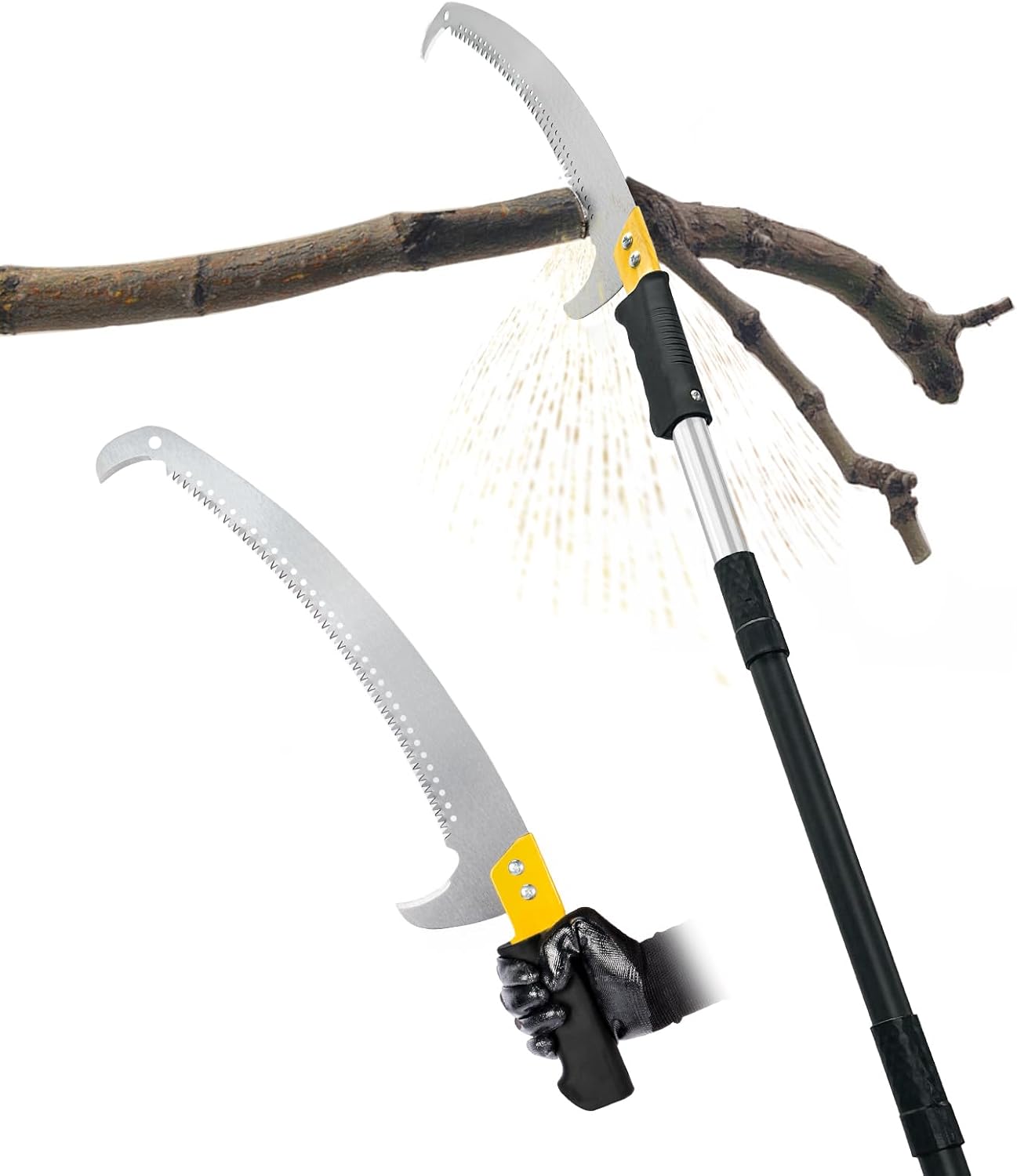
This BlumeTrec pole saw is a manual, multi-section pruning saw designed to let you trim high branches safely from the ground. The pole breaks down into sections so you can assemble it to three fixed lengths (8.5 ft, 11 ft, 14.5 ft) to match the task, and a manganese steel blade with a three-sided edge and double-sided barbs grips and slices branches for cleaner cuts. The stainless steel poles are powder-coated to resist rust and a tightening screw secures the saw head so it stays steady during use. In practice this is a basic, no-power tool that is quiet, low-maintenance, and lighter to carry than most motorized alternatives, making it easier for less experienced users to avoid ladders. Expect quicker work on small to medium branches but slower progress on very thick wood since it is manual. The plastic handle and anti-slip grip improve control but the modular pole means assembly time and storage space should be considered. Overall it is a straightforward, safety-minded option for everyday yard pruning when you want a simple, reliable tool rather than powered equipment.
Best for: Buyers who prioritize safety and simplicity and want to prune high branches from the ground without using power tools or climbing ladders; good for homeowners doing routine yard maintenance.
Less Ideal for: Professional arborists or anyone who needs to cut very large or numerous thick hardwood branches frequently should choose a powered pole saw or chainsaw instead.
- Adjustable multi-section pole offers three fixed reach lengths for flexible use.
- Mn steel blade with three-sided edge and barbs provides secure, clean cuts on small to medium branches.
- Powder-coated stainless poles resist rust for outdoor durability.
- Lightweight manual design reduces noise and maintenance compared with motorized saws.
- Anti-slip grip and extra screw to secure the saw head improve handling and safety.
- Manual cutting limits speed and effectiveness on very thick or hardwood branches.
- Plastic handle may feel less durable under heavy professional use.
Verdict: A simple, rust-resistant extendable manual pole saw that lets risk-conscious homeowners prune high branches from the ground without ladders.
Choosing the Right Hand Pole Saw: Key Factors to Consider
Reach and Height Coverage
How far a hand pole saw reaches determines what pruning jobs you can do from the ground. Consider both the maximum extended length and the effective cutting height when accounting for your own standing reach or a small ladder. Incremental extension increments matter because they affect how precisely you can position the blade under a branch, and longer poles can magnify wobble if the locking system or pole material is weak. Choose a saw with reach that matches the tallest common branches in your yard while keeping control manageable.
Also think about how the pole behaves at intermediate lengths. Some poles are stable only when fully extended; others lock solidly at multiple stops. If you frequently prune at mid heights, a pole that holds steady in those positions will be more useful and safer than one offering just one long reach.
Blade Quality and Cut Type
Blade material, tooth geometry, and knife angle affect how cleanly a pole saw severs wood. A sharper, well-tempered blade slices with less force and reduces tearing of the cambium, which leads to quicker healing in trees. Look for blades that are replaceable or at least serviceable so you can restore cutting performance without replacing the whole tool. Tooth pattern and rake angle influence whether a saw is better for green pruning or dead wood; a more aggressive tooth cuts faster through hard, dry branches while finer teeth give neater finishes on live wood.
Regular sharpening and keeping blades free of sap and pitch will extend life and reduce the effort required. Consider whether the saw accepts common aftermarket blades or branded replacements when planning long-term upkeep.
Pole Material and Locking Mechanism
Pole composition affects weight, stiffness, and durability. Aluminum poles are lightweight and corrosion resistant but can flex under load. Fiberglass or composite poles often offer better vibration damping and more stiffness for long reaches, though they may be heavier. Wood poles are less common but can feel more comfortable in hand. The locking mechanism is as important as pole material. Twist locks, lever clamps, or cam locks each have tradeoffs in speed and reliability. A robust locking system minimizes slip while cutting and reduces the risk of sudden collapse.
Inspect how well the pole sections seat together and whether the lock is easy to operate with gloved hands. For repeated seasonal use, choose systems known to resist wear and loosening over time.
Ergonomics and Handling
Using a hand pole saw often requires working overhead in awkward positions, so handle shape and grip material matter. A comfortable foam or rubber grip reduces hand fatigue and helps control twisting when you pull the blade through a cut. Weight distribution is critical; a heavy head at the end of a long pole will make the tool feel unbalanced, leading to quicker fatigue and reduced accuracy. Look for models with a balance between head weight and pole mass.
Consider how the saw mounts or angles for different cuts. Some heads tilt or are set at a fixed angle to help reach under branches. Also check whether the saw can be operated one-handed or requires two hands for safe cutting at maximum reach.
Portability and Storage
A pole saw should store conveniently and be easy to transport to different parts of a property. Collapsible poles that retract to a compact length are helpful for putting the tool in a shed or car. The number of sections impacts collapsed size and the time needed to extend or pack the pole. Fewer sections often mean faster setup but a longer collapsed length. Lightweight construction reduces effort when carrying the saw between work areas.
Also consider whether the tool includes blade covers or a storage sleeve to protect the teeth and prevent accidents when stored. Durable finishes and rust-resistant components make the tool more reliable if it is kept outdoors or in damp storage.
Maintenance and Replaceability
Routine maintenance keeps a hand pole saw functioning and safe. Blades should be accessible for sharpening or replacing, and the pole should allow cleaning of sap or debris from joints. Easy-to-find replacement parts such as blades, locking collars, or tension hardware will extend the usable life of the tool. Consider how simple it is to tighten connections or adjust blade tension in the field without specialized tools.
Also plan for seasonal checks of fasteners and locks, and treat any exposed metal to avoid rust. Choosing a saw with straightforward maintenance reduces downtime and cost over years of use.
Pruning Techniques for Taller Trees
Proper pruning techniques combined with the right hand pole saw will make cuts that promote tree health. Aim to remove branches at the branch collar without leaving long stubs. Make smaller, controlled cuts rather than trying to take large limbs in a single slice when working from the ground.
For higher limbs, position your body so you are stable and able to pivot the pole smoothly. If a branch is under tension, make an initial undershot cut to prevent bark tearing, then finish with an overcut. Using a pole saw with a blade profile suited to live wood will reduce the force needed and help you place cleaner cuts.
- Stand on solid, level ground and keep a safe distance from falling limbs.
- Use short, steady strokes for control when cutting overhead.
- Make an undercut on tensioned branches to prevent bark ripping.
Safe Use and Personal Protective Equipment
Safety should be your primary concern when working overhead. Wear eye protection, a hard hat if there is a risk of falling debris, and gloves that provide a secure grip. Consider ear protection if you are working near powered tools, even though hand pole saws are manual.
Be mindful of where cut branches will fall. Clear bystanders and pets from the work area and never work under power lines. If a limb is heavy or awkward, do not try to control its descent with the saw alone; use a rope or get assistance.
- Inspect the saw before each use for loose hardware or damaged blades.
- Keep a first-aid kit nearby and have a phone accessible in case of emergency.
Storing and Caring for Blades
Clean blades after use to remove sap and debris that can corrode the cutting edge. A light coat of oil prevents rust and helps the blade remain easier to sharpen. If the pole saw will not be used for an extended period, remove the blade if possible and store it in a dry place with a protective cover.
Sharpen blades periodically following the manufacturer or general hand-saw sharpening guidelines. Properly maintained blades cut faster and require less physical effort, which reduces fatigue and improves control when working at height.
- Use a file or dedicated sharpening tool suitable for the tooth pattern.
- Store the tool collapsed to reduce the chance of bending or damage in transit.
When to Call a Professional
Hand pole saws are great for small to medium limbs, but there are situations where a professional is the safer option. Large-diameter branches, limbs that are close to structures or power lines, and trees with significant disease or structural weakness should be evaluated by a qualified arborist.
If a pruning job requires repeated cuts at extreme reach or involves chainsaw-level removal, a professional has the equipment and rigging expertise to reduce the risk of property damage or injury.
- Seek professional help for limbs thicker than you can cut cleanly in two passes.
- Hire an arborist for major crown reductions or hazardous tree removal.
Adapting Hand Pole Saws for Different Garden Tasks
Beyond pruning high branches, hand pole saws can help clear hedgerows, cut back overgrown fruit trees, and remove deadwood from large shrubs. Choose different blade types or tooth patterns based on whether you are cutting green wood or dry, dead branches.
For repeated light pruning, a shorter, stiffer pole offers better control. For occasional work on a tall property, prioritize reach and blade strength. Evaluate how attachments or replacement heads fit the pole if you plan to use the same shaft for multiple cutting tasks.
- Swap blades designed for dry wood when tackling dead branches to reduce binding.
- Use a pole with a compatible head if you want interchangeable cutting tools.
How We Chose the Best Hand Pole Saw
We shortlisted hand pole saws that demonstrably help gardeners prune higher limbs safely and efficiently. Selection started with tools designed for manual, extension-based cutting rather than powered alternatives. We prioritized build durability, ergonomics for extended use, blade quality for clean cuts, and reach options suitable for common yard heights. Other factors included the ease of adjusting or collapsing poles, secure locking mechanisms, and overall pack weight for repetitive pruning sessions. Excluded from consideration were motorized or battery-powered pole saws, tools intended primarily for professional arborists with extreme reach, and low-quality hobby trim saws that lacked replaceable blades or stable pole locks. Our evaluation focused on four to six practical, scoreable dimensions: reach and telescoping stability, blade sharpness and cutting efficiency, pole construction and locking, and user comfort and handling. These criteria reflect what gardeners actually need when pruning branches from a ladder, the ground, or a low platform.
FAQ
How long should a hand pole saw be for a typical suburban yard?
It depends on your tallest branches, but most suburban yards are served by poles that extend between 8 and 16 feet of effective cutting height when accounting for standing reach. Consider how comfortable you are handling the pole at extended lengths and whether a mid-length locking position is useful.
Can a hand pole saw cut through dead, hard wood?
Yes, with the right blade geometry and sharpness a hand pole saw can cut dead or hard wood, though it may require more effort. Use a blade with coarser teeth for dry wood and maintain sharpness to reduce binding and reduce fatigue.
Is it safe to use a hand pole saw from a ladder?
Using a pole saw from a ladder increases risk because the pole can shift your balance. If you must use a ladder, choose a stable platform, keep both feet planted, and avoid overreaching. Whenever possible, prune from the ground or use a stable work platform and consider a shorter pole for ladder work.
How often should I sharpen or replace the blade?
Frequency depends on use and wood types cut. Light seasonal use may need sharpening once per season, while heavy or abrasive work requires more frequent attention. Replace blades when sharpening no longer restores a clean cutting edge or if teeth are damaged.
What maintenance extends the life of a pole saw?
Regularly clean sap and debris, oil metal parts to prevent rust, check and tighten locking hardware, and inspect the pole for cracks or loose ferrules. Store the tool collapsed and protected to avoid bending and accelerated wear.
Final Verdict
Choosing the right hand pole saw is a balance between reach, blade performance, pole stiffness, and how comfortable the tool feels during extended overhead work. Prioritize reach that matches your tallest pruning tasks while ensuring the pole locks solidly and the blade can deliver clean cuts. Consider ergonomics and maintenance needs because a well-balanced, serviceable saw will be safer and more effective over many seasons. Use the evaluation criteria above to weigh tradeoffs and select a saw that helps you prune confidently and maintain tree health.
