

Note: This article contains affiliate links. If you click on these links and make a purchase, I may earn a small commission at no extra cost to you. This helps support my research and content. Read my full affiliate disclosure here.
If you trim moldings, build picture frames, or do any trim carpentry, a purpose-fit hand saw for mitre cuts makes angled work quicker and more accurate. The right saw reduces tearout at the bevel, tracks a consistent line through the cut, and stays comfortable during repeated strokes. This guide covers six shortlisted hand saws that are well suited to mitre work and explains the features that matter in a real workshop or on-site. Below you will find practical evaluation points we used to narrow the field and how each saw performs on accuracy, control, and ease of use. Read on for the decision factors that will help you pick the best saw for your mitre work and setup.
Top Picks at a Glance
| Best Overall The best all-around choice for most situations | Stanley Saw Storage Miter Box with Saw |  |
| Best Quality Built to a higher standard if you want something more solid | SUIZAN Ryoba 7" Double-Edge Japanese Pull Saw |  |
| Best Value The sweet spot between price and what you get | IVY Classic 14" Miter Back Saw with Hardwood Handle |  |
| Best Budget The cheapest option that still gets the job done reliably | WFOEJEJ 6" Japanese Double-Edge Pull Saw (SK5 Blade) |  |
| Highest Rated A top-rated pick with lots of positive feedback | Magicbox 4‑Piece Japanese Hand Saw Set, SK5 Steel Pull Saws |  |
| Most Popular A crowd favorite that many people choose with confidence | GreatNeck BSB14 12" Mitre Box and Saw Set |  |
Stanley Saw Storage Miter Box with Saw

| Included angles | 90°, 45°, 22.5° |
|---|---|
| Material | Aluminum |
| Cutting length | 11.81in |
| Includes | Miter box with saw and storage |
This Stanley miter box pairs a lightweight aluminum frame with a matching hand saw and a patented storage system that keeps the blade tucked into the box when not in use. It provides preset slots for 90°, 45°, and 22.5° cuts, making it straightforward to lay workpieces in and make accurate crosscuts or common miter angles for trim, picture frames, and small moulding. The 11.8 inch cutting length suits short boards and trim; the aluminum construction resists warping and stays square under normal shop or workshop use. Because it is a manual system, you get steady, controlled cuts without setup for a saw or power mitre saw, and its compact size stores easily. Limitations are the short cutting capacity for wider stock and the fact that highly precise or compound angles require a powered miter saw or specialized jig. For general-purpose mitering on small stock this is a simple, durable option that is easy to use and store.
Best for: A practical buyer who wants an affordable, easy-to-use manual solution for routine miter and crosscuts on trim and small stock without the cost or setup of a powered miter saw.
Less Ideal for: Woodworkers who frequently cut wide lumber, need compound-angle capability, or require shop-level precision should choose a larger powered miter saw or dedicated jig instead.
- Preset 90°, 45°, and 22.5° guide slots for quick, repeatable miter cuts
- Aluminum construction resists warping and keeps guides square
- Includes saw and patented onboard storage to protect the blade and simplify storage
- Compact footprint is easy to store and transport for hobbyists or jobsite touchups
- Cutting length (about 11.8 inches) limits use to narrow boards and trim
- Not suitable for compound angles or very high-precision joinery compared with powered miter saws
Verdict: A durable, easy-to-store manual miter box that gives quick, accurate 90°, 45°, and 22.5° cuts for small trim and hobby projects.
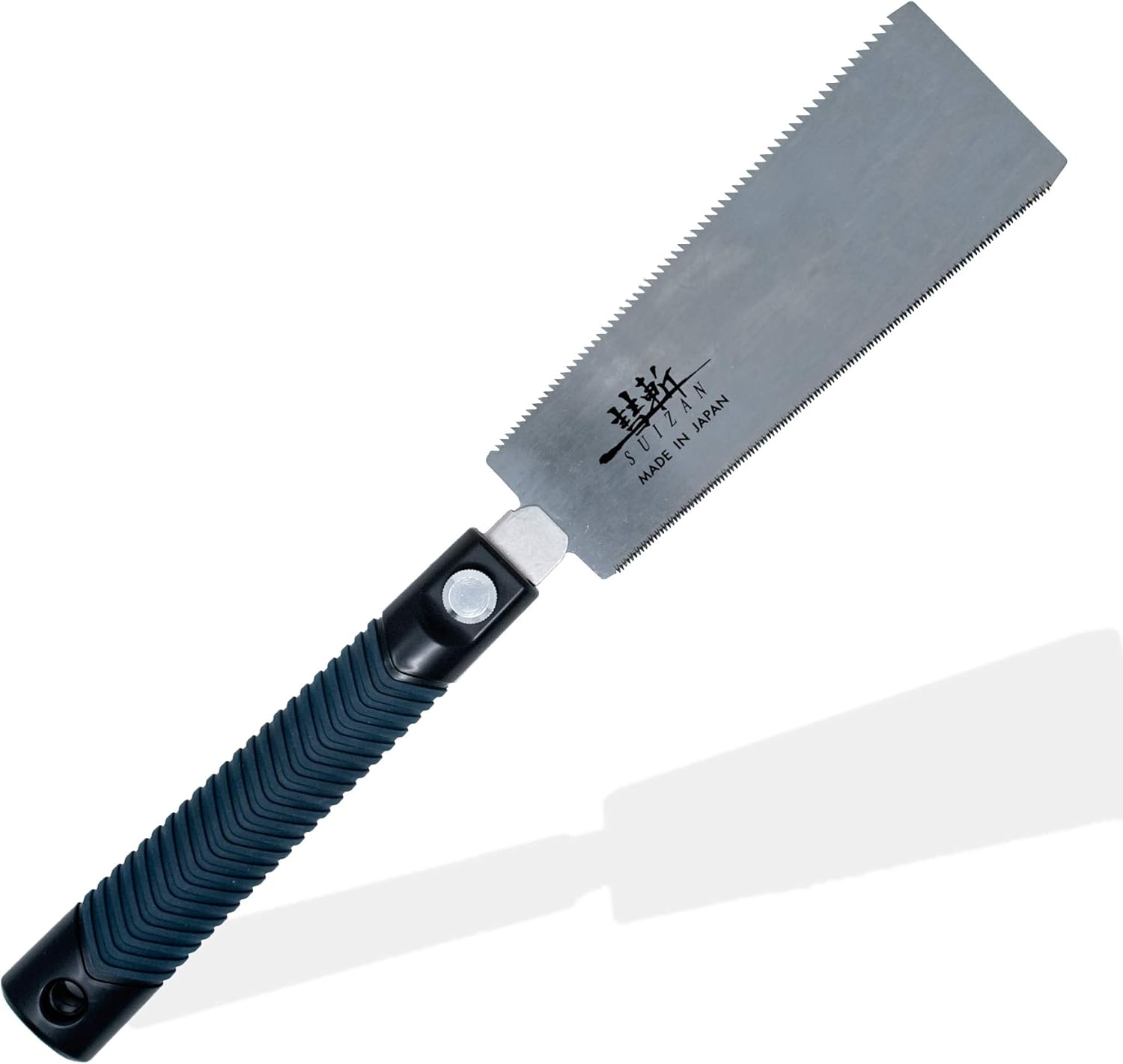
SUIZAN Ryoba 7" Double-Edge Japanese Pull Saw
| Blade Length | 7 inches |
|---|---|
| Blade Material | Japanese Steel |
| Blade Thickness | 0.02" (0.5mm) |
| TPI | 19 (crosscut) / 7-11 (rip) |
The SUIZAN 7" Ryoba is a compact Japanese pull saw built for accurate, low-effort cutting on trim, joinery, and small mitre work. It has a 0.02" thin Japanese-steel blade with dual edges: coarser rip teeth on one side and 19 TPI crosscut teeth on the other, so you can switch between ripping and clean crosscuts without changing tools. Because it cuts on the pull stroke the blade tracks the cut with less flex and a narrower kerf, which helps produce tight mitre joints and fine finish on moulding. The elastomer handle gives a secure grip for controlled strokes and the blade is user-replaceable without tools if you work it hard. Limitations to note are the short 7" blade length, which makes long crosscuts slower and less suitable for large stock, and the very thin blade requires proper support and steady technique to avoid binding on harder or warped lumber. For performance-minded users it shines on precision mitres and detailed carpentry but is not intended to replace a full-size backsaw or panel saw for larger cuts.
Best for: A woodworker or finish carpenter who prioritizes clean, accurate mitre and trim work and values a low-resistance pull-stroke saw for detailed joinery.
Less Ideal for: Users who need to make frequent long crosscuts, rip large boards, or perform heavy rough carpentry should choose a larger backsaw or panel saw instead.
- Dual-edge Ryoba blade gives both rip and fine crosscut capabilities in one tool
- Very thin 0.02" blade and narrow 0.03" kerf produce precise, low-resistance cuts ideal for mitre joins
- High-quality Japanese steel stays sharp and is replaceable without tools
- Elastomer non-slip handle provides a secure grip for controlled pull strokes
- 7" blade is short for long crosscuts or large stock
- Thin blade can be more prone to binding or deflection on very hard or poorly supported wood
Verdict: Choose this compact Ryoba if you want a precision, low-kerf pull saw that produces clean mitre cuts and fine finish work.
IVY Classic 14" Miter Back Saw with Hardwood Handle

| Blade Length | 14 inches |
|---|---|
| Blade Material | Alloy Steel |
| Handle Material | Wood |
| Number of Teeth | 168 |
The IVY Classic 14" Miter Back Saw is a purpose-built hand saw for accurate miter and crosscuts in both soft and hardwoods. The reinforced steel back keeps the blade straight during cuts and the electro-oil impulse hardened alloy-steel blade holds an edge well. Precision-ground tri-edge teeth cut on both push and pull strokes, which speeds cutting and helps produce clean, square faces when used in a miter box. The hardwood handle gives a solid grip and a traditional feel for controlled cuts. Practical users will appreciate the reusable plastic blade guard for safe storage and the saw's suitability for fine trim, moldings, and small joinery tasks. Limitations are its fixed 14-inch blade length and single teeth-per-inch specification, which make it best for miter box work and not for very long ripping cuts or specialty tooth patterns. Expect professional-quality straight cuts for trim and finish work when paired with a miter box and steady technique.
Best for: A buyer who prioritizes accurate, repeatable miter and trim cuts and wants a durable, no-frills saw to use with a miter box for finish carpentry and small joinery projects.
Less Ideal for: People who need a versatile saw for long ripping cuts, heavy demolition, or highly specialized tooth patterns should consider different saw types.
- Reinforced steel back keeps blade rigid for precise, square cuts
- Precision-ground tri-edge teeth cut on push and pull strokes for faster, cleaner cutting
- Electro-oil impulse hardened alloy-steel blade maintains edge life
- Hardwood handle delivers a secure, controlled grip
- Reusable plastic blade guard protects the blade in storage
- 14" blade length limits reach for larger stock and long rip cuts
- Fixed tooth pitch may not be ideal for extremely fine work or specialty cuts
Verdict: Choose this saw if you want a rigid, well‑toothed miter saw for fast, accurate trim and molding cuts when used with a miter box.
WFOEJEJ 6" Japanese Double-Edge Pull Saw (SK5 Blade)

| Power Source | Hand Powered |
|---|---|
| Number of Teeth | 168 |
| Blade Material | Sk5, steel |
| Blade Length | 6 inches |
This 6-inch Japanese pull saw is built for precision work on small pieces and tight mitre joints. The double-edge SK5 blade gives two tooth patterns—14 TPI for faster material removal and 17 TPI for finer finishing—so you can rough-cut then switch sides for a cleaner kerf. The thin, flexible blade is well suited to flush trimming dowels, tenons and mitre waste because it bends to follow the workpiece while cutting on the pull stroke for improved control. A soft, non-slip plastic grip helps keep the saw steady during repeated strokes. At this size it excels on trim, mitre box work and furniture repair where a full-size saw is awkward. Expect limitations when cutting large stock or long crosscuts since the short blade and pull-only action make heavy ripping slow. The plastic handle is lightweight but less premium than molded hardwood, and the thin blade will require careful storage to avoid damage. Overall it is a practical, low-cost option for accurate mitre and trim tasks around the shop or home.
Best for: A budget-focused DIYer or hobbyist who needs a compact, controllable saw for mitre cuts, trim work, and small woodworking projects where precision matters more than speed.
Less Ideal for: Professional woodworkers who frequently rip large boards or need long continuous cuts should choose a full-size saw or powered tool instead.
- Double-edge SK5 blade offers both coarse and fine tooth options for versatility
- Flexible thin blade enables close flush cuts and easier trimming of dowels and tenons
- Pull-stroke design gives good control for precise mitre and trim work
- Short 6-inch blade limits speed and efficiency on larger or longer crosscuts
- Plastic handle is lightweight but less durable and premium-feeling than wooden or metal handles
Verdict: A low-cost, precision-focused pull saw that gives budget-minded users accurate mitre and flush cuts in tight spaces.
Magicbox 4‑Piece Japanese Hand Saw Set, SK5 Steel Pull Saws

| Blade Material | Carbon Steel |
|---|---|
| Power Source | hand powered |
| Other Special Features of the Product | Ergonomic Handle |
| Surface Recommendation | Wood |
| Included Components | Case |
This Magicbox set supplies four Japanese-style pull saws that cover most small to medium woodworking tasks. The kit includes large and compact double-edge pull saws for rip and crosscuts, a flush-cut saw for trimming dowels and joints, and a pointed fine saw for tight spaces. SK5 spring steel blades are heat-treated and have fine triple-ground teeth to deliver clean cuts with reduced tear-out, and the included blade guards make storage safer. Wooden ergonomic handles give a comfortable grip for controlled strokes and longer sessions. The set is lightweight and portable, so it works well for hobbyists, trim carpenters, and furniture makers who need reliable hand tools on the bench or at a job site. Limitations are that the blades are hand tools only so they require proper technique for fast work on large stock, and the wooden handles and carbon steel blades will need occasional care to prevent moisture-related wear. Overall this is a dependable, versatile hand saw set that emphasizes clean cutting and practical storage for everyday woodworking use.
Best for: Buyers who prioritize reliable, precise hand tools for furniture making, trim work, and detailed woodworking and who prefer a complete set that covers multiple cutting needs.
Less Ideal for: Users who need high-speed production cutting of large lumber or who prefer low-maintenance synthetic handles and stainless blades should consider other options.
- Includes four complementary saw types (large and compact double-edge, flush cut, and pointed fine saw) for a wide range of cuts
- SK5 spring steel, heat-treated blades with fine triple-ground teeth for cleaner cuts and durability
- Ergonomic non-slip wooden handles for comfortable control during extended use
- Protective blade covers included for safer storage and transport
- Requires basic pull-saw technique and more time than power tools for large or repetitive cuts
- Wood handles and carbon steel blades need occasional maintenance to avoid rust and wear
Verdict: A versatile, dependable four-piece Japanese saw set that delivers clean, controlled cuts for furniture, trim, and detailed woodworking.
GreatNeck BSB14 12" Mitre Box and Saw Set

| Blade teeth | 12 TPI |
|---|---|
| Cutting depth | 3 inch |
| Ruler | 8.5 inch built-in ruler |
| Mitre angles | Preset 45° and 90° |
The GreatNeck 12" mitre box and saw set is a simple, low-tech solution for making precise 45° and 90° cuts in soft and hard woods used for trim and molding. The kit pairs a high-impact polystyrene mitre box with a reinforced steel back saw that has a high-impact plastic handle. Preset angle guides speed up repeat cuts and the saw’s 12 TPI blade produces relatively smooth edges for hand-cut work. The box includes an 8.5" ruler edge for quick measuring and the saw’s straight back keeps the blade rigid for cleaner bevels and a 3" cutting depth. Because it is manual and compact it is easy to reposition on a workbench or clamp for small jobs and does not require power tools or setup. Limitations are the modest cutting depth and the plastic mitre box, which can wear with heavy use and is less stable than a metal jig for large pieces or professional production runs.
Best for: Buyers who want a budget-friendly, reliable hand solution for occasional trim and molding work and prefer a simple tool they can use without power tools or complex setup.
Less Ideal for: Professionals doing high-volume or heavy-duty cutting, or anyone who needs deeper cuts or the durability and clamping stability of a metal mitre jig.
- Preset 45° and 90° guides for quick, repeatable bevel cuts
- Reinforced steel back saw with 12 TPI for smoother hand cuts
- Built-in 8.5" ruler edge for fast on-tool measurements
- Compact and portable design that clamps easily for small jobs
- Mitre box is high-impact polystyrene which may wear or crack under heavy use
- 3 inch cutting depth limits use on thicker stock
Verdict: A straightforward, portable mitre box kit that delivers accurate 45° and 90° hand cuts for DIY trim and occasional professional touch-ups.
Choosing the Right Hand Saw for Mitre Cuts: Key Factors to Consider
Cut Accuracy & Line Control
Accurate mitre cuts depend on a blade that tracks straight and teeth that slice cleanly at the chosen angle. For hand mitre work you want a saw whose kerf follows your guide line without wandering, especially at shallow bevels. A stiff blade and correct tooth set limit vibration and walking during each stroke, while a consistent tooth pattern helps maintain a true line across the cut.
When making mating pieces for frames or trim, even small deviations show as gaps. That makes accuracy the primary factor: if the saw does not track reliably you will spend time sanding or re-cutting. Test how the blade behaves when you change stroke length and pressure, because mitre cutting often requires controlled, shorter strokes near corners.
Tooth Geometry and Finish
The tooth shape, size, and finishing affect both cut speed and the quality of the cut face. For mitre cuts on trim and molding, teeth that are finely pitched and properly set reduce tearout on the finished face. Crosscut-style teeth with a slight fleam usually score well for clean edges, while a coarser rip style is faster but rougher.
A polished or ground tooth edge cuts more predictably than a crude stamped edge. Some blades have ground teeth or impulse-hardened edges that hold sharpness longer, which matters if you make many precision cuts between resharpenings.
Handle Comfort and Grip
Ergonomics matter in mitre work because you often need to control the saw precisely while applying even pressure. A handle that fits your hand and gives a secure grip reduces wrist fatigue and helps maintain a consistent stroke plane. Look for handles with enough palm support to stabilize the tool during shorter, finish strokes used near corners.
Non-slip grip materials help when your hands are sweaty or when working outdoors. Also consider handle geometry for both right- and left-handed use; some handles favor one hand for better visibility and control when cutting small molding pieces.
Blade Stiffness and Tracking
A stiff blade resists bending and helps the blade stay straight through the cut, which is vital for square mitre faces. Thin, flexible blades can flex under pressure and produce curved or wavy kerfs that make tight joints difficult to assemble.
Blade back reinforcement or a thicker profile near the spine improves tracking. However, stiffer blades may weigh more and reduce the sensitivity of light starting strokes, so balance stiffness with control demands for the types of cuts you make.
Ease of Starting Cuts
Many mitre cuts begin at the edge of a workpiece or on thin trim where a rough start can cause splintering or missed alignment. Saws that are easy to start have a thin, sharp leading tooth or a microset that bites cleanly without catching. A well-shaped toe on the handle and a comfortable stance help you position the saw to begin a cut at the exact mark.
Practice with the saw to find the right angle and pressure for clean starts. For very delicate profiles, using a backing board or scoring the cut line first can reduce tearout, but an easy-to-start saw reduces the need for those extra steps.
Durability and Corrosion Resistance
Hand tools in a workshop or on a job site are exposed to humidity, dust, and occasional knocks. Blade finishes that resist rust and durable handle materials extend service life and preserve cutting performance. Look for blades with protective coatings and handles made from stable materials that do not compress or craze with time.
Durability also covers how well the teeth hold an edge. Hardened or ground teeth stay sharper longer between maintenance sessions, which matters when you rely on consistent mitre performance across many cuts.
Best Practices for Getting Clean Mitre Cuts
Set up a secure mitre box or use a simple fence to guide the saw and stabilize the workpiece. Clamping small trim to a backing board keeps thin pieces from shifting and reduces tearout on the finished face.
Use short, controlled strokes as you approach the cut line and increase stroke length only once the saw is tracking true. Check alignment from multiple angles before finishing the cut so mitre faces meet flush.
- Clamp trim to a sacrificial backing board to prevent splintering.
- Score the cut line with a sharp knife for delicate profiles.
- Start with a light scoring stroke to seat the saw before full cuts.
Setting Up a Portable Mitre Station
If you work on site or move between rooms, keep a small portable mitre box or miter guide and a clamp in your kit. Position the guide on a solid surface and brace the workpiece so vibrations do not throw the blade off line.
Consider a compact marking tool and a small square for quick angle checks. Having a backup thin blade or sharpening file helps when teeth nick during transport.
- Use a quick-clamp that resists twisting under saw stroke pressure.
- Mark angles clearly and check with a small bevel gauge before cutting.
Sharpening and Maintaining Hand Saws
Routine care keeps mitre cuts clean and consistent. For saws with removable blades, inspect teeth and edge finish frequently and file or replace teeth when they dull. For fixed-blade saws, clean resin and pitch from the blade and lightly oil the surface to resist corrosion.
Stropping and jointing the file work prevent uneven teeth that wander during cutting. Keep a small triangular file and a saw set in your toolbox so you can maintain tooth geometry between professional services.
- Remove pitch with a solvent and a nylon brush to restore cutting performance.
- Joint and back files prevent uneven tooth height that causes wandering kerfs.
Working With Different Trim Materials
Hardwoods, softwoods, and engineered trim behave differently at mitre joints. Hardwoods require sharper teeth and steadier pressure to avoid burning or chipping, while softwoods may compress if you apply too much force, leading to rough edges.
For veneered or laminated moldings, support the veneer with a backing board and use a fine-pitched tooth pattern to minimize tearout. Test cuts on scrap offcuts when switching materials to confirm tooth choice and stroke technique.
- Use finer pitch for veneers and laminated surfaces.
- Adjust stroke speed and pressure for hardwoods to avoid burning.
How We Chose the Best Hand Saw for Mitre Cuts
We focused on tools that reliably produce clean, repeatable angled cuts and that are practical for both workshop and on-site trim work. Primary evaluation criteria included cut accuracy at common mitre angles, tooth geometry and finish for reduced tearout, handle ergonomics for controlled strokes, and blade stiffness for straight kerfs. We also weighed portability and setup convenience when a saw needs to be transported to a job, plus durability of the blade finish against rust and wear. Excluded items included generic panel saws and multi-purpose carpentry saws that lack the tooth geometry or ergonomic design needed for accurate mitre work. We did not consider powered mitre saws because this roundup is focused on hand-operated tools. The listed filters and tests emphasize how well each saw holds line under typical mitre-cut conditions, how easy it is to start and finish an angled cut without splintering, and how comfortable the tool is during repeated use.
FAQ
What tooth pitch is best for mitre cuts on trim?
A finer tooth pitch, typically a higher teeth-per-inch count, gives cleaner faces on trim and molding. Finer teeth reduce tearout on finished surfaces but cut more slowly than coarse teeth, so choose based on the profile and material.
Can I use a general-purpose panel saw for mitre work?
Often a general-purpose panel saw lacks the tooth geometry and handle control needed for precise angled cuts. It may work for rough mitres, but for clean trim and frame joints a saw designed for mitre work is preferable.
How do I reduce tearout on delicate molding?
Clamp the molding to a sacrificial backing board and make a light scoring stroke before completing the cut. Using a fine-pitched saw with a polished tooth edge also helps minimize splintering.
How often should I sharpen a hand saw used for mitre cuts?
Frequency depends on use and material hardness. Light hobby use may need attention only a few times a year, while daily trim work on hardwoods requires more frequent filing or professional sharpening. Regular inspection will show when teeth dull.
Is blade thickness more important than tooth shape for mitre accuracy?
Both matter. Blade thickness contributes to stiffness and tracking, while tooth shape controls cut quality and tearout. Opt for a balance: a stiff enough blade to track true with teeth shaped for the material you cut.
Final Verdict
For mitre-focused hand sawing, prioritize tools that combine straight-tracking blades with fine, well-finished teeth and a comfortable handle. Those elements together determine whether your mitre faces meet squarely and without visible gaps or tearout. Consider how often you work with delicate trim, whether you need portability, and how much maintenance you are willing to do; each choice involves tradeoffs between speed, longevity, and finish quality. In short, pick a saw that matches the materials and frequency of your mitre work, and maintain its teeth and blade. That approach delivers the most consistent, professional-looking angled joints over time.
