

Note: This article contains affiliate links. If you click on these links and make a purchase, I may earn a small commission at no extra cost to you. This helps support my research and content. Read my full affiliate disclosure here.
If you make small wooden models, boxes, or home décor, the right hand saw changes how tidy your joints and edges look. A saw built for small wood crafts behaves differently than a full-size carpentry tool: blade thickness, tooth geometry, and handle ergonomics all shape the cut feel and the amount of finish work required. This guide covers six carefully shortlisted hand saws suited for small wood crafts. We evaluated each option on cut quality, ease of control, build durability, and how cleanly it leaves the workpiece. Read on to understand the tradeoffs and which features matter most for precise hobby work.
Top Picks at a Glance
| Best Overall The best all-around choice for most situations | Tamiya Fine Craft Handsaw with Handle |  |
| Best Quality Built to a higher standard if you want something more solid | SUIZAN 5" Flush Cut Japanese Pull Saw |  |
| Best Value The sweet spot between price and what you get | IRWIN ProTouch Coping Saw |  |
| Best Budget The cheapest option that still gets the job done reliably | VPQZUPG Japanese Pull Saw 6" SK5 Double Edge (14/17 TPI) |  |
| Highest Rated A top-rated pick with lots of positive feedback | Magicbox 4‑Piece Japanese Hand Saw Set, SK5 Steel Pull Saws |  |
| Most Popular A crowd favorite that many people choose with confidence | RUITOOL 6" Ryoba Japanese Double-Edge Pull Saw |  |
Tamiya Fine Craft Handsaw with Handle

| Power Source | Manual |
|---|---|
| Blade Material | Carbon Steel |
| Surface Recommendation | plastic and wood |
| Other Special Features of the Product | Ergonomic Handle |
The Tamiya Fine Craft Handsaw is a short, manual saw made for hobbyists working on small wood and plastic projects. It features a 46 mm fine-toothed carbon steel blade and an ergonomic plastic handle that together make controlled, low-effort cuts and leave clean edges on model parts and small craft pieces. It is typically used for trimming sprues, shaping small wooden components, and making delicate cuts where a larger saw would be unwieldy. The saw comes with replaceable blades stored in a plastic case and the narrow blade profile helps reach tight spots on models. Limitations include its small blade length and five-teeth configuration, which means it is not suitable for cutting large stock or fast removal of material; users working on bigger projects will need a larger saw. For detailed hobby work the tool is lightweight and easy to maneuver, but the plastic handle and modest blade size keep it firmly in the fine-craft category rather than a general-purpose woodworking tool.
Best for: Hobbyists and craftmakers focused on small-scale wood and plastic projects who prioritize precise, controlled cuts for models and delicate parts.
Less Ideal for: Woodworkers who need to cut larger boards or remove material quickly should choose a larger rip or crosscut saw instead.
- Fine 46 mm carbon steel blade leaves clean edges on plastic and small wood pieces
- Ergonomic plastic handle offers good control for delicate cuts
- Compact blade profile and included blade case make it easy to reach tight spots and store blades safely
- Replaceable blades let you keep a sharp cutting edge without replacing the whole tool
- Small blade length and five-tooth geometry limit cutting speed and capacity for larger stock
- Plastic handle feels less robust than metal alternatives for heavy use
Verdict: Choose this compact handsaw when you need precise, clean cuts for small wood and plastic craftwork.
SUIZAN 5" Flush Cut Japanese Pull Saw

| Blade Length | 5 inches |
|---|---|
| Blade Thickness | 0.012" (0.3mm) |
| TPI | 17 & 25 |
| Blade Material | Japanese Steel |
| Handle Material | Wood |
The SUIZAN 5" flush cut pull saw is a purpose-built hand saw for fine woodworking, trimming dowels, plugs, and making precise crosscuts in small parts. It is used on the pull stroke and its 0.012" thin blade flexes to lie flat against the workpiece, letting you trim hardware and wood plugs flush without marring the surrounding surface. One edge features 17 TPI for hardwood and the other 25 TPI for softwood, so you can switch between finer and coarser teeth depending on the cut. The beech handle gives a comfortable grip for controlled strokes and the Japanese steel blade stays sharp and delivers a narrow kerf for minimal material removal. Important limitations are that the blade is not replaceable and the short 5" blade is only suited to small tasks and tight spaces rather than ripping or larger panel work. For performance-focused small craft and furniture finishing, this saw delivers clean, professional results when used with proper pull-saw technique.
Best for: A buyer who prioritizes clean, high-performance finishes on small woodworking projects and furniture repairs and who values tools that deliver precise control over quick stock removal.
Less Ideal for: People who need a general-purpose handsaw for ripping large boards, cutting long panels, or who prefer replaceable blades and heavier-duty saws for production work.
- Very thin 0.012" blade produces a narrow kerf and precise flush cuts
- Double-edged teeth (17 TPI and 25 TPI) for effective cutting in both hardwood and softwood
- Zero-set teeth trim flush without scratching adjacent surfaces
- Compact, flexible blade reaches tight spaces and detailed joinery
- Made in Japan Japanese steel for sharpness and durability
- Blade is fixed and not replaceable
- Blade length and design limit use to small workpieces and detailed trimming
Verdict: Buy this if you want a high-precision flush-cut pull saw that produces clean, professional results on small woodcraft and finishing tasks.
IRWIN ProTouch Coping Saw
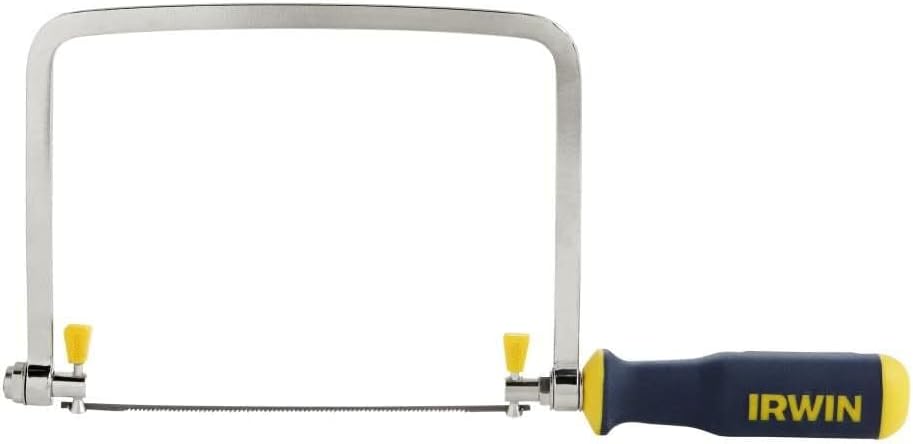
| Blade length | 6-1/2" |
|---|---|
| Frame depth | 5-1/2" |
| Tooth count | 17-pt. |
| Blade material | High-speed steel |
The IRWIN ProTouch Coping Saw is a straightforward hand saw aimed at small woodworking and craft tasks that require accurate curved cuts and interior cutouts. It uses high-speed steel blades with a 17-teeth-per-inch count that handle softwoods, trim, and many common hobby materials cleanly. The flat-bar frame and DuraSteel pins give the tool a durable backbone, while the ProTouch ergonomic handle reduces hand fatigue during repetitive cutting. With a shallow 5-1/2 inch frame depth and 6-1/2 inch blade length it is easy to maneuver inside small workpieces and inside tight curves. Blade tension and replacement are simple, making it suitable for workshops where different blade types or frequent blade changes are needed. The saw is not intended for heavy ripping or large dimensional lumber and its small blade limits reach, so users doing larger demolition or long straight cuts will need a different saw. For detailed trim work, model making, and hobby projects this coping saw balances durability and comfort at a practical, no-frills level.
Best for: Craftspeople and hobbyists who need a reliable, comfortable coping saw for detailed curved cuts, trim work, and small wood projects where control and durability matter.
Less Ideal for: People who frequently cut large boards, perform heavy demolition, or need long straight rip cuts should choose a larger saw designed for those tasks.
- High-speed steel blade suitable for clean cuts in softwood and common hobby materials
- Ergonomic ProTouch handle reduces hand fatigue during extended use
- Flat-bar frame with DuraSteel pins provides durable, long-lasting construction
- Compact frame and 6-1/2 inch blade allow precise curved and interior cuts
- Small blade length limits reach and makes it unsuitable for large or long straight cuts
- Not designed for heavy ripping or cutting large dimensional lumber
Verdict: A durable, comfortable coping saw built for precise curved and interior cuts in small woodworking and craft projects.
VPQZUPG Japanese Pull Saw 6" SK5 Double Edge (14/17 TPI)

| Blade material | SK5 steel |
|---|---|
| Blade length | 6 inch |
| Tooth configuration | Double edge 14/17 TPI |
This 6-inch Japanese pull saw is built for small woodworking tasks where control and precision matter. The SK5 steel blade offers two edges with 14 and 17 teeth per inch so you can switch between faster, rougher cuts and finer, more detailed cuts without changing tools. Its pull-cut action reduces the force needed to start a stroke and helps keep the blade tracking on a line, which is useful for joinery, dowel trimming, model work, and furniture touch-ups. The compact wooden handle is comfortable for short sessions and helps maneuver around tight workpieces. Because the blade is short and optimized for detail, it is not intended for resawing large boards or heavy construction, and aggressive cutting will be slower than with larger saws. For a basic, budget-friendly addition to a craft or hobby toolkit, this saw gives good versatility in a small, easy-to-control package.
Best for: Ideal for budget-conscious hobbyists and DIYers who do small wood crafts, joinery, or furniture touch-ups and need a precise, easy-to-control saw for detail work.
Less Ideal for: Not a good choice for professional carpenters or users who need to rip large boards, perform heavy structural work, or cut for long continuous runs.
- Double-edge 14/17 TPI blade lets you choose between faster or finer cuts
- SK5 steel blade provides good edge retention for hobby woodworking
- Pull-cut design improves control and reduces effort during sawing
- Compact 6-inch blade and wooden handle are easy to maneuver in tight spaces
- Short blade is unsuitable for cutting large boards or heavy-duty tasks
- Wooden handle may be less durable or ergonomic for prolonged use
Verdict: A compact, affordable Japanese pull saw that gives budget-minded crafters two tooth options for precise small-scale woodworking.
Magicbox 4‑Piece Japanese Hand Saw Set, SK5 Steel Pull Saws

| Blade Material | Carbon Steel |
|---|---|
| Power Source | hand powered |
| Other Special Features of the Product | Ergonomic Handle |
| Surface Recommendation | Wood |
| Included Components | Case |
This Magicbox set supplies four Japanese-style pull saws that cover most small to medium woodworking tasks. The kit includes large and compact double-edge pull saws for rip and crosscuts, a flush-cut saw for trimming dowels and joints, and a pointed fine saw for tight spaces. SK5 spring steel blades are heat-treated and have fine triple-ground teeth to deliver clean cuts with reduced tear-out, and the included blade guards make storage safer. Wooden ergonomic handles give a comfortable grip for controlled strokes and longer sessions. The set is lightweight and portable, so it works well for hobbyists, trim carpenters, and furniture makers who need reliable hand tools on the bench or at a job site. Limitations are that the blades are hand tools only so they require proper technique for fast work on large stock, and the wooden handles and carbon steel blades will need occasional care to prevent moisture-related wear. Overall this is a dependable, versatile hand saw set that emphasizes clean cutting and practical storage for everyday woodworking use.
Best for: Buyers who prioritize reliable, precise hand tools for furniture making, trim work, and detailed woodworking and who prefer a complete set that covers multiple cutting needs.
Less Ideal for: Users who need high-speed production cutting of large lumber or who prefer low-maintenance synthetic handles and stainless blades should consider other options.
- Includes four complementary saw types (large and compact double-edge, flush cut, and pointed fine saw) for a wide range of cuts
- SK5 spring steel, heat-treated blades with fine triple-ground teeth for cleaner cuts and durability
- Ergonomic non-slip wooden handles for comfortable control during extended use
- Protective blade covers included for safer storage and transport
- Requires basic pull-saw technique and more time than power tools for large or repetitive cuts
- Wood handles and carbon steel blades need occasional maintenance to avoid rust and wear
Verdict: A versatile, dependable four-piece Japanese saw set that delivers clean, controlled cuts for furniture, trim, and detailed woodworking.
RUITOOL 6" Ryoba Japanese Double-Edge Pull Saw

| Blade Material | Sk5 Steel |
|---|---|
| Blade Length | 6 inches |
| TPI | 14 & 17 |
| Blade Thickness | 0.67mm |
| Handle Material | Beechwood |
This RUITOOL 6-inch Ryoba pull saw is built for small, precise woodworking tasks where control matters. The thin, flexible SK5 blade and the double-edged layout (14 TPI one side, 17 TPI the other) let you switch between smoother crosscuts and finer cuts for hardwood without changing tools. The hardened three-edge teeth and ultra-thin 0.67mm blade improve cutting speed and leave clean surfaces ideal for trim, joinery, and flush cutting close to workpieces. Its compact overall length and beechwood handle make it comfortable to use in tight spaces and for delicate work, and the lightweight construction reduces fatigue during repetitive small cuts. Limitations are the short 6-inch blade, which is not suited for long rip cuts or large stock, and the fixed beechwood handle offers no anti-slip modern grip. It is a hands-on tool that requires proper pull-stroke technique to get the best finish and to avoid bending the blade on heavy-duty jobs.
Best for: Ideal for DIYers and small-craft woodworkers who prioritize precise finish work, trim, and joinery in compact projects and value a traditional pull-saw technique.
Less Ideal for: Not a good fit for users who need to cut large boards, perform long rip cuts, or prefer modern ergonomic handles for heavy-duty, high-volume work.
- Flexible SK5 high-carbon steel blade for smooth, precise flush cuts
- Double-edged teeth (14 and 17 TPI) for crosscuts and finer hardwood cuts without swapping saws
- Hardened three-edge teeth for sharper, longer-lasting cutting performance
- Lightweight, compact design and comfortable beechwood handle for use in tight spaces
- Short 6-inch blade limits reach and makes long straight cuts slower
- Beechwood handle lacks modern textured or rubberized grip for wet or slippery conditions
Verdict: Choose this compact Ryoba pull saw when you want a precise, fast-cutting hand saw tailored for small woodworking and finish cuts.
Choosing the Right Hand Saw for Small Wood Crafts: Key Factors to Consider
Tooth Pitch and Geometry
Tooth pitch and the shape of each tooth determine how the saw cuts different wood species and thicknesses. Finer teeth with higher teeth-per-inch (TPI) produce smoother cuts in thin stock and reduce tear-out on delicate grain, while coarser teeth remove material faster but leave a rougher surface.
For small wood crafts you will usually prefer a finer pitch because it minimizes chipping on trim pieces and model parts. Some saws use a hybrid tooth pattern that balances speed with cleanliness; understand the typical stock thickness you cut and match the tooth geometry accordingly.
Blade Thickness and Kerf
Blade thickness affects both the stiffness of the saw and the width of the cut, or kerf. A thinner blade flexes more, which can make precision work difficult if the cut wanders, but it also removes less material and reduces waste on small parts.
Choose a blade thickness that provides enough stiffness to keep cuts straight without forcing excessive material removal. For tiny components where waste matters, a narrow kerf is attractive, but it should not come at the cost of control.
Handle Shape and Grip Comfort
Handle ergonomics influence your ability to make steady, repeatable cuts. A comfortable grip reduces hand fatigue during repetitive trimming and improves control for delicate maneuvers like short pull strokes or mitered corners.
Look for handles that fit your hand size and allow a secure hold without slipping. Some handles provide palm support or textured surfaces that are useful when working with gloved hands or when finer tactile feedback is needed.
Blade Length and Cut Type
Blade length affects the maximum workpiece size you can cut and the kind of cuts that are most efficient. Shorter blades are easier to control for small components and fine joinery, while slightly longer blades let you break down small boards more quickly.
Also consider whether you need a crosscut-style tooth pattern for cutting across the grain or a rip-style pattern for cutting with the grain. Many hobbyists favor crosscut or hybrid patterns for small projects because they produce cleaner edges on end grain and thin stock.
Material and Corrosion Resistance
Blade steel quality and any rust-resistant coatings determine how long a saw will stay sharp and true in a workshop environment. Lower-quality steel may blunt quickly when used on abrasive materials or if it encounters nails or grit in reclaimed wood.
If you store tools in a humid garage or shed, corrosion resistance becomes more important. Look for protective finishes and consider simple storage and maintenance routines to prolong blade life.
Ease of Sharpening and Maintenance
Some hand saws are easy to sharpen and set, while others are designed as replaceable-blade units. For dedicated hobbyists who plan to use and tune a saw long-term, the ability to refile teeth and restore a set is valuable.
If you prefer less maintenance, a replaceable-blade design or saw made from a harder, longer-lasting steel may be preferable. Factor in the availability of replacement blades or the practicality of sharpening in your workshop.
Best Uses For Small-Craft Hand Saws
Hand saws tailored to small wood crafts excel at trimming dowels, cutting miters for picture frames, slicing thin hardwoods for inlays, and making small box parts. Shorter blades let you work close to clamps and fixtures and offer better control on short stock. For delicate joinery and model making, the priority is a smooth exit and minimal splintering rather than raw cutting speed.
- Fine-tooth crosscut patterns for clean edges on thin stock
- Short blade lengths for control around clamps and fixtures
- Thin kerf for minimizing material waste on small parts
Workshop Setup Tips For Cleaner Cuts
Support your workpiece firmly to prevent vibration and reduce tear-out. Use a bench vise with soft jaws, a small miter box, or sacrificial backers when cutting narrow strips to protect thin stock from splitting. Clamp positioning is important; place clamps so they do not obstruct the saw stroke while still preventing movement.
When making repeated small cuts, mark and pre-score delicate edges with a utility knife or marking blade to guide the saw and prevent chipping. A light coating of paste wax on a saw plate can reduce friction and make the stroke feel smoother without affecting cut quality.
- Use sacrificial backing for thin veneers and laminated parts
- Pre-score joint lines on fragile grain to reduce tear-out
- Keep strokes short and controlled for accuracy
Alternative Tools For Extremely Fine Work
For the smallest parts or extremely intricate profiles, consider complementing a small hand saw with fine-tooth coping saws, hobby knives, or razor saws. These tools are designed for tight curves and detailed cuts that are difficult with even the finest small hand saw.
Combine tools in sequence: remove bulk material with a small hand saw, then refine shapes and fitments with a coping saw or file. This approach reduces stress on thin blades and gives a cleaner final surface.
- Use coping saws for internal curves and tight profiles
- Reserve razor saws for model-scale parts and delicate trims
- Files and sanding sticks are essential for final shaping
Maintaining Saw Teeth and Blade Alignment
Regularly inspect teeth for nicks and check the blade for straightness. Small hook or burrs can be smoothed with a fine file, and a periodic professional sharpening will restore ideal cutting geometry for hobby-critical applications.
If your saw uses replaceable blades, swap them before they become dull enough to cause tear-out. Proper tension and alignment during reassembly keep the blade tracking true and reduce wobble on short cuts.
- Smooth small burrs with a fine file to avoid tear-out
- Check blade straightness against a flat reference
- Replace blades when clean cuts become hard to achieve
How We Chose the Best Hand Saw for Small Wood Crafts
We started by focusing on features that directly impact small-scale woodworking. Criteria included blade tooth geometry because tooth size and pattern determine how cleanly a saw severs thin stock and delicate grain. Blade stiffness and thickness were checked to balance accurate, straight cuts with minimal kerf waste. Handle ergonomics and control were prioritized to reduce hand fatigue and improve accuracy on short cuts and curved work. Build materials and corrosion resistance were assessed to ensure a saw stays true through repeated use and occasional exposure to workshop humidity. Added features such as replaceable blades or comfortable grips were noted when they improved long-term usability. We excluded large crosscut or rip saws intended for rough framing and any tools whose kerf or tooth pitch is unsuited to thin craft stock. We also excluded knives and razor tools; this list focuses on small hand saws designed to produce repeatable, controllable cuts in hobby projects. The final shortlist favors tools that balance precise cutting geometry, manageable kerf, and good user control for hobbyists and small-scale woodworkers.
FAQ
What tooth pitch is best for cutting thin craft plywood?
A fine tooth pitch, typically 10 to 14 TPI depending on ply thickness, gives smoother edges and reduces splintering on thin plywood. Smaller hobby pieces often benefit from even finer teeth or a razor saw for the cleanest finish.
Can I use a full-size carpentry saw for small crafts?
You can, but full-size saws often have coarser teeth and wider kerfs that are less suited to delicate work. They may remove more material and cause more tear-out than a saw designed for small-scale projects.
How should I store hand saws to prevent rust?
Keep saws in a dry place, lightly oiled or treated with a corrosion inhibitor, and hang them to avoid blade contact with other tools. A simple wipe with oiled cloth after use prevents surface rust in humid environments.
Is a replaceable-blade saw better than a fixed-blade for hobbyists?
Replaceable blades offer convenience and quick refresh, which is useful if you do varied work or dislike sharpening. Fixed-blade saws made from quality steel can be re-sharpened and tuned for a lifetime if you are comfortable maintaining them.
How can I reduce splintering on the exit side of a cut?
Use a sacrificial backer board under the cut, score the cut line with a knife beforehand, and use a fine-tooth blade. Cutting with a steady, controlled stroke and supporting the workpiece reduces exit tear-out.
Final Verdict
For small wood crafts prioritize cut cleanliness, control, and a blade profile that matches the stock you work with. Expect tradeoffs between kerf width and stiffness: a slightly thicker blade can make straighter cuts but removes more material, while a thin blade conserves stock at the cost of potential flex. Choose a saw that fits your hand, uses a tooth geometry suited to your typical material, and offers either easy sharpening or replaceable blades depending on how much maintenance you want to do. Focusing on those priorities will make it easier to produce precise, repeatable results in small woodworking projects.
