

Note: This article contains affiliate links. If you click on these links and make a purchase, I may earn a small commission at no extra cost to you. This helps support my research and content. Read my full affiliate disclosure here.
If you need accurate, clean lines in timber, the right hand saw makes a big difference. A saw that tracks true and resists flexing keeps cuts square and reduces finish work. This guide covers the top five hand saws chosen specifically for straight cuts, with attention to blade geometry, tooth set, and stiffness that matter at the jobsite and in the workshop. We shortlisted dependable options and evaluated each against practical criteria gardeners and woodworkers rely on when cutting boards, trimming lumber, or shaping treated timbers. Read on for what we tested and why these characteristics matter for straight, tear-free cuts.
Top Picks at a Glance
| Best Overall The best all-around choice for most situations | CRAFTSMAN 20" Fine Finish Hand Saw (CMHT20881) |  |
| Best Quality Built to a higher standard if you want something more solid | Silky Professional Series TSURUGI 300mm Straight Hand Saw |  |
| Best Value The sweet spot between price and what you get | QYQRQF 14 in. Pro Hand Saw with Ergonomic Soft-Grip Handle |  |
| Best Budget The cheapest option that still gets the job done reliably | EXTYQWC 6" Ryoba Japanese Pull Saw with SK5 Double-Edge Blade |  |
| Highest Rated A top-rated pick with lots of positive feedback | Magicbox 4‑Piece Japanese Hand Saw Set, SK5 Steel Pull Saws |  |
CRAFTSMAN 20" Fine Finish Hand Saw (CMHT20881)

| Blade Length | 20 inches |
|---|---|
| Number of Teeth | 6 |
| Blade Material | High Speed Steel |
| Power Source | Manual Power |
| Handle Material | Composite Materials |
The CRAFTSMAN 20" Fine Finish hand saw is a straightforward wood-cutting tool designed for clean, fast cuts in panel and dimensional lumber. Its 20-inch high-speed steel blade with induction-hardened teeth delivers lasting sharpness and the six teeth per inch profile is tuned for smooth crosscuts and general carpentry tasks. The bi-material ergonomic handle gives good control and includes simple 45- and 90-degree references for square and miter work, which helps when cutting without a box or guide. Because the blade is rectangular and built for fine finish work, it performs best on wood, plywood, and laminate rather than heavy demolition. The saw is lightweight and easy to use for extended periods, making it suitable for finish carpentry, trimming, and DIY projects where a neat edge matters. It lacks specialized features like replaceable blades or extra teeth density for ultra-fine joinery, but as a durable, no-frills hand saw it balances performance and comfort for everyday woodworking tasks.
Best for: A practical homeowner or carpenter who wants a reliable, easy-to-use saw for general woodworking and finish cuts around the house.
Less Ideal for: Woodworkers who need ultra-fine joinery blades, frequent ripping, or modular saw systems with replaceable blades should consider more specialized saws.
- Durable high-speed steel blade with induction-hardened teeth for longer edge life
- Six TPI fine-finish tooth pattern for clean crosscuts in wood and panel materials
- Ergonomic bi-material handle that improves grip and control during cuts
- Lightweight design suitable for extended use and general carpentry
- Tooth count and blade design prioritize finish cuts over aggressive ripping or heavy demolition
- No replaceable blade option for specialized or worn-edge replacements
Verdict: Choose this saw if you need a durable, comfortable 20" hand saw that delivers clean, fast finish cuts for everyday woodworking.
Silky Professional Series TSURUGI 300mm Straight Hand Saw

| Blade Length | 11.81 inches |
|---|---|
| Number of Teeth | 80 |
| Blade Material | High Speed Steel |
| Handle Material | Rubber |
The Silky TSURUGI is a performance-focused straight hand saw built for fast, accurate cutting in pruning and woodworking. Its 300mm high-speed steel blade and aggressive tooth geometry deliver quick material removal and a clean, controlled cut, especially on branches and dimensional lumber where straight, pull-stroke cuts matter. The blade is narrow and finely ground, which reduces binding and lets the saw slice with minimal effort in tight quarters. The two-part rubber grip integrates with the tang for a secure, vibration-damping hold and the included aluminum scabbard with rollers keeps the blade protected and ready on a belt. Practical benefits include light overall weight for extended use, easy re-sheathing in the field, and a lifetime-limited warranty for manufacturing defects. Limitations are that the design favors cut speed over ultra-fine finishing compared with very fine-tooth saws, and its fixed straight blade makes it less convenient for confined angled cuts where a folding or curved pruning saw would fit better.
Best for: Experienced gardeners, arborists, and woodworkers who prioritize fast, reliable straight cuts and want a lightweight, well-balanced saw for frequent field use.
Less Ideal for: Casual users wanting a multi-purpose folding pruning tool or anyone needing ultra-fine finish cuts or better access into tight, curved spaces.
- 300mm high-speed steel blade provides fast, durable cutting performance
- Aggressive tooth count designed for rapid material removal and straight cuts
- Ergonomic two-part rubber grip for secure, comfortable handling during long tasks
- Includes aluminum scabbard with rollers for safe, convenient belt or leg carry
- Coarser teeth prioritize speed over the very finest surface finish
- Straight fixed blade is less practical in tight angled or awkward reach situations
Verdict: Choose the Silky TSURUGI when you need a lightweight, high-performance straight saw that makes fast, precise cuts in wood.
QYQRQF 14 in. Pro Hand Saw with Ergonomic Soft-Grip Handle
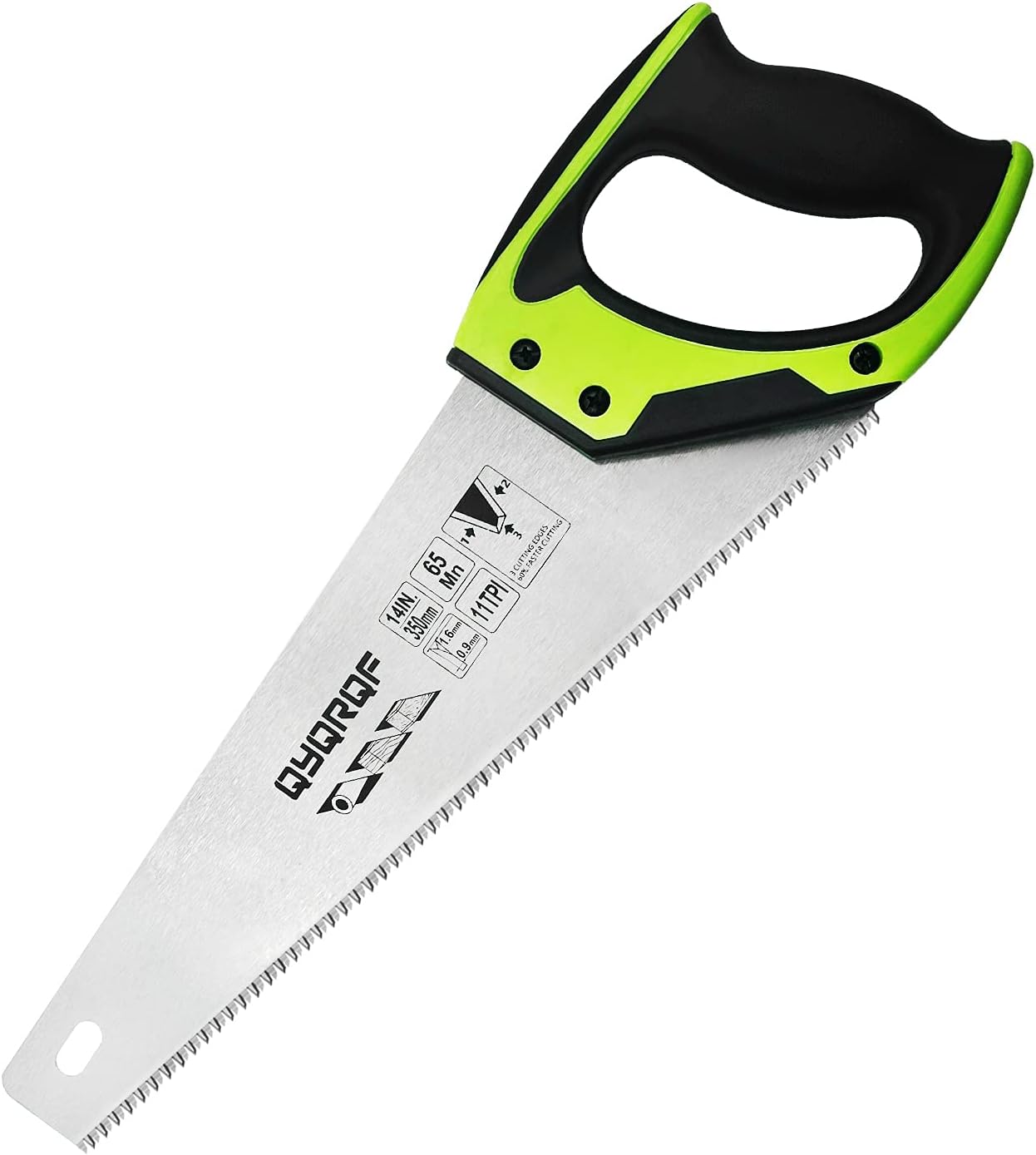
| Blade Material | Alloy Steel |
|---|---|
| Blade Length | 14 inches |
| Number of Teeth | 11 |
| Handle Material | Thermoplastic Elastomers |
This 14-inch pro hand saw is built for fast, accurate cuts in wood, plywood and PVC pipe. The 65Mn heat-treated alloy-steel blade with three-face grinding and deep gullets clears chips quickly, and the 11 TPI fine-cut tooth pattern makes controlled crosscuts and trim work straightforward. A low-friction coating helps the blade slide through material, while the thermoplastic elastomer soft-grip handle is shaped for comfort during repeated strokes and reduces hand fatigue. It ships with a protective sleeve and a hard case for safe storage. For someone focused on practical performance, the saw delivers durable sharpness and predictable cuts without power tools. Limitations are its manual speed compared with a power saw and that the 11 TPI is a compromise between fast ripping and very fine finishing, so you may need a different tooth count for very fine trim or rip work.
Best for: Buyers who prioritize efficient, reliable hand cutting for routine wood trimming and light carpentry and want a durable tool that reduces hand fatigue during regular use.
Less Ideal for: Users who need the fastest bulk ripping or ultra-fine finish cuts, or those who prefer powered saws for large projects.
- Heat-treated 65Mn alloy-steel blade for long-lasting edge retention
- Three-face grinding and deep gullets for faster chip removal and quicker cuts
- Low-friction coating reduces binding and improves stroke efficiency
- Ergonomic non-slip soft-grip handle reduces hand fatigue during extended use
- Manual saw cannot match the speed of powered cutting tools
- 11 TPI is a middle-ground tooth count and may not be ideal for very fine finish cuts or fast ripping
Verdict: A durable, comfortable 14-inch hand saw that speeds up manual cutting with a heat-treated blade and efficient tooth geometry, ideal for everyday wood and trim work.
EXTYQWC 6" Ryoba Japanese Pull Saw with SK5 Double-Edge Blade

| Blade Material | Alloy Steel |
|---|---|
| Number of Teeth | 168 |
| Power Source | manual |
| Other Special Features of the Product | Lightweight |
This EXTYQWC ryoba Japanese pull saw is a small, economical hand saw designed for accurate trimming and joinery work. It cuts on the pull stroke with a thin, flexible SK5 high-carbon blade that has hardened, triple-ground teeth and two cutting edges: 17 TPI for fine hardwood work and 11 TPI for quicker cuts in softwood. Typical uses are flush trimming dowels and plugs, cutting small tenons, and detail work on furniture, crafts, or cabinetry where control matters more than long ripping capacity. The blade flexibility makes flush cuts close to a surface simple, and the short 6-inch length is handy for tight spaces and precision tasks. Limitations are the short blade and compact handle, which limit long straight cuts and heavy stock removal; users needing full-size crosscuts or extended ripping should pair this with a larger saw. For its price the saw delivers practical versatility for small woodworking jobs but is not a replacement for larger saws on big projects.
Best for: Buyers who need an affordable, precise saw for detailed joinery, furniture repair, and trim work where control and flush cutting matter more than long cuts.
Less Ideal for: Woodworkers who frequently make long crosscuts or rip large boards should choose a full-size handsaw designed for those tasks instead.
- Dual 17/11 TPI edges let you switch between fine hardwood cuts and faster softwood cuts.
- Flexible SK5 high-carbon steel blade enables clean flush trimming close to surfaces.
- Triple-ground, hardened teeth improve cutting efficiency and smoothness.
- Compact 6-inch blade is easy to control in tight spaces and for detailed joinery.
- Short blade length limits ability to make long straight cuts or rip large boards.
- Alloy steel handle may be less comfortable for extended use compared with padded or contoured grips.
Verdict: A budget-friendly compact ryoba pull saw that gives precise, dual-purpose cutting for flush trimming and small joinery tasks.
Magicbox 4‑Piece Japanese Hand Saw Set, SK5 Steel Pull Saws

| Blade Material | Carbon Steel |
|---|---|
| Power Source | hand powered |
| Other Special Features of the Product | Ergonomic Handle |
| Surface Recommendation | Wood |
| Included Components | Case |
This Magicbox set supplies four Japanese-style pull saws that cover most small to medium woodworking tasks. The kit includes large and compact double-edge pull saws for rip and crosscuts, a flush-cut saw for trimming dowels and joints, and a pointed fine saw for tight spaces. SK5 spring steel blades are heat-treated and have fine triple-ground teeth to deliver clean cuts with reduced tear-out, and the included blade guards make storage safer. Wooden ergonomic handles give a comfortable grip for controlled strokes and longer sessions. The set is lightweight and portable, so it works well for hobbyists, trim carpenters, and furniture makers who need reliable hand tools on the bench or at a job site. Limitations are that the blades are hand tools only so they require proper technique for fast work on large stock, and the wooden handles and carbon steel blades will need occasional care to prevent moisture-related wear. Overall this is a dependable, versatile hand saw set that emphasizes clean cutting and practical storage for everyday woodworking use.
Best for: Buyers who prioritize reliable, precise hand tools for furniture making, trim work, and detailed woodworking and who prefer a complete set that covers multiple cutting needs.
Less Ideal for: Users who need high-speed production cutting of large lumber or who prefer low-maintenance synthetic handles and stainless blades should consider other options.
- Includes four complementary saw types (large and compact double-edge, flush cut, and pointed fine saw) for a wide range of cuts
- SK5 spring steel, heat-treated blades with fine triple-ground teeth for cleaner cuts and durability
- Ergonomic non-slip wooden handles for comfortable control during extended use
- Protective blade covers included for safer storage and transport
- Requires basic pull-saw technique and more time than power tools for large or repetitive cuts
- Wood handles and carbon steel blades need occasional maintenance to avoid rust and wear
Verdict: A versatile, dependable four-piece Japanese saw set that delivers clean, controlled cuts for furniture, trim, and detailed woodworking.
Choosing the Right Hand Saw for Straight Cuts: Key Factors to Consider
Blade Stiffness and Straightness
A blade that flexes or wanders under pressure makes it hard to keep a straight line. Stiffer blades resist bending during long strokes and when cutting thicker stock, so you can maintain a consistent angle and follow your layout. Look for blades with a tapered or reinforced spine and consistent tempering to reduce chatter and deviation.
Blade straightness out of the box matters too. A warped or twisted blade requires constant correction and defeats the purpose of a hand saw aimed at straight cuts. Inspect blades visually and feel them along a flat table edge to check for twist before buying.
Tooth Geometry and Cut Cleanliness
Tooth pitch, shape, and set determine how the saw evacuates chips and how much tear-out you get on the exit face. Finer teeth often leave cleaner crosscut edges but cut more slowly; coarser teeth remove material faster but can increase splintering. For straight, visible cuts you want a tooth profile that slices cleanly rather than rips and tears.
Be aware of the tooth set pattern as well. A minimal, even set keeps the kerf tight for straighter tracking, while aggressive set can cause wandering. For exterior lumber or rough-sawn boards, a slightly more open set helps prevent clogging, but balancing that with cut cleanliness is key.
Handle Control and Ergonomics
How the handle fits your hand affects how steadily you can guide the saw. A comfortable grip reduces fatigue on longer cuts and helps you maintain a consistent stroke plane. Look for handles that align the wrist naturally with the blade and provide a secure grip when your hands are sweaty or gloved.
Handle design also influences the leverage and stroke length you can generate. Deep, full-hand grips are better for long, powerful strokes; smaller pistol grips give finer control for short finishing cuts. Think about the typical length of cut you will make and choose a handle that supports that motion.
Blade Length and Tooth Count
Blade length affects stroke efficiency and control. Longer blades let you make fewer, longer strokes which helps maintain a straight line over long cuts. Shorter blades are easier to control on short or confined cuts but may require more strokes and can wander.
Tooth count (teeth per inch) ties directly to intended work. Lower TPI suits rip cuts and thick lumber where faster removal matters. Higher TPI suits fine crosscuts and reduces splintering on finished faces. Match blade length and TPI to the material sizes you cut most often.
Maintenance, Sharpening, and Lifetime
A saw that can be easily sharpened and maintained will stay truer for longer. Consider how accessible the teeth and spine are to standard files and whether the tooth profile is common enough for routine re-sharpening. Blades with protective finishes or plating resist rust and pitch build-up, reducing maintenance frequency.
Also consider replacement blades versus full-tool maintenance. Some gardeners and woodworkers prefer models where the blade is replaceable; others value a single-piece tool that can be tuned over time. Think about your willingness to maintain the saw and how much effort you will invest in keeping it cutting straight.
Preparing the Workpiece for a Straight Cut
Even the best saw will struggle if the stock is not secured and marked properly. Start by clamping the board flat and using a sharp marking tool and square to lay out the line. For cut faces that will be visible, mark the waste side and consider scoring the line with a utility knife to reduce tear-out on the exit face.
- Use a flat, stable surface and two clamps to prevent rocking.
- Score the cut line on the face you want to keep tidy.
- Support offcuts to prevent splintering as the saw exits the cut.
Sawing Technique to Maintain a True Line
Your body alignment and stroke cadence affect how straight your cut will be. Stand so the saw blade can move in a straight plane from shoulder to elbow. Begin with short, light starter strokes to establish the kerf, then lengthen your stroke and apply even pressure on the forward or return stroke depending on saw type. Keep your head behind the blade to see the line clearly and avoid twisting the wrist mid-stroke. If the saw wants to drift, stop and widen the starter kerf before continuing rather than forcing the blade back into line.
- Start with short starter strokes to establish the kerf.
- Use long, even strokes to maintain direction once the kerf is established.
- Stop and correct drift early rather than forcing the blade back on line.
Dealing with Knotty or Weathered Lumber
Knotty sections and weathered or resinous timbers can cause the blade to snag or dull quickly, leading to wandering cuts. Slow down through knots and use lighter pressure so the teeth can slice rather than bind. For pitchy wood, periodically clear the teeth of build-up and consider a blade with a protective finish to resist pitch adhesion. When working reclaimed or rough lumber, take extra time marking and supporting the board. Use a backer board where tear-out would be a problem on a visible face.
- Reduce pressure and increase saw stroke speed through knots.
- Clear pitch and debris frequently from the teeth.
- Use a sacrificial backer to prevent exit-face splintering.
Simple Maintenance to Keep Cuts Straight
Regular maintenance keeps tooth geometry consistent and the blade tracking true. Clean the blade after use to remove sap and pitch, lightly oil to inhibit rust, and inspect teeth before a critical cut. If you notice wandering or roughness, re-file the teeth following the original profile and check the set for symmetry. For storage, hang saws flat or store in a sleeve to prevent bends or nicks. Keeping the handle secure and free of cracks also preserves control and helps maintain straight cuts over the tool's life.
- Clean and oil the blade after use to prevent corrosion and pitch build-up.
- Sharpen and check set periodically to maintain consistent cutting behavior.
- Store blades flat or in sleeves to avoid warping.
How We Chose the Best Hand Saw for Straight Cuts
We focused on the qualities that actually affect straight cutting in wood and exterior timbers. Primary evaluation criteria included blade stiffness and straightness under load, tooth geometry and set that influence kerf cleanliness, and handle ergonomics that affect control over long rip and crosscuts. We also assessed ease of sharpening and maintenance, and durability of the blade finish to resist pitch and corrosion in outdoor use. Products were excluded if they were specialized for pull-stroke saws or precision dovetail work only, because those styles do not match the general-purpose straight-cut use case. We prioritized saws with clear specification of tooth per inch or tooth profile, robust spine or taper-ground designs that control flex, and handles shaped to maintain a consistent wrist line during a long stroke. The final list favors tools that deliver predictable, straight results across typical garden and workshop lumber sizes.
FAQ
What tooth per inch works best for straight crosscuts?
A higher tooth count, typically in the 10 to 12 TPI range, produces cleaner crosscut edges and reduces tear-out, which helps maintain the perceived straightness. For very fine finish cuts, use an even higher TPI; for thicker rough lumber, a lower TPI cuts faster but needs more care to avoid splintering.
How do I stop a hand saw from wandering off the line?
Start with short, light strokes to set a straight starter kerf, ensure the blade is stiff and not warped, and keep your wrist and body aligned with the cut. If the blade drifts, stop and widen the starter kerf before proceeding rather than forcing the saw back on track.
Can I sharpen any hand saw at home to restore straight cutting?
Often you can. Many common saw tooth profiles are file-sharpenable with basic tools, and restoring a consistent profile and set will improve tracking. Some specialty tooth patterns are harder to duplicate at home, so factor that into your maintenance plans.
Should I use a backer board to prevent tear-out?
Usually yes for visible edges. Clamping a sacrificial backer behind the cut supports fibers at the exit side and reduces splintering, making your cut look straighter and cleaner without changing saw technique.
Final Verdict
Prioritize blade stiffness, tooth profile, and a handle that lets you guide long, even strokes when choosing a hand saw for straight cuts. Those dimensions most directly affect how well a saw tracks and how much finish work you will need after cutting. Accept tradeoffs between speed and finish: coarser teeth cut faster but may require extra sanding, while finer teeth produce cleaner edges but slow progress. Choose the combination that matches the materials and finish quality you need, and maintain the blade to keep it cutting straight over time.
