

Note: This article contains affiliate links. If you click on these links and make a purchase, I may earn a small commission at no extra cost to you. This helps support my research and content. Read my full affiliate disclosure here.
Goosegrass can turn a neat lawn into a patchy, crusty mess if you do not pick the right treatment. A focused herbicide for goosegrass reduces those dense clumps and prevents re-infestation when applied at the right growth stage and under the right conditions. This guide shortlists the top herbicide options for controlling goosegrass and explains the practical factors that matter in the yard, including how and when to apply, safety around people and pets, and how treatments interact with lawn type. Below are the best picks for targeted goosegrass control along with clear criteria used to judge them so you can choose the option that fits your turf type and maintenance routine.
Top Picks at a Glance
| Best Quality Built to a higher standard if you want something more solid | Metribuzin 75% Dry Granular Herbicide (10 lb) |  |
| Best Budget The cheapest option that still gets the job done reliably | Bonide Sedge Ender Ready-to-Spray Weed Killer, 16 oz |  |
| Highest Rated A top-rated pick with lots of positive feedback | Monterey Grass Getter & Herbicide Helper Combo Pack, 8 oz each |  |
| Most Popular A crowd favorite that many people choose with confidence | Bonide Sedge Ender Concentrate 16 oz |  |
| Best Seller A high-volume bestseller chosen again and again | Syngenta Tenacity Turf Herbicide, 8 oz |  |
Metribuzin 75% Dry Granular Herbicide (10 lb)

| Item Form | Dry Granular |
|---|---|
| Active Ingredients | Metribuzin 75% |
| Coverage | Selective coverage for goosegrass and broadleaf weeds |
| Unit Count | 160 Ounce |
| Included Components | (1) 10 LB. Jug of Metribuzin DF |
This 10 lb jug of metribuzin 75% is a granular, selective herbicide aimed at controlling goosegrass and a broad spectrum of broadleaf weeds in established bermudagrass. It can be used pre-emergence or post-emergence and is labeled for tank mixes, which gives flexibility for timing and targeting problem species. Typical use involves calibrating application rates to the turf label, applying to active or dormant bermudagrass when conditions match label guidance, and following safety directions on the product label. The formulation is concentrated, so a single jug covers a sizeable area for spot or broadcast applications depending on rate. Practical benefits include strong goosegrass control and compatibility with bermudagrass mowing heights above 1/2 inch. Important limitations are that it is labeled specifically for certain turf and crop uses so it is not a general-purpose lawn herbicide for all turf types, and correct mixing and application are essential to avoid turf injury or off-target effects.
Best for: Buyers who prioritize strong, targeted control of goosegrass in established bermudagrass and who are comfortable following label rates and mixing instructions to optimize performance.
Less Ideal for: Homeowners with cool-season lawns, mixed turf types, or those who need a general-purpose weed killer for diverse lawn species should consider alternatives.
- High active ingredient concentration (75%) for effective control of goosegrass
- Labeled for both pre-emergent and post-emergent use in bermudagrass
- Suitable for tank-mixing to broaden spectrum or adjust control strategy
- Granular dry-flowable form is easy to store and measure for larger areas
- Label restricts use to specific turf types and certain crops so it is not universal for all lawns
- Requires careful rate calculation and adherence to label to prevent turf injury
Verdict: If you need a performance-focused herbicide to reliably knock down goosegrass in bermudagrass, this concentrated metribuzin formulation is a strong choice.
Bonide Sedge Ender Ready-to-Spray Weed Killer, 16 oz

| Unit Count | 16 Ounce |
|---|---|
| Item Form | Spray |
| Coverage | 8,700 square feet |
| Active Ingredients | Herbicide, Sulfentrazone |
Bonide Sedge Ender is a ready-to-use lawn herbicide aimed at killing sedges, goosegrass, crabgrass and other grassy weeds by targeting roots and shoots. Packaged in a 16 oz spray bottle, it is applied directly to the lawn and can be used either before weeds sprout or to treat existing infestations. The formulation contains sulfentrazone and is described as rainproof once dry, so applications are forgiving if rain occurs a few hours after spraying. Coverage is broad for its size — the label lists up to 8,700 sq ft when diluted according to directions, which makes the bottle economical for spot treatments and small-to-medium yards. It is marketed as safe on both cool- and warm-season grasses when used as directed. Limitations to note are that it is intended for lawn use only and not for ornamental beds, and effectiveness depends on correct timing and following label instructions; very heavy or established infestations may need repeat applications or a larger professional-strength product.
Best for: Buyers who want an easy, economical lawn-specific herbicide to control sedges and goosegrass without mixing concentrates and who prefer a ready-to-use product for spot or moderate coverage treatments.
Less Ideal for: Homeowners managing large commercial lawns, landscapers, or those needing a product labeled for ornamentals or non-turf areas should consider concentrated or professional formulations instead.
- Ready-to-spray bottle requires no mixing for quick spot treatment.
- Effective on sedges, goosegrass, crabgrass and other common grassy weeds.
- Rainproof once dry, reducing loss from light rain after application.
- Broad label coverage makes small bottles economical for many yards.
- Designed for lawn turf only and not labeled for use on ornamentals or non-turf areas.
- 16 oz size may be small for very large lawns or repeated heavy infestations.
Verdict: A convenient, ready-to-spray lawn herbicide that offers economical, targeted control of sedges and goosegrass for homeowners on a budget.
Monterey Grass Getter & Herbicide Helper Combo Pack, 8 oz each

| Item Form | Liquid |
|---|---|
| Coverage | Grassy Weeds |
| Active Ingredients | surfactant |
| Unit Count | 16 Ounce |
This Monterey combo pairs a grass-targeting herbicide with a surfactant helper to speed up and improve kill on tough grassy weeds. It is typically mixed and applied to grassy weeds like crabgrass, goosegrass, foxtails, and other annuals and perennials; the helper improves foliage wetting so the active ingredient adheres and works faster. The product is sold as two 8-ounce liquids for a total 16 ounces of treatment, and is intended for spot or area applications where grassy weeds are present among desirable plants. Practical benefits include stronger performance against hard-to-kill grasses and fewer repeat applications when used correctly. Important limitations are that it is formulated specifically for grassy weeds so broadleaf weeds will not be controlled, and it must be applied carefully to avoid contact with plants you want to keep. Read and follow label directions for mixing rates, timing, and safety precautions to get consistent, reliable results.
Best for: Gardeners and lawn stewards who need a dependable, grass-specific herbicide to remove persistent grassy weeds and prefer a product designed to improve uptake for faster, consistent control.
Less Ideal for: People seeking a broad-spectrum weed solution or who want an all-in-one product for both grassy and broadleaf weeds should look for a different formulation.
- Formulated specifically to control tough grassy weeds including goosegrass and crabgrass
- Includes a surfactant helper to improve foliage wetting and speed up herbicide action
- Sold as a two-pack totaling 16 ounces for multiple spot treatments
- Liquid formulation allows dilution and precise application for targeted control
- Does not control broadleaf weeds so separate products may be needed
- Requires careful application to avoid injuring desirable turf or ornamentals
Verdict: Use this combo when you want a reliable, grass-targeted herbicide plus a surfactant to speed up and strengthen control of persistent grassy weeds like goosegrass.
Bonide Sedge Ender Concentrate 16 oz

| Unit Count | 16 Ounce |
|---|---|
| Item Form | Spray |
| Liquid Volume | 16 fluid ounces |
| Active Ingredients | Herbicide |
Bonide Sedge Ender is a concentrated lawn herbicide designed specifically to control sedges and other grassy weeds such as yellow nutsedge, crabgrass, goosegrass, and foxtail. Sold as a 16 oz concentrate, it is mixed according to label rates and applied with a sprayer for spot or broadcast treatments across warm and cool season lawns. Notable features include pre- and post-emergent activity, a formula that starts working on contact, and rainproofing within hours after drying so treatments remain effective through light weather. The concentrate format makes it economical for treating areas from a few hundred to several thousand square feet depending on dilution. Important limitations are that it is labeled for lawn use only so it should not be used on ornamental beds, and users must follow safety directions for protective clothing and keep children and pets away until treated areas are dry; handling a concentrated herbicide also requires careful measuring and mixing. For someone managing stubborn grassy weeds in turf, it offers targeted control without killing desirable grasses when applied correctly.
Best for: Homeowners focused on getting rid of persistent grassy weeds in established lawns who prefer a concentrated, economical product with proven effectiveness.
Less Ideal for: Gardeners who need a non-lawn solution for ornamental beds or those unwilling to handle a concentrated chemical or follow protective and mixing instructions.
- Concentrated formula yields economical coverage when mixed properly
- Effective against hard-to-kill grassy weeds including yellow nutsedge and goosegrass
- Works both pre-emergent and post-emergent for flexible timing
- Becomes rainproof within hours after drying so treatments are less likely to wash away
- Labeled for use on lawns only so not suitable for flower beds or many ornamentals
- Requires careful mixing and protective gear because it is a concentrated herbicide
Verdict: Choose Bonide Sedge Ender when you need a concentrated, lawn-safe herbicide that reliably kills goosegrass and other grassy weeds down to the root.
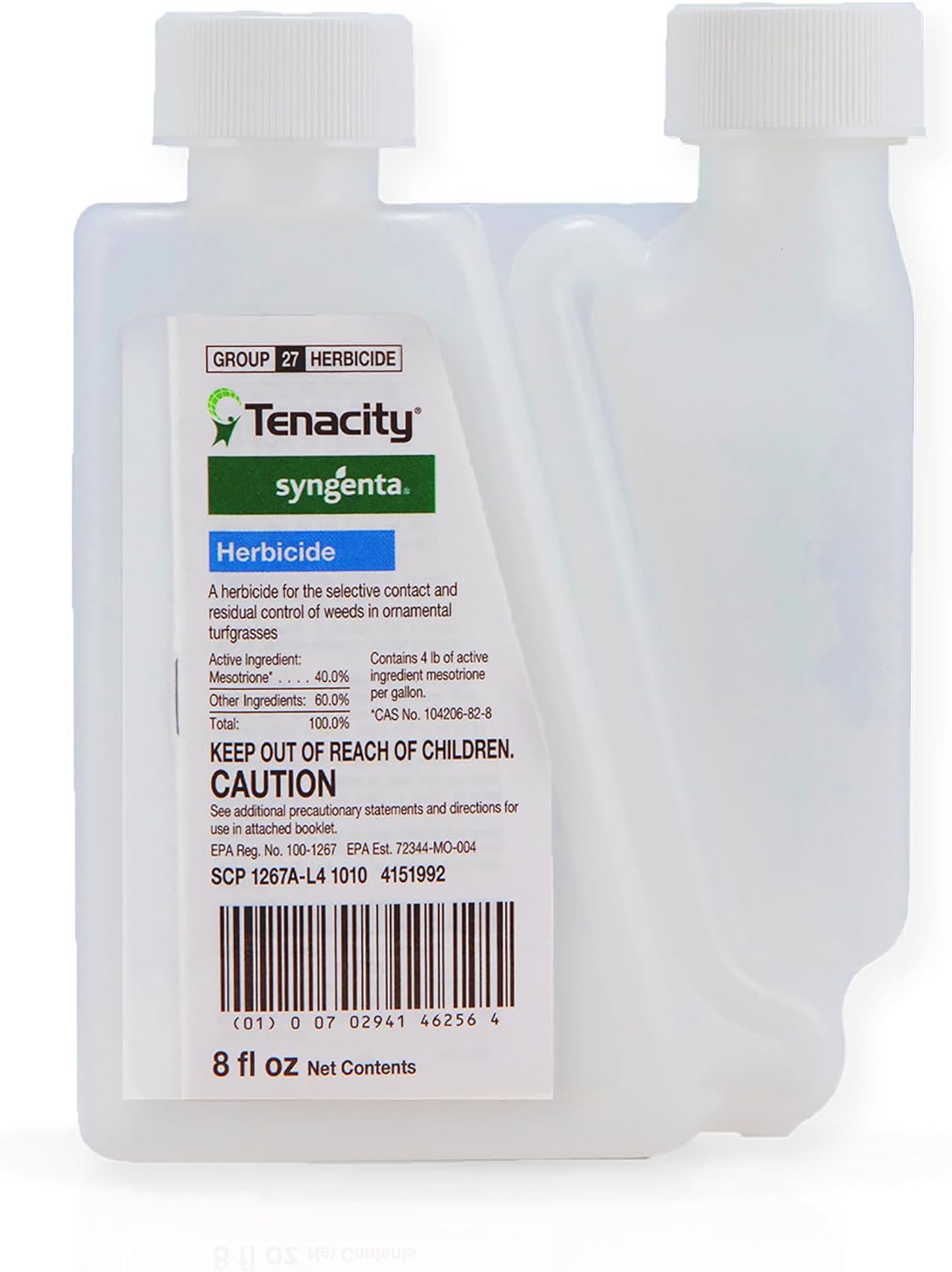
Syngenta Tenacity Turf Herbicide, 8 oz
| Unit Count | 8 Fluid Ounces |
|---|---|
| Item Form | Liquid |
| Coverage | 2000 ft^2 per 1sp of product |
| Active Ingredients | Mesotrione |
Tenacity Turf Herbicide is a concentrated mesotrione-based liquid designed for both pre-emergent and post-emergent control of common lawn weeds including crabgrass, clover, chickweed and dandelions. You apply it diluted according to label rates with a handheld or hose-end sprayer to target problem areas or broadcast across the lawn; when used as a pre-emergent it is taken up as weeds emerge and when applied post-emergent it acts systemically for selective control. The product covers a large area per bottle and the active ingredient provides residual control so you can expect longer suppression than a contact-only herbicide. Important practical points are that it is turf-selective so follow the label for grass species and mixing instructions to avoid turf injury, and results can take several days to appear. Also this is a concentrated chemical intended for careful, measured application rather than spot-use by people who prefer non-chemical methods.
Best for: Gardeners focused on strong, reliable crabgrass and broadleaf weed control who are comfortable using concentrated herbicides and following label directions for turf safety.
Less Ideal for: People seeking organic, mechanical, or spot-only solutions or those unwilling to follow detailed mixing and application instructions should consider other options.
- Systemic mesotrione active ingredient controls both pre- and post-emergent weeds
- Selective to turf when used per label, allowing treatment without killing desirable grass species
- Concentrated 8 oz liquid provides wide coverage per bottle
- Provides residual suppression, reducing frequency of repeat applications
- Requires careful mixing and adherence to label for turf safety
- Not a non-chemical or organic option for weed control
Verdict: Choose Tenacity when you want a concentrated, turf-selective herbicide that delivers pre- and post-emergent control of crabgrass and other common lawn weeds.
Choosing the Right Herbicide for Goosegrass: Key Factors to Consider
Mode of Action and Targeting
Knowing a herbicide's mode of action matters because goosegrass responds differently to pre-emergent chemistry than to post-emergent actives. Pre-emergent products form a soil barrier that prevents seeds from germinating, so timing is tied to soil temperature and local germination windows. Post-emergent actives must translocate into the plant to kill established clumps, and they may work best on young, actively growing goosegrass.
Choosing a product with a mode of action suited to your infestation stage reduces wasted applications and lowers the risk of selecting an actives class that encourages resistant biotypes over time. Rotate chemistries when managing repeated flushes to maintain long-term control.
Turf Type and Safety
Different lawn grasses tolerate herbicides differently. Cool-season turf and warm-season turf can show injury from the same product under certain temperatures or if applied at the wrong growth stage. Always confirm the product label lists your turf species before applying.
Consider reduced-rate recommendations for vulnerable grasses and observe any advised delay between seeding or sodding and chemical application. Turf injury can be subtle at first, so test a small area when using a new chemistry on an unfamiliar lawn.
Timing and Application Window
For pre-emergent control, timing is crucial because the chemical works at or near the soil surface to stop seedlings as they sprout. Soil temperature or phenological cues like forsythia bloom often guide when to apply. Post-emergent treatments perform best on actively growing goosegrass, not on dormant or stressed plants.
Follow label guidance on rainfall and irrigation timing. Applying before heavy rain reduces efficacy for some pre-emergents, while others require moisture to activate. Re-treatment intervals matter for planning follow-up care and avoiding overapplication.
Application Method and Equipment
Herbicides come in granular, liquid concentrate, and ready-to-spray formats. Granules are often easier for homeowners to broadcast but may require irrigation to activate. Liquid concentrates allow targeted spot treatments and more uniform coverage when mixed properly, but they demand calibrated sprayers and careful measuring.
Consider spray quality, nozzle selection, and tank-mix compatibility if combining products. Equipment cleanliness and precise calibration reduce the chance of streaks, overapplication, or missed patches.
Residual Control and Re-Treatment Needs
Residual activity determines how long a single application suppresses goosegrass seedlings. Longer-lasting pre-emergents reduce the number of seasonal applications but may impose longer restrictions on seeding or planting. Short-residual products might require repeat applications timed to multiple germination flushes.
Balance the convenience of longer residual control with the flexibility you need for overseeding, renovating, or planting near treated areas. Check re-treatment intervals on the label to plan follow-up applications responsibly.
Environmental and Safety Restrictions
Look for label instructions about buffer zones, runoff risk, and use near water features. Some active ingredients have tighter restrictions around edible gardens, water bodies, or pollinator foraging areas. PPE requirements and re-entry intervals affect how soon people and pets can access treated areas.
Understanding these constraints helps you choose a product that fits your property layout and comfort level with safety precautions. Proper storage and disposal are also part of responsible use.
Pre-emergent Versus Post-emergent Strategies
Choosing between pre-emergent and post-emergent approaches depends on whether goosegrass is already established or if you are preventing seasonal germination. Pre-emergents work by creating a barrier in the soil that prevents seedlings from emerging and are most effective when timed before the main germination window.
Post-emergent treatments are best for visible patches and often require contact or systemic activity to kill mature clumps. In many lawns, an integrated approach that uses a pre-emergent to reduce new seedlings alongside spot-treating existing clumps yields the most consistent results.
- Pre-emergent: apply before soil temperatures trigger germination
- Post-emergent: target young, actively growing plants for best uptake
- Combine both strategies when infestations are mixed-age
Seasonal Timing and Local Cues
Seasonal cues like soil temperature, local bloom times, and recent weather patterns are more reliable than calendar dates. Goosegrass typically germinates in sync with warming soils, so monitor your microclimate or use a soil thermometer for precise timing.
Adjust application timing for cool microclimates or heat islands. Early or late applications can reduce efficacy and increase the risk of turf injury.
- Use a soil thermometer to time pre-emergent applications
- Delay post-emergent sprays if the lawn is drought-stressed or under heat stress
- Reassess after heavy rains that can shift germination windows
Spot Treatment and Cultural Controls
Physical and cultural tactics reduce reliance on chemicals. Hand-pulling or rototilling small, isolated clumps can be effective in visible patches, especially when the plants are young. Improving lawn density through proper fertilization, mowing height, and irrigation reduces the open niches goosegrass exploits.
Combine spot chemical treatment with cultural fixes: treat visible patches, then overseed thin areas and adjust maintenance practices to favor desirable turf. This lowers the chance that goosegrass will re-establish from seed or surviving plants.
- Mow at the recommended height for your turf species to shade weed seedlings
- Address compacted or bare spots that invite goosegrass
- Use spot sprays for isolated patches to limit overall chemical use
Application Safety and Post-application Care
Follow label directions for personal protective equipment and re-entry intervals. Keep people and pets off treated areas for the recommended period and do not harvest or expose edible plants that are restricted on the label.
Record treatment dates and conditions so you can track efficacy and plan follow-up treatments. Store leftover product in its original container, tightly sealed, and away from children and pets according to label storage instructions.
- Wear recommended PPE when mixing and applying
- Avoid application before heavy rain unless the label allows it
- Rinse equipment promptly and dispose of rinse water according to label
Managing Resistance and Long-term Control
Repeated use of the same active ingredient increases the risk of selecting resistant goosegrass populations. Rotate modes of action across seasons and combine chemical control with cultural practices to reduce selection pressure.
Keep records of active ingredients used and monitor treated areas for declining efficacy. If reduced control appears, consult extension resources for alternative chemistries and integrated tactics to regain control.
- Rotate chemistries to different modes of action when possible
- Integrate non-chemical practices to reduce reliance on herbicides
- Monitor treated areas and adjust plans after each season
How We Chose the Best Herbicide for Goosegrass
We prioritized products that combine proven goosegrass control with practical application and turf safety. Key evaluation criteria included the herbicide's mode of action and spectrum to ensure it targets goosegrass effectively while limiting off-target injury. We examined turf safety across common lawn species, timing windows for pre-emergent and post-emergent use, and label restrictions to avoid treatments that are unsafe for typical home lawns. Application practicality was scored by looking at required re-entry intervals, mixing complexity, and how easy it is to get even coverage across a lawn. Residual control and re-treatment intervals were assessed to estimate how long a single application suppresses new goosegrass flushes. Environmental considerations included runoff potential and restrictions around water bodies or food crops. We excluded products labeled only for non-turf uses, experimental formulations without supporting label data, and any herbicide lacking clear usage directions for goosegrass. The final list favors options that balance efficacy, safety, and straightforward application for home and small-property gardeners.
FAQ
When is the best time to apply a pre-emergent for goosegrass?
The best time is before soil temperatures consistently reach the threshold that triggers goosegrass germination in your area. Many gardeners use a soil thermometer or local phenological indicators to time application. Applying too early or too late reduces effectiveness.
Can I treat goosegrass with a post-emergent product in summer?
You can use post-emergent products in summer if the goosegrass is actively growing, but heat-stressed or drought-stressed plants may not absorb herbicide well and turf injury risk can increase. Favor cooler, active-growth periods for best uptake.
How soon can I overseed after applying a residual herbicide?
Overseeding intervals depend on the product and its residual length. Some pre-emergents restrict seeding for weeks to months. Check the label for the specified wait time after application before seeding to avoid poor germination of desirable turf.
Are there safety concerns for pets and children after treatment?
Yes. Labels specify re-entry intervals and any precautions for pets and children. Many products recommend keeping people and animals off treated areas until spray deposits have dried or for a specified period. Follow label directions closely.
Will cultural practices reduce the need for herbicide?
Often they will. Improving lawn density, addressing bare spots, adjusting mowing height, and correcting irrigation can reduce the niches goosegrass exploits and lower how much chemical control you need. Cultural controls are an important complement to herbicides.
How do I avoid off-target damage when spraying spot treatments?
Use low-drift nozzles, apply on calm days with minimal wind, and shield desirable plants where possible. Calibrate your sprayer to apply the correct rate and avoid overlaps that can cause streaking or turf burn.
Final Verdict
Pick a strategy that matches the infestation stage and your lawn species. Pre-emergent products are the most effective way to prevent seasonal goosegrass outbreaks, while post-emergent options are useful for treating visible clumps. Weigh turf safety, residual duration, and application practicality against environmental restrictions and your maintenance schedule. Prioritize timing and turf compatibility, rotate modes of action over multiple seasons, and combine targeted chemical use with cultural repairs to reduce long-term pressure. That approach provides the most reliable path to a healthier, goosegrass-free lawn.
