

Note: This article contains affiliate links. If you click on these links and make a purchase, I may earn a small commission at no extra cost to you. This helps support my research and content. Read my full affiliate disclosure here.
Weeds in gravel driveways are unsightly and can damage the surface by lifting stones or holding moisture against the subbase. Choosing the right herbicide for gravel driveway conditions matters because product strength, contact versus systemic action, and surface safety determine how well weeds are removed and how often you need to retreat. This guide covers the top shortlisted herbicides suited to gravel drives and explains the practical tradeoffs gardeners face. We evaluated each option on kill speed, residual control, application safety, and how it affects gravel and nearby plants. Read on to find which approaches fit your maintenance routine and driveway conditions.
Top Picks at a Glance
| Best Overall The best all-around choice for most situations | Roundup Dual Action 365 Weed & Grass Killer Plus 12 Month Preventer, 1 gal. |  |
| Best Quality Built to a higher standard if you want something more solid | RM43 Total Vegetation Control 43% Glyphosate Plus Weed Preventer, 2.5-Gallon |  |
| Best Value The sweet spot between price and what you get | Ortho GroundClear Year-Long Vegetation Killer with Comfort Wand, 1.33 gal |  |
| Best Budget The cheapest option that still gets the job done reliably | Pulverize Weed & Grass Killer Ready-to-Use Gallon (Messinas) |  |
| Highest Rated A top-rated pick with lots of positive feedback | Control Solutions Eraser Max 2.5 Gallon Super Concentrate Weed Killer |  |
| Most Popular A crowd favorite that many people choose with confidence | Spectracide Weed & Grass Killer Concentrate, 1 Gallon |  |
| Best Seller A high-volume bestseller chosen again and again | Roundup Weed & Grass Killer 4 Refill, 1.25 gal. |  |
Roundup Dual Action 365 Weed & Grass Killer Plus 12 Month Preventer, 1 gal.

| Unit Count | 128 Fluid Ounces |
|---|---|
| Item Form | Spray |
| Coverage | 300 square feet |
| Active Ingredients | Triclopyr; Fluazifop‑P‑butyl; Imazapic; Diquat Dibromide |
This one‑gallon Roundup Dual Action 365 combines contact and residual activity to kill visible weeds quickly and leave an invisible soil barrier that helps prevent new weed growth for up to a year. It is designed for non‑lawn spots such as gravel driveways, cracks in sidewalks, patios, and under decks. The included Comfort Wand and one‑touch continuous spray make it easier to cover larger areas without hand fatigue, and the formula becomes rainproof in about 30 minutes with visible yellowing of weeds within hours. Practical benefits include treating both broadleaf and grassy weeds and covering up to roughly 300 square feet per gallon when applied as directed. Important limitations are that you must spray the entire area you want controlled rather than spot‑treating individual plants, and the product contains multiple strong active ingredients so follow safety and reentry directions for people and pets. Repeat applications should respect the label rate and timing listed on the container.
Best for: Buyers who want a single, easy‑to‑apply solution to both remove weeds now and prevent regrowth across non‑lawn surfaces like gravel driveways, sidewalks, and patios.
Less Ideal for: Homeowners who need a spot treatment for a few isolated weeds in lawns or who prefer non‑chemical weed control methods.
- Kills existing broadleaf and grassy weeds and produces visible results within hours.
- Provides up to 12 months of residual prevention when the entire area is treated.
- Comfort Wand with one‑touch continuous spray reduces hand fatigue during application.
- Becomes rainproof in as fast as 30 minutes, so light rain soon after application is less likely to wash it away.
- Requires treating the entire surface to get the 12‑month preventer effect rather than spot applications.
- Contains multiple strong herbicide actives so treated areas must be kept off‑limits to people and pets until dry.
Verdict: A practical one‑step product for gravel driveways that kills existing weeds quickly and provides up to 12 months of prevention when you treat the whole area.
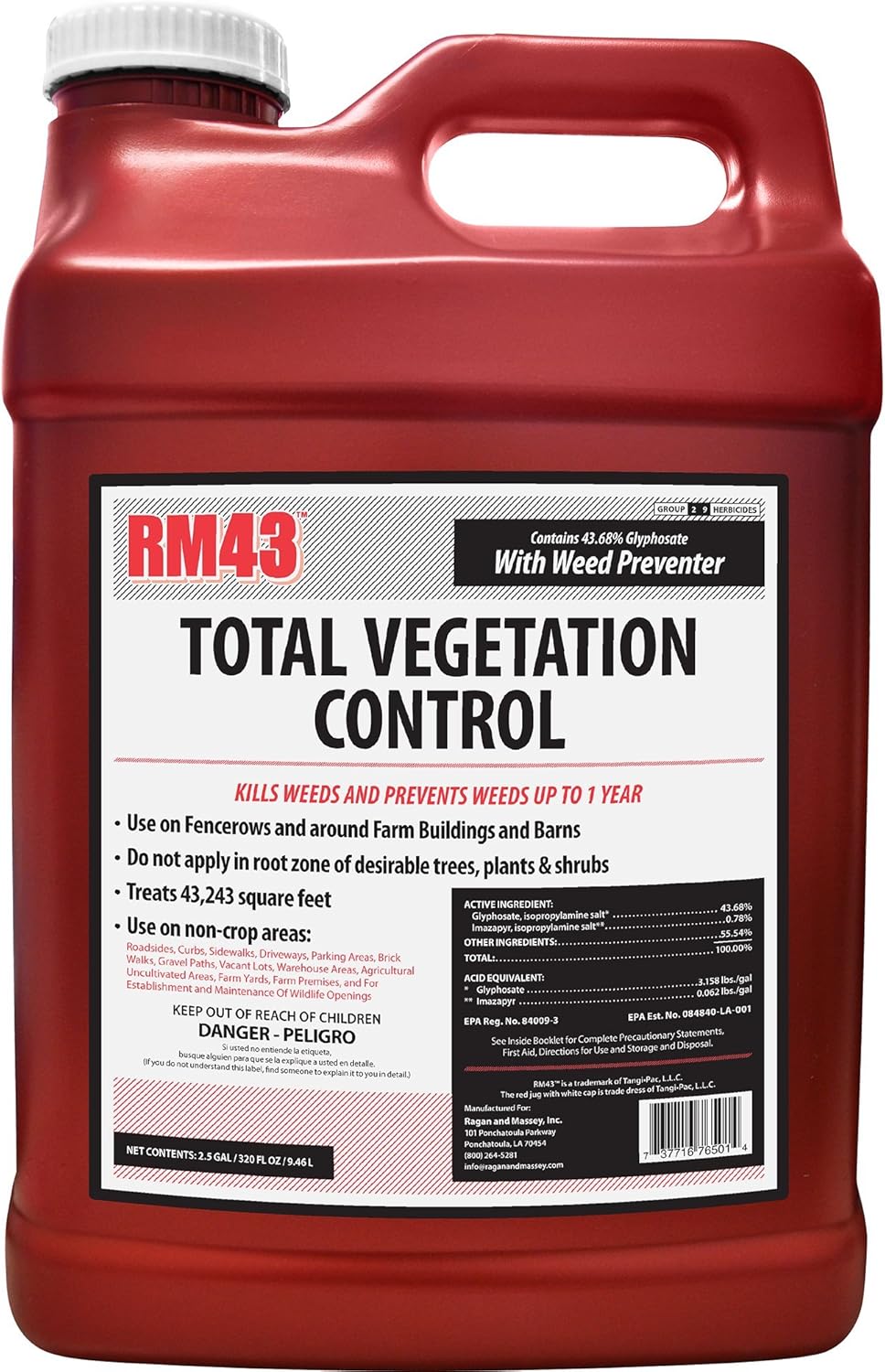
RM43 Total Vegetation Control 43% Glyphosate Plus Weed Preventer, 2.5-Gallon
| Unit Count | 320 Fluid Ounces |
|---|---|
| Liquid Volume | 320 fluid ounces |
| Coverage | 243 243 square feet |
| Active Ingredients | Glyphosate isopropylamine salt, Imazapyr isopropylamine salt |
RM43 Total Vegetation Control is a concentrated 2.5‑gallon herbicide intended for killing existing growth and preventing regrowth for up to a year on areas where no vegetation is desired. You mix it into spray solution and apply to hardscape edges, gravel driveways, fence rows, and around buildings as either spot treatments or blanket applications on bare ground. The formula pairs glyphosate and imazapyr with a surfactant so it kills grasses, broadleaf weeds, vines, brush and some woody growth and becomes rainfast in about two hours. Practical benefits for driveway use include long residual control that reduces repeat spraying and a large coverage rate that treats many square feet from one container. Important limitations are that it is for non‑crop areas only and will damage desirable plants if sprayed over roots or drift occurs, and the active ingredient blend makes it persistent so care is required where you may later want vegetation to return. Follow label directions for mixing, application timing and safety precautions when using near soil that will be planted later.
Best for: Gardeners, property owners, and maintenance crews who prioritize strong, long‑lasting weed eradication on gravel driveways and other non‑crop hardscape areas and want to minimize repeat applications.
Less Ideal for: Homeowners planning to replant treated areas soon or those needing selective weed control near desirable plants should choose a less persistent or more targeted product.
- Combination of glyphosate and imazapyr for both knockdown and long residual control
- Concentrated 2.5‑gallon container covers large areas without frequent refills
- Rainfast in about two hours so light rain soon after application is less likely to reduce effectiveness
- Suitable for total vegetation control on gravel driveways, fence rows and other non‑crop areas
- Persistent active ingredients that can prevent desirable vegetation from reestablishing for an extended period
- Not safe for use where desirable plant roots may be exposed or where drift could contact nearby plants
Verdict: Choose RM43 when you need a single, heavy‑duty application that delivers broad spectrum kill and up to a year of weed prevention on gravel driveways and other non‑crop surfaces.
Ortho GroundClear Year-Long Vegetation Killer with Comfort Wand, 1.33 gal

| Coverage | 400 square feet |
|---|---|
| Item Form | Spray |
| Liquid Volume | 1.33 gallons |
| Active Ingredients | Imazapyr; Pelargonic acid and related fatty acids |
Ortho GroundClear Year-Long Vegetation Killer is a ready-to-use spray designed for spot and area treatment where you do not want vegetation to return. It comes with a comfort wand that helps apply the product evenly to driveways, gravel, patios, sidewalks, and under decks. The fast-acting formula contains imazapyr and pelargonic acid and shows visible weed dieback within an hour while preventing regrowth for up to 12 months when applied as directed. The built-in wand simplifies coverage of cracks and gravel without mixing or additional equipment and the product is rainproof in about an hour. Practical benefits include treating up to 400 sq. ft. per bottle and clear instructions for use on actively growing weeds above 60°F. Important limitations are that it is nonselective and will prevent any desired plants from growing in treated areas, so care is needed to avoid drift or contact with soil where planting is planned. Follow safety directions to avoid contact with skin, eyes, and clothing.
Best for: Homeowners who want a low-effort, long-lasting solution to keep gravel driveways and hardscapes weed-free and prefer a product they can apply themselves with minimal equipment.
Less Ideal for: Gardners who need selective control near planted beds or anyone who plans to replant treated areas within a year should choose a different, more targeted option.
- Ready-to-use spray with attached wand for easy, targeted application
- Fast-acting formula with visible results in about an hour
- Prevents vegetation regrowth for up to one year after a single application
- Rainproof in one hour so light weather changes are less likely to ruin treatment
- Nonselective herbicide that will kill or prevent growth of any plants in treated areas
- Covers about 400 square feet so larger driveways may require multiple bottles
Verdict: If you want a simple, one-application way to keep a gravel driveway or other unplanted hardscape clear of weeds for up to a year, this ready-to-use wand spray delivers that result.
Pulverize Weed & Grass Killer Ready-to-Use Gallon (Messinas)

| Unit Count | 128 Fluid Ounces |
|---|---|
| Item Form | Spray |
| Coverage | Up to 250 sq.ft. (Gallon Ready to Use) |
| Active Ingredients | Maleic hydrazide |
This ready-to-use Pulverize Weed & Grass Killer is a non-selective spray designed to quickly dry out and eliminate unwanted vegetation on hardscape and cultivated areas. You spray leaves thoroughly and the formula works within hours to collapse weeds, grasses, moss and lichens; repeat applications every 2–3 weeks control fresh growth. The product is sold as a gallon ready-to-use liquid so there is no mixing or measuring, which saves time for spot treatments on gravel driveways, between pavers, and along edges. Notable features include a non-staining, plant-derived active ingredient and coverage guidance for typical bottle sizes. Practical benefits are fast visible results, safe re-entry for kids and pets once the spray has dried, and suitability for concrete, stone and gravel surfaces where manual weeding is difficult. Important limitations are that it is non-selective so it will kill desirable plants if contacted and may require reapplication after rain within a few hours; it is intended for surface contact so large perennial roots may need additional mechanical treatment for complete removal.
Best for: Homeowners who need a low-effort, cost-aware solution to clear weeds from gravel driveways, paths, and hardscape edges and prefer ready-to-use products that work quickly.
Less Ideal for: Gardeners who need selective control inside planted beds or those who want a long-term soil-residual systemic herbicide for deep-rooted perennials.
- Ready-to-use gallon eliminates mixing and is convenient for spot treatments
- Fast-acting formula with visible results in hours
- Non-staining on hard surfaces like concrete, stone and pavers
- Plant-derived active ingredient suitable for more mindful yard care
- Non-selective formula will damage any plants it contacts
- May need reapplication if rain occurs within a few hours of treatment
Verdict: A budget-friendly, ready-to-use weed spray that delivers fast, non-staining control for gravel driveways and other hardscape areas.
Control Solutions Eraser Max 2.5 Gallon Super Concentrate Weed Killer

| Unit Count | 320 Fluid Ounces |
|---|---|
| Item Form | Liquid |
| Coverage | 43242.5 square feet |
| Active Ingredients | Glyphosate, Imazapyr |
Control Solutions Eraser Max is a concentrated liquid herbicide designed for durable, wide‑area control of weeds, grasses, vines, brush, and small trees on noncrop surfaces. It is typically mixed and applied as a spot or broadcast treatment on gravel driveways, sidewalks, fence rows, and around farm buildings where long term vegetation suppression is needed. The formula contains glyphosate and imazapyr, which together provide both fast weed knockdown and extended residual control—the label states one application can keep weeds down for up to a year. Practical benefits include a large coverage per unit and the ability to treat tough perennial weeds and woody regrowth that simple contact herbicides often miss. Important limitations are that it is intended only for noncrop or hardscape areas, so it will damage desirable plants and cannot be used where you plan to grow vegetation; it also requires careful handling and follow the safety directions to avoid skin or eye contact. For users seeking dependable, long‑term control on gravel driveways and other hardscape zones, this product is built for that purpose.
Best for: A homeowner or property manager who needs a reliable, long‑lasting solution to prevent weeds in gravel driveways, parking areas, and other nonplanting hardscape zones and prefers a product that reduces reapplication frequency.
Less Ideal for: Gardeners who want to preserve nearby ornamentals or who need a selective or low‑residual option for planting beds should choose a different herbicide or spot‑treatment method.
- Concentrated formula offers large coverage (listed coverage 43,242.5 sq ft) suitable for big driveways and paths
- Contains glyphosate plus imazapyr for both immediate knockdown and longer residual control
- Effective on a wide range of vegetation including grasses, brush, vines and small trees
- Label claims up to one year control from a single application on noncrop areas
- Not selective and will damage any desirable plants if contacted or applied nearby
- Requires careful handling and protective measures due to active ingredients
- Restricted to noncrop/hardscape use so not suitable where future planting is intended
Verdict: Choose this product when you need dependable, one‑application weed control for gravel driveways and other noncrop hardscape areas.
Spectracide Weed & Grass Killer Concentrate, 1 Gallon

| Unit Count | 128 Fluid Ounces |
|---|---|
| Coverage | Non-selective broad spectrum coverage |
| Item Form | Liquid |
Spectracide Weed & Grass Killer Concentrate is a tank-sprayer formula designed for spot treatment of weeds and grasses on driveways, gravel, patios and along foundations. You mix the concentrate with water and spray to thoroughly coat leaves; the product claims visible browning in as fast as three hours and is rainproof after about 15 minutes. Because it is non-selective, it is best used on hardscape and gravel where you want complete vegetation control rather than in beds with desirable plants. Practical benefits include quick results, root-killing action that reduces regrowth and the ability to treat a large area from one gallon of concentrate. Important limitations are that it requires careful application to avoid drift onto nearby plants and that treated surfaces should not be disturbed for several days; you also must follow safety directions to keep children and pets away. For gravel driveways this concentrate is effective when applied on warm, dry days with a tank sprayer and protected nearby plants.
Best for: Buyers who want a proven, fast-acting herbicide to clear weeds from gravel driveways and other hardscape areas and who prioritize reliable results backed by many user reviews.
Less Ideal for: People who need a selective lawn-safe product or those who prefer ready-to-use sprays that do not require mixing and a tank sprayer.
- Concentrate stretches to many gallons so one bottle covers multiple treatments
- Fast visible results often within hours and plant death to the root
- Rainproof in about 15 minutes so light showers are less likely to wash it off
- Formulated for spot treatment around driveways, walkways and patios
- Non-selective formula will damage any desirable plants if contacted
- Requires mixing and a separate tank sprayer rather than ready-to-use convenience
Verdict: A concentrated, fast-acting non-selective herbicide that reliably clears weeds from gravel driveways when applied carefully with a tank sprayer.
Roundup Weed & Grass Killer 4 Refill, 1.25 gal.

| Unit Count | 160 Fluid Ounces |
|---|---|
| Coverage | 375 square feet |
| Item Form | Spray |
| Active Ingredients | Triclopyr; Fluazifop P-Butyl; Diquat Dibromide |
This 1.25 gallon Roundup Weed & Grass Killer 4 refill is designed to be poured into a compatible sprayer and used to remove established weeds and grasses from hardscape and landscape areas. It contains multiple active ingredients formulated to target broadleaf weeds and grasses and promises visible results within hours and rainproofing in about 30 minutes. Typical use is spot or perimeter spraying on gravel driveways, walkways, along fences, and around foundations where you need long-lasting control and want roots killed rather than repeated pulling. The refill covers up to about 375 sq ft and is practical for treating medium-sized driveway sections without repeated trips to buy small bottles. Important limitations are that it is a concentrated herbicide requiring careful handling, precise application to avoid desirable plants, and adherence to safety directions about replanting windows and keeping people and pets out of wet areas. It is not a ready-to-use sprayer so you need a compatible container and dispenser to apply it safely and accurately.
Best for: Homeowners who want a reliable, fast-acting chemical solution to clear weeds from gravel driveways and hardscape edges and who prefer an established herbicide brand with predictable results.
Less Ideal for: People who prefer nonchemical or manual weed control methods or who need a ready-to-use sprayer without buying additional equipment.
- Kills a wide range of broadleaf weeds and grasses to the root for longer control
- Visible results within hours and becomes rainproof in about 30 minutes
- Large 1.25 gallon refill covers up to 375 square feet so fewer refills for medium jobs
- Concentrated chemical that requires careful handling and a separate sprayer for safe application
- Can damage desirable plants if spray drifts or contacts foliage
- Contains specific active ingredients that require following label restrictions for replanting and safety
Verdict: A large refill of a fast, root-killing formula that is well suited to reliably clear weeds from gravel driveways when applied carefully with a sprayer.
Choosing the Right Herbicide for Gravel Driveway: Key Factors to Consider
Contact Vs Systemic Action
Contact herbicides kill the exposed foliage they touch and often deliver rapid visible results within days. They are useful for quick cleanup of annual weeds and for situations where you want to avoid root translocation. On a gravel driveway contact-only products may require repeat treatments to prevent regrowth from crowns or roots.
Systemic herbicides move inside the plant and can kill roots and perennial crowns, giving longer-term control of stubborn weeds. In gravel driveways, systemic action reduces the frequency of retreatment but requires adequate uptake, which can be limited if plants are stressed or if spray coverage is uneven between stones.
Residual Activity and Re-Treatment Interval
Residual control refers to how long a herbicide keeps new weed seedlings from establishing after treatment. Products with measurable soil activity can reduce the need for follow-up applications on a gravel driveway, especially in high-traffic or seed-blown locations. However, residuals may also affect desirable plants close to the driveway, so placement and timing are important.
Consider how long you want a bay or strip of gravel to stay mostly weed-free. Short residuals suit seasonal cleanup while longer residuals are better for low-maintenance areas but require careful application to avoid drift or runoff into beds.
Surface and Gravel Compatibility
Gravel driveways vary in stone size, depth, and base composition. Some herbicides can discolor stones or leave a visible residue when sprayed wet. Others may sink into the fines between stones and reach soil, which increases effectiveness but also raises the chance of affecting adjacent plantings.
Assess how porous and fine your gravel is and whether runoff will carry herbicide to planting beds. Test-spraying a small, inconspicuous area helps check for staining or undesirable effects before treating the whole driveway.
Application Method and Equipment
Liquid concentrates applied with a pump sprayer offer adjustable rates and are efficient for larger driveways, but they require careful calibration to avoid overapplication and drift. Ready-to-use trigger sprays are convenient for spot work and small patches, while granular formulations reduce drift risk and are easier to apply evenly across coarse gravel.
Choose an application method that fits the size and layout of your driveway, and match the product label instructions for nozzle type, pressure, and dilution to ensure consistent coverage between stones.
Non-Target Plant Safety
Gravel driveways often sit close to lawns, borders, or potted plants. Some herbicides are more likely to move off-target through spray drift, splash, or root movement in the substrate. Select products with low volatility and follow buffer recommendations on the label to protect nearby ornamentals.
When treating edges, consider using physical barriers or applying targeted spot treatments to reduce risk to desirable vegetation.
Environmental and Regulatory Considerations
Local regulations and environmental concerns may limit which active ingredients are appropriate in residential areas. Biodegradability, potential for groundwater movement, and restrictions on certain classes of chemicals should influence product choice.
Always check local guidance and follow label directions for disposal and runoff prevention. In sensitive areas, consider shorter-residual contact products combined with mechanical removal to reduce chemical load.
Common Driveway Weeds and Their Growth Habits
Understanding which weeds you face makes it easier to choose the right control approach. Annual weeds such as chickweed and knotweed complete their life cycle quickly and respond well to contact sprays when small. Perennials like dandelion, plantain, and bindweed have deep roots or persistent crowns that often need systemic herbicides for lasting control.
Grassy weeds such as crabgrass and annual ryegrass behave differently from broadleaf species and may require products labeled for grasses or a different timing strategy. Identifying the dominant weed types will help you pick a product with the appropriate mode of action and residual profile.
- Annual broadleaves: quick-kill contact treatments work best early in growth
- Perennials: systemic action is typically needed for root kill
- Grasses: choose products with activity on grassy species or use physical control where labels restrict use
Timing Treatments for Best Results
Timing affects uptake and ultimate control. Apply herbicides when weeds are actively growing and not drought-stressed for better translocation and uptake. Early spring and late summer can both be effective windows depending on species present.
Avoid treatment right before heavy rain, which can wash products away from the target zone. For contact herbicides, treat small weeds before they mature; for systemic products, allow a few weeks for full root translocation and dieback.
- Treat actively growing weeds, not dormant ones
- Avoid application before rain or extreme heat
- Schedule follow-up checks after two to four weeks
Spot Treatment and Edge Management
Spot treating visible weed patches reduces overall chemical use and non-target exposure. Use a trigger sprayer or a brush-on applicator for weeds at the edge of beds where splash or drift could harm other plants.
For driveway edges, consider a protective strip of mulch or a physical barrier to limit movement of herbicide and cut down on re-infestation from adjacent beds.
- Use low-volume, targeted applications for isolated patches
- Protect adjacent plants with cardboard or wet rags during application
- Inspect edges monthly during the growing season
Post-Treatment Cleanup and Re-Establishment
After weeds have died back, rake the loosened vegetation out of the gravel and inspect for areas where fines or soil have accumulated. Removing organic matter reduces seed germination and improves the appearance of the drive.
If you plan to re-seed adjacent lawn or plant borders, allow the labeled re-entry interval and any soil contact guidance to elapse. Regrading or topping with fresh gravel in high-traffic spots can also discourage weed return.
- Remove dead material to reduce future seed beds
- Regrade or add gravel where fines build up
- Observe label re-entry intervals before planting nearby
Integrated Strategies Without Heavy Reliance on Chemicals
Combining mechanical removal, hand pulling, and targeted herbicide use reduces overall chemical load and often yields better long-term results. Regular maintenance such as sweeping and removing seed heads prevents new establishment.
Thermal tools or boiled-water treatments can be useful for immediate knockdown of small patches without residual soil activity. Use these methods in rotation with selective herbicide treatments when appropriate.
- Use physical removal for small infestations
- Rotate methods to reduce reliance on any single tactic
- Keep organic debris from accumulating in gravel
How We Chose the Best Herbicide for Gravel Driveway
We focused on products and approaches that work reliably on gravel surfaces and the common weeds that colonize them. Our selection criteria emphasized measurable, garden-relevant attributes: kill speed on broadleaf and grassy weeds, length of residual control on exposed aggregate, safety for adjacent turf and ornamentals, and ease of application on uneven surfaces. We also considered formulation type because liquid concentrates, ready-to-use sprayers, and granular products behave differently on loose stone. Practical handling factors such as drift risk, required reentry intervals, and compatibility with spot treatment or full-driveway applications were included. We excluded products intended only for indoor, agricultural, or industrial applications where label directions do not cover residential gravel driveways. We omitted purely manual approaches unless a product combined chemical control with an integrated application method. The final list favors options that balance quick knockdown with sensible residual activity and manageable safety precautions for typical home driveway settings.
FAQ
Can I use a general garden herbicide on a gravel driveway?
Often you can, but only if the product label includes directions for use on driveways or exposed aggregate. Check the label for surface compatibility and follow application instructions to avoid staining or harming nearby plants.
How soon after treatment will weeds die?
Contact products often show browning within days, while systemic herbicides can take one to three weeks for full root kill. Results depend on weed species, weather, and how actively the plants are growing at application.
Will herbicide runoff harm nearby garden beds?
Runoff can be a risk, especially with products that have soil activity. Minimize risk by treating during dry weather, avoiding overapplication, and using barriers or spot treatments near beds.
Is it better to spot treat or broadcast treat a whole driveway?
Spot treatment reduces chemical use and limits non-target exposure, making it a good approach for scattered weeds. Broadcast treatments may be appropriate for heavy, uniform infestations but require careful calibration and buffer precautions.
Can I plant next to a treated gravel area immediately after application?
That depends on the product. Some contact products have minimal soil activity and allow planting sooner, while residual or systemic herbicides may require waiting the interval on the label before planting nearby.
How often will I need to reapply herbicide in a gravel driveway?
Frequency depends on product residual, weed species, and local seed pressure. Annual maintenance treatments or targeted spot applications during the growing season are common, while perennial issues may need repeated systemic treatments over multiple seasons.
Final Verdict
Choose a herbicide for gravel driveway based on the weeds you face and how hands-on you want to be with maintenance. For quick cleanup of annuals, contact products applied as spot treatments work well. For persistent perennials, select options with systemic activity and follow label timing to reach roots. Prioritize surface compatibility, application method, and protection of nearby plantings when making your decision. Combining sensible herbicide use with mechanical cleaning and routine maintenance will keep a gravel driveway looking tidy with fewer repeat treatments.
