

Note: This article contains affiliate links. If you click on these links and make a purchase, I may earn a small commission at no extra cost to you. This helps support my research and content. Read my full affiliate disclosure here.
Poa annua can appear as unsightly patches and seedheads in lawns and turf, and choosing the right herbicide for Poa Annua matters because some products control the weed without damaging desirable grass while others stress turf during hot weather. If you want targeted control of Poa annua in managed lawns, greens, or ornamental turf, this guide shortlists the top options and explains how they behave in real garden and turf situations. We evaluated products for how reliably they suppress or remove Poa annua, how safe they are to common turf species, and practical application details like timing and reentry. Below are the best herbicides for Poa annua along with clear buying considerations to help you pick the right treatment for your site.
Top Picks at a Glance
| Best Overall The best all-around choice for most situations | Atticus Sertay Herbicide (1.25 oz) — Sulfosulfuron Selective Weed Control |  |
| Best Quality Built to a higher standard if you want something more solid | Pronamide 3.3 SC Herbicide, 1 Gallon |  |
| Best Value The sweet spot between price and what you get | Barricade 4FL Herbicide Concentrate (4 fl oz) |  |
| Highest Rated A top-rated pick with lots of positive feedback | Quali-Pro Prodiamine Pre-Emergent Herbicide, 5 lb Granules |  |
| Most Popular A crowd favorite that many people choose with confidence | Syngenta Tenacity Turf Herbicide, 8 oz |  |
Atticus Sertay Herbicide (1.25 oz) — Sulfosulfuron Selective Weed Control

| Item Form | Water-Dispersible Granule |
|---|---|
| Coverage | 12,500 square feet per 1.25 oz bottle |
| Active Ingredients | sulfosulfuron |
Atticus Sertay is a concentrated water-dispersible granule herbicide designed to target Poa annua, sedges, and a range of grassy and broadleaf weeds in warm-season turf and landscape beds. It is typically mixed and applied to actively growing young weeds in spring, summer, or fall, with visible control of Poa annua in about three to four weeks under warm, moist conditions. The product’s small 1.25 ounce unit covers up to 12,500 square feet, so a little goes a long way for spot treatments or larger areas when measured correctly. Sertay is labeled for use on common southern grasses such as bermudagrass, St. Augustine, zoysia, and centipede, and can be used near woody ornamentals and perennial groundcovers when label directions are followed. Important limitations are its state restrictions and the need to follow label timing and buffer instructions because it can harm aquatic life and is not approved everywhere. It is best used by gardeners comfortable measuring and applying selective herbicides and who follow safety and reentry guidance on the label.
Best for: Gardeners and turf managers who want a targeted, professional-strength solution to suppress Poa annua and sedges in warm-season lawns and landscaped areas and who are comfortable following label directions for selective herbicide use.
Less Ideal for: Homeowners seeking an all-purpose, nontechnical weed killer or those who need a product approved for use in restricted states or near sensitive aquatic areas.
- Contains 75% sulfosulfuron, the active ingredient proven effective on Poa annua and nutsedge
- Water-dispersible granule formula that mixes for broadcast or spot applications
- High coverage rate of up to 12,500 sq ft per 1.25 oz bottle when applied at labeled rates
- Labeled for use on a wide range of warm-season turfgrasses and around woody ornamentals
- Not registered for sale or use in some jurisdictions and requires strict adherence to label restrictions
- Can be harmful to aquatic life, so buffer zones and careful application are necessary
Verdict: Choose Sertay when you need a concentrated, selective herbicide that reliably suppresses Poa annua and sedges in warm-season turf when applied according to the label.
Pronamide 3.3 SC Herbicide, 1 Gallon

| Unit Count | 128 Fluid Ounces |
|---|---|
| Item Form | Liquid |
| Active Ingredients | Pronamide 35.6% |
Pronamide 3.3 SC is a suspension concentrate herbicide intended primarily as a pre-emergent treatment for warm-season turfgrass with some post-emergent activity. It is typically mixed in spray tanks and applied to turf where it creates a soil residual that suppresses germinating annual weeds, and it is noted specifically for controlling Poa annua. The formulation is low-odor and designed for tank-mix flexibility so you can combine it with compatible products to broaden control or address existing weeds. Because it uses a different chemistry than sulfonylurea herbicides, it is a useful rotational tool to manage resistant weed populations. Practical benefits include strong residual control and the ability to fit into an integrated program. Important limitations are that label directions must be followed for timing and rates to avoid turf injury and that it is not a standalone quick knockdown for large, established infestations; post-emergent results are limited compared with dedicated contact herbicides.
Best for: Turf managers and homeowners focused on performance who need a rotational pre-emergent to suppress Poa annua in warm-season lawns and who plan seasonal, programmatic weed control.
Less Ideal for: Casual users seeking an immediate knockdown solution for large, established weeds or those unwilling to follow specific label timing and application requirements.
- Effective pre-emergent residual control against Annual Bluegrass in warm-season turf
- Different active ingredient class useful for resistance management against sulfonylurea-resistant weeds
- Suspension concentrate formulation with low odor and tank-mix flexibility
- Available in a one-gallon jug suitable for treating multiple applications
- Not designed as a fast-acting contact solution for large established weed patches
- Requires careful adherence to label timing and rates to prevent turf damage
Verdict: Choose Pronamide 3.3 SC when you need proven residual pre-emergent control of Poa annua as part of a performance-oriented turf herbicide program.
Barricade 4FL Herbicide Concentrate (4 fl oz)

| Unit Count | 4 Ounce |
|---|---|
| Item Form | Spray |
| Coverage | Selective coverage for various grassy weeds |
| Active Ingredients | Prodiamine |
Barricade 4FL is a concentrated preemergent herbicide whose active ingredient, prodiamine, prevents weed seeds from germinating when applied as a diluted spray. It is used by mixing the concentrate per label directions and applying before target weeds emerge to protect lawns, turfgrass, ornamentals, container and field-grown plants. Notable features include long-lasting preemergent activity and selective control aimed at grassy weeds, so a single properly timed application can provide season-long suppression. Practical benefits for a lawn owner are reduced hand weeding and fewer visible grassy volunteers without directly harming established turf when labeled rates and timing are followed. Important limitations are that it does not control weeds that have already emerged and it requires careful timing, correct dilution and adherence to safety instructions to avoid non-target damage or environmental contamination.
Best for: A homeowner or groundskeeper who prioritizes consistent, season-long prevention of grassy weeds and prefers a product with established active ingredient and predictable performance.
Less Ideal for: Gardeners needing to kill already emerged weeds or those who want an immediate, post-emergent solution should choose a different product.
- Contains prodiamine for proven preemergent control of grassy weeds
- Concentrated formula lets users treat larger areas from a small bottle
- Labeled for use on lawns, turf, ornamentals, container and field-grown settings
- Long-lasting activity can reduce frequency of applications during a season
- No post-emergent activity so existing weeds must be removed separately
- Requires accurate dilution and correct timing to be effective
Verdict: Buy this if you want a reliable, long-lasting preemergent treatment to prevent grassy weeds from germinating in established lawns and ornamental areas.
Quali-Pro Prodiamine Pre-Emergent Herbicide, 5 lb Granules

| Item Form | Granule |
|---|---|
| Coverage | Pre-emergent grass and broadleaf weed control, season long crabgrass control |
| Active Ingredients | Prodiamine 65% |
Quali-Pro Prodiamine is a granular pre-emergent herbicide designed to prevent germination of common annual grassy and broadleaf weeds across lawns and landscape beds. You apply it before weed seeds germinate in spring or as a fall treatment to build residual control through the growing season. The product contains 65% prodiamine, which is widely used for reliable, long-lasting control of crabgrass, annual bluegrass and several broadleaf weeds, and it mixes readily when tank-mixed with fertilizers or iron. In real-world use it offers predictable, season-long suppression when applied at the labeled rate and incorporated by irrigation or rainfall. Important practical limits are that it is preventive only and will not kill established weeds, and proper timing and rate are essential to avoid reduced effectiveness. For larger areas the 5 lb package covers moderate lawn acreage but may require multiple bags for extensive turf.
Best for: Homeowners and lawn care professionals who prioritize a dependable, season-long preventive solution to keep crabgrass and annual weeds from establishing in turf.
Less Ideal for: Gardeners needing a post-emergent solution for existing weeds or those who prefer liquid ready-to-use products for spot treatments.
- High active ingredient concentration (Prodiamine 65%) for long residual control
- Granular form allows easy broadcast application and tank mixing with fertilizers
- Effective season-long crabgrass and annual weed suppression when applied correctly
- Suitable for spring or fall applications to build preventive control
- Pre-emergent only and will not control established weeds
- 5 lb bag may be insufficient for large lawns without purchasing additional quantity
Verdict: Choose this prodiamine granule when you want a proven, season-long preventive herbicide to reliably stop crabgrass and other annual weeds before they start.
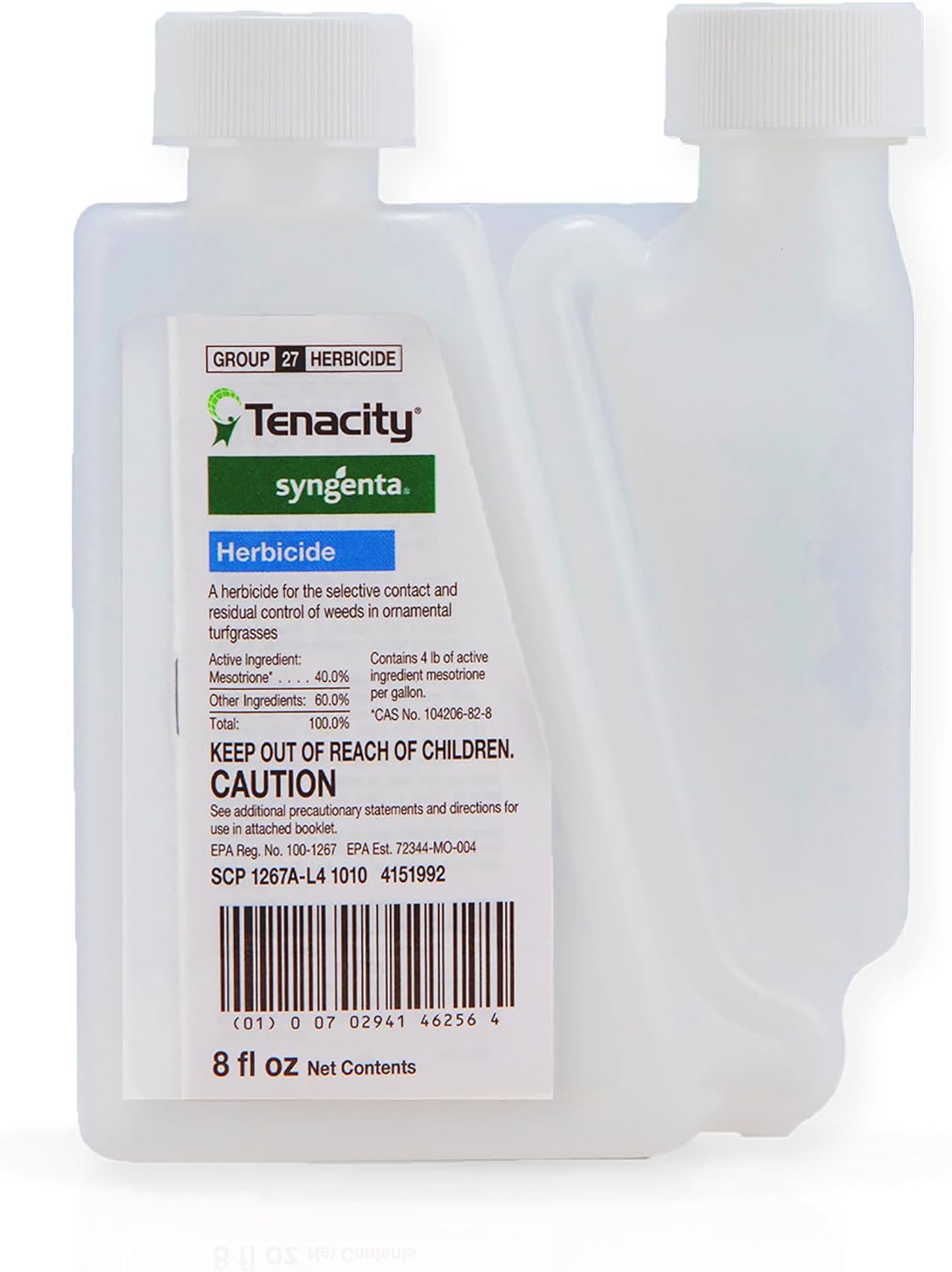
Syngenta Tenacity Turf Herbicide, 8 oz
| Unit Count | 8 Fluid Ounces |
|---|---|
| Item Form | Liquid |
| Coverage | 2000 ft^2 per 1sp of product |
| Active Ingredients | Mesotrione |
Tenacity Turf Herbicide is a concentrated mesotrione-based liquid designed for both pre-emergent and post-emergent control of common lawn weeds including crabgrass, clover, chickweed and dandelions. You apply it diluted according to label rates with a handheld or hose-end sprayer to target problem areas or broadcast across the lawn; when used as a pre-emergent it is taken up as weeds emerge and when applied post-emergent it acts systemically for selective control. The product covers a large area per bottle and the active ingredient provides residual control so you can expect longer suppression than a contact-only herbicide. Important practical points are that it is turf-selective so follow the label for grass species and mixing instructions to avoid turf injury, and results can take several days to appear. Also this is a concentrated chemical intended for careful, measured application rather than spot-use by people who prefer non-chemical methods.
Best for: Gardeners focused on strong, reliable crabgrass and broadleaf weed control who are comfortable using concentrated herbicides and following label directions for turf safety.
Less Ideal for: People seeking organic, mechanical, or spot-only solutions or those unwilling to follow detailed mixing and application instructions should consider other options.
- Systemic mesotrione active ingredient controls both pre- and post-emergent weeds
- Selective to turf when used per label, allowing treatment without killing desirable grass species
- Concentrated 8 oz liquid provides wide coverage per bottle
- Provides residual suppression, reducing frequency of repeat applications
- Requires careful mixing and adherence to label for turf safety
- Not a non-chemical or organic option for weed control
Verdict: Choose Tenacity when you want a concentrated, turf-selective herbicide that delivers pre- and post-emergent control of crabgrass and other common lawn weeds.
Choosing the Right Herbicide for Poa Annua: Key Factors to Consider
Mode of Action and Timing
Knowing whether a product is postemergent or preemergent changes when you apply it and what stage of Poa annua it will control. Preemergents work best before seed germination and reduce summer seedlings, while postemergents target actively growing seedlings or mature plants.
Timing also affects turf safety. Many postemergent herbicides stress grass when temperatures are high or when turf is dry. Reading labeled application windows and matching mode of action to the life cycle of Poa annua in your region reduces wasted treatments and lowers risk to desirable turf.
Turfgrass Species Compatibility
Different turfgrasses tolerate herbicides differently. Cool-season species and warm-season species can show contrasting sensitivity to the same active ingredient. You need to confirm the product label lists your turf species or gives specific use rates and limitations for similar turf types.
Failure to match a product to your turf species can result in bleaching, thinning, or long recovery times. When treating mixed-species lawns, choose products with broad labeled compatibility or plan spot treatments rather than blanket applications to protect sensitive areas.
Efficacy and Expected Results
Efficacy covers how quickly the herbicide acts, the percentage of plants it will suppress or kill, and whether it prevents reseeding. Some products provide visible decline within days, others require multiple applications or show best results when combined with cultural practices.
Real-world results also depend on application rate, water quality for tank mixes, and environmental conditions like temperature and soil moisture. Consider whether you need rapid knockdown for high-visibility turf or steady suppression over a season.
Residual Control and Reapplication Window
Residual activity determines how long a product prevents new Poa annua seedlings from establishing. Longer residuals reduce the need for follow-up treatments but can limit planting or renovation activities.
Understand labeled reapplication intervals and rotation restrictions. Overlapping residuals from multiple products can increase turf stress or violate label directions. Plan treatments with future maintenance in mind, such as overseeding or soil cultivation.
Application Method and Equipment Needs
Some herbicides require calibrated sprayers, shielded applications, or surfactants to perform correctly. The choice of nozzle, spray volume, and droplet size affects coverage and risk of drift onto ornamentals or flower beds.
For homeowners, ease of use is important. Look for products with straightforward mixing instructions and forgiving application windows. For larger properties, consider tank-mix compatibility and whether you need professional equipment to apply at labeled rates safely.
Environmental and Safety Considerations
Consider runoff potential, buffer requirements from water features, and reentry intervals for people and pets. Some active ingredients have restrictions near surface water or require extra precautions during windy or rainy conditions.
Personal protective equipment and disposal instructions matter. Choosing a product with manageable safety requirements makes it simpler to comply with label directions and reduces the chance of accidental exposure or noncompliant applications.
When To Treat Poa Annua
Timing is key for effective Poa annua control. For preemergent approaches, apply before soil temperatures consistently reach the germination threshold in your area, usually in late winter to early spring. Postemergent treatments are most effective when Poa is actively growing but not under heat or drought stress.
For maintained turf, schedule treatments during moderate temperatures and when irrigation can be used to support turf recovery. Repeated spot treatments may be better than blanket applications when infestations are isolated.
- Apply preemergents before seed germination for best prevention
- Use postemergents on actively growing Poa, avoiding peak heat
- Prefer spot treatments when infestations are limited
Integrating Cultural Controls
Herbicides work best as part of a broader turf management plan. Improving mowing practices, fertility, drainage, and overseeding with competitive desirable grasses reduces the niches where Poa annua thrives. Dense, healthy turf shades soil and suppresses seedlings.
Adjust irrigation to avoid prolonged surface moisture that favors Poa seed germination. Aeration and managing thatch can also reduce short-term Poa establishment by improving seed-to-soil contact for desired species during overseeding.
- Raise mowing height slightly to favor desired grasses
- Avoid overwatering in spring to reduce seed germination
- Overseed bare patches after residual herbicide restrictions expire
Safe Application Practices
Minimize off-target damage by selecting the proper nozzle and spray volume, avoiding application on windy days, and using shields where practical. Follow label directions for buffer zones near ornamentals and water features.
Mix only the amount needed and clean sprayers thoroughly between different active ingredients. Wear recommended protective gear and note reentry intervals before allowing foot traffic, pets, or children back onto treated areas.
- Calibrate sprayer and use recommended nozzles
- Avoid application during high wind or imminent rain
- Observe reentry and irrigation restrictions on the label
Managing Tough Patches and Seedheads
For visible patches or seedhead flushes, combine spot postemergent treatments with follow-up cultural measures. Mowing seedheads before they shed reduces seed return and improves the effectiveness of herbicide contact on the foliage that remains.
Persistent infestations may require multiple, timed treatments and attention to surrounding edges where seeds can migrate from sidewalks, beds, or adjacent properties.
- Mow or remove seedheads before they set seed when practical
- Plan follow-up spot treatments rather than immediate blanket resprays
- Inspect and treat borders and paths that act as seed sources
Overseeding After Control
If you plan to overseed after Poa control, check residual activity and seeding restrictions on the product label. Some residuals require waiting periods before seeding, while others allow seeding with reduced success rates.
If seeding must wait, use interim cultural practices to reduce weed pressure and improve seedbed conditions so desired grasses establish quickly once the label allows reseeding.
- Confirm waiting periods for seeding on the herbicide label
- Prepare seedbeds after restrictions expire for best germination
- Consider choosing turf cultivars that compete well with Poa annua
How We Chose the Best Herbicide for Poa Annua
We focused on products that offer reliable activity against Poa annua while minimizing risk to desirable turf. Our selection filters prioritized demonstrated control of annual Poa in either postemergent or preemergent use, clear application windows, and guidance for common turfgrass species. We also included products with documented turf safety data and instructions that reduce scorch and off-target injury when used as directed. Evaluation criteria emphasized three turf-specific dimensions: labeled efficacy on Poa annua, documented turf safety across cool- and warm-season grasses, and ease of use in landscape or lawn settings. Practical considerations included application timing, required equipment or tank mixes, and reapplication intervals. We excluded products with ambiguous labeling for turf, incomplete instructions for mixing or timing, or unacceptable restrictions that make them impractical for home or commercial turf managers. The resulting short list reflects options that balance control, safety, and usability for Poa annua treatment.
FAQ
Can I apply herbicide for Poa annua during summer heat?
You can, but many postemergent products stress desirable turf when temperatures are high. It often depends on the active ingredient and the turf species. For hot periods consider spot treatments, ensure adequate soil moisture, and follow label temperature or timing warnings.
Will a single application eliminate Poa annua for the season?
A single treatment may reduce visible plants, but complete seasonal control often requires follow-up applications or a program combining preemergent and postemergent measures. Residuals and timing play large roles in how long suppression lasts.
How long should I wait to overseed after using a herbicide for Poa annua?
Waiting periods vary by product and are specified on the label. Some herbicides allow seeding after a short interval, others require several weeks. Always check labeled seeding restrictions to avoid poor germination or seedling injury.
Are there organic options that control Poa annua effectively?
Organic or non-synthetic options typically provide limited, short-term suppression and rarely give the same level of control as labeled chemical herbicides. Cultural practices are the most effective nonchemical approach for long-term reduction of Poa annua.
Will treating Poa annua harm nearby flower beds or ornamentals?
Drift and run-off can harm sensitive plants. Use proper nozzles, maintain buffer zones, avoid application on windy days, and consider shielded or spot treatments near ornamental beds to reduce risk.
Is it better to spot-treat or broadcast-apply herbicide for Poa annua?
Spot treatments reduce total chemical use and lower risk to turf and ornamentals when infestations are isolated. Broadcast applications may be appropriate for widespread problems but require careful selection of a turf-safe product and strict adherence to label directions.
Final Verdict
When selecting a herbicide for Poa annua, prioritize a product with documented control of the weed and a label that matches your turfgrass species. Balance the need for quick knockdown against turf safety and residual restrictions to avoid needless damage or long no-seed windows. Plan treatments around proper timing, integrate cultural practices to reduce reinfestation, and choose application methods that limit off-target injury. With those tradeoffs in mind you can pick an approach that fits your maintenance schedule and preserves overall lawn health.
