

Note: This article contains affiliate links. If you click on these links and make a purchase, I may earn a small commission at no extra cost to you. This helps support my research and content. Read my full affiliate disclosure here.
A good homeowner compost bin turns kitchen scraps and yard trimmings into usable soil without creating a nuisance. For people with limited space, typical suburban yards, or the desire for low-maintenance composting, the right bin controls odor, speeds breakdown, and is easy to manage. This guide covers the top shortlisted options for homeowners, focusing on capacity, aeration, access, and upkeep. Below we review seven strong homeowner compost bins and explain the practical tradeoffs you should weigh when choosing the best fit for your garden and routine.
Top Picks at a Glance
| Best Overall The best all-around choice for most situations | Redmon 65-Gallon Outdoor Compost Bin with Lift-Off Lid |  |
| Best Quality Built to a higher standard if you want something more solid | Jora Composter JK 400 Rotating Dual-Chamber Tumbler |  |
| Best Value The sweet spot between price and what you get | VIVOSUN 43‑Gallon Dual‑Chamber Tumbling Composter |  |
| Best Budget The cheapest option that still gets the job done reliably | GEOBIN Expandable Backyard Compost Bin (Plastic) |  |
| Highest Rated A top-rated pick with lots of positive feedback | IVWOXO 0.7-Gallon Countertop Compost Bin with Handle |  |
| Most Popular A crowd favorite that many people choose with confidence | Utopia Kitchen Countertop Compost Bin, 1.3 Gallon Stainless Steel |  |
| Best Seller A high-volume bestseller chosen again and again | GEOBIN 246‑Gallon Expandable Backyard Compost Bin |  |
Redmon 65-Gallon Outdoor Compost Bin with Lift-Off Lid

| Capacity | 65 gallons |
|---|---|
| Material Type | Plastic |
| Manufacturer | Redmon |
| Item Highlight | 4 Door Access Composting Bin |
The Redmon 65-gallon outdoor compost bin is a practical backyard composter aimed at homeowners who want an easy, low-maintenance way to turn kitchen scraps and yard waste into usable compost. It is built from weather-resistant plastic made with a high percentage of post-consumer recycled material and includes multiple vent holes for aeration, a snap-off lift lid for adding fresh material, and four side access doors to remove finished compost without disturbing the pile. Assembly is tool-free so you can set it up quickly, and the trapezoid shape and sizable capacity let you handle seasonal yard cleanup and continuous kitchen scrap additions. Important limitations are that the unit does not have a tumbling mechanism, so turning will require a garden fork or aerator tool, and plastic construction can be less insulating than wooden or insulated bins in colder climates. For standard backyard composting this bin provides durable, simple containment and easy access to finished compost when you need it.
Best for: Homeowners who want a straightforward, low-effort compost solution to process kitchen scraps and regular garden waste and who value easy access to finished compost.
Less Ideal for: People seeking a fast-composting tumbler system or those needing an insulated composter for cold climates should consider alternative designs.
- Large 65-gallon capacity handles kitchen scraps and seasonal yard waste
- Four access doors allow easy removal of finished compost without emptying the whole bin
- Made from mostly post-consumer recycled plastic for weather resistance and durability
- Tool-free assembly and a snap-off lift lid make setup and daily use straightforward
- No tumbling or active mixing mechanism so aeration requires manual turning
- Plastic construction provides limited insulation in cold weather which can slow decomposition
Verdict: A simple, large-capacity outdoor bin that gives homeowners easy access to finished compost without complicated setup or maintenance.
Jora Composter JK 400 Rotating Dual-Chamber Tumbler

| Capacity | 106 gallons |
|---|---|
| Material Type | Metal |
| Model Number | JK 400 |
The Jora JK 400 is a large, metal rotating compost tumbler built for homeowners who want faster, hotter composting without constant manual turning. It has two chambers so you can fill one side while the other cures, and the insulated, food-grade interior encourages high temperatures that speed breakdown of kitchen and yard waste. Side vents provide oxygen flow to support aerobic composting and the hand-turned barrel makes mixing straightforward. Practical benefits include a high weekly throughput for busy yards and reduced pest access compared with open piles. The robust metal construction and octagonal drum give stability and a durable feel, but the unit is very heavy and needs a firm, level base for safe assembly and rotation. Also note one listing warning that some units are refurbished and sold for parts only which would affect reliability. Expect strong performance where heat-driven decomposition and capacity matter most, but plan for a solid installation and occasional maintenance of seals and vents to keep it running efficiently.
Best for: Homeowners who prioritize fast, heat-driven composting and need a high-capacity, durable system for processing regular kitchen and yard waste.
Less Ideal for: Small-space gardeners, renters, or anyone unwilling to install a heavy unit or perform occasional maintenance should consider smaller or simpler composters.
- Dual-chamber design lets you fill one side while the other matures for continuous composting
- Insulated, food-grade interior promotes high temperatures for faster pathogen reduction and decomposition
- Side vents provide airflow to support aerobic composting
- Large 106 gallon capacity handles substantial weekly volumes for busy households
- Heavy unit requires a stable, level base and may be difficult to move or assemble
- Metal construction can need occasional care to maintain seals and prevent gaps
Verdict: Choose the Jora JK 400 if you want a high-capacity, insulated tumbler that produces compost quickly through heat and continuous two-chamber operation.
VIVOSUN 43‑Gallon Dual‑Chamber Tumbling Composter
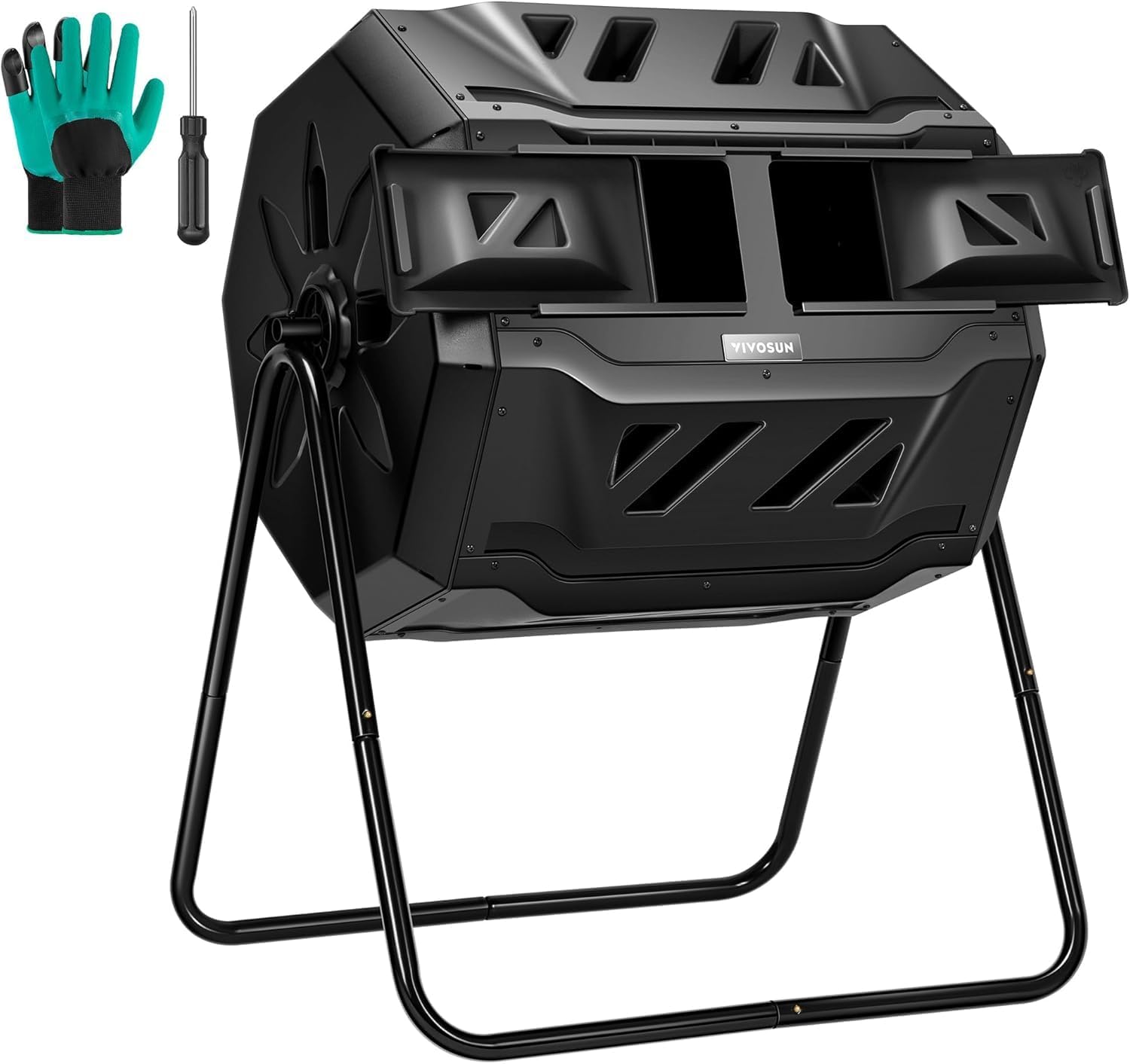
| Capacity | 43 gallons |
|---|---|
| Material Type | galvanized steel |
| Shape | Octagonal |
This VIVOSUN tumbling composter is built for homeowners who want steady, hands‑off composting without frequent turning. It has two chambers so you can fill one side while the other finishes breaking down, and the barrel rotates 360 degrees on a metal frame so turning is quick and mechanical rather than manual. Deep fins inside the octagonal drum help break up clumps while multiple vents promote airflow for aerobic decomposition. The unit combines a galvanized steel frame with a PP plastic body for weather resistance and durability, and it comes with waterproof garden gloves and plastic claws for handling and mixing. Practical benefits include continuous output of finished compost, reduced odor thanks to aeration, and easier turning compared with a static bin. Limitations are its 43‑gallon capacity, which may be small for very large yards, and the need to assemble the frame and drum; wet food scraps may still require mixing with browns to avoid clumping. For a homeowner seeking a reliable, low‑effort system, this composter streamlines the process but is best for small to medium household quantities.
Best for: Homeowners who want a low‑effort, continuous composting system that reduces manual turning and produces finished compost on a regular schedule.
Less Ideal for: People with very large vegetable gardens or heavy weekly green waste who need higher capacity or commercial‑scale composting solutions.
- Dual chambers allow one batch to finish while you add new material to the other for continuous composting
- 360° tumbling design makes turning fast and reduces manual labor
- Ventilation and internal fins improve aeration and help break up clumps for faster decomposition
- Galvanized steel frame and PP plastic body resist corrosion and outdoor weathering
- 43‑gallon capacity may be limiting for large yards or heavy garden waste
- Requires assembly and occasional manual mixing of very wet materials
Verdict: A practical, low‑effort dual‑chamber tumbler that delivers continuous compost for small to medium households.
GEOBIN Expandable Backyard Compost Bin (Plastic)

| Capacity | 216 gallons |
|---|---|
| Material Type | Plastic |
The GEOBIN is a no-frills backyard composter that delivers a large, breathable container for kitchen scraps and yard waste. It arrives as a flexible plastic sleeve that assembles with a few closure keys and can be expanded to increase capacity, making it convenient to move, reconfigure, or store when not in use. The cylindrical, ventilated design encourages airflow for faster breakdown of organic material, and the large volume keeps you from having to empty it frequently. Practical benefits include very low weight for handling and straightforward setup that suits beginners or homeowners who want an inexpensive way to start composting. Important limitations are its basic construction and lack of rigid panels, so it will not insulate heat as well as solid bins and can be less durable under heavy animal pressure or rough handling. It is best used on level ground with regular turning to keep decomposition active and to avoid odors.
Best for: Homeowners who want an inexpensive, high-capacity compost solution they can set up quickly and adjust as their needs change.
Less Ideal for: Gardeners seeking a heavy-duty, insulated bin for rapid hot composting or those who need an animal-proof, long-term containment solution.
- Large capacity suitable for household and yard waste
- Very easy to assemble and reconfigure with closure keys
- Lightweight and easy to move or store when not in use
- Ventilated design promotes airflow for faster composting
- Thin plastic sleeve provides less insulation and protection than rigid bins
- May be vulnerable to damage from persistent animals or rough handling
Verdict: Choose the GEOBIN if you want the most budget-friendly, easy-to-assemble large-capacity compost bin for basic backyard composting.
IVWOXO 0.7-Gallon Countertop Compost Bin with Handle

| Capacity | 0.7 gallons |
|---|---|
| Material Type | Plastic |
This IVWOXO countertop compost bin is built for everyday kitchen use where space and odor control matter. It holds about 0.7 gallons and features a nearly airtight lid plus a removable inner bucket with a built-in filter basket to keep smells contained and separate liquids from solids. The one-handed lid and sturdy handle make it easy to move to the outdoor compost or under the sink, and the smooth plastic interior is dishwasher safe for straightforward cleaning. Its small footprint fits on counters or beside a coffee station for collecting grounds without taking up room. Because it is plastic and compact, it is best for regular emptying rather than long-term storage of large amounts of food waste, and it lacks a replaceable charcoal filter so aggressive odors may develop if not emptied frequently. For homeowners who want a reliable, low-maintenance kitchen scrap collector that stays discreet, this model covers the basics well.
Best for: Homeowners who want a dependable, no-fuss countertop container for daily kitchen scraps and who will empty it regularly to avoid odors.
Less Ideal for: Large households or people who want a high-capacity indoor composter that can store scraps for several days before transfer outdoors.
- Nearly airtight lid reduces kitchen odors without needing activated carbon cartridges
- Removable inner bucket separates liquids and solids to slow decomposition
- Dishwasher-safe smooth plastic interior for easy cleaning
- Compact 0.7-gallon size fits on countertops or under sinks
- Sturdy handle and one-handed lid for convenient carrying and use
- Small capacity requires frequent emptying for households that produce more scraps
- No replaceable charcoal filter for long-term odor control in heavy-use situations
Verdict: A compact, easy-to-clean countertop bin that quietly contains daily kitchen scraps for homeowners who value reliability and simple upkeep.
Utopia Kitchen Countertop Compost Bin, 1.3 Gallon Stainless Steel

| Capacity | 4.92 liters |
|---|---|
| Material Type | Stainless Steel |
| Item Highlight | Odorless countertop compost bin with charcoal filter |
| Item Type Name | Kitchen Compost Bin for Kitchen Countertop – 1.3 |
The Utopia Kitchen countertop compost bin is a small indoor bucket made for collecting daily food scraps at the sink or on a prep counter before transfer to an outdoor pile or larger composter. Its stainless steel body and cylindrical shape sit neatly on a counter and resist scratches and staining from typical kitchen waste. A secure lid and included charcoal filter control odors so you can keep scraps inside for several days without noticeable smell, and the 1.3 gallon capacity works for one to two people or for short collection intervals in larger households. Maintenance is straightforward: line the bottom with paper or cardboard to absorb moisture and rinse the bin weekly with mild soap or vinegar. The main limitations are capacity and drainage handling — it is not meant to replace an outdoor composter and will need frequent emptying if you generate a lot of wet waste. Also the metal finish can show fingerprints without regular cleaning.
Best for: Homeowners who want a tidy, odor-controlled way to collect daily kitchen scraps before moving them to an outdoor composter and who value a durable, countertop-friendly container.
Less Ideal for: People who need a large-capacity indoor solution or who want an all-in-one composting system that processes waste rather than storing it.
- Stainless steel construction for durability and easy wiping
- Charcoal filter and tight lid reduce kitchen odors effectively
- Compact cylindrical design fits on most countertops without dominating space
- Small 1.3 gallon capacity requires frequent emptying for larger households
- No built-in drainage or spout so wet scraps require extra lining or manual draining
Verdict: A durable, compact countertop compost bin that keeps everyday food scraps contained and odor-free until you can empty them outdoors.
GEOBIN 246‑Gallon Expandable Backyard Compost Bin

| Capacity | 246 gallons |
|---|---|
| Material Type | High Density Polyethylene (HDPE) |
The GEOBIN 246‑gallon compost bin is a simple, high-capacity system designed for homeowners who want an easy route to turn yard and kitchen waste into usable compost. It assembles quickly using connection keys and expands to about 4 feet tall to accept large volumes of leaves, grass clippings, and food scraps. The HDPE construction is weather-resistant and inert so it will not leach into the compost, while the perforated design provides good airflow to speed decomposition. In practice it is best used as a single large pile rather than a multi-bin rotation system, and periodic turning with a pitchfork or aerator will keep the pile active. The bin lacks a built-in access door for finished compost, so harvesting requires collapsing or tipping the container or reaching in from the top. For gardeners who want a low-maintenance, long-lived outdoor composter that handles bulk material, this GEOBIN provides a cost-effective solution; buyers who need staged composting or easy bottom access should consider alternative designs.
Best for: Homeowners who want a low-maintenance, high-capacity outdoor composter for bulk yard waste and occasional kitchen scraps and prioritize durability and simple setup.
Less Ideal for: Gardeners who need a multi-stage or easy-bottom-access system for continuous small-batch composting or those with very limited backyard space.
- Very large expandable capacity suitable for whole-yard seasons of leaves and clippings
- High density polyethylene construction resists weathering and will not leach into compost
- Perforated design and ventilation promote faster decomposition
- Simple assembly with connection keys makes setup quick for nontechnical users
- No built-in access door for easy removal of finished compost
Verdict: Choose this GEOBIN if you want a durable, large-capacity backyard composter that is easy to assemble and handles big volumes of yard waste.
Choosing the Right Homeowner Compost Bin: Key Factors to Consider
Container Size and Yard Fit
Choose a bin size that matches both the amount of organic waste you generate and the physical space you have. A too-small bin fills quickly and can become anaerobic, producing odors and slowing decomposition. A too-large unit may sit underused and take longer to heat up, which reduces microbial activity.
Consider how often you will add material and whether you want a single bin or a multi-bin system for staged composting. Also factor in how visible the bin will be from living areas and whether it fits within local yard or homeowners association guidelines.
Aeration and Turning Mechanism
Good airflow and regular mixing are essential for aerobic composting and faster, less smelly results. Some bins have fixed vents or perforated walls to promote passive aeration, while others include built-in tumblers or removable cores that make turning easy.
If you prefer low-effort composting, look for designs that simplify turning or provide passive airflow that reduces the need for frequent agitation. For gardeners who want faster results, a tumbler or a bin with easy access for a pitchfork or turning tool will accelerate breakdown.
Access for Adding and Removing Material
How you add scraps and harvest finished compost matters for convenience and for keeping the pile active. Top-loading units are simple for daily kitchen scraps but can make removing finished compost awkward. Bottom-access panels, removable bases, or front doors let you collect finished material without disturbing active layers.
Think about the height of the bin as well. Tall bins reduce bending when adding waste but can make turning harder. Shorter, wider designs often make harvesting and mixing easier for gardeners who prefer manual handling.
Pest Resistance and Odor Management
Homes close to neighbors or with wildlife presence need bins that limit access by rodents, raccoons, and other animals. Secure lids, fine-mesh vents, and enclosed bases help keep pests out. Proper airflow and balanced green-to-brown ratios reduce anaerobic spots that cause foul odors.
Also consider how the bin drains excess moisture. Poor drainage can create smelly, wet zones that attract pests. Look for designs that keep moisture balanced while allowing excess liquid to escape or be collected.
Material Durability and Weather Resistance
Outdoor compost bins face sun, rain, and temperature swings. UV-resistant plastics and treated metals resist cracking, warping, and rust. Solid construction keeps vents and doors aligned so pests cannot exploit gaps.
Longevity matters because replacing a failed bin adds work and cost. Check for sturdy hinges, reinforced panels, and resistant finishes. Ease of assembly and the ability to secure the bin to the ground or a base are helpful in windy or animal-prone locations.
Maintenance Effort and Time to Compost
Different designs require different levels of regular attention. Aerated systems and tumblers can speed composting but often require more frequent turning. Passive or batch bins need less routine tedium but can take longer to produce finished compost.
Decide how much time you are willing to invest each week. If you want finished compost within months, choose a system that supports active management. If you prefer a mostly set-and-forget approach, opt for models that emphasize passive aeration and steady decomposition.
Compost Bin Placement and Preparation
Where you place the bin affects decomposition rate and convenience. Aim for a level, well-drained spot with partial sun to encourage microbial activity during cooler months. Avoid low spots where water pools; excess moisture slows decomposition and can create odors.
Prepare a mix layer at the start: coarse browns like twigs or straw at the bottom improve drainage, then alternate greens and browns to jump-start microbial activity. If your yard produces a lot of grass clippings, spread them in thinner layers so they do not compact and block airflow.
- Choose a location near your kitchen or compost collection but not directly against the house.
- Place the bin on soil or a coarse base to allow soil organisms to migrate in.
- Keep the bin accessible year-round for adding material and harvesting finished compost.
Managing Moisture and Carbon-to-Nitrogen Balance
Moisture and the carbon-to-nitrogen ratio are the two main levers to control compost performance. Piles should feel like a wrung-out sponge; too wet leads to anaerobic decay and odor, too dry stalls microbial activity.
Balance green materials (kitchen scraps, fresh grass) with dry browns (leaves, shredded paper). If you add a lot of wet material, mix in absorbent browns and turn the pile to restore aeration. During heavy rain, cover the bin top to prevent saturation but retain enough moisture for microbes.
- Aim for about three parts brown to one part green by volume as a starting point.
- If a pile smells bad, add dry carbon and turn to reintroduce air.
- Collect excess liquid at the base or allow it to drain into the soil if the design permits.
Winter Composting Tips for Homeowners
Composting slows in cold weather but does not stop. Insulate the bin with extra brown material and add larger volumes before a cold snap to preserve heat. Keep activity going by layering greens and browns and minimizing unnecessary opening of insulated units.
If you need finished compost in the spring, use a smaller, more active bin or a tumbler that retains heat more effectively. For passive bins, accept a longer timeline and plan to continue additions through the season to build up material for next year.
- Position bins away from freezing winds and consider adding a straw or leaf insulating collar.
- Avoid adding meat, dairy, or fatty wastes in winter when microbial action is slow.
- Layer larger woody material to create internal air channels that hold warmth.
Troubleshooting Common Bin Problems
If the bin smells, the usual causes are too much moisture, insufficient aeration, or an excess of greens. Remedy this by turning the pile, adding dry browns, and checking vents and drainage.
If decomposition is very slow without foul odors, you likely need more nitrogen-rich materials or smaller particle sizes to increase surface area. Chop or shred large pieces and adjust the green-to-brown ratio to stimulate microbial activity.
- For pest issues, inspect seals and vents and remove any food scraps left on the bin exterior.
- To revive compacted material, open the bin and mix in coarse dry browns to restore airflow.
- If liquid accumulates at the bottom, temporarily stop adding greens and mix in dry material to absorb moisture.
Using Finished Compost in the Home Garden
Finished compost is a soil amendment, not a complete fertilizer. Work it into planting beds, sprinkle it over lawns before seeding, or mix it into potting mixes to improve water retention and nutrient availability.
Screen compost if you need a fine, uniform texture for seed starting or potting. Coarser compost is excellent as mulch around trees and shrubs where nutrients release more slowly.
- Apply a 1 to 3 inch layer of compost to beds and lightly fork it into the topsoil.
- Use finished compost around new transplants to reduce transplant shock.
- Store finished compost in a covered container to keep it usable and pest-free.
How We Chose the Best Homeowner Compost Bin
We evaluated options that suit typical homeowner situations: small to medium yards, mixed kitchen and yard waste, and gardeners who want usable compost within a season or two. Selection prioritized bins designed for common homeowner constraints-compact footprint, pest resistance, manageable capacity, and straightforward maintenance. Key evaluation criteria included container capacity and footprint to match yard size and waste volume; aeration and mixing systems that influence decomposition speed; access and ease of harvesting finished compost; material durability and weather resistance for long-term outdoor use; and pest control and odor management to keep neighborhoods pleasant. We excluded specialized systems intended for high-volume municipal or commercial composting and units that require complex plumbing, electricity, or uncommon accessories. Where possible we favored products with clear instructions and practical design features that reduce routine work. The final list balances speed of breakdown with convenience and durability so homeowners can choose what matters most for their space and schedule.
FAQ
How much yard waste will a homeowner compost bin handle?
It depends on bin capacity and how often you add material. Small backyard bins typically handle weekly kitchen scraps for one to three people plus seasonal yard waste. If you produce a lot of grass clippings or large amounts of pruning waste, you may need a larger unit or staged system.
Can I compost meat and dairy in a homeowner bin?
Meat and dairy are best avoided in most homeowner bins because they attract pests and generate strong odors unless the system is specifically designed to handle them. For safe composting of these items, use a high-heat or specially sealed system.
How long does composting take in a typical homeowner bin?
Time to finished compost usually ranges from a few months to more than a year. Active systems with regular turning and good aeration can produce usable compost in a few months. Passive bins or cooler climates will take longer.
Do I need to turn my compost often?
Turning frequency depends on the bin design and your goals. Tumblers or active piles benefit from weekly to biweekly turning to speed decomposition. Passive bins with good passive aeration require less frequent turning, sometimes only a few times per season.
Will a compost bin attract rodents to my yard?
It can if the bin has gaps, unsecured lids, or if food scraps are left exposed. Choosing a bin with secure closures, fine-mesh vents, and a solid base reduces the chance of rodents. Properly balancing materials and avoiding attractive foods also helps.
Final Verdict
Choose a homeowner compost bin that fits your yard size and how much time you will spend managing the pile. Prioritize aeration and access if you want finished compost quickly, or pick a low-maintenance enclosed bin if convenience and pest control are most important. Balance capacity, ease of harvesting, and durability against the level of active management you are willing to do. With the right tradeoffs, a homeowner compost bin will reduce waste and supply valuable organic matter for healthier soil and plants.
