

Note: This article contains affiliate links. If you click on these links and make a purchase, I may earn a small commission at no extra cost to you. This helps support my research and content. Read my full affiliate disclosure here.
If you spend evenings on your patio, the right insect killer for patio can make outdoor time comfortable instead of itchy. Patio devices face sun, wind, and open spaces, so what works in a garage or kitchen often underperforms outside. This guide shortlists the top options built for patio use and explains how each one matches common outdoor challenges like coverage area, weather resistance, and safety around kids and pets. Below you will find picks that suit different patios and maintenance preferences, plus the specific evaluation criteria we used to compare them.
Top Picks at a Glance
| Best Quality Built to a higher standard if you want something more solid | Flowtron BK-40D 40W Electric Outdoor Bug Zapper (1 Acre) |  |
| Best Budget The cheapest option that still gets the job done reliably | Repel Outdoor Fogger Camp Fogger 16 oz |  |
| Highest Rated A top-rated pick with lots of positive feedback | Jahy2Tech Solar-Powered Outdoor Bug Zapper (4-Pack) |  |
| Most Popular A crowd favorite that many people choose with confidence | Ortho Home Defense Insect Killer for Indoor & Perimeter, 1.33 gal. with Comfort Wand |  |
| Best Seller A high-volume bestseller chosen again and again | GOOTOP Zap T6 Pro 4200V Plug-in Bug Zapper (with Replaceable Bulb) |  |
Flowtron BK-40D 40W Electric Outdoor Bug Zapper (1 Acre)

| Power Source | Corded Electric |
|---|---|
| Target Species | Mosquito |
| Coverage | Approximately 1 acre |
| Grid Voltage | 5600V |
| Bulb Wattage | 40W UV |
The Flowtron BK-40D is a heavy-duty outdoor bug zapper built to cover roughly one acre of yard with continuous, low-effort insect control. It combines a 40W UV bulb with an included octenol cartridge to increase attraction of mosquitoes and other flying pests, then instantly kills them on a non-clogging 5600V grid. The vertical, weatherproof polycarbonate housing is designed for year-round outdoor use and the insect remains fall to the ground so there is no sticky tray to empty. Setup is simple: mount or place near an outdoor outlet and replace the bulb and octenol cartridge as they expire. Practical benefits include broad coverage, audible confirmation of zaps, and a no-spray alternative that is safe around people and pets when used as directed. Important limitations are that effectiveness depends on placement and environmental factors and it targets light- and scent-attracted species so it will not eliminate all mosquito sources like nearby breeding sites. Routine bulb and cartridge replacement are required to maintain peak performance.
Best for: Buyers who prioritize reliable, continuous outdoor mosquito reduction across a large yard and want a low-maintenance, non-chemical solution that runs from an outlet.
Less Ideal for: People who need a portable, battery-powered trap for short-term use or those seeking a device that removes breeding sources rather than attracting and zapping flying adults.
- Combination of 40W UV bulb and octenol attractant boosts mosquito capture compared with UV-only units
- High-voltage 5600V non-clogging grid for instant kills and audible confirmation
- Weatherproof polycarbonate housing intended for continuous outdoor use
- Covers up to about one acre, suitable for large yards or patios
- No sticky strips or chemical sprays required
- Requires periodic replacement of the UV bulb and octenol cartridge to retain effectiveness
- Performance depends on correct placement and local insect behavior rather than guaranteed elimination of all mosquitoes
Verdict: Choose this unit if you want a weatherproof, high‑power zapper that reliably reduces flying mosquitoes across a large yard without sprays or sticky traps.
Repel Outdoor Fogger Camp Fogger 16 oz

| Item Volume | 16 fluid ounces |
|---|---|
| Item Form | Aerosol |
| Indoor Outdoor Usage | Outdoor |
| Target Species | Mosquito |
The Repel Outdoor Fogger is a 16-ounce aerosol designed to quickly knock down mosquitoes and a range of other flying and crawling insects around campsites, patios and picnic areas. You use it by spraying when the air is calm or with the wind if there is a breeze, holding the can slightly downward and allowing a few minutes for the spray to take effect. The formula lists active ingredients tetramethrin and phenothrin and is intended for outdoor spot treatments where fast control is needed. Practical benefits include rapid results, compact portable packaging that is easy to throw in a camping kit, and a broad target list that covers gnats, flies, wasps and some ants. Important limitations are that it is for outdoor use only, treatments should not exceed once per day, and the product contains chemicals that carry a California health warning for reproductive harm and cancer, so users should follow label precautions and avoid repeated exposure. This works best as an occasional quick-response solution rather than a long-term landscape treatment.
Best for: Buyers who want an inexpensive, portable spray to get rapid temporary relief from mosquitoes and flies during outdoor activities like camping, picnics or backyard gatherings.
Less Ideal for: People seeking continuous, long-term yard protection or those who prefer non-chemical or low-toxicity pest control methods should consider alternate approaches.
- Fast knockdown of mosquitoes and many common outdoor insects
- Portable 16-ounce aerosol is easy to carry for camping and outings
- Simple application instructions suitable for quick spot treatments
- Broad target list includes flying and crawling pests commonly found at outdoor gatherings
- Contains chemicals with a state health warning which requires careful use and avoidance of repeated exposure
- Not intended for daily or long-term landscape pest control
Verdict: A low-cost, portable aerosol fogger that delivers quick on-contact control of mosquitoes and common outdoor flies for short-term outdoor use.
Jahy2Tech Solar-Powered Outdoor Bug Zapper (4-Pack)
| Power Source | solar_powered |
|---|---|
| Number of Pieces | 4 |
| Material Type | Stainless Steel |
| IP Rating | IP65 |
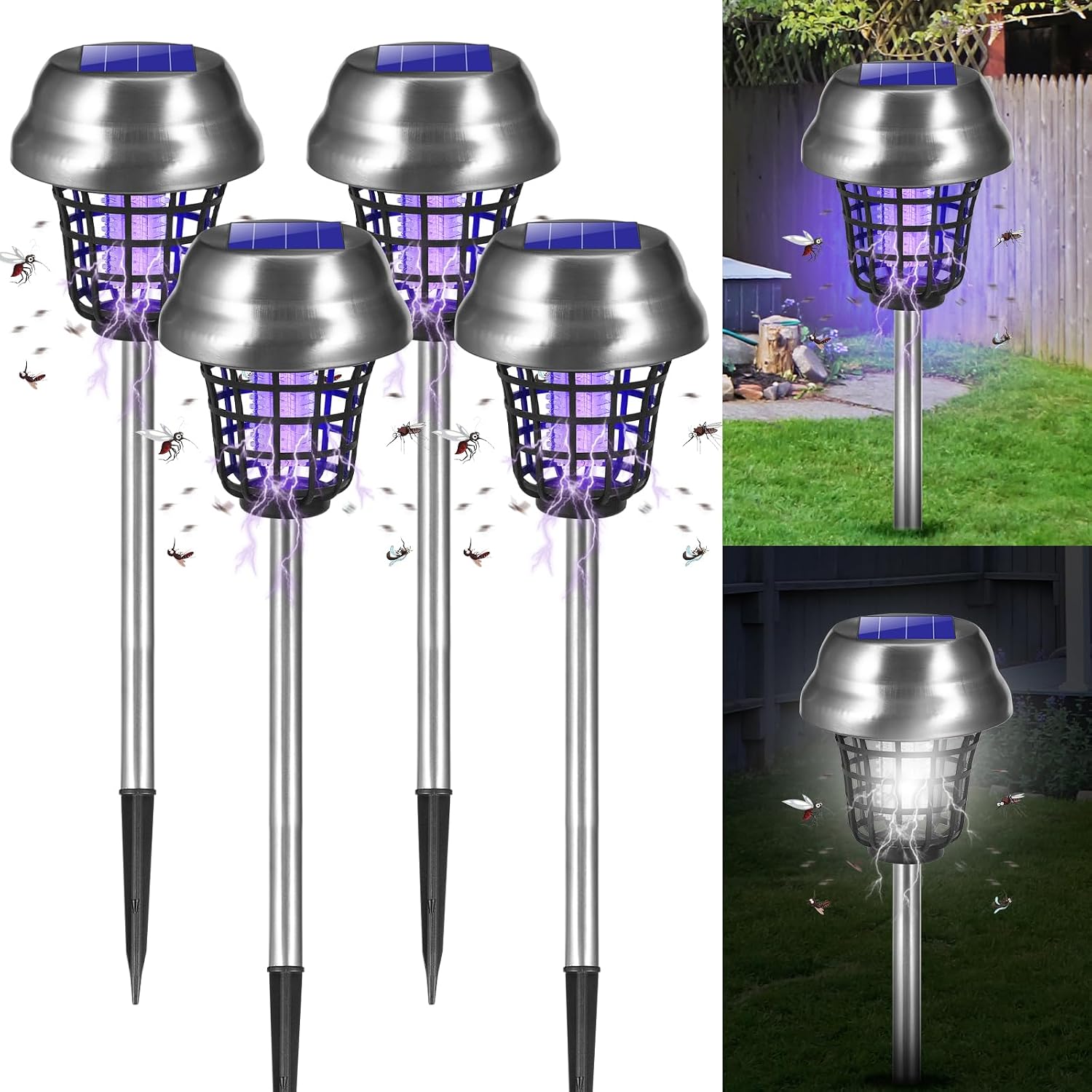
This 4-pack of Jahy2Tech solar bug zappers is a cordless, low-maintenance option for outdoor mosquito and gnat control around patios, pathways, and garden borders. Each unit charges by its integrated solar panel during the day and automatically turns on at dusk via a built-in light sensor, providing roughly 8 to 10 hours of nighttime operation after a full charge. The 365–395 nm purple UV LEDs attract small flying insects and a high-intensity electric grid delivers the kill, while the stainless-steel weather-resistant housing (IP65) is designed to resist rain and heat for outdoor use. The included stakes make placement straightforward and the four-pack lets you space units to create perimeter coverage. Limits to expect are dependency on direct sunlight for full runtime and reduced performance under heavy shade or long cloudy periods, and like all small solar zappers the effective attraction radius is modest rather than whole-yard scale. For reliable, maintenance-light insect control in sunny, open outdoor spots this set performs well.
Best for: Buyers who want a dependable, low-maintenance, cordless solution to reduce small flying insects around seating areas and garden borders and prioritize devices that run automatically without wiring or frequent upkeep.
Less Ideal for: Anyone needing fast knockdown across large lawns or users who lack sunny placement for daytime charging should consider higher-capacity or mains-powered alternatives.
- Solar-powered with automatic dusk-to-dawn operation via built-in light sensor
- IP65 weather-resistant stainless-steel housing suitable for rain and heat exposure
- Four-unit pack allows flexible placement to cover patios, pathways, and garden edges
- 365–395 nm UV light plus electric grid targets mosquitoes, gnats, fruit flies and other small flying insects
- Performance depends on receiving direct sunlight so runtime falls in shade or cloudy weather
- Attraction radius is limited compared with larger electric zappers intended for whole-yard coverage
Verdict: A reliable, low-maintenance solar four-pack for dusk-to-dawn control of mosquitoes and gnats in sunny, open outdoor spots.
Ortho Home Defense Insect Killer for Indoor & Perimeter, 1.33 gal. with Comfort Wand

| Item Form | Spray |
|---|---|
| Target Species | Insects |
| Liquid Volume | 1.33 gallons |
| Active Ingredients | Bifenthrin 0.05%, Zeta-Cypermethrin 0.0125% |
This 1.33 gallon Ortho Home Defense spray is designed to treat both indoor problem spots and the outdoor perimeter of a home to reduce ants, roaches, spiders and many other crawling and flying insects. It comes with a battery-powered Comfort Wand that delivers a continuous spray so you can apply a uniform band around foundations, patios and entry points without bending or pumping. The formula with bifenthrin and zeta-cypermethrin is intended to kill on contact and establish a barrier that the manufacturer says lasts up to 12 months for ants, roaches and spiders on non-porous indoor surfaces. In real-world use that means fewer repeat treatments in busy yard perimeters and around doors and windows. The spray dries clear with minimal fumes which helps for indoor use near kitchens and living areas. Limitations are that this is a chemical insecticide so users should follow safety directions around children, pets and plants and it is not a specific solution for pests not listed on the label. For homeowners focused on strong, perimeter-level protection this product simplifies application and covers a large area per container.
Best for: Homeowners who want a performance-focused perimeter treatment to reduce recurring yard and entry-point insect problems and prefer a ready-to-use product that is easy to apply.
Less Ideal for: People seeking organic or non-chemical control methods or those who need a targeted solution for pests not listed on the label should consider alternative products.
- Includes battery-powered Comfort Wand for continuous, fatigue-free application
- Ready-to-use 1.33 gallon container covers large perimeters without mixing
- Formula creates a barrier claimed to provide up to 12 months protection against ants, roaches and spiders on non-porous indoor surfaces
- Dries clear and gives off minimal fumes, making indoor use more practical
- Contains synthetic insecticides so precautions are required around children, pets and ornamentals
- Protection claims are specific to certain species and surfaces so results vary by pest and conditions
Verdict: A powerful, ready-to-use perimeter and indoor spray for homeowners who want long-lasting, performance-oriented protection against common yard and household insects.
GOOTOP Zap T6 Pro 4200V Plug-in Bug Zapper (with Replaceable Bulb)

| Target Species | Mosquitoes, Flies, Moths, Gnats, Wasps, Flying Insects |
|---|---|
| Power Source | ac |
| Maximum Range | 1.5 millimeters |
| Unit Count | 1 Count |
| Material Type | Plastic |
The GOOTOP Zap T6 Pro is a lightweight plug-in bug zapper that attracts flying pests with a UV bulb and kills them on contact with a 4200V electric grid. It is designed to hang or stand near patios, garages, porches, or indoor spots where insects gather after dark. Notable features include a removable bottom tray for easy disposal of dead insects, a replaceable 15W U-shaped bulb, and a plastic outer housing that keeps the grid guarded. In practice it works best at night in relatively dark areas where the bulb is the primary attractant. The unit is simple to use — plug it into AC power and it begins working immediately — and the light weight makes installation flexible. Limitations to consider are the need for darkness to maximize attraction, periodic bulb replacement as luminance drops, and the fact that it targets flying insects so it will not affect crawling pests. For garages, it can reduce mosquito and fly activity near work areas but perform best when placed away from competing light sources and out of reach of children and pets.
Best for: Buyers who want a low-maintenance, chemical-free way to reduce mosquitoes and flies in garages or covered outdoor work areas and who prefer solutions with demonstrated user satisfaction.
Less Ideal for: People seeking an all-in-one pest control solution for crawling insects or daytime use should consider alternate devices or integrated pest strategies.
- Effective at attracting and electrocuting a wide range of flying insects including mosquitoes and flies
- Removable bottom tray and brush make cleaning simple
- Replaceable 15W bulb extends usable life and maintains attraction
- Lightweight design and hanging ring allow flexible placement indoors or in sheltered outdoor spaces
- Requires dark conditions to attract insects most effectively
- Needs occasional bulb replacement to retain peak performance
Verdict: A simple, plug-in electric zapper that reliably cuts down flying insects in garages and covered outdoor spaces without sprays or chemicals.
Choosing the Right Insect Killer for Patio: Key Factors to Consider
Coverage Area
Coverage area determines how many square feet a device will meaningfully control. Patios vary from small balcony nooks to expansive paved terraces, and a unit rated for indoor rooms will not necessarily protect open-air seating. Look for realistic coverage figures based on outdoor testing or manufacturer guidance that accounts for wind and open sightlines. Positioning also affects coverage: a centrally placed unit can perform better than one tucked behind planters, but open airflow may still reduce effective range.
Underestimating coverage needs means you might buy a unit that only protects a small corner while insects remain active where people gather. Consider the layout, dominant wind direction, and whether the device will be permanently mounted, freestanding, or moved between spots when judging coverage.
Safety and Non-Target Risk
Safety matters when children, pets, or pollinators are present. Some insect killers use electrified grids, others use light traps, and some use low-toxicity attractants. Each method carries different risks. Electrified units can injure curious fingers if grills are poorly shielded; sticky or glue traps can unintentionally capture beneficial insects. Choose devices with secure housings, downward-facing intakes, or selective attractants that target biting flies and mosquitoes rather than bees.
Also evaluate chemical or bait-based systems for appropriate label safety information. Even low-toxicity attractants should be stored and serviced in ways that minimize accidental exposure. For multi-use patios with potted plants or pollinator habitat, prefer designs that limit attraction of beneficial species.
Weather Resistance and Durability
Patio equipment is exposed to sun, humidity, rain, and occasional debris. Look for materials and construction that withstand UV, corrosion, and temperature swings. Plastic housings should be UV-stabilized; metal components should be powder-coated or stainless to limit rust. Seals, brackets, and electrical connections matter for units that remain outdoors year-round. Devices intended only for sheltered use will degrade quickly if left uncovered on an open patio.
Think about seasonal storage too. A unit that ages gracefully when stored indoors during winter reduces long-term replacement cost and maintenance headaches. Check how easily weather seals can be inspected and replaced if needed.
Maintenance Effort
All insect control devices require some upkeep to keep working well. Maintenance effort covers how often you must empty catch containers, clean grids or lamps, replace consumables, and winterize units. Devices with removable trays and washable components save time. Models that rely on proprietary cartridges or bait can be easy to service but may add expense and supply dependency.
Also evaluate how messy the maintenance is. Sticky traps or glue boards can be unpleasant to handle, while electric collection cups that allow quick rinsing are easier. The best patio options minimize routine attention while still offering straightforward deep cleaning when needed.
Power and Placement Flexibility
Power flexibility affects where and how you use a device on your patio. Hardwired or plug-in units give continuous coverage but need an outlet or extension. Battery and solar-assisted models offer placement freedom but may have limited nightly runtime or reduced performance in shaded areas. Consider whether you will move the unit between entertaining areas or leave it fixed.
Also check mounting options. Some patios benefit from hanging units that keep attraction sources above seating level, while others need ground or table-top placement. The combination of power choices and mounting options determines how effectively a device integrates with your outdoor living patterns.
How Insect Killers Behave Outdoors
Patio environments are dynamic: wind disperses attractant plumes, sunlight can reduce lure effectiveness, and open spaces let insects approach from multiple angles. Expect lower effective range compared with indoor ratings. Devices that use a combination of attractant types, such as light plus CO2 mimicry or thermal cues, often perform more consistently in varied conditions.
Placement is often as important as device strength. Position units downwind of seating areas so attractant plumes carry insects away from people and toward the trap. Elevation can change capture rates depending on local insect flight paths, so try both hanging and table-top positions during early trials to find the sweet spot for your space.
- Test placement during peak insect hours to evaluate real-world coverage
- Avoid placing units adjacent to dining tables where lights may draw insects toward people
- Sheltered corners can extend device life but may reduce attraction effectiveness
Safety Tips for Family-Friendly Patios
When children or pets frequent the patio, prioritize units with enclosed intake paths and user-lock features. Keep devices out of reach and follow instructions for securing power cords and mounting hardware. For pollinator-friendly gardens, avoid broad-spectrum attractants and place devices where they are less likely to intercept beneficial insect flight lines.
If you use bait or chemical attractants, store them in a locked or high cabinet and handle with gloves. Regularly inspect housings for damage that could expose electrical elements or sticky surfaces.
- Choose downward-facing intakes to limit accidental contact
- Mount units at heights that reduce child and pet access
- Inspect and replace worn safety grills or covers promptly
Integrating Devices Into Outdoor Entertaining
For patios used primarily for entertaining, consider portable units with quick-start operation and quiet fans. Some models have low-light modes or directional settings that let you target seating clusters without flooding the whole patio with attraction cues. Use a combination of units if your layout has multiple seating areas, placing smaller portable devices near the edges and a larger unit to protect the main gathering spot.
Schedule maintenance before event season to ensure trays are empty and lamps or batteries are fresh. Keep a backup power option on hand if reliable outlet access is limited.
- Rotate portable units to trial best placement before events
- Use low-visibility mounting options to keep devices discreet during gatherings
- Coordinate maintenance with entertaining calendar to avoid mid-season failures
Seasonal Use and Storage
Patio insect pressure often peaks in warm months and drops in cooler seasons. For many gardeners, winter storage protects devices and extends lifespan. Clean the unit thoroughly before storing, remove batteries or consumables, and keep electrical components dry. If you plan year-round use in warm climates, choose models rated for continuous outdoor exposure.
Inspect seals and moving parts each spring. Replacing worn gaskets and cleaning intake fans before peak season improves performance and reduces maintenance surprises.
- Deep-clean and dry units before long-term storage
- Label consumable replacement dates to avoid mid-season lapses
- Consider a weatherproof cover for units left in mildly exposed areas
How We Chose the Best Insect Killer for Patio
We focused on attributes that matter for reliable, everyday patio use rather than laboratory claims. Each candidate had to demonstrate clear outdoor coverage specs and durable construction suitable for partial exposure to the elements. We prioritized devices with documented safety features such as low-toxicity operating modes, secure housings to prevent accidental contact, and measures to limit non-target captures. Ease of upkeep was another required filter: units that need frequent deep cleaning or proprietary consumables were downgraded. Portability and power options were considered so devices work on small urban terraces as well as larger backyard patios. Finally, we excluded products intended only for indoor use, single-use disposable traps, and designs that rely on unproven attractants with no real-world field feedback. The result is a list emphasizing coverage, safety, durability, maintenance, and power versatility.
FAQ
Will an outdoor insect killer also attract bees and other pollinators?
It often depends on the attractant type. Broad-spectrum light traps and sticky boards can catch non-target insects. Choosing devices with targeted attractants or placing units away from flowering plants reduces unwanted impact on pollinators.
How far from my seating area should I place an insect killer?
Placing the device 10 to 20 feet downwind of seating is a common starting point, but actual distance depends on wind patterns and unit coverage. Test different positions during peak insect activity to find the best balance between draw and protection.
Are battery-powered units effective for whole-patio coverage?
Battery models provide flexibility but often have shorter runtimes and lower suction or light output than plug-in units. For small patios they can be effective, but larger open terraces may need higher-powered or multiple units.
How often should I clean or empty an outdoor insect killer?
Routine emptying every one to four weeks is typical during high season, with more frequent checks during heavy insect activity. Deep cleaning of grills, trays, and fans every one to three months maintains performance.
Can I leave an insect killer outside in rainy weather?
Only if the unit is rated for outdoor exposure. Even weather-rated models benefit from sheltered placement to extend lifespan. Avoid leaving non-weatherproof units exposed to direct rain or prolonged humidity.
Final Verdict
For patio use, prioritize realistic coverage, clear safety measures, and weather-resistant construction. Tradeoffs are common: highly portable battery units offer placement freedom but may need more frequent servicing, while mains-powered or larger units provide broader coverage at the cost of fixed placement. Balance maintenance effort and safety priorities against the size and layout of your patio to choose the best option. Focus on devices that match your typical entertaining patterns and storage habits. With the right placement and routine maintenance, an appropriate insect killer for patio can dramatically reduce biting insects while minimizing impact on beneficial species.
