

Note: This article contains affiliate links. If you click on these links and make a purchase, I may earn a small commission at no extra cost to you. This helps support my research and content. Read my full affiliate disclosure here.
Pest pressure can turn an enjoyable afternoon in your yard into a battle with biting insects or destructive garden pests. The right insect repellent for garden use keeps you comfortable and protects plants without stressing delicate foliage or introducing unnecessary chemicals. This guide looks at five shortlisted options chosen for real outdoor conditions, from standing-water edges to raised beds and patio containers. We evaluated each repellent for how well it reduces bites or pest damage, how safe it is around plants and pets, and how easy it is to apply and maintain in typical garden settings. The next sections explain what to weigh and why these top picks made the list.
Top Picks at a Glance
| Best Overall The best all-around choice for most situations | Garden Safe Crawling Insect Killer Diatomaceous Earth, 4 lb |  |
| Best Quality Built to a higher standard if you want something more solid | Wondercide Outdoor Pest Control Spray — 32 oz Ready-to-Use |  |
| Best Value The sweet spot between price and what you get | Cutter Backyard Bug Control Spray Concentrate, 32 oz (2 pack) |  |
| Most Popular A crowd favorite that many people choose with confidence | Mighty Mint Peppermint Oil Insect Repellent Spray, 1 Gallon |  |
| Best Seller A high-volume bestseller chosen again and again | Atticus Talak 7.9% Bifenthrin Indoor/Outdoor Insecticide Concentrate, 32 oz |  |
Garden Safe Crawling Insect Killer Diatomaceous Earth, 4 lb

| Item Form | Powder |
|---|---|
| Target Species | Insects |
| Active Ingredients | Silicon Dioxide |
| Specification Met | EPA |
Garden Safe Crawling Insect Killer is a powdered diatomaceous earth formulation intended for outdoor, plant-side use to control crawling pests. It is applied as a thin dust to soil around plants or directly onto insects where the fine granules abrade and absorb oils from exoskeletons, causing dehydration and death. Typical uses include edging vegetable beds, dusting under potted plants, and treating areas where ants, fleas, cockroaches, beetles, and mealybugs are active. The product is labeled for organic gardening and meets EPA specification guidance, so it is a low-chemical option for routine garden pest control. Practical benefits are persistence in dry, calm conditions and a non-spray, hands-on application that targets contact exposures. Important limitations are that it must stay dry to remain effective, can be dusty to apply so ventilation and a mask are advised, and it is not effective against insects that are not contacted by the dust or for wood-destroying beetles and certain ant species listed on the label. Follow label directions and reapply after heavy rain or disturbance for continued protection.
Best for: Gardeners who prefer practical, low-chemical pest control and want a contact-based solution for crawling insects around plants and beds.
Less Ideal for: People seeking a fast-acting, systemic treatment for flying pests or infestations inside structures should consider other control methods.
- Works by physical action so no chemical insecticides are required
- Approved for use in organic gardening and meets EPA specification guidance
- Can be applied directly to soil and plants to target crawling pests
- Long-lasting when kept dry and undisturbed
- Ineffective if the treatment area becomes wet or is washed away
- Creates airborne dust during application so respiratory protection is recommended
Verdict: A practical, organic-friendly diatomaceous earth powder for gardeners who want a non-chemical contact treatment for crawling garden pests.
Wondercide Outdoor Pest Control Spray — 32 oz Ready-to-Use
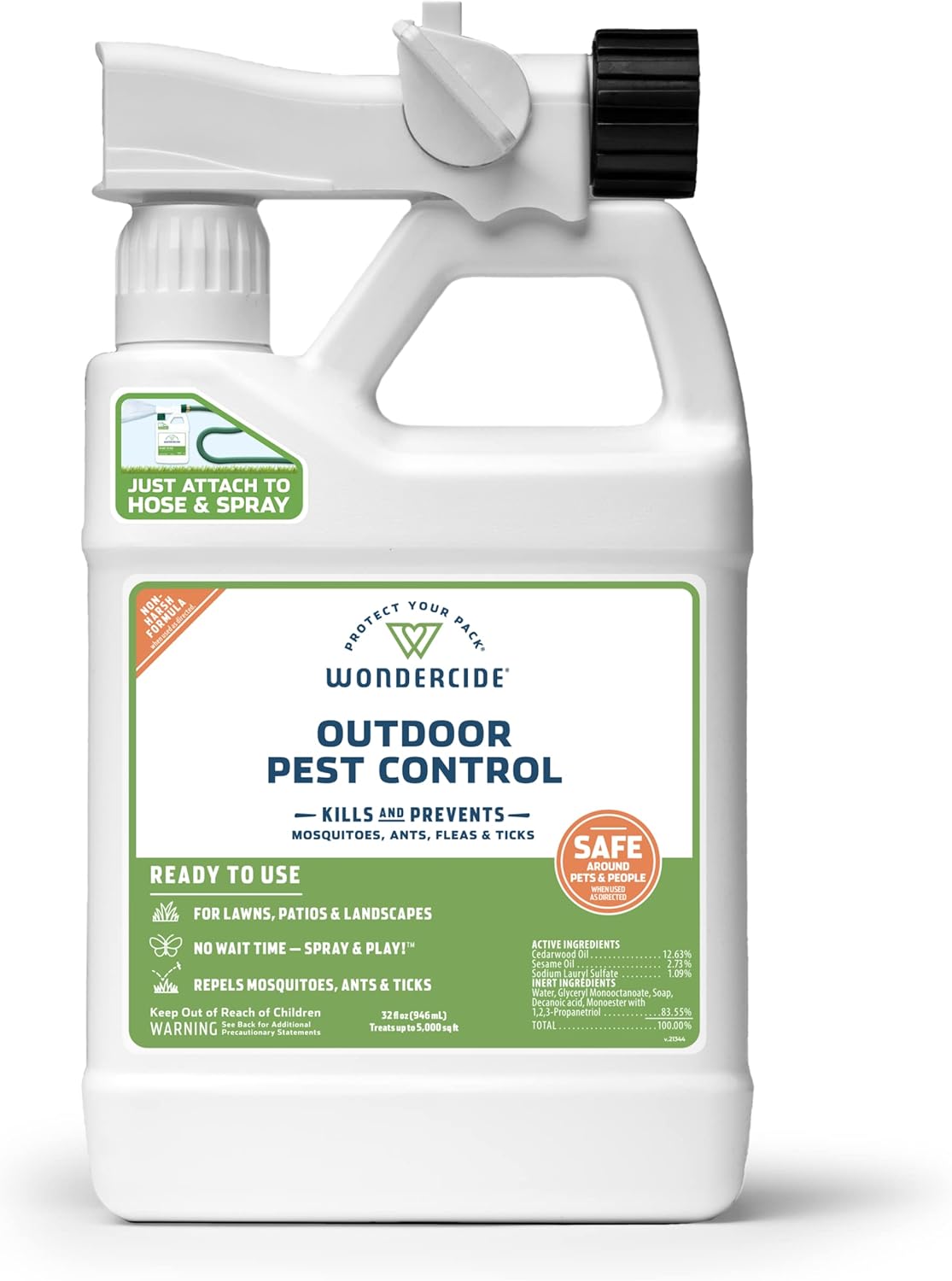
| Format | Pre-mixed, hose-end spray |
|---|---|
| Active ingredients | Cedarwood Oil 12.63%, Sesame Oil 2.73% |
| Coverage | Up to 5,000 sq ft (general); 2,500 sq ft (ticks/mosquito repel) |
Wondercide Ready-to-Use Outdoor Pest Control is a hose‑end spray designed for treating yards up to 5,000 sq ft for general pests and 2,500 sq ft for ticks and mosquito repellency. You attach the bottle to a garden hose, sweep the nozzle across lawns, patios, and foundation lines, and the cedarwood‑based formula delivers quick coverage with no dry time required. Notable features include plant-powered active ingredients (cedarwood and sesame oils), ready-to-use convenience, and instructions for both active infestations and preventative maintenance. Practical benefits are that it is safe to use around people and pets when directions are followed, residues are reported to be non-harmful to pollinators, and the hose attachment makes treating large areas fast. Important limitations are that effectiveness depends on water pressure, walking speed, and weather, heavy rain may require reapplication, and spraying in temperatures above 90°F or direct sun can cause plant burn. Users who need an all‑season, high‑durability pesticide for heavy infestations should plan on repeated applications and follow label precautions to protect sensitive plants.
Best for: Buyers who prioritize effective, plant‑based mosquito and tick control for medium to large yards and want a fast hose‑attached solution that is safe around families and pets when used as directed.
Less Ideal for: Gardeners who need a single, long‑lasting professional‑grade pesticide for severe, persistent infestations or who cannot reapply after rain should consider alternative, heavier‑duty treatments.
- Ready-to-use hose-end applicator for fast coverage of large yards
- Plant-based active ingredients (cedarwood and sesame oils) that target common yard pests
- No dry time required so kids and pets can re-enter treated areas quickly
- Covers up to 5,000 sq ft for general pest control and 2,500 sq ft for ticks/mosquito repellency
- May cause phytotoxic burning if applied in direct sun or temperatures above 90°F
- Performance depends on water pressure and user walking speed which can lead to uneven coverage
- Heavy rain can wash it away and requires reapplication
Verdict: If you want a fast, family- and pet-friendly plant‑based spray to reduce mosquitoes and ticks across a medium to large yard, this ready‑to‑use hose‑end formula delivers practical, repeatable results.
Cutter Backyard Bug Control Spray Concentrate, 32 oz (2 pack)

| Unit Count | 64 Fluid Ounces |
|---|---|
| Item Form | Spray |
| Target Species | Insects |
| Active Ingredients | Lambda Cyhalothrin |
This Cutter Backyard Bug Control Spray Concentrate is a hose‑end applicator concentrate designed to treat lawns, shrubs and other outdoor surfaces to reduce mosquitoes and a range of listed insects. You attach the QuickFlip hose‑end sprayer, walk the area and apply as a cover spray; the ready‑to‑mix nozzle meters water automatically so you do not need separate measuring. The formula lists lambda‑cyhalothrin as an active ingredient and claims up to 12 weeks of control and coverage for up to 5,000 sq ft per bottle, which makes it suitable for seasonal perimeter treatments and spot landscape applications. Practical benefits include easy application with the flip‑on nozzle, thorough foliar coverage when used as directed, and long residual control that reduces repeat treatments. Important limitations are that it is a pesticide so you must keep children and pets out of treated areas until dry, follow label restrictions for vegetables and sensitive areas, and avoid applications before rain or near drains or water bodies.
Best for: Buyers who want a simple, ready‑to‑use perimeter treatment to reduce mosquitoes and common yard insects across lawns and landscaped beds without frequent reapplication.
Less Ideal for: People who need an organic, pet‑safe, or water‑safe option for insect control or those who require frequent spot treatments in small container gardens.
- Hose‑end QuickFlip sprayer for fast, no‑mix application over large areas
- Claims up to 12 weeks of residual control, reducing the need for frequent reapplications
- Covers up to 5,000 sq ft per bottle for single‑treatment perimeter protection
- Works on lawns, shrubs and outdoor surfaces for flexible use around the yard
- Contains a synthetic pesticide ingredient and requires strict adherence to safety and label restrictions
- Not intended for use where runoff could reach water bodies or drains
Verdict: A convenient hose‑end concentrate that delivers broad yard coverage and long‑lasting mosquito and insect control with minimal setup.
Mighty Mint Peppermint Oil Insect Repellent Spray, 1 Gallon

| Volume | 128 oz |
|---|---|
| Ingredients | Water, Glycerin, Polyglycerol Oleate, Soap, Peppermint Oil |
| Use areas | Indoor / Outdoor |
| Scent | Peppermint |
Mighty Mint’s 1-gallon peppermint oil spray is a plant-based insect repellent intended for broad indoor and outdoor use. The product is supplied as a large ready-to-use bottle with a detachable nozzle for spraying around entryways, baseboards, patios, and gardens or for refilling smaller spray bottles. Its formula lists peppermint oil along with water, glycerin, and soap, so it works by delivering a strong peppermint scent that repels spiders, ants, roaches and similar pests without synthetic pesticides. Practical benefits include the large 128 oz volume for extended coverage and a scent that many households find more pleasant than chemical sprays. The label notes it is safe for use around people and pets when used as directed, and the concentrate-style packaging simplifies repeat applications. Limitations to keep in mind are that it is a deterrent rather than a lethal insecticide, so it may not eliminate established infestations, and effectiveness can vary by pest and environmental conditions. Users should follow safety directions and reapply after heavy rain or watering for outdoor use.
Best for: Buyers who prioritize safer, plant-based pest control and want a proven, widely used product with visible social proof for routine outdoor and perimeter pest prevention.
Less Ideal for: People facing severe infestations who need a fast-acting, residual insecticide or professional pest control should consider stronger, targeted treatments instead.
- Large 128 oz ready-to-use gallon provides long-lasting coverage and value
- Plant-based formula using peppermint oil rather than synthetic pesticides
- Versatile for indoor and outdoor application and can refill smaller bottles
- Pleasant mint scent that is less intrusive than chemical alternatives
- Designed as a repellent and deterrent so it may not eradicate heavy or established infestations
- Performance can be inconsistent depending on pest type and weather conditions
Verdict: Choose this gallon peppermint spray if you want a plant-based, widely adopted repellent for routine outdoor perimeter and home pest prevention.
Atticus Talak 7.9% Bifenthrin Indoor/Outdoor Insecticide Concentrate, 32 oz

| Active Ingredient | Bifenthrin |
|---|---|
| Formulation | Suspension Concentrate |
| Liquid Volume | 32 fluid ounces |
| Length of Control | Up to three months |
| Target Species | Insects |
Talak 7.9% is a liquid concentrate for treating lawns, landscaping, outdoor living areas and indoor perimeter spots like baseboards and cabinets. You dilute the concentrate with water to create a spray for barrier treatments, spot applications or lawn mixes; label rates explain how much to mix per gallon depending on the use. The product uses bifenthrin, a proven broad-spectrum active ingredient, and the manufacturer states it controls over 75 species and can give residual control for as long as three months. Its water-based formula dries clear, leaves no odor or visible residue, and is not phytotoxic on plants when used per label. Practical benefits include flexible indoor and outdoor use, clear drying, and a bottle designed for easier pouring. Important limitations are that solutions should be mixed only for same-day use, it is not registered for sale in a few states, and it is not approved for fogger application, so professional-style misting methods are not appropriate.
Best for: Buyers who want a single, reliable product to protect yards, patios and building perimeters from a wide range of common pests and prefer conservative, label-driven application practices.
Less Ideal for: People seeking ready-to-use sprays or fogger-compatible products or those in states where this formulation is not registered should look at alternatives.
- Broad-spectrum control listed for 75+ indoor and outdoor pest species
- Water-based formula that dries clear and leaves no odor or residue
- Flexible label directions for lawns, landscapes, hardscapes and indoor perimeter treatments
- Long residual activity up to three months when applied at recommended rates
- Mixed spray solutions cannot be stored and must be used the same day
- Not approved for fogger application and not available for sale in some states
Verdict: A versatile, water-based bifenthrin concentrate that delivers long-lasting, broad-spectrum outdoor (and perimeter indoor) control when used according to the label.
Choosing the Right Insect Repellent for Garden: Key Factors to Consider
Target Pest Spectrum
Different repellents and control products target different insects. Some are formulated primarily to deter biting insects such as mosquitoes, ticks, and biting midges while others focus on chewing or sap-sucking pests that damage leaves and fruit. Matching the product to the pest you actually face improves results and avoids unnecessary exposure.
Identify whether you need personal protection for people working or relaxing in the garden, localized treatment for a pest hotspot, or broader deterrence across planting beds. Look at labels and active ingredients to confirm which species or pest groups are covered, and consider integrated approaches when multiple pest types coexist.
Plant Safety and Crop Compatibility
Garden plants vary in sensitivity. Delicate annuals, young seedlings, and some herbs or edible crops can be harmed by harsh oils, systemic chemicals, or high-concentration sprays. Choose a repellent with documented compatibility for ornamentals and edibles if you plan to apply near food plants.
When in doubt, test a small, inconspicuous area or follow label guidance for pre-harvest intervals. Consider contact versus systemic modes of action: contact repellents sit on surfaces and wash off, while systemic materials move inside plant tissues and may require stricter restrictions for edible crops.
Application Method and Coverage
How a product is applied affects practicality and effectiveness in the garden. Spray formulations let you treat foliage and soil surface but require even coverage. Foggers and misters can cover larger areas quickly but may drift. Topical personal repellents protect people and pets but do not address pests on plants.
Think about the area size, access to a hose or power source, and whether you need precise spot treatment or broad-area deterrence. Ease of mixing, refill options, and the ability to calibrate coverage also matter for repeat applications.
Longevity and Weather Performance
Outdoor conditions can reduce a repellent's effectiveness. Sunlight, rain, and irrigation will wash or break down many materials, so persistence and weather resistance are important. Some formulations adhere to leaf surfaces and withstand light rain, while others require frequent reapplication after watering or downpours.
Plan for how often you will realistically reapply. A longer-lasting product reduces labor and maintains protection through peak pest periods, but it must still align with safety and crop rules for your garden.
Safety for People, Pets, and Beneficials
Gardeners must weigh protection against human and pet exposure and impacts on pollinators, predatory insects, and soil biology. Low-toxicity options and targeted delivery reduce non-target risks. Read labels for reentry intervals and pet safety instructions before treating high-traffic areas.
Favor repellents with clear guidance on safe use around bees and other beneficial insects, or schedule treatments for times when pollinators are not active. Use physical barriers and cultural controls where possible to minimize chemical reliance.
Matching Repellent Type to Garden Use
Repellents fall into broad categories: personal repellents for skin or clothing, foliar sprays for plants, perimeter treatments for patios and seating areas, and ambient devices that create treated airspace. Each has pros and cons depending on the garden task. For example, a foliar spray protects plants directly from chewing or sucking pests but will not prevent a person from getting bitten while gardening.
Consider pairing approaches. Use personal protection when you expect to spend time in flowering beds, and deploy targeted plant-safe sprays or baits for pest hotspots. Perimeter treatments are useful for social areas but may need reapplication after rain.
- Personal repellents protect people but do not treat plants.
- Foliar sprays treat plant pests but require attention to crop safety.
- Perimeter or ambient options defend seating zones and entry points.
Applying Repellents Around Edible Plants
When treating near vegetables, herbs, or fruiting plants, look for products labeled safe for use around edibles and follow any harvest interval guidance. Choose contact formulations that dry quickly and avoid systemic options unless explicitly approved for food crops.
Rinse edible leaves intended for immediate consumption if the label suggests doing so. Time applications for periods when pollinators are least active, such as early morning or evening, to reduce impacts on beneficial insects.
- Check pre-harvest intervals and wash instructions.
- Avoid treating flowering stages when pollinators are present unless product is pollinator-safe.
- Use spot treatments instead of blanket spraying when possible.
Nonchemical and Cultural Alternatives
Physical methods and cultural practices can dramatically reduce the need for repellents. Eliminating standing water, improving drainage, and rotating crops reduce mosquito and pest breeding sites. Row covers, netting, and sticky traps offer barrier control without chemical exposure.
Encouraging beneficial insects through habitat plantings and avoiding broad-spectrum insecticides helps keep pest populations in check. Use repellents as part of an integrated pest management plan rather than as a sole solution.
- Fix drainage and remove water-holding containers to cut mosquito breeding.
- Use netting and barriers for high-value or vulnerable plants.
- Plant insectary flowers to attract predators and parasitoids.
Safe Timing and Reapplication Strategies
Plan applications to align with weather and garden activities. Apply repellents when wind is low to minimize drift and avoid treatment before heavy rain unless the product is rainfast. Reapply according to label instructions and your observed pest pressure rather than on a fixed calendar alone.
For high-use zones like patios, shorter-acting products used more frequently may be preferable for minimizing plant exposure. For plant treatments, allow treated foliage to dry and keep people and pets away until reentry times have passed.
- Avoid spraying on windy days to reduce drift.
- Reapply after heavy rain if the product is not rainfast.
- Time treatments when pollinators are not active.
Reading Labels and Understanding Active Ingredients
Labels provide crucial information on target pests, safe uses, application rates, and restrictions. Learn the active ingredient types and how they work so you can match them to garden scenarios. Botanical oils often provide short-term deterrence with lower persistence, while synthetic actives may last longer but require stricter handling.
Labels also list protective equipment recommendations and any environmental precautions. Follow these directions closely to protect yourself, your plants, and beneficial organisms in the garden.
- Compare active ingredient profiles and labeled uses.
- Follow personal protective equipment guidance on the label.
- Note any environmental warnings and pollinator precautions.
How We Chose the Best Insect Repellent for Garden
We prioritized products that deliver reliable insect control in outdoor garden settings while minimizing plant stress and non-target impacts. Key evaluation criteria included efficacy against common garden pests and biting insects, the repellent or active ingredient profile and documented safety for ornamental plants and edible crops, and persistence of effect under sun and rain. We also considered application method versatility for beds, containers, and patio zones, plus ease of reapplication and formulation stability. Excluded from consideration were items intended only for indoor use, broad-spectrum insecticides that require licensed application, and products with unclear labeling about plant safety. We focused on options that gardeners can reasonably use themselves and that provide transparent instructions for safe treatment around people, pets, and edible plants. The criteria below guided inclusion: bite and pest control effectiveness; plant compatibility and residue profile; application method and convenience; and weather resistance and longevity.
FAQ
Can I use insect repellents around edible vegetables and herbs?
Often yes, but it depends on the formulation. Use products labeled for use on or near edible crops and follow any pre-harvest intervals. Rinsing harvested produce can reduce surface residues when recommended.
How often do outdoor repellents need reapplication?
Reapplication frequency depends on the product and weather. Shorter-acting botanical sprays may need reapplication every few days, while some formulations hold up for a week or more. Always follow label instructions and reapply after heavy rain if the product is not rainfast.
Are natural or botanical repellents effective in gardens?
Botanical repellents can be effective for short-term deterrence and are generally gentler on plants and beneficials. Their duration is usually shorter than synthetic options, so they may require more frequent application during peak pest periods.
Will using repellents harm pollinators in my garden?
It depends on the product and timing. Many repellents include precautions to avoid spraying during bloom or when pollinators are active. Use targeted applications, choose pollinator-safer products when possible, and treat in the early morning or evening to minimize exposure.
What is the safest way to protect my patio area from mosquitoes?
Combine source reduction such as removing standing water with perimeter treatments or ambient options designed for outdoor seating areas. Use personal repellents when sitting outside and apply area products when people are not present to reduce direct exposure.
Final Verdict
Choosing the best insect repellent for garden use means balancing effective pest deterrence with plant compatibility and safety for people, pets, and beneficial insects. Prioritize products that target the pests you actually face, have clear labeling for use around edibles, and fit your application practicalities such as area size and weather resistance. Accept tradeoffs between longevity and non-target impacts: longer-lasting treatments reduce reapplication but may need stricter safety measures. Use repellents alongside cultural controls and barriers to reduce reliance on chemicals and to protect pollinators and soil life.
