

Note: This article contains affiliate links. If you click on these links and make a purchase, I may earn a small commission at no extra cost to you. This helps support my research and content. Read my full affiliate disclosure here.
If ants are marching through your kitchen, garden beds, or along foundation lines, choosing the right insecticide for ants matters more than grabbing whatever bottle is handy. The right product reduces trails, treats nests, and minimizes repeat treatments while keeping people, pets, and beneficial insects in mind. This guide shortlists seven top options selected for typical home and garden ant problems, with attention to how each product performs on residual control, application ease, and safety. Read on for practical notes on where and when to use different formulations and what tradeoffs to expect between speed and persistence.
Top Picks at a Glance
| Best Overall The best all-around choice for most situations | Atticus Talak 7.9% Indoor/Outdoor Bifenthrin Insecticide Concentrate (1 gal) |  |
| Best Quality Built to a higher standard if you want something more solid | Syngenta Advion Ant Gel (4 tubes, 30 g each) |  |
| Best Value The sweet spot between price and what you get | Ortho Home Defense Insect Killer for Indoor & Perimeter, 1.33 gal with Comfort Wand |  |
| Best Budget The cheapest option that still gets the job done reliably | Raid Ant Killer Baits, 8 Count (Child-Resistant) |  |
| Highest Rated A top-rated pick with lots of positive feedback | Envu Tempo SC Ultra Insecticide Concentrate, 240 ml |  |
| Most Popular A crowd favorite that many people choose with confidence | TERRO Liquid Ant Killer Bait Stations, 12-Pack (T300B) |  |
| Best Seller A high-volume bestseller chosen again and again | Atticus Talak 7.9% Bifenthrin Indoor/Outdoor Insecticide Concentrate, 32 oz |  |
Atticus Talak 7.9% Indoor/Outdoor Bifenthrin Insecticide Concentrate (1 gal)

| Active Ingredients | Bifenthrin |
|---|---|
| Unit Count | 128 Fluid Ounces |
| Formulation | Suspension Concentrate |
| Length of Control | Up to three months |
Talak 7.9% is a water‑based bifenthrin concentrate designed to control more than 75 common pests both inside and outside the home. You mix the concentrate with water at label rates and apply it as a spray for perimeter barrier treatments, spot treatments around baseboards and cabinets, lawn drench, or landscape applications. The formula dries clear, is odor‑free, and is labeled to provide residual control for up to three months, which makes it useful for seasonal prevention as well as reactive treatments. Practical benefits include flexible dilution rates for lawns, landscapes, and surfaces, an easy‑pour bottle for measured mixing, and suitability around pet areas once treated surfaces are dry. Important limitations are that solutions should be mixed only for same‑day use and it is not approved for foggers, so you need a pump sprayer or handheld sprayer for application and must follow label precautions for safe handling and site restrictions in some states.
Best for: Buyers who want a single, flexible insecticide to manage ants and other common pests across lawns, landscapes, and indoor perimeters and who prefer a product that provides longer residual protection.
Less Ideal for: People seeking a ready‑to‑use product or a fogging solution should consider alternatives, as this concentrate requires measuring, mixing, and use with a sprayer; those in states where it is not registered should look for a locally approved formulation.
- Broad spectrum control targeting 75+ indoor and outdoor pests including ants and mosquitoes
- Water‑based formula that dilutes easily, dries clear, and is odor‑free
- Provides residual control up to three months per labeled application
- Versatile for use on lawns, landscapes, hard surfaces, and interior perimeter treatments
- Easy‑pour bottle with pre‑marked sections for measured mixing
- Concentrate must be mixed fresh each day and mixed solutions cannot be stored
- Not approved for fogger application so a sprayer is required
- Restricted availability in certain states
Verdict: Choose Talak 7.9% when you want one versatile concentrate that delivers broad, long‑lasting control of ants and other common indoor and outdoor pests.
Syngenta Advion Ant Gel (4 tubes, 30 g each)

| Item Form | Gel |
|---|---|
| Target Species | Insects |
| Active Ingredients | 0.05% indoxacarb |
| Included Components | 4 tubes (30 g each), 1 plunger, 2 tips |
Advion Ant Gel is a professional-style ant bait that works by attracting worker ants to a highly palatable gel that they carry back to the colony, allowing treatment of the nest rather than just killing foragers. Typical use is to apply small dabs or thin lines in cracks, along trails, and in concealed areas indoors or outdoors where ants are active; the package includes a plunger and tips to make placement easy. Notable features are the non-repellent formulation and the MetaActive activity that targets insects, which helps ants feed freely without avoiding the bait and increases the chance of colony elimination. Practical benefits include targeted control of many common species such as Argentine and carpenter ants, low odor, and compact syringes for precise placement in tight spots. Important limitations are that it is a bait so effectiveness depends on ants accepting the gel and sharing it within the colony, and it will be slower to reduce visible activity than contact sprays; it also requires careful placement out of reach of children and pets.
Best for: Buyers who prioritize reliable, professional-grade colony control and are willing to use targeted baiting rather than quick-contact sprays for longer-lasting results.
Less Ideal for: People who need instant visible knockdown or want a one-time broad surface spray should consider contact insecticides instead.
- Non-repellent 0.05% indoxacarb formula promotes feeding and transfer to the nest
- Included plunger and application tips allow precise placement in cracks and crevices
- Suitable for indoor and outdoor use in targeted baiting spots
- Odorless gel that is easy to apply and store
- Effectiveness depends on ants accepting and sharing the bait so results can vary by species and food preferences
- Not an immediate knockdown of visible ants since it relies on colony transfer
Verdict: Choose Advion Ant Gel when you want a professional, non-repellent bait that targets entire colonies rather than just killing surface-foraging ants.
Ortho Home Defense Insect Killer for Indoor & Perimeter, 1.33 gal with Comfort Wand

| Item Form | Spray |
|---|---|
| Target Species | Insects |
| Liquid Volume | 1.33 gallons |
| Active Ingredients | Bifenthrin 0.05%, Zeta-Cypermethrin 0.0125% |
This Ortho Home Defense ready-to-use spray is designed to kill household insects where they enter and hide and to form a long-lasting perimeter barrier. It is typically used indoors around doors, windows and kitchens and outdoors along foundation lines, patios and decks. The included battery-powered Comfort Wand gives a continuous spray for easier coverage without bending or pumping, and the Invisi-Shield formula dries clear with no noticeable fumes. Active ingredients bifenthrin and zeta-cypermethrin target ants, roaches, spiders and other common pests and the label claims up to 12 months protection against ants, roaches and spiders on non-porous indoor surfaces. Practical benefits include straightforward application, wide target spectrum and a sizable 1.33 gallon volume for treating multiple areas. Important limitations are that the 12-month claim applies to specific indoor uses on non-porous surfaces rather than all surfaces or outdoor conditions, and it is a chemical pesticide so users must follow safety directions and keep people and pets away until treated areas dry.
Best for: Buyers who want a practical, no-mix solution to control ants and other common household pests around entry points and outdoor perimeters and who prioritize ease of application and longer-lasting indoor protection.
Less Ideal for: Users seeking organic or non-chemical ant control methods or those who need a product specifically labeled for continuous outdoor residual protection on porous surfaces should look elsewhere.
- Ready-to-use 1.33 gallon volume suitable for treating multiple entry points and perimeters
- Battery-powered Comfort Wand provides continuous spray for easier, less tiring application
- Formulation targets a broad range of common household insects including ants, roaches and spiders
- Invisi-Shield formula dries clear with low fumes for indoor use on non-porous surfaces
- Long-duration protection claim is limited to indoor non-porous surfaces and may not hold under outdoor exposure or porous materials
- Contains synthetic insecticides so proper safety precautions and label instructions are required
Verdict: A large ready-to-use spray with a continuous wand that makes fast, effective ant and household pest control easy for practical homeowners.
Raid Ant Killer Baits, 8 Count (Child-Resistant)
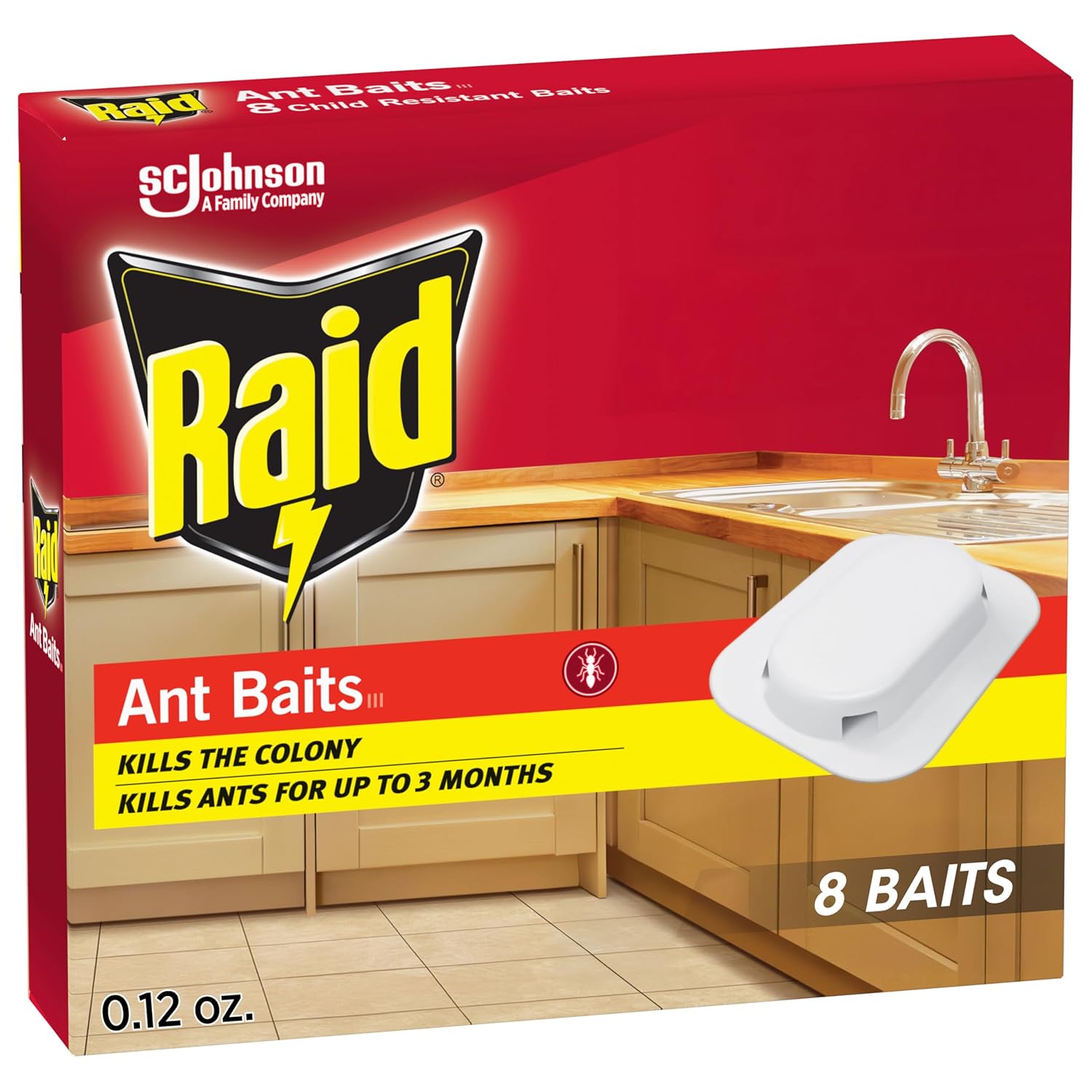
| Package count | 8 count |
|---|---|
| Intended use | Indoor |
| Child safety | Child-resistant |
| Residual protection | Up to 3 months |
These bait stations provide a simple, low-effort way to control indoor ant problems. Place them along baseboards, in corners, or near entry points where you see ant activity; worker ants collect the bait and bring it back to the colony, which can eliminate the nest within weeks and provide protection for up to three months. The units are child-resistant and pre-filled, so no measuring or mixing is required, and the small trays fit discreetly in tight areas. Because they rely on ant foraging behavior, effectiveness depends on ants finding and accepting the bait, and extremely heavy infestations may need additional placements or professional treatment. The packaging makes them easy to set and replace, and their ready-to-use format is convenient for renters and busy households that want a low-fuss solution without specialized equipment.
Best for: Practical homeowners or renters who want an inexpensive, low-effort indoor solution to reduce ant populations without mess or special equipment.
Less Ideal for: People facing very large or outdoor ant mounds or those needing immediate visible knockdown should consider stronger contact sprays or professional services.
- Pre-filled, ready-to-use bait stations for quick setup
- Kills the colony by allowing worker ants to transfer bait to nest
- Child-resistant design for safer indoor placement
- Effective residual action advertised up to three months
- Depends on ants accepting the bait so may require multiple placements
- Not formulated for outdoor mound treatment or instant knockdown
Verdict: A simple, budget-friendly indoor bait option that kills ant colonies by letting worker ants carry bait back to the nest.
Envu Tempo SC Ultra Insecticide Concentrate, 240 ml

| Item Volume | 240 ml |
|---|---|
| Item Form | Liquid |
| Target Species | Ants, flies, cockroaches, crawling pests, and ticks |
| Scent Name | Chalk-like |
| Material Features | No Ordor and Non-Staining |
Tempo SC Ultra is a water-based concentrate containing beta-cyfluthrin designed for both indoor and outdoor use to control ants, spiders, cockroaches, ticks, and other crawling pests. You mix the concentrate per label directions and apply as surface, spot, crack-and-crevice, or perimeter treatments around foundations, doorways, patios, garages, and basements. Notable features include a suspension concentrate formulation that mixes easily, low odor and non-staining material properties, and a residual effect that continues to reduce activity after application. The concentrate format lets a small volume treat large areas, which is convenient for routine perimeter maintenance and targeted interventions. Important limitations are that it is a professional-grade insecticide so it requires careful dilution and following safety directions, and it targets contact and residual control of crawling pests rather than acting as a repellent or a fumigant for airborne insects.
Best for: Buyers who prioritize dependable, long-lasting control of ants and other crawling pests around the home and want a concentrate they can apply to perimeters and cracks for routine maintenance.
Less Ideal for: People seeking an immediate-use aerosol or a product aimed primarily at flying insects or odor-free casual spot treatments should consider alternative formats.
- Broad-spectrum control effective against ants and other common crawling pests
- Fast knockdown plus residual activity for longer-lasting perimeter protection
- Water-based suspension concentrate mixes easily and covers surfaces evenly
- Low odor and non-staining formulation suitable for use near living areas
- Requires proper dilution and handling to use safely
- Not designed to repel flying insects or serve as a fumigant
Verdict: Choose this concentrate when you want a reliable, low-odor residual insecticide for routine perimeter and crack-and-crevice treatments against ants and other crawling pests.
TERRO Liquid Ant Killer Bait Stations, 12-Pack (T300B)

| Unit Count | 12 Count |
|---|---|
| Item Form | Liquid |
| Target Species | Insects |
| Active Ingredients | Sodium Tetraborate Decahydrate (Borax), 5.40% |
TERRO Liquid Ant Killer Bait Stations are small, ready-to-place liquid traps designed to control common sugar-loving household ants by using a borax-based bait that workers carry back to the colony. Typical use is simple: open the tab and set stations along baseboards, under appliances, on counters, or anywhere you see ant trails. The liquid formula attracts ants quickly and is formulated so workers survive long enough to spread the bait through the nest, which can reduce visible activity within days and often clears an infestation over 2 to 4 weeks. The pack of 12 provides multiple placements around a home for broader coverage. Because the product is a bait, it works best when competing food sources are removed and where ants prefer sweet baits. It is intended for indoor use and will not provide immediate knockdown like sprays, so expect an initial increase in ant traffic as workers recruit to the bait. The stations are low-effort and long-lasting while bait remains, but households with pets or children should place them out of reach and monitor placements per label instructions.
Best for: Homeowners who want a low-effort indoor solution focused on eliminating entire ant colonies rather than quick surface spraydowns and who value proven, widely used products with large user adoption.
Less Ideal for: People needing an immediate visible knockdown for an active picnic or outdoor event or those dealing with ant species that do not feed on sweet baits should consider alternative products or complementary methods.
- Ready-to-use stations that require no mixing or setup
- Borax-based liquid attracts worker ants and is designed to be carried back to the nest for colony-level control
- Twelve stations in the pack allow multiple placements for better coverage
- Fast attraction with noticeable reduction in ant activity within days when used correctly
- Not a rapid contact killer so visible ants may increase briefly before colony decline
- Formulation targets sugar-preferring ants and may be less effective on species that prefer protein or grease
Verdict: Choose TERRO liquid bait stations when you want a simple, widely used indoor bait that targets worker ants and eliminates colonies rather than just killing ants on sight.
Atticus Talak 7.9% Bifenthrin Indoor/Outdoor Insecticide Concentrate, 32 oz

| Active Ingredients | Bifenthrin |
|---|---|
| Liquid Volume | 32 fluid ounces |
| Item Form | Liquid |
| Specification Met | EPA |
| Target Species | Insects |
Talak 7.9% is a liquid concentrate that you dilute with water and apply as a spray for perimeter, lawn, landscape, and indoor baseboard treatments. It uses 7.9% bifenthrin to deliver contact knockdown plus several weeks to months of residual control, and the label lists ants specifically among the target pests. Typical use is mixing the recommended teaspoons per gallon depending on application type then spraying edges, vegetated perimeters, or treating mounds for fire ant control. The formula is water-based so it dries clear, leaves no residue and is odor-free after drying, and the bottle has a pour-friendly design for easier measuring. Important limits to note are label restrictions on storage of mixed solution, state availability restrictions, and the need to follow safety directions for concentrated insecticides. While it is effective for broad-spectrum perimeter and turf use, precise dilution and careful application are required to get the expected residual performance and to minimize non-target exposure.
Best for: Buyers who prioritize reliable, label-backed perimeter and turf protection and want a single concentrate they can mix for indoor and outdoor ant control while following conservative safety practices.
Less Ideal for: People seeking ready-to-use products or who prefer non-chemical ant control methods should consider alternatives; those in prohibited states must look elsewhere.
- Broad-spectrum control that lists ants and fire ants among 75+ target pests
- Water-based formula dries clear, leaves no odor and is non-staining
- Label indicates up to three months of residual control after application
- Versatile for lawns, landscapes, structural perimeters and mound drenches
- Bottle design includes pour markings to simplify measuring and mixing
- Mixed solutions cannot be stored and must be used the same day
- Not approved for sale in some states, limiting availability
- Requires careful dilution and application to avoid non-target exposure
Verdict: Choose Talak 7.9% if you want a single, water-based concentrate that professionals and homeowners can dilute for reliable indoor and outdoor ant and perimeter control backed by a long-lasting bifenthrin formula.
Choosing the Right Insecticide for Ants: Key Factors to Consider
Residual Effectiveness and Longevity
Residual effectiveness determines how long treated surfaces or soil remain hostile to ants after application. A longer residual can reduce the frequency of reapplication and help prevent reinvasion along foundation lines, entry points, or around garden beds. Longevity varies by active ingredient and formulation; granules and certain liquid barriers often persist longer in soil, while contact sprays may break down faster under sunlight and rain.
When planning treatment, consider where you need lasting protection versus a quick knockdown. For barriers and perimeter work, prioritize residual products labeled for outdoor use. For indoor treatments near food prep areas, shorter-residual options that target visible trails may be preferable to reduce long-term exposure.
Mode of Action and Bait Compatibility
Understanding mode of action helps you match treatments to the infestation. Contact insecticides kill ants on contact and can quickly reduce visible workers, but they may not eliminate the nest if foragers do not transfer the material. In contrast, slow-acting active ingredients in baits allow workers to feed and return to the nest, spreading the toxicant to queens and brood.
Many ant control plans combine both approaches: use baits to tackle the colony and spot sprays or dusts to manage heavy foraging while baits take effect. Make sure the chosen insecticide does not interfere with baits if you plan combined tactics. Read labels for compatibility with bait stations and for any restrictions on concurrent products.
Formulation and Application Method
Insecticides for ants come as ready-to-use sprays, concentrates, granules, dusts, aerosols, and bait stations. Each formulation has practical implications: dusts are effective in wall voids and dry nest sites, granules are good for treating soil and plant drip lines, and liquid concentrates let you treat large perimeters with a sprayer. Ready-to-use sprays are convenient for spot treatments but may be less economical for large areas.
Think about how you will apply the product in your landscape or home. If you need to treat under eaves or inside cracks, choose a product compatible with that application. For gardeners, consider whether the formulation is safe around shrubs, vegetable beds, or pollinator plantings and whether the application method fits your equipment.
Safety for People, Pets, and Beneficials
Safety profile covers label restrictions, required personal protective equipment, and re-entry or watering restrictions after treatment. For home and garden use, prioritize products with clear, conservative instructions for avoiding exposure to children and pets. Some active ingredients require longer re-entry intervals or restriction from use on edible crops.
Also consider non-target impacts. Broad-spectrum residuals can harm beneficial insects if applied directly to flowering plants. When treating near pollinator-attractive plantings, use targeted baiting or apply sprays to non-flowering surfaces to reduce risk.
Target Species and Labeled Uses
Different ant species vary in nesting behavior and foraging habits. Some species are surface foragers while others nest in soil or wall voids. Choose products labeled for the ant species or the typical infestation site you face, such as indoor foraging, outdoor perimeter control, landscape beds, or turf.
Labels indicate the types of ants controlled and the specific uses approved. Following label directions ensures effective control and legal, safe application. If you are unsure about species, select flexible products labeled broadly for common household and landscape ants.
Environmental Conditions and Weather Sensitivity
Weather affects how well outdoor treatments perform. Rain, irrigation, and intense sunlight can reduce residual life or wash away surface applications. Granules and soil-applied materials are often less susceptible to short-term rain than surface sprays, while microencapsulated formulations can withstand exposure better.
Apply treatments when conditions favor uptake or persistence. Avoid spraying before heavy rain, and follow label guidance for irrigation timing after application. Consider seasonal ant activity and soil moisture when planning control for the best results.
When to Use Baits Versus Contact Treatments
Baits and contact treatments serve different roles in an ant control plan. Use baits when you want colony-level control because foragers will carry bait back to the nest, potentially eliminating the queen and brood. Baits are often the best first-line strategy for persistent or widespread infestations.
Contact treatments are appropriate for rapid reduction of heavy foraging or to treat accessible nest openings. They work well as a stopgap while baits take effect or for isolating new invasion points. Combining both approaches is common: place baits away from freshly sprayed areas so foragers are attracted to the bait first.
- Place baits along trails and near entry points where ants are actively foraging.
- Reserve contact sprays for visible nests, cracks, and heavy traffic lanes.
- Avoid spraying directly on bait stations or freshly-applied bait placements.
Safe Application Around Edible Gardens
When treating ant problems near vegetable beds or herb patches, prioritize label-approved products for use around edibles and follow withholding periods if listed. For many home gardeners, targeted baiting or perimeter treatments around the garden bed perimeter reduces exposure to edible crops.
Use physical barriers, such as diatomaceous earth applied sparingly, or non-chemical tactics where possible. If you must use a chemical insecticide near edible plants, choose formulations and application methods that limit drift and direct contact with foliage and flowers.
- Apply sprays to soil or foundation lines rather than to leaves of edible plants.
- Do not apply residuals directly to flowering plants visited by pollinators.
Managing Ants in Structures and Wall Voids
Ants that nest inside walls require different tactics than outdoor foragers. Dust formulations and injectible aerosols designed for void treatment can reach nests without saturating living spaces. Always follow label directions for indoor use and ventilate treated areas per instructions.
For indoor infestations, combine bait stations along trails with targeted dust applications in voids and along baseboards. Seal obvious entry points after treatment to reduce re-infestation from outside colonies.
- Use dusts sparingly and only where the label allows void treatment.
- Keep baits out of reach of children and pets by placing them in concealed stations.
Integrating Cultural and Nonchemical Controls
Nonchemical tactics reduce ant attractants and make insecticide efforts more effective. Keep food and pet feeding areas clean, store sweets in sealed containers, and remove debris or mulch that provides nesting sites. Structural repairs, such as sealing cracks and fixing moisture issues, reduce suitable nesting habitat near buildings.
Landscaping choices matter too. Avoid over-mulching right up to foundations and choose plantings that do not create continuous moisture against walls. These cultural changes work alongside insecticides to provide longer-term control.
- Trim plants away from foundations to reduce ant pathways.
- Maintain tidy outdoor trash and compost practices to limit food sources.
Timing Treatments for Seasonal Ant Activity
Ant activity rises in spring and late summer for many species. Apply baiting and monitoring early in the season when foragers are actively seeking food, which improves bait acceptance. For long-residual perimeter treatments, apply before peak activity periods to create a protective zone.
Avoid heavy applications during extreme heat when foragers may not accept baits. Monitor treated areas and reapply according to label guidance and observed activity rather than on a strict calendar alone.
- Monitor trails after treatment to judge bait uptake and residual action.
- Plan perimeter treatments in calm, dry weather for best adhesion and persistence.
How We Chose the Best Insecticide for Ants
We selected products that are proven to address ant infestations commonly encountered around homes, gardens, and landscaped areas. Selection focused on measurable, application-relevant attributes: residual effectiveness at typical label rates, speed of knockdown on foraging ants, safety profile for household members and pets when used as directed, formulation suitability for indoor or outdoor use, and versatility for treating nests versus barrier treatments. We prioritized products whose labeled uses match common ant species and infestation sites, and we looked for clear application instructions and realistic coverage rates. We excluded products labeled only for agricultural or commercial structural pest control, specialty baits that require professional placement, and any insecticide lacking a clear residential-use label. The final shortlist balances fast-acting options and longer-residual materials so gardeners can choose based on infestation severity and safety priorities.
FAQ
Can I use the same insecticide for indoor and outdoor ant problems?
It depends on the product label. Some formulations are approved for both indoor and outdoor use, while others are restricted to one or the other. Always follow the label for application sites and re-entry intervals.
How long until I see results after applying an ant insecticide?
Contact sprays can reduce visible ant numbers within hours, while baits often take several days to eliminate a colony because workers need time to feed and transfer the toxicant. Expect different timelines depending on the mode of action.
Are granular insecticides better if my yard gets heavy rain?
Granules and soil-applied materials are generally less immediately affected by light rain than surface sprays, but heavy or prolonged rain can still reduce effectiveness. Follow label guidance about reapplication after rain and choose formulations noted for residual stability if your area is prone to wet conditions.
Will insecticide treatments harm beneficial insects or pollinators?
Some broad-spectrum residuals can harm non-target insects if applied directly to flowering plants. To reduce risk, avoid spraying blooms, use targeted baits, and apply treatments to non-flowering surfaces when pollinators are active.
Can I use insecticide and baits at the same time?
You can use both tactics, but placement matters. Avoid spraying directly on bait placements and allow foragers to find baits. Use contact treatments for immediate control and baits for colony suppression, spacing them so they do not interfere with one another.
How do I choose the right active ingredient for the ant species in my yard?
Species identification helps because nesting and foraging behavior influence control success. If you cannot identify the ant, choose products labeled broadly for common household and landscape ants and select a plan that combines baits and targeted treatments.
Final Verdict
Choosing the right insecticide for ants means balancing fast knockdown with colony-level control and minimizing exposure to people, pets, and beneficials. Prioritize products with a suitable residual life for the treatment site, and combine baiting with targeted contact or residual treatments when you need both immediate reduction and long-term suppression. Consider application method, label restrictions near edible plants, and seasonal timing to get the most reliable results. With a plan that matches product formulation to the infestation type and setting, you can control ants effectively while limiting non-target impacts.
