

Note: This article contains affiliate links. If you click on these links and make a purchase, I may earn a small commission at no extra cost to you. This helps support my research and content. Read my full affiliate disclosure here.
Carpenter bees bore into wood and can quickly create many nests that weaken porch railings, fascia boards, and trim. Picking the right insecticide for carpenter bees matters because treatment needs to reach gallery tunnels, offer lasting residual activity, and be safe to apply near outdoor living areas. This guide shortlists seven top options gardeners and homeowners commonly consider for carpenter bee control. We evaluated products for how well they penetrate and linger in tunnels, how easy and safe they are to apply, and how they affect treated wood. Read on to understand the practical tradeoffs and which performance features matter most for your situation.
Top Picks at a Glance
| Best Overall The best all-around choice for most situations | BioAdvanced Carpenter Ant & Termite Killer Plus Spray, 1 Gal |  |
| Best Quality Built to a higher standard if you want something more solid | BASF Fendona CS Controlled Release Insecticide, 16 oz Concentrate |  |
| Best Value The sweet spot between price and what you get | BioAdvanced Termite & Carpenter Bee Killer Plus Foam, 18 oz |  |
| Best Budget The cheapest option that still gets the job done reliably | Spectracide Carpenter Bee & Ground-Nesting Yellowjacket Killer, 16 oz |  |
| Highest Rated A top-rated pick with lots of positive feedback | Bayer Advanced 18 oz Termite and Bee Foam |  |
| Most Popular A crowd favorite that many people choose with confidence | TERRO Carpenter Ant, Termite & Carpenter Bee Killer Aerosol, 2-Pack (32 fl oz total) |  |
| Best Seller A high-volume bestseller chosen again and again | Ortho Home Defense Insect Killer for Indoor & Perimeter, 1.33 gal with Comfort Wand |  |
BioAdvanced Carpenter Ant & Termite Killer Plus Spray, 1 Gal

| Item Form | Spray |
|---|---|
| Target Species | Insects |
| Liquid Volume | 1 gallons |
| Included Components | Ready-to-Use |
| Specification Met | EPA |
This ready-to-use BioAdvanced spray is a one-step insecticide aimed at controlling wood-infesting pests such as carpenter ants, termites, and carpenter bees along with common crawling and flying insects. It comes in a gallon bottle with a pump-style sprayer and adjustable nozzle for even coverage, so you can spray foundation perimeters, decks, eaves, and entry points to create a protective barrier. The active ingredient is deltamethrin 0.02%, which provides contact kill for a wide list of pests and is EPA registered. Practical benefits include quick application without mixing, the ability to treat both exterior problem zones and select indoor locations like cracks and baseboards, and a formula meant for non-staining use. Important limitations are that it is primarily for localized, direct treatments rather than structural fumigation or complete colony elimination, and safety precautions must be followed for use around people, pets, and pollinators. For ongoing or large infestations, professional treatment or a targeted baiting strategy may be more effective.
Best for: Buyers who want a convenient, do-it-yourself spray for spot treatment and perimeter protection against wood-infesting insects and common yard pests.
Less Ideal for: Homeowners facing extensive or established infestations that require structural or long-term colony control should consult a pest professional or use integrated methods rather than relying solely on this spray.
- Ready-to-use with pump sprayer and adjustable nozzle for easy, even application
- Broad-spectrum formula that targets carpenter bees, carpenter ants, termites and 75+ listed pests
- Can be applied outdoors around foundations, decks and entry points and in limited indoor spots for localized control
- Formulation provides contact and localized control but will not eliminate deep nests or entire colonies on its own
Verdict: An easy, ready-to-use spray that gives homeowners fast, targeted control of carpenter bees and other wood-infesting pests for perimeter and spot treatments.
BASF Fendona CS Controlled Release Insecticide, 16 oz Concentrate

| Item Form | Spray |
|---|---|
| Target Species | Ants, Bed Bugs, Cockroaches, Fleas, Spiders, Mosquitoes, Ticks, Asian Lady Beetles |
| Special Features | Fast-Acting, Long-Lasting, Pet-Safe, Weather-Resistant |
| Liquid Volume | 16 fluid ounces |
| Active Ingredients | Alpha-cypermethrin |
Fendona CS is a micro-mesh encapsulated alpha-cypermethrin concentrate designed to deliver quick knockdown and multi-week residual control when mixed and applied according to the label. It is typically diluted and applied around eaves, decks, wooden structures, and known carpenter bee entry sites to both kill on contact and leave a weather-resistant barrier that lasts longer than standard emulsions. The controlled-release formulation helps maintain efficacy on treated surfaces, which is useful for seasonal carpenter bee protection and reducing repeat treatments. Practical benefits include broad target coverage, EPA specification, and a concentrate format that lets you treat larger areas economically. Important limitations are that it requires proper dilution and application equipment, personal protective gear, and strict adherence to label directions to remain safe around people, pets, and plants. This product is intended for use by homeowners comfortable handling professional-style concentrates or by pest control contractors seeking a durable residual option for wood-boring and other insects.
Best for: Buyers who prioritize long-lasting, professional-grade control for carpenter bees and other structural pests and who are comfortable mixing and applying a concentrate safely.
Less Ideal for: Casual gardeners or users who want an off-the-shelf ready-to-use spray or who prefer to avoid handling concentrated insecticides.
- Controlled-release micro-mesh encapsulation provides extended residual protection on treated surfaces
- Broad spectrum activity against crawling and flying pests relevant to wood structures
- Concentrate format is economical for treating multiple spots or larger perimeters
- Fast-acting formulation delivers quick knockdown on contact
- Requires correct mixing and application equipment rather than ready-to-use convenience
- Must be used according to label with protective clothing due to concentrated active ingredient
Verdict: Choose Fendona CS when you need a professional-strength, controlled-release concentrate that delivers fast knockdown and durable residual protection for carpenter bee hotspots.
BioAdvanced Termite & Carpenter Bee Killer Plus Foam, 18 oz

| Liquid Volume | 18 fluid ounces |
|---|---|
| Item Form | Spray |
| Target Species | Termites, Carpenter Bees, Ants, Wood‑infesting Beetles |
| Active Ingredients | Lmidacloprid |
This expanding foam formulation is built to treat hidden infestations where liquid sprays cannot reach. The can delivers a precision foam that expands up to 30:1, letting you inject treatment into wall voids, crawlspaces, between boards, and insect galleries to contact both visible and concealed termites and carpenter bees. It lists additional control for ants and wood‑infesting beetles and uses a nonstaining formula for use on wood when directions are followed. Typical use is targeted spot treatment rather than broadcast spraying: shake, aim into the hole or void, and reapply as needed to maintain coverage. Practical benefits include deep penetration into galleries and a controlled spray pattern that reduces waste and drift. Limitations are that it is for localized control only and does not replace structural repairs or professional termite remediation for large infestations, and it excludes certain ant species from control. Users should follow safety directions and avoid excessive heat during storage.
Best for: A practical homeowner who wants an effective, targeted solution for small to moderate carpenter bee or termite problems and prefers spot treatments they can apply themselves.
Less Ideal for: People facing widespread structural termite infestations or those who prefer nonchemical or professional-only solutions should consider alternatives.
- Expanding foam penetrates cracks and voids for contact with hidden colonies.
- Precision spray application for targeted, low‑drift treatments.
- Nonstaining formula suitable for use on wooden structures when used as directed.
- Effective listed control for termites, carpenter bees, and several wood‑infesting pests.
- Designed for localized spot treatments and not a substitute for full structural termite remediation.
- Does not control all ant species listed in common infestations.
Verdict: Choose this foam when you need a targeted, deep‑penetrating treatment to reach and kill carpenter bees and hidden termites in voids and gaps.
Spectracide Carpenter Bee & Ground-Nesting Yellowjacket Killer, 16 oz

| Item Form | Spray |
|---|---|
| Target Species | Insects |
| Active Ingredients | Prallethrin, Lambda-Cyhalothrin |
| Liquid Volume | 16 fluid ounces |
This foaming aerosol from Spectracide is designed to treat active carpenter bee tunnels and ground-nesting yellowjacket holes by delivering an expanding foam that reaches deep into nests. It includes an extension tube for targeted application and kills on contact; for carpenter bees the label advises leaving the entrance hole open for 48 hours so the insecticide can spread through galleries before sealing the hole. Typical use is during early morning or late evening when activity is low, spraying directly into the tunnel or ground hole and then plugging the entrance after the recommended wait period. The practical benefits are straightforward: the foam penetrates cavities that liquid sprays might miss, the extension tube increases accuracy, and directions are clear about timing and follow-up to reduce reinfestation. Limitations are that it is a chemical insecticide so users must follow safety warnings to keep children and pets away and read the label, and repeated treatments or nest plugging are necessary steps rather than one-time fixes.
Best for: Buyers who want a straightforward, economical solution to treat visible carpenter bee tunnels or active yellowjacket holes and who are comfortable using a chemical spray and following label directions.
Less Ideal for: People seeking nonchemical, long-term exclusion methods or those who prefer professional pest control services for complete colony removal.
- Foaming aerosol expands into nest galleries for better contact with insects
- Extension tube allows precise targeting of tunnels and ground holes
- Labeled instructions recommend timing and follow-up to reduce reinfestation
- Kills carpenter bees and ground-nesting yellowjackets on contact
- Contains chemical active ingredients requiring safety precautions around people and pets
- Not a one-time permanent fix—requires waiting periods and plugging holes after treatment
Verdict: An affordable, easy-to-use foaming aerosol that reaches into tunnels and holes to quickly eliminate carpenter bees and ground-nesting yellowjackets when used as directed.
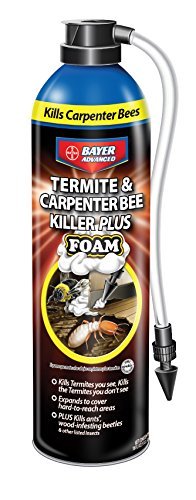
Bayer Advanced 18 oz Termite and Bee Foam
| Brand | Bayer Advanced |
|---|---|
| Unit Count | 18 Ounce |
| Intended pests | Termite, Bee |
This 18 oz Bayer Advanced foam is formulated for treating bees and termite galleries where a foaming application is useful. It dispenses as a dense foam that expands to contact insects inside voids and crevices, so it is typically used by directing the nozzle into holes, cracks, or wood cavities where carpenter or other bees are nesting. The practical benefits are straightforward: the foam fills cavities to reach insects hidden from surface sprays and the aerosol can is portable and easy to apply without pumps or hoses. Notable features are the foaming action for better coverage inside galleries and the 18 ounce can size that provides multiple spot treatments. Important limitations are that this product is a spot treatment rather than a perimeter or residual barrier and it requires careful application to avoid non target exposure; it will not treat structural wood damage or large infestations by itself. For reliability-focused buyers this is a useful tool for targeted knockdown of nesting bees when used as part of a broader control plan.
Best for: Buyers who prioritize dependable, targeted control of nesting bees and want a ready-to-use product to treat individual galleries quickly and directly.
Less Ideal for: People needing long-term barrier protection, large-scale colony removal, or a solution for structural wood repair should consider other options.
- Foaming formula expands to reach insects inside voids and galleries
- Aerosol can is ready-to-use and portable for spot treatments
- 18 ounce can provides multiple targeted applications
- Designed for spot treatment only and not a residual perimeter control
- Requires careful application to avoid exposure to non target areas
Verdict: A reliable, ready-to-use foaming spot treatment for knocking down bees nesting in voids when you need direct access to galleries.
TERRO Carpenter Ant, Termite & Carpenter Bee Killer Aerosol, 2-Pack (32 fl oz total)

| Liquid Volume | 32 fluid ounces |
|---|---|
| Active Ingredients | Deltamethrin 0.03% |
| Item Form | Spray |
| Target Species | Insects |
This TERRO aerosol comes as a convenient ready-to-use spray for treating wood-infesting pests around the home. It is typically used for spot treatments on infested wood, around windows and doorframes, and into wall voids where carpenter bees, carpenter ants, or termites hide. The can features a two-way spray nozzle for broad coverage or a precision crack-and-crevice stream, and the active ingredient (deltamethrin 0.03%) provides fast contact kill plus residual control that can continue to reduce pests for up to a month. The formula is non-staining and marketed as low-odor, which makes it acceptable for indoor use when applied carefully to surfaces. Important limitations: it is intended for localized treatments and is not a substitute for professional termite eradication on active infestations, and like any aerosol insecticide it requires following safety directions to avoid inhalation or unintended exposure. For homeowners who need an easy, targeted option for carpenter bee nests or small carpenter ant spots, this spray is practical and effective.
Best for: Homeowners who want a ready-to-use, targeted spray to treat visible carpenter bee holes, small carpenter ant trails, or localized wood infestations themselves with minimal setup and fuss.
Less Ideal for: People facing large or active termite colonies, or those who prefer non-spray treatments such as dusts or baits, should consider professional services or alternative products.
- Two-way nozzle allows both broad spray and precision crack-and-crevice application
- Contains deltamethrin for fast contact kill with residual control up to one month
- Non-staining, low-odor formula suitable for indoor and outdoor spot treatments
- Ready-to-use aerosol requires no mixing and is easy to apply
- Not recommended as the sole solution for active termite infestations where professional treatment is needed
- Aerosol format can be messy in tight spaces and requires careful handling to avoid inhalation or overspray
Verdict: A straightforward, ready-to-use aerosol for homeowners who need a precise, low-odor treatment for carpenter bees and other wood-infesting pests.
Ortho Home Defense Insect Killer for Indoor & Perimeter, 1.33 gal with Comfort Wand

| Item Form | Spray |
|---|---|
| Target Species | Insects |
| Liquid Volume | 1.33 gallons |
| Active Ingredients | Bifenthrin 0.05%, Zeta-Cypermethrin 0.0125% |
This ready-to-use Ortho Home Defense product is a broad-spectrum insect spray designed for indoor use on nonporous surfaces and for perimeter treatments around foundations, patios, decks and garages. It comes in a 1.33 gallon container with a battery-powered continuous-spray Comfort Wand that makes applying a consistent band without bending or pumping straightforward. The formula lists bifenthrin and zeta-cypermethrin as active ingredients and claims up to 12 months of barrier protection against ants, roaches and spiders when used as directed on indoor nonporous surfaces. Typical use is spraying a 4-inch band indoors or a 12-inch band around the home perimeter until slightly wet and allowing it to dry; people and pets may re-enter once dry. Practical benefits are easy application over large areas, a clear no-fume dry finish, and multi-species coverage. Limitations to note are that efficacy claims focus on ants, roaches and spiders so results against wood-boring insects like carpenter bees are not explicit, and outdoor performance will depend on application to appropriate entry points and local conditions. Observe all safety directions and keep product away from children and sensitive plants.
Best for: A risk-averse homeowner who wants a proven, easy-to-apply indoor and perimeter spray for routine pest prevention and control around entry points and living spaces.
Less Ideal for: Specialist users seeking a targeted carpenter bee or other wood-boring insect treatment should consider products specifically labeled for those pests or consult a professional.
- Ready-to-use 1.33 gallon container reduces measuring and mixing
- Comfort Wand provides continuous spray for easier, less tiring application
- Claims up to 12 months barrier protection on indoor nonporous surfaces
- Dries clear with no noticeable fumes for indoor use
- Label and marketing emphasize common household pests rather than wood-boring insects like carpenter bees
Verdict: A convenient, long-lasting ready-to-use spray that simplifies indoor and perimeter pest control for homeowners wanting easy application and broad insect coverage.
Choosing the Right Insecticide for Carpenter Bees: Key Factors to Consider
Residual Effectiveness
How long an active ingredient continues to kill or repel carpenter bees after application affects whether you need follow-up treatments. A product with longer residual control reduces the chance of reinfestation from eggs or new adults returning to the same galleries. Consider typical seasonal activity in your region; higher residual persistence is more valuable where bees are active for many weeks. Residual longevity also interacts with weather exposure. Sun, rain, and temperature extremes can shorten field life, so check product labels for post-application expectations and reapplication intervals.
Long residuals can also mean longer periods when non-target insects may be exposed, so balance longevity against the placement of treated surfaces near pollinator-attractive flowering plants.
Tunnel Penetration And Delivery Method
Carpenter bees nest deep in galleries, so the ability of a formulation to reach eggs and larvae is critical. Liquid sprays may coat entry holes and the immediate gallery interior, but dusts and low-volume aerosols can penetrate further into narrow tunnels. Some products list injection or dusting as preferred methods for deep gallery treatment.
Think about access and safety when choosing a delivery method. Dust formulations often require a nozzle or bulb applicator and careful placement to avoid drift. Aerosols can be convenient for small nests but may not provide the same penetration as a targeted dust. Evaluate whether you can safely reach the galleries from ladders or with extension tools before selecting a product.
Application Safety Around People And Pets
Treatments are applied on exterior structures near living spaces, so user safety and potential exposure to family members and pets matter. Review label instructions for personal protective equipment recommendations, re-entry intervals, and whether treated surfaces should be covered or rinsed before contact.
Some formulations produce vapors or fine aerosols that increase inhalation risk during application. Others require careful avoidance of runoff into gardens and water features. In general, choose a product whose safety profile matches how often you will be near treated areas and whether you have children, pets, or pollinator plantings close by.
Impact On Wood Appearance And Surface Compatibility
Insecticides can interact with paint, stain, or bare wood differently. Some leave visible residues, cause discoloration, or interfere with future painting or staining. If you are treating decorative trim, painted railings, or cedar siding, consider products labeled as non-staining or designed for exterior finishes.
When aesthetics matter, test a small, inconspicuous area if possible, and follow label guidance about drying times and compatibility with paints or preservatives. Remember that repeated treatments can build visible deposits over time, so factor long-term appearance into the product choice.
Environmental Considerations And Non-target Exposure
Carpenter bee control often occurs where pollinators forage, so minimizing harm to beneficial insects is important. Choose application methods and timing to avoid direct spray on flowering plants and to reduce drift. Targeted treatments to gallery entrances reduce non-target exposure compared with broad surface sprays.
Also consider runoff risks. Treatments applied to siding or trim can wash into soil or nearby planters during heavy rain. Follow label instructions for buffer distances from water, and choose formulations with lower aquatic toxicity when treating near ponds, streams, or irrigation systems.
Practical Ease Of Use And Availability Of Accessories
Ease of application affects whether you can perform treatments effectively and safely. Look for products that work with standard household sprayers, dust applicators, or aerosol extension wands. Readily available accessories, such as narrow nozzles or extension tubes, make it easier to place treatment precisely into tunnels.
Also consider storage and shelf life. Products that require minimal mixing or that come in ready-to-use formats reduce setup time. If you plan to treat multiple structures or a large property, bulk or concentrated formulations that measure easily can be more practical.
When To Treat Carpenter Bee Galleries
Timing treatments for carpenter bees improves success and reduces unnecessary exposure. Treating late in the season after adult activity declines will not eliminate established larvae, while treating during peak adult flight focuses on stopping new gallery creation. Many gardeners target treatments in early spring before females begin intense boring or in late summer when adults are less active but galleries are accessible.
Also consider weather. Avoid treating immediately before heavy rain, which can wash active material from surfaces, and choose a calm day to minimize drift when applying dust or aerosols.
- Early spring: target emerging adults at nest entrances
- Late summer: treat existing galleries when adults are less active
- Avoid application before heavy rain or during windy conditions
Nonchemical Options To Combine With Insecticide Use
Integrated control often gives the best results. After active nests are no longer occupied, physical repair such as filling tunnels with wood putty or caulk and repainting prevents reoccupation. Installing bee houses or providing alternative nesting substrates away from structures can encourage bees to nest elsewhere.
Trapping is sometimes used but often requires frequent maintenance and proper placement to be effective. Combining mechanical exclusion and habitat modification with targeted insecticide treatments reduces the need for repeated chemical applications.
- Plug galleries after nests are inactive to prevent reuse
- Provide alternative nesting sites if you want to support solitary bees
- Use traps sparingly and monitor them regularly
Application Technique Tips For Better Results
Preparing the treatment area and using the right technique increases the chance that insecticide reaches deep galleries. Clean loose wood shavings from entrance holes before applying, and use an applicator that can deliver dust or low-volume aerosols into the tunnel throat. For liquid sprays, apply a steady, short burst aimed into the opening rather than a broad sweep over the surface.
Follow label directions for required dwell times and any necessary reapplication interval. Wear recommended protective gear during application and keep bystanders away until surfaces have dried or ventilation clears any aerosols.
- Remove debris from hole entrances before application
- Use a narrow nozzle or dust applicator for deeper penetration
- Observe labelled reapplication intervals and PPE guidance
Managing Treated Wood And Follow-up Care
After treatment, monitor galleries for new activity and note any changes in wood appearance. If you plan to paint or restain treated surfaces, allow the product to dry fully per label instructions and test a small area. Re-treat only when label intervals allow and when new emergence or activity is observed.
Regular inspections in spring and late summer help catch reinfestation early so you can treat single galleries rather than large surface areas.
- Inspect treated areas seasonally for fresh bore holes or frass
- Delay finishing work until treatments have fully dried and cured
- Record application dates and methods for future reference
Safety Measures For Applying Insecticides Outdoors
Personal protection reduces exposure risk during application. Use gloves, eye protection, and a mask if the product produces fine dust or aerosol. Keep children and pets indoors while you treat and for any re-entry period listed on the label.
Prevent environmental contamination by avoiding spraying near open water and by containing drips when treating elevated surfaces. Clean equipment thoroughly after use and dispose of empty containers according to local regulations.
- Wear recommended PPE and avoid inhalation of dusts or mists
- Keep people, pets, and pollinators away until treated surfaces are safe
- Contain runoff and clean equipment after use
How We Chose the Best Insecticide for Carpenter Bees
We prioritized criteria that reflect real-world carpenter bee control needs. Residual effectiveness measures how long a treatment remains active inside tunnels and on treated surfaces because many carpenter bee problems recur over weeks or months. Tunnel penetration covers how well an insecticide reaches deep galleries through spray, dust, or injection application methods. Application safety considers inhalation risk, surface contact hazards, and suitability for use around porches, play areas, and food gardens. Wood finish and staining evaluates whether treatments darken or damage painted, stained, or bare wood. Ease of application rates the practicality of treating nests and large exterior surfaces with common homeowner equipment. Finally, formulation versatility looks at whether a product can be used as a dust, liquid spray, or aerosol to match how nests are accessed. We excluded products that are labeled only for indoor pests or for insect groups that do not include carpenter bees. We also filtered out formulations that require professional-only equipment or certifications. The resulting shortlist focuses on options that combine measurable residual control, realistic tunnel penetration, manageable safety precautions, and minimal negative impact on exterior wood appearance.
FAQ
How long before a treated gallery is safe to touch or paint?
Safety depends on the product and formulation. Many labels specify a drying or re-entry time ranging from a few hours to 24 hours for exterior applications. For painting or staining, wait until the product has fully dried and follow any label guidance about compatibility with finishes.
Can I use the same insecticide on multiple wooden structures around the yard?
Often you can, but check the label for recommended application rates and surface compatibility. Some formulations are intended for spot treatment while others are suitable for broader surface applications. Adjust technique and PPE accordingly when treating multiple areas.
Will treating carpenter bee galleries harm native pollinators?
Targeted treatments to gallery entrances reduce non-target exposure compared with broad spraying of flowers. However, any residual active ingredient can pose risk if it contacts blooms or foraging insects. Time treatments for when flowers are not in bloom and avoid drift onto plants that attract pollinators.
Are dust formulations better than sprays for deep tunnels?
Dusts often penetrate narrow galleries more effectively than broad liquid sprays, and they can provide longer local persistence inside tunnels. That said, dusts require careful placement and applicators. The best choice depends on access to the gallery and your comfort using a dust applicator.
How often should I re-treat to prevent reinfestation?
Re-treatment intervals depend on the product's residual life and local bee activity. Some products list reapplication at intervals of several weeks to months, while others recommend treatment only when new activity is observed. Inspect galleries seasonally and follow label directions for re-treatment timing.
Can I treat galleries myself or do I need a professional?
Many homeowner-labeled formulations are suitable for do-it-yourself treatment if you follow label instructions and safety precautions. Professional services may be appropriate for extensive infestations, high or inaccessible structures, or when specialized equipment is required.
Final Verdict
When choosing an insecticide for carpenter bees, prioritize products that combine effective tunnel penetration with sufficient residual activity while minimizing harm to people, pets, and pollinators. Balance the need for deep gallery delivery against the safety profile and the potential for wood staining. Practical application considerations such as available applicators, access to nests, and the timing of treatments will determine which features matter most for your situation. Focus on targeted treatment of gallery entrances, follow label instructions carefully, and combine chemical control with physical repairs and preventative measures to reduce future problems.
