

Note: This article contains affiliate links. If you click on these links and make a purchase, I may earn a small commission at no extra cost to you. This helps support my research and content. Read my full affiliate disclosure here.
If centipedes are turning up in basements, garages, or along foundation lines, choosing the right insecticide for centipedes matters for both quick relief and ongoing prevention. You want a product that delivers a fast knockdown to handle active infestations and a solid residual to keep centipedes from returning, without damaging common surfaces or harming non-target plants and pets. This guide covers six shortlisted insecticides for centipedes suitable for perimeter, foundation, and targeted indoor use. We evaluate each option on factors gardeners and homeowners care about, including residual effectiveness, surface compatibility, application ease, and safety considerations. Read on for practical guidance to match treatment to your situation before the product reviews below.
Top Picks at a Glance
| Best Quality Built to a higher standard if you want something more solid | Zenprox EC Insecticide Concentrate (16 fl oz) |  |
| Best Value The sweet spot between price and what you get | NatureStop Centipede Repellent Spray (16 oz) |  |
| Best Budget The cheapest option that still gets the job done reliably | Harris Diatomaceous Earth Crawling Insect Killer, 8 oz |  |
| Highest Rated A top-rated pick with lots of positive feedback | Terro Ant Killer Aerosol, 16 oz (Model 401) |  |
| Most Popular A crowd favorite that many people choose with confidence | Atticus Talak 7.9% Bifenthrin Indoor/Outdoor Insecticide Concentrate, 32 oz |  |
| Best Seller A high-volume bestseller chosen again and again | Ortho Home Defense Max Indoor Insect Barrier, 1 gal. (Wand Ready) |  |
Zenprox EC Insecticide Concentrate (16 fl oz)

| Unit Count | 16 Fluid Ounces |
|---|---|
| Brand | Zenprox |
| Target Species | Insects |
Zenprox EC is a professional‑strength concentrate formulated for indoor broadcast applications where quick, wide‑range control is needed. Mixed into a sprayer or tank, the etofenprox formulation knocks down ants, cockroaches, fleas, bed bugs and many other crawling and flying pests; the product description specifically lists centipedes among the target pests. It is commonly used in homes, offices, warehouses and other indoor spaces and can be tank‑mixed with an IGR to extend population control. Notable features include a non‑repellent action that allows insects to contact treated surfaces and lethal activity reported against newly hatched bed bug nymphs, and residual control of fleas for up to a month. Important limitations are that this is a concentrate requiring proper dilution and application equipment and it is labeled for indoor broadcast use only, so outdoor perimeter needs require a different product. Users must follow label directions for safety and pet precautions when treating occupied spaces.
Best for: Buyers who prioritize fast, effective indoor control of a wide range of pests and are comfortable mixing and applying a professional concentrate in homes or commercial spaces.
Less Ideal for: Casual users who want a ready‑to‑spray consumer product or those needing outdoor perimeter protection should consider alternative formulations.
- Broad spectrum control covering over 25 listed insect pests including centipedes
- Non-repellent, contact‑kill formulation useful for catching hidden or newly hatched pests
- Concentrate form allows dosing flexibility for different indoor application sizes
- Compatible with IGR tank‑mixes to help suppress reinfestation
- Requires proper dilution and sprayer equipment rather than ready‑to‑use convenience
- Label restricts use to indoor broadcast applications so not suitable for outdoor perimeter treatments
Verdict: Choose Zenprox EC when you need a powerful indoor concentrate that delivers broad, contact kill against centipedes and many other pest species.
NatureStop Centipede Repellent Spray (16 oz)

| Net volume | 16 oz |
|---|---|
| Intended use | Indoor centipede repellent |
| Made in | USA |
| Manufacturer | NatureStop |
NatureStop Centipede Repellent is a 16 oz plant-based spray intended to reduce centipede activity inside homes by creating an unfriendly surface environment. It is applied around baseboards, corners, and entry points in basements, bathrooms, closets, and storage areas where centipedes commonly appear. The formulation emphasizes safer ingredients for households with pets and children when directions are followed, and regular reapplication is recommended to maintain effectiveness. The product is easy to use from a standard trigger bottle and is made in the USA, which may appeal to buyers who prefer domestically manufactured pest solutions. Expect it to work as a deterrent rather than an immediate kill: it helps reduce sightings over time rather than delivering fast knockdown like insecticides with synthetic neurotoxic actives. If you need a low-toxicity, maintenance-oriented approach to keep centipedes out of living spaces, this spray is a practical option; users seeking rapid elimination of heavy infestations should pair it with spot treatments or professional control.
Best for: Buyers who prioritize safer, lower-toxicity pest control and want a straightforward maintenance product to reduce centipede sightings in living areas.
Less Ideal for: Those dealing with large, established infestations who need immediate knockdown or long-term residual control should consider stronger targeted insecticides or professional services.
- Plant-based formula aimed at deterring centipedes, reducing reliance on harsh chemicals
- Labeled for indoor use and targeted application around baseboards and corners
- Formulated for use in homes with pets and families when used as directed
- Simple trigger-spray bottle makes spot and perimeter treatments straightforward
- Acts as a repellent/deterrent rather than providing fast kill for heavy infestations
- Requires regular reapplication to maintain protection
Verdict: Choose this plant-based spray if you want a pet- and family-friendly, maintenance-focused way to discourage centipedes in indoor problem areas.
Harris Diatomaceous Earth Crawling Insect Killer, 8 oz

| EPA registration | No. 3-18 |
|---|---|
| Active ingredient | 100% freshwater diatomaceous earth |
| Intended use | Indoor & outdoor |
This ready-to-use diatomaceous earth product provides a non-chemical way to control ants and other crawling pests around the home. You apply the fine powder in cracks, along baseboards, near entry points, or in crawlspaces using the included puffer tip for targeted placement. The diatomaceous earth works mechanically by abrading insect exoskeletons and causing dehydration, so insects that contact the dust typically die within 48 hours. Because the material is 100% freshwater diatomaceous earth with no additives and is EPA registered, it is a good fit when you want a low-toxicity option usable near people and pets when directions are followed. It stays effective indefinitely as long as it stays dry, making it a convenient barrier treatment in attics, basements, garages, and around foundations. Limitations are that it must remain dry to work and it is a contact-only control method, so heavy infestations or nesting insects may require repeated application or combined methods for faster results.
Best for: Practical households that prioritize low-toxicity, long-lasting ant control and want a simple, targeted treatment they can apply themselves around entry points and inside cracks.
Less Ideal for: People facing severe or widespread infestations who need rapid knockdown or prefer liquid chemical treatments should consider professional services or a different product.
- 100% freshwater diatomaceous earth with no additives for a non-chemical control option
- Built-in puffer tip allows precise application into cracks and crevices
- Remains effective indefinitely when kept dry, providing long-lasting barrier protection
- Mechanically kills a wide range of crawling insects including ants, roaches, fleas, and bed bugs
- Only effective on insects that contact the powder and must stay dry to work
- Not a fast-acting spray alternative for large, established infestations
Verdict: Choose this product if you want a low-toxicity, long-lasting mechanical barrier to control ants and other crawling insects around the home.
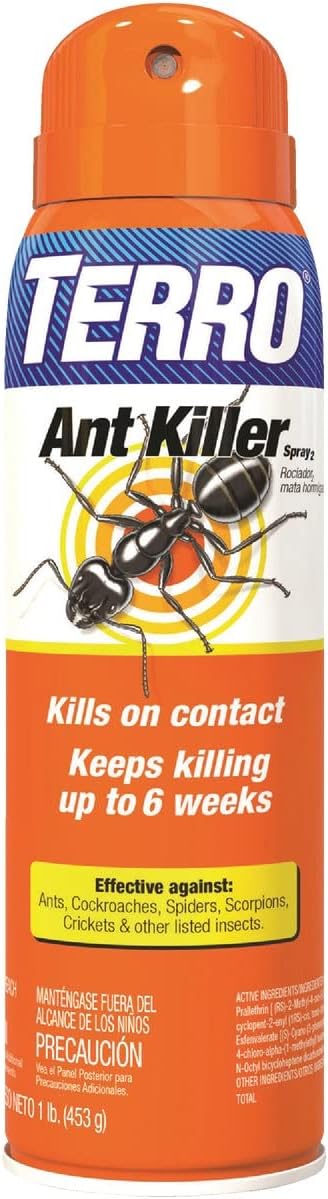
Terro Ant Killer Aerosol, 16 oz (Model 401)
| Item Form | Spray |
|---|---|
| Target Species | Cricket |
| Liquid Volume | 16 fluid ounces |
The Terro 16 oz Ant Killer Aerosol is an easy-to-use spray designed to kill ants on contact while leaving a residual that controls returning pests for weeks. Intended for spot and perimeter treatments, it comes with a spray tube to reach cracks and crevices where insects shelter. The formula lists permethrin as the active ingredient and the product description notes efficacy not only against ants but also cockroaches, crickets, silverfish, spiders, scorpions and centipedes, making it a practical multipurpose option for indoor and outdoor use. In real-world use it works well for targeted applications around baseboards, entry points and foundation gaps; the aerosol form makes application quick but requires careful aim to avoid overspray. Limitations include the need to follow label safety guidance for indoor use and that aerosol cans provide spot coverage rather than treating large areas or soil. For consistently reliable control of crawling pests in and around the home this product is a straightforward, proven option when used as part of a broader pest management routine.
Best for: Buyers who prioritize dependable, long-lasting control of crawling pests and want a quick, targeted spray for entry points, baseboards and cracks.
Less Ideal for: Those needing wide-area perimeter or soil treatments or who prefer non-aerosol application methods should consider alternative formulations.
- Kills ants on contact and leaves residual control up to 12 weeks
- Active ingredient permethrin provides broad efficacy against many crawling pests including centipedes
- Aerosol with spray tube reaches cracks and crevices for targeted application
- Suitable for indoor and outdoor spot treatments
- Aerosol format is best for spot treatments and not ideal for treating large outdoor areas
- Requires careful handling and adherence to label safety instructions for indoor use
Verdict: A compact, permethrin-based aerosol that delivers reliable, long-lasting spot control of centipedes and other crawling pests.
Atticus Talak 7.9% Bifenthrin Indoor/Outdoor Insecticide Concentrate, 32 oz

| Active Ingredient | Bifenthrin |
|---|---|
| Formulation | Suspension Concentrate |
| Liquid Volume | 32 fluid ounces |
| Length of Control | Up to three months |
| Target Species | Insects |
Talak 7.9% is a liquid concentrate for treating lawns, landscaping, outdoor living areas and indoor perimeter spots like baseboards and cabinets. You dilute the concentrate with water to create a spray for barrier treatments, spot applications or lawn mixes; label rates explain how much to mix per gallon depending on the use. The product uses bifenthrin, a proven broad-spectrum active ingredient, and the manufacturer states it controls over 75 species and can give residual control for as long as three months. Its water-based formula dries clear, leaves no odor or visible residue, and is not phytotoxic on plants when used per label. Practical benefits include flexible indoor and outdoor use, clear drying, and a bottle designed for easier pouring. Important limitations are that solutions should be mixed only for same-day use, it is not registered for sale in a few states, and it is not approved for fogger application, so professional-style misting methods are not appropriate.
Best for: Buyers who want a single, reliable product to protect yards, patios and building perimeters from a wide range of common pests and prefer conservative, label-driven application practices.
Less Ideal for: People seeking ready-to-use sprays or fogger-compatible products or those in states where this formulation is not registered should look at alternatives.
- Broad-spectrum control listed for 75+ indoor and outdoor pest species
- Water-based formula that dries clear and leaves no odor or residue
- Flexible label directions for lawns, landscapes, hardscapes and indoor perimeter treatments
- Long residual activity up to three months when applied at recommended rates
- Mixed spray solutions cannot be stored and must be used the same day
- Not approved for fogger application and not available for sale in some states
Verdict: A versatile, water-based bifenthrin concentrate that delivers long-lasting, broad-spectrum outdoor (and perimeter indoor) control when used according to the label.
Ortho Home Defense Max Indoor Insect Barrier, 1 gal. (Wand Ready)

| Unit Count | 128 Fluid Ounces |
|---|---|
| Item Form | Spray |
| Target Species | Insects |
| Liquid Volume | 1 gallons |
| Active Ingredients | bifenthrin 0.05% |
Ortho Home Defense Max is a one-gallon, ready-to-use indoor insect spray that creates a barrier to kill and prevent common household pests including spiders, ants, roaches and more. It is applied using the included Extended Reach Comfort Wand so you can treat baseboards, doorframes and hard-to-reach corners without bending. The formula is fast-drying, advertised as non-staining and low-odor so treated rooms are usable once surfaces dry. For indoor spider control it works as both a spot treatment where you see activity and as a preventative band along entry points; outdoor perimeter applications are also recommended every three months to reduce re-entry. The active ingredient is bifenthrin 0.05%, a standard synthetic pyrethroid effective on crawling insects. Important limitations are that it is for nonporous indoor surfaces and perimeter use only and it requires following label safety instructions around children and pets until dry. Expect reliable seasonal suppression rather than complete elimination of all spiders in heavily infested structures.
Best for: Homeowners who want a straightforward, long-lasting indoor perimeter treatment to reduce spider activity without frequent reapplication and who prefer an easy-to-use wand for spot and barrier treatments.
Less Ideal for: People seeking an organic or insecticide-free option or those needing rapid knockdown for very heavy indoor infestations should consider alternative products or professional services.
- Ready-to-use gallon with an Extended Reach Comfort Wand for easier application in corners and along baseboards
- Fast-drying, low-odor formula that claims no stains so rooms can be reoccupied soon after treatment
- Provides up to 12 months of protection against ants, roaches and spiders on treated nonporous indoor surfaces when used as directed
- Contains bifenthrin so it is a synthetic insecticide and must be used with care around children, pets and sensitive areas
- Not formulated for porous surfaces or as a direct fogging solution for heavy indoor infestations
Verdict: A convenient, wand-ready indoor barrier spray that delivers long-lasting, low-odor protection against spiders and other common household insects.
Choosing the Right Insecticide for Centipedes: Key Factors to Consider
Knockdown Speed and Mode of Action
How quickly an insecticide incapacitates centipedes matters when you need visible reduction of activity. Products that act via neurotoxic contact have faster knockdown and show immediate results, which is useful for active indoor sightings. Slower-acting products that rely mainly on ingestion are less useful for centipedes because these predators do not readily feed on bait formulations.
Understanding mode of action also helps you plan follow-up treatments and rotate chemistries to reduce resistance in heavily infested sites. For homeowners, favor products labeled for fast contact effects where immediate reduction of visible centipedes is a priority.
Residual Activity and How Long It Lasts
Residual control determines how often you need to re-treat perimeter and foundation areas. Residuals are usually described in days or weeks; longer residuals reduce treatment frequency but can increase exposure windows for non-targets. Consider environmental factors that shorten residual life, such as UV exposure, heavy rainfall, and frequent watering, which wash or degrade residues.
For indoor applications, residuals on baseboards and cracks can last longer because they are shielded from weather. Match expected residual duration to your tolerance for retreatment and the typical centipede pressure at the site.
Surface and Substrate Compatibility
Not all insecticides are safe on every surface. Some formulations can stain wood, concrete, or painted trim, while others are specifically designed for masonry and foundation gaps. If you plan to treat indoor baseboards, carpets, or stone, confirm the label lists those substrates. Avoid products that warn against application to porous materials if you need to treat those areas.
Compatibility also affects where you can apply perimeter band treatments versus targeted crack-and-crevice use. Choose formulations that match the surfaces common in your home and landscape to avoid damage and ensure effective placement.
Application Method and Ease of Use
Application practicality matters for most homeowners. Some insecticides come as ready-to-use trigger sprays, others as concentrates that require dilution with water and a pump sprayer. Concentrates allow treating larger perimeters at lower cost per area but require careful mixing and personal protective equipment. Ready-to-use products are convenient for spot treatments but may be less economical for whole-house perimeter work.
Also consider nozzle types and whether the product can be used in a coarse fan spray for foundation bands or as a pinpoint application for cracks and crevices. Ease of clean-up and clear label instructions are important for safe and effective use.
Indoor Safety and Pet Considerations
Because centipedes are often found inside, indoor safety is a key factor. Labels vary on re-entry times, ventilation requirements, and whether surface residues are safe where pets or children may contact them. Choose products with clear, conservative safety directions if you have crawling pets, small children, or allergy concerns.
Implement non-chemical precautions like sealing gaps and reducing moisture to limit centipede habitat and reduce reliance on chemical treatments. Always follow label instructions for application rates, PPE, and post-application care to minimize risks.
Environmental Conditions and Timing
Environmental conditions influence treatment success. Centipedes prefer moist, shaded habitats, so treating during dry weather and reducing moisture sources increases effectiveness. Avoid applying residual products immediately before rain or irrigation because residues can be washed off and wasted.
Timing also matters seasonally. Late spring through fall is when centipede activity and movement into structures is highest in many regions. Plan treatments to establish a residual band before peak movement and pair chemical control with habitat modification for the best long-term outcome.
Perimeter Band Treatments Versus Spot Applications
Perimeter band treatments create a barrier along foundation lines and are useful when centipedes are entering from the outside. A well-applied band on the soil adjacent to foundations and along threshold areas reduces the chance of centipedes crossing into living spaces. Consider a product with a reliable residual that lists outdoor perimeter use on the label.
Spot or crack-and-crevice applications are better for indoor sightings and focused infestations. Use a product formulated for indoor cracks, baseboards, and around plumbing penetrations. Targeted treatments reduce exposure to non-targets and limit the amount of active ingredient used inside the home.
- Perimeter bands protect entry points but may need reapplication after heavy rain.
- Spot treatments are cheaper for small indoor problems and reduce surface residues.
Non-Chemical Steps to Reduce Centipede Pressure
Chemical controls are most effective when combined with habitat reduction. Centipedes need moisture and shelter; eliminating excess moisture, removing leaf litter near foundations, and sealing gaps in doors and windows will reduce the number of centipedes that reach treated areas.
Keep firewood and compost piles away from house walls, trim back dense vegetation, and improve drainage around the foundation. These steps lower reliance on repeat chemical treatments and make any insecticide applications more effective.
- Repair leaking pipes and improve basement ventilation to reduce indoor humidity.
- Move mulch and dense ground cover several feet away from foundations.
Using Insecticides Safely Around Pets and Gardens
When applying insecticides for centipedes near garden beds or potted plants, avoid direct contact with desirable plants and edible crops unless the label explicitly allows it. Protect pollinator-friendly plants by treating during low-activity times and avoiding blooms.
Keep pets out of treated areas until the product's re-entry time has passed and surfaces are dry. Store mixed solutions and concentrates securely away from children and animals. Read and follow all label PPE and post-application instructions to minimize risks.
- Barrier treatments on soil a few inches from planting beds reduce drift onto plants.
- Use spot applications inside garages and basements rather than sweeping whole-room sprays.
When to Rethink Chemical Control
If centipede sightings persist despite correct application and habitat changes, reassess moisture sources, structural entry points, and whether a different mode of action is needed. Persistent indoor populations often point to an ongoing habitat issue rather than product failure.
Also reconsider chemical control if you have chronic concerns about children, pets, or pollinators in treated areas. In many cases, improved moisture management and exclusion will reduce sightings enough that chemical use becomes occasional rather than routine.
- Persistent activity after treatment usually indicates untreated harborages or re-entry points.
- Non-chemical exclusion measures often reduce the need for frequent insecticide use.
Mixing, Equipment, and Personal Protection
Concentrate formulas require accurate measurement and dilution. Use dedicated measuring tools and label mixed containers with the product name and dilution date. Follow label recommendations for sprayer types to achieve the desired spray pattern for perimeter bands or crack injection.
Personal protective equipment matters even for consumer formulations. At minimum, wear gloves and eye protection during mixing and application, and ventilate indoor spaces well. Clean equipment immediately after use to prevent residue build-up and cross-contamination.
- Use a pump sprayer for consistent perimeter bands and a hand trigger bottle for indoor spot treatments.
- Rinse equipment in an appropriate area away from garden beds and storm drains.
How We Chose the Best Insecticide for Centipedes
We focused on products that give gardeners and homeowners practical control of centipedes in and around dwellings. Selection prioritized insecticides with documented fast knockdown plus measurable residual activity so treatments address both immediate infestations and reinfestation risk. We looked for formulations compatible with common application sites such as foundations, concrete, wood trim, and interior crack-and-crevice use, and for options that integrate with pet- and child-aware safety practices. Concrete evaluation criteria included speed of knockdown, residual duration measured in days or weeks, surface and substrate compatibility, ease of application using standard garden sprayers or trigger bottles, and labeled safety instructions for indoor and perimeter use. We preferred products that offered clear mixing and application guidance and that minimized staining or plant damage when used as directed. Exclusions: items without clear residential use directions, products labeled only for agricultural or industrial sites, and contact-only treatments lacking any residual effect. The final lineup balances immediate efficacy with practical application and safety for typical home and garden scenarios.
FAQ
Are baits effective for controlling centipedes?
Baits are usually not effective because centipedes are predators that do not typically consume standard insect baits. For centipedes, contact and residual treatments applied to harborages and entry points are typically more useful.
How often should perimeter treatments be reapplied?
Reapplication depends on the product's labeled residual and environmental conditions. Many residuals last several weeks, but heavy rain, irrigation, or UV exposure can shorten effectiveness and necessitate more frequent treatments.
Can I use outdoor perimeter insecticide inside my basement?
Not all outdoor products are labeled for indoor use. Check the label for explicit interior or crack-and-crevice directions before applying inside. If the label allows indoor use, follow indoor PPE and ventilation guidance closely.
Will treating the yard eliminate centipedes from inside the house?
Treating the yard can reduce the number of centipedes near your foundation and lower entry pressure, but indoor populations also depend on moisture, clutter, and internal harborages. Combine perimeter treatment with moisture control and sealing gaps for best results.
Is it safe to apply insecticide around garden plants?
Some formulations are safe for use on soil near ornamental plants when the label permits, but you should avoid spraying flowers or edible crops unless explicitly allowed. Use targeted bands and avoid drift onto desirable vegetation.
What should I do if centipedes keep returning after treatment?
Reevaluate moisture sources, clutter, and structural entry points. Confirm the application covered typical harborages and consider a different labeled mode of action if treatments were applied correctly but control remains poor.
Final Verdict
Choose an insecticide for centipedes based on where you need control, the desired speed of knockdown, and how long you want the residual to last. Prioritize surface compatibility and clear indoor safety directions if you will treat inside. Pair chemical measures with habitat modification, moisture control, and exclusion to reduce repeat treatments and achieve longer-term reduction in centipede activity. When in doubt, start with targeted spot treatments and perimeter bands on labeled substrates, then escalate to broader treatments only if necessary. That approach balances efficacy with safety for people, pets, and garden plants.
