

Note: This article contains affiliate links. If you click on these links and make a purchase, I may earn a small commission at no extra cost to you. This helps support my research and content. Read my full affiliate disclosure here.
If you grow food in containers, raised beds, or a small backyard plot, choosing the right insecticide for edible plants matters for harvest safety and crop yield. You need options that control common pests without leaving long-lasting residues or harming beneficial insects. This guide presents seven shortlisted insecticides suited to edible gardens, focusing on application safety, effectiveness on typical garden pests, and ease of use. Each pick was evaluated for how it behaves in a real garden setting, including re-entry and harvest intervals, target pest range, and compatibility with integrated pest management. Read on for the practical criteria we used and guidance to help you choose the safest effective option for your situation.
Top Picks at a Glance
| Best Overall The best all-around choice for most situations | Bonide Captain Jack's Deadbug Brew 16 oz Concentrate |  |
| Best Quality Built to a higher standard if you want something more solid | Bonide Captain Jack's Neem Oil Concentrate, 16 oz |  |
| Best Value The sweet spot between price and what you get | BioAdvanced Fruit, Citrus & Vegetable Insect Control Concentrate, 32 oz |  |
| Best Budget The cheapest option that still gets the job done reliably | BioAdvanced Organics Neem Oil Spray, Ready-to-Use, 24 fl oz |  |
| Highest Rated A top-rated pick with lots of positive feedback | ferti-lome Spinosad Insecticide Concentrate (16 fl. oz.) |  |
| Most Popular A crowd favorite that many people choose with confidence | Bonide Captain Jack's Ready-to-Use Neem Oil Spray, 32 oz |  |
| Best Seller A high-volume bestseller chosen again and again | Bonide Captain Jack's Tomato & Vegetable 3-in-1 Ready-to-Use Spray, 32 oz |  |
Bonide Captain Jack's Deadbug Brew 16 oz Concentrate

| Unit Count | 16 Ounce |
|---|---|
| Item Form | Spray |
| Target Species | Insects |
| Active Ingredients | Spinosad (Mixture of Spinosyn A and Spinosad D) |
Bonide Captain Jack's Deadbug Brew is a concentrated spinosad insecticide designed for use on vegetables, fruits, ornamentals, and other garden plants. You mix the 16 fl oz concentrate with water and apply it with a trigger, hand-held, backpack, or hose-end sprayer to target caterpillars, beetles, borers, leaf miners, and similar chewing pests. Because the active ingredient is spinosad, the product is approved for organic gardening and is selective enough that it does not significantly impact many predatory beneficial insects and mites when used as directed. In practical use it provides quick knockdown of listed pests and is suitable for protecting squash and other cucurbits from feeding damage. The main limitations are that it must be mixed and applied correctly following label rates and safety instructions and that repeated broad use can still affect non-target insects if timing and coverage are not careful. For gardeners focused on protecting food crops, it is a straightforward, effective option when integrated with scouting and spot treatments.
Best for: Gardeners who prioritize practical, effective pest control for edible gardens and want an organic-approved concentrate they can mix and apply themselves to protect squash and other crops.
Less Ideal for: Gardeners seeking a ready-to-use spray or those unwilling to follow label mixing and safety instructions should consider alternative formats or professional application.
- Contains spinosad, an active ingredient approved for organic gardening and effective against caterpillars and beetles
- Concentrate mixes with water for use with trigger, backpack, hand-held, or hose‑end sprayers
- Labeled for use on a wide range of vegetables, fruits, and ornamentals including cucurbits
- Designed to minimize impact on many predatory beneficial insects and mites when used as directed
- Requires careful mixing and application per label to avoid harming non-target insects
- Not a residual solution for all pests so repeat applications or scouting are often necessary
Verdict: A practical, organic-approved spinosad concentrate that reliably controls chewing pests on squash and other garden crops when mixed and applied correctly.
Bonide Captain Jack's Neem Oil Concentrate, 16 oz

| Unit Count | 16 Ounce |
|---|---|
| Item Form | Oil |
| Target Species | Multi-Purpose |
| Active Ingredients | neem oil |
Bonide Captain Jack's Neem Oil is a 16-ounce concentrate designed to be mixed and sprayed for broad-spectrum pest and disease control in home gardens. It combines neem oil as the active ingredient to target insects at all life stages while also helping prevent common fungal problems such as powdery mildew and blight. Typical use is dilution into a sprayer according to the label and applying at the first sign of pests or disease, or as a seasonal dormant spray. Practical benefits include organic-appropriate control across vegetables, herbs, ornamentals, trees, and houseplants and control of mites, aphids, beetles, and many other listed pests. Because it is a concentrate, one bottle covers multiple applications and storage is straightforward when kept as directed. Limitations are that it must be mixed before use so buyers need a sprayer and must follow label directions for timing and rates to avoid plant phytotoxicity in hot weather and to ensure safe application.
Best for: Gardeners who want a single organic-compatible product to manage common insects and fungal issues across vegetables, ornamentals, and container plants and who are comfortable mixing a concentrate for regular spray applications.
Less Ideal for: People who prefer ready-to-use sprays or who do not want to handle mixing and calibration of a sprayer should consider alternative formats.
- Works as an insecticide, miticide, and fungicide in one product
- Derived from neem seed and suitable for organic gardening
- Kills insects at all life stages including eggs and larvae
- Concentrated 16 fl. oz. formula stretches for multiple applications
- Sold as a concentrate that requires correct dilution and a sprayer
- Can cause plant injury if applied in hot sun or at improper rates
Verdict: Choose this concentrate if you want one organic-friendly product that handles insects, mites, and common fungal diseases across a wide range of garden plants.
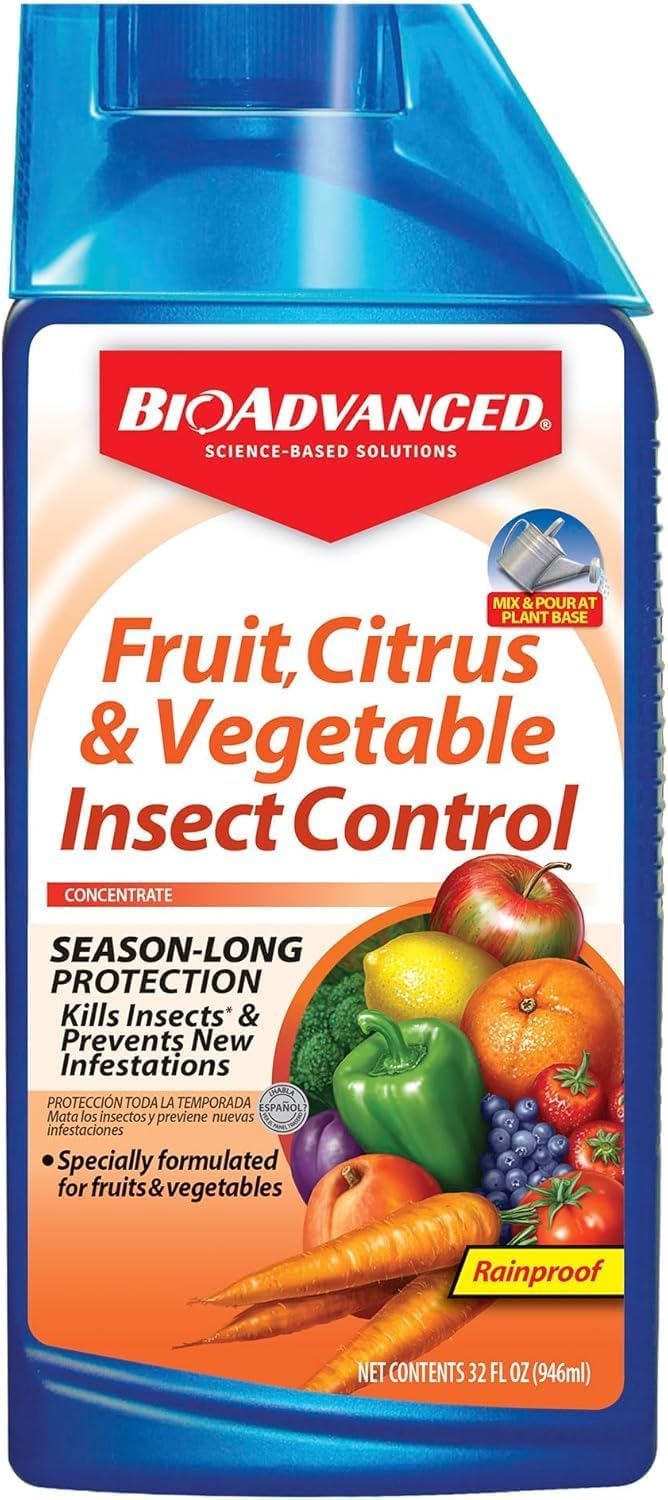
BioAdvanced Fruit, Citrus & Vegetable Insect Control Concentrate, 32 oz
| Item Form | Concentrate |
|---|---|
| Target Species | Aphid, Whiteflies, Japanese Beetles, Mealybugs, Asian Citrus Psyllid |
| Liquid Volume | 32 fluid ounces |
| Specification Met | EPA |
| Active Ingredients | avocado |
This BioAdvanced concentrate is designed as a season-long, systemic insect control for edible gardens. You mix the concentrate with water and pour it around the root zone, so no foliar spraying is required; after uptake the product protects plants from feeding pests such as aphids, whiteflies, leafhoppers, scale and Japanese beetles and is rainproof after one hour. A single application covers large areas and the label states protection for up to two months, which makes it useful for producers who want durable control without repeated sprays. Because it is systemic the active ingredient is taken up by the plant, protecting new growth as well as existing foliage. Important limitations are regulatory restrictions in several U.S. states and the fact that systemic chemistry can affect nontarget insects, so follow label directions and harvest intervals carefully. For gardeners focused on strong, low-effort insect control for edible crops, this product delivers predictable season-long protection when used as directed.
Best for: Gardeners and small-scale growers who prioritize reliable, low-effort, season-long protection for edible vegetables and fruit and who want a pour-in-root treatment instead of repeated foliar sprays.
Less Ideal for: People who prefer organic contact-only treatments or who manage pollinator-heavy plantings where nontarget exposure must be minimized should consider alternative products.
- Systemic mode of action protects new growth and does not require foliar spraying
- Provides rainproof protection one hour after application
- Single application gives season-long control for up to two months
- Covers a wide range of listed pests relevant to vegetables and fruit
- Not permitted for sale or use in several U.S. states and some New York counties
- Contains systemic insecticide chemistry that can impact nontarget insects if misused
Verdict: Choose this concentrate if you want dependable, season-long systemic protection for vegetables and fruit with a single pour-in application.
BioAdvanced Organics Neem Oil Spray, Ready-to-Use, 24 fl oz

| Unit Count | 24 Fluid Ounces |
|---|---|
| Item Form | Oil |
| Target Species | Spider |
| Specification Met | OMRI |
| Active Ingredients | Clarified Hydrophobic Extract of Neem Oil 0.9% |
This BioAdvanced Organics Neem Oil spray is a ready-to-use 3-in-1 treatment for home gardeners who need broad protection from both pests and common fungal diseases. The trigger bottle applies neem oil in a clarified hydrophobic extract formulation that kills eggs, larvae, and adults of listed insects such as aphids, whiteflies, and spider mites on contact while also helping prevent and control fungal problems like black spot, powdery mildew, and rust when used on a 7 to 14 day schedule. It is labeled for roses, flowers, vegetables, fruits and shrubs and can be used up to the day of harvest, making it suitable for edible gardens. Practical benefits include convenience of a pre-mixed spray, multi-target control in one treatment, and OMRI recognition for organic gardening. Limits to expect are that it is a contact-based product so full coverage is required for effectiveness and repeated applications are needed for prevention, and results can be slower than synthetic pesticides for heavy infestations. The bottle is best for small to medium gardens and spot treatments rather than large-scale applications.
Best for: Gardeners who want a single, organic-friendly spray to manage common insects and fungal issues on roses, ornamentals, and edible plants without mixing concentrates.
Less Ideal for: Those managing very large beds or commercial plantings who need high-volume coverage or fast knockdown from systemic synthetic products should consider concentrate or professional options.
- Ready-to-use trigger spray for easy application
- Combines insecticide, miticide, and fungicide action in one product
- Labeled for use on edible plants and permitted up to day of harvest
- OMRI listed formulation suitable for organic gardening
- Effectiveness depends on thorough coverage because it works primarily on contact
- Requires repeated applications on a regular schedule for disease prevention
Verdict: A convenient ready-to-use organic neem spray that gives home gardeners broad, multi-purpose protection against common insects and fungal diseases.
ferti-lome Spinosad Insecticide Concentrate (16 fl. oz.)

| Unit Count | 16 Fluid Ounces |
|---|---|
| Item Form | Oil |
| Target Species | Foliage feeding worms, thrips and other listed pests |
| Specification Met | OMRI |
| Active Ingredients | Spinosad |
This ferti-lome spinosad concentrate is a water-soluble, OMRI-listed insecticide formulated to control bagworms, tent caterpillars, armyworms and a wide range of foliage-feeding pests on vegetables, trees, shrubs, flowers and fruit. You dilute the concentrate (label recommends about 4 tablespoons per gallon) and apply it as a spray to affected foliage, which makes it convenient for spot treatments or whole-plant coverage. The active ingredient spinosad is effective against chewing insects while being approved for organic gardening, so it fits into integrated pest management plans. Practical benefits include broad-spectrum control of caterpillars and similar pests, compatibility with many outdoor uses, and a concentrate format that stretches farther than ready-to-spray alternatives. Important limitations are that it targets primarily chewing and foliage-feeding insects rather than sap-sucking pests, and label directions and safety precautions must be followed for timing and application to protect pollinators and beneficial insects.
Best for: Gardeners who prioritize practical, cost-effective pest control for outdoor plants and want an organic-approved concentrate to treat bagworms and other caterpillars across trees, shrubs and edibles.
Less Ideal for: People seeking an all-in-one product for sucking pests or those who want a pre-mixed spray with no measuring and mixing steps.
- OMRI listed so suitable for organic gardening and certified operations
- Concentrate form lets you dilute for multiple applications and spot treatments
- Effective against bagworms, tent caterpillars and a broad range of chewing foliage pests
- Water-soluble formulation is easy to mix into spray equipment
- Targets primarily chewing insects and is not intended for sap-sucking pests like aphids
- Requires mixing and correct dilution which adds preparation time compared with ready-to-spray products
Verdict: A concentrated, OMRI-listed spinosad solution that gives practical, organic-approved control of bagworms and other chewing caterpillars across outdoor plants.
Bonide Captain Jack's Ready-to-Use Neem Oil Spray, 32 oz

| Item Form | Liquid |
|---|---|
| Target Species | Insects |
| Liquid Volume | 32 fluid ounces |
| Active Ingredients | Clarified Hydrophobic Extract of Neem Oil |
This ready-to-use neem oil spray is a multipurpose garden treatment that kills insects at all life stages while also serving as a miticide and preventative fungicide. Packaged in a 32-ounce trigger bottle, it is applied by shaking and thoroughly spraying plant surfaces, including leaf undersides, at the first sign of pests or disease and reapplying every 7 to 14 days as needed. The active ingredient is a clarified hydrophobic extract of neem oil, which is approved for organic gardening and labeled safe to use on vegetables up to the day of harvest. Practical benefits include broad pest coverage (aphids, whiteflies, spider mites and others), disease suppression such as powdery mildew, and convenience from a ready-to-use sprayer. Important limitations are that results are slower than synthetic contact insecticides and application timing matters to avoid leaf burn in full sun; repeated applications may be needed for heavy infestations. Follow label safety directions and keep the product away from children and pets.
Best for: Gardeners who want a single, organic-approved product to manage common vegetable garden pests and fungal problems and who prefer products with strong user feedback.
Less Ideal for: Growers needing rapid knockdown of severe infestations or commercial producers who require fast-acting, high-throughput treatments.
- Kills multiple pest stages including eggs, larvae and adults for more complete control.
- Also acts as a fungicide and miticide so one product covers pests and common fungal issues.
- Ready-to-use trigger bottle requires no mixing and is easy to apply to leaves and undersides.
- Approved for organic gardening and can be used on vegetables up to day of harvest.
- Slower-acting than many synthetic contact insecticides, so it may take several applications to see control.
- Must avoid spraying in peak sunlight to reduce risk of leaf burn.
Verdict: A convenient, organic-approved all-in-one neem spray that controls common vegetable garden pests and fungal issues with minimal fuss.
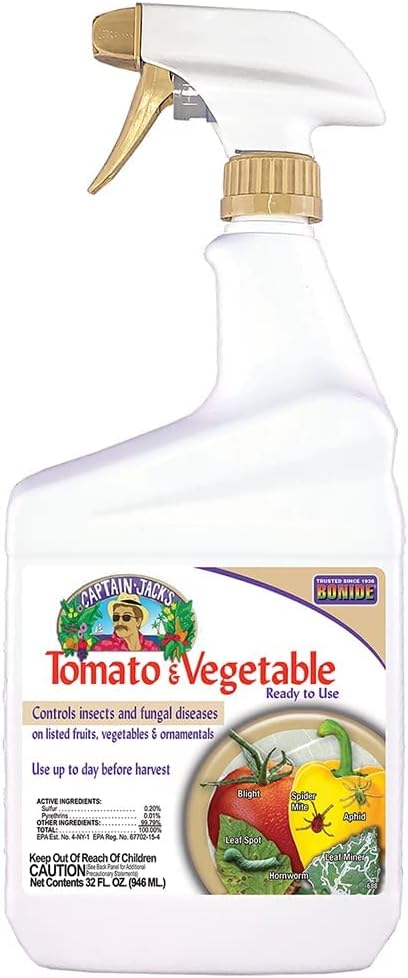
Bonide Captain Jack's Tomato & Vegetable 3-in-1 Ready-to-Use Spray, 32 oz
| Unit Count | 32 Ounce |
|---|---|
| Active Ingredients | sulfur |
| Item Type Name | Tomato & Vegetable 3-in-1 Ready-To-Use |
| Special Features | organic |
Bonide Captain Jack's Tomato & Vegetable Ready-to-Use is a 32 oz spray formulated to control common insect pests and a range of fungal diseases on tomatoes and other garden plants. It is used as a contact spray applied to foliage and new growth with a trigger nozzle that makes spot or whole-plant coverage straightforward. The product lists sulfur as an active ingredient and claims control of aphids, spider mites, caterpillars and more while also suppressing problems like powdery mildew, leaf spot and blight when applied preventively. Practical benefits include the convenience of a pre-mixed bottle, suitability for many listed vegetables and ornamentals, and a broad target list that lets one treat mixed beds without swapping products. Limitations are that it works by contact so thorough coverage is required and it is intended for preventive or early-season use rather than curing severe established infections. Users who need systemic control or highly targeted biological products may prefer an alternative formula.
Best for: Gardeners who want a simple, all-in-one spray to prevent and manage common insect pests and early fungal problems on tomatoes and mixed vegetable beds.
Less Ideal for: Growers seeking systemic fungicides, targeted biological controls, or solutions for severe, established diseases should consider other products.
- Ready-to-use bottle with trigger nozzle for quick application
- Controls a broad range of common garden insects and several fungal diseases
- Suitable for use on tomatoes, many vegetables and ornamentals
- Contains sulfur, a long-established option for organic-compatible fungal control
- Contact-only action requires thorough coverage and repeat applications for good control
- Not formulated for systemic action so it will not cure deep or established infections
Verdict: Pick this ready-to-use spray if you want a convenient, broad-spectrum preventive product to manage common tomato pests and early fungal issues.
Choosing the Right Insecticide for Edible Plants: Key Factors to Consider
Residual Safety and Pre-Harvest Interval
How long a product leaves active residues on leaves, stems, or fruit directly affects when you can safely harvest. Shorter pre-harvest intervals reduce the risk of ingesting residues and simplify scheduling for frequent-harvest crops like salad greens.
For edible gardens, pick products with clear, short PHI guidance on the label. Some materials break down rapidly under sunlight or wash off with rain, while others persist in plant tissues and require longer wait times. Understand whether residue limits exist for the crops you grow and follow label instructions to the letter to protect consumers and comply with regulations.
Spectrum of Target Pests
Different insecticides work on different insect groups. Broad-spectrum options may control many garden pests but can also harm beneficial predators. Narrow-spectrum or selective materials target specific pests such as caterpillars or sap-sucking insects, which can be more appropriate when you know the pest identity.
Matching the active ingredient to your most common pests improves control success and reduces unnecessary applications. Consider what pests are most damaging in your plot and choose an insecticide with demonstrated activity against those groups rather than assuming one product fits all scenarios.
Impact on Pollinators and Beneficials
Many edible plants flower and attract pollinators that are essential for fruit set. Some insecticides are highly toxic to bees, lady beetles, and predatory wasps. Using those products during bloom or when pollinators are active increases risk to beneficial populations and can reduce future natural pest control.
Choose products with lower toxicity to pollinators, apply treatments in late evening when pollinators are less active, or target applications to nonflowering parts. Consider whether the material is systemic, which can affect pollen and nectar, versus contact-only products that degrade on the leaf surface.
Application Method and Ease of Use
How a product is applied affects both effectiveness and safety. Ready-to-use sprays, hose-end applicators, and concentrated formulations each have tradeoffs. Concentrates allow flexibility and economy but require careful measurement and mixing. Ready-to-use options reduce mixing errors but can be less economical for larger plots.
Also consider sprayer type, droplet size, and whether the product requires adjuvants for control. Ease of rinsing equipment, clarity of label instructions, and required personal protective equipment influence whether a gardener will use the product correctly and safely.
Crop Compatibility and Labeling
Not all insecticides are labeled for every edible crop. Some products list a limited set of fruits, vegetables, or herbs. Always check the label for specific crop allowances, recommended rates, and harvest intervals. Using a product off-label can risk crop damage or legal issues.
Labels may also note phytotoxicity warnings for tender seedlings or certain varieties. If you grow diverse edibles, prefer formulations with broad crop compatibility or separate guidance for the crops you plan to treat.
Environmental Persistence and Runoff Risk
Some active ingredients bind to soil and persist, while others break down rapidly. Persistence affects how frequently you may need to reapply and the potential for runoff into water bodies. For home gardens near ponds, streams, or storm drains, select products with low aquatic toxicity and low mobility in soil where possible.
Consider timing applications to avoid heavy rain forecasts and follow label instructions for buffer zones and disposal. Minimizing overapplication reduces environmental load and lowers risk to non-target organisms beyond your garden.
When to Treat Versus When to Monitor
Not every pest sighting requires a spray. Many vegetable gardens tolerate low populations of sap-suckers or flea beetles without significant yield loss. Scouting and threshold-based action prevents unnecessary exposure and preserves beneficial insects.
Monitor plants weekly and focus treatments on hotspots, repeated damage, or visible egg masses and larvae that will reduce marketable yield. Recordings of pest pressure over time help refine whether an insecticide is needed or cultural controls will suffice.
- Inspect undersides of leaves and young growth where many pests hide
- Treat localized infestations with spot sprays when possible
- Combine cultural tactics like row covers and hand removal before chemical control
Timing Applications Around Flowering and Pollinators
To protect pollinators, avoid applying sprays while plants are in full bloom. If treatment during bloom is unavoidable, use products with low bee toxicity and apply in the evening after pollinators have left the flowers.
If a product is systemic, remember that residues may appear in nectar or pollen. For systemic materials check label guidance and aim to apply well before bloom or after flowering concludes when possible.
- Apply in early morning or late evening when pollinators are inactive
- Remove flowering weeds before spray to limit unintended exposure
- Consider nonchemical options during peak bloom periods
Integrating Insecticides Into Organic or IPM Systems
Many edible-plant pest programs blend cultural, biological, and selective chemical tools. For gardeners following organic practices, look for permitted substances and use them as part of a rotation to delay resistance. For IPM, rely on monitoring, thresholds, and targeted treatments rather than routine calendar sprays.
Rotate modes of action where possible to reduce resistance development in pest populations. Preserve natural enemies by using narrow-spectrum options and spot treatments.
- Encourage predatory insects by planting habitat and avoiding broad-spectrum sprays
- Use mechanical barriers and row covers early in the season
- Replace continuous spraying with targeted interventions based on scouting
Safe Application Practices for Small Gardens
Use the smallest effective sprayer and mix only the volume you need to reduce waste and exposure risk. Always follow label PPE recommendations and store concentrates locked away from children and pets. Rinse equipment in an area where rinse water will not enter storm drains or surface water.
Mark treated areas and record application dates and PHIs so you do not unknowingly harvest too soon. For edible gardens, consider keeping a simple log that lists product, active ingredient, application rate, and harvest-ready date.
- Calibrate handheld sprayers to apply recommended rates
- Wear recommended gloves and eye protection during mixing
- Dispose of empty containers per label and local regulations
Reducing Residues on Harvested Produce
Simple post-harvest steps help reduce surface residues. Washing produce under running water and removing outer leaves or peels where appropriate lowers surface residues. Some products break down with light and water, so scheduling harvests a few days after rain or irrigation may reduce residues further.
For root crops or thick-skinned fruit, follow label PHIs strictly; peeling can remove surface residues but not systemic residues. For delicate greens, minimize sprays close to harvest and favor physical controls where possible.
- Trim outer leaves from leafy greens before serving
- Rinse fruits and vegetables under running water rather than soaking
- Store treated garden tools and sprayers away from food preparation areas
How We Chose the Best Insecticide for Edible Plants
We shortlisted products based on garden-relevant performance and safety metrics that matter for edible plants. Primary evaluation criteria included residual safety and pre-harvest interval, measured by how long residues persist and recommended wait time to harvest after application. We prioritized pest control spectrum, assessing whether a product targets common edible-plant pests like aphids, caterpillars, whiteflies, and beetles. Application safety and user risk were key, including ease of proper dilution, PPE requirements, and re-entry intervals. Environmental impact was assessed by documented toxicity to pollinators and aquatic life and whether the product fits in an integrated pest management plan. Finally we checked formulation practicality, such as ready-to-use versus concentrate, tank-mix compatibility, and ease of application for small-scale gardeners. We excluded products intended only for ornamental, turf, or agricultural bulk-use settings where label instructions and re-entry or harvest timings do not apply to home gardeners. We also excluded options with unclear labeling for edible crops or missing key safety details. The resulting list focuses on items with clear edible-plant labeling, realistic application methods for home growers, and documented guidance on harvest intervals.
FAQ
Can I use the same insecticide across all vegetables and fruits?
It depends. Some products are labeled for many crops, but others list only specific vegetables or fruits. Always check the product label for allowed crops and crop-specific rates before applying.
How soon after spraying can I safely harvest?
That varies by product. Look for the pre-harvest interval on the label, which specifies days to wait before harvest. Short PHIs are preferable for frequent-harvest crops like salad greens.
Will insecticides harm pollinators visiting my vegetable flowers?
Some insecticides are more toxic to pollinators than others. Use low-toxicity materials, avoid spraying during bloom, and apply in the evening to reduce pollinator exposure.
Are organic insecticides always safer for edible plants?
Organic status does not guarantee low toxicity. Some organic-approved materials can still harm beneficials or leave residues. Consider mode of action, PHI, and environmental impact when choosing any product.
How can I reduce pest resistance to insecticides in my garden?
Rotate products with different modes of action and combine chemical control with cultural and biological tactics. Use targeted spot treatments and avoid frequent blanket applications to reduce selection pressure.
Final Verdict
Choosing an insecticide for edible plants means balancing effective pest control with harvest safety and protection of beneficial insects. Prioritize products with short, clear pre-harvest intervals, appropriate target pest coverage, and lower toxicity to pollinators when possible. Match your application method and timing to the crop and growing situation to minimize residues and environmental impact. Focus on integrated approaches: scout regularly, use cultural controls, and reserve targeted insecticide treatments for when thresholds are exceeded. That approach will protect yields while preserving the safety and ecological health of your edible garden.
