

Note: This article contains affiliate links. If you click on these links and make a purchase, I may earn a small commission at no extra cost to you. This helps support my research and content. Read my full affiliate disclosure here.
If flies are making the yard, porch, or outbuilding unpleasant, choosing the right insecticide for flies matters for quick relief and ongoing control. You want a product that stops biting or nuisance flies fast, is safe to apply where people and pets move about, and leaves a residual effect long enough to avoid constant reapplication. This guide shortlists seven top options suited to a range of outdoor needs and application methods. We evaluated each pick for knockdown speed, residual longevity, ease of application, and safety considerations so you can decide which treatment fits your property and routine.
Top Picks at a Glance
| Best Overall The best all-around choice for most situations | Absorbine UltraShield EX Insecticide & Repellent, 1 gallon |  |
| Best Quality Built to a higher standard if you want something more solid | BASF Alpine WSG Water-Soluble Granule Insecticide (Dinotefuran 40%) |  |
| Best Value The sweet spot between price and what you get | HOT SHOT Flying Insect Killer Aerosol, 15 fl oz (3 pack) |  |
| Best Budget The cheapest option that still gets the job done reliably | Raid Flying Insect Killer Spray, 18 oz |  |
| Highest Rated A top-rated pick with lots of positive feedback | Elanco Agita 10 WG Insecticide for House Fly and Darkling Beetle Control, 2.2 lb |  |
| Most Popular A crowd favorite that many people choose with confidence | ZEVO Flying Insect Killer Spray, 30 fl oz (single bottle) |  |
| Best Seller A high-volume bestseller chosen again and again | Atticus Talak 7.9% Bifenthrin Indoor/Outdoor Insecticide Concentrate (32 oz) |  |
Absorbine UltraShield EX Insecticide & Repellent, 1 gallon

| Unit Count | 128 Ounce |
|---|---|
| Item Form | Liquid |
| Scent Name | Unscented |
| Recommended Uses For Product | Fly Control |
| Active Ingredients | Pyrethrins |
Absorbine UltraShield EX is a one-gallon, ready-to-use fly spray designed for multi-species use and premise treatment. It combines insecticidal pyrethrins with repellency boosters to kill and repel more than 70 pest species, and the water-based formula contains sunscreens and coat conditioners so it protects and conditions hair while avoiding greasy residue. Typical use is spraying evenly over animal coats or targeted areas around barns and doorways; the label and brand guidance recommend applying to a clean coat and using roughly 2 ounces per application for good coverage. Notable features include weatherproof UltraBond technology that can extend protection up to 17 days in some conditions, EPA-approved actives, and compatibility for horses, dogs, and premises. Practical benefits are strong broad-spectrum pest control, reduced reapplication compared with basic sprays, and a non-oily finish that helps with grooming. Important limitations are that the product contains pyrethrins and related actives so you must follow label safety instructions for animals and humans, and effectiveness will vary with infestation pressure and environmental conditions.
Best for: Buyers who want a reliable, broad‑spectrum fly control they can use on horses, dogs, and around barns with less frequent reapplication and an emphasis on coat care.
Less Ideal for: People seeking a purely natural or fragrance-free repellent without synthetic insecticides should look for alternative formulations; those needing spot treatments for sensitive animals should consult a veterinarian first.
- Ready-to-use water-based formula requires no mixing and leaves no greasy residue
- Broad-spectrum control that kills and repels 70+ insect species listed on the label
- Includes sunscreens and coat conditioners to protect and condition animal coats
- UltraBond weatherproof technology can extend protection up to 17 days under some conditions
- Contains pyrethrins and other insecticidal ingredients that require following label safety directions
- Actual reapplication interval can vary with activity, weather, and heavy infestations
Verdict: A dependable, ready-to-use fly spray that combines broad-spectrum kill and repellency with coat protection for busy horse and barn owners.
BASF Alpine WSG Water-Soluble Granule Insecticide (Dinotefuran 40%)

| Item Form | Granules |
|---|---|
| Target Species | Ants, cockroaches, bed bugs, beetles, stink bugs, fleas, house flies, mosquitoes |
| Active Ingredients | Dinotefuran 40% |
| Specification Met | EPA |
BASF Alpine WSG is a concentrated water-soluble granule insecticide formulated for fast, wide-ranging control of ants, cockroaches, bed bugs, flies, mosquitoes and other listed pests. You dilute the granules in water to make a clear spray solution and apply it to foundations, patios, garbage areas, attics and other targeted sites where insects hide or travel. Notable features include a high-percentage active ingredient, EPA reduced-risk status for certain uses, and nonrepellent action that helps pests pick up and transfer the active ingredient through a colony. For a performance-focused user this product delivers quick knockdown and effective residual control when used according to label directions, and one gallon of finished dilution treats about 1,000 sq ft. Important limitations are that it is a concentrated chemical that requires careful mixing and adherence to label safety instructions, and applications must be timed and placed to minimize exposure to pollinators and non-target animals.
Best for: Experienced homeowners or pest control pros who prioritize fast, reliable knockdown and residual control for a wide range of structural and perimeter pest problems.
Less Ideal for: Casual users who prefer passive, non-chemical approaches or beginners uncomfortable with measuring and handling concentrated insecticides should consider gentler alternatives.
- High active ingredient concentration (Dinotefuran 40%) for rapid knockdown
- Water-soluble granule format mixes to a clear spray for easy application
- Broad spectrum labeled for many indoor and outdoor pest species
- EPA granted reduced-risk status for certain public health and food-handling uses
- Requires precise dilution and careful handling due to concentrated active ingredient
- Not selective so applications must avoid pollinator exposure and sensitive areas
Verdict: Buy this if you need a concentrated, fast-acting water-soluble insecticide that delivers professional-grade knockdown and broad-spectrum control when mixed and applied correctly.
HOT SHOT Flying Insect Killer Aerosol, 15 fl oz (3 pack)
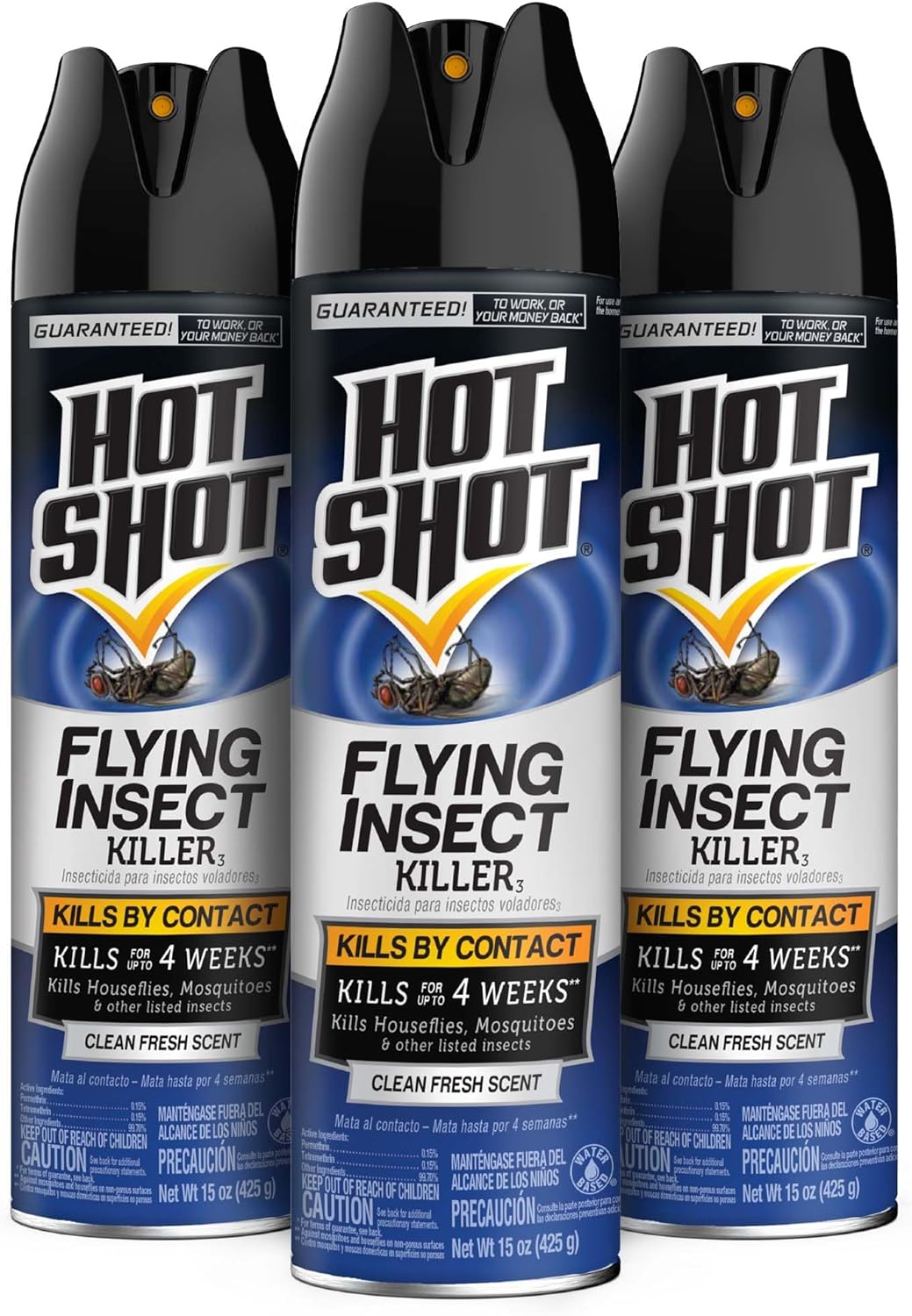
| Unit Count | 45 Ounce |
|---|---|
| Included Components | 15 Fl Oz (3 Pack) |
| Item Form | Aerosol |
| Target Species | Insects |
| Active Ingredients | Permethrin (0.15%), Tetramethrin (0.15%) |
The HOT SHOT Flying Insect Killer is an aerosol spray designed to kill houseflies, mosquitoes and other listed flying insects on contact and to leave a residual kill on nonporous surfaces for up to four weeks. It is used as a directed surface spray for entry points and congregating spots or as a space spray indoors by filling a room with mist and vacating for the recommended time. The formula contains low-percentage permethrin and tetramethrin and includes application directions for nests, eaves and around light fixtures. Practical benefits include quick knockdown, a clean fresh scent, and versatility for both indoor spot treatment and outdoor perimeter spraying. Important limitations: it is toxic to aquatic life so avoid water, it is pressurized so must be stored and used away from heat and flames, and label precautions mean it is not suitable for use directly on plants or where food is exposed. Users should follow safety and ventilation instructions and avoid contact with skin or clothing.
Best for: Buyers who want a fast, no-fuss way to reduce flying insect annoyances around the home and treat problem entry points or nests with occasional repeat applications.
Less Ideal for: People who need insect control near ponds, water features, edible gardens, or who prefer non-chemical or plant-safe pest control methods should consider alternatives.
- Kills a wide range of common flying insects on contact
- Provides up to four weeks of residual control on nonporous surfaces
- Suitable for both indoor space sprays and targeted outdoor surface treatments
- Aerosol format offers quick, convenient application and a clean fresh scent
- Toxic to fish and aquatic environments so cannot be used near water
- Contains pressurized propellant requiring careful storage and handling
- Not intended for direct treatment of plants or food-preparation areas
Verdict: A quick, versatile aerosol for homeowners who want fast knockdown and weeks-long residual control of common flying insects around the house.
Raid Flying Insect Killer Spray, 18 oz

| Item Form | Spray |
|---|---|
| Target Species | Insects |
| Liquid Volume | 18 fluid ounces |
| Active Ingredients | d-Phenothrin 0.125%, prallethrin 0.100% |
| Specification Met | EPA |
Raid Flying Insect Killer is an aerosol mist designed to knock down and provide short residual control of many common flying pests including flies, mosquitoes, fruit flies, gnats, wasps, hornets, and yellow jackets. It is used by sweeping the spray up into the air to mist a room for general control or by directing the spray at individual insects for fast knockdown; the label recommends keeping about 3 feet from walls and fabrics and ventilating the treated area after two hours. Notable features include an EPA-specified formulation with d-Phenothrin and prallethrin as active ingredients, an outdoor-fresh scent, and the ability to treat both indoor spaces and outdoor calm-air areas like near trash or compost. Practical benefits are quick visible results, simple aerosol application without mixing, and multi-insect coverage that makes it useful for occasional home pest problems. Important limitations are the need to evacuate people and pets during treatment and ventilate thoroughly afterward, the flammability of the product, and that it is not intended for food-preparation or continuous preventive use.
Best for: Buyers looking for a low-effort, familiar aerosol solution to handle occasional flying-insect problems indoors and around outdoor seating or trash areas.
Less Ideal for: People wanting continuous preventive treatments, households with frequent exposure to pets, infants, or immunocompromised individuals who prefer non-chemical control methods.
- Kills a wide range of common flying insects on contact and with misted residual effect
- Works for both indoor and outdoor spot or area treatments
- Ready-to-use aerosol that requires no mixing and is easy to apply
- Water-based formula that dries without a greasy residue and has a mild outdoor-fresh scent
- Contains flammable ingredients and requires careful storage and ventilation
- Requires temporary evacuation of people and pets and two-hour ventilation before reentry
Verdict: A straightforward, ready-to-use aerosol that quickly knocks down a broad set of flying insects for homeowners who want an easy, budget-friendly fix.
Elanco Agita 10 WG Insecticide for House Fly and Darkling Beetle Control, 2.2 lb

| Net weight | 2.2 lb |
|---|
Agita 10 WG is a granular, mix-and-spray insecticide designed for use around animal housing to reduce house fly and darkling beetle populations. The sugar-containing formulation includes (Z)-9-Tricosene to attract both male and female flies and delivers thiamethoxam as the active ingredient for a rapid kill plus persistent residual activity. In practice you mix the granules with lukewarm water and apply as a perimeter spray or under poultry feeders and in bedding for beetle control. The product is useful as part of a rotation strategy because the neonicotinoid chemistry offers an alternative mode of action to help manage resistance. Its strengths are targeted knockdown of flies, flexibility of application around structures and litter, and a concentrated 2.2-pound jar that treats multiple areas. Limitations to consider are that it is a pesticide requiring careful handling, labeled use around animal facilities only, and it does not replace integrated sanitation and mechanical control measures.
Best for: Livestock and poultry managers who prioritize dependable fly and beetle control around barns and coops and who plan pest management as part of a resistance-management rotation.
Less Ideal for: Homeowners seeking general indoor fly sprays or nonchemical options should look elsewhere; gardeners without animal housing needs will not benefit from this product.
- Formulation attracts both male and female house flies for more effective knockdown
- Delivers rapid kill with residual activity to reduce reinfestation
- Granules disperse in water for easy mix-and-spray application
- Suitable for spot application under feeders and around animal housing
- Contains a neonicotinoid active ingredient that requires careful handling and adherence to label directions
- Intended specifically for use in and around animal housing rather than general household use
Verdict: Choose Agita 10 WG when you need a reliable, mix-and-spray insecticide that attracts and rapidly kills house flies and helps control darkling beetles around animal housing.
ZEVO Flying Insect Killer Spray, 30 fl oz (single bottle)

| Item Volume | 30 fluid ounces |
|---|---|
| Target Species | Fly, Fruit Fly, Gnat, Mosquito |
| Included Components | Sprays |
| Brand Name | ZEVO |
ZEVO Flying Insect Killer is a ready-to-use aerosol spray designed to kill common flying pests on contact around the home. You use it as a spot treatment whenever you see flies, fruit flies, gnats, or mosquitoes—aim the nozzle at the insect, spray until wet, and wipe away any residue as instructed. The formula is based on rosemary and cornmint oils rather than traditional synthetic pyrethroids, which gives it a more natural scent profile and may feel safer to households concerned about harsher chemicals. The 30 fl oz canister provides multiple targeted treatments for kitchens, patios, bathrooms, and living spaces. Important practical points: it only kills insects that are sprayed directly, surfaces can become slippery or stainable after use, and the label warns to avoid spraying on people, pets, plants, and food-preparation areas. For those who value an oil-based botanical formulation and immediate knockdown of visible flies, ZEVO is convenient and effective; for ongoing prevention or hidden infestations you will still need traps, exclusion, or a broader integrated pest approach.
Best for: Buyers who want a fast, on-demand solution to kill visible flying insects and prefer a botanical-based aerosol over stronger synthetic insecticides, backed by solid user feedback.
Less Ideal for: People seeking long-term prevention, residual protection, or a solution for crawling pests should consider traps, baits, or professional options instead.
- Kills common flying insects on contact including fruit flies, gnats, house flies, and mosquitoes
- Formulated with rosemary and cornmint oils for a less chemical smell compared with many aerosols
- Suitable for indoor and outdoor spot treatments in kitchens, patios, bathrooms, and living areas
- Large 30 fl oz canister supplies multiple targeted treatments for recurring visible problems
- Requires direct spray on insects so it does not provide area-wide residual control
- Can make surfaces slippery and may stain porous or unsealed materials if oversprayed
Verdict: Choose ZEVO when you need a quick, botanical-based aerosol to kill visible flying insects on contact around the home.
Atticus Talak 7.9% Bifenthrin Indoor/Outdoor Insecticide Concentrate (32 oz)

| Liquid Volume | 32 fluid ounces |
|---|---|
| Active Ingredients | Bifenthrin |
| Formulation | Suspension Concentrate |
| Target Species | Insects |
| Specification Met | EPA |
The Atticus Talak 7.9% concentrate is a water-based insecticide intended for both indoor perimeter treatments and outdoor lawn and landscape applications. You dilute measured teaspoons into water and spray around baseboards, eaves, patios, shrubs, turf or other surfaces to create a contact-and-residual barrier that the label says lasts up to three months. Notable features include a 7.9% bifenthrin active ingredient familiar to many pros, a formula that dries clear and is described as odor-free, and pre-marked pour sections to help reduce overpours. In practice this product is useful for broad-spectrum control of ants, ticks, spiders, mosquitoes and many turf pests, and it can be used as a mound drench for fire ant colonies. Important limitations are that mixed solutions should be used same day and cannot be applied with a fogger, and the product is not registered for sale in a few states. Follow label directions for rates, PPE, and re-entry timing to get reliable, low-surprise results.
Best for: Buyers who want a proven, familiar active ingredient and a single concentrate that can treat both indoor perimeters and outdoor lawns with predictable residual control.
Less Ideal for: People seeking ready-to-use sprays, fogger-compatible products, or those living in states where this formulation is not registered should look for alternatives.
- Broad-spectrum control listed for more than 75 indoor and outdoor pests
- Water-based formula that dries clear, leaves no residue, and is described as odor-free
- Long residual effect with up to three months of control per labeled application
- Convenient bottle with pre-marked pour sections to reduce mess when measuring
- Mixed spray solutions must be used the same day and cannot be stored
- Not approved for fogger application and not available for sale in some states
Verdict: A reliable bifenthrin concentrate for homeowners who want one product to treat indoor perimeters and outdoor lawns with long-lasting residual control.
Choosing the Right Insecticide for Flies: Key Factors to Consider
Target Fly Species and Behavior
Different fly species behave and feed differently, so knowing which flies you are treating affects product choice. House flies and stable flies respond well to contact sprays and residuals on resting surfaces, while fruit flies and small gnats often require baiting or area-wide coverage. Understanding whether flies are breeding on manure, compost, decaying vegetation, or in wet organic matter helps you choose a formulation and placement that intercepts adults or targets immature stages.
If flies are concentrated in animal housing or waste-handling zones, you will likely need products labeled for those locations and that tolerate organic matter. For nuisance flies clustering on porch ceilings or eaves, a residual spray applied to resting surfaces is usually more effective than space sprays.
Formulation and Application Method
Formulations include ready-to-use aerosols, concentrated sprays to mix in a pump sprayer, baits, granules, and residual surface treatments. Each has pros and cons: aerosols give quick, localized knockdown but limited residual; concentrates let you treat larger areas and adjust rates but require careful mixing; baits rely on ingestion and work best where flies feed; granules are useful in refuse or drainage areas where liquid sprays are impractical.
Choose a method that matches where flies congregate and how you prefer to apply chemicals. Pumps and hose-end sprayers cover large exterior walls and barns quickly, while spot treatments with a trigger sprayer are better for porch eaves or around doors. Always follow label directions for application equipment to ensure even coverage and safe use.
Residual Effect and Reapplication Interval
Residual activity determines how often you must reapply and how long treated surfaces continue to kill or repel flies. Outdoor residuals fade faster due to sunlight, rain, and dust, so products with formulation ingredients that adhere to rough surfaces or include microencapsulation tend to last longer. Expect labeled residual claims to represent ideal conditions; in direct sun or heavy rainfall you will need more frequent reapplication.
Plan treatments around weather and high-traffic times. For example, applying a residual spray to eaves and overhangs where flies rest is usually more durable than treating horizontal surfaces exposed to runoff. Note the reapplication window on the label and schedule follow-up treatments before efficacy drops significantly.
Safety, Label Restrictions, and Non-Target Risk
Safety is critical when treating areas near people, pets, food prep surfaces, or edible gardens. Look for insecticides labeled for residential outdoor use and pay attention to personal protective equipment requirements. Some formulations are unsuitable for use in animal housing or near livestock feed; others require keeping people and pets away until treated surfaces have dried.
Consider the risk to beneficial insects, pollinators, and aquatic life. Avoid broadcast sprays over flowering plants where bees forage and restrict use near ponds, streams, or drainage. Choosing targeted applications and baits can reduce non-target impacts compared to wide-area sprays.
Compatibility with Sanitation and Integrated Control
An insecticide is most effective when combined with nonchemical measures. Removing or managing breeding sites like soiled bedding, exposed manure, food waste, and standing moisture reduces fly populations and lowers the amount of insecticide needed. Use traps and exclusion where feasible to reduce adult numbers, then apply targeted insecticide treatments to residual resting areas or concentrated fly pathways.
Products that work alongside traps or that are labeled for use in bait stations are useful when sanitation cannot be immediately improved. Plan an integrated schedule that alternates treatments, cleans breeding areas, and inspects for new fly hotspots to avoid overreliance on chemicals.
Mixing Convenience and Label Clarity
How easy a product is to measure, mix, and apply affects correct usage. Concentrates with clear mixing tables and premeasured dosing cups reduce the risk of over- or under-application. Ready-to-use aerosols remove mixing errors but may be more costly per application and offer less coverage. Baits and premeasured station refills simplify placement and reduce direct contact with chemicals.
Check label guidance for compatible equipment and whether the product can be tank-mixed with other formulations. Labels that provide troubleshooting tips for hard-to-reach infestations or high-organic conditions make field application easier and safer.
Where Flies Rest and How That Guides Treatment
Flies typically rest on vertical surfaces like eaves, fences, window frames, and the undersides of overhangs. Treating these resting surfaces with a residual spray interrupts their normal behavior and leads to higher contacts. Horizontal surfaces often wash away residues faster, so target sheltered, shaded spots where residue lasts longer.
For animal housing and compost areas, treat areas flies use as perches rather than trying to blanket the whole space. Spot treatments reduce chemical use and lower risk to beneficial insects.
- Focus residue sprays on shaded, sheltered perches
- Use baits near feeding and breeding hotspots
- Avoid spraying flowering plants or open water
Using Baits and Stations Effectively
Baits attract flies to an ingestible attractant mixed with an active ingredient. Baits work best when placed where flies forage and away from competing food sources. For outdoor situations, protect bait stations from rain and sun to maintain attractiveness.
- Place stations near trash, compost, or animal pens but out of reach of children and pets
- Rotate or replace bait according to label to maintain efficacy
- Combine baits with sanitation to reduce breeding that undermines baiting
Timing Applications Around Weather and Activity
Apply residual treatments during dry weather and when wind is low to limit drift and wash-off. Early morning or late evening applications reduce UV breakdown and avoid peak pollinator activity. Schedule treatments before known high-traffic events or seasonal peaks so you get maximum benefit when you need it.
Avoid applying sprays right before rain is expected. If a heavy rain follows an application, inspect treated areas and reapply as the label allows.
- Treat sheltered resting spots during dry periods
- Avoid applying sprays during windy conditions
- Coordinate applications with barn cleaning or waste removal
Nonchemical Options to Reduce Reliance on Sprays
Sanitation, exclusion, and mechanical traps cut the pressure on chemical controls. Tight-fitting lids on waste containers, routine removal of soiled bedding, and screening doors and windows reduce fly access and breeding. Sticky traps and electric fly traps lower adult numbers in high-use areas without chemical exposure.
Using these methods in combination with targeted insecticides extends the useful life of treatments and reduces the number of chemical applications needed each season.
- Implement regular cleaning schedules for waste and bedding
- Use exclusion to prevent flies entering living spaces
- Match trap type to fly species for better capture rates
Safe Storage and Disposal Practices
Store insecticides in their original labeled containers in a cool, dry location away from food, feed, and reach of children. Keep concentrates locked and out of direct sunlight. Follow label instructions for disposal of unused product and empty containers to avoid environmental contamination.
Never pour leftover mixes onto soil or into drains. Many labels provide concrete disposal steps and community hazardous-waste options if household disposal is restricted.
- Keep products in clearly labeled containers
- Follow label disposal instructions exactly
- Use local hazardous-waste programs for unwanted concentrates
How We Chose the Best Insecticide for Flies
We prioritized options that balance rapid knockdown with a useful residual effect under outdoor conditions. Important evaluation criteria were efficacy against common fly species and speed of action, measured by reported knockdown times and labeled claims. Residual longevity on typical outdoor surfaces was essential because short-lived contact kills often mean more frequent treatments. Application flexibility and delivery format were included so gardeners can choose sprays, bait stations, or surface treatments that suit porches, barns, patios, or compost areas. Safety and labeled use around people, pets, and edible gardens guided exclusions; we excluded products without clear labeling for typical residential outdoor use or those with restricted-use classifications. Ease of mixing and clarity of label directions affected selections because complicated prep increases misuse risk. Finally, compatibility with alternative control tactics like sanitation and traps was considered so the chosen insecticides integrate into a broader fly-management plan.
FAQ
How quickly will an insecticide for flies knock down adult flies?
Knockdown time varies by active ingredient and formulation. Contact sprays and aerosols often cause visible knockdown within minutes, while baits may take longer because flies must ingest the active ingredient. Expect faster results indoors or in sheltered spots and slower action in open, windy conditions.
Can I use fly insecticides near vegetable gardens or pollinator plants?
It depends on the label. Many products restrict use near flowering plants or edible crops to protect pollinators and prevent contamination. Use targeted spot treatments away from blooms and follow label reentry intervals and safety precautions to minimize non-target risk.
How often should I reapply a residual fly treatment outdoors?
Reapplication intervals depend on the product's labeled residual claim and environmental conditions. Sun, rain, and surface abrasion shorten residual life, so outdoor treatments often need more frequent reapplication than label claims suggest. Inspect treated areas regularly and follow label timing for repeat applications.
Are bait stations safe around pets and children?
Bait stations are designed to limit access but must be placed out of reach of children and pets. Choose enclosed stations and site them where non-target access is unlikely. Always read safety instructions and replace or remove stations per label guidance.
Will treating adult flies fix a breeding problem?
Treating adults reduces nuisance and bites quickly but does not eliminate the source. For long-term control, address breeding sites by removing or managing organic waste, cleaning animal housing, and eliminating standing moisture where larvae develop.
Can I tank-mix fly insecticides with other garden products?
Tank-mixing is sometimes possible but depends on label allowances and chemical compatibility. Only mix products when the label explicitly permits it and follow recommended compatibility tests. When in doubt, use separate applications to avoid reduced efficacy or phytotoxicity.
Final Verdict
Prioritize treatments that match where flies live and feed. Fast knockdown matters for immediate nuisance relief, while residual longevity and safe application determine how much follow-up work you will need. Combine targeted insecticide use with sanitation, exclusion, and trapping to reduce overall chemical dependence. Focus on labeled uses, apply during suitable weather, and choose formulations that fit your routine to achieve dependable fly control.
