

Note: This article contains affiliate links. If you click on these links and make a purchase, I may earn a small commission at no extra cost to you. This helps support my research and content. Read my full affiliate disclosure here.
Ground wasp nests can appear in sunny lawns, along pathways, or in raised beds, and a poorly chosen product can leave you dealing with returning colonies. Picking the right insecticide for ground wasps matters because gardeners need something that kills active workers quickly and provides enough residual in the soil to suppress re-establishment. This guide covers six shortlisted products that fit common garden situations and application styles. We evaluate each option on how fast it neutralizes foraging wasps and how well it holds up in soil or turf, plus ease of application and safety considerations. Read on for practical guidance to match a control method to your yard and timing.
Top Picks at a Glance
| Best Overall The best all-around choice for most situations | Atticus Tirade 1% Dust Insecticide (1.25 lb) |  |
| Best Quality Built to a higher standard if you want something more solid | Demon Max Insecticide 16 oz |  |
| Best Value The sweet spot between price and what you get | Bonide Revenge Spider & Ground Bee Killer, 10 oz Ready-to-Use Dust |  |
| Best Budget The cheapest option that still gets the job done reliably | Spectracide PRO Wasp & Hornet Killer Spray, 18 oz |  |
| Highest Rated A top-rated pick with lots of positive feedback | Envu Tempo 1% Dust Insecticide, Ready-to-Use Cyfluthrin Powder |  |
| Most Popular A crowd favorite that many people choose with confidence | Atticus Talak 7.9% Bifenthrin Indoor/Outdoor Insecticide Concentrate, 32 oz |  |
Atticus Tirade 1% Dust Insecticide (1.25 lb)

| Item Form | Powder |
|---|---|
| Target Species | Insects |
| Active Ingredients | Cyfluthrin |
| Unit Count | 20 Ounce |
Tirade 1% Dust is a ready-to-use cyfluthrin powder formulated for crack-and-crevice, void, and perimeter applications where flying, crawling, and soil-nesting insects hide. It is applied with a powder duster or bulb applicator so the dust reaches deep into ant mounds, ground bee burrows, wall voids, and behind baseboards. The label lists control for 50-plus pests including wasps, hornets, yellow jackets, and many ground-nesting insects, and it leaves a residual in undisturbed areas that can continue to protect for months. Practical benefits include a low odor, non-staining formula and straightforward application without mixing. Limitations are that proper use requires a duster and following label directions to avoid visible dust on surfaces and to keep pets away from treated areas. Also, state registrations vary so check local allowances before use.
Best for: Homeowners and property managers who want a straightforward, residual dust treatment for ground-nesting bees, wasps, and common household insects and who can apply it carefully in voids and mounds.
Less Ideal for: People who prefer non-chemical or organic control methods or who cannot restrict pet and child access to treated areas should consider alternative approaches.
- Ready-to-use powder that requires no mixing
- Formulated with cyfluthrin for broad-spectrum control including ground-nesting insects
- Low odor and non-staining for indoor or outdoor use
- Leaves a residual in undisturbed areas for extended control
- Requires a powder duster or applicator for effective placement
- Not registered for sale in several states and territories
Verdict: Use Tirade 1% Dust when you need a ready-to-use, residual powder that reaches deep into mounds and voids to control ground bees and a wide range of insect pests.
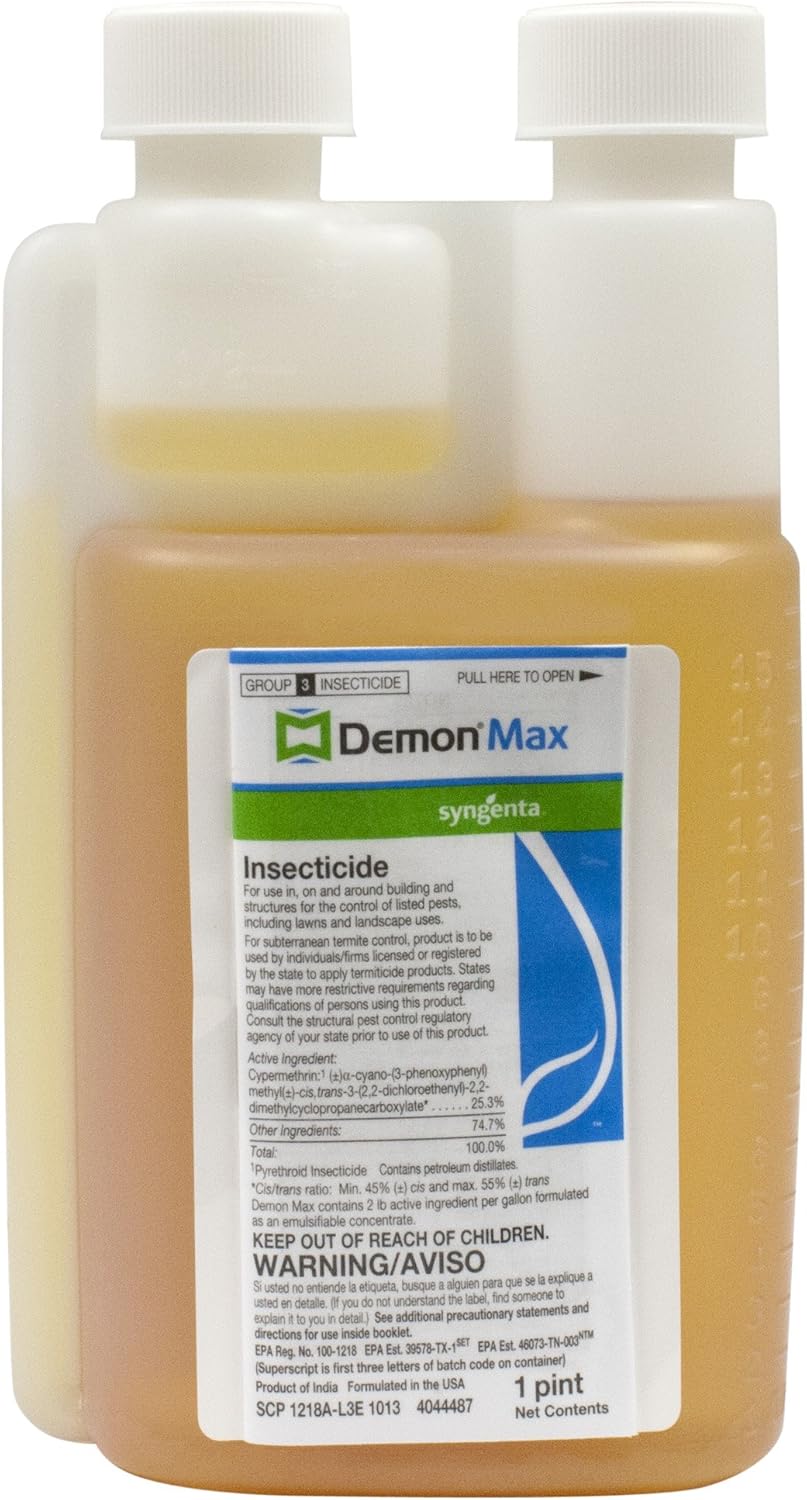
Demon Max Insecticide 16 oz
| Unit Count | 16 Ounce |
|---|---|
| Item Form | Liquid |
| Target Species | Insects |
| Active Ingredients | Cypermethrin |
Demon Max is a concentrated 16 ounce liquid insecticide designed for both quick knockdown and lasting residual control of more than 30 insect pests, making it suitable for spot, crack-and-crevice, and perimeter treatments. It is typically mixed in a hand-pump or compressed sprayer and applied around foundations, on lawns and vegetation, and in and around structures where pest activity is observed. The product lists cypermethrin as the active ingredient, which delivers fast contact mortality and residual protection when applied according to label directions. Practical benefits include flexible application options across multiple surfaces and economical coverage from a small concentrate. Important limitations are the need to measure and mix correctly for the treatment area and to follow safety precautions, including keeping it away from children and avoiding application on unintended plants or areas. This is a professional-strength, pesticide-focused option for users who want effective, long-lasting roach and general insect control when applied responsibly.
Best for: Buyers who prioritize strong, long-lasting pest control results and are comfortable mixing and applying a concentrated insecticide for targeted indoor and outdoor treatments.
Less Ideal for: Casual users seeking ready-to-use sprays or nonchemical options should consider simpler consumer products or mechanical controls instead.
- Fast knockdown and residual control against a wide range of insect pests
- Versatile use for crack-and-crevice, spot treatments, lawns, vegetation, and building perimeters
- Concentrated liquid formula that can be mixed to cover varied square footage
- Contains cypermethrin, a proven synthetic pyrethroid active ingredient
- Requires careful measuring and mixing for correct coverage and safety
- Labeled for professional-style applications and may need precautions for use near ornamentals and non-target areas
Verdict: Choose Demon Max when you need a concentrated, professional-strength liquid that delivers fast knockdown and lasting residual control of roaches and other insects.
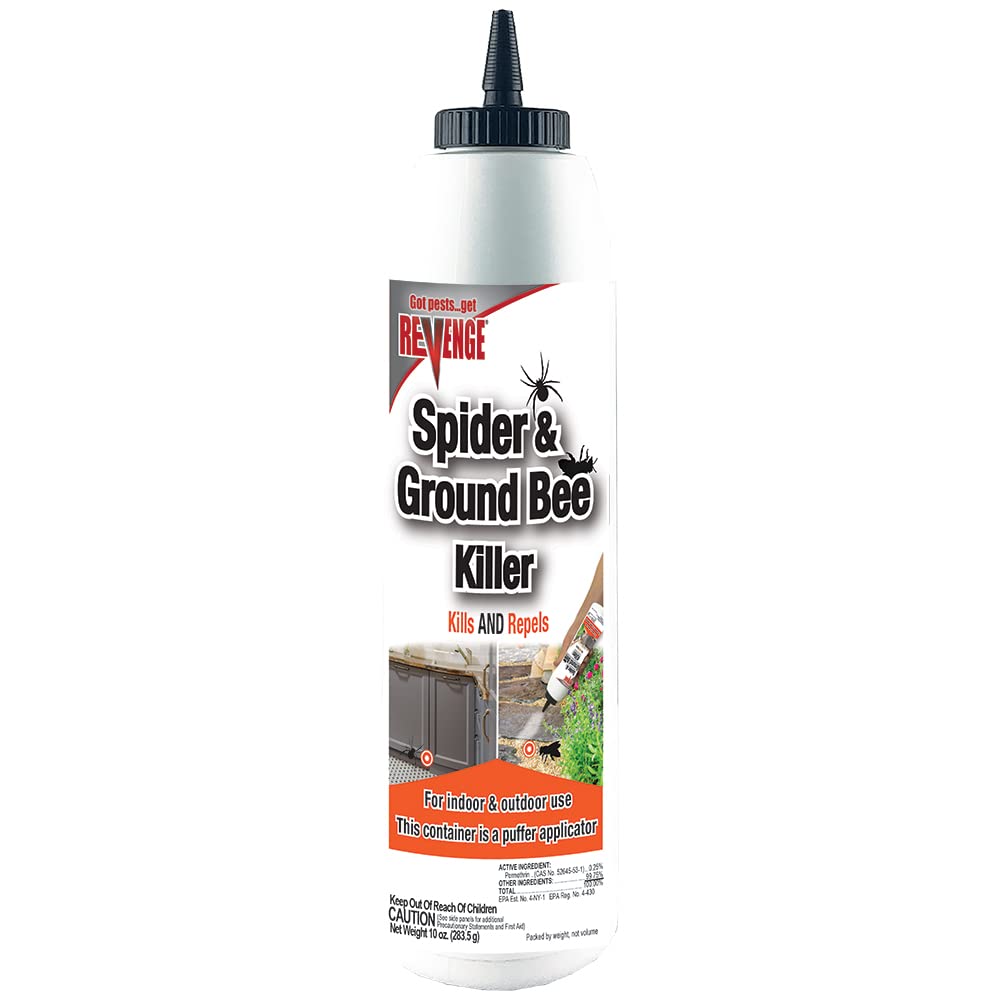
Bonide Revenge Spider & Ground Bee Killer, 10 oz Ready-to-Use Dust
| Unit Count | 10 Ounce |
|---|---|
| Item Form | Powder, Spray |
| Target Species | Insects |
The Bonide Revenge Spider & Ground Bee Killer is a 10-ounce ready-to-use dust designed for targeted treatment of spiders, ground bees, ants, roaches and other crawling pests around the home. It comes as a puffer applicator so you can squeeze bursts of dust into cracks, crevices, nests and hard-to-reach areas without mixing or spraying. In practice it is used on porches, eaves, window frames, garages and in dark indoor corners or behind appliances where pests hide. The formula both kills and repels common nuisance species, which helps reduce activity around treated entry points and nests. Notable features are the simple applicator cap and the dual indoor/outdoor labeling that gives flexibility for focused spot treatments. Important limitations are that it is a localized dust treatment rather than a perimeter spray and it requires careful application to avoid drift or exposure to non-targets; it is not a broadcast solution for large lawns or widespread infestations and label directions must be followed for safe use around people and pets.
Best for: Buyers who want a compact, easy-to-use product for targeted control of ground-nesting bees and localized crawling pests and who prioritize products proven by other users. Ideal for homeowners addressing specific nests or entry-point infestations.
Less Ideal for: Not a good fit for someone needing wide-area perimeter protection or treating extensive infestations across large lawns or landscape beds.
- Ready-to-use puffer makes targeted application simple without mixing
- Effective against a wide range of crawling and ground-nesting insects including spiders and ground bees
- Labeled for both indoor and outdoor spot treatments for flexible use
- Small container good for treating nests and hard-to-reach areas without large equipment
- Not intended for broadcast treatment of large yards or heavy infestations
- Dust can drift and requires cautious application to avoid exposure to people, pets, or beneficial insects
Verdict: A compact, ready-to-use dust applicator that lets you target and eliminate ground bees and other crawling pests quickly and precisely.
Spectracide PRO Wasp & Hornet Killer Spray, 18 oz

| Liquid Volume | 18 fluid ounces |
|---|---|
| Item Form | Spray |
| Target Species | Insects |
| Specification Met | EPA |
Spectracide PRO Wasp & Hornet Killer is an 18-ounce aerosol designed to stop aggressive stinging insects from a safe distance. The product shoots a focused jet spray that the manufacturer says can reach nests up to 20 feet away, which makes it useful for treating nests high under eaves or in trees without close approach. It is formulated to kill the entire nest and claims residual control that deters returning wasps and hornets for up to four weeks. Typical use is at sunrise or sunset and involves soaking the nest while standing well back, then waiting at least 24 hours before removing the nest. Notable features include the long spray reach and an EPA specification listed on the label. Limitations are that it is for outdoor use only and requires careful handling and adherence to label directions; its aerosol format means it is a single-use canister sized for spot treatments rather than large-scale infestations.
Best for: Buyers who want an inexpensive, ready-to-use spray to quickly eliminate a single nest or occasional wasp problems around a yard or patio.
Less Ideal for: Homeowners facing multiple large nests, commercial pest controllers, or anyone wanting a non-chemical or long-term integrated control solution should consider alternatives.
- Long jet spray that can reach nests up to 20 feet away
- Claims residual activity that reduces returning wasps and hornets for up to four weeks
- Aerosol format allows quick spot treatment without mixing or equipment
- Intended for outdoor, spot use only so not suitable for indoor infestations
- Single 18 oz can is limited for large or multiple nests
- Requires careful handling and timing (apply at dawn or dusk) due to active ingredients
Verdict: A low-cost, ready-to-use aerosol that lets you spray nests from a safe distance for fast, targeted wasp and hornet control.
Envu Tempo 1% Dust Insecticide, Ready-to-Use Cyfluthrin Powder

| Item Form | Powder |
|---|---|
| Target Species | Insects |
| Specification Met | EPA |
| Included Components | 1 bottle |
Tempo 1% Dust is a professional-style insecticide powder formulated for targeted applications where sprays cannot reach. Applied with a hand duster or power duster, the dry formulation is best used sparingly in cracks, crevices, wall voids, and nests to deliver quick knockdown and long residual control. Its 1% cyfluthrin active ingredient provides broad-spectrum efficacy against ants, cockroaches, spiders, bed bugs, and especially stinging insects like wasps and hornets. The dust is low-odor and non-staining, which makes it usable for indoor perimeter work when applied according to label directions. Practical benefits include deep penetration into voids and persistent residue on undisturbed surfaces, so treated harborages remain inhospitable over time. Important limitations are that dusts require careful placement to avoid drift and are not suited for broadcast surface treatment, and proper protective equipment and label compliance are necessary for safe use around people and pets.
Best for: Buyers who prioritize reliable, long-lasting control of ants and other crawling or stinging pests and who are comfortable using a hand or power duster for targeted treatments.
Less Ideal for: People who need a simple spray-on solution for open areas or who prefer non-chemical or ready-to-spray consumer products.
- Ready-to-use powder for precise crack, crevice, void, and nest applications
- Contains 1% cyfluthrin for fast knockdown and long residual activity
- Low-odor and non-staining formulation suitable for indoor perimeter use when applied correctly
- Penetrates wall voids and hard-to-reach areas for durable control of harboring insects
- Requires a duster and careful application to avoid dust drift and exposure
- Not intended for broadcast or surface treatments and must be used per label for safety
Verdict: Choose Tempo 1% Dust when you need a dependable, long-residual powder for precise crack, crevice, and void treatments against ants and other common pests.
Atticus Talak 7.9% Bifenthrin Indoor/Outdoor Insecticide Concentrate, 32 oz

| Active Ingredient | Bifenthrin |
|---|---|
| Formulation | Suspension Concentrate |
| Liquid Volume | 32 fluid ounces |
| Length of Control | Up to three months |
| Target Species | Insects |
Talak 7.9% is a liquid concentrate for treating lawns, landscaping, outdoor living areas and indoor perimeter spots like baseboards and cabinets. You dilute the concentrate with water to create a spray for barrier treatments, spot applications or lawn mixes; label rates explain how much to mix per gallon depending on the use. The product uses bifenthrin, a proven broad-spectrum active ingredient, and the manufacturer states it controls over 75 species and can give residual control for as long as three months. Its water-based formula dries clear, leaves no odor or visible residue, and is not phytotoxic on plants when used per label. Practical benefits include flexible indoor and outdoor use, clear drying, and a bottle designed for easier pouring. Important limitations are that solutions should be mixed only for same-day use, it is not registered for sale in a few states, and it is not approved for fogger application, so professional-style misting methods are not appropriate.
Best for: Buyers who want a single, reliable product to protect yards, patios and building perimeters from a wide range of common pests and prefer conservative, label-driven application practices.
Less Ideal for: People seeking ready-to-use sprays or fogger-compatible products or those in states where this formulation is not registered should look at alternatives.
- Broad-spectrum control listed for 75+ indoor and outdoor pest species
- Water-based formula that dries clear and leaves no odor or residue
- Flexible label directions for lawns, landscapes, hardscapes and indoor perimeter treatments
- Long residual activity up to three months when applied at recommended rates
- Mixed spray solutions cannot be stored and must be used the same day
- Not approved for fogger application and not available for sale in some states
Verdict: A versatile, water-based bifenthrin concentrate that delivers long-lasting, broad-spectrum outdoor (and perimeter indoor) control when used according to the label.
Choosing the Right Insecticide for Ground Wasps: Key Factors to Consider
Knockdown Speed and Worker Control
How quickly an insecticide incapacitates and kills foraging worker wasps determines immediate safety near the nest. Fast knockdown reduces the number of active stingers you or pets might encounter during and after treatment. Products vary from nearly instantaneous contact toxicity to slower-acting systemic or stomach poisons that require ingestion. For ground-nesting colonies you usually want a product that rapidly stops workers so you can safely approach the nest to apply a residual treatment or plug the entrance after verifying activity decline.
Also consider whether the formulation provides both contact and ingestion effects. A product that only causes delayed mortality may allow workers to return to the nest and expose nestmates before dying, prolonging colony activity and increasing the risk of secondary stings.
Soil Residual Activity
Residual activity in soil or turf is the period the product continues to affect wasps that contact treated surfaces or tunnel through treated soil. Longer residual protection reduces the chance of rapid recolonization by scouts or new queens in the same season. Residual life depends on active ingredient chemistry, formulation type, and environmental factors such as sun exposure, rainfall, and soil organic matter.
Think about how long you need protection based on lawn use and wasp pressure. In high-traffic areas or vegetable beds, a shorter residual with safer re-entry intervals might be preferable. In low-disturbance turf or gravel where reinfestation risk is high, a longer-lasting option can be more effective at keeping the site clear for weeks to months.
Application Method and Ease
Different products come as dusts, ready-to-use liquids, concentrates for drenching, or baits. Dusts are useful for placing material directly into the nest entrance and tend to cling in tunnels, while liquid drenches can distribute into surrounding soil. Baits are not commonly effective for social ground wasps unless formulations attract and are taken back to the nest. Consider what tools and skills you have: dusters and hand cranked applicators make dust use simple; liquid concentrates require measuring and mixing and a sprayer or watering can.
Application ease also affects safety. More complex methods increase the chance of off-target contamination or misapplication. Choose a form you are comfortable handling and read label directions to ensure correct placement and dosage for nest treatment.
Label Safety, Re-entry, and Environmental Instructions
The product label is the legal and practical guide for safe use. Clear instructions on re-entry intervals, personal protective equipment, and buffer distances for pollinators and water features make a product easier to use responsibly. Labels should specify how to treat active nests, how long to keep people and pets away, and any restrictions for use near edible gardens or water bodies.
Pay attention to instructions about turf watering, irrigation restrictions, and the need to cover or mark treated areas. A formulation with well-documented safety directions reduces the chance of accidental exposure and helps you comply with best practices for minimizing environmental impact.
Non-target and Pollinator Risk
Ground wasp treatments often occur in areas where bees, beneficial insects, or other wildlife are active. Some insecticides are highly toxic to pollinators on contact and should not be applied near flowering plants. Consider timing applications for evening or night when wasps are active but pollinators are not, and avoid broadcast treatments that contaminate floral resources.
Also weigh risks to pets and earthworms when treating turf or garden beds. Products with lower persistence or targeted application instructions can reduce non-target exposure while still controlling the wasp nest.
Site and Timing Considerations
Where the nest is located and when you treat it changes which product is best. Nests in open sunny turf respond differently than nests in gravel driveways, under pavers, or at the edge of flower beds. Soil type, drainage, and recent rain influence how long a residual will last. Treating at dusk or night when most workers are in the nest lowers the chance of stings and increases treatment effectiveness for contact dusts.
Seasonal timing matters because early-season queens and small colonies are often easier to suppress than large late-summer colonies. Consider whether you need immediate knockdown for safety or a long residual to prevent re-establishment through the rest of the season.
When to Treat a Ground Wasp Nest
Treat active ground wasp nests when you or family members routinely use the area, when pets are at risk, or when nests are near structures or edible gardens. If the nest is in an out-of-the-way lawn area and not causing a safety issue, monitoring until population peaks may be acceptable.
Timing treatments for dusk or night reduces worker activity above ground and lowers sting risk. For fast-acting dusts, evening applications often produce excellent results because most workers are inside the nest and will contact treated material.
- Prioritize nests in high-traffic areas or near children and pets
- Delay nonessential treatments until cooler evening hours
- Avoid treating during bloom when pollinators are active
Safe Application Practices
Wear appropriate protective gear such as long sleeves, pants, closed-toe shoes, eye protection, and gloves when approaching a nest. Even with a fast-acting product, unexpected worker activity can occur during application.
Keep people and pets well away from the treatment area for the period specified on the label. Mark treated sites if you use a residual material in turf so others do not disturb the area until any re-entry interval has passed.
- Apply from a safe distance and retreat if aggressive behavior begins
- Have an escape route planned in case a large number of wasps emerge
- Follow label disposal instructions for unused product and containers
Using Dusts Versus Liquid Drenches
Dust formulations are effective for getting material directly into tunnel entrances where workers will pass through and carry particles inside. Dust tends to adhere to wasp bodies and can be especially useful in dry conditions. Dust application is best for small, isolated nests where the entrance is easy to access.
Liquid drenches or soil treatments can move into surrounding substrate and are useful when you want broader soil residual protection. Liquids may be preferred for nests in turf or gravel where dust application is awkward. However, liquids can runoff or be diluted by irrigation or rain so timing around weather is important.
- Use dusts for direct nest entrance treatment and quick worker contact
- Use drenches for wider soil residual coverage in turf or compacted sites
- Avoid broadcast applications near floral resources
Post-treatment Monitoring and Follow-up
Check treated nests the evening after application and again within 48 to 72 hours. A successful treatment typically shows few or no returning workers after the first night. If worker activity persists, a second targeted treatment may be necessary following label limits.
If activity subsides, avoid disturbing the area until the label's recommended waiting period has passed. For persistent or large colonies, consider integrating nest treatment with habitat management such as removing attractive debris and sealing potential nesting sites.
- Re-inspect after 24 to 72 hours to assess effectiveness
- Only reapply as allowed by label instructions
- Combine chemical control with habitat changes to reduce recurrence
Protecting Pollinators and Beneficials
Select application times and methods that minimize contact with bees and other beneficial insects. Evening applications when flowers are closed and pollinators are less active reduce non-target impacts. Avoid spraying or broadcasting insecticides on flowering plants.
Where possible, limit treatments to the nest entrance and a small perimeter rather than widespread lawn or garden coverage. This targeted approach controls the nesting colony while preserving beneficial insect activity in the broader garden.
- Treat at night or late evening to reduce pollinator exposure
- Avoid applying treatments to blooming plants
- Use targeted nest applications rather than blanket turf treatments
How We Chose the Best Insecticide for Ground Wasps
We shortlisted products that address real garden scenarios where ground-nesting social wasps create safety and crop concerns. Selection focused on materials formulated for soil or nest treatments rather than general-purpose sprays designed only for foliage. Key evaluation criteria included knockdown speed against active workers, residual activity in soil or turf, ease and safety of application for home gardeners, label instructions for nest application and surrounding vegetation, and flexibility of use across application methods such as dusts, dust-to-gel mixes, and liquid drench. We also favored formulations with clear re-entry and environmental guidance to help gardeners reduce non-target exposure. Excluded from consideration were products intended only for building-crack treatments, repellents that do not kill colonies, and broad insecticides without explicit nest or soil use directions. The final list emphasizes materials that balance rapid colony suppression with enough soil persistence to limit quick reinfestation, while keeping typical homeowner safety and application capabilities in mind.
FAQ
Can I treat a ground wasp nest myself or should I call a professional?
Many ground-wasp nests can be treated safely by a homeowner if you follow label directions and use appropriate protective gear. Call a professional when nests are in hard-to-reach areas, there are multiple large colonies, or anyone in the household has severe insect-sting allergies.
When is the safest time of day to apply an insecticide to a ground nest?
Evening or nighttime is usually safest because most workers are inside the nest and pollinators are less active. Cooler temperatures also reduce aggressive defensive behavior, improving application safety.
Will treating one nest prevent new nests from forming nearby?
A properly applied residual treatment can reduce the chance of reinfestation at that specific site for weeks to months, depending on the product and environmental conditions. It will not prevent queens from establishing nests elsewhere in the yard unless those sites are also treated or made less attractive.
Are there non-chemical ways to reduce ground wasp problems?
Habitat changes can help, such as removing debris, filling holes, reducing open soil patches, and limiting attractive prey sources. These measures lower nesting opportunities but may not eliminate an existing active colony quickly.
How should I protect pets and children during and after application?
Keep pets and children away from the treated area for the period specified on the product label. Securely cover or block treated patches if possible and follow all label instructions about re-entry and rinsing contaminated surfaces.
Final Verdict
For ground-nesting wasps, prioritize products that combine rapid worker knockdown with an appropriate soil residual for the level of reinfestation risk. Match the formulation to the site: use dusts for direct nest entrance placement and liquids for broader soil protection in turf or compacted sites. Always follow label safety instructions, time applications to reduce pollinator exposure, and plan post-treatment checks so you can reapply only when truly necessary. Ultimately, choose the option that balances quick control, manageable residual life for your site, and clear safety guidance so you can protect people, pets, and beneficial insects while removing the immediate hazard.
