

Note: This article contains affiliate links. If you click on these links and make a purchase, I may earn a small commission at no extra cost to you. This helps support my research and content. Read my full affiliate disclosure here.
When pests chew leaves, bore into stems, or suck sap, outdoor plants can decline quickly. Choosing the right insecticide for outdoor plants matters because products differ in how they work, how long they protect, and how they affect beneficial insects and plant health. This guide covers seven shortlisted insecticides suited to typical outdoor garden uses and growing spots, from flower beds and vegetable rows to container gardens and shrubs. We evaluated options on control strength, safety for plants and pollinators, application ease, and persistence in the landscape. Read on to understand the tradeoffs so you can pick a solution that fits your planting style and pest pressure.
Top Picks at a Glance
| Best Overall The best all-around choice for most situations | BioAdvanced 3-in-1 Insect, Disease & Mite Control Concentrate, 32 oz |  |
| Best Quality Built to a higher standard if you want something more solid | Atticus Talak 7.9% Bifenthrin Indoor/Outdoor Insecticide Concentrate, 32 oz |  |
| Best Value The sweet spot between price and what you get | BioAdvanced 3-in-1 Insect, Disease & Mite Control Ready-to-Spray, 32 oz |  |
| Best Budget The cheapest option that still gets the job done reliably | BioAdvanced 3-in-1 Insect, Disease & Mite Control Spray, 24 fl oz |  |
| Highest Rated A top-rated pick with lots of positive feedback | Athena IPM Ready-to-Use Insecticide & Fungicide Spray, 32 fl oz |  |
| Most Popular A crowd favorite that many people choose with confidence | Bonide Captain Jack's Ready-to-Use Neem Oil Spray, 32 oz |  |
| Best Seller A high-volume bestseller chosen again and again | Ortho Home Defense Insect Killer for Indoor & Perimeter, 1.33 gal. with Comfort Wand |  |
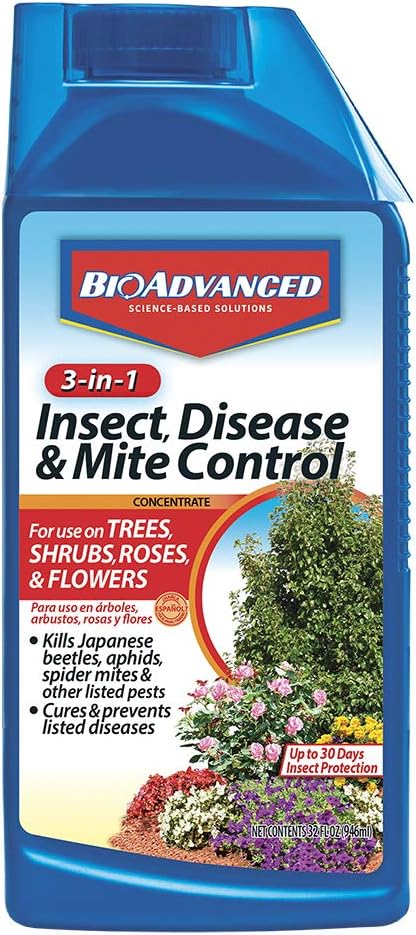
BioAdvanced 3-in-1 Insect, Disease & Mite Control Concentrate, 32 oz
| Unit Count | 32 Fluid Ounces |
|---|---|
| Item Type Name | Concentrate |
| Liquid Volume | 32 fluid ounces |
| Active Ingredients | Imidacloprid, Tau-fluvalinate, Tebuconazole |
| Specification Met | EPA |
This BioAdvanced concentrate is designed as an all-purpose plant treatment that kills listed insects on contact, controls common fungal diseases, and suppresses spider mites in one product. You mix the concentrate with water to make spray solution (it yields up to about 12 gallons), then apply to roses, flowers, shrubs, trees, and other ornamentals. Key active ingredients—imidacloprid, tau-fluvalinate, and tebuconazole—deliver systemic, rainproof protection that the label says can last up to 30 days. For mite control specifically, the miticide component gives both suppression and residual activity, so it is useful for follow-up sprays during an outbreak. Practical benefits include fewer separate products to buy and the convenience of treating multiple problems with one application. Important limitations are regulatory restrictions that make it unavailable in several states and the need to follow label safety precautions because it contains systemic insecticide active ingredients that can affect non-target insects if misused.
Best for: Gardeners who want a single, practical product to manage insect pests, fungal diseases, and spider mites on roses and ornamentals and who prefer a preventive residual treatment.
Less Ideal for: Organic gardeners or those managing pollinator-attractive plantings who avoid systemic insecticides should choose non-systemic or organic miticide and fungicide options instead.
- Combines insecticide, fungicide, and miticide in one concentrate for fewer products to store and apply
- Systemic formulation with rainproof protection that can last up to 30 days after application
- Makes up to 12 gallons of spray from a 32 fl oz bottle, suitable for treating multiple plants or repeat applications
- Active ingredients target a broad list of pests including aphids, spider mites, Japanese beetles and common foliar diseases
- Not available for sale in several U.S. states, limiting where it can be used
- Contains systemic insecticides that require careful adherence to label directions to avoid harming beneficial insects
Verdict: If you want one dependable product to both kill spider mites and prevent common foliar diseases across roses and ornamentals, this 3-in-1 concentrate simplifies treatment with a month-long systemic residual.
Atticus Talak 7.9% Bifenthrin Indoor/Outdoor Insecticide Concentrate, 32 oz

| Active Ingredient | Bifenthrin |
|---|---|
| Formulation | Suspension Concentrate |
| Liquid Volume | 32 fluid ounces |
| Length of Control | Up to three months |
| Target Species | Insects |
Talak 7.9% is a liquid concentrate for treating lawns, landscaping, outdoor living areas and indoor perimeter spots like baseboards and cabinets. You dilute the concentrate with water to create a spray for barrier treatments, spot applications or lawn mixes; label rates explain how much to mix per gallon depending on the use. The product uses bifenthrin, a proven broad-spectrum active ingredient, and the manufacturer states it controls over 75 species and can give residual control for as long as three months. Its water-based formula dries clear, leaves no odor or visible residue, and is not phytotoxic on plants when used per label. Practical benefits include flexible indoor and outdoor use, clear drying, and a bottle designed for easier pouring. Important limitations are that solutions should be mixed only for same-day use, it is not registered for sale in a few states, and it is not approved for fogger application, so professional-style misting methods are not appropriate.
Best for: Buyers who want a single, reliable product to protect yards, patios and building perimeters from a wide range of common pests and prefer conservative, label-driven application practices.
Less Ideal for: People seeking ready-to-use sprays or fogger-compatible products or those in states where this formulation is not registered should look at alternatives.
- Broad-spectrum control listed for 75+ indoor and outdoor pest species
- Water-based formula that dries clear and leaves no odor or residue
- Flexible label directions for lawns, landscapes, hardscapes and indoor perimeter treatments
- Long residual activity up to three months when applied at recommended rates
- Mixed spray solutions cannot be stored and must be used the same day
- Not approved for fogger application and not available for sale in some states
Verdict: A versatile, water-based bifenthrin concentrate that delivers long-lasting, broad-spectrum outdoor (and perimeter indoor) control when used according to the label.
BioAdvanced 3-in-1 Insect, Disease & Mite Control Ready-to-Spray, 32 oz

| Item Form | Liquid |
|---|---|
| Target Species | Insect, Disease & Mite |
| Liquid Volume | 32 fluid ounces |
| Active Ingredients | Bifenthrin 0.57% Myclobutanil 0.53% |
This ready-to-spray 3-in-1 formula combines bifenthrin insecticide and myclobutanil fungicide to protect roses, flowers, shrubs, and trees from common pests and diseases. You connect the bottle to a garden hose and apply an even spray that kills listed insects on contact, controls diseases such as black spot and powdery mildew, and suppresses spider mites for up to about 14 days. The convenience of a hose-end applicator makes coverage fast on larger beds and established ornamentals, and the absorbed active ingredients provide a short-term protective barrier so you do not need to re-treat daily. Important limitations are that it is a broad synthetic pesticide formula, so users must follow label directions for safety, avoid using on edible food crops unless specified, and expect nonselective effects on beneficial insects if applied indiscriminately. For gardeners who want a single go-to product to handle insects, fungal problems, and mites on landscape ornamentals, this product simplifies care and reduces the number of separate treatments needed.
Best for: Gardeners who want a single, convenient product to manage common insect pests, fungal diseases, and mites on roses, flowers, shrubs, and landscape plants without mixing concentrates.
Less Ideal for: Growers who prioritize organic methods, home vegetable gardens, or highly targeted biological controls should consider specialized or organic alternatives.
- Combines insecticide, fungicide, and miticide in one ready-to-spray bottle
- Hose-end applicator provides fast, even coverage for shrubs and flower beds
- Active ingredients offer residual protection for up to about 14 days
- Effective against a wide range of listed pests including aphids, whiteflies, and Japanese beetles
- Contains synthetic pesticides that require careful handling and strict adherence to label safety instructions
- Not specified for use on edible food crops which limits use to ornamentals
Verdict: A convenient, ready-to-spray all-in-one solution for gardeners who want broad protection against insects, fungal diseases, and mites on landscape ornamentals.
BioAdvanced 3-in-1 Insect, Disease & Mite Control Spray, 24 fl oz

| Unit Count | 24 Fluid Ounces |
|---|---|
| Item Form | Spray |
| Liquid Volume | 24 fluid ounces |
| Active Ingredients | 0.012% Imidacloprid, 0.014% Tau-fluvalinate, 0.015% Tebuconazole |
| Specification Met | EPA |
This ready-to-use BioAdvanced 3-in-1 spray combines an insecticide, miticide, and fungicide for broad protection on ornamental plants, including orchids listed among similar use sites. It is applied with a trigger sprayer to foliage and blooms, killing aphids, caterpillars, Japanese beetles and controlling spider mites on contact while the systemic components provide rainproof protection for up to 30 days. The inclusion of a fungicide helps manage common diseases such as powdery mildew and black spot, which can benefit orchids prone to fungal problems in humid conditions. Practical benefits are ease of use, multi-target control in one bottle, and coverage for dozens of plants per container. Important limitations are that the formula contains systemic insecticides so it must be used according to label directions and is not allowed for sale in several states, and specific orchid suitability is not detailed on the label so spot-testing on a few plants is prudent before wide application. Expect good short-term control but follow safety and timing guidance for flowering plants.
Best for: Home gardeners who want a single, easy-to-use product to manage common insect pests, mites, and fungal issues on ornamental plants and potted specimens while minimizing application time.
Less Ideal for: Specialist growers who require orchid-specific products or organic/chemical-free controls should consider targeted or softer alternatives tailored to sensitive species.
- Combines insect, mite, and fungal control in one ready-to-use spray for simplified treatment.
- Trigger-spray applicator makes spot and foliar application easy for container and potted plants.
- Systemic, rainproof protection that can last up to 30 days reduces reapplication frequency.
- Covers many common pests on ornamentals including aphids, caterpillars, Japanese beetles, and spider mites.
- Label does not list detailed directions specific to orchids so compatibility with sensitive species is not guaranteed.
- Not available for sale in several states which limits access depending on location.
- Contains multiple active ingredients so users must follow safety precautions and withholding periods for bloom treatments.
Verdict: A convenient all-in-one ready-to-use spray for casual orchid and ornamental growers who want combined insect, mite, and disease control with minimal fuss.
Athena IPM Ready-to-Use Insecticide & Fungicide Spray, 32 fl oz

| Brand | Athena |
|---|---|
| Unit Count | 32 Fluid Ounces |
| EPA Status | 25(b) minimum risk |
| Pest Targets | Spider mites, aphids, thrips |
| Use Type | Ready to use |
Athena IPM is a 32-ounce ready-to-use spray that combines botanical insecticidal and fungicidal action for routine plant protection. It is formulated to kill spider mites, aphids, thrips and contact-treat powdery mildew, so you use it by shaking the bottle and spraying affected leaves, stems, and surrounding foliage. Because it meets EPA 25(b) minimum risk criteria, it is positioned as an eco-friendlier option that can be used around people and pets when directions are followed. The product is versatile for outdoor beds, ornamental plants, vegetables, fruit trees and greenhouse use, and it requires no mixing or special equipment which simplifies regular preventive treatments. Practical limitations are that it is a contact-control product so it works best on visible infestations and vulnerable life stages rather than as a long-lasting residual solution, and repeated applications may be required for complete control of heavy infestations. Follow safety guidance for storage and keep away from children and pets while applying.
Best for: Gardeners and plant stewards who prioritize dependable, easy-to-use pest and mildew control and prefer lower-toxicity, ready-made solutions for routine outdoor plant care.
Less Ideal for: Anyone needing a long-lasting residual insecticide or rapid systemic control for severe, established infestations should consider professional or stronger systemic products.
- Ready-to-use formula requires no measuring or mixing
- Broad-spectrum action against common pests and powdery mildew on contact
- EPA 25(b) minimum risk ingredients for reduced chemical exposure when used as directed
- Suitable for a wide range of plant settings including gardens, greenhouses, and hydroponics
- Contact-only action provides limited residual control against re-infestation
- May require multiple applications for heavy or established pest problems
Verdict: A simple, lower-toxicity ready-to-use spray that reliably handles common outdoor plant pests and powdery mildew for gardeners who want straightforward, repeatable protection.
Bonide Captain Jack's Ready-to-Use Neem Oil Spray, 32 oz

| Item Form | Liquid |
|---|---|
| Target Species | Insects |
| Liquid Volume | 32 fluid ounces |
| Active Ingredients | Clarified Hydrophobic Extract of Neem Oil |
This ready-to-use neem oil spray is a multipurpose garden treatment that kills insects at all life stages while also serving as a miticide and preventative fungicide. Packaged in a 32-ounce trigger bottle, it is applied by shaking and thoroughly spraying plant surfaces, including leaf undersides, at the first sign of pests or disease and reapplying every 7 to 14 days as needed. The active ingredient is a clarified hydrophobic extract of neem oil, which is approved for organic gardening and labeled safe to use on vegetables up to the day of harvest. Practical benefits include broad pest coverage (aphids, whiteflies, spider mites and others), disease suppression such as powdery mildew, and convenience from a ready-to-use sprayer. Important limitations are that results are slower than synthetic contact insecticides and application timing matters to avoid leaf burn in full sun; repeated applications may be needed for heavy infestations. Follow label safety directions and keep the product away from children and pets.
Best for: Gardeners who want a single, organic-approved product to manage common vegetable garden pests and fungal problems and who prefer products with strong user feedback.
Less Ideal for: Growers needing rapid knockdown of severe infestations or commercial producers who require fast-acting, high-throughput treatments.
- Kills multiple pest stages including eggs, larvae and adults for more complete control.
- Also acts as a fungicide and miticide so one product covers pests and common fungal issues.
- Ready-to-use trigger bottle requires no mixing and is easy to apply to leaves and undersides.
- Approved for organic gardening and can be used on vegetables up to day of harvest.
- Slower-acting than many synthetic contact insecticides, so it may take several applications to see control.
- Must avoid spraying in peak sunlight to reduce risk of leaf burn.
Verdict: A convenient, organic-approved all-in-one neem spray that controls common vegetable garden pests and fungal issues with minimal fuss.
Ortho Home Defense Insect Killer for Indoor & Perimeter, 1.33 gal. with Comfort Wand

| Item Form | Spray |
|---|---|
| Target Species | Insects |
| Liquid Volume | 1.33 gallons |
| Active Ingredients | Bifenthrin 0.05%, Zeta-Cypermethrin 0.0125% |
This 1.33 gallon Ortho Home Defense spray is designed to treat both indoor problem spots and the outdoor perimeter of a home to reduce ants, roaches, spiders and many other crawling and flying insects. It comes with a battery-powered Comfort Wand that delivers a continuous spray so you can apply a uniform band around foundations, patios and entry points without bending or pumping. The formula with bifenthrin and zeta-cypermethrin is intended to kill on contact and establish a barrier that the manufacturer says lasts up to 12 months for ants, roaches and spiders on non-porous indoor surfaces. In real-world use that means fewer repeat treatments in busy yard perimeters and around doors and windows. The spray dries clear with minimal fumes which helps for indoor use near kitchens and living areas. Limitations are that this is a chemical insecticide so users should follow safety directions around children, pets and plants and it is not a specific solution for pests not listed on the label. For homeowners focused on strong, perimeter-level protection this product simplifies application and covers a large area per container.
Best for: Homeowners who want a performance-focused perimeter treatment to reduce recurring yard and entry-point insect problems and prefer a ready-to-use product that is easy to apply.
Less Ideal for: People seeking organic or non-chemical control methods or those who need a targeted solution for pests not listed on the label should consider alternative products.
- Includes battery-powered Comfort Wand for continuous, fatigue-free application
- Ready-to-use 1.33 gallon container covers large perimeters without mixing
- Formula creates a barrier claimed to provide up to 12 months protection against ants, roaches and spiders on non-porous indoor surfaces
- Dries clear and gives off minimal fumes, making indoor use more practical
- Contains synthetic insecticides so precautions are required around children, pets and ornamentals
- Protection claims are specific to certain species and surfaces so results vary by pest and conditions
Verdict: A powerful, ready-to-use perimeter and indoor spray for homeowners who want long-lasting, performance-oriented protection against common yard and household insects.
Choosing the Right Insecticide for Outdoor Plants: Key Factors to Consider
Pest Target and Mode of Action
Different insecticides work in different ways: contact, stomach poison, systemic uptake, or growth regulators. Knowing the pests you need to control matters because a contact spray may only work on visible insects at the time of application, while a systemic product taken up by roots or leaves can protect new growth. Mode of action also affects resistance management. Rotating between different modes of action over a season reduces the chance that pest populations become tolerant.
Match the product's labeled target list to the pests you see. For broad-spectrum outbreaks you may want a product with wide coverage, but for specific pests such as scale, caterpillars, or aphids a targeted mode of action can be more effective and less disruptive to beneficial insects.
Plant Safety and Phytotoxicity
Outdoor plants vary in sensitivity to chemicals. Young foliage, newly planted specimens, or heat-stressed plants can be more prone to burning or leaf spotting after application. Always check that the insecticide is labeled for the kinds of ornamentals, vegetables, or shrubs you grow, and note any temperature or timing restrictions.
Avoid applying during midday heat or drought stress, and if treating edibles, observe the pre-harvest interval. Some formulations are safe for flowers but not for edible leaves, while others are labeled for both. Plant safety influences where and when you can safely use a product without harming growth or bloom.
Pollinator and Beneficial Insect Impact
Garden ecosystems depend on pollinators and predatory insects to keep pests in check. Broad-spectrum insecticides can kill bees, ladybugs, lacewings, and parasitic wasps, causing pest rebounds later. Consider products and application methods that reduce contact with blooms and avoid spraying during peak pollinator activity.
If pollinator safety is a priority, choose targeted products, apply to nonflowering parts, or schedule treatments for early morning or evening when bees are less active. Some insecticides have lower toxicity to beneficials, and labels often include guidance to minimize non-target exposure.
Residual Activity and Reapplication Interval
Residual activity determines how long a single application provides control and affects labor and timing. Short-residual contact sprays may require frequent reapplication during heavy infestations, while systemic or longer-residual products can protect new growth for weeks. However, longer persistence can increase exposure risk to non-target organisms and may limit use on crops nearing harvest.
Balance the convenience of longer residual control against safety and rotation needs. For seasonal pests, plan applications so residues decline before bloom or harvest when necessary.
Application Method and Ease
Different formulations-ready-to-use sprays, concentrates, granules, or soil drenches-fit different gardening situations. Sprays give foliar coverage for visible pests, soil drenches and systemic treatments protect from root uptake, and granules can be easier for large beds. Consider how comfortable you are with mixing concentrates, whether you prefer hose-end applicators, and how precise the product needs to be to avoid drift onto desirable plants.
Ease of application affects not only time but also accuracy and safety. If you have many containers or tight shrub borders, a targeted spray or drench that minimizes overspray can be preferable.
Label Restrictions and Edible Use
If you grow food, label directions determine what you can legally and safely apply. Labels specify which crops are listed, the pre-harvest interval, and maximum application frequency. Some insecticides are labeled for ornamental use only and should not be applied to vegetables or herbs.
Reading the label prevents misuse and potential crop residue issues. Choose products with clear, short pre-harvest intervals for vegetables or choose ornamental-only products for nonedible plantings to avoid complications.
When to Use Spot Treatments Versus Area Applications
Small infestations on a single plant often respond best to spot treatments. Spraying only the affected leaves or branches limits exposure to beneficial insects and reduces the total amount of product used. Spot treatments are ideal for isolated aphid colonies, small caterpillar patches, or scale on a single shrub.
For larger outbreaks across beds or when pests are widespread and actively feeding, area applications may be more practical. Use a method that provides even coverage while following label directions to minimize drift and non-target exposure. Factor in bloom timing and pollinator activity when scheduling broader sprays.
- Spot treatments minimize non-target exposure
- Area applications are more efficient for widespread infestations
- Time area treatments to avoid blooms and pollinator activity
Integrating Insecticide Use with Cultural Controls
Effective pest control in outdoor plants is rarely just a chemical fix. Combine insecticide use with cultural practices like proper watering, soil feeding, and pruning to reduce stress that attracts pests. Removing heavily infested foliage and encouraging air circulation can lower pest pressure and reduce the number of treatments needed.
Encourage beneficial insects by planting companion blooms and providing habitat. When insecticides are necessary, use the least disruptive option and apply at times that minimize impact on predators and pollinators.
- Prune and remove infested material
- Maintain plant vigor to resist pests
- Use habitat plantings for beneficial insects
Timing Applications to Life Stages
Many insecticides target specific life stages. For example, products that affect larvae or young nymphs are most effective when applied early in an outbreak before heavy adult populations build. Likewise, contact sprays are most useful when insects are exposed on foliage rather than sheltered in buds or soil.
Monitor plants regularly to catch early feeding and time treatments for vulnerable stages. Using traps, sticky cards, or simple visual checks helps you apply treatments when they will have the greatest effect with the least number of repeats.
- Target vulnerable life stages for greater efficacy
- Regular monitoring reduces unnecessary applications
- Pair treatment timing with weather and plant phenology
Protecting Pollinators While Controlling Pests
Protecting pollinators is important in any outdoor planting. Avoid applying insecticides when plants are in bloom and during mid-day when pollinator activity peaks. Select products that are less toxic to bees or that have application methods limiting direct contact with flowers.
If you must treat flowering plants, opt for targeted stem and foliage applications, treat in the evening after bees have finished foraging, and consider using mechanical removal where feasible. Label guidance often includes specific steps to minimize pollinator exposure.
- Avoid spraying during bloom and peak pollinator hours
- Choose reduced-risk formulations when possible
- Apply to nonflowering parts or during evening hours
Using Systemics Safely in Mixed Plantings
Systemic insecticides taken up by roots or leaves can protect new growth but may also translocate into nectar and pollen. In mixed plantings that include ornamentals and edibles, choose systemic products only when labeled for all intended plant types and when the timing minimizes exposure to pollinators and harvest windows.
When using systemics, follow label rates closely and avoid overapplication. Consider targeted drench applications rather than widespread soil treatment in beds with flowering plants to reduce non-target exposure.
- Confirm label allowances for edibles and ornamentals
- Prefer targeted drenches over blanket soil treatments in mixed beds
- Observe pre-harvest intervals for edible crops
How We Chose the Best Insecticide for Outdoor Plants
Our shortlist focuses on insecticides that are practical for home gardeners managing pests on outdoor plants. We applied several concrete filters: mode of action and target pest spectrum, demonstrated plant safety across common ornamentals and edibles, application flexibility for spray or soil use, persistence and reapplication interval, and non-target risk including pollinators and beneficial insects. We prioritized products with clear directions for common garden pests and those that can be used in multiple outdoor contexts such as beds, borders, containers, and shrubs. Exclusions: we omitted products intended only for indoor houseplants, treatments designed solely for turf or structural pest control, and formulations lacking clear use directions for edible plants when labeled for such use. The goal was to highlight options that give reliable control while letting gardeners limit harm to desirable insects and avoid phytotoxic reactions.
FAQ
How soon will an insecticide start working on outdoor plants?
Effect timing depends on mode of action. Contact sprays can reduce visible insects within hours but offer little protection for new growth. Systemic products may take several days to move through plant tissue but will protect emerging foliage for longer periods.
Can I use the same insecticide on flowers and vegetables?
It depends on the label. Some products are labeled for both ornamentals and edible crops with specified pre-harvest intervals. Others are ornamental-only and should not be used on food plants. Always follow label directions to ensure safe use.
Will frequent use of one insecticide cause resistance?
Yes. Repeated use of an insecticide with the same mode of action can select for tolerant pest populations. Rotate among products with different modes of action and integrate nonchemical controls to slow resistance development.
Are natural or organic insecticides always safer for beneficial insects?
Not always. Some botanical or organic options can still be broad-spectrum and harmful to beneficials if applied indiscriminately. Safety depends on formulation, application timing, and where on the plant you spray.
How do I avoid burning plants when applying insecticide?
Avoid spraying during high heat or drought stress, follow label dilution rates, and perform a small patch test on a few leaves if you are unsure about plant sensitivity. Do not mix more than labeled concentrations and wait the recommended interval after fertilizing or pruning.
Can I treat pests without harming pollinators?
Often yes. Use targeted applications, avoid blooming parts, treat during low pollinator activity times, and choose products with lower toxicity to bees. Cultural controls and spot treatments also reduce the need for blanket sprays.
Final Verdict
Choose insecticides based on the pests you face, the plants you grow, and the level of risk you are willing to accept for pollinators and beneficial insects. Prioritize products that match the target pest and life stage, and factor in plant sensitivity and pre-harvest rules if you grow edibles. Integrate chemical control with cultural measures and rotate modes of action to maintain effectiveness. With careful selection and timing, you can control pests while protecting plant health and the garden ecosystem.
