

Note: This article contains affiliate links. If you click on these links and make a purchase, I may earn a small commission at no extra cost to you. This helps support my research and content. Read my full affiliate disclosure here.
If snails are chewing holes in your seedlings, ornamentals, or vegetables, picking the right insecticide for snails changes how quickly you recover plant vigor and reduce feeding damage. You need a product that targets gastropods effectively while fitting your planting situation, whether in raised beds, container gardens, or dense flower borders. This guide shortlists the top options for controlling snails and explains how we evaluated each pick for knockdown speed, residual protection, application ease, and safety around desirable plants and wildlife. Read on to understand the tradeoffs so you can choose the control method that matches your garden layout and tolerance for chemical or bait approaches.
Top Picks at a Glance
| Best Overall The best all-around choice for most situations | Corry's Slug and Snail Killer Bait, 3.5 lb |  |
| Best Quality Built to a higher standard if you want something more solid | Monterey Sluggo Slug & Snail Killer, 2.5 lb |  |
| Best Value The sweet spot between price and what you get | Ortho Bug-Geta Snail & Slug Killer (1 oz) |  |
| Best Budget The cheapest option that still gets the job done reliably | Corry's Slug and Snail Killer Pellets, 1.75 lb |  |
| Highest Rated A top-rated pick with lots of positive feedback | Monterey Sluggo Maxx Slug and Snail Killer, 10 lb |  |
| Most Popular A crowd favorite that many people choose with confidence | Garden Safe Slug & Snail Bait Granules, 2 lb |  |
Corry's Slug and Snail Killer Bait, 3.5 lb

| Unit Count | 56 Ounce |
|---|---|
| Item Form | Granules |
| Active Ingredients | ferric edta |
| Specification Met | USDA |
Corry's Slug and Snail Killer is a granular bait that uses ferric EDTA to control slugs and snails within a few days while allowing people and pets back into treated areas immediately. You apply the granules around susceptible plants in the morning or evening, scattering a light barrier on soil near plants you want to protect. The formula is labeled for use on lawns, ornamentals and vegetable or fruit gardens and is stated to remain effective after rain, which reduces the need for repeat applications after wet weather. Practical benefits include a low-restriction active ingredient that can be used up to harvest and straightforward application with no special equipment. Limitations are that it is a contact/ingestion bait so effectiveness depends on pest feeding activity and placement, and granules can be less tidy than contained baits in windy or high-traffic spots. Follow label safety directions to avoid eye irritation and wash hands after handling.
Best for: Gardeners who want a straightforward, low-restriction bait that protects lawns, ornamentals and edibles without complicated application steps.
Less Ideal for: People wanting a non-bait physical barrier or deterrent method or those who prefer contained, tamper-resistant bait stations for high-pet households.
- Contains ferric EDTA effective against slugs and snails with results in 3 to 6 days
- Approved for use in vegetable and fruit gardens including up to the day of harvest
- Remains effective after rain, reducing reapplication after wet weather
- Ready-to-use granules that are easy to scatter without special equipment
- Granular form can be messy in windy conditions or where pets and children play
- Depends on pests finding and ingesting the bait so placement is critical
Verdict: A practical, low-restriction granular bait that gives reliable slug and snail control for mixed home gardens and lawns.
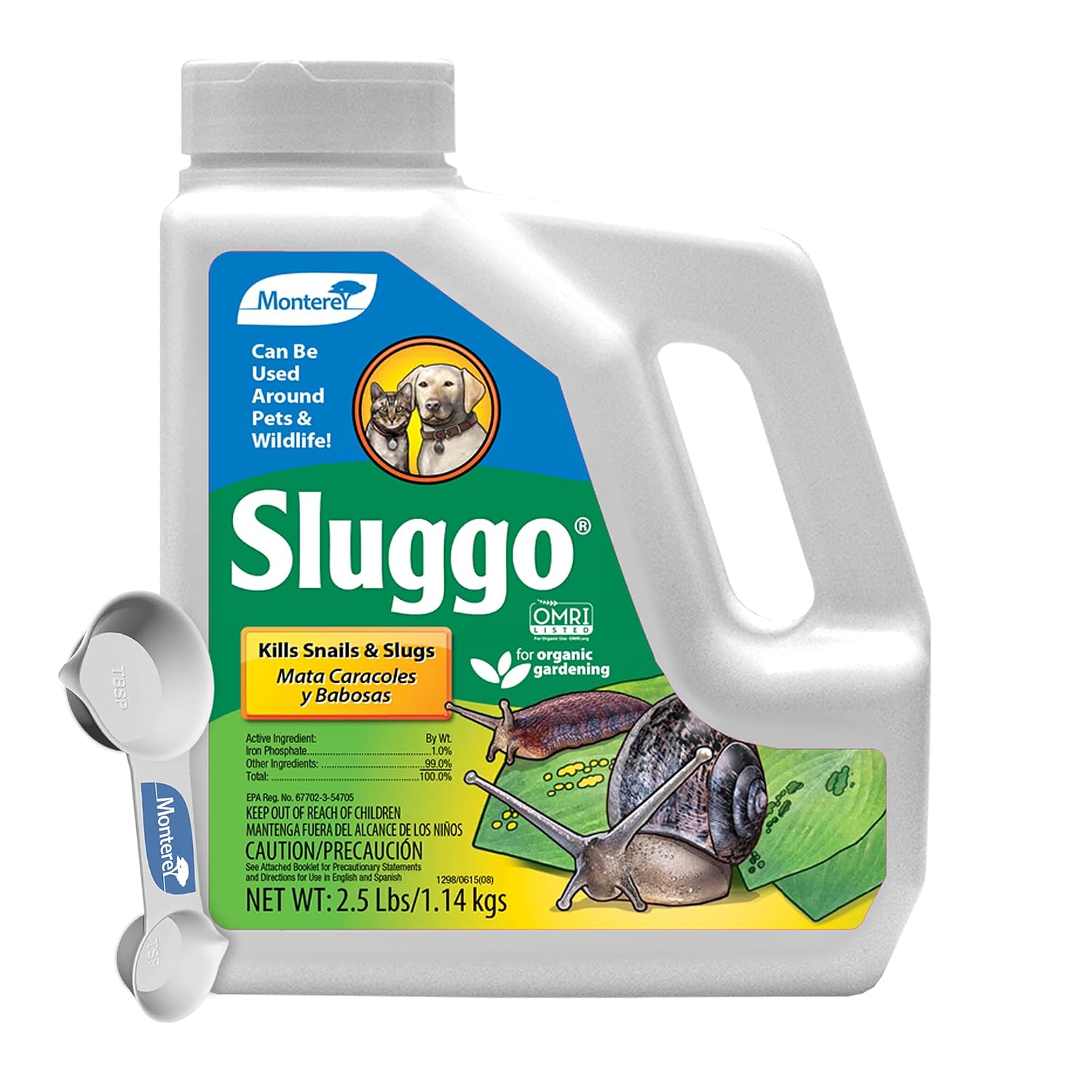
Monterey Sluggo Slug & Snail Killer, 2.5 lb
| Unit Count | 40 Ounce |
|---|---|
| Item Form | Powder |
| Target Species | Slug |
| Liquid Volume | 1.13 kg |
Sluggo uses an iron phosphate active ingredient in a granular form to attract and control slugs and snails without toxic metals. You spread the granules around vulnerable plants, in garden beds, or with a broadcast spreader for larger areas; slugs consume the bait and stop feeding within a short time so plants are protected. Notable features include OMRI listing for organic gardening, pet and wildlife friendly formulation, and resistance to normal rainfall so effectiveness lasts until heavy wash-off. Practical benefits are straightforward: it is safe to use around ornamentals, vegetables, berries and in greenhouses, and the granular form makes spot treatments and perimeter protection simple. Important limitations are that control can be slower than metal-based baits so you may need repeat applications for heavy infestations and very heavy rainfall requires reapplication to restore coverage.
Best for: Gardeners who prioritize effective, low-toxicity control and need a product that fits organic practices and safe use around pets and wildlife.
Less Ideal for: Those who need immediate extermination of very large slug populations or want the fastest chemical knockdown available should consider alternative, faster-acting products.
- OMRI listed and safe for organic use around edible plants
- Granular formula works with spreaders for quick coverage of larger areas
- Contains iron phosphate which is wildlife and pet friendly
- Resists normal rain so bait remains effective until heavy wash-off
- Slower knockdown than metal-based baits so multiple applications may be needed
- May require reapplication after heavy rain to maintain protection
Verdict: Choose Monterey Sluggo when you want reliable, pet- and wildlife-friendly slug control that fits organic gardening and scales from spot treatments to larger beds.
Ortho Bug-Geta Snail & Slug Killer (1 oz)

| Unit Count | 1 Ounce |
|---|---|
| Item Form | Spray |
| Target Species | Insects |
| Active Ingredient | 1.0% Sulfur |
Ortho Bug-Geta is a small, ready-to-use snail and slug bait formulated with sulfur that attracts and kills slugs and snails over one to three days after ingestion. Home gardeners typically scatter the granular bait around vulnerable plants in the evening when these pests are active, reapplying as pellets are consumed or at least every three weeks. Notable features include its OMRI listing for organic use, stated safety for use around pets and wildlife when label directions are followed, and resistance to light rain for about three weeks so you do not need to reapply immediately after sprinkling. The product works discreetly because dead pests often crawl away, reducing visible mess in beds and containers. Limitations are the small unit count and that it is a bait rather than a contact control, so severe infestations may require heavier or more frequent applications or complementary controls; it also relies on pests finding and eating the pellets, so placement and timing matter. For gardeners who prefer low-prep, label-directed pest control, this bait is an easy-to-use option for protecting vegetables, ornamentals, and fruiting plants.
Best for: Gardeners who want a low-effort, organic-compatible bait to protect vegetable beds, ornamentals, and fruit trees and who prioritize simple, label-directed pest control.
Less Ideal for: Large-scale growers or gardeners facing severe slug and snail outbreaks who need high-volume or immediate contact control should consider broadcast treatments or integrated approaches.
- OMRI listed for organic use which allows use around many edible plants when label directions are followed
- Granular bait remains effective after light rain or sprinkling for up to three weeks
- Ready-to-use formulation requires no mixing or spraying and is simple to apply in the evening
- Targets a wide variety of slugs and snails and begins killing within one to three days
- Small unit count may require multiple purchases for larger gardens or heavy infestations
- Effectiveness depends on slugs and snails finding and ingesting the bait, so strategic placement is required
Verdict: A ready-to-use, OMRI-listed bait that provides simple, rain-resistant protection for gardens against slugs and snails.
Corry's Slug and Snail Killer Pellets, 1.75 lb

| Item Form | Pellets |
|---|---|
| Target Species | Insects |
| Item Weight | 1.8 pounds |
Corry's slug and snail killer is a simple pellet bait designed to attract and kill slugs and snails within a few days. You scatter the pellets around plants or on soil in the morning or evening, and pests consume the bait then retreat to hide and die, which helps reduce visible slug activity. The formula is labeled for use on lawns, ornamentals, fruit and vegetable gardens and is cleared for use up to and including day of harvest in edible gardens. It is moisture-tolerant so it keeps working after rain, and the manufacturer states people and pets may enter treated areas immediately, which makes it convenient for busy gardeners. The product comes in a modest 1.75 pound container that suits smaller beds or spot treatments. Limitations to expect are that pellets must be reapplied after heavy disturbance or if you need season-long protection and that bait efficacy depends on slugs actually feeding on it, so placement matters. Follow label safety directions to avoid eye or skin contact while handling.
Best for: Gardeners on a budget who need a straightforward, labeled bait for spot-treating slugs and snails in small lawns, beds or vegetable patches and who prefer a product that can be used up to harvest day.
Less Ideal for: Large properties or gardeners seeking a long-season automated control solution should consider higher-capacity or integrated options instead.
- Effective pellet bait that kills slugs and snails within 3 to 6 days
- Labeled for use in lawns, ornamentals and edible gardens including day-of-harvest use
- Remains effective after rain so moisture does not immediately reduce performance
- Safe to re-enter treated areas immediately for people and pets when used as directed
- Small 1.75 lb package may require multiple purchases for larger gardens or repeated treatments
- Requires careful placement and occasional reapplication for ongoing control
Verdict: A compact, affordable pellet bait that provides fast, rain-resistant slug and snail control for small gardens and spot treatments.
Monterey Sluggo Maxx Slug and Snail Killer, 10 lb

| Ingredients | Iron Phosphate (3.0%) |
|---|---|
| Weight | 10 lb |
| OMRI Listed | Yes |
| Water Resistance | Remains effective after rain or sprinkling |
Monterey Sluggo Maxx is a concentrated iron phosphate bait designed to control slugs and snails across large areas. Applied as granular bait around vulnerable plants, it delivers a 3.0% iron phosphate formula that the manufacturer says is roughly three times stronger than standard 1% products, so you can expect quicker reductions in slug activity. The granules are water resistant, so they retain effectiveness after rain or irrigation and reduce the need for immediate reapplication. It is OMRI listed for organic gardening and labeled safe to use around pets, wildlife, and edible crops when used as directed, which makes it suitable for vegetable beds, ornamentals, lawns, and greenhouses. The product claims high coverage per pound, letting a single container treat a large area, which helps keep labor and repeat purchases down. Limitations to note are that it still relies on correct placement to intercept pests and that effectiveness depends on slug pressure and environmental conditions rather than being an instant fix.
Best for: Gardeners and landscapers who prioritize dependable, long‑lasting slug control and want a product that is safe to use around edibles and pets while covering large areas efficiently.
Less Ideal for: People who need immediate knockdown of heavy infestations or who prefer non‑bait mechanical controls like traps or barriers.
- Higher concentration iron phosphate formula for faster control than standard 1% baits
- Water-resistant granules remain effective after rain or sprinkler events
- OMRI listed and labeled safe for use around edible crops, pets, and wildlife when used as directed
- High coverage per pound reduces frequency of reapplication and treats large areas
- Performance still depends on correct bait placement and local slug pressure
- Not an instant kill; results occur over days as slugs feed and stop damaging plants
Verdict: Choose Sluggo Maxx when you want a reliable, pet‑ and edible‑safe iron phosphate bait that covers large areas and holds up after rain.
Garden Safe Slug & Snail Bait Granules, 2 lb

| Item Form | Granules |
|---|---|
| Included Components | Slug & Snail Bait, 2 lb |
| Item Type Name | Slug and Snail |
Garden Safe Slug & Snail Bait uses iron phosphate granules to control slugs and snails in lawns, vegetable beds, ornamentals and greenhouses. Scatter the granules in the evening or early morning where slugs travel, avoid application if rain is expected within 24 hours, and reapply as directed. The active iron phosphate is a common garden nutrient so the product is labeled for use around pets, wildlife and edible plants when used according to instructions, and pests typically stop feeding and die within three to six days. Practical benefits include easy broadcast application, compatibility with organic gardens, and minimal risk to birds or mammals compared with metaldehyde baits. Limitations are that results are not instant and repeated applications may be needed during heavy infestations or wet weather, and the bait can wash away if applied before rain or on steep slopes.
Best for: Buyers who want a low-toxicity, pet- and wildlife-friendly bait with established user acceptance for routine slug and snail control in edible and ornamental plantings.
Less Ideal for: People needing instant elimination for extreme infestations or a bait suitable for aquatic or heavily rainy sites should consider different control methods.
- Uses iron phosphate which is accepted for use around pets and wildlife when label directions are followed
- Designed for use on lawns, vegetable gardens, ornamentals and greenhouses
- Granular form is easy to scatter for spot treatments or larger areas
- Kills slugs and snails within three to six days after ingestion
- Not an immediate knockdown; pests stop feeding and die over several days
- Can be washed or blown away if applied before rain or windy conditions
Verdict: A practical low-toxicity granular bait for gardeners who prioritize safety around pets and edible plants while controlling slugs and snails.
Choosing the Right Insecticide for Snails: Key Factors to Consider
Mode of Action and Target Specificity
How an insecticide affects snails determines both effectiveness and non-target risk. Some products rely on metal-based active ingredients that cause mortality after ingestion, while others use biological or botanical agents that interfere with snail feeding or physiology. A formulation that is specific to gastropods reduces unintended harm to pollinators and other beneficial invertebrates. Labels that clearly state gastropod-specific activity and directions for minimizing exposure to non-target species make it easier to use a product responsibly.
Understanding mode of action also helps you vary tactics if snails become persistent. Alternating between different control modes can reduce reliance on a single mechanism and limit environmental buildup. Reading and following label precautions is essential for safe, effective control.
Speed of Control Vs Residual Protection
Some insecticides produce fast visible results, killing or immobilizing snails within hours. Fast knockdown is useful when you need immediate protection for vulnerable transplants or tender young plants. Other products provide longer residual protection, reducing the need for reapplication but possibly requiring pre-emptive placement or coverage. Longer residuals are helpful in areas where snails are repeatedly active, such as damp low spots or under dense mulch.
Choose based on the garden situation: for small outbreaks, a fast-acting option may be enough; for chronic pressure, prioritize longer-lasting formulations while observing label reapplication intervals.
Application Method and Garden Fit
Insecticides for snails come in baits, granules, pellets, concentrates, and sprays. Baits and pellets are easy to place around plants and are convenient for spot treatment in beds or containers. Liquid concentrates or sprays can be useful for broad coverage but may be harder to apply precisely without contacting desirable plants. Consider whether you need hand-placed stations for targeted control or a formulation that tolerates light rainfall if you cannot reapply immediately.
Your chosen method should suit the scale of the problem and the layout of your garden. For tight spaces like pots or tiered planters, small, low-drift application options are often preferable.
Safety Around Plants, Pets, and Beneficials
Gardeners must balance effective snail control with safety for pets, children, and beneficial wildlife. Some active ingredients pose higher acute risks if ingested by pets or wildlife, while others are less toxic when used according to label directions. Consider whether treated areas are accessible to pets and whether pollinator activity is high during treatment periods.
Label guidance will indicate safe use near edible crops and pre-harvest intervals. If you keep poultry or have gardens close to wildlife corridors, favor options with lower non-target impacts and take extra care to place bait away from non-target access.
Environmental Conditions and Weather Sensitivity
Moisture and temperature strongly influence both snail activity and product performance. Many treatments work best when the soil surface is moist and snails are active at night and early morning. Heavy rain soon after application can wash away baits or reduce efficacy of topically applied sprays, while very dry conditions can limit snail movement and bait uptake.
Plan applications for cool, damp periods and check reapplication guidance after rain. Select weather-resistant formulations if you expect frequent precipitation or if irrigation practices cannot be altered.
Residue Concerns and Pre-Harvest Intervals
If you are treating vegetable beds or herbs, pay close attention to labeled pre-harvest intervals and allowable uses on edible crops. Some products are cleared for use around fruits and vegetables with short withholding periods, while others are restricted to ornamental plantings.
Following these restrictions prevents crop contamination and ensures food safety. For container-grown herbs and salad greens, choose treatments explicitly permitted for edible use or use physical control methods to avoid residues.
When to Use Baits Versus Sprays
Baits are the most common homeowner approach to snail control because they attract feeding snails and concentrate the active ingredient where snails encounter it. They are suitable for spot treatments around seedlings, low-growing vegetables, and ornamental beds where you can place bait away from non-target access.
Sprays or drench applications can cover larger areas and are useful when snails are widespread across a lawn or a large border. However, sprays often require more careful application to avoid contact with desirable plants and may be more affected by rain. Match the method to your garden scale and the level of snail pressure.
- Use baits for targeted, low-impact control in beds and containers.
- Choose sprays for broad infestations but protect blooms and foliage.
- Place bait stations in shady, moist spots where snails travel.
Integrating Nonchemical Controls
Insecticide use works best as part of an integrated approach. Physical barriers such as copper tape, diurnal hand-picking, and habitat modification reduce shelter and moisture where snails thrive. Removing hiding places like boards, dense groundcover, and excessive mulch limits daytime refuges and lowers overnight populations.
Combine habitat changes with targeted treatments to reduce the amount of product needed and to lengthen the interval between applications. A monitoring routine early in the season helps catch populations before they become severe.
- Inspect plants at dusk and dawn to remove snails by hand.
- Use barriers around pots and raised beds to deter movement.
- Reduce dense groundcover and keep bed edges clear to improve airflow.
Safe Placement and Timing
Timing applications for cooler, damp parts of the day increases bait uptake because snails are most active then. Avoid placing baits or granules on highly exposed sunny surfaces where they dry out quickly and become unattractive to snails.
Place bait stations where pets and wildlife cannot easily access them. For edible crops, follow labeled intervals before harvesting and consider using bait stations to limit contact with produce.
- Apply treatments in the evening or early morning when snails feed.
- Protect baits from rain with small shelters if heavy showers are expected.
- Avoid direct placement on edible leaves; use tray placement near plants instead.
Managing Resistance and Long-Term Control
Repeated reliance on a single active ingredient can reduce long-term effectiveness. Rotate between control modes if product labels allow different active ingredients with distinct modes of action. Keep records of what you apply and when so you can switch strategies if control seems to decline.
Long-term control also depends on reducing habitat suitability. Improve drainage, thin dense plantings, and limit nighttime irrigation to make the area less attractive to snails. Over time, combining cultural controls with targeted treatments will reduce overall product use.
- Alternate modes of action when practical and permitted.
- Record application dates and observed results for future planning.
- Focus on habitat modification to lower recurring pressure.
Using Treatments Around Edibles and Containers
When treating vegetable beds and container-grown herbs, prioritize products labeled safe for edible crops and follow all harvesting restrictions. Spot treatments and bait stations placed away from direct crop contact can reduce residue risk while still protecting plants.
For containers, consider barriers and manual removal first. If using baits, place them at the edge of the pot or under saucers to limit direct contact with the soil surface where roots and leaves are harvested.
- Check label permissions for edible uses and pre-harvest intervals.
- Prefer targeted placement over broadcast applications near food crops.
- Use small bait stations in containers rather than scattering granules.
How We Chose the Best Insecticide for Snails
We focused on products and formulations that are suited to targeting snails in typical garden settings. Our evaluation filtered for options explicitly labeled for gastropod control and for formulations gardeners commonly use in beds, borders, and containers. We prioritized demonstrable control metrics such as rapid mortality after exposure and meaningful residual protection between applications. Safety around non-target plants, pets, and beneficial organisms was another core filter, along with ease of application for homeowners using hand-applied baits, granules, or liquid treatments. Excluded items included products not registered for garden use against snails, broad-spectrum insect controls without gastropod claims, and methods that require specialized commercial equipment. We also considered formulation suitability for different garden situations, weather sensitivity, and clarity of label directions. The dimensions we used to judge each candidate align with the scoring criteria below: snail knockdown speed, residual control duration, plant and pollinator safety, and application convenience.
FAQ
Are insecticides the only effective option for snail control?
No. Insecticides can be very effective, but integrated approaches that include hand removal, barriers, habitat modification, and targeted baits provide strong control with less product use. Combining methods often gives more consistent, long-term reduction.
How soon will I see results after applying a snail insecticide?
Results vary by product and formulation. Some bait-based treatments cause snail mortality within hours to a day, while others may take longer as snails must feed and return to shelters. Residual formulations may take effect more slowly but protect for longer periods.
Is it safe to use snail insecticides in vegetable gardens?
Some products are labeled for use around edibles with specific pre-harvest intervals. Always follow label directions and use targeted placement to minimize residue on crops. If you have concerns, consider nonchemical controls or treatments explicitly cleared for edible use.
Will rain wash away baits or reduce effectiveness?
Heavy rain can reduce the effectiveness of surface baits and some sprays by dispersing or diluting the active ingredient. Place baits in protected locations or reapply according to label guidance after substantial rainfall to maintain control.
How should I protect pets and wildlife when using snail treatments?
Use bait stations or place baits out of reach of pets and wildlife, and follow label instructions on placement and storage. Consider options with lower non-target toxicity and avoid broadcasting treatments in areas frequented by animals.
Can snails become resistant to these treatments?
Resistance can develop over time with repeated use of the same active ingredient. Rotating between different control modes and integrating cultural practices reduces the risk of diminished effectiveness.
Final Verdict
Choosing the right insecticide for snails depends on your garden layout, the severity of the infestation, and your tolerance for non-target risk. Prioritize treatments that match the scale of the problem: spot baits and stations for small areas, longer-residual options for chronic pressure, and methods cleared for edibles when treating food crops. Combine targeted products with habitat changes and timing adjustments to reduce repeat applications and protect beneficial organisms. Aim for an approach that balances quick control with safety and long-term reduction of snail habitat. That will give you reliable damage reduction while minimizing impact on plants, pets, and pollinators.
