

Note: This article contains affiliate links. If you click on these links and make a purchase, I may earn a small commission at no extra cost to you. This helps support my research and content. Read my full affiliate disclosure here.
You need an insecticide for yellow jackets that stops aggressive stinging workers fast while limiting re-infestation of the nest. The wrong product or application can leave nests active or expose you to unnecessary risk. This guide covers seven shortlisted insecticide options suited for yard and property use against yellow jackets, and explains the real-world pros and cons of typical formulations and application methods. We evaluate products by how well they reach nests, how long they keep working, and how practical and safe they are to apply in common garden and yard situations.
Top Picks at a Glance
| Best Overall The best all-around choice for most situations | Spectracide Carpenter Bee & Ground-Nesting Yellowjacket Killer, 16 oz |  |
| Best Quality Built to a higher standard if you want something more solid | Cutter Backyard Bug Control Outdoor Fogger, 16 oz (2 pack) |  |
| Best Value The sweet spot between price and what you get | Spectracide Foaming Wasp & Hornet Killer, 14 oz (3-pack) |  |
| Best Budget The cheapest option that still gets the job done reliably | Spectracide PRO Wasp & Hornet Killer Spray, 18 oz |  |
| Highest Rated A top-rated pick with lots of positive feedback | Envu Tempo 1% Dust Insecticide (Powder) |  |
| Most Popular A crowd favorite that many people choose with confidence | Raid Wasp & Hornet Killer Spray, 14 oz, 2‑Pack |  |
| Best Seller A high-volume bestseller chosen again and again | Atticus Talak 7.9% Bifenthrin Indoor/Outdoor Insecticide Concentrate, 32 oz |  |
Spectracide Carpenter Bee & Ground-Nesting Yellowjacket Killer, 16 oz

| Item Form | Spray |
|---|---|
| Target Species | Insects |
| Active Ingredients | Prallethrin, Lambda-Cyhalothrin |
| Liquid Volume | 16 fluid ounces |
This foaming aerosol from Spectracide is designed to treat active carpenter bee tunnels and ground-nesting yellowjacket holes by delivering an expanding foam that reaches deep into nests. It includes an extension tube for targeted application and kills on contact; for carpenter bees the label advises leaving the entrance hole open for 48 hours so the insecticide can spread through galleries before sealing the hole. Typical use is during early morning or late evening when activity is low, spraying directly into the tunnel or ground hole and then plugging the entrance after the recommended wait period. The practical benefits are straightforward: the foam penetrates cavities that liquid sprays might miss, the extension tube increases accuracy, and directions are clear about timing and follow-up to reduce reinfestation. Limitations are that it is a chemical insecticide so users must follow safety warnings to keep children and pets away and read the label, and repeated treatments or nest plugging are necessary steps rather than one-time fixes.
Best for: Buyers who want a straightforward, economical solution to treat visible carpenter bee tunnels or active yellowjacket holes and who are comfortable using a chemical spray and following label directions.
Less Ideal for: People seeking nonchemical, long-term exclusion methods or those who prefer professional pest control services for complete colony removal.
- Foaming aerosol expands into nest galleries for better contact with insects
- Extension tube allows precise targeting of tunnels and ground holes
- Labeled instructions recommend timing and follow-up to reduce reinfestation
- Kills carpenter bees and ground-nesting yellowjackets on contact
- Contains chemical active ingredients requiring safety precautions around people and pets
- Not a one-time permanent fix—requires waiting periods and plugging holes after treatment
Verdict: An affordable, easy-to-use foaming aerosol that reaches into tunnels and holes to quickly eliminate carpenter bees and ground-nesting yellowjackets when used as directed.
Cutter Backyard Bug Control Outdoor Fogger, 16 oz (2 pack)

| Item Form | Spray |
|---|---|
| Target Species | Insects |
| Active Ingredients | Tetramethrin (0.20%), Phenothrin (0.20%) |
| Coverage per Can | Up to 1,200 cu ft |
The Cutter Backyard Bug Control Outdoor Fogger is a ready-to-use aerosol designed to clear patios, decks and small backyard zones of mosquitoes and other flying insects. Each twin pack contains two 16 oz cans that deliver a fine fog for spot treatment; the label says one can treats up to about 1,200 cu ft, so you typically use it to target active areas rather than fog an entire acre. Active ingredients tetramethrin and phenothrin kill on contact and work quickly when sprayed in calm conditions. Practical features include EPA specification compliance and clear reapply guidance of no more than once per day. Expect fast knockdown of mosquitoes, gnats, flies and some wasps, but limited residual protection and no efficacy against certain ant types. Because it is aerosol-based, you need to remove food, keep people and pets away until sprays dry, and avoid use in enclosed porches. For yard owners who want a quick, on-demand reduction in flying pests, this fogger is straightforward and effective; for larger or long-term barrier control you will need a broader treatment approach.
Best for: Buyers who want a simple, fast way to clear mosquitoes and flying insects from outdoor living areas for occasional, targeted treatments.
Less Ideal for: People seeking long-lasting perimeter or landscape-wide pest control or those needing solutions for listed ant infestations should choose a different product.
- Ready-to-use aerosol that delivers fast knockdown of mosquitoes and other flying insects
- EPA specification met and uses registered active ingredients (tetramethrin and phenothrin)
- Twin-pack gives two treatments for spot applications around patios and decks
- Clear usage instructions and limits reapplication to once per day
- Designed for localized, short-term control with limited residual protection
- Not labeled for certain ant species and not suitable for enclosed indoor use
Verdict: A practical, fast-acting aerosol fogger for on-demand reduction of mosquitoes and other flying pests around patios and small yard areas.
Spectracide Foaming Wasp & Hornet Killer, 14 oz (3-pack)

| Item Form | Aerosol |
|---|---|
| Target Species | Wasps, Hornets, Yellowjackets, Mud Daubers |
| Liquid Volume | 14 fluid ounces |
| Unit Count | 42 Ounce |
This Spectracide foaming wasp and hornet killer is a spot-treatment aerosol that delivers a blanketing foam to kill insects on contact and treat nests. It is typically used outdoors at dusk when wasps are less active; the long-range jet lets you stand back while directing foam into nests up high or in eaves. The water-based formula minimizes oily residue and visible staining, and the manufacturer recommends waiting at least 24 hours before removing treated nests. Practical benefits include targeted application for quick knockdown and a foaming action that clings to nest material for better coverage than a straight spray. Important limitations are that it is for spot treatments only and not for broadcast use, so it is not intended for treating broad areas, and safe handling precautions are required because it is an aerosol product. For performance-focused buyers it provides reach and a contact-kill foam that makes nest treatment faster and safer than short-range aerosols.
Best for: Buyers who prioritize fast, reliable nest knockdown and want a product that reaches nests from a distance while minimizing visible residue.
Less Ideal for: Gardeners who need broad-area or preventative coverage or who prefer non-aerosol application methods should consider other options.
- Blanketing foam clings to nests for better contact kill than a simple spray
- Long-range jet spray lets users stand a safe distance from nests
- Water-based, non-staining formula leaves minimal residue
- Ready-to-use aerosol for quick spot treatments
- Approved only for spot treatments so not suitable for treating large areas
Verdict: Choose this foaming aerosol when you want a high‑reach, contact‑kill solution that blankets and quickly neutralizes active wasp and hornet nests.
Spectracide PRO Wasp & Hornet Killer Spray, 18 oz

| Liquid Volume | 18 fluid ounces |
|---|---|
| Item Form | Spray |
| Target Species | Insects |
| Specification Met | EPA |
Spectracide PRO Wasp & Hornet Killer is an 18-ounce aerosol designed to stop aggressive stinging insects from a safe distance. The product shoots a focused jet spray that the manufacturer says can reach nests up to 20 feet away, which makes it useful for treating nests high under eaves or in trees without close approach. It is formulated to kill the entire nest and claims residual control that deters returning wasps and hornets for up to four weeks. Typical use is at sunrise or sunset and involves soaking the nest while standing well back, then waiting at least 24 hours before removing the nest. Notable features include the long spray reach and an EPA specification listed on the label. Limitations are that it is for outdoor use only and requires careful handling and adherence to label directions; its aerosol format means it is a single-use canister sized for spot treatments rather than large-scale infestations.
Best for: Buyers who want an inexpensive, ready-to-use spray to quickly eliminate a single nest or occasional wasp problems around a yard or patio.
Less Ideal for: Homeowners facing multiple large nests, commercial pest controllers, or anyone wanting a non-chemical or long-term integrated control solution should consider alternatives.
- Long jet spray that can reach nests up to 20 feet away
- Claims residual activity that reduces returning wasps and hornets for up to four weeks
- Aerosol format allows quick spot treatment without mixing or equipment
- Intended for outdoor, spot use only so not suitable for indoor infestations
- Single 18 oz can is limited for large or multiple nests
- Requires careful handling and timing (apply at dawn or dusk) due to active ingredients
Verdict: A low-cost, ready-to-use aerosol that lets you spray nests from a safe distance for fast, targeted wasp and hornet control.
Envu Tempo 1% Dust Insecticide (Powder)

| Item Form | Powder |
|---|---|
| Target Species | Insects |
| Specification Met | EPA |
| Unit Count | 1 Count |
Tempo 1% Dust is a professional-style insecticide dust designed for treating hard-to-reach harborages such as wall voids, cracks, and wasp or yellow jacket nests. It is applied with a hand or power duster so the powder can penetrate voids and remain in place to provide residual control. The 1% cyfluthrin formulation offers quick knockdown of stinging insects and crawling pests while the low-odor, non-staining powder reduces surface mess when applied properly. Typical use is spot or directed treatments rather than broadcast spraying, making it suited for perimeter work, nest injections, and crack-and-crevice applications around structures. Important limitations are that dusts require careful, targeted application to avoid exposure to people, pets, and beneficial insects, and they are not a substitute for protective equipment or integrated pest management steps. Also, effectiveness depends on correct placement; dust disturbed by heavy traffic or weather will lose residual effect faster.
Best for: Buyers who prioritize dependable, residual control of nests, voids, and cracks and who are comfortable using a duster and following label safety directions for targeted pest elimination.
Less Ideal for: People who need a ready-to-spray, wide-area treatment or who are unwilling to use dust application tools and personal protective equipment.
- Ready-to-use powder for easy void and nest application with a hand or power duster
- 1% cyfluthrin delivers quick knockdown and long residual against stinging insects and common household pests
- Low-odor, non-staining formulation suitable for indoor and outdoor directed treatments
- Requires precise, targeted application and personal protective equipment to minimize exposure risk
- Not intended for broadcast surface treatment or situations where dust may be widely dispersed
Verdict: Choose Tempo 1% Dust when you need a reliable, long-residual dust for targeted nest and void treatments against yellow jackets and other stinging insects.
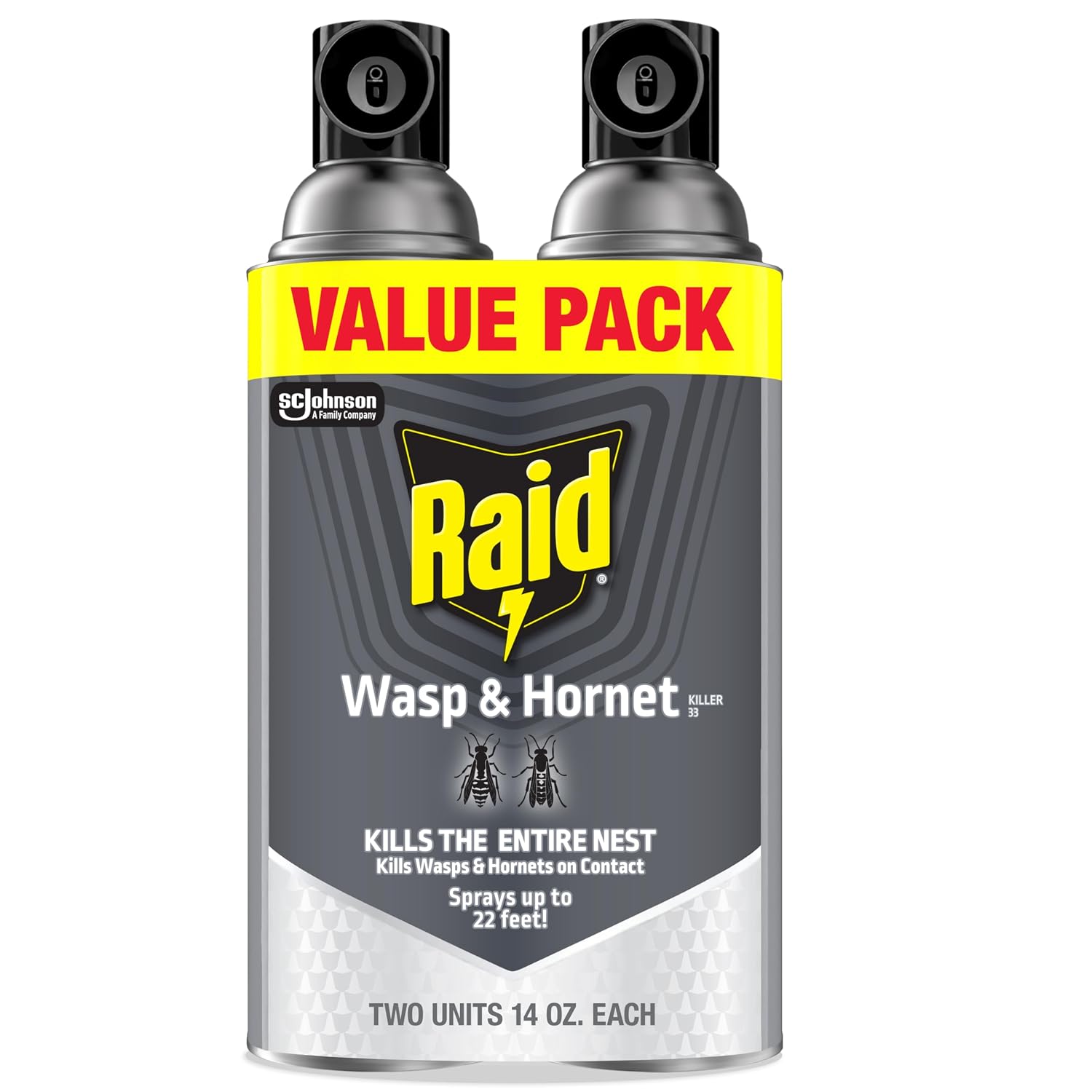
Raid Wasp & Hornet Killer Spray, 14 oz, 2‑Pack
| Unit Count | 28 Ounce |
|---|---|
| Included Components | Two 14 oz cans |
| Item Form | Spray |
| Active Ingredients | Prallethrin, Cypermethrin |
Raid Wasp & Hornet Killer is a straightforward outdoor aerosol for quickly dealing with stinging flying insects and nests. Each 14 oz canister sprays up to about 22 feet so you can treat nests from a safe distance, and the formula is designed to kill paper wasps, yellow jackets, mud daubers and bald‑face hornets on contact. It is electrically non‑conducting up to 32,500 volts, which can be helpful if nests are near electrical equipment. Typical use is to spray a saturated stream at the nest in early morning or evening when insects are less active, then wait 24 hours before removing the nest. The product includes common active ingredients (prallethrin and cypermethrin) and comes as a two‑pack so you have a backup or enough coverage for multiple nests. Important limitations are that it is for outdoor use only, is extremely flammable and toxic to aquatic life, and requires careful handling to avoid exposure to people and pets. Follow label directions closely and avoid spraying vegetation or water sources.
Best for: Buyers who prioritize a reliable, no‑nonsense solution to quickly eliminate outdoor wasp and hornet nests and who follow label safety instructions.
Less Ideal for: People looking for non‑chemical, pet‑safe, or aquatic‑safe options or those who need an indoor insecticide should consider alternative approaches.
- Sprays up to 22 feet to allow treatment from a safer distance
- Kills common stinging wasps and hornets on contact for fast results
- Two 14 oz cans provide extra coverage or a spare for larger problems
- Non‑conducting formulation reduces electrical hazard when treating nests near power equipment
- Contains flammable propellants and petroleum distillates so it must be stored and used with caution
- Extremely toxic to fish and aquatic invertebrates so not safe near water
- Intended for outdoor use only and not for use on edible crops or around pets
Verdict: Choose this if you want a proven, distance‑spraying aerosol that quickly kills wasps and hornets so you can remove nests with confidence.
Atticus Talak 7.9% Bifenthrin Indoor/Outdoor Insecticide Concentrate, 32 oz

| Active Ingredient | Bifenthrin |
|---|---|
| Formulation | Suspension Concentrate |
| Liquid Volume | 32 fluid ounces |
| Length of Control | Up to three months |
| Target Species | Insects |
Talak 7.9% is a liquid concentrate for treating lawns, landscaping, outdoor living areas and indoor perimeter spots like baseboards and cabinets. You dilute the concentrate with water to create a spray for barrier treatments, spot applications or lawn mixes; label rates explain how much to mix per gallon depending on the use. The product uses bifenthrin, a proven broad-spectrum active ingredient, and the manufacturer states it controls over 75 species and can give residual control for as long as three months. Its water-based formula dries clear, leaves no odor or visible residue, and is not phytotoxic on plants when used per label. Practical benefits include flexible indoor and outdoor use, clear drying, and a bottle designed for easier pouring. Important limitations are that solutions should be mixed only for same-day use, it is not registered for sale in a few states, and it is not approved for fogger application, so professional-style misting methods are not appropriate.
Best for: Buyers who want a single, reliable product to protect yards, patios and building perimeters from a wide range of common pests and prefer conservative, label-driven application practices.
Less Ideal for: People seeking ready-to-use sprays or fogger-compatible products or those in states where this formulation is not registered should look at alternatives.
- Broad-spectrum control listed for 75+ indoor and outdoor pest species
- Water-based formula that dries clear and leaves no odor or residue
- Flexible label directions for lawns, landscapes, hardscapes and indoor perimeter treatments
- Long residual activity up to three months when applied at recommended rates
- Mixed spray solutions cannot be stored and must be used the same day
- Not approved for fogger application and not available for sale in some states
Verdict: A versatile, water-based bifenthrin concentrate that delivers long-lasting, broad-spectrum outdoor (and perimeter indoor) control when used according to the label.
Choosing the Right Insecticide for Yellow Jackets: Key Factors to Consider
Formulation Type
Aerosol, dust, liquid concentrate, and foam formulations behave very differently in a yard. Aerosols and foams are often best for cavity or elevated nests because they can be directed into openings and provide immediate contact with workers inside. Dusts can be useful for ground nests where the opening is narrow and you need a product that will cling to foraging workers. Liquid concentrates give flexibility for sprays and drenching but require proper dilution and application equipment.
Choosing the right formulation affects how effectively the active ingredient reaches the nest interior, how long the treatment lasts, and how much exposure the applicator and non-targets might face. Match the formulation to the nest location and your comfort level with mixing and applying pesticides.
Spray Reach and Delivery Mechanism
Many yellow jacket nests are in voids, attics, eaves, wall cavity spaces, or high tree branches. A product that offers long-range spray reach or a jet-style delivery helps you treat nests from a safer distance and places insecticide deeper into the nest. Short-range sprays may require closer approach, increasing risk of provoking defensive workers.
Consider whether the product allows a continuous, controlled stream or a foaming expansion that fills cavities. Delivery also includes compatible application tools: can you use a wand, extension, or nozzle to reach the nest without getting too close?
Knockdown Speed
Fast knockdown reduces the period during which workers can exit and sting. Products that act quickly on contact lower immediate risk during and after treatment. However, quick knockdown does not guarantee nest elimination if the product lacks residual activity.
When immediate reduction of aggressive activity is a primary goal, prioritize formulations and active ingredients known for rapid contact toxicity. Balance speed with safety and residual needs so you are not left with surviving workers after a surface-level application.
Residual Persistence
Residual activity determines how long treated areas remain lethal to returning or surviving wasps. Long residuals can suppress re-emergence and reduce the chance of the colony rebuilding, but they can also increase risk to beneficial insects if applied in flowering areas. Residual needs vary by nest location; a protected cavity may retain residuals longer than open spaces.
Assess how long a product is expected to remain active on the surfaces you will treat and whether that persistence fits the location and season. For nests near pollinator forage, favor shorter residuals or targeted delivery to avoid harming non-target insects.
Application Safety and Personal Protection
Treating yellow jackets can provoke defensive behavior, so minimizing exposure is critical. Look for products that allow application from a distance and labels that specify protective equipment recommendations. Consider whether an applicator can use a wand or extension and how easy it is to maintain control of spray direction.
Also consider label-specified re-entry intervals and how the product behaves if wind or drift are present. Your ability to follow PPE guidance and local pesticide regulations should factor into the product you choose.
Non-target and Environmental Considerations
Yellow jacket treatments can affect bees, butterflies, and other beneficial insects if those insects are present at time of application or if residues persist on forage. Some active ingredients break down faster and pose less long-term risk to non-targets. Timing treatments for evening or night when pollinators are inactive and avoiding application to blooming plants mitigates risk.
Also factor in runoff potential for liquid treatments and label restrictions near water and areas used by pets. Choosing a product with clear label guidance on reducing non-target exposure helps protect the broader garden ecosystem.
When to Treat a Yellow Jacket Nest
Not every wasp presence requires direct nest treatment. If yellow jackets are only sporadically seen foraging away from structures and not showing aggressive behavior near people or pets, non-chemical steps like removing food sources and closing openings can suffice. Treat nests that pose an immediate safety risk, such as those near high-traffic areas, playgrounds, doorways, or children's play equipment.
Plan treatment for evening or night when most workers are in the nest and foraging is minimal. Cooler temperatures reduce activity and make treatments more effective while lowering pollinator exposure. Always confirm the nest location and access route so you can apply the chosen product with minimal disturbance.
- Treat nests that are within frequent human activity zones
- Prefer night treatments to reduce worker activity and pollinator contact
- Avoid treating if nest is inaccessible or if treatment could harm nearby pollinators
Personal Protective Gear and Safer Application Practices
Wear protective clothing that covers skin, eye protection, and gloves when approaching a nest. Even with distance-capable delivery, unpredictable worker behavior means you should plan for the worst-case. Use long sleeves, thick pants, and closed footwear to reduce sting risk.
Use a long spray wand or extension to maintain distance and a directed nozzle to minimize drift. If possible, enlist a second person to watch for escapes and help keep people and pets away from the treatment area. Read and follow label instructions for required PPE and re-entry times.
- Use long extensions to increase application distance
- Remove nearby children and pets before treating
- Keep a fast escape route planned in case workers become highly active
Non-chemical and Complementary Options
Non-chemical methods can be useful for prevention and for low-risk situations. Sealing openings, removing food attractants, and keeping trash containment tight reduce the chance of yellow jackets nesting near activity areas. Traps can reduce local forager numbers but are less effective at eliminating a nearby nest.
Combine methods: use traps to lower forager pressure before a targeted nest treatment, or seal potential entry points after treating a nest to prevent reoccupation. Remember that traps attract some wasps and may draw activity closer to your property if placed improperly.
- Seal cracks, soffits, and wall voids to prevent new nests
- Use traps strategically away from high-traffic areas
- Follow up chemical treatment with exclusion work to deter recolonization
Handling Ground Nests Vs Elevated Nests
Ground nests often have small openings and may be best treated with directed dusts or drenching sprays that will reach the interior tunnel system. Applying a dust that clings to worker bodies can transport the active ingredient deeper into the nest. Take care to avoid collapsing the entrance or creating dust clouds that cause workers to emerge aggressively.
Elevated nests in eaves, attics, or tree branches often require nozzle reach or foaming products that expand into cavities. Foams can fill voids and coat internal surfaces, improving contact with hidden workers and brood. For elevated nests, always prioritize distance and avoid standing directly beneath the opening when treating.
- Use dust or drench for ground nests with narrow entrances
- Use foam or long-range spray for elevated or cavity nests
- Assess approach and escape paths before treatment
Timing Treatments Around Pollinators
Time chemical treatments for dusk or after sunset when bees and other pollinators are inactive. Avoid spraying on flowering plants or when pollinator activity is high. Some active ingredients have extended residuals and can remain hazardous to pollinators for days, so avoid applying where foraging will occur after treatment.
If the nest is near flowering shrubs, consider targeted cavity treatments that limit surface contamination, or plan physical exclusion methods after dark to reduce collateral harm.
- Treat after dark to minimize pollinator exposure
- Avoid spraying blooming plants and hive areas
- Choose delivery methods that limit drift and surface residues
How We Chose the Best Insecticide for Yellow Jackets
We created this list by prioritizing practical, field-relevant attributes that matter when dealing with yellow jacket nests. Key evaluation points included spray reach and delivery, because many nests are in cavities or high places and require a product that will penetrate and coat interior surfaces. Residual control was assessed to determine how long treated nests and surrounding activity stay suppressed. Speed of knockdown was considered to reduce immediate sting risk during an application. Application safety and user controls were weighed to reflect typical homeowner and gardener abilities to apply treatments without specialized equipment. Environmental persistence and non-target impact were examined to prefer options that lower undue harm to beneficial insects and pets when used correctly. Formulation versatility and ease of use were used to judge how well a product fits different nest locations and user comfort levels. We excluded broad lawn or garden insecticides that lack label instructions for yellow jacket nest treatment, and we did not include niche professional-only formulations that require technician licensing. The resulting shortlist focuses on products labeled or commonly used for direct nest treatment and offers a mix of delivery forms suitable for ground and elevated nests.
FAQ
Can I treat a yellow jacket nest myself or should I call a professional?
Many homeowners can treat small, accessible nests safely if they use an appropriate product, follow label directions, and wear proper protective gear. However, if the nest is large, inside walls, in an attic, or in a location that makes safe access difficult, hiring a licensed professional is usually the safer option.
What time of day is best to apply insecticide for yellow jackets?
Evening or night is best because most workers are inside the nest and activity is lower. Cooler temperatures reduce flight and make targeted applications more effective while minimizing pollinator exposure.
How long does a treatment usually keep a nest suppressed?
Residual times vary by active ingredient and formulation. Some treatments kill workers quickly but offer only short residual control, while others leave lasting residues that can suppress activity for days or weeks. Match residual expectations to nest location and pollinator risk to choose appropriately.
Will killing workers eliminate the colony right away?
Not always. Quick knockdown reduces immediate threat, but if brood or a queen remains protected deeper in the nest, the colony can persist. Effective nest treatments combine reach, residual activity, and correct delivery to maximize the chance of colony elimination.
Are dusts safer than sprays for ground nests?
Dusts can be more effective at clinging to foraging workers and moving deeper into tunnels, which makes them useful for ground nests. They also reduce liquid runoff. However, dusts can create clouds that provoke aggressive behavior if applied improperly, so apply them carefully and avoid inhalation exposure.
How can I reduce risk to bees and other beneficial insects when treating a nest?
Treat at night when pollinators are inactive, avoid spraying flowering plants, and use delivery methods that target the nest opening rather than broad surface spraying. Selecting treatments with lower environmental persistence where possible also reduces non-target risk.
Final Verdict
Choosing the right insecticide for yellow jackets hinges on matching formulation and delivery to nest location while balancing knockdown speed, residual needs, and non-target safety. Prioritize products that let you keep distance during application and that provide sufficient residual activity for the nest context. If access is difficult or the nest is large and active, professional help is the safer route. With careful timing and protective practices, you can safely reduce nest activity and minimize impacts to beneficial insects.
