

Note: This article contains affiliate links. If you click on these links and make a purchase, I may earn a small commission at no extra cost to you. This helps support my research and content. Read my full affiliate disclosure here.
If you keep koi, the right pond filter is one of the most important investments you will make for long-term fish health and clear water. Filters control ammonia and nitrite, trap debris, and maintain oxygen levels – all things that matter in small backyard ponds and larger ornamental systems alike. This guide highlights six carefully shortlisted koi fish pond filters suited to varying pond sizes and maintenance styles. We evaluate each option on the practical factors that affect day-to-day pond care, including filtration efficiency and maintenance demands. Read on to understand which filter features matter most for your pond setup and why these shortlisted systems earned a place in our roundup.
Top Picks at a Glance
| Best Overall The best all-around choice for most situations | VIVOHOME 2640 GPH Auto‑Cleaning Pressurized Bio Pond Filter with 18W Light |  |
| Best Quality Built to a higher standard if you want something more solid | Atlantic Water Gardens BF1600 Pond Filter & 16-inch Waterfall Spillway |  |
| Best Value The sweet spot between price and what you get | VCRAZE CFP-1500 25W Pond Filter Pump with 4-Stage Filtration |  |
| Highest Rated A top-rated pick with lots of positive feedback | Aquascape Signature Series 2500 BioFalls Filter |  |
| Most Popular A crowd favorite that many people choose with confidence | VIVOHOME VH515 Pressurized Biological Pond Filter with 13W UV Light |  |
| Best Seller A high-volume bestseller chosen again and again | TotalPond Complete Pressurized Pond Filter with 9W UV Clarifier |  |
VIVOHOME 2640 GPH Auto‑Cleaning Pressurized Bio Pond Filter with 18W Light

| Max flow | 2640 GPH |
|---|---|
| Suitable pond capacity | Up to 3170 gallons (ornamental) / 1585 gallons (koi) |
| Light power | 18W |
| Filter media | 20 PPI and 25 PPI sponges plus bio-balls |
The VIVOHOME 2640GPH pressurized bio pond filter is built to keep medium-sized freshwater ponds clear with minimal fuss. It combines coarse and fine sponge pads plus bio-balls for mechanical and biological filtration, and an internal 18W lamp with a simple 0/12/24-hour timer to help control algae and maintain water clarity. Installation is straightforward: attach the pump hose using the included adapters, set the timer, and use the FILTER/CLEAN lever when prompted. Cleaning is genuinely easier than many gravity filters because the motorized auto-clean cycle spins and flushes the sponges at the flip of a switch, then signals completion with a beep. The unit is weather-resistant and intended for ponds up to the stated capacities, so it suits decorative and koi setups in that range. Limitations to note are freshwater-only use and reliance on a compatible pump (pump not included). The light has a finite lifespan and will need replacement after several months of regular use, but a spare bulb and replacement guide are provided.
Best for: Homeowners who want a low-maintenance, reliable filter that balances automatic cleaning, biological filtration, and an integrated light for medium ornamental or koi ponds.
Less Ideal for: People maintaining saltwater systems or those who need filtration for very large koi ponds beyond the stated capacity should look at more heavy-duty or saltwater-rated solutions.
- Auto-cleaning motorized flush cycle reduces manual maintenance
- Multi-stage filtration (coarse and fine sponges plus bio-balls) for mechanical and biological clarity
- Built-in 18W lamp with 0/12/24H timer to help limit algae growth
- Includes multiple hose adapters for broad pump compatibility
- Durable ABS construction with IP44 splash protection for outdoor use
- Not suitable for saltwater ponds due to corrosion risk
- Requires a separate compatible pump which is not included
Verdict: Choose this filter if you want an easy-to-maintain, pressurized biological system with auto-cleaning and a timed light for medium-sized freshwater koi or ornamental ponds.
Atlantic Water Gardens BF1600 Pond Filter & 16-inch Waterfall Spillway

| Included components | Installation Kit, male thread adapter and one piece liner flange |
|---|---|
| Item Type Name | Pond Filter & Waterfall Spillway |
| Model Number | BF1600 |
| Pet Type | Fish |
The Atlantic Water Gardens BF1600 is a combined biological filter and waterfall spillway built for high-performance pond setups. It functions as an oversized filter chamber that accepts up to three Matala filter mats plus additional bio media in its included media bag, so you can scale filtration as stock density increases. Typical use is as a primary filter for koi or heavily stocked ponds where converting ammonia and nitrite and removing suspended solids is critical. Notable features include multiple bulkhead locations for flexible plumbing, a reinforced body and support bars that let you conceal the unit with heavier stone, and an overhanging weir that reduces leakage from seal failure. Practical benefits are improved water clarity and oxygenation from biological conversion and a large media capacity that delays maintenance and upgrades. Limitations are that the unit is a fixed-volume spillway/filter so it requires adequate space and correct plumbing to reach peak performance, and you will still need periodic mat/media cleaning and proper pump sizing to match pond flow demands.
Best for: Buyers building or upgrading koi and heavily stocked ponds who prioritize robust biological filtration and the ability to increase media capacity as fish loads grow.
Less Ideal for: Small water features, hobbyist tabletop ponds, or buyers who need a compact plug-and-play filter that requires minimal plumbing work.
- Large chamber accepts multiple filter mats and additional bio media for scalable filtration
- Reinforced body and support bars let you hide the unit under heavier stone without deforming
- Multiple bulkhead locations and included installation kit allow flexible plumbing layouts
- Overhanging weir with drip edge reduces risk of leaks from silicone seal failure
- Requires proper pump sizing and plumbing to perform optimally
- Takes up dedicated space and needs periodic mat and media maintenance
Verdict: Choose the BF1600 when you need a durable, expandable biological filter and spillway that can grow with a high-density koi pond.
VCRAZE CFP-1500 25W Pond Filter Pump with 4-Stage Filtration

| Power Source | Corded Electric |
|---|---|
| Flow Rate | 1500 liters per hour |
| Maximum Lifting Height | 6 feet |
| Horsepower | 25 watts |
The VCRAZE CFP-1500 pairs a modest 25W submersible pump with an integrated 4-stage filter box to handle mechanical and biological filtration for small backyard ponds. You set the unit in the pond or attach it as a prefilter for a fountain or waterfall and the housing channels water through coarse and fine sponges, ceramic rings, and bio-balls for debris removal, bacterial toxin processing, and improved oxygenation. The enclosed filter box protects fish and keeps leaves away from the impeller, while the removable media make routine cleaning straightforward. With a 400 GPH (approx.) flow and 6 ft maximum head it is sized for ponds around 200–350 gallons, so it will cycle water quickly in that range without excess electricity use. Expect occasional media cleaning every couple of weeks during heavy debris seasons and plan to source hoses or fittings separately for fountain hookups. The materials and design aim for season-long outdoor use but buyers wanting higher flow or taller heads should choose a larger model instead.
Best for: A practical buyer who needs an affordable, all-in-one pump and filter for a small to mid-size backyard pond or water feature and values easy maintenance and low running cost.
Less Ideal for: Owners of larger ponds, high-head waterfall installations, or those who need a heavy-duty commercial system should look at higher-flow, higher-head models.
- Integrated 4-stage filtration (coarse sponge, fine sponge, ceramic rings, bio-balls) for mechanical and biological cleaning
- Enclosed filter box protects fish and keeps debris away from the impeller
- Low power draw (25W) suitable for continuous operation on small ponds
- Removable, reusable filter media make cleaning simple and reduce replacement waste
- Designed for ponds up to about 200–350 gallons so it is undersized for larger ponds
- Hoses and fittings for fountain or waterfall connections are not included
- Requires regular cleaning in leafy or heavily stocked ponds to maintain flow
Verdict: Buy this if you want a budget-friendly, low-energy pump with built-in 4-stage filtration that keeps small ponds and fountains clear with minimal fuss.
Aquascape Signature Series 2500 BioFalls Filter

| Installation Type | Freestanding |
|---|---|
| Purification Method | Carbon Block, Ultra Filtration |
| Supported Water TDS Level Maximum (PPM) | 300 |
| Capacity | 2500 gallons |
| Material Type | Plastic |
The Aquascape Signature Series 2500 BioFalls is a robust, all-in-one pond filter that combines mechanical and biological filtration for ponds up to 2,500 gallons. It is freestanding and constructed from rotationally molded polyethylene for weather resistance and structural strength. The unit is typically installed at a waterfall or spillway where the reversible 21.5-inch spillway lip and included rock and plant tray let you integrate natural stone and planting for a concealed look. The kit ships with dual 2-inch bulkheads, media nets, Poly-Flo biological filter mats, fish-safe silicone, and hardware so you can complete setup without sourcing many extra parts. Practical benefits include high flow handling, substantial biological surface area for beneficial bacteria, and durable construction that stands up to outdoor conditions. Important limitations are the manual power source listing which means a pump is required but not included and the filter size and capacity that may be overkill for very small ponds. Overall this model is engineered for long-term, low-maintenance performance in medium to large backyard ponds.
Best for: Buyers who prioritize a dependable, long-lasting filtration solution for medium to large backyard ponds and want a kit that minimizes additional parts sourcing and frequent maintenance.
Less Ideal for: Not a good choice for hobbyists with very small containers, tabletop water features, or those who need a compact, pump-included micro filter solution.
- Designed for ponds up to 2,500 gallons with flow capacity up to 5,000 GPH
- Durable rotationally molded polyethylene construction for outdoor longevity
- Includes comprehensive installation hardware and biological filter mats for immediate setup
- Reversible 21.5-inch spillway and rock/plant tray allow natural integration into landscape
- Poly-Flo ESA filter mats provide increased surface area for beneficial bacteria
- Pump is required but not included
- Large footprint and capacity may be unnecessary for very small ponds
Verdict: A heavy-duty, easy-to-integrate filter kit built for reliable, long-term biological and mechanical filtration in medium to large backyard ponds.
VIVOHOME VH515 Pressurized Biological Pond Filter with 13W UV Light
| Power Source | Electric |
|---|---|
| Voltage | 110 volts |
| Horsepower | 13 watts |
| Material Type | Acrylonitrile Butadiene Styrene (ABS) |
| Included Components | Filter, UV sterilizer light (13W) |
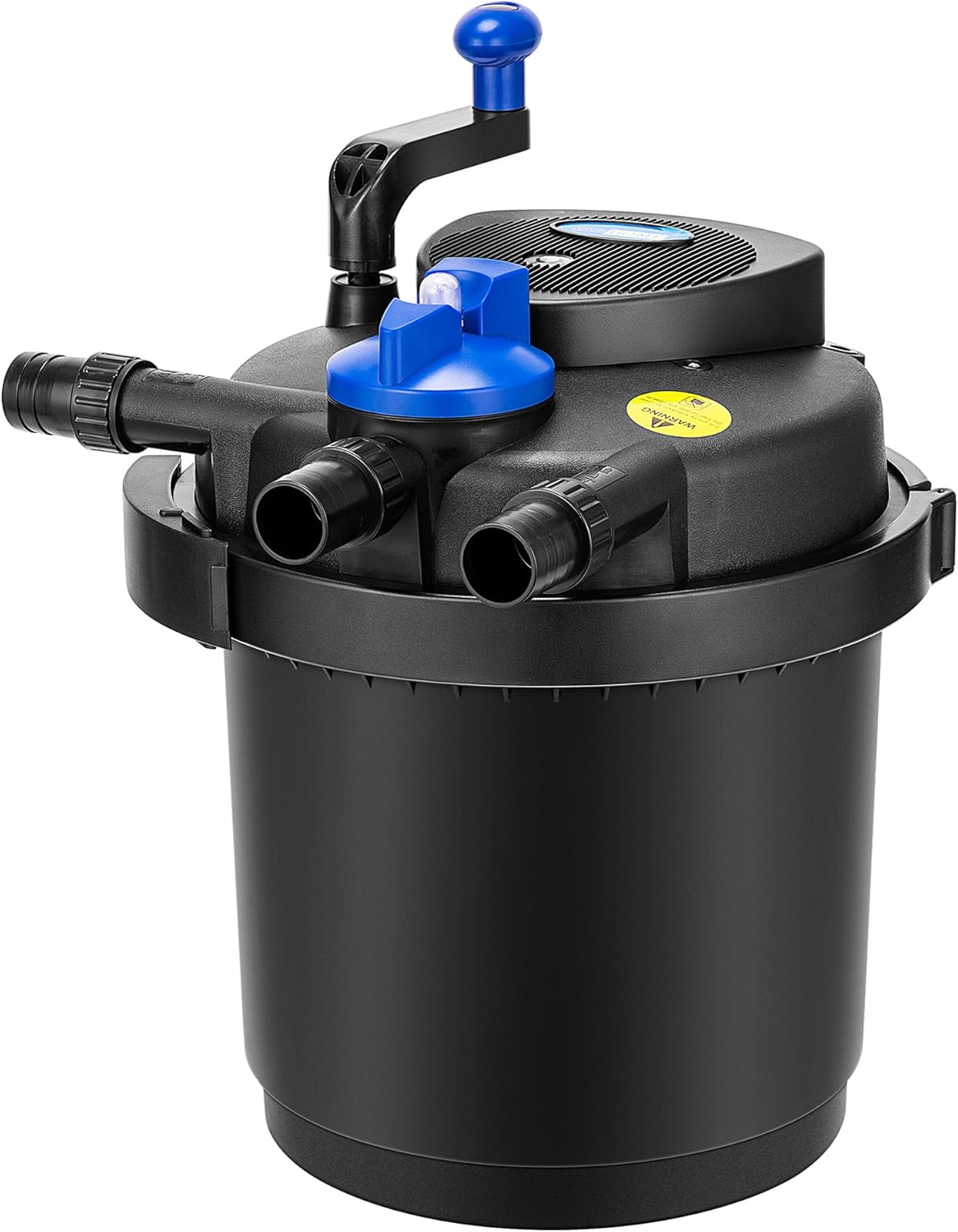
The VIVOHOME VH515 is a pressurized biological filter intended to keep koi and decorative ponds clear by combining mechanical sponge filtration with a 13W UV clarifying lamp. It is installed inline with a separate water pump and connects via the included multi-size hose adapters. Water passes through coarse and fine reusable sponges that trap debris while the lamp reduces free-floating algae, and a simple handle-driven backwash lets you switch to Clean mode and flush accumulated muck without disassembling the unit. The ABS, weather-resistant housing and clear inlet/outlet labels make outdoor siting straightforward and reduce installation guesswork. Practical benefits include low ongoing consumable cost because sponges are reusable, simple routine maintenance signaled by a red float, and compatibility with ponds up to about 1,600 gallons (ornamental) or 800 gallons with fish. Important limits are that the unit requires a separate pump and the UV bulb has a finite lifespan and must be replaced if water breaches the lamp seal; performance also depends on matching pump flow and hose size for steady filtration.
Best for: Buyers who want a low-maintenance, reliable filter for a small to mid-size koi or ornamental pond and prioritize simple installation and predictable upkeep.
Less Ideal for: Not the best choice for very large or heavily stocked ponds where industrial-scale filtration or integrated pumping is needed; pond owners who prefer fully submersible combo units should look elsewhere.
- Combined mechanical and UV clarification reduces both debris and free-floating algae
- Reusable coarse and fine sponge media lowers ongoing replacement costs
- Handle-driven backwash makes routine cleaning quick and tool-free
- Includes multiple hose adapters and clear inlet/outlet labeling for easier installation
- Weather-resistant ABS housing suited for year-round outdoor use
- Requires a separate water pump so total system cost and compatibility must be planned
- UV lamp has limited life and can fail if the lamp compartment seal is compromised
Verdict: A straightforward, low-maintenance pressurized biofilter that pairs with your pump to deliver clear water and easy weekly backflushing for small to mid-size koi and ornamental ponds.
TotalPond Complete Pressurized Pond Filter with 9W UV Clarifier

| Capacity | 1200 gallons |
|---|---|
| Other Special Features of the Product | UV Clarification |
| Purification Method | Ultraviolet |
| Power Source | Ac/DC |
| Included Components | Filter body, 9W UV Clarifier, 2 filter pads, 12 bio-balls |
The TotalPond Complete Pressurized Pond Filter combines mechanical pads, bio-balls and a 9W ultraviolet clarifier into a single freestanding unit for ponds and waterfalls up to 1200 gallons. You install your own pump and route water through the inlet so it passes the UV chamber, then two filter pads and the bio-ball chamber where beneficial bacteria establish. The enclosed, pressurized design keeps water moving and reduces clogging compared with open-media boxes, and the included stepped adapters accept 3/4 or 1 inch ID tubing for common pond setups. Practical benefits include simpler maintenance from the removable lid and preloaded media, plus UV-treated flow that helps clear green water and controls single-cell algae. Limitations are that the unit requires a separate pump sized to your pond and the 9W UV is modest for very high sunlight or larger koi ponds, so heavy algae pressure may need a stronger clarifier or supplemental filtration. The plastic housing is lightweight and easy to hide but not as rugged as heavy-duty commercial filters.
Best for: Buyers who want a single, compact filter that simplifies startup and maintenance while improving water clarity for backyard koi or decorative ponds and who prefer choices supported by established product reviews.
Less Ideal for: Large commercial koi collections, very high-biomass ponds, or owners who want an all-in-one pump-plus-filter solution without adding a pump.
- Integrated 9W UV clarifier to reduce green water and microscopic algae
- Pressurized design promotes steady flow and helps prevent debris settling
- Includes mechanical filter pads and bio-balls for combined mechanical and biological filtration
- Fits common tubing sizes with stepped adapters for straightforward plumbing
- Removable watertight lid and included media make initial setup and routine cleaning easier
- Requires a separate pond pump so additional cost and pump sizing are necessary
- 9W UV output is limited for very large or high-algae ponds
Verdict: A compact pressurized filter with UV and biological media that reliably improves clarity for backyard koi ponds up to 1200 gallons.
Choosing the Right Koi Fish Pond Filter: Key Factors to Consider
Mechanical Filtration Capacity
Mechanical filtration removes leaves, uneaten food, and suspended solids before they break down into ammonia. A filter with large mechanical capacity slows organic loading on the biological stage and reduces how often you have to clean the biological media.
Consider how the filter traps debris: multi-stage trays, screens, or pre-filters all behave differently in a working pond. A roomy mechanical chamber that is easy to access and rinse will lower maintenance frequency and help keep water clear during heavy leaf fall or peak feeding periods.
Biological Media Surface Area
Koi produce significant waste that becomes ammonia and nitrite unless beneficial bacteria can colonize adequate surface area to process it. The effective surface area of biological media determines how much nitrifying bacteria the system can sustain.
Look for media designed to keep channels open for flow rather than compacting into dead zones. Media that offers high surface area while allowing easy flushing of solids helps the biological colony stay healthy without constant intervention.
Flow Rate and Pond Volume Match
A filter must match the pump flow and pond turnover needs. Too low a flow starves the biological media and reduces oxygenation. Too high a flow may push solids through the biological stage before bacteria can process them.
Calculate pond volume and aim for a turnover rate appropriate for koi ponds, then confirm the filter handles that flow at realistic pump head. Consider adjustable flow or bypass options for fine tuning during seasonal changes.
Ease and Frequency of Maintenance
Practical maintenance features determine whether you will actually keep the filter working optimally. Accessibility of mechanical chambers, clear-out drains, and simple media replacement reduce time spent on routine care.
Also consider how often the system needs attention. Some filters require frequent skimming or backwashing, while others concentrate solids removal in a single, easily emptied chamber. Seasonal maintenance needs, like winterizing or cleaning bio-media without killing beneficial bacteria, should factor into your choice.
Durability and Weather Resistance
Filters sit outdoors and must resist UV, freezing cycles, and constant moisture. Materials, seals, and inlet/outlet fittings should be robust enough for years of use without frequent leaks or cracking.
Think about installation location and exposure. A unit that tolerates partial burial, sun exposure, and occasional splashing will outlast a less sturdy alternative and reduce the chance of sudden failures during hot summers or cold winters.
Integration With Pond Equipment
How a filter connects to pumps, skimmers, and UV clarifiers affects system simplicity and performance. Filters that accept standard plumbing sizes, have clear inlet/outlet orientations, and allow easy addition of complementary equipment reduce installation headaches.
Check whether the filter supports common plumbing layouts and if it allows adding a UV unit or a separate settling chamber. Flexibility in plumbing can make upgrades and seasonal changes easier without having to rework the entire system.
Sizing Your Filter to Pond Conditions
Filter sizing depends on pond volume, stocking density, and how intensely you feed your koi. A lightly stocked, well-planted pond will tolerate lower mechanical load than a crowded koi pond with daily feedings.
Estimate realistic peak load conditions such as summer feeding and leaf fall. When in doubt, choose a filter rated for higher flow and greater media capacity than the bare minimum. Oversizing mechanical capacity reduces the risk of frequent clogging and protects biological stages.
- Match filter flow rating to pump output at expected head pressure.
- Aim for higher biological media surface area if you keep many or large koi.
- Consider a modular filter that adds capacity as your pond changes.
Types of Pond Filters and How They Behave
There are several common filter styles including pressurized units, gravity-fed multi-chamber boxes, and compartmentalized external filters. Each style handles solids and bacteria differently.
Pressurized filters can be easier to hide and pair with UV clarifiers, but they often need careful maintenance to avoid bypassing biological media. Gravity-fed systems typically provide easier access to media and larger mechanical chambers, which can make them simpler for seasonal cleaning.
- Pressurized filters: compact footprint and good for installing under decking.
- Gravity filters: larger chambers, easier to service, often better for heavier loads.
- Modular or DIY systems: flexible but require more planning and plumbing.
Routine Care Calendar for Reliable Filtration
Establishing a simple maintenance calendar keeps filtration performing well year-round. Key tasks include skimming large debris, checking and rinsing mechanical media, inspecting biological media, and confirming flow rates.
Frequency varies by season. Expect more frequent mechanical cleaning during autumn leaf drop and summer when feeding is highest. Biological media generally needs only occasional rinsing in pond water to remove trapped solids while preserving beneficial bacteria.
- Weekly: surface skimming and flow check during active seasons.
- Monthly: rinse mechanical pads or pre-filters and inspect plumbing.
- Seasonal: deeper clean of mechanical chambers and winter preparation as needed.
Dealing With Common Problems
Cloudy water, foul odors, or sudden ammonia spikes usually point to maintenance or flow issues rather than media failure. Start troubleshooting by checking pump output and clearing mechanical chambers of solids.
If biological parameters are off after cleaning, avoid over-cleaning all media at once. Preserve some colonized media during service and reintroduce it if bacteria levels drop. Also verify that plumbing and valves are not creating dead zones where water bypasses media.
- Cloudiness after cleaning may indicate disturbed beneficial bacteria; monitor ammonia and nitrite.
- Low flow often results from clogged pre-filters or pump strain; inspect and clear obstructed intakes.
- Persistent odors usually mean organic buildup in a mechanical chamber; deeper cleaning is needed.
Adding UV Clarifiers and Complementary Equipment
A UV clarifier can reduce suspended algae and improve water clarity but it does not replace mechanical or biological filtration. Integrating UV in the right location, typically after mechanical filtration, maximizes effectiveness and protects the UV lamp from fouling.
Consider adding settling chambers, leaf traps, or skimmers upstream of your main filter. These accessories reduce solids load and prolong the intervals between major filter maintenance tasks.
- Place UV after mechanical filters to avoid rapid fouling.
- Leaf traps reduce the amount of debris reaching the main filter.
- Use valves to balance flow between filter stages and allow easy maintenance.
How We Chose the Best Koi Fish Pond Filter
We prioritized filters that deliver dependable mechanical and biological cleanup while remaining practical for typical backyard koi keepers. Evaluation criteria focused on measurable pond-management needs: mechanical debris removal capacity, biological media surface area, flow rate compatibility with pond volume and pump head, ease and frequency of maintenance, and build durability for outdoor, wet conditions. We also considered how straightforward installation and seasonal care are, since many pond owners handle setup and winterizing themselves. Products were excluded if they lacked clear specifications for flow range and media capacity or if they were intended only for small decorative ponds unsuitable for koi. We filtered out units with no practical maintenance access or unclear media options. The final picks represent filters that balance strong filtration metrics with real-world usability for koi ponds of common sizes.
FAQ
How often should I clean the mechanical part of a koi pond filter?
It depends on pond load and season. During heavy feeding or autumn leaf fall you may need to clear mechanical media weekly. In quieter months a monthly rinse is often sufficient.
Can a small filter handle a pond with several large koi?
Usually not. Koi produce a lot of waste, so a small filter will struggle to provide enough biological surface area and mechanical capacity. Aim for a filter rated above the pond's bare minimum turnover when keeping multiple large fish.
Is a pressurized filter better than a gravity-fed unit?
Each type has tradeoffs. Pressurized units are compact and pair well with UVs but can be harder to service. Gravity-fed units often offer larger mechanical chambers and easier access for cleaning, which can be preferable for heavily stocked koi ponds.
Will a UV clarifier fix green water on its own?
A UV clarifier reduces free-floating algae but will not address the underlying nutrient load. It works best as part of a system that includes good mechanical removal and stable biological filtration.
What should I check if my filter suddenly loses flow?
Inspect the pump intake and pre-filters for blockages, check for collapsed or kinked plumbing, and confirm valves are open. Also look for clogged mechanical pads or a stuck media tray that could be restricting flow.
How do I winterize my pond filter?
Winterizing depends on climate and filter type. In colder regions, remove and store delicate components, clear solids from chambers, and protect plastic housings from freeze damage. Some robust filters can remain in place if kept free of ice and heavy freezing stress.
Final Verdict
Prioritize a filter that provides both generous mechanical capacity and ample biological media for the size and stocking of your koi pond. Think through how often you are willing to maintain the system, and choose a unit with accessible chambers and durable construction that fits your plumbing layout. Balancing flow compatibility, maintenance effort, and robustness will help you keep water clear and fish healthy across seasons.
